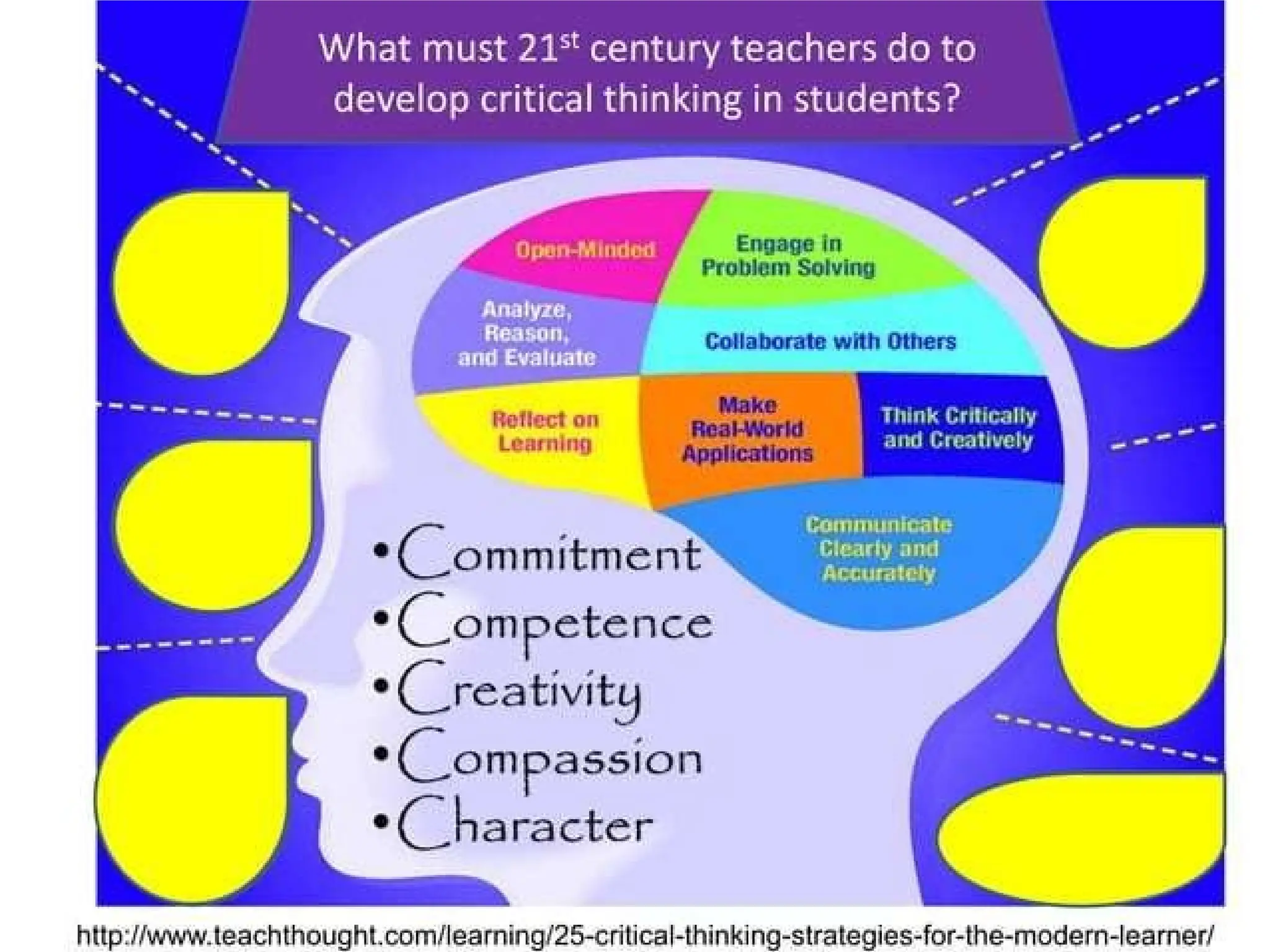
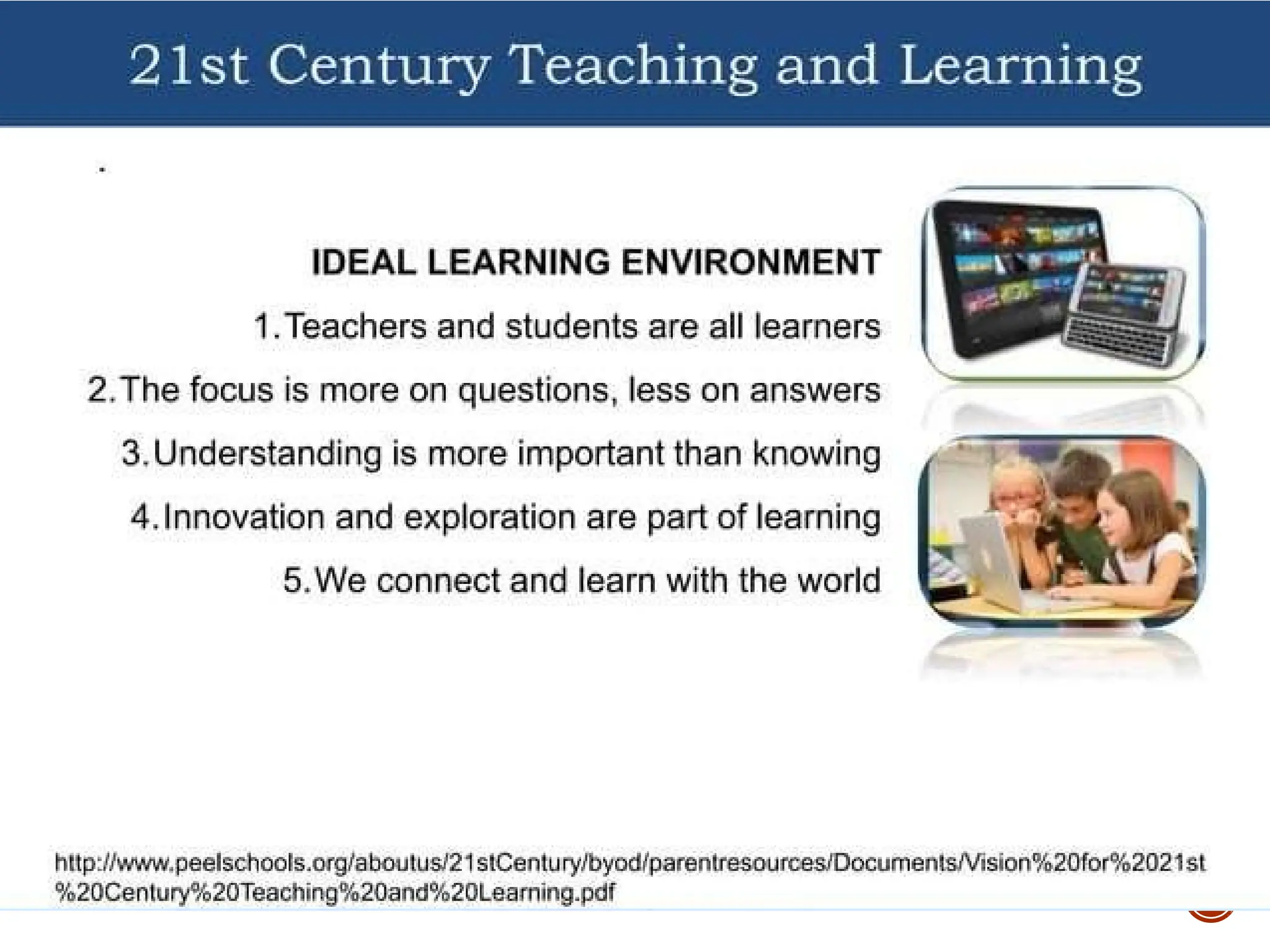
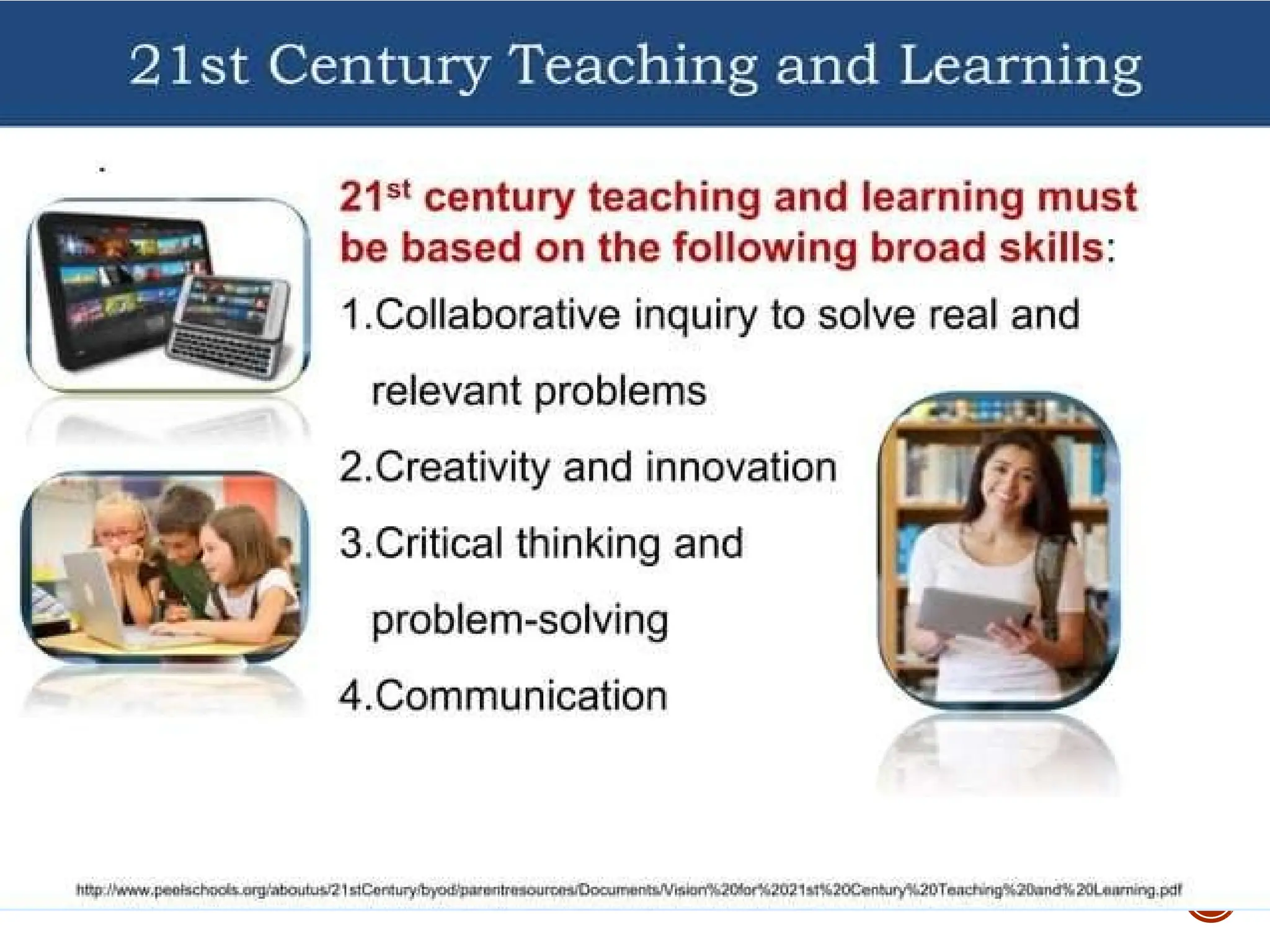
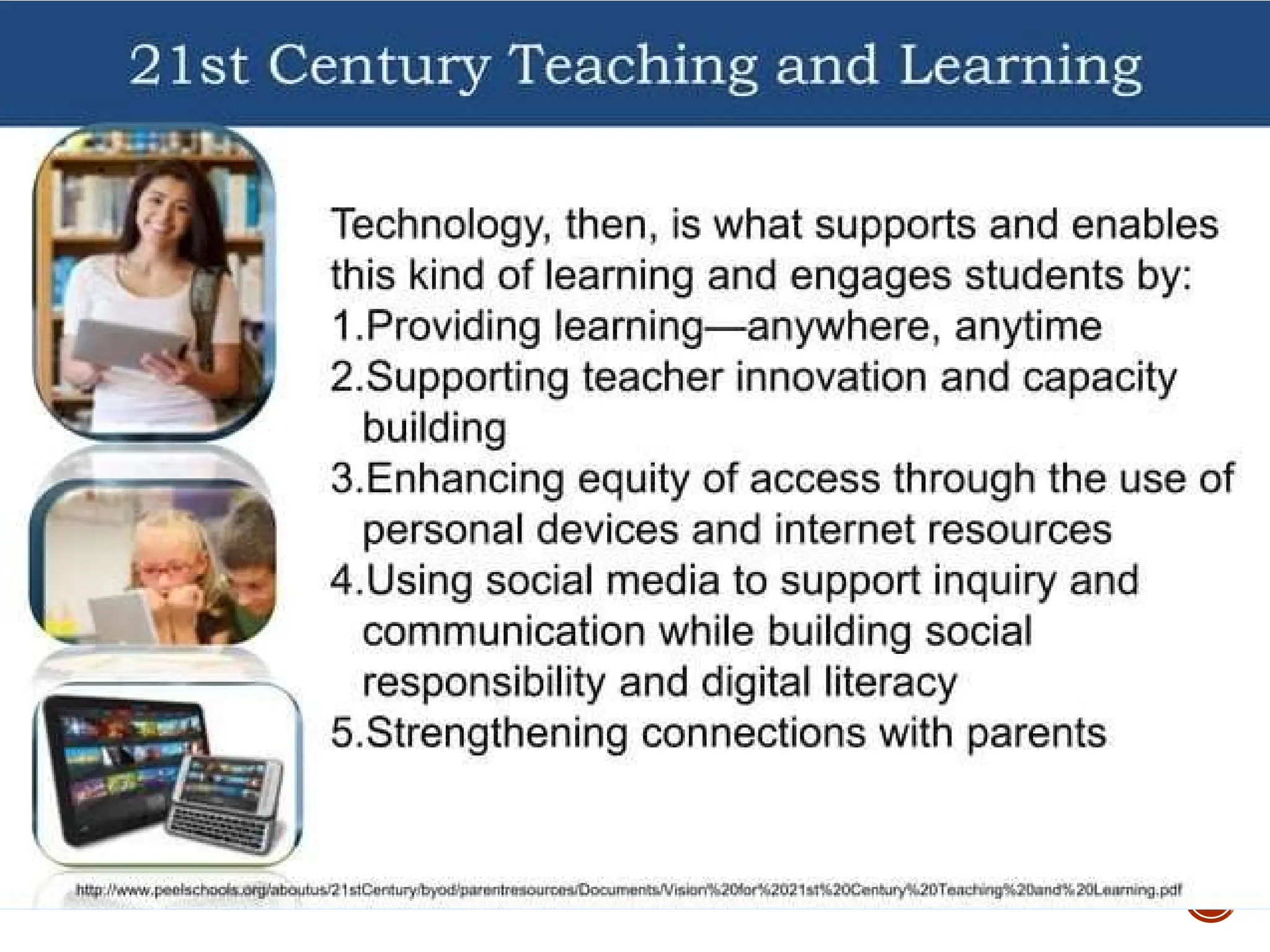
21st
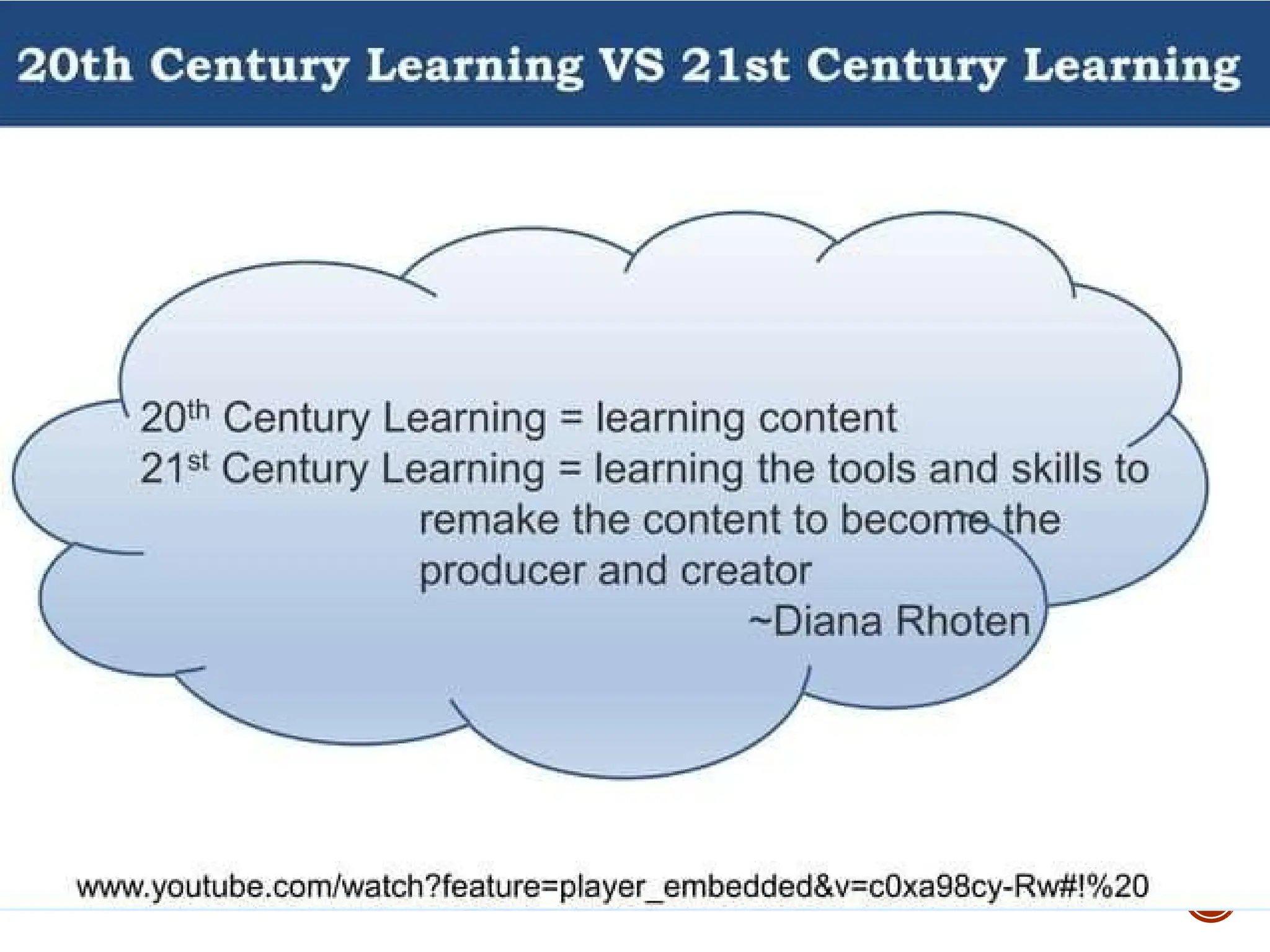
Century Learner
Is aboutconstructing and validating
knowledge.
- A student who has the skills to navigate
the digital world and work
collaboratively to problems
AS A STUDENT,YOUHAVE BEEN THROUGH A LOT OF ASSESSMENTS, MOST OF
WHICH IF NOT ALL,YOU DID NOT WELCOME. IF YOU ONLY HAD A CHOICE,YOU
WOULD NOT SUBJECT YOURSELF TO THE ASSESSMENT PROCESS. ONE OF THE
POPULAR BARGAIN THAT STUDENTS ASK OF THEIR TEACHERS IS “ NO MORE
TEST, MA’AM/SIR”
31.
IF IT WASNOT POSSIBLE,THE REQUEST WOULD GO THIS WAY “
PLEASE GIVE A TEST WHICH WE CAN ANSWER EVEN WITHOUT
STUDYING”.THESE JUST PROVE THAT SEVERAL STUDENTS HAVE A
NEGATIVE ATTITUDE TOWARD ASSESSMENT.
Diagnostic assessment?
This isa form of pre- assessment that
allows a teacher to determine
individual student’s prior knowledge
including misconceptions before
instructions.
Diagnostic assessment?
When touse diagnostic
assessment
a. At the beginning of a course
or unit
b. Before one-on-one instruction
c. At the end of a course
36.
Diagnostic assessment?
How touse diagnostic assessment
1. Compare pre- and post-course assessments
to show
student improvement
2. Group students for remediation or
enrichment
3. Use the results to plan instruction
4. Use the results to make instructional
adjustments
37.
In short, itis primarily diagnose what students
already know and don’t yet know in order to
guide instructions.
The results of diagnostic assessment also
provide a basis for comparison to determine
how much learning has taken place after the
learning activity is completed.
Diagnostic assessment?
-A diagnosticassessment is a form
of pre-assessment or a pre-test
where teachers can evaluate
students' strengths, weaknesses,
knowledge and skills before their
instruction. These assessments are
typically low-stakes and usually
don't count for grades.
40.
FORMATIVE ASSESSMENT
Formativeassessment takes place DURING
instruction (during the formative process) to provide
the teacher with information regarding how well the
learning objectives of a given learning activity are
being met.
According to Merriam webster dictionary
‘FORMATIVE” means of, relating to, or
characterized by important growth or formation.
41.
FORMATIVE ASSESSMENT
Informative assessment, teachers monitor student learning to
get on going feedback to improve their teaching and for
students to improve their learning.
In formative assessment, students are helped to identify their
strength and weaknesses and target area that need work.
Likewise, teachers are also helped to recognize where
students, are struggling and so address problems
immediately.
It is evidenced- based improvement of on – going teaching
learning.
42.
FORMATIVE ASSESSMENT
HOW TOUSE FORMATIVE ASSESSMENT
•Teachers use a variety of questioning
strategies to identify areas of difficulty
•Teachers provide detailed feedback on
student work
•Teachers observe and survey students to
determine if activities should be modified
•Teachers use frequent assessments to identify
patterns of achievement
NOTE: Frequent assessment is a teaching strategy that involves evaluating
student learning on a regular basis. It can help students learn more and
teachers improve their teaching.
43.
FORMATIVE ASSESSMENT
Formative assessmentis refereed to as
“ASSESSMENT FOR LEARNING” because it is
meant to ensure that learning takes place. In
the process of instruction, the teacher checks
on student’s learning. If he/she discovers that
concepts and skills are not yet mastered, right
there and then, the teacher re-teaches to
ensure learning. Thus, the phrase
“ASSESSMENT FOR LEARNING”
44.
FORMATIVE ASSESSMENT
EXAMPLE OFFORMATIVE ASSESSMENT
- SOCRATIIVE or informal questioning
- Quiz
- Assignment
- Discussion board
- Buzz group
45.
SUMMATIVE ASSESSMENT
This isused to evaluate student learning at
the end of a defined instructional period.
While formative assessment is referred to as
“assessment for learning” Summative
assessment is referred to as “assessment of
learning”.
46.
SUMMATIVE ASSESSMENT
A summativeassessment is a way to
evaluate how well students have
learned the material in a
course. Summative assessments are
typically given at the end of a unit or
course. They help teachers determine
if students have met the learning
objectives and if they are ready to
move on to the next level.
SUMMATIVE ASSESSMENT
It isassessment of learning
typically at the end of a project,
unit, course, semester, programs,
or school year.
49.
SUMMATIVE ASSESSMENT
Canbe done through paper – and- pencil tests and
non – paper-pencil tests.
NOTE: A "non-paper-pencil test" refers to any assessment
method that does not require students to write answers on
paper with a pencil, essentially encompassing a wide range
of alternative assessment formats like oral presentations,
portfolios, projects, computer-based tests, simulations,
performance-based assessments, and practical
demonstrations, where students demonstrate their
knowledge and skills through active engagement rather
than solely written responses.
50.
ASSESSMENT OF LEARNINGVS.
ASSESSMENT FOR LEARNING
Assessments of Learning
Assessments of learning are typically administered at
the end of a unit or grading period and evaluate a
student’s understanding by comparing his or her
achievement against a class-, district-, or
nationwide benchmark or standard
Assessments for Learning
Assessments for learning – also described
as assessments as learning – assess a student’s
comprehension and understanding of a skill or
lesson during the learning and teaching process.
TRADITIONAL ASSESSMENT
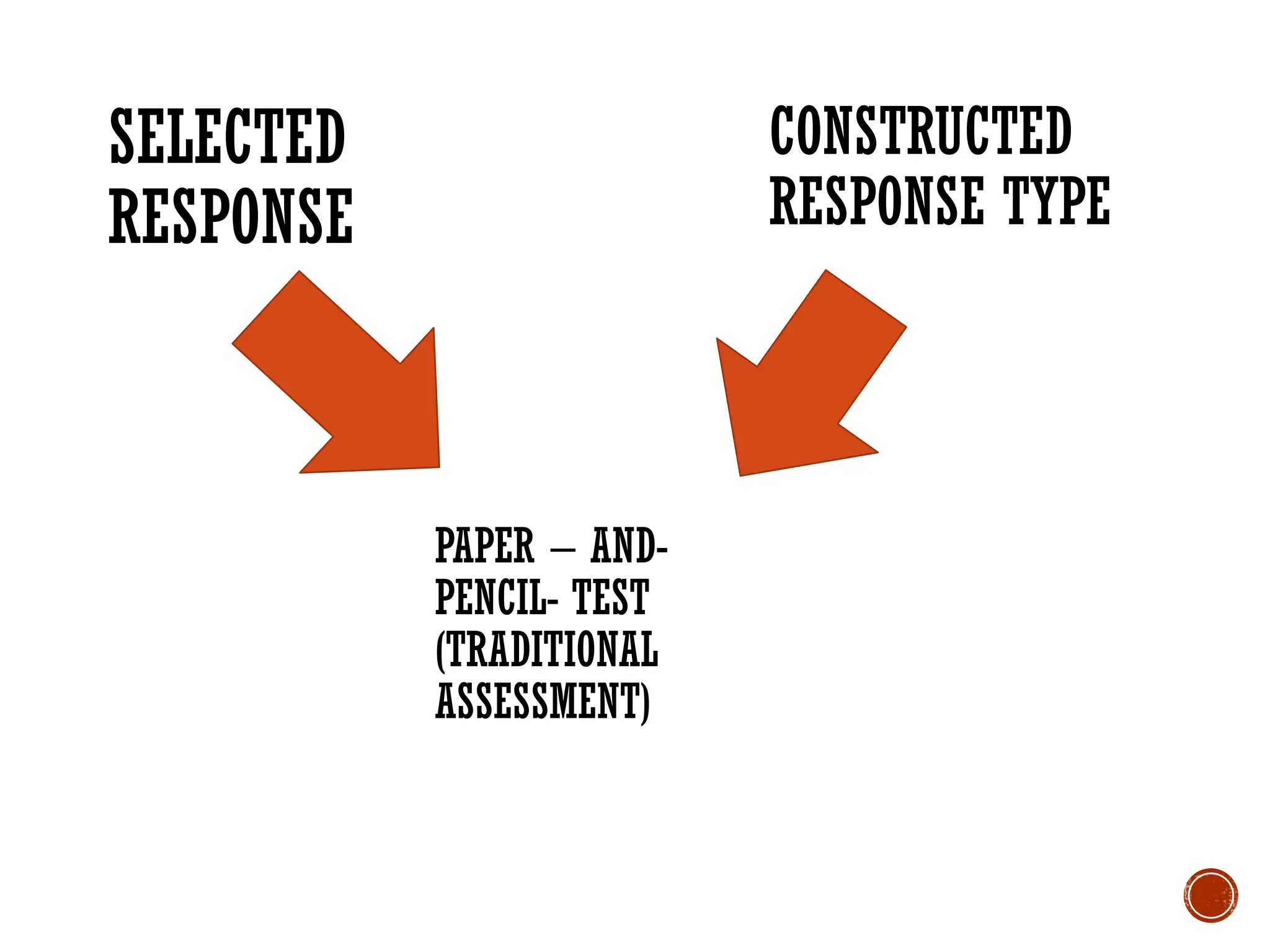
An assessmentincludes the paper-
pencil tests. Paper – and- Pencil tests
either the selected response type or
constructed – response.
54.
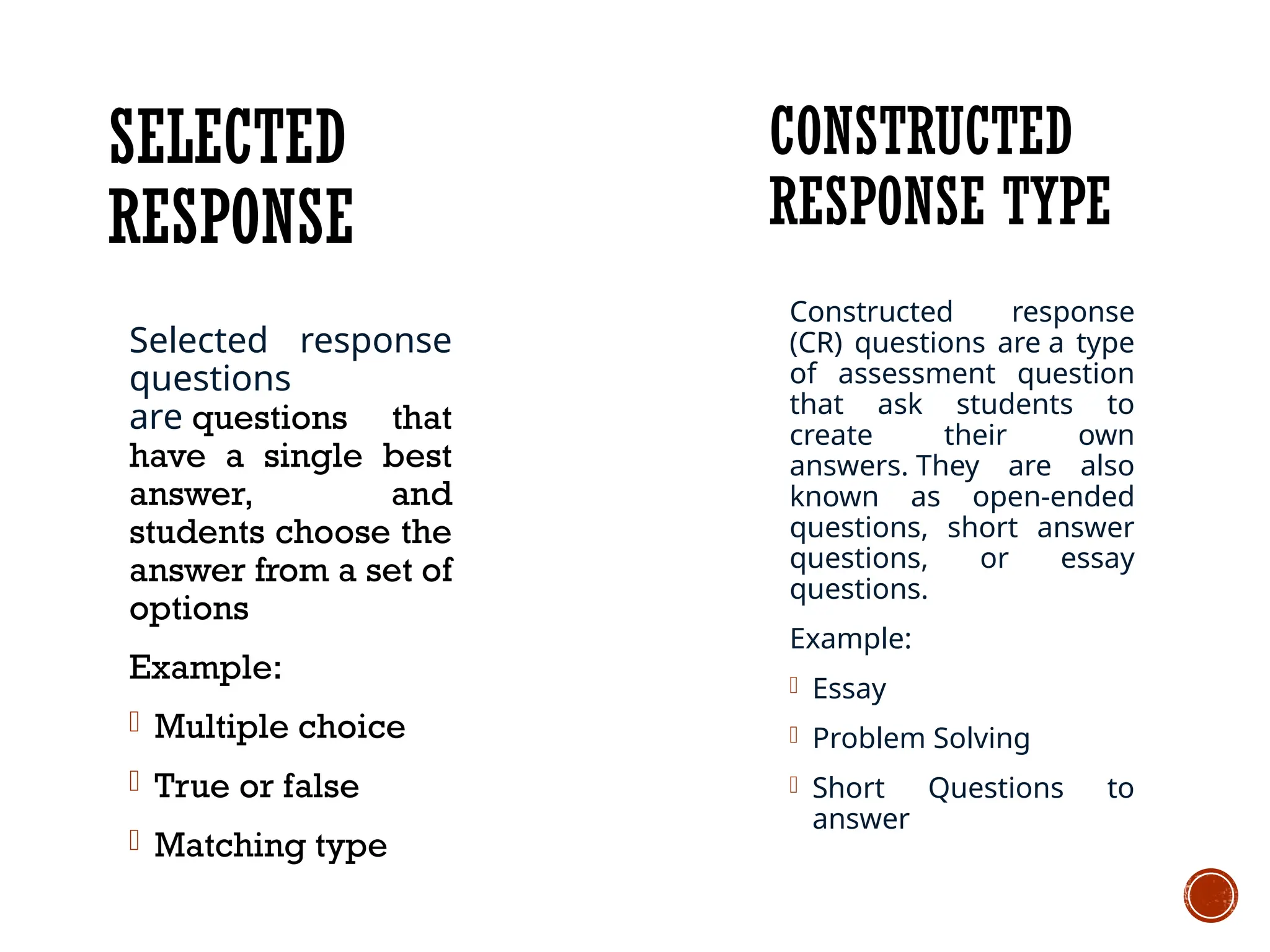
SELECTED
RESPONSE
Constructed response
(CR) questionsare a type
of assessment question
that ask students to
create their own
answers. They are also
known as open-ended
questions, short answer
questions, or essay
questions.
Example:
- Essay
- Problem Solving
- Short Questions to
answer
CONSTRUCTED
RESPONSE TYPE
Selected response
questions
are questions that
have a single best
answer, and
students choose the
answer from a set of
options
Example:
- Multiple choice
- True or false
- Matching type
TRADITIONAL ASSESSMENT
One keyfeature of traditional assessments is that
they're often summative, meaning they are
assessments that are given at the end of a learning
period—like a chapter, unit, or semester—to sum up
what a student has learned.
The primary purpose of traditional assessment is to evaluate
student learning outcomes.
57.
TRADITIONAL ASSESSMENT
Traditionalassessments have
SEVERAL DEFINING CHARACTERISTICS:
• Standardized: The same test is given to all students.
• Summative: Aimed at evaluating learning outcomes.
• Objective: Grading is often automated or follows a strict
rubric.
• Time-Bound: Usually conducted within a set timeframe.
58.
AUTHENTIC ASSESSMENT
Theterm authentic assessment was coined by
GRANT WIGGINS (1993) a leading proponent of
reform in testing. Assessment in termed AUTHENTIC
because student’s knowledge and skills are assessed
in a context that approximates the real world or real
life as closely as possible.
59.
AUTHENTIC ASSESSMENT
Thatis why AUNTHENTIC assessment also called as
“PERFORMANCE ASSESSMENT”.
Authentic Assessment is also called as NON –
TRADITIONAL ASESSEMENT and ALTERNATIVE
ASSESSMENT. It is referred to as ALTERNATIVE
ASSESSMENT it offers students more choices than
just taking a paper- and- pencil test.
60.
AUTHENTIC ASSESSMENT
- Authenticassessment is a method of
evaluation that asks students to apply their
knowledge and skills in real-world scenarios.
61.
AUTHENTIC ASSESSMENT
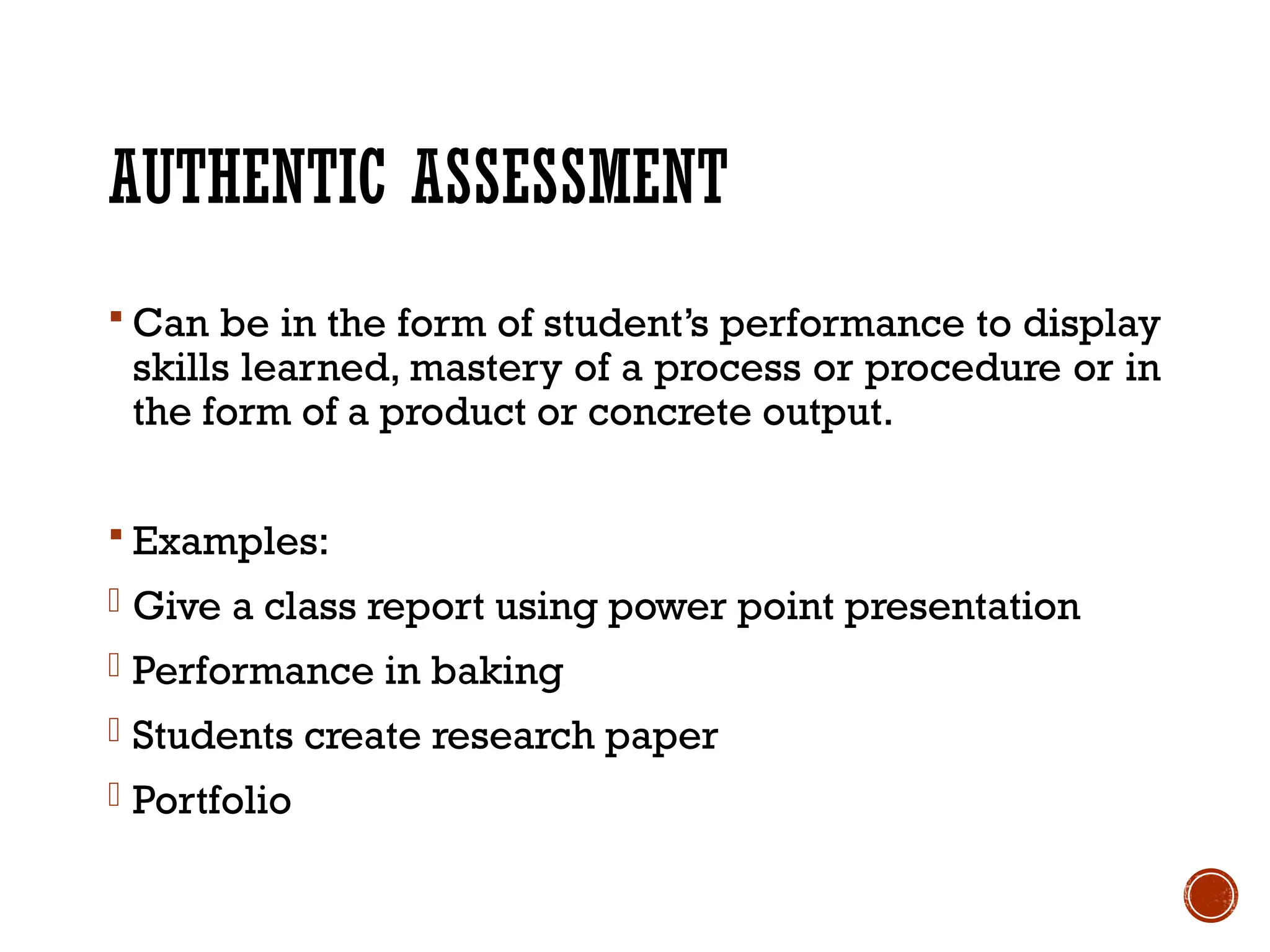
Canbe in the form of student’s performance to display
skills learned, mastery of a process or procedure or in
the form of a product or concrete output.
Examples:
- Give a class report using power point presentation
- Performance in baking
- Students create research paper
- Portfolio
NORM VS. CRITERION-REFERENCED
ASSESSMENT
- Norm-referenced assessments are designed to compare a
student's performance against a larger group, often at
a national level. These assessments are useful for identifying
where a student stands in relation to their peers, some
examples include standardized tests.
- Norm-referenced assessments are particularly useful for
identifying high and low performers within a larger group. This
is often beneficial for college admissions, scholarship
allocations, and other competitive scenarios where ranking
is essential.
Example : Ranking System
64.
NORM VS. CRITERION-REFERENCED
ASSESSMENT
- On the other hand, criterion-referenced assessments focus on
measuring a student's skills or knowledge based on
predefined criteria or learning objectives. These
assessments are often used in classrooms to gauge whether a
student has mastered specific content or skills.
- Example : Category of students between “BASIC” “
PROFICIENT”“ADVANCED”
65.
ASSIGNMENT:
SEARCH ABOUT THEFOLLOWING:
LEARNING OUTCOMES
MEANING AND SOURCES
CHARACTERISTICS OF GOOD LEARNING OUTCOMES
LEARNING OUTCOMES
- Thelearning outcomes provide an overview of what
students should know, be able to do, or be able to value after
completing a course or program.
- Learning outcomes means how much knowledge or skills a
student should acquire through various assignments, course,
class or programs, by the end of a specific time period. They
are observable and measurable by knowledge, skills, abilities,
values, etc. Learning outcomes describe clearly what it is you
want your students to be able to do by the end of a course.
68.
LEARNING OUTCOMES
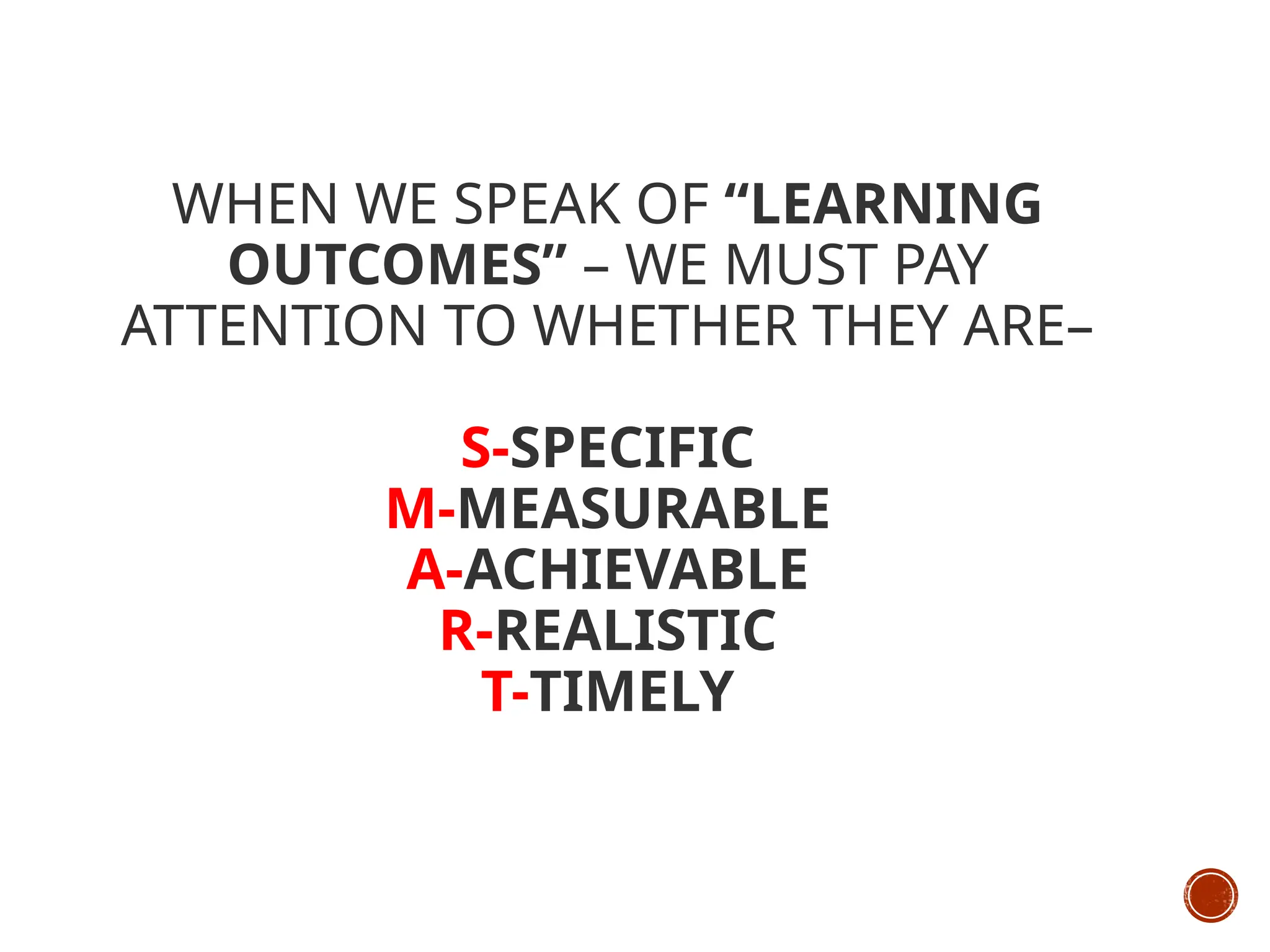
- THETERM “LEARNING OUTCOMES” CAN BE DEFINED AS AN
AMALGAMATION OF A LEARNER’S KNOWLEDGE, SKILL SET, AND
THE ABILITY TO LEVERAGE THEM IN REAL-TIME SITUATIONS.
- THERE ARE SEVERAL TAXONOMIES SUCH AS SOLO
(STRUCTURE OF OBSERVED LEARNING OUTCOMES), BLOOM’S
TAXONOMY, FINK'S TAXONOMY, WIGGINS AND MCTIGHE
TAXONOMY ON EDUCATION.
69.
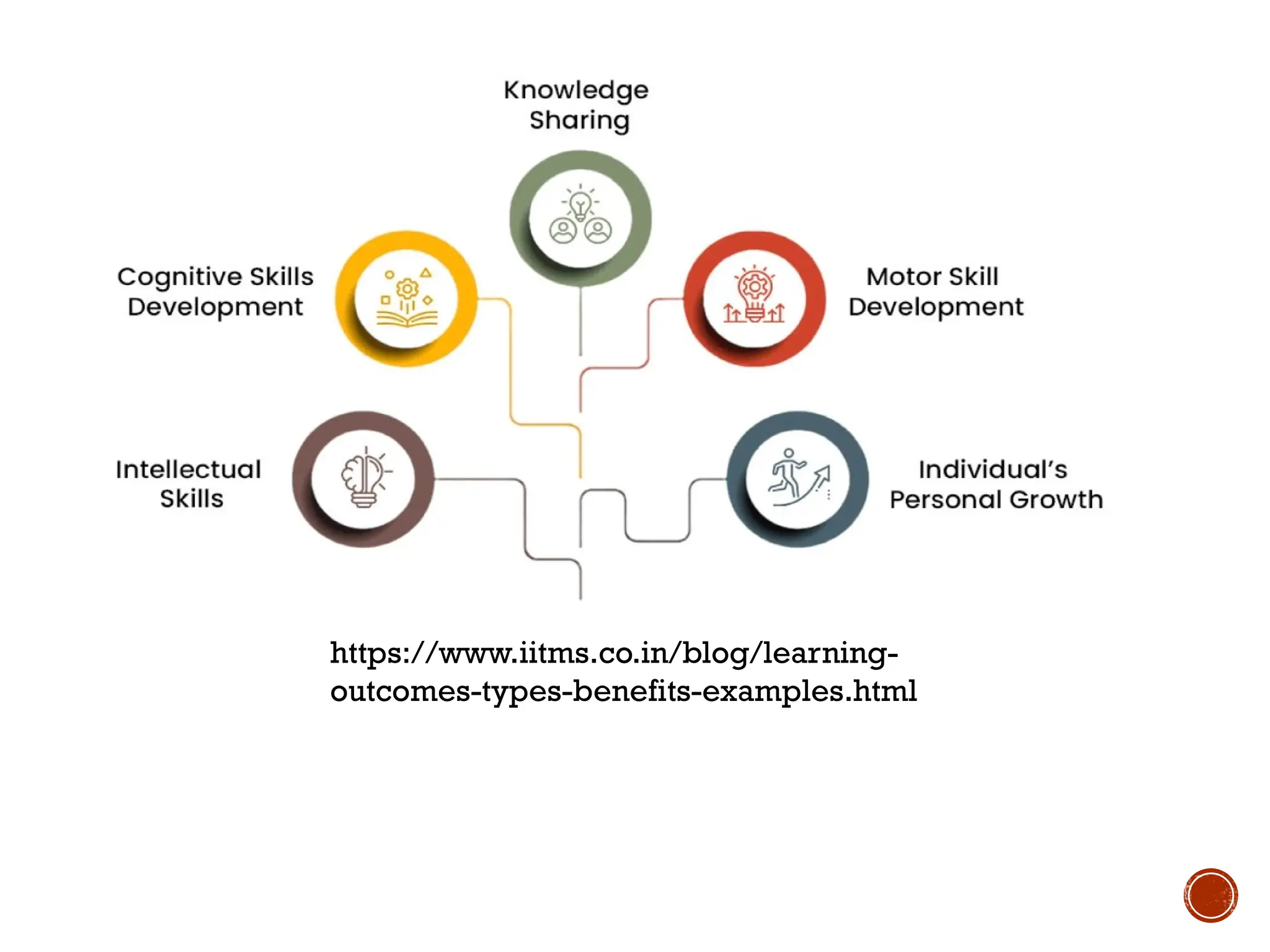
5 TYPES OFLEARNING OUTCOMES
1. INTELLECTUAL SKILLS THIS TYPE OF LEARNING OUTCOME
ENABLES THE LEARNER TO UNDERSTAND RULES, CONCEPTS,
OR PROCEDURES.
2. COGNITIVE STRATEGY IN THIS TYPE, THE LEARNER USES HIS
OR HER THINKING ABILITIES TO MAKE STRATEGIES AND
ORGANIZE, LEARN, THINK, AND BEHAVE.
3. VERBAL INFORMATION
4. MOTOR SKILLS
5. ATTITUDE
Note: An intellectual is a person who engages in critical thinking, research, and reflection about the nature of
reality, especially the nature of society and proposed solutions for its normative problems.
Verbal information is information that is conveyed through spoken or written words.
70.
5 TYPES OFLEARNING OUTCOMES
1. INTELLECTUAL SKILLS THIS TYPE OF LEARNING OUTCOME
ENABLES THE LEARNER TO UNDERSTAND RULES, CONCEPTS,
OR PROCEDURES.
2. COGNITIVE STRATEGY IN THIS TYPE, THE LEARNER USES HIS
OR HER THINKING ABILITIES TO MAKE STRATEGIES AND
ORGANIZE, LEARN, THINK, AND BEHAVE.
3. VERBAL INFORMATION
4. MOTOR SKILLS
5. ATTITUDE
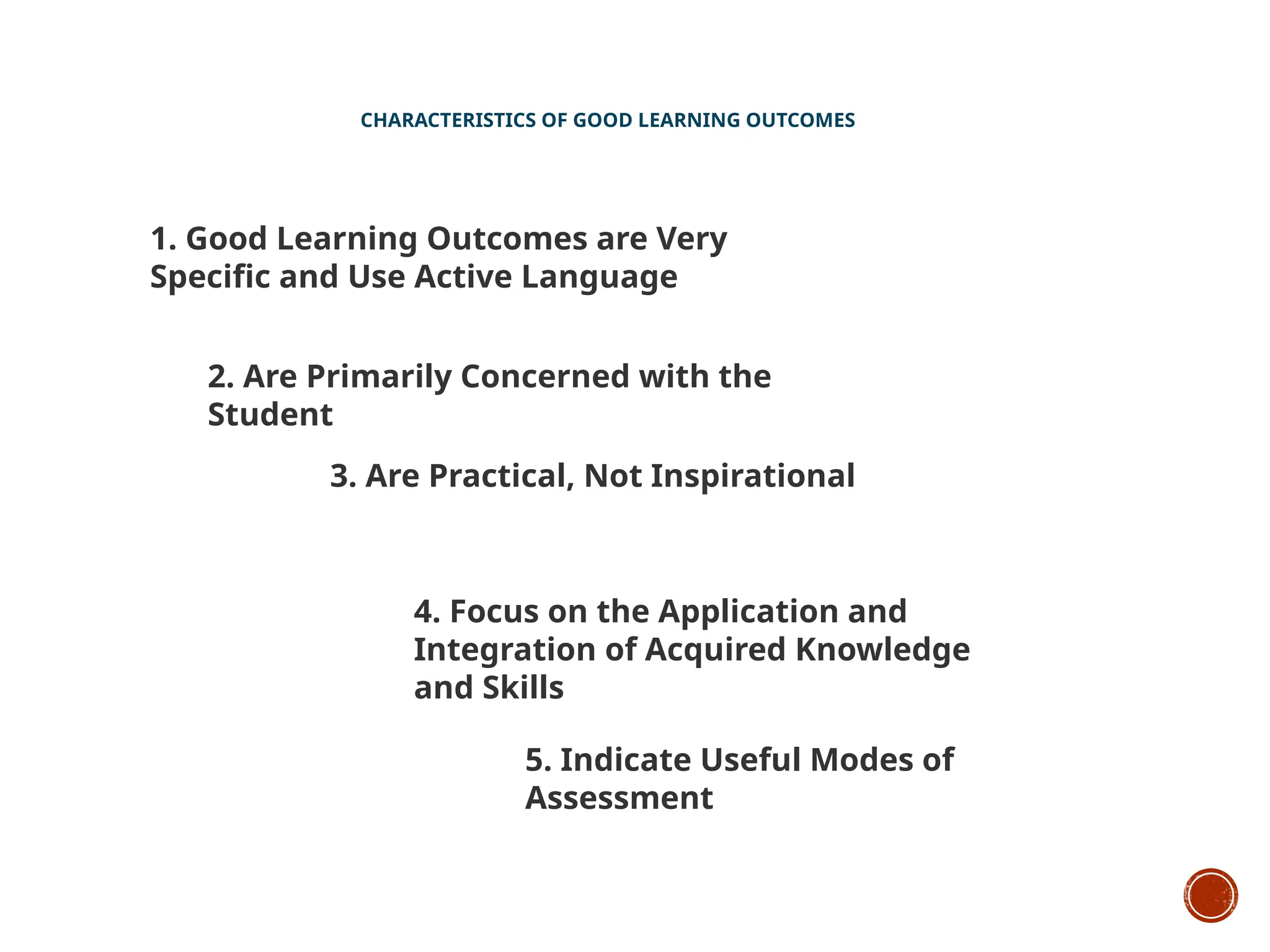
CHARACTERISTICS OF GOODLEARNING OUTCOMES
1. Good Learning Outcomes are Very
Specific and Use Active Language
2. Are Primarily Concerned with the
Student
3. Are Practical, Not Inspirational
4. Focus on the Application and
Integration of Acquired Knowledge
and Skills
5. Indicate Useful Modes of
Assessment
77.
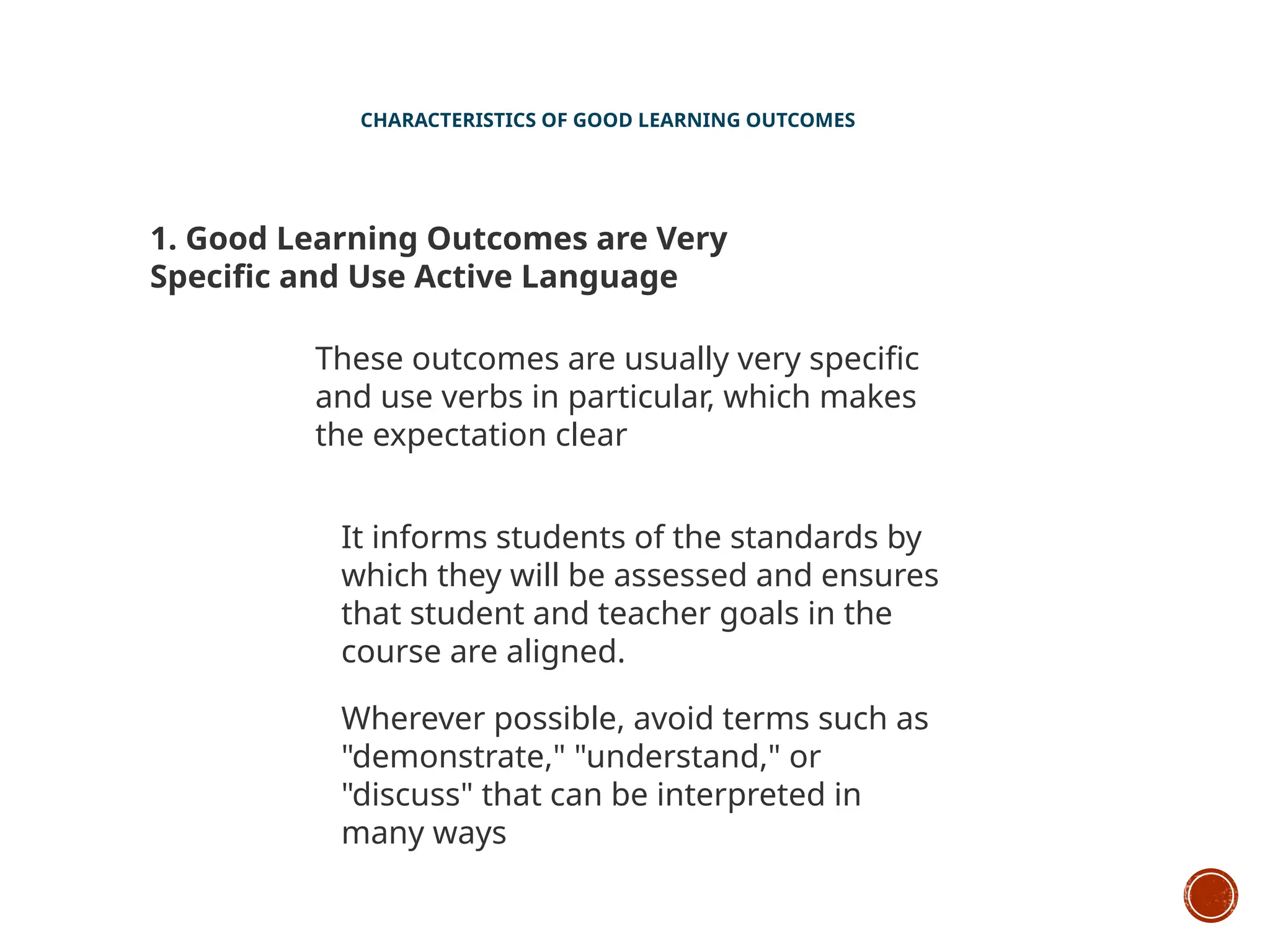
CHARACTERISTICS OF GOODLEARNING OUTCOMES
1. Good Learning Outcomes are Very
Specific and Use Active Language
These outcomes are usually very specific
and use verbs in particular, which makes
the expectation clear
It informs students of the standards by
which they will be assessed and ensures
that student and teacher goals in the
course are aligned.
Wherever possible, avoid terms such as
"demonstrate," "understand," or
"discuss" that can be interpreted in
many ways
78.
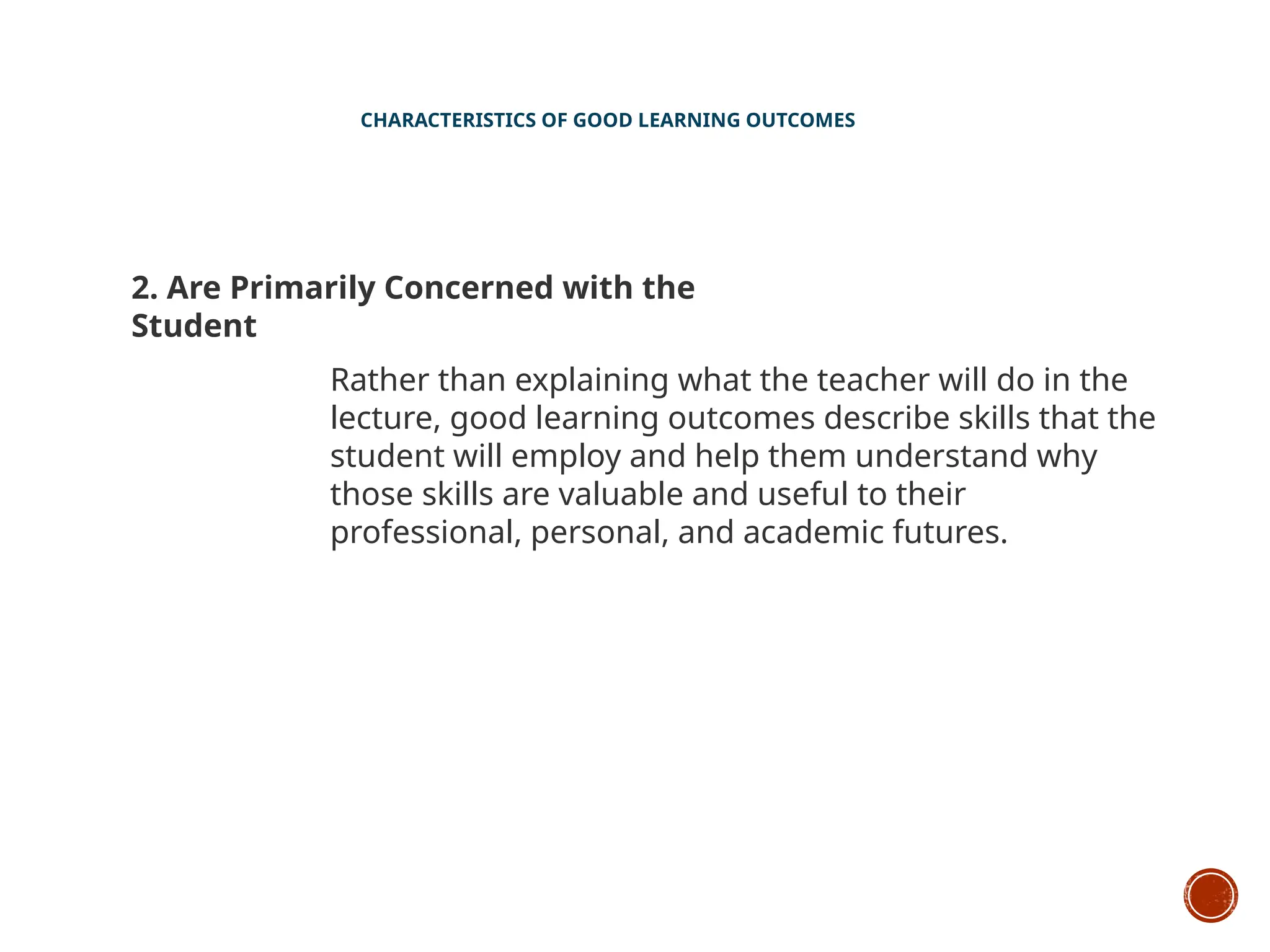
CHARACTERISTICS OF GOODLEARNING OUTCOMES
2. Are Primarily Concerned with the
Student
Rather than explaining what the teacher will do in the
lecture, good learning outcomes describe skills that the
student will employ and help them understand why
those skills are valuable and useful to their
professional, personal, and academic futures.
79.
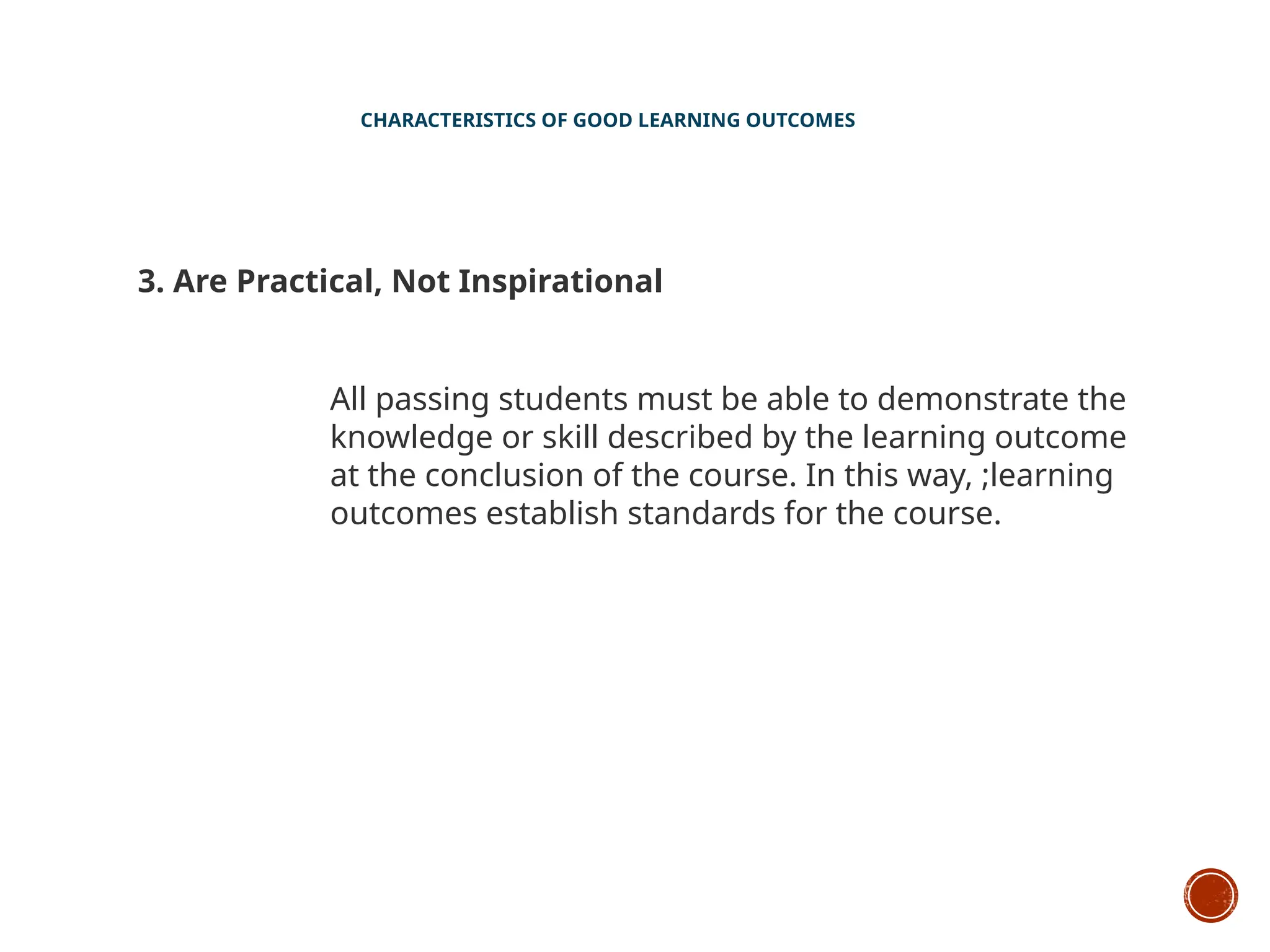
CHARACTERISTICS OF GOODLEARNING OUTCOMES
3. Are Practical, Not Inspirational
All passing students must be able to demonstrate the
knowledge or skill described by the learning outcome
at the conclusion of the course. In this way, ;learning
outcomes establish standards for the course.
80.
CHARACTERISTICS OF GOODLEARNING OUTCOMES
4. Focus on the Application and
Integration of Acquired Knowledge
and Skills
Good learning outcomes reflect the ways in which
the described knowledge and skills may be used
by the student now and in the future.
81.
CHARACTERISTICS OF GOODLEARNING OUTCOMES
5. Indicate Useful Modes of
Assessment
Specific elements are assessed. Good learning
outcomes prepare students for assessment and
help them feel engaged in and empowered by the
evaluation and assessment process.
82.
PRACTICES TO AVOIDWHILE BUILDING LEARNING OUTCOMES
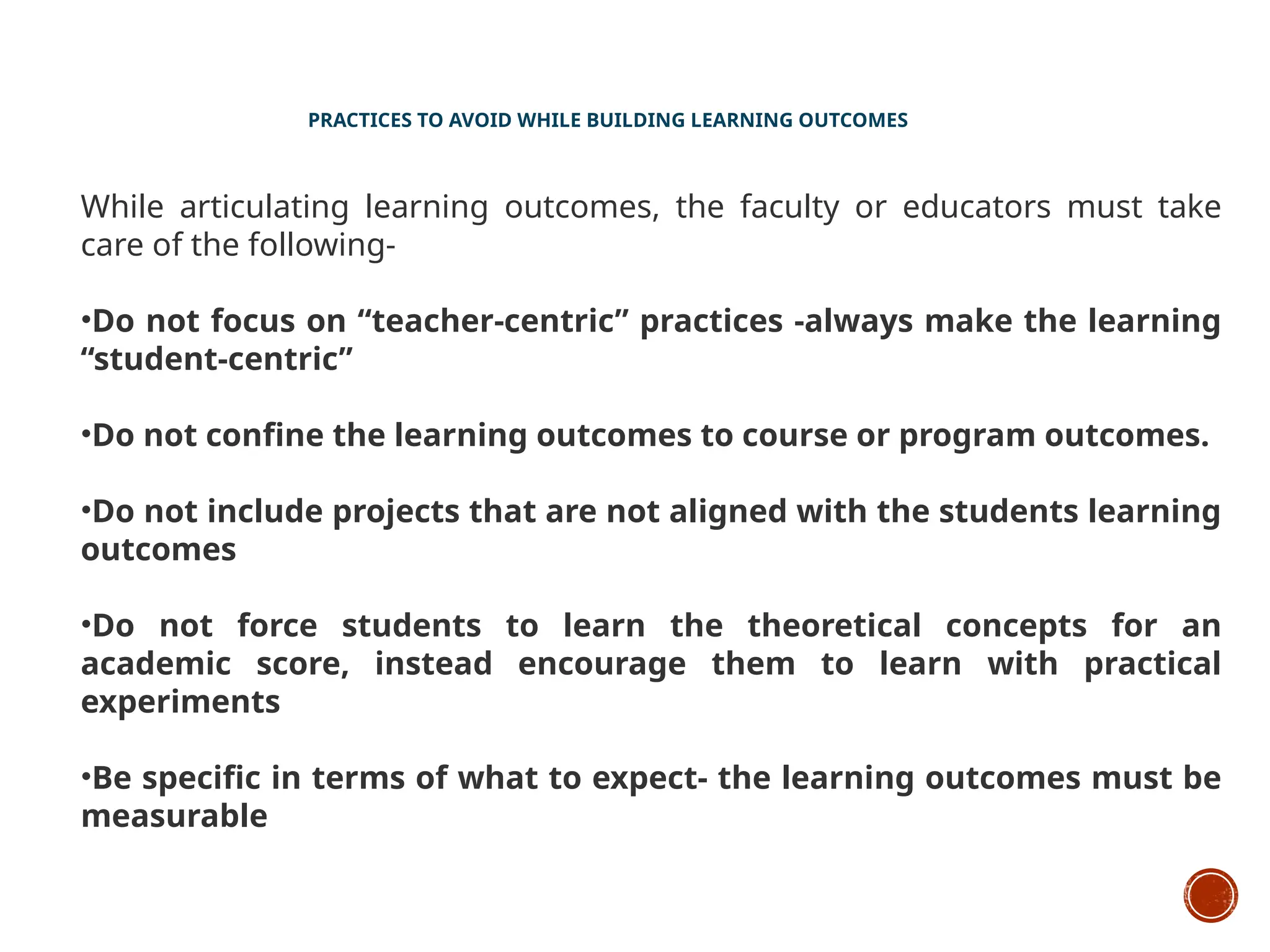
While articulating learning outcomes, the faculty or educators must take
care of the following-
•Do not focus on “teacher-centric” practices -always make the learning
“student-centric”
•Do not confine the learning outcomes to course or program outcomes.
•Do not include projects that are not aligned with the students learning
outcomes
•Do not force students to learn the theoretical concepts for an
academic score, instead encourage them to learn with practical
experiments
•Be specific in terms of what to expect- the learning outcomes must be
measurable
83.
LEVELS OF LEARNINGOUTCOMES
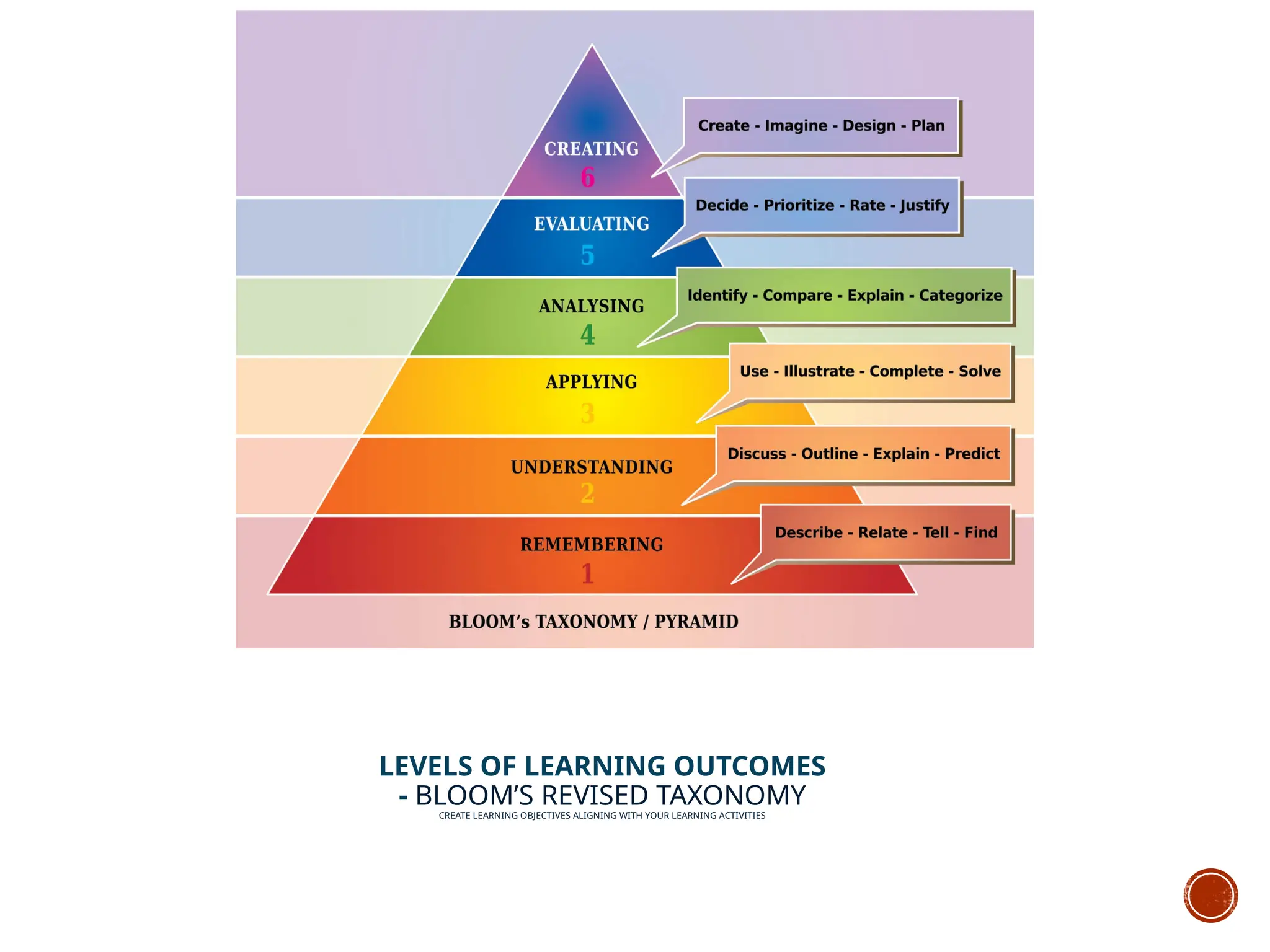
- BLOOM’S REVISED TAXONOMY
CREATE LEARNING OBJECTIVES ALIGNING WITH YOUR LEARNING ACTIVITIES