Contesting Auteur
Theory: Beyond
Andrew Sarris
An in-depth analysis of film authorship, moving past the traditional
auteur theory championed by Andrew Sarris. This presentation
explores new frameworks for understanding the creative process
behind cinematic works.
Ga
by Mustafa Yehya H Alhashim
Auteur
Introduction to Auteur Theory
Director-Centric
Auteur theory positions the
film director as the primary
creative force behind a
movie, much like a painter or
literary author.
Unique Style
According to Sarris, an
auteur's distinct style and
thematic focus are the
hallmarks that distinguish
their work.
Director as Author
The theory promoted the
idea of the director as the
singular "author" of a film,
challenging the traditional
Hollywood model.
Theory is a concept that attributes the artistic influence and authorial intention
of a film primarily to its director, emphasizing their unique style, creativity, and
technical competence (Petrie, G., 1973).
Thesis Statement
Oversimplification of
Film Authorship
While Sarris's auteur theory
emphasizes the director's
role as the primary creative
force behind a film, it fails to
account for the collaborative
nature of filmmaking
involving various
contributors beyond the
director.
Collective Film
Authorship
This presentation argues that
film authorship is a collective
process, with the director as
one of many vital
contributors, including
writers, cinematographers,
producers, and others who
shape the final product.
Collaborative
Filmmaking
By recognizing the
collaborative nature of
filmmaking, we can gain a
more nuanced
understanding of how films
are created and the various
creative voices that come
together to produce a
cohesive work of art.
Historical Context of Auteur Theory
Origins in 1950s
France
Auteur theory emerged
from the influential
French film magazine
Cahiers du Cinéma in the
1950s, challenging the
commercial factory model
of Hollywood's studio
system.
Elevation of Film as
Art
The theory was part of a
broader cultural
movement that sought to
elevate film from mere
entertainment to the
status of high art, on par
with other established
artistic mediums.
Reaction Against
Commercialism
Auteur theory proposed
that the director should
be recognized as the
primary creative force
behind a film, in
opposition to the
commercialized, profit-
driven studio system.
Criteria for Auteurism
Technical
Competence
According to Andrew Sarris,
the first criterion for
defining an auteur is their
ability to demonstrate a
high level of craftsmanship
in the technical aspects of
filmmaking.
Personal Style
The second criterion is the
director's unique style that
is distinguishable across
their body of work, creating
a distinctive cinematic
signature.
Interior Meaning
The third and most
important criterion is the
deeper, underlying themes
and messages that the
director consistently
explores and expresses
through their films.
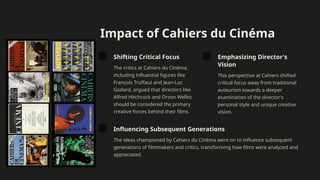
Impact of Cahiers du Cinéma
Shifting Critical Focus
The critics at Cahiers du Cinéma,
including influential figures like
François Truffaut and Jean-Luc
Godard, argued that directors like
Alfred Hitchcock and Orson Welles
should be considered the primary
creative forces behind their films.
Emphasizing Director's
Vision
This perspective at Cahiers shifted
critical focus away from traditional
auteurism towards a deeper
examination of the director's
personal style and unique creative
vision.
Influencing Subsequent Generations
The ideas championed by Cahiers du Cinéma went on to influence subsequent
generations of filmmakers and critics, transforming how films were analyzed and
appreciated.
Examples of Auteurs According to
Sarris
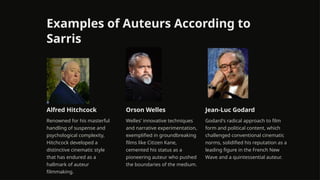
Alfred Hitchcock
Renowned for his masterful
handling of suspense and
psychological complexity,
Hitchcock developed a
distinctive cinematic style
that has endured as a
hallmark of auteur
filmmaking.
Orson Welles
Welles' innovative techniques
and narrative experimentation,
exemplified in groundbreaking
films like Citizen Kane,
cemented his status as a
pioneering auteur who pushed
the boundaries of the medium.
Jean-Luc Godard
Godard's radical approach to film
form and political content, which
challenged conventional cinematic
norms, solidified his reputation as a
leading figure in the French New
Wave and a quintessential auteur.
Overview of the Critique
Studio
Authorship
and Corporate
Art
Film scholar
Jerome
Christenson
challenges auteur
theory by arguing
that the studio
system, not the
director, wields
ultimate creative
control over a film's
production and
vision.
The Producer
as Auteur
Matthew
Bernstein posits
that the producer,
not the director, is
often the true
auteur who shapes
a film's themes,
style, and creative
direction.
The
Oppositional
Gaze
Feminist scholar
bell hooks
critiques auteur
theory for
neglecting the
perspectives of
marginalized
groups, arguing for
an "oppositional
gaze" that
challenges
dominant
cinematic
narratives.
Authorship
and Context
Mike Hale
emphasizes the
importance of
cultural, historical,
and social contexts
in interpreting
films, beyond the
director's
individual creative
vision.
Jerome Christenson: Studio
Authorship and Corporate Art
Corporate
Branding
Christenson argues that
the distinct branding
and corporate identities
of major studios like
MGM and Warner Bros.
play a significant role in
shaping the films they
produce, challenging
the traditional auteur
theory.
Industrial Context
He emphasizes the
importance of the
industrial and economic
contexts of film
production, which shape
the creative process
beyond the individual
director's vision.
Collective
Authorship
Christenson's
perspective suggests
that the studio itself,
rather than a single
director, can be seen as
the primary "author" of
a film, through its
institutional structures
and decision-making
processes.
Matthew Bernstein: The Producer as
Auteur
Film Production
Bernstein argues that
producers, like directors, can
significantly shape a film's
creative direction and be
considered auteurs.
Collaborative Process
He cites producers such as
David O. Selznick, who had a
major influence on films like
"Gone with the Wind," as
examples of producer-
auteurs.
Film Scholarship
Bernstein's perspective
highlights the importance of
the producer's role in the
filmmaking process and
challenges traditional auteur
theory.
Examples of Producer Influence
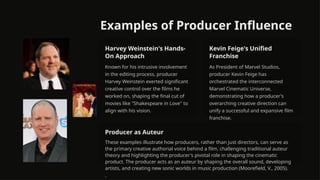
Harvey Weinstein's Hands-
On Approach
Known for his intrusive involvement
in the editing process, producer
Harvey Weinstein exerted significant
creative control over the films he
worked on, shaping the final cut of
movies like "Shakespeare in Love" to
align with his vision.
Kevin Feige's Unified
Franchise
As President of Marvel Studios,
producer Kevin Feige has
orchestrated the interconnected
Marvel Cinematic Universe,
demonstrating how a producer's
overarching creative direction can
unify a successful and expansive film
franchise.
Producer as Auteur
These examples illustrate how producers, rather than just directors, can serve as
the primary creative authorial voice behind a film, challenging traditional auteur
theory and highlighting the producer's pivotal role in shaping the cinematic
product. The producer acts as an auteur by shaping the overall sound, developing
artists, and creating new sonic worlds in music production (Moorefield, V., 2005).
.
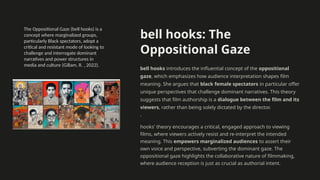
bell hooks: The
Oppositional Gaze
bell hooks introduces the influential concept of the oppositional
gaze, which emphasizes how audience interpretation shapes film
meaning. She argues that black female spectators in particular offer
unique perspectives that challenge dominant narratives. This theory
suggests that film authorship is a dialogue between the film and its
viewers, rather than being solely dictated by the director.
.
hooks' theory encourages a critical, engaged approach to viewing
films, where viewers actively resist and re-interpret the intended
meaning. This empowers marginalized audiences to assert their
own voice and perspective, subverting the dominant gaze. The
oppositional gaze highlights the collaborative nature of filmmaking,
where audience reception is just as crucial as authorial intent.
The Oppositional Gaze (bell hooks) is a
concept where marginalized groups,
particularly Black spectators, adopt a
critical and resistant mode of looking to
challenge and interrogate dominant
narratives and power structures in
media and culture (Gillam, R. , 2022).
Examples of the Oppositional Gaze
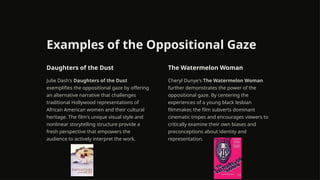
Daughters of the Dust
Julie Dash's Daughters of the Dust
exemplifies the oppositional gaze by offering
an alternative narrative that challenges
traditional Hollywood representations of
African American women and their cultural
heritage. The film's unique visual style and
nonlinear storytelling structure provide a
fresh perspective that empowers the
audience to actively interpret the work.
The Watermelon Woman
Cheryl Dunye's The Watermelon Woman
further demonstrates the power of the
oppositional gaze. By centering the
experiences of a young black lesbian
filmmaker, the film subverts dominant
cinematic tropes and encourages viewers to
critically examine their own biases and
preconceptions about identity and
representation.
Aaron Hunter: Final Thoughts on
Authorship
Aaron Hunter provides a comprehensive and nuanced examination of the concept of
film authorship. He emphasizes that authorship in cinema is not limited to the director,
but rather involves a complex web of contributions from various collaborators, including
writers, producers, actors, and even the audience. Hunter's perspective underscores the
inherently collective nature of filmmaking, challenging the traditional auteur theory that
has long dominated film studies.
Hunter's analysis encourages a more holistic understanding of the filmmaking process,
acknowledging the vital roles played by all members of the creative team. By stepping
away from the director-centric view, Hunter's framework allows for a richer appreciation
of the collaborative artistry that shapes the cinematic experience. His insights highlight
the multifaceted nature of authorship and the need to consider the diverse voices that
shape a film's final form.
Ultimately, Hunter's perspective reinforces the complexity and nuance inherent in the
study of film authorship. His work serves as a valuable counterpoint to the reductive
notions of the auteur, opening up new avenues for critical analysis and a deeper
understanding of the collaborative nature of the cinematic medium.
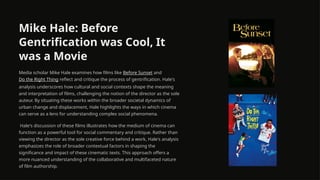
Mike Hale: Before
Gentrification was Cool, It
was a Movie
Media scholar Mike Hale examines how films like Before Sunset and
Do the Right Thing reflect and critique the process of gentrification. Hale's
analysis underscores how cultural and social contexts shape the meaning
and interpretation of films, challenging the notion of the director as the sole
auteur. By situating these works within the broader societal dynamics of
urban change and displacement, Hale highlights the ways in which cinema
can serve as a lens for understanding complex social phenomena.
Hale's discussion of these films illustrates how the medium of cinema can
function as a powerful tool for social commentary and critique. Rather than
viewing the director as the sole creative force behind a work, Hale's analysis
emphasizes the role of broader contextual factors in shaping the
significance and impact of these cinematic texts. This approach offers a
more nuanced understanding of the collaborative and multifaceted nature
of film authorship.
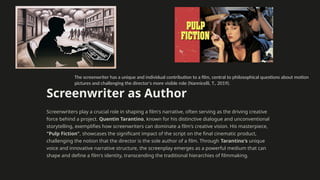
Screenwriter as Author
Screenwriters play a crucial role in shaping a film's narrative, often serving as the driving creative
force behind a project. Quentin Tarantino, known for his distinctive dialogue and unconventional
storytelling, exemplifies how screenwriters can dominate a film's creative vision. His masterpiece,
"Pulp Fiction", showcases the significant impact of the script on the final cinematic product,
challenging the notion that the director is the sole author of a film. Through Tarantino's unique
voice and innovative narrative structure, the screenplay emerges as a powerful medium that can
shape and define a film's identity, transcending the traditional hierarchies of filmmaking.
The screenwriter has a unique and individual contribution to a film, central to philosophical questions about motion
pictures and challenging the director's more visible role (Nannicelli, T., 2019).
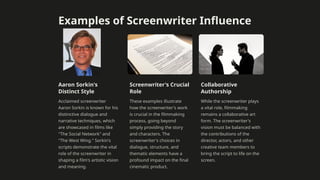
Examples of Screenwriter Influence
Aaron Sorkin's
Distinct Style
Acclaimed screenwriter
Aaron Sorkin is known for his
distinctive dialogue and
narrative techniques, which
are showcased in films like
"The Social Network" and
"The West Wing." Sorkin's
scripts demonstrate the vital
role of the screenwriter in
shaping a film's artistic vision
and meaning.
Screenwriter's Crucial
Role
These examples illustrate
how the screenwriter's work
is crucial in the filmmaking
process, going beyond
simply providing the story
and characters. The
screenwriter's choices in
dialogue, structure, and
thematic elements have a
profound impact on the final
cinematic product.
Collaborative
Authorship
While the screenwriter plays
a vital role, filmmaking
remains a collaborative art
form. The screenwriter's
vision must be balanced with
the contributions of the
director, actors, and other
creative team members to
bring the script to life on the
screen.
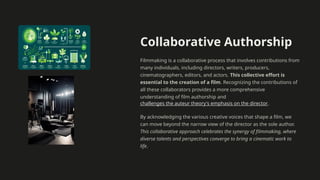
Collaborative Authorship
Filmmaking is a collaborative process that involves contributions from
many individuals, including directors, writers, producers,
cinematographers, editors, and actors. This collective effort is
essential to the creation of a film. Recognizing the contributions of
all these collaborators provides a more comprehensive
understanding of film authorship and
challenges the auteur theory's emphasis on the director.
By acknowledging the various creative voices that shape a film, we
can move beyond the narrow view of the director as the sole author.
This collaborative approach celebrates the synergy of filmmaking, where
diverse talents and perspectives converge to bring a cinematic work to
life.
Examples of Collaborative
Filmmaking
Screenwriters
The Lord of the Rings trilogy,
directed by Peter Jackson,
showcases the collaborative
efforts of screenwriters Fran
Walsh and Philippa Boyens.
Their contributions were
essential in adapting the
beloved fantasy novels into a
cinematic masterpiece.
Cinematography
Andrew Lesnie's iconic
cinematography played a
crucial role in bringing the
world of Middle-earth to life.
His masterful use of lighting
and camera angles helped to
create the film's distinctive
visual style and immersive
atmosphere.
Composition
Composer Howard Shore's
sweeping musical score was
integral to the success of the
Lord of the Rings trilogy. His
evocative themes and
leitmotifs enhanced the
emotional resonance of the
films and became an integral
part of the overall cinematic
experience.
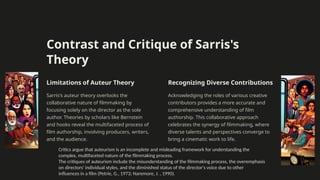
Contrast and Critique of Sarris's
Theory
Limitations of Auteur Theory
Sarris's auteur theory overlooks the
collaborative nature of filmmaking by
focusing solely on the director as the sole
author. Theories by scholars like Bernstein
and hooks reveal the multifaceted process of
film authorship, involving producers, writers,
and the audience.
Recognizing Diverse Contributions
Acknowledging the roles of various creative
contributors provides a more accurate and
comprehensive understanding of film
authorship. This collaborative approach
celebrates the synergy of filmmaking, where
diverse talents and perspectives converge to
bring a cinematic work to life.
Critics argue that auteurism is an incomplete and misleading framework for understanding the
complex, multifaceted nature of the filmmaking process.
The critiques of auteurism include the misunderstanding of the filmmaking process, the overemphasis
on directors' individual styles, and the diminished status of the director's voice due to other
influences in a film (Petrie, G., 1973; Naremore, J. , 1990).
Implications for Other Media
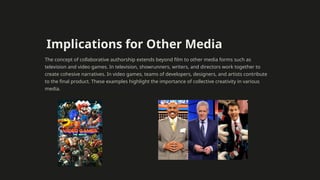
The concept of collaborative authorship extends beyond film to other media forms such as
television and video games. In television, showrunners, writers, and directors work together to
create cohesive narratives. In video games, teams of developers, designers, and artists contribute
to the final product. These examples highlight the importance of collective creativity in various
media.
Conclusion
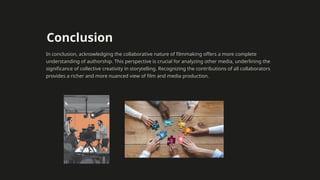
In conclusion, acknowledging the collaborative nature of filmmaking offers a more complete
understanding of authorship. This perspective is crucial for analyzing other media, underlining the
significance of collective creativity in storytelling. Recognizing the contributions of all collaborators
provides a richer and more nuanced view of film and media production.
References
1. Bernstein, M. (2008). The Producer as Auteur. In B. K. Grant (Ed.), Auteurs and Authorship: A Film Reader (pp. 180-189). Malden, MA: Blackwell.
2. Christensen, J.C. (2011). America's Corporate Art: The Studio Authorship of Hollywood Motion Pictures.
3. Gillam, R. (2022). bell hooks’ Oppositional Gaze and Black Feminist Film Production in Brazil. Women's Studies in Communication, 45, 450-456.
https://doi.org/10.1080/07491409.2022.2135911.
4. Hale, M. (2007). Before gentrification was cool, it was a movie. The New York Times. https://www.nytimes.com/2007/09/19/movies/19land.html
5. hooks, b. (1992). The Oppositional Gaze: Black Female Spectators. In Black Looks: Race and Representation (pp. 115-131). Boston: South End
Press.
6. Moorefield, V. (2005). The Producer as Composer: Shaping the Sounds of Popular Music. https://doi.org/10.5860/choice.43-5190.
7. Nannicelli, T. (2019). What Is Screenplay? The Palgrave Handbook of the Philosophy of Film and Motion Pictures. https://doi.org/10.1007/978-3-
030-19601-1_10.
8. Naremore, J. (1990). Authorship and the Cultural Politics of Film Criticism. Film Quarterly, 44, 14-23. https://doi.org/10.2307/1212695.
9. Petrie, G. (1973). Alternatives to Auteurs. Film Quarterly, 26, 27-35. https://doi.org/10.2307/1211342.
10. Porter, V. (2012). Making and Meaning: The Role of the Producer in British Films. Journal of British Cinema and Television, 9, 7-25.
https://doi.org/10.3366/JBCTV.2012.0057.

Contesting-Auteur-Theory-Beyond-Andrew-Sarris.pptx

  • 1.
    Contesting Auteur Theory: Beyond AndrewSarris An in-depth analysis of film authorship, moving past the traditional auteur theory championed by Andrew Sarris. This presentation explores new frameworks for understanding the creative process behind cinematic works. Ga by Mustafa Yehya H Alhashim
  • 2.
    Auteur Introduction to AuteurTheory Director-Centric Auteur theory positions the film director as the primary creative force behind a movie, much like a painter or literary author. Unique Style According to Sarris, an auteur's distinct style and thematic focus are the hallmarks that distinguish their work. Director as Author The theory promoted the idea of the director as the singular "author" of a film, challenging the traditional Hollywood model. Theory is a concept that attributes the artistic influence and authorial intention of a film primarily to its director, emphasizing their unique style, creativity, and technical competence (Petrie, G., 1973).
  • 3.
    Thesis Statement Oversimplification of FilmAuthorship While Sarris's auteur theory emphasizes the director's role as the primary creative force behind a film, it fails to account for the collaborative nature of filmmaking involving various contributors beyond the director. Collective Film Authorship This presentation argues that film authorship is a collective process, with the director as one of many vital contributors, including writers, cinematographers, producers, and others who shape the final product. Collaborative Filmmaking By recognizing the collaborative nature of filmmaking, we can gain a more nuanced understanding of how films are created and the various creative voices that come together to produce a cohesive work of art.
  • 4.
    Historical Context ofAuteur Theory Origins in 1950s France Auteur theory emerged from the influential French film magazine Cahiers du Cinéma in the 1950s, challenging the commercial factory model of Hollywood's studio system. Elevation of Film as Art The theory was part of a broader cultural movement that sought to elevate film from mere entertainment to the status of high art, on par with other established artistic mediums. Reaction Against Commercialism Auteur theory proposed that the director should be recognized as the primary creative force behind a film, in opposition to the commercialized, profit- driven studio system.
  • 5.
    Criteria for Auteurism Technical Competence Accordingto Andrew Sarris, the first criterion for defining an auteur is their ability to demonstrate a high level of craftsmanship in the technical aspects of filmmaking. Personal Style The second criterion is the director's unique style that is distinguishable across their body of work, creating a distinctive cinematic signature. Interior Meaning The third and most important criterion is the deeper, underlying themes and messages that the director consistently explores and expresses through their films.
  • 6.
    Impact of Cahiersdu Cinéma Shifting Critical Focus The critics at Cahiers du Cinéma, including influential figures like François Truffaut and Jean-Luc Godard, argued that directors like Alfred Hitchcock and Orson Welles should be considered the primary creative forces behind their films. Emphasizing Director's Vision This perspective at Cahiers shifted critical focus away from traditional auteurism towards a deeper examination of the director's personal style and unique creative vision. Influencing Subsequent Generations The ideas championed by Cahiers du Cinéma went on to influence subsequent generations of filmmakers and critics, transforming how films were analyzed and appreciated.
  • 7.
    Examples of AuteursAccording to Sarris Alfred Hitchcock Renowned for his masterful handling of suspense and psychological complexity, Hitchcock developed a distinctive cinematic style that has endured as a hallmark of auteur filmmaking. Orson Welles Welles' innovative techniques and narrative experimentation, exemplified in groundbreaking films like Citizen Kane, cemented his status as a pioneering auteur who pushed the boundaries of the medium. Jean-Luc Godard Godard's radical approach to film form and political content, which challenged conventional cinematic norms, solidified his reputation as a leading figure in the French New Wave and a quintessential auteur.
  • 8.
    Overview of theCritique Studio Authorship and Corporate Art Film scholar Jerome Christenson challenges auteur theory by arguing that the studio system, not the director, wields ultimate creative control over a film's production and vision. The Producer as Auteur Matthew Bernstein posits that the producer, not the director, is often the true auteur who shapes a film's themes, style, and creative direction. The Oppositional Gaze Feminist scholar bell hooks critiques auteur theory for neglecting the perspectives of marginalized groups, arguing for an "oppositional gaze" that challenges dominant cinematic narratives. Authorship and Context Mike Hale emphasizes the importance of cultural, historical, and social contexts in interpreting films, beyond the director's individual creative vision.
  • 9.
    Jerome Christenson: Studio Authorshipand Corporate Art Corporate Branding Christenson argues that the distinct branding and corporate identities of major studios like MGM and Warner Bros. play a significant role in shaping the films they produce, challenging the traditional auteur theory. Industrial Context He emphasizes the importance of the industrial and economic contexts of film production, which shape the creative process beyond the individual director's vision. Collective Authorship Christenson's perspective suggests that the studio itself, rather than a single director, can be seen as the primary "author" of a film, through its institutional structures and decision-making processes.
  • 10.
    Matthew Bernstein: TheProducer as Auteur Film Production Bernstein argues that producers, like directors, can significantly shape a film's creative direction and be considered auteurs. Collaborative Process He cites producers such as David O. Selznick, who had a major influence on films like "Gone with the Wind," as examples of producer- auteurs. Film Scholarship Bernstein's perspective highlights the importance of the producer's role in the filmmaking process and challenges traditional auteur theory.
  • 11.
    Examples of ProducerInfluence Harvey Weinstein's Hands- On Approach Known for his intrusive involvement in the editing process, producer Harvey Weinstein exerted significant creative control over the films he worked on, shaping the final cut of movies like "Shakespeare in Love" to align with his vision. Kevin Feige's Unified Franchise As President of Marvel Studios, producer Kevin Feige has orchestrated the interconnected Marvel Cinematic Universe, demonstrating how a producer's overarching creative direction can unify a successful and expansive film franchise. Producer as Auteur These examples illustrate how producers, rather than just directors, can serve as the primary creative authorial voice behind a film, challenging traditional auteur theory and highlighting the producer's pivotal role in shaping the cinematic product. The producer acts as an auteur by shaping the overall sound, developing artists, and creating new sonic worlds in music production (Moorefield, V., 2005). .
  • 12.
    bell hooks: The OppositionalGaze bell hooks introduces the influential concept of the oppositional gaze, which emphasizes how audience interpretation shapes film meaning. She argues that black female spectators in particular offer unique perspectives that challenge dominant narratives. This theory suggests that film authorship is a dialogue between the film and its viewers, rather than being solely dictated by the director. . hooks' theory encourages a critical, engaged approach to viewing films, where viewers actively resist and re-interpret the intended meaning. This empowers marginalized audiences to assert their own voice and perspective, subverting the dominant gaze. The oppositional gaze highlights the collaborative nature of filmmaking, where audience reception is just as crucial as authorial intent. The Oppositional Gaze (bell hooks) is a concept where marginalized groups, particularly Black spectators, adopt a critical and resistant mode of looking to challenge and interrogate dominant narratives and power structures in media and culture (Gillam, R. , 2022).
  • 13.
    Examples of theOppositional Gaze Daughters of the Dust Julie Dash's Daughters of the Dust exemplifies the oppositional gaze by offering an alternative narrative that challenges traditional Hollywood representations of African American women and their cultural heritage. The film's unique visual style and nonlinear storytelling structure provide a fresh perspective that empowers the audience to actively interpret the work. The Watermelon Woman Cheryl Dunye's The Watermelon Woman further demonstrates the power of the oppositional gaze. By centering the experiences of a young black lesbian filmmaker, the film subverts dominant cinematic tropes and encourages viewers to critically examine their own biases and preconceptions about identity and representation.
  • 14.
    Aaron Hunter: FinalThoughts on Authorship Aaron Hunter provides a comprehensive and nuanced examination of the concept of film authorship. He emphasizes that authorship in cinema is not limited to the director, but rather involves a complex web of contributions from various collaborators, including writers, producers, actors, and even the audience. Hunter's perspective underscores the inherently collective nature of filmmaking, challenging the traditional auteur theory that has long dominated film studies. Hunter's analysis encourages a more holistic understanding of the filmmaking process, acknowledging the vital roles played by all members of the creative team. By stepping away from the director-centric view, Hunter's framework allows for a richer appreciation of the collaborative artistry that shapes the cinematic experience. His insights highlight the multifaceted nature of authorship and the need to consider the diverse voices that shape a film's final form. Ultimately, Hunter's perspective reinforces the complexity and nuance inherent in the study of film authorship. His work serves as a valuable counterpoint to the reductive notions of the auteur, opening up new avenues for critical analysis and a deeper understanding of the collaborative nature of the cinematic medium.
  • 15.
    Mike Hale: Before Gentrificationwas Cool, It was a Movie Media scholar Mike Hale examines how films like Before Sunset and Do the Right Thing reflect and critique the process of gentrification. Hale's analysis underscores how cultural and social contexts shape the meaning and interpretation of films, challenging the notion of the director as the sole auteur. By situating these works within the broader societal dynamics of urban change and displacement, Hale highlights the ways in which cinema can serve as a lens for understanding complex social phenomena. Hale's discussion of these films illustrates how the medium of cinema can function as a powerful tool for social commentary and critique. Rather than viewing the director as the sole creative force behind a work, Hale's analysis emphasizes the role of broader contextual factors in shaping the significance and impact of these cinematic texts. This approach offers a more nuanced understanding of the collaborative and multifaceted nature of film authorship.
  • 16.
    Screenwriter as Author Screenwritersplay a crucial role in shaping a film's narrative, often serving as the driving creative force behind a project. Quentin Tarantino, known for his distinctive dialogue and unconventional storytelling, exemplifies how screenwriters can dominate a film's creative vision. His masterpiece, "Pulp Fiction", showcases the significant impact of the script on the final cinematic product, challenging the notion that the director is the sole author of a film. Through Tarantino's unique voice and innovative narrative structure, the screenplay emerges as a powerful medium that can shape and define a film's identity, transcending the traditional hierarchies of filmmaking. The screenwriter has a unique and individual contribution to a film, central to philosophical questions about motion pictures and challenging the director's more visible role (Nannicelli, T., 2019).
  • 17.
    Examples of ScreenwriterInfluence Aaron Sorkin's Distinct Style Acclaimed screenwriter Aaron Sorkin is known for his distinctive dialogue and narrative techniques, which are showcased in films like "The Social Network" and "The West Wing." Sorkin's scripts demonstrate the vital role of the screenwriter in shaping a film's artistic vision and meaning. Screenwriter's Crucial Role These examples illustrate how the screenwriter's work is crucial in the filmmaking process, going beyond simply providing the story and characters. The screenwriter's choices in dialogue, structure, and thematic elements have a profound impact on the final cinematic product. Collaborative Authorship While the screenwriter plays a vital role, filmmaking remains a collaborative art form. The screenwriter's vision must be balanced with the contributions of the director, actors, and other creative team members to bring the script to life on the screen.
  • 18.
    Collaborative Authorship Filmmaking isa collaborative process that involves contributions from many individuals, including directors, writers, producers, cinematographers, editors, and actors. This collective effort is essential to the creation of a film. Recognizing the contributions of all these collaborators provides a more comprehensive understanding of film authorship and challenges the auteur theory's emphasis on the director. By acknowledging the various creative voices that shape a film, we can move beyond the narrow view of the director as the sole author. This collaborative approach celebrates the synergy of filmmaking, where diverse talents and perspectives converge to bring a cinematic work to life.
  • 19.
    Examples of Collaborative Filmmaking Screenwriters TheLord of the Rings trilogy, directed by Peter Jackson, showcases the collaborative efforts of screenwriters Fran Walsh and Philippa Boyens. Their contributions were essential in adapting the beloved fantasy novels into a cinematic masterpiece. Cinematography Andrew Lesnie's iconic cinematography played a crucial role in bringing the world of Middle-earth to life. His masterful use of lighting and camera angles helped to create the film's distinctive visual style and immersive atmosphere. Composition Composer Howard Shore's sweeping musical score was integral to the success of the Lord of the Rings trilogy. His evocative themes and leitmotifs enhanced the emotional resonance of the films and became an integral part of the overall cinematic experience.
  • 20.
    Contrast and Critiqueof Sarris's Theory Limitations of Auteur Theory Sarris's auteur theory overlooks the collaborative nature of filmmaking by focusing solely on the director as the sole author. Theories by scholars like Bernstein and hooks reveal the multifaceted process of film authorship, involving producers, writers, and the audience. Recognizing Diverse Contributions Acknowledging the roles of various creative contributors provides a more accurate and comprehensive understanding of film authorship. This collaborative approach celebrates the synergy of filmmaking, where diverse talents and perspectives converge to bring a cinematic work to life. Critics argue that auteurism is an incomplete and misleading framework for understanding the complex, multifaceted nature of the filmmaking process. The critiques of auteurism include the misunderstanding of the filmmaking process, the overemphasis on directors' individual styles, and the diminished status of the director's voice due to other influences in a film (Petrie, G., 1973; Naremore, J. , 1990).
  • 21.
    Implications for OtherMedia The concept of collaborative authorship extends beyond film to other media forms such as television and video games. In television, showrunners, writers, and directors work together to create cohesive narratives. In video games, teams of developers, designers, and artists contribute to the final product. These examples highlight the importance of collective creativity in various media.
  • 22.
    Conclusion In conclusion, acknowledgingthe collaborative nature of filmmaking offers a more complete understanding of authorship. This perspective is crucial for analyzing other media, underlining the significance of collective creativity in storytelling. Recognizing the contributions of all collaborators provides a richer and more nuanced view of film and media production.
  • 23.
    References 1. Bernstein, M.(2008). The Producer as Auteur. In B. K. Grant (Ed.), Auteurs and Authorship: A Film Reader (pp. 180-189). Malden, MA: Blackwell. 2. Christensen, J.C. (2011). America's Corporate Art: The Studio Authorship of Hollywood Motion Pictures. 3. Gillam, R. (2022). bell hooks’ Oppositional Gaze and Black Feminist Film Production in Brazil. Women's Studies in Communication, 45, 450-456. https://doi.org/10.1080/07491409.2022.2135911. 4. Hale, M. (2007). Before gentrification was cool, it was a movie. The New York Times. https://www.nytimes.com/2007/09/19/movies/19land.html 5. hooks, b. (1992). The Oppositional Gaze: Black Female Spectators. In Black Looks: Race and Representation (pp. 115-131). Boston: South End Press. 6. Moorefield, V. (2005). The Producer as Composer: Shaping the Sounds of Popular Music. https://doi.org/10.5860/choice.43-5190. 7. Nannicelli, T. (2019). What Is Screenplay? The Palgrave Handbook of the Philosophy of Film and Motion Pictures. https://doi.org/10.1007/978-3- 030-19601-1_10. 8. Naremore, J. (1990). Authorship and the Cultural Politics of Film Criticism. Film Quarterly, 44, 14-23. https://doi.org/10.2307/1212695. 9. Petrie, G. (1973). Alternatives to Auteurs. Film Quarterly, 26, 27-35. https://doi.org/10.2307/1211342. 10. Porter, V. (2012). Making and Meaning: The Role of the Producer in British Films. Journal of British Cinema and Television, 9, 7-25. https://doi.org/10.3366/JBCTV.2012.0057.