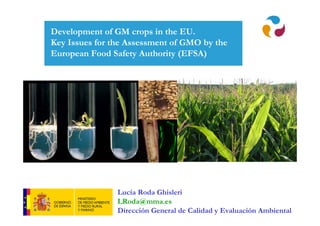
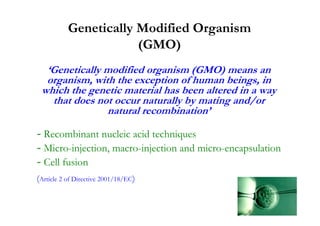
Development of GM crops in the EU.
Key Issues for the Assessment of GMO by the
European Food Safety Authority (EFSA)


                Lucía Roda Ghisleri
                LRoda@mma.es
                Dirección General de Calidad y Evaluación Ambiental
EU Legislation on GMOs in the EU
• Directive 2009/41/EC on the contained use of genetically modified
  microorganisims.
• Directive 2001/18/EC on the deliberate release into the environment of
  genetically modified organisms and repealing.
• Regulation (EC) Nº 178/2002 laying down the general principles and
  requirements of food law, establishing the European Food Safety
  Authority (EFSA) and laying down procedures in matters of food safety.
• Regulation (EC) Nº 1829/2003 on genetically modified food and feed.
• Regulation (EC) Nº 1830/2003 concerning the traceability and
  labelling of genetically modified organisms and the traceability of food and
  feed products produced from genetically modified organisms
• Regulation (EC) Nº 1946/2003 on transboundary movements of
  genetically modified organisms.
• Recommendation (EU) (2010/C 200/01) on guidelines for the
  development of national co-existence measures to avoid the unintended
  presence of GMOs in conventional and organic crops.
Genetically Modified Organism
                       (GMO)
  ‘Genetically modified organism (GMO) means an
  organism, with the exception of human beings, in
 which the genetic material has been altered in a way
   that does not occur naturally by mating and/or
               natural recombination’

- Recombinant nucleic acid techniques
- Micro-injection, macro-injection and micro-encapsulation
- Cell fusion
(Artícle 2 of Directive 2001/18/EC)
Biosafety                                      Food Safety
 ‘Put in place politics and          ‘Protection of life and human
 measures focused on the             beings, of the human health and the
 health and the                      animal welfare, the environment
 environment protection’.            and the consumer interests’.

Risk Assessment based on                Risk Analysis based on available
existing scientific data.               scientific studies.
                       PRECAUTIONARY
                         PRINCIPLE
                         ‘CASE BY CASE’
                         ‘STEP BY STEP’


  Confined use            Experimental trials         Commercialisation
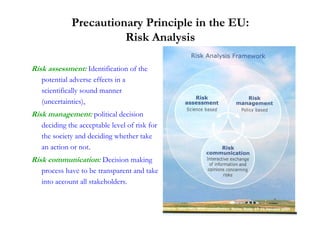
Precautionary Principle in the EU:
                       Risk Analysis

Risk assessment: Identification of the
   potential adverse effects in a
   scientifically sound manner
   (uncertainties),
Risk management: political decision
   deciding the acceptable level of risk for
   the society and deciding whether take
   an action or not.
Risk communication: Decision making
   process have to be transparent and take
   into account all stakeholders.
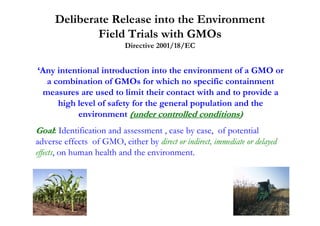
Deliberate Release into the Environment
             Field Trials with GMOs
                           Directive 2001/18/EC


‘Any intentional introduction into the environment of a GMO or
  a combination of GMOs for which no specific containment
 measures are used to limit their contact with and to provide a
     high level of safety for the general population and the
          environment (under controlled conditions)
Goal: Identification and assessment , case by case, of potential
adverse effects of GMO, either by direct or indirect, immediate or delayed
effects, on human health and the environment.
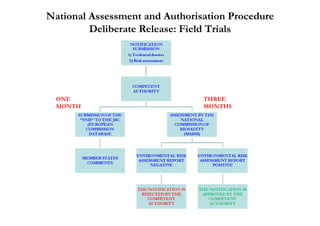
National Assessment and Authorisation Procedure
         Deliberate Release: Field Trials


  ONE                           THREE
  MONTH                         MONTHS
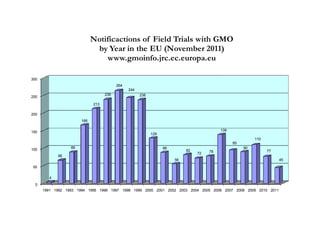
Notificactions of Field Trials with GMO
                              by Year in the EU (November 2011)
                                 www.gmoinfo.jrc.ec.europa.eu

300
                                         264
                                               244
                                   239               238
250

                             213

200
                       166

150                                                                                       139
                                                           129
                                                                                                          110
                                                                                                95
100               89                                             88                                  90
                                                                           82        78                         77
                                                                                72
             66
                                                                      56                                             45
50

         4
  0
      1991 1992 1993 1994 1995 1996 1997 1998 1999 2000 2001 2002 2003 2004 2005 2006 2007 2008 2009 2010 2011
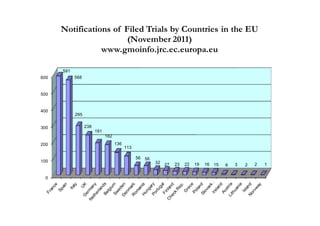
Notifications of Filed Trials by Countries in the EU
                        (November 2011)
                 www.gmoinfo.jrc.ec.europa.eu

      591
600         568


500


400
            295


300               238
                        191
                              182
200                                 136
                                          113

                                                56   56
100                                                       32   27   23   22   19   16   15   6   3   2   2   1


 0
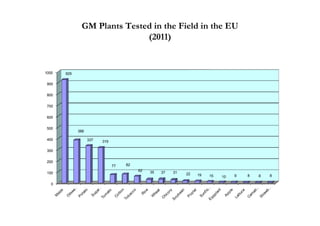
GM Plants Tested in the Field in the EU
                             (2011)


1000   929

 900

 800


 700


 600

 500
             388

 400               337   319

 300

 200
                               77   82
                                         62   35
 100                                               37   31   22   19   15   10   9   8   8   8

   0
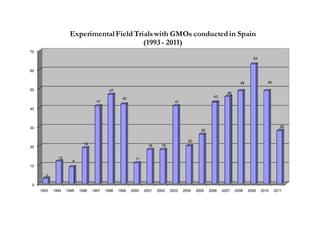
Experimental Field Trials with GMOs conducted in Spain
                                          (1993 - 2011)
70
                                                                                                                       63


60


                                                                                                                49             49
50                                        47
                                                                                                         46
                                                 42                                               43
                                   41                                        41
40


30                                                                                                                                     28
                                                                                           26

                                                                                    20
                            19                                 18     18
20

              12                                        11
                      9
10

       3

 0
     1993   1994   1995   1996   1997   1998   1999   2000   2001   2002   2003   2004   2005   2006   2007   2008   2009   2010    2011
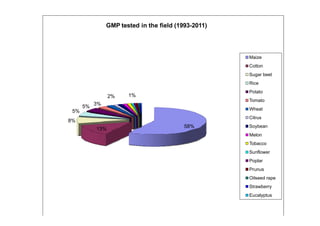
GMP tested in the field (1993-2011)


                                                    Maize
                                                    Cotton
                                                    Sugar beet
                                                    Rice
                                                    Potato
               2%    1%
                                                    Tomato
      5% 3%                                         Wheat
 5%
                                                    Citrus
8%
         13%                             58%        Soybean
                                                    Melon
                                                    Tobacco
                                                    Sunflower
                                                    Poplar
                                                    Prunus
                                                    Oilseed rape
                                                    Strawberry
                                                    Eucalyptus
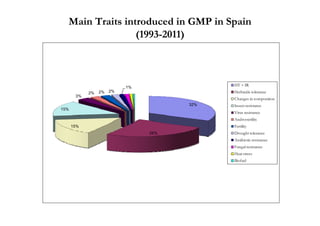
Main Traits introduced in GMP in Spain
                 (1993-2011)


                                            HT + IR
                           1%
            2%   2%   2%                    Herbicide tolerance
       3%
                                            Changes in composition
                                      32%   Insect resistance
15%
                                            Virus resistance
                                            Androsterility
      15%                                   Fertility
                                26%         Drought tolerance
                                            Antibiotic resistance
                                            Fungal resistance
                                            Heat stress
                                            Biofuel
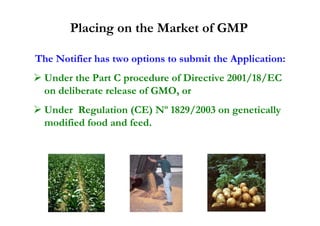
Placing on the Market of GMP

The Notifier has two options to submit the Application:
  Under the Part C procedure of Directive 2001/18/EC
  on deliberate release of GMO, or
  Under Regulation (CE) Nº 1829/2003 on genetically
  modified food and feed.
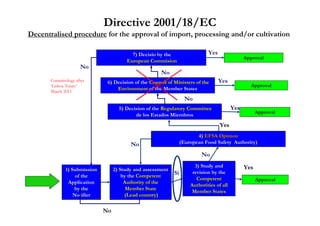
Directive 2001/18/EC
Decentralised procedure for the approval of import, processing and/or cultivation

                                          7) Decisio by the                   Yes
                                                                                                 Approval
                                        European Commision
                      No
                                                       No
       Commitology after       6) Decision of the Counsil of Ministers of the       Yes
       ‘Lisboa Treaty’                                                                             Approval
       March 2011
                                   Environment of the Member States
                                                                    No
                                     5) Decision of the Regulatory Committee               Yes
                                                                                                       Approval
                                            de los Estados Miembros
                                                                                    Yes
                                                                         4) EFSA Opinion
                                          No                      (European Food Safety Authority)

                                                                           No
                                                                        3) Study and             Yes
              1) Submission        2) Study and assessment
                                                             Sí        revision by the
                   of the              by the Competent
                                                                         Competent                     Approval
               Application              Authority of the
                                                                      Authorities of all
                  by the                 Member State
                                                                       Member States
                  Notifier              (Lead country)

                              No
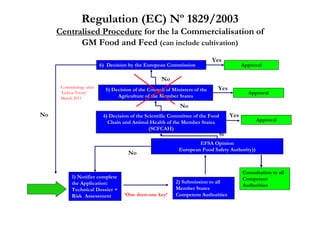
Regulation (EC) Nº 1829/2003
     Centralised Procedure for the la Commercialisation of
           GM Food and Feed (can include cultivation)
                                                                             Yes
                          6) Decision by the European Commission                          Approval

                                                     No
      Commitology after                                                       Yes
                            5) Decision of the Council of Ministers of the
      ‘Lisboa Treaty’                                                                       Approval
      March 2011                 Agriculture of the Member States
                                                             No
No                         4) Decision of the Scientific Committee of the Food      Yes
                             Chain and Animal Health of the Member States                       Approval
                                                (SCFCAH)
                                                                               Sí
                                                                     EFSA Opinion
                                                             European Food Safety Authority))
                                      No


                                                                                          Consultation to all
           1) Notifier complete                                                           Competent
           the Application:                                2) Submission to all
                                                                                          Authorities
           Technical Dossier +                             Member States
           Risk Assessment          ‘One door-one key’     Competent Authorities
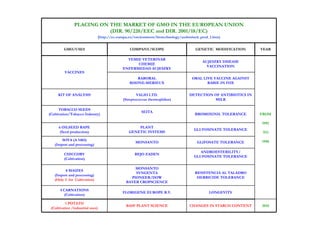
PLACING ON THE MARKET OF GMO IN THE EUROPEAN UNION
                          (DIR. 90/220/EEC and DIR. 2001/18/EC)
                              (http://ec.europa.eu/environment/biotechnology/authorised_prod_1.htm)

         GMO/USES                               COMPANY/SCOPE                        GENETIC MODIFICATION      YEAR

                                              VEMIE VETERINAR
                                                                                         AUJESZKY DISEASE
                                                  CHEMIE
                                                                                           VACCINATION
                                            ENFERMEDAD AUJESZKY
         VACCINES
                                                  RABORAL                          ORAL LIVE VACCINE AGAINST
                                               RHONE-MERIEUX                              RABIE IN FOX


     KIT OF ANÁLYSIS                                VALIO LTD.                   DETECTION OF ANTIBIOTICS IN
                                            (Streptococcus thermophilus)                   MILK

      TOBACCO SEEDS
                                                      SEITA
(Cultivation/Tobacco Industry)                                                      BROMOXINIL TOLERANCE       FROM

                                                                                                               1992
      6 OILSEED RAPE                               PLANT
                                                                                    GLUFOSINATE TOLERANCE
       (Seed production)                       GENETIC SYSTEMS                                                  TO

       SOYA (A 5403)                                                                                           1998
                                                   MONSANTO                           GLIFOSATE TOLERANCE
   (Import and processing)
                                                                                       ANDROESTERILITY/
         CHICCORY                                 BEJO ZADEN
                                                                                    GLUFOSINATE TOLERANCE
         (Cultivation)

                                                  MONSANTO
         8 MAIZES
                                                  SYNGENTA                          RESISTENCIA AL TALADRO
   (Import and processing)
                                                PIONEER/DOW                          HERBICIDE TOLERANCE
   (Only 3 for Cultivation)
                                              BAYER CROPSCIENCE

      4 CARNATIONS
                                            FLORIGENE EUROPE B.V.                           LONGEVITY
        (Cultivation)

          1 POTATO
                                              BASF PLANT SCIENCE                 CHANGES IN STARCH CONTENT     2010
 (Cultivation /industrial uses)
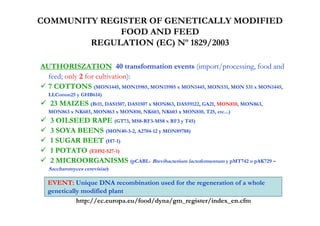
COMMUNITY REGISTER OF GENETICALLY MODIFIED
             FOOD AND FEED
        REGULATION (EC) Nº 1829/2003

AUTHORISZATION 40 transformation events (import/processing, food and
  feed; only 2 for cultivation):
  7 COTTONS (MON1445, MON15985, MON15985 x MON1445, MON531, MON 531 x MON1445,
  LLCotton25 y GHB614)
   23 MAIZES (Bt11, DAS1507, DAS1507 x MON863, DAS59122, GA21, MON810, MON863,
  MON863 x NK603, MON863 x MON810, NK603, NK603 x MON810, T25, etc...)
   3 OILSEED RAPE (GT73, MS8-RF3-MS8 x RF3 y T45)
   3 SOYA BEENS (MON40-3-2, A2704-12 y MON89788)
   1 SUGAR BEET (H7-1)
   1 POTATO (EH92-527-1)
   2 MICROORGANISMS (pCABL- Brevibacterium lactofermentum y pMT742 o pAK729 –
  Saccharomyces cerevisiae)

  EVENT: Unique DNA recombination used for the regeneration of a whole
  genetically modified plant
            http://ec.europa.eu/food/dyna/gm_register/index_en.cfm
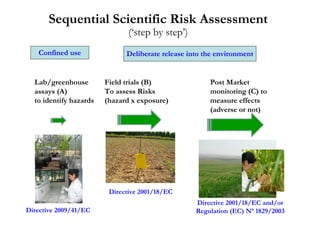
Sequential Scientific Risk Assessment
                               (‘step by step’)
   Confined use               Deliberate release into the environment


  Lab/greenhouse        Field trials (B)               Post Market
  assays (A)            To assess Risks                monitoring (C) to
  to identify hazards   (hazard x exposure)            measure effects
                                                       (adverse or not)


                         Directive 2001/18/EC
                                                   Directive 2001/18/EC and/or
Directive 2009/41/EC                               Regulation (EC) Nº 1829/2003
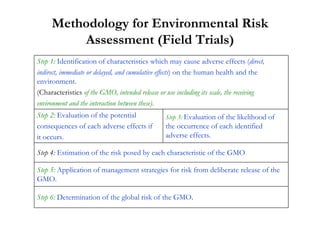
Methodology for Environmental Risk
         Assessment (Field Trials)
Step 1: Identification of characteristics which may cause adverse effects (direct,
indirect, immediate or delayed, and cumulative effects) on the human health and the
environment.
(Characteristics of the GMO, intended release or use including its scale, the receiving
environment and the interaction between these).
Step 2: Evaluation of the potential              Step 3: Evaluation of the likelihood of
consequences of each adverse effects if          the occurrence of each identified
it occurs.                                       adverse effects.

Step 4: Estimation of the risk posed by each characteristic of the GMO

Step 5: Application of management strategies for risk from deliberate release of the
GMO.

Step 6: Determination of the global risk of the GMO.
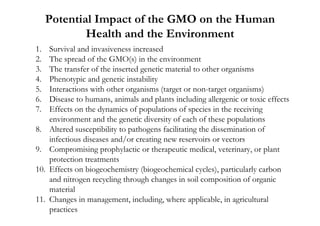
Potential Impact of the GMO on the Human
             Health and the Environment
1.    Survival and invasiveness increased
2.    The spread of the GMO(s) in the environment
3.    The transfer of the inserted genetic material to other organisms
4.    Phenotypic and genetic instability
5.    Interactions with other organisms (target or non-target organisms)
6.    Disease to humans, animals and plants including allergenic or toxic effects
7.    Effects on the dynamics of populations of species in the receiving
      environment and the genetic diversity of each of these populations
8.    Altered susceptibility to pathogens facilitating the dissemination of
      infectious diseases and/or creating new reservoirs or vectors
9.    Compromising prophylactic or therapeutic medical, veterinary, or plant
      protection treatments
10.   Effects on biogeochemistry (biogeochemical cycles), particularly carbon
      and nitrogen recycling through changes in soil composition of organic
      material
11.   Changes in management, including, where applicable, in agricultural
      practices
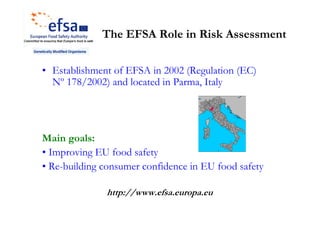
The EFSA Role in Risk Assessment

• Establishment of EFSA in 2002 (Regulation (EC)
  Nº 178/2002) and located in Parma, Italy


Main goals:
• Improving EU food safety
• Re-building consumer confidence in EU food safety

              http://www.efsa.europa.eu
EFSA Tasks and Approach
EFSA’s tasks:
• Deliver sound scientific opinion on food safety to the risk managers
• Ensuring close collaboration between national bodies (National Biosafety
  Committees and Competent Authorities)
• Engage and exchange information with the many different stakeholders
• Risk communication: Providing the right information to consumers,
  government, industrial, NGO and other stakeholders at the right time
EFSA Approach:
• Scientific excellence
• Independence
• Transparency/openness
• Close collaboration with Member States
• Building consumer confidence
EFSA Structure:
• Management Board
• Advisory Forum
• Executive Director and Staff
• Scientific Committee and Panels
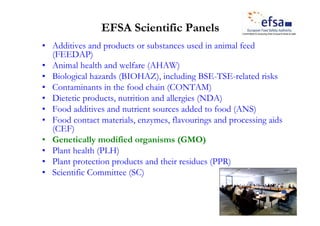
EFSA Scientific Panels
• Additives and products or substances used in animal feed
  (FEEDAP)
• Animal health and welfare (AHAW)
• Biological hazards (BIOHAZ), including BSE-TSE-related risks
• Contaminants in the food chain (CONTAM)
• Dietetic products, nutrition and allergies (NDA)
• Food additives and nutrient sources added to food (ANS)
• Food contact materials, enzymes, flavourings and processing aids
  (CEF)
• Genetically modified organisms (GMO)
• Plant health (PLH)
• Plant protection products and their residues (PPR)
• Scientific Committee (SC)
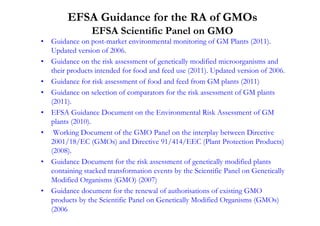
EFSA Guidance for the RA of GMOs
                EFSA Scientific Panel on GMO
• Guidance on post-market environmental monitoring of GM Plants (2011).
  Updated version of 2006.
• Guidance on the risk assessment of genetically modified microorganisms and
  their products intended for food and feed use (2011). Updated version of 2006.
• Guidance for risk assessment of food and feed from GM plants (2011)
• Guidance on selection of comparators for the risk assessment of GM plants
  (2011).
• EFSA Guidance Document on the Environmental Risk Assessment of GM
  plants (2010).
• Working Document of the GMO Panel on the interplay between Directive
  2001/18/EC (GMOs) and Directive 91/414/EEC (Plant Protection Products)
  (2008).
• Guidance Document for the risk assessment of genetically modified plants
  containing stacked transformation events by the Scientific Panel on Genetically
  Modified Organisms (GMO) (2007)
• Guidance document for the renewal of authorisations of existing GMO
  products by the Scientific Panel on Genetically Modified Organisms (GMOs)
  (2006
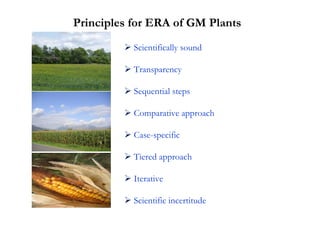
Principles for ERA of GM Plants
           Scientifically sound

           Transparency

           Sequential steps

           Comparative approach

           Case-specific

           Tiered approach

           Iterative

           Scientific incertitude
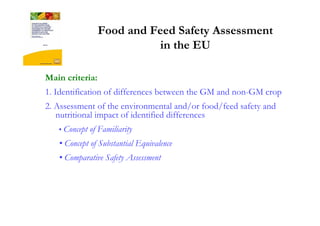
Food and Feed Safety Assessment
                           in the EU

Main criteria:
1. Identification of differences between the GM and non-GM crop
2. Assessment of the environmental and/or food/feed safety and
   nutritional impact of identified differences
   • Concept   of Familiarity
   • Concept of Substantial Equivalence
   • Comparative Safety Assessment
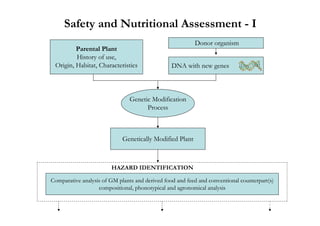
Safety and Nutritional Assessment - I
                                                          Donor organism
         Parental Plant
         History of use,
 Origin, Habitat, Characteristics                DNA with new genes


                                Genetic Modification
                                      Process


                             Genetically Modified Plant


                        HAZARD IDENTIFICATION

Comparative analysis of GM plants and derived food and feed and conventional counterpart(s)
                   compositional, phonotypical and agronomical analysis
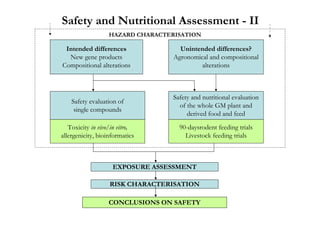
Safety and Nutritional Assessment - II
                   HAZARD CHARACTERISATION

 Intended differences                Unintended differences?
  New gene products                Agronomical and compositional
Compositional alterations                   alterations


                                   Safety and nutritional evaluation
    Safety evaluation of
                                     of the whole GM plant and
     single compounds
                                        derived food and feed
   Toxicity in vivo/in vitro,        90-daysrodent feeding trials
allergenicity, bioinformatics          Livestock feeding trials


                    EXPOSURE ASSESSMENT

                   RISK CHARACTERISATION

                  CONCLUSIONS ON SAFETY
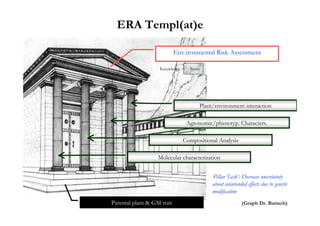
ERA Templ(at)e

                            Env.ironmental Risk Assessment

                    Knowledge =    Stone


                                       Plant/environment interaction

                                  Agronomic/phenotyp. Characters.

                               Compositional Analysis

                   Molecular characterization


                                            ‘PillarTask‘: Decrease uncertainty
                                            about unintended effects due to genetic
                                            modification
Parental plant & GM trait                                  (Graph Dr. Bartsch)
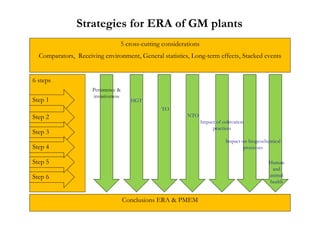
Strategies for ERA of GM plants
                                 5 cross-cutting considerations
  Comparators, Receiving environment, General statistics, Long-term effects, Stacked events


6 steps
                     Persistence &
                     invasiveness
Step 1                                 HGT
                                                TO
Step 2                                                    NTO
                                                                  Impact of cultivation
                                                                       practices
Step 3
                                                                              Impact on biogeochemical
Step 4                                                                                processes

Step 5                                                                                          Human
                                                                                                 and
Step 6                                                                                          animal
                                                                                                health


                                     Conclusions ERA & PMEM                                        34
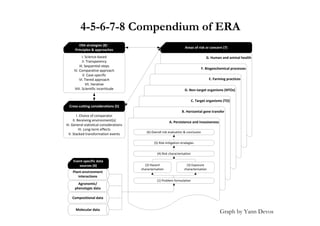
4-5-6-7-8 Compendium of ERA
         ERA strategies (8) ‐
                                                                          Areas of risk or concern (7)
      Principles & approaches
            I. Science‐based                                                               G. Human and animal health
            II. Transparency
         III. Sequential steps
                                                                                         F. Biogeochemical processes
     IV. Comparative approach
            V. Case‐specific
         VI. Tiered approach                                                                 E. Farming practices
               VII. Iterative
      VIII. Scientific incertitude                                        D. Non‐target organisms (NTOs)

                                                                                 C. Target organisms (TO)
  Cross‐cutting considerations (5)
                                                                        B. Horizontal gene transfer
          I. Choice of comparator
      II. Receiving environment(s)                            A. Persistence and invasiveness
III. General statistical considerations
            IV. Long‐term effects
                                              (6) Overall risk evaluation & conclusion
  V. Stacked transformation events

                                                   (5) Risk mitigation strategies


                                                     (4) Risk characterisation

    Event‐specific data
       sources (4)                           (2) Hazard                    (3) Exposure
                                          characterisation               characterisation
    Plant‐environment
       interactions
                                                     (1) Problem formulation
        Agronomic/
      phenotypic data

    Compositional data


      Molecular data
                                                                                                    Graph by Yann Devos
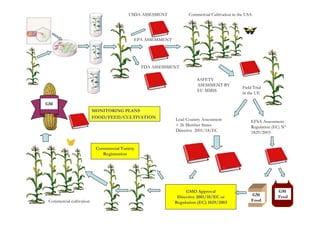
USDA ASSESMENT           Commercial Cultivation in the USA


                                           EPA ASSESSMENT


                                               FDA ASSESSMENT

                                                                      SAFETY
                                                                      ASESSMENT BY
                                                                                              Field Trial
                                                                      EU MMSS
                                                                                              in the UE

GM
                         MONITORING PLANS
                         FOOD/FEED/CULTIVATION              Lead Country Assessment                EFSA Assessment
                                                            + 26 Member States                     Regulation (EC) Nº
                                                            Directive 2001/18/EC                   1829/2003


                          Commercial Variety
                             Registration


                                                                 GMO Approval                                   GM
                                                             Directive 2001/18/EC or               GM           Feed
Commercial cultivation                                      Regulation (EC) 1829/2003              Food
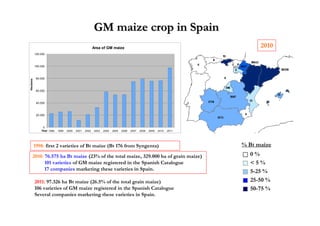
GM maize crop in Spain
                                                       Area of GM maize                                                     2010
           120.000


           100.000


            80.000
Hectares


            60.000


            40.000


            20.000


                0
               Year 1998   1999   2000   2001   2002   2003   2004   2005   2006   2007   2008   2009   2010   2011


           1998: first 2 varieties of Bt maize (Bt 176 from Syngenta)                                                 % Bt maize
      2010: 76.575 ha Bt maize (23% of the total maize, 329.000 ha of grain maize)                                      0%
            101 varieties of GM maize registered in the Spanish Catalogue                                               <5%
            17 companies marketing these varieties in Spain.                                                            5-25 %
           2011: 97.326 ha Bt maize (26.5% of the total grain maize)                                                    25-50 %
           106 varieties of GM maize registered in the Spanish Catalogue                                                50-75 %
           Several companies marketing these varieties in Spain.
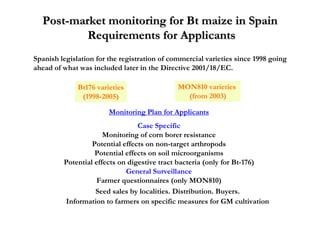
Post-market monitoring for Bt maize in Spain
          Requirements for Applicants
Spanish legislation for the registration of commercial varieties since 1998 going
ahead of what was included later in the Directive 2001/18/EC.

              Bt176 varieties                 MON810 varieties
               (1998-2005)                      (from 2003)

                        Monitoring Plan for Applicants
                                 Case Specific
                      Monitoring of corn borer resistance
                  Potential effects on non-target arthropods
                   Potential effects on soil microorganisms
         Potential effects on digestive tract bacteria (only for Bt-176)
                             General Surveillance
                    Farmer questionnaires (only MON810)
                   Seed sales by localities. Distribution. Buyers.
         Information to farmers on specific measures for GM cultivation
Public Research Studies for Bt-maize.
  Bt-176 (1998-2005) and MON810 (2003-2010)

  Ecology of corn borers in Spain and susceptibility to Bt maize and Bt
  toxin.
  Ecological risk assessment of transgenic maize.
  Assessment of the potential ecological risks of transgenic maize
  Mid and long-term monitoring of the potential ecological risks of insect
  resistant transgenic crops (maize and cotton)
  Centro de Investigaciones Biológicas (CSIC).
  Gene transfer from transgenic maize to the microbial population in the
  planting soil and effects on soil populations.
  Centro Nacional de Biotecnología (CSIC).


MARM (CNB) + public research institutions (CSIC, Universities)
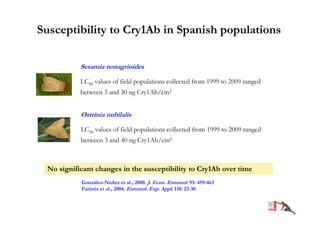
Susceptibility to Cry1Ab in Spanish populations

           Sesamia nonagrioides

           LC50 values of field populations collected from 1999 to 2009 ranged
           between 3 and 30 ng Cry1Ab/cm2


           Ostrinia nubilalis

           LC50 values of field populations collected from 1999 to 2009 ranged
           between 3 and 40 ng Cry1Ab/cm2


 No significant changes in the susceptibility to Cry1Ab over time
           González-Núñez et al., 2000. J. Econ. Entomol. 93: 459-463
           Farinós et al., 2004. Entomol. Exp. Appl. 110: 23-30
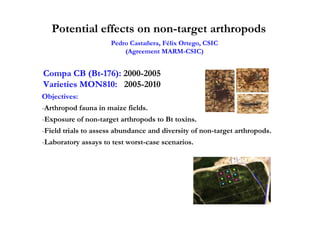
Potential effects on non-target arthropods
                     Pedro Castañera, Félix Ortego, CSIC
                         (Agreement MARM-CSIC)


Compa CB (Bt-176): 2000-2005
Varieties MON810: 2005-2010
Objectives:
-Arthropod fauna in maize fields.
-Exposure of non-target arthropods to Bt toxins.
-Field trials to assess abundance and diversity of non-target arthropods.
-Laboratory assays to test worst-case scenarios.
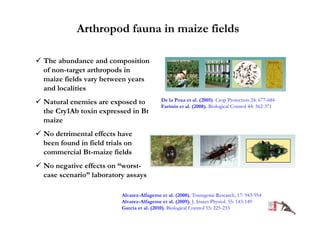
Arthropod fauna in maize fields

The abundance and composition
of non-target arthropods in
maize fields vary between years
and localities
Natural enemies are exposed to             De la Poza et al. (2005) Crop Protection 24: 677-684
                                           Farinós et al. (2008). Biological Control 44: 362-371
the Cry1Ab toxin expressed in Bt
maize
No detrimental effects have
been found in field trials on
commercial Bt-maize fields
No negative effects on “worst-
case scenario” laboratory assays

                         Alvarez-Alfageme et al. (2008). Transgenic Research, 17: 943-954
                         Alvarez-Alfageme et al. (2009). J. Insect Physiol. 55: 143-149
                         García et al. (2010). Biological Control 55: 225-233
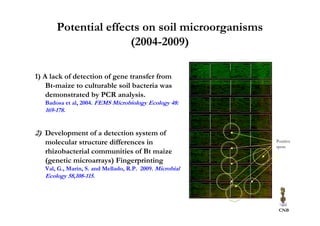
Potential effects on soil microorganisms
                      (2004-2009)

1) A lack of detection of gene transfer from
    Bt-maize to culturable soil bacteria was
    demonstrated by PCR analysis.
   Badosa et al, 2004. FEMS Microbiology Ecology 48:
   169-178.


2) Development of a detection system of
   molecular structure differences in                     Positive
                                                          spots
   rhizobacterial communities of Bt maize
   (genetic microarrays) Fingerprinting
   Val, G., Marín, S. and Mellado, R.P. 2009. Microbial
   Ecology 58,108-115.


                                                           CNB
http://www.marm.es/es/calidad-y-   http://ec.europa.eu/research/biosociety/
evaluacion-                        pdf/a_decade_of_eu-
ambiental/temas/biotecnologia/PL   funded_gmo_research.pdf
AN_DE_SEGUIMIENTO_mar_2
011_tcm7-147305.pdf
New Politics on GMO in the EU
  Conclusions of the Council of December 2008 under the French Presidency
    • The legal framework was comprehensive
    • The need to better implement the existing provisions, notably as concerns cultivation.
    • Need to evaluate the current legislation
    • Need to evaluate the socio-economic impact of GMO
    • EFSA Guidance for the assessment of environmental risks

   New approach of the Commission with regards GMO cultivation

   13 Member States called the Commission to prepare proposals to give freedom to Member
States to decide on cultivation of GMO

   Barroso, in September 2009, indicated that it should be possible to combine an EU
authorisation system, based on science, with freedom for Member States to decide whether or not
they wish to cultivate GM crops in their territory

  In July 2010, the Commission makes a proposal compound by three steps:
    • New Recommendation on coexistence (already published)
    • Legislative amendment: Regulation that amends the Directive 2001/18 that increase
    flexibility to Member States on GMO cultivation in all or part of their territory
    • Revision of all the existing legislation
THANK YOU!

Lucía Roda Ghisleri - Development of GM crops in the EU. Key Issues for the Assessment of GMO by the European Food Safety Authority (EFSA)

  • 1.
    Development of GMcrops in the EU. Key Issues for the Assessment of GMO by the European Food Safety Authority (EFSA) Lucía Roda Ghisleri LRoda@mma.es Dirección General de Calidad y Evaluación Ambiental
  • 2.
    EU Legislation onGMOs in the EU • Directive 2009/41/EC on the contained use of genetically modified microorganisims. • Directive 2001/18/EC on the deliberate release into the environment of genetically modified organisms and repealing. • Regulation (EC) Nº 178/2002 laying down the general principles and requirements of food law, establishing the European Food Safety Authority (EFSA) and laying down procedures in matters of food safety. • Regulation (EC) Nº 1829/2003 on genetically modified food and feed. • Regulation (EC) Nº 1830/2003 concerning the traceability and labelling of genetically modified organisms and the traceability of food and feed products produced from genetically modified organisms • Regulation (EC) Nº 1946/2003 on transboundary movements of genetically modified organisms. • Recommendation (EU) (2010/C 200/01) on guidelines for the development of national co-existence measures to avoid the unintended presence of GMOs in conventional and organic crops.
  • 3.
    Genetically Modified Organism (GMO) ‘Genetically modified organism (GMO) means an organism, with the exception of human beings, in which the genetic material has been altered in a way that does not occur naturally by mating and/or natural recombination’ - Recombinant nucleic acid techniques - Micro-injection, macro-injection and micro-encapsulation - Cell fusion (Artícle 2 of Directive 2001/18/EC)
  • 4.
    Biosafety Food Safety ‘Put in place politics and ‘Protection of life and human measures focused on the beings, of the human health and the health and the animal welfare, the environment environment protection’. and the consumer interests’. Risk Assessment based on Risk Analysis based on available existing scientific data. scientific studies. PRECAUTIONARY PRINCIPLE ‘CASE BY CASE’ ‘STEP BY STEP’ Confined use Experimental trials Commercialisation
  • 5.
    Precautionary Principle inthe EU: Risk Analysis Risk assessment: Identification of the potential adverse effects in a scientifically sound manner (uncertainties), Risk management: political decision deciding the acceptable level of risk for the society and deciding whether take an action or not. Risk communication: Decision making process have to be transparent and take into account all stakeholders.
  • 6.
    Deliberate Release intothe Environment Field Trials with GMOs Directive 2001/18/EC ‘Any intentional introduction into the environment of a GMO or a combination of GMOs for which no specific containment measures are used to limit their contact with and to provide a high level of safety for the general population and the environment (under controlled conditions) Goal: Identification and assessment , case by case, of potential adverse effects of GMO, either by direct or indirect, immediate or delayed effects, on human health and the environment.
  • 7.
    National Assessment andAuthorisation Procedure Deliberate Release: Field Trials ONE THREE MONTH MONTHS
  • 8.
    Notificactions of FieldTrials with GMO by Year in the EU (November 2011) www.gmoinfo.jrc.ec.europa.eu 300 264 244 239 238 250 213 200 166 150 139 129 110 95 100 89 88 90 82 78 77 72 66 56 45 50 4 0 1991 1992 1993 1994 1995 1996 1997 1998 1999 2000 2001 2002 2003 2004 2005 2006 2007 2008 2009 2010 2011
  • 9.
    Notifications of FiledTrials by Countries in the EU (November 2011) www.gmoinfo.jrc.ec.europa.eu 591 600 568 500 400 295 300 238 191 182 200 136 113 56 56 100 32 27 23 22 19 16 15 6 3 2 2 1 0
  • 10.
    GM Plants Testedin the Field in the EU (2011) 1000 929 900 800 700 600 500 388 400 337 319 300 200 77 82 62 35 100 37 31 22 19 15 10 9 8 8 8 0
  • 11.
    Experimental Field Trialswith GMOs conducted in Spain (1993 - 2011) 70 63 60 49 49 50 47 46 42 43 41 41 40 30 28 26 20 19 18 18 20 12 11 9 10 3 0 1993 1994 1995 1996 1997 1998 1999 2000 2001 2002 2003 2004 2005 2006 2007 2008 2009 2010 2011
  • 12.
    GMP tested inthe field (1993-2011) Maize Cotton Sugar beet Rice Potato 2% 1% Tomato 5% 3% Wheat 5% Citrus 8% 13% 58% Soybean Melon Tobacco Sunflower Poplar Prunus Oilseed rape Strawberry Eucalyptus
  • 13.
    Main Traits introducedin GMP in Spain (1993-2011) HT + IR 1% 2% 2% 2% Herbicide tolerance 3% Changes in composition 32% Insect resistance 15% Virus resistance Androsterility 15% Fertility 26% Drought tolerance Antibiotic resistance Fungal resistance Heat stress Biofuel
  • 14.
    Placing on theMarket of GMP The Notifier has two options to submit the Application: Under the Part C procedure of Directive 2001/18/EC on deliberate release of GMO, or Under Regulation (CE) Nº 1829/2003 on genetically modified food and feed.
  • 15.
    Directive 2001/18/EC Decentralised procedurefor the approval of import, processing and/or cultivation 7) Decisio by the Yes Approval European Commision No No Commitology after 6) Decision of the Counsil of Ministers of the Yes ‘Lisboa Treaty’ Approval March 2011 Environment of the Member States No 5) Decision of the Regulatory Committee Yes Approval de los Estados Miembros Yes 4) EFSA Opinion No (European Food Safety Authority) No 3) Study and Yes 1) Submission 2) Study and assessment Sí revision by the of the by the Competent Competent Approval Application Authority of the Authorities of all by the Member State Member States Notifier (Lead country) No
  • 16.
    Regulation (EC) Nº1829/2003 Centralised Procedure for the la Commercialisation of GM Food and Feed (can include cultivation) Yes 6) Decision by the European Commission Approval No Commitology after Yes 5) Decision of the Council of Ministers of the ‘Lisboa Treaty’ Approval March 2011 Agriculture of the Member States No No 4) Decision of the Scientific Committee of the Food Yes Chain and Animal Health of the Member States Approval (SCFCAH) Sí EFSA Opinion European Food Safety Authority)) No Consultation to all 1) Notifier complete Competent the Application: 2) Submission to all Authorities Technical Dossier + Member States Risk Assessment ‘One door-one key’ Competent Authorities
  • 17.
    PLACING ON THEMARKET OF GMO IN THE EUROPEAN UNION (DIR. 90/220/EEC and DIR. 2001/18/EC) (http://ec.europa.eu/environment/biotechnology/authorised_prod_1.htm) GMO/USES COMPANY/SCOPE GENETIC MODIFICATION YEAR VEMIE VETERINAR AUJESZKY DISEASE CHEMIE VACCINATION ENFERMEDAD AUJESZKY VACCINES RABORAL ORAL LIVE VACCINE AGAINST RHONE-MERIEUX RABIE IN FOX KIT OF ANÁLYSIS VALIO LTD. DETECTION OF ANTIBIOTICS IN (Streptococcus thermophilus) MILK TOBACCO SEEDS SEITA (Cultivation/Tobacco Industry) BROMOXINIL TOLERANCE FROM 1992 6 OILSEED RAPE PLANT GLUFOSINATE TOLERANCE (Seed production) GENETIC SYSTEMS TO SOYA (A 5403) 1998 MONSANTO GLIFOSATE TOLERANCE (Import and processing) ANDROESTERILITY/ CHICCORY BEJO ZADEN GLUFOSINATE TOLERANCE (Cultivation) MONSANTO 8 MAIZES SYNGENTA RESISTENCIA AL TALADRO (Import and processing) PIONEER/DOW HERBICIDE TOLERANCE (Only 3 for Cultivation) BAYER CROPSCIENCE 4 CARNATIONS FLORIGENE EUROPE B.V. LONGEVITY (Cultivation) 1 POTATO BASF PLANT SCIENCE CHANGES IN STARCH CONTENT 2010 (Cultivation /industrial uses)
  • 18.
    COMMUNITY REGISTER OFGENETICALLY MODIFIED FOOD AND FEED REGULATION (EC) Nº 1829/2003 AUTHORISZATION 40 transformation events (import/processing, food and feed; only 2 for cultivation): 7 COTTONS (MON1445, MON15985, MON15985 x MON1445, MON531, MON 531 x MON1445, LLCotton25 y GHB614) 23 MAIZES (Bt11, DAS1507, DAS1507 x MON863, DAS59122, GA21, MON810, MON863, MON863 x NK603, MON863 x MON810, NK603, NK603 x MON810, T25, etc...) 3 OILSEED RAPE (GT73, MS8-RF3-MS8 x RF3 y T45) 3 SOYA BEENS (MON40-3-2, A2704-12 y MON89788) 1 SUGAR BEET (H7-1) 1 POTATO (EH92-527-1) 2 MICROORGANISMS (pCABL- Brevibacterium lactofermentum y pMT742 o pAK729 – Saccharomyces cerevisiae) EVENT: Unique DNA recombination used for the regeneration of a whole genetically modified plant http://ec.europa.eu/food/dyna/gm_register/index_en.cfm
  • 22.
    Sequential Scientific RiskAssessment (‘step by step’) Confined use Deliberate release into the environment Lab/greenhouse Field trials (B) Post Market assays (A) To assess Risks monitoring (C) to to identify hazards (hazard x exposure) measure effects (adverse or not) Directive 2001/18/EC Directive 2001/18/EC and/or Directive 2009/41/EC Regulation (EC) Nº 1829/2003
  • 23.
    Methodology for EnvironmentalRisk Assessment (Field Trials) Step 1: Identification of characteristics which may cause adverse effects (direct, indirect, immediate or delayed, and cumulative effects) on the human health and the environment. (Characteristics of the GMO, intended release or use including its scale, the receiving environment and the interaction between these). Step 2: Evaluation of the potential Step 3: Evaluation of the likelihood of consequences of each adverse effects if the occurrence of each identified it occurs. adverse effects. Step 4: Estimation of the risk posed by each characteristic of the GMO Step 5: Application of management strategies for risk from deliberate release of the GMO. Step 6: Determination of the global risk of the GMO.
  • 24.
    Potential Impact ofthe GMO on the Human Health and the Environment 1. Survival and invasiveness increased 2. The spread of the GMO(s) in the environment 3. The transfer of the inserted genetic material to other organisms 4. Phenotypic and genetic instability 5. Interactions with other organisms (target or non-target organisms) 6. Disease to humans, animals and plants including allergenic or toxic effects 7. Effects on the dynamics of populations of species in the receiving environment and the genetic diversity of each of these populations 8. Altered susceptibility to pathogens facilitating the dissemination of infectious diseases and/or creating new reservoirs or vectors 9. Compromising prophylactic or therapeutic medical, veterinary, or plant protection treatments 10. Effects on biogeochemistry (biogeochemical cycles), particularly carbon and nitrogen recycling through changes in soil composition of organic material 11. Changes in management, including, where applicable, in agricultural practices
  • 25.
    The EFSA Rolein Risk Assessment • Establishment of EFSA in 2002 (Regulation (EC) Nº 178/2002) and located in Parma, Italy Main goals: • Improving EU food safety • Re-building consumer confidence in EU food safety http://www.efsa.europa.eu
  • 26.
    EFSA Tasks andApproach EFSA’s tasks: • Deliver sound scientific opinion on food safety to the risk managers • Ensuring close collaboration between national bodies (National Biosafety Committees and Competent Authorities) • Engage and exchange information with the many different stakeholders • Risk communication: Providing the right information to consumers, government, industrial, NGO and other stakeholders at the right time EFSA Approach: • Scientific excellence • Independence • Transparency/openness • Close collaboration with Member States • Building consumer confidence EFSA Structure: • Management Board • Advisory Forum • Executive Director and Staff • Scientific Committee and Panels
  • 27.
    EFSA Scientific Panels •Additives and products or substances used in animal feed (FEEDAP) • Animal health and welfare (AHAW) • Biological hazards (BIOHAZ), including BSE-TSE-related risks • Contaminants in the food chain (CONTAM) • Dietetic products, nutrition and allergies (NDA) • Food additives and nutrient sources added to food (ANS) • Food contact materials, enzymes, flavourings and processing aids (CEF) • Genetically modified organisms (GMO) • Plant health (PLH) • Plant protection products and their residues (PPR) • Scientific Committee (SC)
  • 28.
    EFSA Guidance forthe RA of GMOs EFSA Scientific Panel on GMO • Guidance on post-market environmental monitoring of GM Plants (2011). Updated version of 2006. • Guidance on the risk assessment of genetically modified microorganisms and their products intended for food and feed use (2011). Updated version of 2006. • Guidance for risk assessment of food and feed from GM plants (2011) • Guidance on selection of comparators for the risk assessment of GM plants (2011). • EFSA Guidance Document on the Environmental Risk Assessment of GM plants (2010). • Working Document of the GMO Panel on the interplay between Directive 2001/18/EC (GMOs) and Directive 91/414/EEC (Plant Protection Products) (2008). • Guidance Document for the risk assessment of genetically modified plants containing stacked transformation events by the Scientific Panel on Genetically Modified Organisms (GMO) (2007) • Guidance document for the renewal of authorisations of existing GMO products by the Scientific Panel on Genetically Modified Organisms (GMOs) (2006
  • 29.
    Principles for ERAof GM Plants Scientifically sound Transparency Sequential steps Comparative approach Case-specific Tiered approach Iterative Scientific incertitude
  • 30.
    Food and FeedSafety Assessment in the EU Main criteria: 1. Identification of differences between the GM and non-GM crop 2. Assessment of the environmental and/or food/feed safety and nutritional impact of identified differences • Concept of Familiarity • Concept of Substantial Equivalence • Comparative Safety Assessment
  • 31.
    Safety and NutritionalAssessment - I Donor organism Parental Plant History of use, Origin, Habitat, Characteristics DNA with new genes Genetic Modification Process Genetically Modified Plant HAZARD IDENTIFICATION Comparative analysis of GM plants and derived food and feed and conventional counterpart(s) compositional, phonotypical and agronomical analysis
  • 32.
    Safety and NutritionalAssessment - II HAZARD CHARACTERISATION Intended differences Unintended differences? New gene products Agronomical and compositional Compositional alterations alterations Safety and nutritional evaluation Safety evaluation of of the whole GM plant and single compounds derived food and feed Toxicity in vivo/in vitro, 90-daysrodent feeding trials allergenicity, bioinformatics Livestock feeding trials EXPOSURE ASSESSMENT RISK CHARACTERISATION CONCLUSIONS ON SAFETY
  • 33.
    ERA Templ(at)e Env.ironmental Risk Assessment Knowledge = Stone Plant/environment interaction Agronomic/phenotyp. Characters. Compositional Analysis Molecular characterization ‘PillarTask‘: Decrease uncertainty about unintended effects due to genetic modification Parental plant & GM trait (Graph Dr. Bartsch)
  • 34.
    Strategies for ERAof GM plants 5 cross-cutting considerations Comparators, Receiving environment, General statistics, Long-term effects, Stacked events 6 steps Persistence & invasiveness Step 1 HGT TO Step 2 NTO Impact of cultivation practices Step 3 Impact on biogeochemical Step 4 processes Step 5 Human and Step 6 animal health Conclusions ERA & PMEM 34
  • 35.
    4-5-6-7-8 Compendium ofERA ERA strategies (8) ‐ Areas of risk or concern (7) Principles & approaches I. Science‐based G. Human and animal health II. Transparency III. Sequential steps F. Biogeochemical processes IV. Comparative approach V. Case‐specific VI. Tiered approach E. Farming practices VII. Iterative VIII. Scientific incertitude D. Non‐target organisms (NTOs) C. Target organisms (TO) Cross‐cutting considerations (5) B. Horizontal gene transfer I. Choice of comparator II. Receiving environment(s) A. Persistence and invasiveness III. General statistical considerations IV. Long‐term effects (6) Overall risk evaluation & conclusion V. Stacked transformation events (5) Risk mitigation strategies (4) Risk characterisation Event‐specific data sources (4) (2) Hazard (3) Exposure characterisation characterisation Plant‐environment interactions (1) Problem formulation Agronomic/ phenotypic data Compositional data Molecular data Graph by Yann Devos
  • 36.
    USDA ASSESMENT Commercial Cultivation in the USA EPA ASSESSMENT FDA ASSESSMENT SAFETY ASESSMENT BY Field Trial EU MMSS in the UE GM MONITORING PLANS FOOD/FEED/CULTIVATION Lead Country Assessment EFSA Assessment + 26 Member States Regulation (EC) Nº Directive 2001/18/EC 1829/2003 Commercial Variety Registration GMO Approval GM Directive 2001/18/EC or GM Feed Commercial cultivation Regulation (EC) 1829/2003 Food
  • 37.
    GM maize cropin Spain Area of GM maize 2010 120.000 100.000 80.000 Hectares 60.000 40.000 20.000 0 Year 1998 1999 2000 2001 2002 2003 2004 2005 2006 2007 2008 2009 2010 2011 1998: first 2 varieties of Bt maize (Bt 176 from Syngenta) % Bt maize 2010: 76.575 ha Bt maize (23% of the total maize, 329.000 ha of grain maize) 0% 101 varieties of GM maize registered in the Spanish Catalogue <5% 17 companies marketing these varieties in Spain. 5-25 % 2011: 97.326 ha Bt maize (26.5% of the total grain maize) 25-50 % 106 varieties of GM maize registered in the Spanish Catalogue 50-75 % Several companies marketing these varieties in Spain.
  • 38.
    Post-market monitoring forBt maize in Spain Requirements for Applicants Spanish legislation for the registration of commercial varieties since 1998 going ahead of what was included later in the Directive 2001/18/EC. Bt176 varieties MON810 varieties (1998-2005) (from 2003) Monitoring Plan for Applicants Case Specific Monitoring of corn borer resistance Potential effects on non-target arthropods Potential effects on soil microorganisms Potential effects on digestive tract bacteria (only for Bt-176) General Surveillance Farmer questionnaires (only MON810) Seed sales by localities. Distribution. Buyers. Information to farmers on specific measures for GM cultivation
  • 39.
    Public Research Studiesfor Bt-maize. Bt-176 (1998-2005) and MON810 (2003-2010) Ecology of corn borers in Spain and susceptibility to Bt maize and Bt toxin. Ecological risk assessment of transgenic maize. Assessment of the potential ecological risks of transgenic maize Mid and long-term monitoring of the potential ecological risks of insect resistant transgenic crops (maize and cotton) Centro de Investigaciones Biológicas (CSIC). Gene transfer from transgenic maize to the microbial population in the planting soil and effects on soil populations. Centro Nacional de Biotecnología (CSIC). MARM (CNB) + public research institutions (CSIC, Universities)
  • 40.
    Susceptibility to Cry1Abin Spanish populations Sesamia nonagrioides LC50 values of field populations collected from 1999 to 2009 ranged between 3 and 30 ng Cry1Ab/cm2 Ostrinia nubilalis LC50 values of field populations collected from 1999 to 2009 ranged between 3 and 40 ng Cry1Ab/cm2 No significant changes in the susceptibility to Cry1Ab over time González-Núñez et al., 2000. J. Econ. Entomol. 93: 459-463 Farinós et al., 2004. Entomol. Exp. Appl. 110: 23-30
  • 41.
    Potential effects onnon-target arthropods Pedro Castañera, Félix Ortego, CSIC (Agreement MARM-CSIC) Compa CB (Bt-176): 2000-2005 Varieties MON810: 2005-2010 Objectives: -Arthropod fauna in maize fields. -Exposure of non-target arthropods to Bt toxins. -Field trials to assess abundance and diversity of non-target arthropods. -Laboratory assays to test worst-case scenarios.
  • 42.
    Arthropod fauna inmaize fields The abundance and composition of non-target arthropods in maize fields vary between years and localities Natural enemies are exposed to De la Poza et al. (2005) Crop Protection 24: 677-684 Farinós et al. (2008). Biological Control 44: 362-371 the Cry1Ab toxin expressed in Bt maize No detrimental effects have been found in field trials on commercial Bt-maize fields No negative effects on “worst- case scenario” laboratory assays Alvarez-Alfageme et al. (2008). Transgenic Research, 17: 943-954 Alvarez-Alfageme et al. (2009). J. Insect Physiol. 55: 143-149 García et al. (2010). Biological Control 55: 225-233
  • 43.
    Potential effects onsoil microorganisms (2004-2009) 1) A lack of detection of gene transfer from Bt-maize to culturable soil bacteria was demonstrated by PCR analysis. Badosa et al, 2004. FEMS Microbiology Ecology 48: 169-178. 2) Development of a detection system of molecular structure differences in Positive spots rhizobacterial communities of Bt maize (genetic microarrays) Fingerprinting Val, G., Marín, S. and Mellado, R.P. 2009. Microbial Ecology 58,108-115. CNB
  • 44.
    http://www.marm.es/es/calidad-y- http://ec.europa.eu/research/biosociety/ evaluacion- pdf/a_decade_of_eu- ambiental/temas/biotecnologia/PL funded_gmo_research.pdf AN_DE_SEGUIMIENTO_mar_2 011_tcm7-147305.pdf
  • 45.
    New Politics onGMO in the EU Conclusions of the Council of December 2008 under the French Presidency • The legal framework was comprehensive • The need to better implement the existing provisions, notably as concerns cultivation. • Need to evaluate the current legislation • Need to evaluate the socio-economic impact of GMO • EFSA Guidance for the assessment of environmental risks New approach of the Commission with regards GMO cultivation 13 Member States called the Commission to prepare proposals to give freedom to Member States to decide on cultivation of GMO Barroso, in September 2009, indicated that it should be possible to combine an EU authorisation system, based on science, with freedom for Member States to decide whether or not they wish to cultivate GM crops in their territory In July 2010, the Commission makes a proposal compound by three steps: • New Recommendation on coexistence (already published) • Legislative amendment: Regulation that amends the Directive 2001/18 that increase flexibility to Member States on GMO cultivation in all or part of their territory • Revision of all the existing legislation
  • 46.