AURICULAR
RECONSTRUCTION
Dr. Ridima Sachdeva
Mch Resident
Department of Plastic surgery
• Indications
• Preoperative workup : physical examination ,
investigations , preanaesthetic checkup
• Anaesthesia : GA / LA
• Planning of sequence of operations & counselling
ANATOMY OF EAR
Characterstics of Ear
• Tolleth stated : “ a proper ear requires five characterstics
to have a satisfactory appearance :
1. Posteriorly inclined axis
2. 0.6 : 1 ratio of width to height
3. Three curved lines that outline its shape ( key line )
4. Tragus , antitragus and concha
5. Helix with its root beginning in the concha
History
• Sushruta (6 BC) was the first surgeon who repaired ear
lobe with cheek flap
• Tagliacozzi repaired ear deformities with retroauricular
flap
• Dieffenbach in 1845 repaired middle ear with
advancement flap
• Gillies buried carved costal cartilage under mastoid skin
and elevated it with cervical flap
• Gillies ( 1937) also used maternal ear cartilage for more
than 30 microtic ears which were resorbed.
• Peer in 1948 diced autogenous rib cartilage and placed it
in a vitallium ear mold beneath the abdomen. After 5
months, he retrieved it and used it for ear reconstruction.
• Steffensen in 1955 used preserved cartilage which
resulted in progressive resorption of the grafted cartilage.
• Tanzer is father of modern auricular construction.
• Tanzer in 1959 used rib cartilage for ear reconstruction.
• Brent in 1970 developed four stage ear reconstruction
using rib cartilage
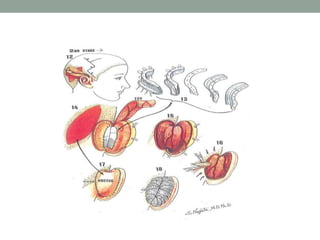
• Nagata in 1990 described two staged method for ear
reconstruction.
ALLOPLASTIC IMPLANTS
• Cronin introduced silicon framework for auricular
reconstruction in 1966
• Reinisch in 1991 used porous polyethylene for ear
reconstruction
Techniques of Ear Reconstruction
• Tanzer technique using autogenous costal cartilage
• Brent technique
• Nagata technique
• Firmin technique
Brent Technique of Ear Reconstruction
Four stages
1. Implanting the cartilage graft
2. Transposition of lobule
3. Ear elevation
4. Tragus creation, conchal excavation & contralateral
otoplasty
Planning & Preparation
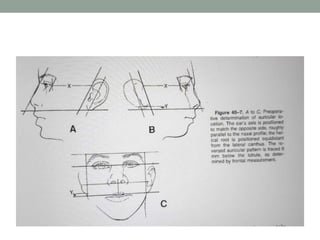
• Preoperative study photographs are obtained
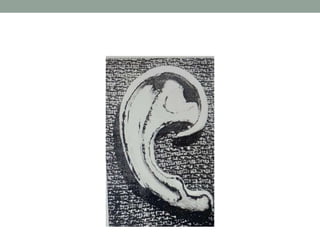
• Xray film pattern is traced from opposite ear
• Duplicate its position at proposed reconstruction site
• Height of vestige from front view is compared with the opposite
normal ear
• Ear axis is roughly parallel to nasal profile
• Distance between the lateral canthus and normal ear’s helical
root is noted
First stage of Reconstruction
• Rib cartilages are obtained from the side contralateral to the
ear being constructed
• Chest incision : Horizontal or oblique incision is made above
the costal cartilage
• External oblique & rectus muscles are divided
• Rib resection is done as per the requirement being determined
by xray film pattern
• Helical rim is fashioned separately with cartilage from first free
floating rib
• Synchondrotic region of sixth & seventh ribs supplies a
sufficient block to carve framework body
• Extraperichondrial dissection is done
Framework Fabrication
• Helical rim & details of antihelical rim is obtained with
scalpel blade and rounded wood carving chisel
• Basic ear silhouette is carved from cartilage
• If thinning is required , care should be taken to preserve
perichondrium on the lateral outer aspect of the
framework to facilitate its adherence.
• Helix is fastened to the framework body with horizontal
mattress sutures ( nylon suture ) with knots buried on the
frame’s undersurface.
Framework Implantation
• Cutaneous pocket is created
• A small incision is made anterior to auricular vestige
• Thin flap is raised ( preserving subdermal plexus)
• Skin is dissected from native cartilage remnant, which is
excised & discarded
• Pocket is completed by dissecting 1 or 2 cm peripherally
to the projected framework markings
• After insertion of cartilage , skin is coapted to framework
by suction drain
• Dressing is done which conforms to the convolutions of
newly constructed auricle.
Postoperative Care
• Patient is frequently assessed for signs of infection or
vascular compromise
• To avoid flattening of helical rim , patient is advised to
sleep on the opposite side
• Patient can return to school three weeks postoperatively
• Running & sports are discouraged for additional three
weeks
Lobule Transposition
• The rotation or repositioning of this normal but displaced
structure is accomplished by Z – plasty.
• The appropriate lobule position will be deepithelized to
receive the transposed earlobe
• The lobule is transposed as an inferiorly based flap.
Auricular Elevation
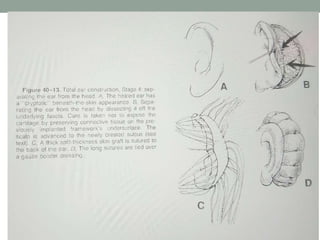
• Posterior auricular margin is defined by separating the ear from
the head & covering its undersurface with thick split thickness
skin graft
• It is done after the edema has subsided & auricular details are
well defined.
• Incision is made several millimeters behind the rim
• Retroauricular skin is advanced into the newly created sulcus
so that only graft is required on the ear undersurface
• Bolster dressing is done
Tragal Construction & Conchal Definition
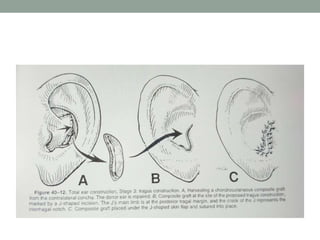
• Harvest the chondrocutaneous composite graft from
contralateral concha
• J- shaped incision is made in the conchal region
• The main limb of J is placed at the posterior tragal margin
& crook of J represents the intertragal notch
• Extra soft tissues are excised beneath tragal flap to
deepen the concha
Managing the Hairline
• Firstly implant the cartilage & later eradicate the hair.
• If hairline covers more than half of newly constructed ear ,
brent considered primary temporal fascial flap to cover the
ear framework
Secondary Reconstruction
• Brent excised the entire auricular scar area & immediately
placed sculpted autogenous rib cartilage graft and
covered it with temporoparietal fascial flap & skin graft.
Criticism
• Number of stages required are more
• Chest wall deformity may occur
• Lack of defination of of conchal bowl, intertragic notch &
contour of antitragus
• No ear projection
• Effacement of post auricular sulcus due to contraction of
skin graft
NAGATA TECHNIQUE
• Two stages :
Fabrication & grafting of 3D costal cartilage
Projection of reconstructed ear
Requirements :
age : 10 years
Chest circumference at xiphoid process – 60 cm
NAGATA METHOD
• INCISION
• Draw imaginary line from xiphoid to inferior margin of
costal cartilage and divide it into three parts
• Draw horizontal line 1/3rd from the top where inferior
margin of 7th costal cartilage lies of size approximately 5
cm
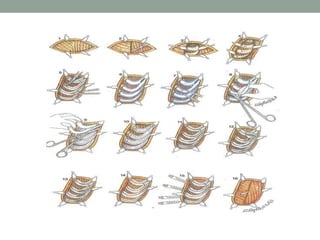
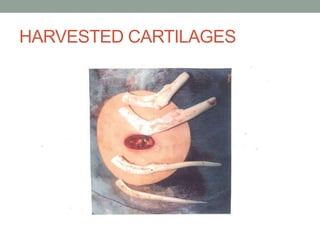
• During 1st stage 6-9th costal cartilage is harvested &
second stage 4th & 5th cartilage is harvested
• Cartilage is harvested en bloc
• Skin & fat incised
• Fascia of external oblique & rectus abdominis exposed
• Incise between two muscles
• Intercostal muscles & perichondrium of 6th – 9th costal
cartilage appear
• Mark centre of perichondrium
• Undermine anterior perichondrium & then posterior
perichondrium
• For 8th – 9th costal cartilage : hold the cartilage & cut
slightly cartilage side of costochondral junction
• For 6th & 7th cartilage is harvested enbloc
• Suture perichondrium with 4-0 nylon at 5mm intervals but
leave central portion open
• From there return remaining cartilages that have been
diced to 2-3 mm blocks using a funnel until perichondrium
is full
• Suture the rest of perichondrium
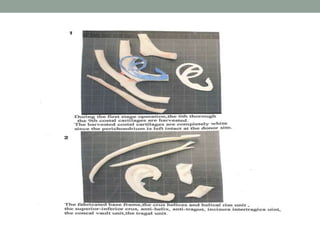
HARVESTED CARTILAGES
Fabrication of 3D Frame
• C : Conchal vault unit fabricated from remaining costal
cartilage after fabrication of base frame units & tragus unit
• B : Base frame from synchondrotic 6th & 7th costal
cartilage
• T : Tragus from largest remaining costal cartilage after
fabrication of base frame units
• H : crus helix from 8th costal cartilage rim
• AH : Antihelix superior & inferior crus from 9th costal
cartilage
Fixation of 3D frame
• Base frame units are fixed with 38 G stainless steel double
armed wire sutures
• Fixation of crus helix & helical rim unit to base frame
• Head of proximal region of crus helix is fixed to posterior
surface of base frame.
• Wire fixations are placed at 3 mm intervals
• Loop portion of wire suture is embedded into cartilage
framework to avoid postoperative complication of wire suture
protrusion
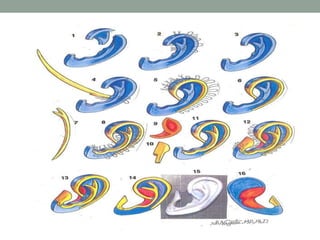
• Fixation of antihelix unit is done starting with superior crus
f/b inferior & antihelix
• Then tragal unit is fixed f/b conchal unit
Lobule type Microtia
• Nagata created deep concha by splitting the lobule into
two flaps creating anterior & posterior flap
• Anterior lobule flap is transposed to cover the anterior
portion of framework
• Posterior flap is transposed anteriorly to cover the
posterior aspect of tragus & concha cavity
Small concha type Microtia
• Skin incision is made along the margin of small
indentation
• The indentation is turned inside out to form an inverted
cone pocket to cover framework
Removing vestige auricular cartilage
• In lobule type , all vestige cartilage is removed because it
will not contribute to framework & it will obstruct the
smooth expansion of skin envelope
• In concha type microtia, remnant conchal cartilage is
preserved as a cuff to facilitate the smooth transition of
concha cavity
Skin pocket dissection
• He created 2 mm thick skin flap using blunt scissors
• Extent of skin pocket dissection is 1 cm beyond the
hairline
• Not to violate trapezium shaped space in front of new
auricle to prevent anterior inclination of newly constructed
auricle
• Bolster sutures are placed in indentations & around the
helical rim of reconstructed ear
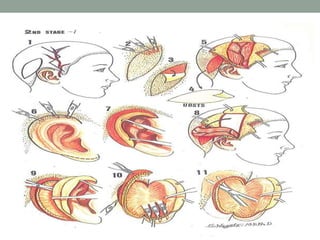
SECOND STAGE
• Raising temporoparietal fascia flap
• Harvesting scalp split thickness skin graft
• Cartilage block for ear elevation
Raising temporoparietal fascia flap
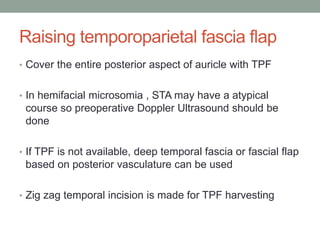
• Cover the entire posterior aspect of auricle with TPF
• In hemifacial microsomia , STA may have a atypical
course so preoperative Doppler Ultrasound should be
done
• If TPF is not available, deep temporal fascia or fascial flap
based on posterior vasculature can be used
• Zig zag temporal incision is made for TPF harvesting
Cartilage Block for Elevation
• Area immediately adjacent to helical rim is elevated to
distance of 4 mm from margin of reconstructed ear
• The skin of temporal & mastoid surface is undermined
• Cartilage block is fixed to soft tissue of posterior surface
of 3 D frame & to temporal & mastoid surfaces with 4-0
nylon
• TPF covers the exposed helix & posterior surface of ear
cartilage block
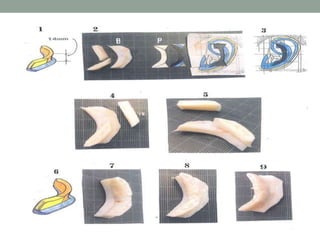
Fabrication of Cartilage
• Crescent shaped costal cartilage is fabricated to support
& project the reconstructed ear
• In bilateral microtia , 4 & 5th costal cartilage is harvested
from same side
• In unilateral microtia, 6 th & 7th from opposite side may be
used
• Two costal cartilages are placed on base frame to
fabricate a costal cartilage block with 14mm thickness
COMPLICATIONS
• Infection
• Pneumothorax
• Postoperative pneumonia
• Suture failure
• Alopecia
Firmin Technique
• Age : 9- 10 yrs
• Two staged :
1st stage : framework placed under skin pocket
2nd stage : ear elevation with additional cartilage for
projection & skin grafted galeal fascial flap
Harvesting of Costal Cartilage
• Ipsilateral side of microtia
• 4-5 cm oblique skin incision is made
• Base of framework : 6th & 7th rib
• Helix : 8th rib
• 9th rib is harvested if more material is required
• Template of normal ear is made on sterile x ray
• Posterior perichondrium is left intact
• No drains are used
• Piece of cartilage is placed under thoracic skin for second
stage reconstruction of concha
Sculpture of Framework
• Base is carved first
• Deepening the area of scapha and triangular fossa
• Different pieces are added to reproduce 3 D architecture
• Antihelix / helix / tragus- antitragus complex is fixed to
base frame with 5-0 stainless steel wire
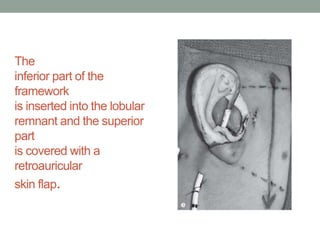
• Inferior part of framework is inserted into lobular remnant
& superior part into retroauricular skin flap
Harvestingautologousribcartilage.
aThreeorfoursegmentsofribcartilage
(6thto
9th)areharvestedonthesideipsilateral
tothe
microtia,leavingtheposterior
perichondrium
intact.bThecartilageisturnedoverand
the
differentpiecesneededtoconstructthe
framework
aredrawnusingthetemplatebased
upon
thecontralateralear,selectingthebest
construction
possible.Thedifferentpieceswillbe
fixedonthebase,whichistypically
drawnon2
adjacentribs,overasynchondrosis.
The differentsteps of construction ofa completeframework. a The 2 extremitiesof the framework
are deepened.b The scaphaand triangularfossaare carved. c The piecereproducingthe anthelix
isfixed to the baseusingwire sutures.d The piecereproducing thehelixisalsofixed to the base.
e AV-shapedpieceisadded. f The new pieceiscarvedto reproducethe tragus and antitragus.
The
inferior part of the
framework
is inserted into the lobular
remnant and the superior
part
is covered with a
retroauricular
skin flap.
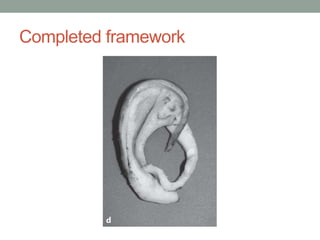
Types of Framework
• Type 1 : complete framework
• Type 2 : No tragus
• Type 3 : No antitragus or tragus
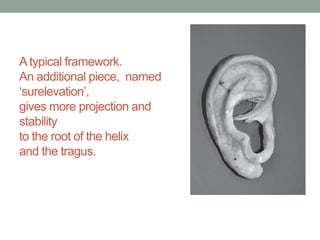
Surelevation : described as adding additional piece of
cartilage behind root of helix & tragus to accentuate
contour & more projection
Completed framework
Type 2 framework without tragus
Type 3 framework
Atypical framework.
An additional piece, named
‘surelevation’,
gives more projection and
stability
to the root of the helix
and the tragus.
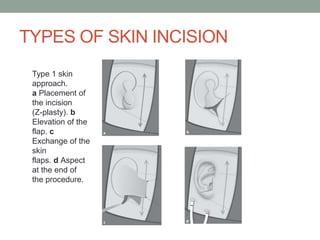
TYPES OF SKIN INCISION
Type 1 skin
approach.
a Placement of
the incision
(Z-plasty). b
Elevation of the
flap. c
Exchange of the
skin
flaps. d Aspect
at the end of
the procedure.
• Type 1 : z plasty in which one of the flap incorporates the
lobule
• Type 2 : transverse transfixion incision ( transfixes skin &
fibrocartilage horizontally splitting the remnant into two parts )
• Type 3a : vertical cutaneous incision; accessing the
fibrocartilage through direct incision & replacing it with
framework
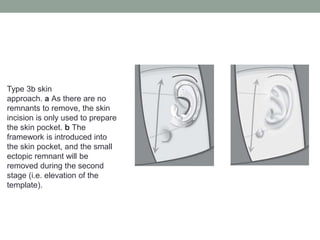
• Type 3 b : there is not enough skin to include part of framework
into the remnants . The entire framework is buried & elevated
in second stage.
Type 2 skin
approach.
a Transfixion
incision of the
remnants. b
Adhesion of the
posterior edge of
the transfixion
incision to the
inferior
edge of the back
cut. c The
inferior part of the
framework
is introduced into
the lobule. d
The superior part
of the framework
is covered with a
retroauricular
skin flap.
Type 3a skin
approach (can only be performed
in 1 stage). a The skin
incision gives access to the
deformed fibrocartilage. b
Through removal of the
fibrocartilage,
a skin pocket has
been created to receive the
framework. c The framework is
introduced into the skin
pocket, replacing the
deformed fibrocartilage. d The
anterior and posterior surfaces
of the framework are covered
with skin.
Type 3b skin
approach. a As there are no
remnants to remove, the skin
incision is only used to prepare
the skin pocket. b The
framework is introduced into
the skin pocket, and the small
ectopic remnant will be
removed during the second
stage (i.e. elevation of the
template).
Estimation of the ideal location of
the reconstructed ear. a In a
frontal view, the position of
the lobule is compared to the
normal side. b Landmarks drawn
on the normal side are: a line
parallel
to the axis of the nose and
another one parallel to the axis of
the ear. The angle made by these
2 lines
is measured. Distances between
the external canthus and root of
the helix (a–a) and the corner of
the mouth and lobule (b–b) are
also measured. c. All these
landmarks are transferred onto
the
abnormal side to determine the
ideal location of the future ear.
Second Stage
• Timing : after 6 months
• Entire posterior surface of framework is exposed
• The piece of cartilage stored under thoracic skin during
first stage is prepared
• The curvature of the cartilage is as of antihelix.
• Fixation to the posterior surface of the base behind the
antihelix must be solid to avoid secondary displacement.
•
• A temporal fascial flap will cover the posterior surface of
the framework as well as the reconstructed posterior wall
of the concha.
• To avoid the presence of hair behind the superior part of
the reconstructed ear, they fix the non hair-bearing skin to
the depth of the sulcus that generally reaches the mid
level of the retroauricular sulcus.
• The remaining raw area of the mastoid is covered by a
separate split-thickness skin graft harvested from the
nearby scalp, and a second skin graft covers the temporal
fascia
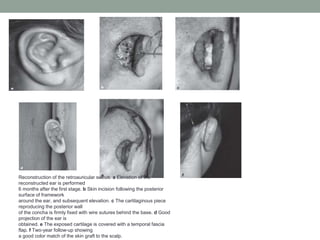
Reconstruction of the retroauricular sulcus. a Elevation of the
reconstructed ear is performed
6 months after the first stage. b Skin incision following the posterior
surface of framework
around the ear, and subsequent elevation. c The cartilaginous piece
reproducing the posterior wall
of the concha is firmly fixed with wire sutures behind the base. d Good
projection of the ear is
obtained. e The exposed cartilage is covered with a temporal fascia
flap. f Two-year follow-up showing
a good color match of the skin graft to the scalp.
Thank you

Auricular reconstruction

  • 1.
    AURICULAR RECONSTRUCTION Dr. Ridima Sachdeva MchResident Department of Plastic surgery
  • 2.
    • Indications • Preoperativeworkup : physical examination , investigations , preanaesthetic checkup • Anaesthesia : GA / LA • Planning of sequence of operations & counselling
  • 3.
  • 4.
    Characterstics of Ear •Tolleth stated : “ a proper ear requires five characterstics to have a satisfactory appearance : 1. Posteriorly inclined axis 2. 0.6 : 1 ratio of width to height 3. Three curved lines that outline its shape ( key line ) 4. Tragus , antitragus and concha 5. Helix with its root beginning in the concha
  • 6.
    History • Sushruta (6BC) was the first surgeon who repaired ear lobe with cheek flap • Tagliacozzi repaired ear deformities with retroauricular flap • Dieffenbach in 1845 repaired middle ear with advancement flap • Gillies buried carved costal cartilage under mastoid skin and elevated it with cervical flap
  • 7.
    • Gillies (1937) also used maternal ear cartilage for more than 30 microtic ears which were resorbed. • Peer in 1948 diced autogenous rib cartilage and placed it in a vitallium ear mold beneath the abdomen. After 5 months, he retrieved it and used it for ear reconstruction. • Steffensen in 1955 used preserved cartilage which resulted in progressive resorption of the grafted cartilage. • Tanzer is father of modern auricular construction.
  • 8.
    • Tanzer in1959 used rib cartilage for ear reconstruction. • Brent in 1970 developed four stage ear reconstruction using rib cartilage • Nagata in 1990 described two staged method for ear reconstruction.
  • 9.
    ALLOPLASTIC IMPLANTS • Croninintroduced silicon framework for auricular reconstruction in 1966 • Reinisch in 1991 used porous polyethylene for ear reconstruction
  • 10.
    Techniques of EarReconstruction • Tanzer technique using autogenous costal cartilage • Brent technique • Nagata technique • Firmin technique
  • 12.
    Brent Technique ofEar Reconstruction Four stages 1. Implanting the cartilage graft 2. Transposition of lobule 3. Ear elevation 4. Tragus creation, conchal excavation & contralateral otoplasty
  • 13.
    Planning & Preparation •Preoperative study photographs are obtained • Xray film pattern is traced from opposite ear • Duplicate its position at proposed reconstruction site • Height of vestige from front view is compared with the opposite normal ear • Ear axis is roughly parallel to nasal profile • Distance between the lateral canthus and normal ear’s helical root is noted
  • 15.
    First stage ofReconstruction • Rib cartilages are obtained from the side contralateral to the ear being constructed • Chest incision : Horizontal or oblique incision is made above the costal cartilage • External oblique & rectus muscles are divided • Rib resection is done as per the requirement being determined by xray film pattern • Helical rim is fashioned separately with cartilage from first free floating rib
  • 16.
    • Synchondrotic regionof sixth & seventh ribs supplies a sufficient block to carve framework body • Extraperichondrial dissection is done
  • 17.
    Framework Fabrication • Helicalrim & details of antihelical rim is obtained with scalpel blade and rounded wood carving chisel • Basic ear silhouette is carved from cartilage • If thinning is required , care should be taken to preserve perichondrium on the lateral outer aspect of the framework to facilitate its adherence. • Helix is fastened to the framework body with horizontal mattress sutures ( nylon suture ) with knots buried on the frame’s undersurface.
  • 19.
    Framework Implantation • Cutaneouspocket is created • A small incision is made anterior to auricular vestige • Thin flap is raised ( preserving subdermal plexus) • Skin is dissected from native cartilage remnant, which is excised & discarded • Pocket is completed by dissecting 1 or 2 cm peripherally to the projected framework markings
  • 21.
    • After insertionof cartilage , skin is coapted to framework by suction drain • Dressing is done which conforms to the convolutions of newly constructed auricle.
  • 22.
    Postoperative Care • Patientis frequently assessed for signs of infection or vascular compromise • To avoid flattening of helical rim , patient is advised to sleep on the opposite side • Patient can return to school three weeks postoperatively • Running & sports are discouraged for additional three weeks
  • 23.
    Lobule Transposition • Therotation or repositioning of this normal but displaced structure is accomplished by Z – plasty. • The appropriate lobule position will be deepithelized to receive the transposed earlobe • The lobule is transposed as an inferiorly based flap.
  • 25.
    Auricular Elevation • Posteriorauricular margin is defined by separating the ear from the head & covering its undersurface with thick split thickness skin graft • It is done after the edema has subsided & auricular details are well defined. • Incision is made several millimeters behind the rim • Retroauricular skin is advanced into the newly created sulcus so that only graft is required on the ear undersurface • Bolster dressing is done
  • 27.
    Tragal Construction &Conchal Definition • Harvest the chondrocutaneous composite graft from contralateral concha • J- shaped incision is made in the conchal region • The main limb of J is placed at the posterior tragal margin & crook of J represents the intertragal notch • Extra soft tissues are excised beneath tragal flap to deepen the concha
  • 29.
    Managing the Hairline •Firstly implant the cartilage & later eradicate the hair. • If hairline covers more than half of newly constructed ear , brent considered primary temporal fascial flap to cover the ear framework
  • 30.
    Secondary Reconstruction • Brentexcised the entire auricular scar area & immediately placed sculpted autogenous rib cartilage graft and covered it with temporoparietal fascial flap & skin graft.
  • 31.
    Criticism • Number ofstages required are more • Chest wall deformity may occur • Lack of defination of of conchal bowl, intertragic notch & contour of antitragus • No ear projection • Effacement of post auricular sulcus due to contraction of skin graft
  • 32.
    NAGATA TECHNIQUE • Twostages : Fabrication & grafting of 3D costal cartilage Projection of reconstructed ear Requirements : age : 10 years Chest circumference at xiphoid process – 60 cm
  • 33.
  • 34.
    • Draw imaginaryline from xiphoid to inferior margin of costal cartilage and divide it into three parts • Draw horizontal line 1/3rd from the top where inferior margin of 7th costal cartilage lies of size approximately 5 cm • During 1st stage 6-9th costal cartilage is harvested & second stage 4th & 5th cartilage is harvested • Cartilage is harvested en bloc
  • 35.
    • Skin &fat incised • Fascia of external oblique & rectus abdominis exposed • Incise between two muscles • Intercostal muscles & perichondrium of 6th – 9th costal cartilage appear • Mark centre of perichondrium • Undermine anterior perichondrium & then posterior perichondrium • For 8th – 9th costal cartilage : hold the cartilage & cut slightly cartilage side of costochondral junction • For 6th & 7th cartilage is harvested enbloc
  • 36.
    • Suture perichondriumwith 4-0 nylon at 5mm intervals but leave central portion open • From there return remaining cartilages that have been diced to 2-3 mm blocks using a funnel until perichondrium is full • Suture the rest of perichondrium
  • 38.
  • 39.
  • 40.
    • C :Conchal vault unit fabricated from remaining costal cartilage after fabrication of base frame units & tragus unit • B : Base frame from synchondrotic 6th & 7th costal cartilage • T : Tragus from largest remaining costal cartilage after fabrication of base frame units • H : crus helix from 8th costal cartilage rim • AH : Antihelix superior & inferior crus from 9th costal cartilage
  • 41.
    Fixation of 3Dframe • Base frame units are fixed with 38 G stainless steel double armed wire sutures • Fixation of crus helix & helical rim unit to base frame • Head of proximal region of crus helix is fixed to posterior surface of base frame. • Wire fixations are placed at 3 mm intervals • Loop portion of wire suture is embedded into cartilage framework to avoid postoperative complication of wire suture protrusion
  • 42.
    • Fixation ofantihelix unit is done starting with superior crus f/b inferior & antihelix • Then tragal unit is fixed f/b conchal unit
  • 47.
    Lobule type Microtia •Nagata created deep concha by splitting the lobule into two flaps creating anterior & posterior flap • Anterior lobule flap is transposed to cover the anterior portion of framework • Posterior flap is transposed anteriorly to cover the posterior aspect of tragus & concha cavity
  • 50.
    Small concha typeMicrotia • Skin incision is made along the margin of small indentation • The indentation is turned inside out to form an inverted cone pocket to cover framework
  • 52.
    Removing vestige auricularcartilage • In lobule type , all vestige cartilage is removed because it will not contribute to framework & it will obstruct the smooth expansion of skin envelope • In concha type microtia, remnant conchal cartilage is preserved as a cuff to facilitate the smooth transition of concha cavity
  • 53.
    Skin pocket dissection •He created 2 mm thick skin flap using blunt scissors • Extent of skin pocket dissection is 1 cm beyond the hairline • Not to violate trapezium shaped space in front of new auricle to prevent anterior inclination of newly constructed auricle • Bolster sutures are placed in indentations & around the helical rim of reconstructed ear
  • 54.
    SECOND STAGE • Raisingtemporoparietal fascia flap • Harvesting scalp split thickness skin graft • Cartilage block for ear elevation
  • 56.
    Raising temporoparietal fasciaflap • Cover the entire posterior aspect of auricle with TPF • In hemifacial microsomia , STA may have a atypical course so preoperative Doppler Ultrasound should be done • If TPF is not available, deep temporal fascia or fascial flap based on posterior vasculature can be used • Zig zag temporal incision is made for TPF harvesting
  • 58.
    Cartilage Block forElevation • Area immediately adjacent to helical rim is elevated to distance of 4 mm from margin of reconstructed ear • The skin of temporal & mastoid surface is undermined • Cartilage block is fixed to soft tissue of posterior surface of 3 D frame & to temporal & mastoid surfaces with 4-0 nylon • TPF covers the exposed helix & posterior surface of ear cartilage block
  • 59.
    Fabrication of Cartilage •Crescent shaped costal cartilage is fabricated to support & project the reconstructed ear • In bilateral microtia , 4 & 5th costal cartilage is harvested from same side • In unilateral microtia, 6 th & 7th from opposite side may be used • Two costal cartilages are placed on base frame to fabricate a costal cartilage block with 14mm thickness
  • 61.
    COMPLICATIONS • Infection • Pneumothorax •Postoperative pneumonia • Suture failure • Alopecia
  • 62.
    Firmin Technique • Age: 9- 10 yrs • Two staged : 1st stage : framework placed under skin pocket 2nd stage : ear elevation with additional cartilage for projection & skin grafted galeal fascial flap
  • 63.
    Harvesting of CostalCartilage • Ipsilateral side of microtia • 4-5 cm oblique skin incision is made • Base of framework : 6th & 7th rib • Helix : 8th rib • 9th rib is harvested if more material is required
  • 64.
    • Template ofnormal ear is made on sterile x ray • Posterior perichondrium is left intact • No drains are used • Piece of cartilage is placed under thoracic skin for second stage reconstruction of concha
  • 65.
    Sculpture of Framework •Base is carved first • Deepening the area of scapha and triangular fossa • Different pieces are added to reproduce 3 D architecture • Antihelix / helix / tragus- antitragus complex is fixed to base frame with 5-0 stainless steel wire • Inferior part of framework is inserted into lobular remnant & superior part into retroauricular skin flap
  • 66.
  • 67.
    The differentsteps ofconstruction ofa completeframework. a The 2 extremitiesof the framework are deepened.b The scaphaand triangularfossaare carved. c The piecereproducingthe anthelix isfixed to the baseusingwire sutures.d The piecereproducing thehelixisalsofixed to the base. e AV-shapedpieceisadded. f The new pieceiscarvedto reproducethe tragus and antitragus.
  • 68.
    The inferior part ofthe framework is inserted into the lobular remnant and the superior part is covered with a retroauricular skin flap.
  • 69.
    Types of Framework •Type 1 : complete framework • Type 2 : No tragus • Type 3 : No antitragus or tragus Surelevation : described as adding additional piece of cartilage behind root of helix & tragus to accentuate contour & more projection
  • 70.
  • 71.
    Type 2 frameworkwithout tragus
  • 72.
  • 73.
    Atypical framework. An additionalpiece, named ‘surelevation’, gives more projection and stability to the root of the helix and the tragus.
  • 74.
    TYPES OF SKININCISION Type 1 skin approach. a Placement of the incision (Z-plasty). b Elevation of the flap. c Exchange of the skin flaps. d Aspect at the end of the procedure.
  • 75.
    • Type 1: z plasty in which one of the flap incorporates the lobule • Type 2 : transverse transfixion incision ( transfixes skin & fibrocartilage horizontally splitting the remnant into two parts ) • Type 3a : vertical cutaneous incision; accessing the fibrocartilage through direct incision & replacing it with framework • Type 3 b : there is not enough skin to include part of framework into the remnants . The entire framework is buried & elevated in second stage.
  • 76.
    Type 2 skin approach. aTransfixion incision of the remnants. b Adhesion of the posterior edge of the transfixion incision to the inferior edge of the back cut. c The inferior part of the framework is introduced into the lobule. d The superior part of the framework is covered with a retroauricular skin flap.
  • 77.
    Type 3a skin approach(can only be performed in 1 stage). a The skin incision gives access to the deformed fibrocartilage. b Through removal of the fibrocartilage, a skin pocket has been created to receive the framework. c The framework is introduced into the skin pocket, replacing the deformed fibrocartilage. d The anterior and posterior surfaces of the framework are covered with skin.
  • 78.
    Type 3b skin approach.a As there are no remnants to remove, the skin incision is only used to prepare the skin pocket. b The framework is introduced into the skin pocket, and the small ectopic remnant will be removed during the second stage (i.e. elevation of the template).
  • 79.
    Estimation of theideal location of the reconstructed ear. a In a frontal view, the position of the lobule is compared to the normal side. b Landmarks drawn on the normal side are: a line parallel to the axis of the nose and another one parallel to the axis of the ear. The angle made by these 2 lines is measured. Distances between the external canthus and root of the helix (a–a) and the corner of the mouth and lobule (b–b) are also measured. c. All these landmarks are transferred onto the abnormal side to determine the ideal location of the future ear.
  • 80.
    Second Stage • Timing: after 6 months • Entire posterior surface of framework is exposed • The piece of cartilage stored under thoracic skin during first stage is prepared • The curvature of the cartilage is as of antihelix.
  • 81.
    • Fixation tothe posterior surface of the base behind the antihelix must be solid to avoid secondary displacement. • • A temporal fascial flap will cover the posterior surface of the framework as well as the reconstructed posterior wall of the concha.
  • 82.
    • To avoidthe presence of hair behind the superior part of the reconstructed ear, they fix the non hair-bearing skin to the depth of the sulcus that generally reaches the mid level of the retroauricular sulcus. • The remaining raw area of the mastoid is covered by a separate split-thickness skin graft harvested from the nearby scalp, and a second skin graft covers the temporal fascia
  • 83.
    Reconstruction of theretroauricular sulcus. a Elevation of the reconstructed ear is performed 6 months after the first stage. b Skin incision following the posterior surface of framework around the ear, and subsequent elevation. c The cartilaginous piece reproducing the posterior wall of the concha is firmly fixed with wire sutures behind the base. d Good projection of the ear is obtained. e The exposed cartilage is covered with a temporal fascia flap. f Two-year follow-up showing a good color match of the skin graft to the scalp.
  • 84.