Augmented
Reality
KRISHNASAMY COLLEGE OF ENGINEERING &
TECHNOLOGY
DEPARTMENT OF ELECTRONICS AND
COMMUNICTAION ENGINEERING
PRESENTED BY
R.RAGHUL RAJ ECE..,
A.GUNASEELAN ECE..,
INTRODUCTION
Augmented reality (AR) is a technology that superimposes digital information onto
the real world, creating a hybrid environment where digital and physical elements
coexist. AR has been around for decades, but recent advancements in hardware
and software have made it more accessible and powerful than ever before.
AR in Healthcare: A
Revolution in Patient Care
AR has the potential to
revolutionize healthcare by
enabling doctors and nurses to
visualize and manipulate
medical data in real time, right
in front of the patient. With AR,
medical professionals can
overlay digital images onto the
patient's body, providing a more
accurate and detailed view of
the problem at hand.
AR in Entertainment : A New
Era of Immersive
Experiences
AR has already started to
transform the entertainment
industry, as it allows users to
experience digital content in a
more immersive and interactive
way. AR games, for example, can
overlay digital characters and
objects onto the real world,
creating a new kind of gameplay
that blends virtual and physical
elements.
The Future of AR: From
Headsets to Contact Lenses
AR is still in its early stages, but
experts predict that it will
become an increasingly
important part of our lives in
the coming years. As hardware
and software continue to
improve, AR devices will
become smaller, lighter, and
more powerful, allowing us to
access digital information
seamlessly and effortlessly.
1
2
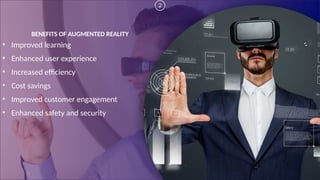
BENEFITS OF AUGMENTED REALITY
• Improved learning
• Enhanced user experience
• Increased efficiency
• Cost savings
• Improved customer engagement
• Enhanced safety and security
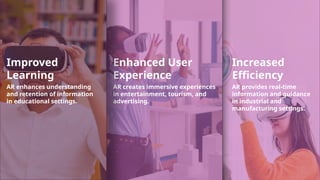
Increased
Efficiency
AR provides real-time
information and guidance
in industrial and
manufacturing settings.
Enhanced User
Experience
AR creates immersive experiences
in entertainment, tourism, and
advertising.
Improved
Learning
AR enhances understanding
and retention of information
in educational settings.
3
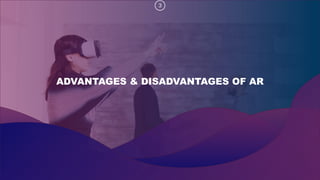
ADVANTAGES & DISADVANTAGES OF AR
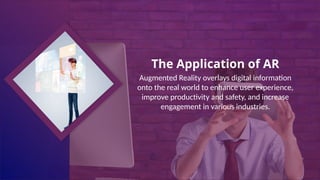
The Application of AR
Augmented Reality overlays digital information
onto the real world to enhance user experience,
improve productivity and safety, and increase
engagement in various industries.
4
CONCLUSION
Augmented Reality is a rapidly growing
technology that has the potential to
revolutionize various industries. Its ability to
overlay digital information onto the real world
can enhance user experience, improve
productivity and safety, and increase
engagement. However, ethical and privacy
concerns must be addressed, and further
research and development are needed to fully
realize its potential.
QUERIES

Augmented reality 3.pptx jiigjgxfxkxkifx

  • 1.
    Augmented Reality KRISHNASAMY COLLEGE OFENGINEERING & TECHNOLOGY DEPARTMENT OF ELECTRONICS AND COMMUNICTAION ENGINEERING PRESENTED BY R.RAGHUL RAJ ECE.., A.GUNASEELAN ECE..,
  • 2.
    INTRODUCTION Augmented reality (AR)is a technology that superimposes digital information onto the real world, creating a hybrid environment where digital and physical elements coexist. AR has been around for decades, but recent advancements in hardware and software have made it more accessible and powerful than ever before. AR in Healthcare: A Revolution in Patient Care AR has the potential to revolutionize healthcare by enabling doctors and nurses to visualize and manipulate medical data in real time, right in front of the patient. With AR, medical professionals can overlay digital images onto the patient's body, providing a more accurate and detailed view of the problem at hand. AR in Entertainment : A New Era of Immersive Experiences AR has already started to transform the entertainment industry, as it allows users to experience digital content in a more immersive and interactive way. AR games, for example, can overlay digital characters and objects onto the real world, creating a new kind of gameplay that blends virtual and physical elements. The Future of AR: From Headsets to Contact Lenses AR is still in its early stages, but experts predict that it will become an increasingly important part of our lives in the coming years. As hardware and software continue to improve, AR devices will become smaller, lighter, and more powerful, allowing us to access digital information seamlessly and effortlessly. 1
  • 3.
    2 BENEFITS OF AUGMENTEDREALITY • Improved learning • Enhanced user experience • Increased efficiency • Cost savings • Improved customer engagement • Enhanced safety and security
  • 4.
    Increased Efficiency AR provides real-time informationand guidance in industrial and manufacturing settings. Enhanced User Experience AR creates immersive experiences in entertainment, tourism, and advertising. Improved Learning AR enhances understanding and retention of information in educational settings.
  • 5.
  • 6.
    The Application ofAR Augmented Reality overlays digital information onto the real world to enhance user experience, improve productivity and safety, and increase engagement in various industries.
  • 7.
    4 CONCLUSION Augmented Reality isa rapidly growing technology that has the potential to revolutionize various industries. Its ability to overlay digital information onto the real world can enhance user experience, improve productivity and safety, and increase engagement. However, ethical and privacy concerns must be addressed, and further research and development are needed to fully realize its potential.
  • 8.