

SteelCentral Performance Management
The Need for Unified
Performance Management
Across all applications, networks, infrastructure & end users
Table of Contents
The Need for Unified Performance Management
Addressing the Performance Challenges of Today
Traditional Performance Managment is Not Enough
Facing the Business Service Needs of Tomorrow
Key Components of Unified Performance Monitoring
Riverbed SteelCentral
About Riverbed
3
4
5
6
8
10
The Need for Unified Performance Management
3
Virtually anything that touches an application can affect its performance—and the list of
usual suspects is dizzying. The network is commonly the first point of blame, but further
research often proves that application code, application architecture, and user
endpoints, among others, are common culprits.
Without a unified view of network and application performance, troubleshooting often
degrades into finger-pointing and duplicate efforts among IT staff. As separate teams
across various technology silos scour their point monitoring solutions for a cause,
application performance continues to suffer while user satisfaction rates and employee
productivity plummets.
What if you could
eliminate finger-
pointing between
technology silos and
get to the root cause
of performance
degradation in
minutes, not weeks?
1 Forrester. Realize Practical Application Management. February 2013.
2 Ibid.
3 The Aberdeen Group. The Performance of Web Applications:
Customers are Won or Lost in One Second.
Addressing the Performance
Challenges of Today
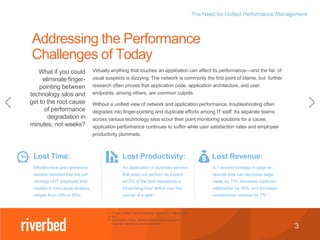
Lost Time:
Infrastructure and operations
leaders reported that the per-
centage of IT employee time
wasted in root-cause analysis
ranges from 10% to 50%.1
Lost Productivity:
An application or business service
that does not perform as expect-
ed 2% of the time represents a
45-working-hour deficit over the
course of a year.2
Lost Revenue:
A 1-second increase in page re-
sponse time can decrease page
views by 11%, decrease customer
satisfaction by 16%, and decrease
conversions/ revenue by 7%.3
The Need for Unified Performance Management
4
4
When a performance degradation occurs, there are more factors and
interrelationships to consider than ever before. The typical enterprise has between 6
and 10 network monitoring and troubleshooting tools in active use, with even more
‘shelfware’. Siloed tools only prove domain innocence; such a fragmented
approach to monitoring leads to frustration and delay. In the end, your business
struggles to identify the root cause of performance problems and collaborate
efficiently across technology domains.
Clearly, a new approach to performance management is needed—one that as-
sesses network and application health as a whole so your business can:
• Effectively react to the performance challenges you face today
• Proactively meet the business service needs of tomorrow
The realities of the modern IT landscape are daunting. Your business-critical applications are multi-platform, multi-tier, and
span physical, virtual, and hybrid cloud environments. To reach your end user, application transactions traverse complex
networks and infrastructure that are handling ever-increasing loads. In light of this, never has it been more challenging to
monitor the performance and availability of the business services that your employees and customers count on.
4. Enterprise Management Associates. Managing
Networks in the Age of the Cloud, SDN and Big
Data: Network Management Megatrends 2014.
64%
use a fragmented
approach to technology
monitoring.5
Traditional Performance
Management Is Not Enough
5. Forrester. Application Performance
Management Is Critical To Business
Success. February 2014.
4
The Need for Unified Performance Management
5
Technology is evolving at an aggressive pace. To increase availability, reduce total cost of
ownership, and consolidate resources, data centers are transforming from an on-premises
model to a hybrid of on-site, cloud-based, and virtualized environments. This new
reality changes where and how your business-critical applications are hosted. What’s more,
your end-user audience is hungry for new applications and features that allow them to
interact with and consume your business services from any location, using any device.
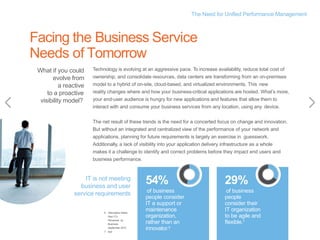
The net result of these trends is the need for a concerted focus on change and innovation.
But without an integrated and centralized view of the performance of your network and
applications, planning for future requirements is largely an exercise in guesswork.
Additionally, a lack of visibility into your application delivery infrastructure as a whole
makes it a challenge to identify and correct problems before they impact end users and
business performance.
6 Information Week.
How IT’s
Perceived by
Business.
September 2012.
7 Ibid.
54%
of business
people consider
IT a support or
maintenance
organization,
rather than an
innovator.6
29%
of business
people
consider their
IT organization
to be agile and
flexible.7
Facing the Business Service
Needs of Tomorrow
IT is not meeting
business and user
service requirements
What if you could
evolve from
a reactive
to a proactive
visibility model?
The Need for Unified Performance Management
6
In order to effectively address these specific challenges, you
need a holistic approach to performance management—one
that converges network, application, infrastructure and end-
user experience monitoring into a single interface for a uni-
fied and blended view of all applications and networks. But it’s
not enough to simply provide that single pain of glass, a truly
blended performance monitoring solution provides inte-
gration at the domain-level to further streamline cross-team
troubleshooting and collaboration.
Key Components of Unified
Performance Monitoring
What if you could gain access to all the
performance metrics you need in one tool?
The Need for Unified Performance Management
7
What to look for in a Performance
Management solution:
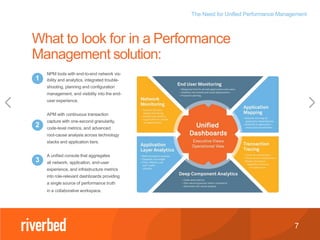
NPM tools with end-to-end network vis-
ibility and analytics, integrated trouble-
shooting, planning and configuration
management, and visibility into the end-
user experience.
APM with continuous transaction
capture with one-second granularity,
code-level metrics, and advanced
root-cause analysis across technology
stacks and application tiers.
A unified console that aggregates
all network, application, end-user
experience, and infrastructure metrics
into role-relevant dashboards providing
a single source of performance truth
in a collaborative workspace.
1
2
3
The Need for Unified Performance Management
8
Riverbed SteelCentral delivers powerful performance management technologies in a
single console. Through this resource, your organization will have access to a Gartner
Magic Quadrant Leader in Network Performance Monitoring and Diagnostics as well
as a Visionary in Application Performance Management. It’s time to:
• Eliminate Guesswork and War Rooms: Grant executive, development, quality
assurance, network and application staff access to a single integrated performance
management platform and drastically improve efficiency and collaboration among
previously siloed teams.
• Troubleshoot Performance Issues Faster: Leverage automated root cause analy-
sis to uncover the source of performance degradations in minutes. And by utilizing
the platform’s powerful, open-ended search, isolate problem transactions quickly to
accelerate troubleshooting efforts.
Riverbed SteelCentral
With Riverbed® SteelCentral, you can deliver
the application service levels that users, and
the business, demand.
The Need for Unified Performance Management
9
SteelCentral by
the numbers
Customers have:
• Slashed triage time up to 95%
• Reduced production issues
up to 50%
• Improved application rollout
processes up to 6x
• Increased transaction times
and application
responsiveness up to 10x
• Prioritize Tasks: Capture and store all performance metrics. You will have
the ability to examine historical records to determine when a problem first
occurred and how many users were affected. With this information in hand,
determine how and when to prioritize resolution efforts.
• Drive Change: Utilize big data-driven intelligence to analyze every
end-to-end transaction. You’ll uncover operational insights and detect
performance issues well before they impact end-user performance.
Riverbed SteelCentral
“The ability of Riverbed to quickly distinguish server,
network, and application problems has greatly
increased IT staff productivity. And the less time
we spend troubleshooting and upgrading, the more
time we have for new projects.”
- Network Manager, Bellevue Hospital Center
For more information on
Riverbed SteelCentral, go
here: http://rvbd.ly/1PnDaxT

The Need for Unified Performance Management

  • 1.
    SteelCentral Performance Management TheNeed for Unified Performance Management Across all applications, networks, infrastructure & end users
  • 2.
    Table of Contents TheNeed for Unified Performance Management Addressing the Performance Challenges of Today Traditional Performance Managment is Not Enough Facing the Business Service Needs of Tomorrow Key Components of Unified Performance Monitoring Riverbed SteelCentral About Riverbed 3 4 5 6 8 10
  • 3.
    The Need forUnified Performance Management 3 Virtually anything that touches an application can affect its performance—and the list of usual suspects is dizzying. The network is commonly the first point of blame, but further research often proves that application code, application architecture, and user endpoints, among others, are common culprits. Without a unified view of network and application performance, troubleshooting often degrades into finger-pointing and duplicate efforts among IT staff. As separate teams across various technology silos scour their point monitoring solutions for a cause, application performance continues to suffer while user satisfaction rates and employee productivity plummets. What if you could eliminate finger- pointing between technology silos and get to the root cause of performance degradation in minutes, not weeks? 1 Forrester. Realize Practical Application Management. February 2013. 2 Ibid. 3 The Aberdeen Group. The Performance of Web Applications: Customers are Won or Lost in One Second. Addressing the Performance Challenges of Today Lost Time: Infrastructure and operations leaders reported that the per- centage of IT employee time wasted in root-cause analysis ranges from 10% to 50%.1 Lost Productivity: An application or business service that does not perform as expect- ed 2% of the time represents a 45-working-hour deficit over the course of a year.2 Lost Revenue: A 1-second increase in page re- sponse time can decrease page views by 11%, decrease customer satisfaction by 16%, and decrease conversions/ revenue by 7%.3
  • 4.
    The Need forUnified Performance Management 4 4 When a performance degradation occurs, there are more factors and interrelationships to consider than ever before. The typical enterprise has between 6 and 10 network monitoring and troubleshooting tools in active use, with even more ‘shelfware’. Siloed tools only prove domain innocence; such a fragmented approach to monitoring leads to frustration and delay. In the end, your business struggles to identify the root cause of performance problems and collaborate efficiently across technology domains. Clearly, a new approach to performance management is needed—one that as- sesses network and application health as a whole so your business can: • Effectively react to the performance challenges you face today • Proactively meet the business service needs of tomorrow The realities of the modern IT landscape are daunting. Your business-critical applications are multi-platform, multi-tier, and span physical, virtual, and hybrid cloud environments. To reach your end user, application transactions traverse complex networks and infrastructure that are handling ever-increasing loads. In light of this, never has it been more challenging to monitor the performance and availability of the business services that your employees and customers count on. 4. Enterprise Management Associates. Managing Networks in the Age of the Cloud, SDN and Big Data: Network Management Megatrends 2014. 64% use a fragmented approach to technology monitoring.5 Traditional Performance Management Is Not Enough 5. Forrester. Application Performance Management Is Critical To Business Success. February 2014. 4
  • 5.
    The Need forUnified Performance Management 5 Technology is evolving at an aggressive pace. To increase availability, reduce total cost of ownership, and consolidate resources, data centers are transforming from an on-premises model to a hybrid of on-site, cloud-based, and virtualized environments. This new reality changes where and how your business-critical applications are hosted. What’s more, your end-user audience is hungry for new applications and features that allow them to interact with and consume your business services from any location, using any device. The net result of these trends is the need for a concerted focus on change and innovation. But without an integrated and centralized view of the performance of your network and applications, planning for future requirements is largely an exercise in guesswork. Additionally, a lack of visibility into your application delivery infrastructure as a whole makes it a challenge to identify and correct problems before they impact end users and business performance. 6 Information Week. How IT’s Perceived by Business. September 2012. 7 Ibid. 54% of business people consider IT a support or maintenance organization, rather than an innovator.6 29% of business people consider their IT organization to be agile and flexible.7 Facing the Business Service Needs of Tomorrow IT is not meeting business and user service requirements What if you could evolve from a reactive to a proactive visibility model?
  • 6.
    The Need forUnified Performance Management 6 In order to effectively address these specific challenges, you need a holistic approach to performance management—one that converges network, application, infrastructure and end- user experience monitoring into a single interface for a uni- fied and blended view of all applications and networks. But it’s not enough to simply provide that single pain of glass, a truly blended performance monitoring solution provides inte- gration at the domain-level to further streamline cross-team troubleshooting and collaboration. Key Components of Unified Performance Monitoring What if you could gain access to all the performance metrics you need in one tool?
  • 7.
    The Need forUnified Performance Management 7 What to look for in a Performance Management solution: NPM tools with end-to-end network vis- ibility and analytics, integrated trouble- shooting, planning and configuration management, and visibility into the end- user experience. APM with continuous transaction capture with one-second granularity, code-level metrics, and advanced root-cause analysis across technology stacks and application tiers. A unified console that aggregates all network, application, end-user experience, and infrastructure metrics into role-relevant dashboards providing a single source of performance truth in a collaborative workspace. 1 2 3
  • 8.
    The Need forUnified Performance Management 8 Riverbed SteelCentral delivers powerful performance management technologies in a single console. Through this resource, your organization will have access to a Gartner Magic Quadrant Leader in Network Performance Monitoring and Diagnostics as well as a Visionary in Application Performance Management. It’s time to: • Eliminate Guesswork and War Rooms: Grant executive, development, quality assurance, network and application staff access to a single integrated performance management platform and drastically improve efficiency and collaboration among previously siloed teams. • Troubleshoot Performance Issues Faster: Leverage automated root cause analy- sis to uncover the source of performance degradations in minutes. And by utilizing the platform’s powerful, open-ended search, isolate problem transactions quickly to accelerate troubleshooting efforts. Riverbed SteelCentral With Riverbed® SteelCentral, you can deliver the application service levels that users, and the business, demand.
  • 9.
    The Need forUnified Performance Management 9 SteelCentral by the numbers Customers have: • Slashed triage time up to 95% • Reduced production issues up to 50% • Improved application rollout processes up to 6x • Increased transaction times and application responsiveness up to 10x • Prioritize Tasks: Capture and store all performance metrics. You will have the ability to examine historical records to determine when a problem first occurred and how many users were affected. With this information in hand, determine how and when to prioritize resolution efforts. • Drive Change: Utilize big data-driven intelligence to analyze every end-to-end transaction. You’ll uncover operational insights and detect performance issues well before they impact end-user performance. Riverbed SteelCentral “The ability of Riverbed to quickly distinguish server, network, and application problems has greatly increased IT staff productivity. And the less time we spend troubleshooting and upgrading, the more time we have for new projects.” - Network Manager, Bellevue Hospital Center
  • 10.
    For more informationon Riverbed SteelCentral, go here: http://rvbd.ly/1PnDaxT