www.data61.csiro.au
AFV: Enabling Application
Function Virtualization and
Scheduling in Wearable Networks
Refer our paper here for more Information.
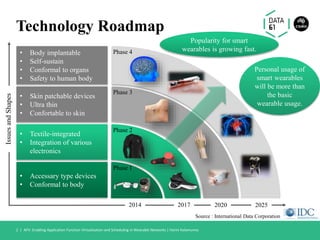
Technology Roadmap
• Body implantable
• Self-sustain
• Conformal to organs
• Safety to human body
• Skin patchable devices
• Ultra thin
• Confortable to skin
• Textile-integrated
• Integration of various
electronics
• Accessary type devices
• Conformal to body
Phase 1
Phase 3
Phase 4
Phase 2
IssuesandShapes
2014 2017 2020 2025
Source : International Data Corporation
Popularity for smart
wearables is growing fast.
Personal usage of
smart wearables
will be more than
the basic
wearable usage.
2 | AFV: Enabling Application Function Virtualization and Scheduling in Wearable Networks | Harini Kolamunna
Personal Area Network
(PAN)
Extended Personal Area
Network
Wristbands & Rings
Ear buds/ headsets
Armbands
e-textile
Bio-patches
Shoes & Soles
Tier 2
Watches
Glasses
Tier 1
Tablets & Phones
Laptops & PCs
Observations and Predictions
3 | AFV: Enabling Application Function Virtualization and Scheduling in Wearable Networks | Harini Kolamunna
Are we optimally utilizing the functions in a PAN?
– Common functions are available in PAN devices.
– Non-optimal utilization depending on the context:
o Waste of the limited resources.
o Poor functionality.
Step
counter
4 | AFV: Enabling Application Function Virtualization and Scheduling in Wearable Networks | Harini Kolamunna
Motivation
Popular fitness tracking applications (smartphone, smartwatch)
Are we optimally utilizing the functions in a PAN?
Function Allocation
– Random
– ALL
My Fitness
Companion
Cardiograph UP WearRun Sleep as
Android
Context Awareness
Battery level
User mobility
Location
Execution mode
– No context monitoring
– No dynamic adaptation to context changes
We are NOT optimally utilizing the functions in a PAN.
5 | AFV: Enabling Application Function Virtualization and Scheduling in Wearable Networks | Harini Kolamunna
Motivation
Goal
Utilize the common functionalities available in a PAN
6 |
Adaptability UsabilityOptimality
AFV: Enabling Application Function Virtualization and Scheduling in Wearable Networks | Harini Kolamunna
Maximize the user
quality of experience
Dynamically adapting
to context changes.
Easier for
app developers and
end users.
• Request (Rx) is mapped to device (D have Vx).
– Maximize the quality of experience.
Automatic
Dynamic
(Request) R  D (Device)
D1 R1
Requesting a
file upload
A1Smartphone
• Considering context;
– Capability of the D to perform the function V
– Requirements of A
– User’s preference
D1
D2
Dn
.
.
V1 V2
V1 V2
V1
Smartphone
Smartwatch
Tablet
Internet
connection
7
Approach
AFV
(Application Function Virtualization)
A framework enabling automated dynamic function virtualization/
scheduling across devices,
simplifying context-aware application development
8 | AFV: Enabling Application Function Virtualization and Scheduling in Wearable Networks | Harini Kolamunna
AFV Architecture
Function allocation problem (FAP)
Validation and benefits to AFV users
9 | AFV: Enabling Application Function Virtualization and Scheduling in Wearable Networks | Harini Kolamunna
AFV
(Application Function Virtualization)
10 | AFV: Enabling Application Function Virtualization and Scheduling in Wearable Networks | Harini Kolamunna
Decision
Engine
Function
Manager
Context
Monitoring
AFV APIs
app 1 app 2 app 3
Function
Execution
OS APIs
AFVFrameworkOSApps
CommunicationManager
Tier 1 - Device 3
Tier 1 - Device 2
Tier 1 - Device 1
Apps
OS
AFV
Framework
Apps
OS
AFV
Framework
Tier 2 - Devices
– AFV APIs
– Function Manager
o Knowledge about PAN
o Manages the requests
– Context Monitoring
– Decision Engine
o Functions Allocation Problem (FAP)
– Communication Manager
o Manages all AFV communication in
the PAN
– Function Execution
AFV Architecture
AFV Architecture
Function allocation problem (FAP)
Validation and benefits to AFV users
11 | AFV: Enabling Application Function Virtualization and Scheduling in Wearable Networks | Harini Kolamunna
AFV
(Application Function Virtualization)
V1
V2
V3
V1
V1
V2
.
.
D1
D2
Dn
Transfer Cost cr,d
Functioning
Cost fv,d
.
.
R1
R2
R2
R3
D2
Dn
R1
R2
D1
Objective:
Minimize the total cost of the PAN
Objective :
12 | AFV: Enabling Application Function Virtualization and Scheduling in Wearable Networks | Harini Kolamunna
Functions Allocation Problem Formulation
Functions Allocation Problem (FAP) is equivalent to
standard Uncapacitated Facility Location Problem (UFLP)
• Solutions to UFLP is NP-Hard.
• Adopting the available greedy solution for UFLP.
• Solutions to FAP is to be taken at resources–restricted PAN devices.
• We chose the simplest greedy method.
13 | AFV: Enabling Application Function Virtualization and Scheduling in Wearable Networks | Harini Kolamunna
Functions Allocation Problem Formulation
AFV Architecture
Function allocation problem (FAP)
Validation and benefits to AFV users
14 | AFV: Enabling Application Function Virtualization and Scheduling in Wearable Networks | Harini Kolamunna
AFV
(Application Function Virtualization)
Evaluation of FAP
• Evaluating the optimality of the method of solving FAP
– 5 devices, each have the function and request
– Costs are considered where σ= 0.1 *μ
• compared against
Optimal – Results obtained using optimization problem solver, Gurobi.
Random – One of the arbitrary selected device will run the function.
ALL – All the devices run the function
Error of FAP is less than 1% to the optimal solution, irrespective of the cost ratio
ALL – FAP %
ALL
15 | AFV: Enabling Application Function Virtualization and Scheduling in Wearable Networks | Harini Kolamunna
Implementation of the framework
• Implemented on Android OS and Android Wear OS
16 | AFV: Enabling Application Function Virtualization and Scheduling in Wearable Networks | Harini Kolamunna
AFV is Implementable
Integration of AFV in to kernel User-level application
All the applications can take the service
with minor changes.
Applications need to compile the library
and service is requested via IPC calls.
Need special access to the OS for the
installation.
No special access is needed for the
installation.
Example Use Cases
17 | AFV: Enabling Application Function Virtualization and Scheduling in Wearable Networks | Harini Kolamunna
• Function allocation for information accuracy.
Fitness tracking application requesting accelerometer data.
o Head Exercises  Smartglasses
o Body Stretching Exercises  Smartwatch
o Walking  Smartphone
18 | AFV: Enabling Application Function Virtualization and Scheduling in Wearable Networks | Harini Kolamunna
Example Use Cases
• Function allocation for better network quality
Availability of a higher throughput network
19 | AFV: Enabling Application Function Virtualization and Scheduling in Wearable Networks | Harini Kolamunna
Example Use Cases
• Function allocation for extending the device uptime
Conclusion and Future Work
• Current applications do not utilize the common functionalities optimally.
• AFV: enables automated dynamic function virtualization /scheduling across
devices, simplifying context-aware application development.
• Objective for the optimization : Minimizing the total cost.
• Implemented AFV as a user-level application.
• In the process of designing more complex function allocation algorithms.
• In the process of releasing AFV as an SDK.
20 | AFV: Enabling Application Function Virtualization and Scheduling in Wearable Networks | Harini Kolamunna
www.data61.csiro.au
Harini Kolamunna
PhD Student
UNSW & Data61–CSIRO
t +61 2 9490 5748
e harini.kolamunna@data61.csiro.au
w www.csiro.au/data61

Function Virtualization in Wearable Networks

  • 1.
    www.data61.csiro.au AFV: Enabling Application FunctionVirtualization and Scheduling in Wearable Networks Refer our paper here for more Information.
  • 2.
    Technology Roadmap • Bodyimplantable • Self-sustain • Conformal to organs • Safety to human body • Skin patchable devices • Ultra thin • Confortable to skin • Textile-integrated • Integration of various electronics • Accessary type devices • Conformal to body Phase 1 Phase 3 Phase 4 Phase 2 IssuesandShapes 2014 2017 2020 2025 Source : International Data Corporation Popularity for smart wearables is growing fast. Personal usage of smart wearables will be more than the basic wearable usage. 2 | AFV: Enabling Application Function Virtualization and Scheduling in Wearable Networks | Harini Kolamunna
  • 3.
    Personal Area Network (PAN) ExtendedPersonal Area Network Wristbands & Rings Ear buds/ headsets Armbands e-textile Bio-patches Shoes & Soles Tier 2 Watches Glasses Tier 1 Tablets & Phones Laptops & PCs Observations and Predictions 3 | AFV: Enabling Application Function Virtualization and Scheduling in Wearable Networks | Harini Kolamunna
  • 4.
    Are we optimallyutilizing the functions in a PAN? – Common functions are available in PAN devices. – Non-optimal utilization depending on the context: o Waste of the limited resources. o Poor functionality. Step counter 4 | AFV: Enabling Application Function Virtualization and Scheduling in Wearable Networks | Harini Kolamunna Motivation
  • 5.
    Popular fitness trackingapplications (smartphone, smartwatch) Are we optimally utilizing the functions in a PAN? Function Allocation – Random – ALL My Fitness Companion Cardiograph UP WearRun Sleep as Android Context Awareness Battery level User mobility Location Execution mode – No context monitoring – No dynamic adaptation to context changes We are NOT optimally utilizing the functions in a PAN. 5 | AFV: Enabling Application Function Virtualization and Scheduling in Wearable Networks | Harini Kolamunna Motivation
  • 6.
    Goal Utilize the commonfunctionalities available in a PAN 6 | Adaptability UsabilityOptimality AFV: Enabling Application Function Virtualization and Scheduling in Wearable Networks | Harini Kolamunna Maximize the user quality of experience Dynamically adapting to context changes. Easier for app developers and end users.
  • 7.
    • Request (Rx)is mapped to device (D have Vx). – Maximize the quality of experience. Automatic Dynamic (Request) R  D (Device) D1 R1 Requesting a file upload A1Smartphone • Considering context; – Capability of the D to perform the function V – Requirements of A – User’s preference D1 D2 Dn . . V1 V2 V1 V2 V1 Smartphone Smartwatch Tablet Internet connection 7 Approach
  • 8.
    AFV (Application Function Virtualization) Aframework enabling automated dynamic function virtualization/ scheduling across devices, simplifying context-aware application development 8 | AFV: Enabling Application Function Virtualization and Scheduling in Wearable Networks | Harini Kolamunna
  • 9.
    AFV Architecture Function allocationproblem (FAP) Validation and benefits to AFV users 9 | AFV: Enabling Application Function Virtualization and Scheduling in Wearable Networks | Harini Kolamunna AFV (Application Function Virtualization)
  • 10.
    10 | AFV:Enabling Application Function Virtualization and Scheduling in Wearable Networks | Harini Kolamunna Decision Engine Function Manager Context Monitoring AFV APIs app 1 app 2 app 3 Function Execution OS APIs AFVFrameworkOSApps CommunicationManager Tier 1 - Device 3 Tier 1 - Device 2 Tier 1 - Device 1 Apps OS AFV Framework Apps OS AFV Framework Tier 2 - Devices – AFV APIs – Function Manager o Knowledge about PAN o Manages the requests – Context Monitoring – Decision Engine o Functions Allocation Problem (FAP) – Communication Manager o Manages all AFV communication in the PAN – Function Execution AFV Architecture
  • 11.
    AFV Architecture Function allocationproblem (FAP) Validation and benefits to AFV users 11 | AFV: Enabling Application Function Virtualization and Scheduling in Wearable Networks | Harini Kolamunna AFV (Application Function Virtualization)
  • 12.
    V1 V2 V3 V1 V1 V2 . . D1 D2 Dn Transfer Cost cr,d Functioning Costfv,d . . R1 R2 R2 R3 D2 Dn R1 R2 D1 Objective: Minimize the total cost of the PAN Objective : 12 | AFV: Enabling Application Function Virtualization and Scheduling in Wearable Networks | Harini Kolamunna Functions Allocation Problem Formulation Functions Allocation Problem (FAP) is equivalent to standard Uncapacitated Facility Location Problem (UFLP)
  • 13.
    • Solutions toUFLP is NP-Hard. • Adopting the available greedy solution for UFLP. • Solutions to FAP is to be taken at resources–restricted PAN devices. • We chose the simplest greedy method. 13 | AFV: Enabling Application Function Virtualization and Scheduling in Wearable Networks | Harini Kolamunna Functions Allocation Problem Formulation
  • 14.
    AFV Architecture Function allocationproblem (FAP) Validation and benefits to AFV users 14 | AFV: Enabling Application Function Virtualization and Scheduling in Wearable Networks | Harini Kolamunna AFV (Application Function Virtualization)
  • 15.
    Evaluation of FAP •Evaluating the optimality of the method of solving FAP – 5 devices, each have the function and request – Costs are considered where σ= 0.1 *μ • compared against Optimal – Results obtained using optimization problem solver, Gurobi. Random – One of the arbitrary selected device will run the function. ALL – All the devices run the function Error of FAP is less than 1% to the optimal solution, irrespective of the cost ratio ALL – FAP % ALL 15 | AFV: Enabling Application Function Virtualization and Scheduling in Wearable Networks | Harini Kolamunna
  • 16.
    Implementation of theframework • Implemented on Android OS and Android Wear OS 16 | AFV: Enabling Application Function Virtualization and Scheduling in Wearable Networks | Harini Kolamunna AFV is Implementable Integration of AFV in to kernel User-level application All the applications can take the service with minor changes. Applications need to compile the library and service is requested via IPC calls. Need special access to the OS for the installation. No special access is needed for the installation.
  • 17.
    Example Use Cases 17| AFV: Enabling Application Function Virtualization and Scheduling in Wearable Networks | Harini Kolamunna • Function allocation for information accuracy. Fitness tracking application requesting accelerometer data. o Head Exercises  Smartglasses o Body Stretching Exercises  Smartwatch o Walking  Smartphone
  • 18.
    18 | AFV:Enabling Application Function Virtualization and Scheduling in Wearable Networks | Harini Kolamunna Example Use Cases • Function allocation for better network quality Availability of a higher throughput network
  • 19.
    19 | AFV:Enabling Application Function Virtualization and Scheduling in Wearable Networks | Harini Kolamunna Example Use Cases • Function allocation for extending the device uptime
  • 20.
    Conclusion and FutureWork • Current applications do not utilize the common functionalities optimally. • AFV: enables automated dynamic function virtualization /scheduling across devices, simplifying context-aware application development. • Objective for the optimization : Minimizing the total cost. • Implemented AFV as a user-level application. • In the process of designing more complex function allocation algorithms. • In the process of releasing AFV as an SDK. 20 | AFV: Enabling Application Function Virtualization and Scheduling in Wearable Networks | Harini Kolamunna
  • 21.
    www.data61.csiro.au Harini Kolamunna PhD Student UNSW& Data61–CSIRO t +61 2 9490 5748 e harini.kolamunna@data61.csiro.au w www.csiro.au/data61

Editor's Notes

  • #13 Simplify the explanation