Central Auditory Disorders
Central Auditory Dysfunction
Rationale for CAD tests
Peripheral & Central disorders have different manifestations
Normal or near normal HTL, SDS
yet difficulty in following speech, more so in noise.
To provide a complete assessment of integrity of
total auditory system, identify site of lesion
as well as functional deficits in auditory processing
thus help in remedial measures.
Less costly, time saving & more sensitive
than CT, MRI. Minimal lesions not detectable by CT
More true for our country
Interest in development & use of special tests for
assessment of CANS
Central Auditory Nervous System grew
after a report of normal HTL & SDS
for a hemispherectomy.
So conventional PT & Speech tests
fail to detect defects higher up in CANS.
So different type of test are required for
detecting these disorders.
Why they fail to detect ?
Intrinsic & Extrinsic redundancy
Redundant : superfluous, not needed.
Can be omitted without any loss of significance
Intrinsic Redundancy:
Due to multiplicity of neural pathways, centers,
decussations & their interrelationships
Due to bilateral representation of auditory system.
Extrinsic Redundancy
Due to aspects of signal like freq range, duration, rhythm
Contextual cues
Individual’s familiarity with semantic, syntactic
& phonological rules of language.
This enables us to perceive message though
parts of it are absent or degraded.
Intrinsic redundancy is reduced by lesion in CANS
but conventional sp tests can’t detect it
unless large proportion of nuclei & neurons are affected.
But pat has problems is sp perception in daily life.
So, extrinsic redundancy of signal has to be reduced
to detect CANS lesion.
This is the basis of CAD test
It taxes the CANS
Two principles must be understood before we study CAD
1. Principle of Subtlety: The signs & symptoms of CAD
become more subtle as lesion becomes more central.
2. Bottleneck Principle: A complex signal like speech
encounters neural congestion at the junction
of 8th
Nerve & brain stem.
Lesions at this site has more deleterious affect on
speech recognition than lesions more
peripheral or central to it.
Pure tones & Speech stimuli are
modified to tax CANS
Pure tones can be modified in numerous ways
without destroying the signal,
are independent of linguistic capacity of individual,
their results easily verifiable by animal studies.
Speech signals can be modified by
spectrum filtering,
time compression,
competition with noise etc
Types of lesions affecting CANS
Space occupying tumors Degenerative diseases
Demyelinating disorders Infections
Vascular Disorders Head Trauma
Congenital neurological deficits
Anatomy of CANS
Up to 8th
nerve & CN junction (1st
order neurons)
is peripheral nervous system
CANS begins at CN at the level of Pons.
CN to ipsi & contra
SOC are 2nd
order neurons.
This is lower BS
Upper BS includes IC.
MGB is in Thalamus.
Fibers from MGB go
through Corpus Callosum
to Heschl’s gyrus, the Primary auditory Area,
known as Broadman’s Area 41.
This primary area is Middle Posterior portion of
Superior Temporal gyrus in each hemisphere.
& good portion of Insular cortex.
Surrounding areas are called Auditory Association area # 22 & 42
BS lesions are those affecting
major decussations of CANS pathways in BS
and / or associated nuclei.
Lesions of cortex affect Temporal lobe & adjacent tissue.
Interhemispheric lesions affect Corpus Callosum
& other commissural connections
between two hemispheres.
Central Auditory testing has been employed
1. To detect & localize site of CAD lesion
2. To identify children with CA processing disorders
who show learning or communication problems
3. To quantify & describe deficits in CA processing
to decide remedial & rehabilitative measures
4. To assess benefits of educational & medical intervention
5. to determine ear dominance & hemisphere specialization
for various types of auditory stimulus
6. to study effects of maturation on CA processing
Tests using Pure Tones as Stimuli
1. Masking Level Difference
Binaural Release from Masking
Binaural Unmasking
Useful clinical tool to assess lower BS function
MLD depends on the ability of auditory system
to process subtle interaural time & amplitude differences
Stim used is 500 Hz tone or Spondaic word
Masker is 500 Hz NBN or BBN noise at 80 dB sl
If we present a tone binaurally
& then mask it with minimal masker.
Now, if we reverse the phase of either stim
or masker in one ear,
the signal becomes audible again.
This is called release from masking.
Now we have to
reduce the level of stim before
it gests masked again.
This difference between two stim levels is MLD.
The stim & masker are presented binaurally in 2 conditions
1. Both stim & masker are in phase S0 N0
Homophasic Condition
2. Stim is out of phase, but masker is in phase SΠ N0
Antiphasic Condition ( also S0 NΠ )
Threshold for stim is obtained in both cases.
-
Difference between two thresholds is MLD
MLD = S0 N0 - SΠ N0 or S0 N0 - S0 NΠ
Difference is better in antiphasic condition by 9 – 15 dB in
adults & up to 13 dB in children.
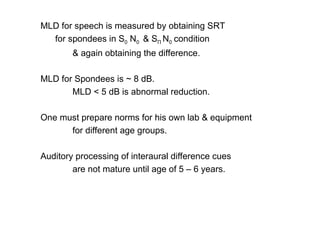
MLD for speech is measured by obtaining SRT
for spondees in S0 N0 & SΠ N0 condition
& again obtaining the difference.
MLD for Spondees is ~ 8 dB.
MLD < 5 dB is abnormal reduction.
One must prepare norms for his own lab & equipment
for different age groups.
Auditory processing of interaural difference cues
are not mature until age of 5 – 6 years.
MLD is pathologic groups
Anterior temporal lesion : No reduction in MLD
Cerebral Lesions No reduction in MLD
So MLD is unaffected by cortical lesions.
B S lesions involving MS or other path : 50 – 60 % have MLD< 6 dB
MLD scores were significantly less in path of Pontomedullary
region ( lower B S ) than
Normals, Cerebral, Upper Pons, Thalamic lesions.
[ Lynn et al 1981]
They concluded
Lower B S mediates MLD.
Most probably SOC.
Those people also showed abnormality in Wave 3 of ABR
which is thought to arise from SOC & CN.
People with normal Wave 1, 2 & 3 did not have
reduced MLD.
Spondee MLD is more sensitive than PT MLD.
Since the hit rate for the spondee MLD
appears not to be substantially higher than chance,
not a good tool for detection of brainstem dysfunction.
Pitch Pattern Sequence Test ( PPS )
Pinheiro ( 1977 )developed PPS test to measure both
Pitch perception & temporal sequencing abilities.
Two versions: for adults & for Children
Two pure tones,
Low 880 Hz & High 1430 Hz
of 200 msec ( 500 for kids ) duration are given
with a gap of 150 msec ( 300 for kids )
are given in groups of 3
e.g. Low High Low , High Low High
There are six possible sequences
Tones presented Monoaurally at 50 dB SL re 1K threshold
Response mode is
Humming, Verbal & Pointing
Normals respond well in all modes.
1. LD individuals could hum correct response, but did
poorly on verbal & pointing tasks [ Musiek et al 1982]
2. Pats with interhemispheric dysfunction could hum,
but not in other modes
3. Pats with auditory cortex dysfunction, in either HS,
did badly in all modes of response.
LD & Interhemispheric ( Split Brain ) cases show that
they can perceive Temporal order of pattern accurately
But are unable to process the input recognition
& output sequencing.
3. Binaural beats
Beats are produced when two tones
of slightly different frequencies are delivered
to an ear simultaneously. We hear waxing & waning.
MONAURAL BEATS
When tones are delivered to an ear,
the subjective perception is a tone
which is modulated at a rate equal to
the difference in frequency between the two tones
[Oster 1973]
BINAURAL BEATS-
If the two tones are delivered separately to
each ear of the subject,
the modulation is heard within the head.
Binaural beats effect reflects binaural interaction
which first occurs in the lower brainstem
[Burlach and Colburn, 1978 ]
Procedure
Give instructions to the client
Present a tone at a fixed frequency in one ear
Change the frequency in the other ear
slightly to make him hear the flutter
Interpretation :
If the flutter is not detected, brainstem lesion could be suspected.
Few subjects hear monaural beats
but not binaural beats.
The result is probably a reflection of intactness of
auditory system in the peripheral area
where monaural beats develop.
showing the abnormalities of the brainstem structure
where the binaural beats occur.
Tests using Speech as stimuli
1. Filtered Speech Test
2. Dichotic Binaural Fusion Test
3. Time Altered Speech Test
4. RASP
5. SWAMI
6. SSI – ICM & SSI – CCM
7. Dichotic Digit Test
8. Dichotic CV test
9. Speech in Noise Test
10. SSW
1. Filtered Speech Test:
If we filter some spectrum, our intelligibility suffers
* Temporal Lobe tumor cases with normal HTL
showed poor SDS scores in contra ear
with Low pass filtered speech ( cut off 500 Hz )
They had good SDS with unfiltered speech. [ Bocca et al 1955]
* Lynn & Gilroy : Pats with TL tumors
74 % - poor contra results
3 % - ipsi effects
24 % - Normal Scores
Lesions of Corpus Callosum or
Anterior sectioning of CC
did not affect LPF scores.
Consistent findings not reported for B S lesions.
Contra, Ipsi & bilateral ear effects have been reported.
Could be due to diffuse nature of B S lesion.
If peripheral Hearing Loss is present,
comparison of LPF and unfiltered Speech results
give us idea of extent of CANS involvement.
2. Dichotic Binaural Fusion test (BF)
1st
BF test by Matzker (1959) for testing lower BS
Pat is required to combine
High Freq Band (HFB) portion of message in one ear
with LFB portion given to other ear
to perceive the spondee.
HFB : 1815 – 2500 Hz LFB : 500 – 800 Hz
Normals could fuse two bands & recognised the PB word
i.e. they integrated info from two ears.
If only HFB or LFB was given to any ear, they failed to recognise.
If both bands given to both ears (diotic) again good results
This is a special dichotic test
since different but complimentary signals are given
simultaneously to 2 ears.
No difference in diotic or dichotic condition for Normals.
Results:
Ivey (1969) Two lists of 20 PB words, each carried 5 % weight
Normals & SN cases: 89 % score ( range 75 – 100 %) [ Williford,1977]
Temporal & Parietal lobe tumors : Normal results
Poor results in 100 % BS pats in dichotic compared to diotic.
64 % of LD children got poor scores [ Willeford, 1977]
Later reports of low hit rate in BS pats ( ~ 30%)
showed that original theory of it being a test
for BS was wrong.
79 % of dyslexics got lower scores.
Poor scores in them may implicated a dysfunction
at the earliest level of visual & auditory interaction in BS
Superior Colliculus ( visual centre ) is close to
Inferior Colliculus. Defect here may cause difficulty
in learning to read by phonic approach.
3. Time Altered Speech Test
Time or Rate altered sp tests evaluate
temporal auditory processing.
Stim is accelerated monosyllable, spondees or sentences
Presented monoaurally
Earlier method of
Fast playback of tape recorder - shift in spectrum
Chop & splice - tedious & awkward.
Electromechanical time compressor
deleted samples & spliced remaining samples
Discarded sample could be within a word.
Presently computers are used to do this job.
Contra effects in TL cases, but less pronounced than filtered test
Diffuse disorders of CANS & BS – reduced scores
NU # 6 word list is available at different compression
rates of 0 %, 30 %, 40 %, 50 %, 60 % & 70 %.
SDS decreases gradually for normals till 60 %.
After that drastic reduction is seen.
60 % compression caused
reduced scores in contra ear for diffuse TL lesion due to
CVA
but not for discrete anterior TL lesion
Elderly people have low scores than young
at all compression ratios.
Peripheral hearing loss can also depress scores at 60 %
So, if peripheral loss ++, then it is
difficult to identify concomitant CAD
If hearing is normal, yet 20 % difference in two ear scores
it indicates CAD on the contra side.
4. Rapidly Alternating Speech : RASP
Two versions were developed:
Lynn & Gilroy (1975) Willeford (1977)
Both presented 20 sentences, each having 5% score.
Each ear received 300 msec long signal
then it was switched to other ear.
Sentences were presented in alternating mode
such that Right ear received 1st
segment of 10 snetences
& LE received 1st
segment of 10 sentences
Willeford: Mean score for RASP was 99 % in 20 normals.
Range 90 – 100 %.
Lynn & Gilroy
Rt TL tumors 100 % scores
Lt TL tumors 80 % scores
Rt Parietal lobe tumors 92 % scores
Upper B S lesions 84 % scores
Lower Pons CPA lesion 38 % scores
Nearly 50 % of BS lesion pats had abnormal RASP scores
While 6 % of TL cases showed similar scores.
So RASP can detect lower BS lesions, though sensitivity is less.
[ RASP involves integration of segments over time, while
Binaural Fusion test is a spectrum integration job]
5. SWAMI (Speech with alternate masking index)
Test for Brain Stem Pathology
SWAMI is a modification of RASP (Jerger,1964)
PB words are presented at 50 dB SL to one ear
and 500 msec burst of thermal noise at 70 dB SL in other
ear
and the stimulus is alternated between the ears.
Difficulty on the SWAMI test is usually
associated with brainstem abnormalities and
also with diffuse cortical problems.
Normal Subjects get 100 % score due to binaural integration
Results are poorer in B S pats
No differences in the performance between
Rt ear and the left ears scores in BS pats
But their mean scores for both ears
was lower both for SWAMI & filtered speech tests.
Incidentally normal subjects had depressed LPF scores
their SWAMI scores were normal.
6. Synthetic Sentence Identification ( Jerger, 1965 )
SSI – ICM & SSI – CCM
Speech test based on artificial sentences
in order to investigate the relation between
temporal Charecteristics of message &
speech recognition ability.
Closed set test. Contains sentence stimuli
controlled for length, vocabulary, syntax & word familiarity.
Problem of sentence identification b recognising
a Key word was overcome by use of artificial sentence.
How Synthetic sentence are made ?
A word is selected.
A person is asked to suggest next possible word.
Thus a sentence is made.
This is 2nd
order sentence.
Next stage involves selecting a word pair
and suggesting third word.
Other person will be given 2nd
& 3rd
word pair
He suggests 4th
word.
This continues till sentence is 7 words long.
This is 3rd
order sentence.
10 such sentences were developed & printed on a card.
Pat has to point out the sentence spoken in the list.
Many normals & hearing impaired obtained 100 % scores.
So the test was made difficult by
adding a competing message – a narrative story.
Sentence & Competing message were
spoken by same person to avoid vocal
cues.
Competing message can be presented
Ipsilaterally – SSI – ICM
Contralaterally – SSI – ICM
SSI – ICM : presented at +10, 0, & - 10 dB SNR
SSI – CCM : presented at 0, - 20 & - 40 dB SNR
SNR is called Message to Competition ratio, MCR.
Sentence always ++ed at 40 dB SL at all MCR.
Jerger (1968)
Normals have 90 - 100 % scores at all MCR for SSI – ICM
For SSI – CCM 100 % at + 10 dB MCR
94 % at 0 dB MCR
80 % at - 10 dB MCR
55 % at - 20 dB MCR
Pathologic group
Jerger & Jerger (1974):
11 pats with intra axial BS lesions with PTA < 39 dB in BE
All had reduced scores in SSI – ICM bilaterally or in Contra ear.
If bil, poorer scores in contra ear.
SSI – CCM scores normal bilaterally
or slightly (~ 70%) reduced in contra ear
For 6 TL pats, SSI – ICM showed normal scores
or poor scores in contra ear.
But did poorly on SSI – CCM.
In summary,
B S pats do more poorly on SSI – ICM than SSI – CCM
TL pats do more poorly on SSI – CCM than SSI – ICM
Antonelli et al (1987)
Poor ICM scores in 75 % of B S group
Poor CCM scores in 80 % of TL group.
However, 16 % of BS pat also had poor CCM
scores.
Pats with MS show poor results
ranging from 25 – 55 % in ICM & CCM scores.
This indicates that
- SSI test is not much sensitive to ++ce of MS
- Region & Extent of CNS affected determines
whether ICM or CCM scores are poor.
Elderly show poorer ICM scores after 50 – 60 years.
But their PBmax was relatively unaffected.
So comparison of PBmax & ICM can give indication
of central involvement.
SSI should not be used in elderly to detect CAD as
ageing itself reduces SSI scores.
Dichotic tests.
Dichotic testing refers to stimulation of both ears
with different stimuli.
RE advantage is seen in Lt HS dominant & v v.
During dichotic testing, ipsi pathway transmission is
suppressed, so majority of info passes thro contra pathways.
Data ++ed to LE is received by Rt HS which does initial
acoustic analysis. Then it is sent to Lt HS thro
Corpus Callosum for linguistic analysis.
This transfer degrades signal slightly.
Data in RE goes directly to Lt HS for acoustic. & ling analysis
so no degradation. Hence RE adv. But very subtle so
monotic tests can not reveal this.
Like other test of CANS path,
when dichotic speech is presented to individuals
with TL lesions,
reduced performance is expected
in the ear contralateral to
the disorder since crossed fibers are dominant.
7. Dichotic Digit test
Kimura (1961): 1st
to use dichotic digits to test pats with brain
damage.
A pair 3, 8, was ++ed.
RE received 3 and LE got 8.
Three such pairs were ++ed.
After 6 digits, pat was to repeat them
in any order.
Subjects had temporal lobectomy
for intractable seizures.
She reported decreased scores for LE
when Rt TL was affected.
But when Lt TL was affected,
scores in both ears were depressed.
Musiek et al ++ed 2 digits to each ear
for e.g. 2,5 to RE & 6,8 to LE
at 50 dB SL re SRT or PTA.
Sub asked to repeat in any order.
40 such pairs were delivered.
Normal typically scored above 90 %
Peripheral loss cases above 80 %.
Scores below 80 % indicated CANS lesion.
83 % of hemispheric lesion &
75 % of B S lesion had abnormal scores
in one or both ears.
[ slightly more sensitive to HS than BS lesions ]
Of HS lesions on one side, 87 % had abnormal contra score.
Of HS lesion with bil abnormal scores,
85 % had greater contra than ipsi deficits.
B S pats showed higher deficits in ipsi ear.
This negates Jerger’s findings that
Intra axial BS lesions show contra effects.
Lynn & Gilroy: Both ipsi & contra effects are seen in
Intra axial BS lesions.
Anatomical position, magnitude & type of lesion
within BS affect the production of
ipsi & contra effects on dichotic digit test
Collard et al carried out Musiek test on 26 TL
lobectomy cases.
Pre & post operative tests did not reveal any
statistical difference.
Deep lesions affecting callosal fiber from Rt HS
causes decreased scores for LE, but not for RE
[ stim from LE travels from Rt HS thro CC to Lt HS, so degradation ]
Ipsi effect seen in Lt TL lesion,
but not Rt TL lesion
again means callosal involvement.
8. Dichotic Consonant – Vowel Test ( Berlin et al, early 1970s)
Consists of 6 nonsense CV syllables: pa, ta, ka, ba, da, ga
They can be better aligned than digits
because of similarity of CV
No linguistic value, only acoustic & phonetic competition.
Relies less heavily on short term memory required for digit test
as 6 digits are to be remembered.
Stim parameters: CV duration is 310 msec ( 320 for ‘pa’).
Inter stim interval = 6 sec.
Alignment under simultaneous condition is accurate to 2.5
msec
PLs from 55 – 80 dB SPL to MCL used
Two types of ++n
Simultaneous & Staggered
Staggered: Dichotic CV ++ed such that onset of CV
to one ear lags behind other ear by 15, 30, 60, 90 or 120 msec
Sim ++n: RE 70 – 80 % score. LE 58 – 70 % score.
So RE advantage is seen.
Normals get better scores with lag times of 30 – 90 msec
than on simultaneous presentation.
Similar improvement not seen in TL tumor pats
Difference between 0 & 90 msec lag is between
10 – 15 % improvement.
Of the two ears, scores are better for lagging ear.
If RE is the lag ear, RE advantage gets boosted
& its score becomes much better.
If the LE is lag ear, RE advantage is overcome
% LE shows better scores, albeit lesser than above
condition.
This effect is called lag effect.
After 90 msec, lag effect disappears.
Pathological group:
Lag effect was absent in TL & HS cases
Contra ear always showed poorer scores.
Ipsi ear performed better than normals in Rt TL cases
but poorer than normals in Lt TL lobectomies
In HS cases both ears had better score than normals.
Ipsi ear 100 % score in Rt HS
Ipsi ear 84 % score in Lt HS cases
Olsen (1983): DCV test to 50 normals &
67 pats of anterior portion Rt & Lt TL removal
Wide range of scores obtained for Normals.
Over 40 % of TL cases had scores
falling in the range of TL case.
Ipsi ear effects were also observed by Olsen.
He ( & later Speaks, 1975) concluded that
Determination of side of cortical lesion
can’t be accomplished using dichotic listening tasks.
Mueller et al (1987)
Contra as well as Ipsi effects in
Lt posterior TL injuries.
* Normals get 40 – 45 % double correct scores
i.e. both CV identified correctly
It is difficult as both CV get fused into single entity.
* Double correct scores were significantly lower
for TL cases. But does not help in determining
which HS is involved.
• BS pat improved score from 10 to 40 % after chemotherapy [Berlin]
DCV is difficult for some. Instead SSW or digit test may be used
9. Speech in Noise Tests
Like spectrum filtering, another method of
reducing redundancy of monosyllabic words
is to present (++) Ipsi competing noise.
Common complaint of CAPD cases is difficulty
in hearing in noisy situations.
Ability to process speech in ++ce of noise
can be tested in many ways.
Audiologist can choose from several types of
Speech stim : monosyllables, sentences
Noise : White, Speech, Cafeteria, Multi talker, discourse
SNR : - 10 to + 20
Noise ++n : Ipsi, Contra, or thro sound field
Speech in noise tests use standardized PB list
like NU # 6 or CID W22
White or Speech noise at 0 to +10 SNR
Recorded tests can be administered
by conventional audiometer & tape recorder.
Correct SNR must be maintained.
Various studies have reported
correct % identification from 48 – 82 %.
Wide variability is due to
improperly controlled test parameters.
Many studies have reported
reduced performance on Speech in noise tests.
8th
nerve lesions Intra axial lesions
Extra axial lesions TL path
Split brain persons M S & L D adults
have been reported to do poorly on these tasks.
Olsen et al (1975) collected normative data
for large group of Normal listeners
with NU # 6 , White Noise & 0 dB SNR
They compared these results with
Coch, Retro, TL & MS pats.
Significant reduction in speech recognition
for all these disorders.
Difference of more than 40 % between scores
in Quiet & in Noise ( difference scores )
was considered significant.
Olsen: Useful for suggesting abnormal auditory function,
but not for identifying site of lesion.
Some tests not in syllabus
but important ones.
SAAT:
Selective Auditory Attention Test ( Cherry )
Diotic monosyllabic sp in noise test
0 dB SNR - Noise is a distracter story
LD children get less scores in noise than in quiet.
SCAN:
Screening Test for Auditory processing disorders ( Keith )
Monosyllables ++ed monaurally in a babble noise
SNR of + 8 dB. Scores compared with age norms.
SPIN:
Speech Perception in Noise Test
Sentences ++ed.
Final word is the target word.
Target response is easily predicted
by context in 50 % sentences &
not predictable in rest of 50 % sentences
Babble Noise given at + 8 dB SNR.
SSI – ICM & its pediatric version
Pediatric Speech Intelligibility Test ( PSI )
also belong to this group of test.
10. Staggered Spondaic Word: (Jerger, 1962)
Test designed to evaluate central auditory disorders
Familiar Spondaic words are presented in
semi dichotic fashion
in a partially overlapped fashion at 50 dB SL.
2 channel tape recorder required
Test scored quantitatively & qualitatively.
Spondees are paired such that
1st
monosyllable of 1st
spondee &
2nd
monosyllable of 2nd
spondee
would form a third spondee.
rnc rc / lc lnc
RE 1st
Up Stairs
REF Down Town
LE 1st
Out Side
LEF In Law
lnc lc / rc rnc
Starting of presentation is varied between two ears
i.e. both ears become lead & lag ear in turn.
40 test items ( Test EC ) using 80 spondaic words
consisting of 160 monosyllables were made.
4 practice items are also included.
SSW material is used in many countries
with little variation. Copied in other languages
like Spanish, Turkish, Japanese etc.
Chandrashekhar (1973) standardized SSW
in Indians, but normative data not available.
Nagaraja used multi syllabic paired words
to make a test called Staggered Paired word test.
Masking is never done in this test as both ears receive stim.
Each of 160 mono syllables are judged individually
to be right or wrong.
Error can be omission or substitution of word.
Line is dashed on the error word,
Substituted word is written over the line. ( Item 31, 32 )
Each pair of spondee is an item containing 4 monosyllables.
Total number of mistakes made in an item
is entered in column Wrong
Order of repeating is entered beneath the word.
Incorrect order is no error.
Out of sequence words with no more than
one error is Reversal, Encircle R. Item 38, 39, 40
If no error, enter a dot in Wrong column.
Score chart shows 8 columns
A to D is for REF items E to F is for LEF items
These 8 cardinal numbers give info about pat performance.
Quantitative Scoring
R SSW score.
Percentage error of 4 conditions ( rc, lc, rnc, lnc)
gives Condition score
Average error for each ear gives Ear score.
Average error for entire test gives Total error.
Ear effect: Sum of numbers in Wrong column
separately for RE & LE
Order Effect:
1 = A + E, 2 = B + F, 3 = C + G, 4 = D + H
Combined totals for
RNC = A + H
RC = B + G
LC = C + E
LNC = D + E
These combined totals are carried to score sheet.
Max possible error for any condition ( say RC )
is 40.
So, to get percent error, we multiply each Condition score
with 2.5 to get R SSW score for that condition
Condition score
Average of RC & RNC gives us RE error
Average of LC & LNC gives us LE error
Ear score
Average of RE error & LE error gives us Total Error
C SSW score
is obtained by subtracting SDS of W 22 error
from each Condition score
to nullify effect of peripheral hearing loss.
In our example,
Pat got 96 % score in RE & 100 % score in LE
on W 22 SDS.
So error in RE is 4 % & in LE is 0%
So subtract accordingly to get C SSW for all 4 conditions
Do averaging to obtain Ear & Total scores
R SSW & C SSW scores are plotted on SSW gram
Norms given by Katz are as follows in 5 catagoriess
Score Total Ear Condition
Over Corrected upto -5 upto -7 upto -10
Normal - 4 to 5 -6 to 10 -9 to 15
Mildly abnormal 6 to 15 11 to 20 16 to 25
Mod. abnormal 16 to 35 21 to 40 26 to 45
Sev. abnormal 36 to 100 41 to 100 46 to 100
Pathological groups
Coch cases: C SSW scores are usually very close to Zero
The percentage of SSW error is generally far less
than on monosyllabic word discmn test.
Pats with low BS lesions had very low C SSW scores
in the affected (ipsi) ear.
High BS lesions : C SSW score of +53 in ipsi ear ( highly abn )
Heschl’s Gurus lesion ( AR ) show high scores ( ~ 50 – 55 )
in contra ear. Effect chiefly seen in Competing condition
i.e. LC or RC
So, between BS & AR centre, effect shifts from ipsi to contra.
Anterior TL lesions have less error than Posterior lesion
NAR cases show low errors or even normal scores.
Anterior part of CC affected -> no effect on SSW scores
If middle or posterior CC affected,
LC condition shows poor score irrespective of HS involved.
Reversals may be due to lesion in area of sensory & motor strip
around the fissure of Rolando.
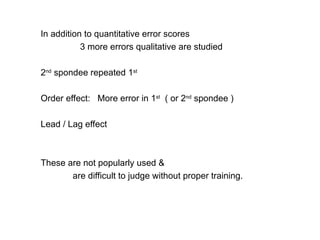
In addition to quantitative error scores
3 more errors qualitative are studied
2nd
spondee repeated 1st
Order effect: More error in 1st
( or 2nd
spondee )
Lead / Lag effect
These are not popularly used &
are difficult to judge without proper training.
Lynn & Gilroy: SSW test to anterior & posterior TL tumor cases
With posterior TL cases involving Heschl’s gyrus
85 % of subjects scored abnormally
in the competing condition in the
ear contralateral to lesion
Only 53 % cases showed poor scores
in non competing portions.

Central Auditory processing Disorder ppt

  • 1.
    Central Auditory Disorders CentralAuditory Dysfunction Rationale for CAD tests Peripheral & Central disorders have different manifestations Normal or near normal HTL, SDS yet difficulty in following speech, more so in noise. To provide a complete assessment of integrity of total auditory system, identify site of lesion as well as functional deficits in auditory processing thus help in remedial measures. Less costly, time saving & more sensitive than CT, MRI. Minimal lesions not detectable by CT More true for our country
  • 2.
    Interest in development& use of special tests for assessment of CANS Central Auditory Nervous System grew after a report of normal HTL & SDS for a hemispherectomy. So conventional PT & Speech tests fail to detect defects higher up in CANS. So different type of test are required for detecting these disorders. Why they fail to detect ? Intrinsic & Extrinsic redundancy
  • 3.
    Redundant : superfluous,not needed. Can be omitted without any loss of significance Intrinsic Redundancy: Due to multiplicity of neural pathways, centers, decussations & their interrelationships Due to bilateral representation of auditory system. Extrinsic Redundancy Due to aspects of signal like freq range, duration, rhythm Contextual cues Individual’s familiarity with semantic, syntactic & phonological rules of language. This enables us to perceive message though parts of it are absent or degraded.
  • 4.
    Intrinsic redundancy isreduced by lesion in CANS but conventional sp tests can’t detect it unless large proportion of nuclei & neurons are affected. But pat has problems is sp perception in daily life. So, extrinsic redundancy of signal has to be reduced to detect CANS lesion. This is the basis of CAD test It taxes the CANS
  • 5.
    Two principles mustbe understood before we study CAD 1. Principle of Subtlety: The signs & symptoms of CAD become more subtle as lesion becomes more central. 2. Bottleneck Principle: A complex signal like speech encounters neural congestion at the junction of 8th Nerve & brain stem. Lesions at this site has more deleterious affect on speech recognition than lesions more peripheral or central to it.
  • 6.
    Pure tones &Speech stimuli are modified to tax CANS Pure tones can be modified in numerous ways without destroying the signal, are independent of linguistic capacity of individual, their results easily verifiable by animal studies. Speech signals can be modified by spectrum filtering, time compression, competition with noise etc
  • 7.
    Types of lesionsaffecting CANS Space occupying tumors Degenerative diseases Demyelinating disorders Infections Vascular Disorders Head Trauma Congenital neurological deficits Anatomy of CANS Up to 8th nerve & CN junction (1st order neurons) is peripheral nervous system
  • 8.
    CANS begins atCN at the level of Pons. CN to ipsi & contra SOC are 2nd order neurons. This is lower BS Upper BS includes IC. MGB is in Thalamus. Fibers from MGB go through Corpus Callosum to Heschl’s gyrus, the Primary auditory Area, known as Broadman’s Area 41. This primary area is Middle Posterior portion of Superior Temporal gyrus in each hemisphere. & good portion of Insular cortex. Surrounding areas are called Auditory Association area # 22 & 42
  • 9.
    BS lesions arethose affecting major decussations of CANS pathways in BS and / or associated nuclei. Lesions of cortex affect Temporal lobe & adjacent tissue. Interhemispheric lesions affect Corpus Callosum & other commissural connections between two hemispheres.
  • 22.
    Central Auditory testinghas been employed 1. To detect & localize site of CAD lesion 2. To identify children with CA processing disorders who show learning or communication problems 3. To quantify & describe deficits in CA processing to decide remedial & rehabilitative measures 4. To assess benefits of educational & medical intervention 5. to determine ear dominance & hemisphere specialization for various types of auditory stimulus 6. to study effects of maturation on CA processing
  • 23.
    Tests using PureTones as Stimuli 1. Masking Level Difference Binaural Release from Masking Binaural Unmasking Useful clinical tool to assess lower BS function MLD depends on the ability of auditory system to process subtle interaural time & amplitude differences Stim used is 500 Hz tone or Spondaic word Masker is 500 Hz NBN or BBN noise at 80 dB sl
  • 24.
    If we presenta tone binaurally & then mask it with minimal masker. Now, if we reverse the phase of either stim or masker in one ear, the signal becomes audible again. This is called release from masking. Now we have to reduce the level of stim before it gests masked again. This difference between two stim levels is MLD.
  • 25.
    The stim &masker are presented binaurally in 2 conditions 1. Both stim & masker are in phase S0 N0 Homophasic Condition 2. Stim is out of phase, but masker is in phase SΠ N0 Antiphasic Condition ( also S0 NΠ ) Threshold for stim is obtained in both cases. - Difference between two thresholds is MLD MLD = S0 N0 - SΠ N0 or S0 N0 - S0 NΠ Difference is better in antiphasic condition by 9 – 15 dB in adults & up to 13 dB in children.
  • 26.
    MLD for speechis measured by obtaining SRT for spondees in S0 N0 & SΠ N0 condition & again obtaining the difference. MLD for Spondees is ~ 8 dB. MLD < 5 dB is abnormal reduction. One must prepare norms for his own lab & equipment for different age groups. Auditory processing of interaural difference cues are not mature until age of 5 – 6 years.
  • 27.
    MLD is pathologicgroups Anterior temporal lesion : No reduction in MLD Cerebral Lesions No reduction in MLD So MLD is unaffected by cortical lesions. B S lesions involving MS or other path : 50 – 60 % have MLD< 6 dB MLD scores were significantly less in path of Pontomedullary region ( lower B S ) than Normals, Cerebral, Upper Pons, Thalamic lesions. [ Lynn et al 1981]
  • 28.
    They concluded Lower BS mediates MLD. Most probably SOC. Those people also showed abnormality in Wave 3 of ABR which is thought to arise from SOC & CN. People with normal Wave 1, 2 & 3 did not have reduced MLD. Spondee MLD is more sensitive than PT MLD. Since the hit rate for the spondee MLD appears not to be substantially higher than chance, not a good tool for detection of brainstem dysfunction.
  • 29.
    Pitch Pattern SequenceTest ( PPS ) Pinheiro ( 1977 )developed PPS test to measure both Pitch perception & temporal sequencing abilities. Two versions: for adults & for Children Two pure tones, Low 880 Hz & High 1430 Hz of 200 msec ( 500 for kids ) duration are given with a gap of 150 msec ( 300 for kids ) are given in groups of 3 e.g. Low High Low , High Low High There are six possible sequences
  • 30.
    Tones presented Monoaurallyat 50 dB SL re 1K threshold Response mode is Humming, Verbal & Pointing Normals respond well in all modes. 1. LD individuals could hum correct response, but did poorly on verbal & pointing tasks [ Musiek et al 1982] 2. Pats with interhemispheric dysfunction could hum, but not in other modes 3. Pats with auditory cortex dysfunction, in either HS, did badly in all modes of response.
  • 31.
    LD & Interhemispheric( Split Brain ) cases show that they can perceive Temporal order of pattern accurately But are unable to process the input recognition & output sequencing.
  • 32.
    3. Binaural beats Beatsare produced when two tones of slightly different frequencies are delivered to an ear simultaneously. We hear waxing & waning. MONAURAL BEATS When tones are delivered to an ear, the subjective perception is a tone which is modulated at a rate equal to the difference in frequency between the two tones [Oster 1973]
  • 33.
    BINAURAL BEATS- If thetwo tones are delivered separately to each ear of the subject, the modulation is heard within the head. Binaural beats effect reflects binaural interaction which first occurs in the lower brainstem [Burlach and Colburn, 1978 ]
  • 34.
    Procedure Give instructions tothe client Present a tone at a fixed frequency in one ear Change the frequency in the other ear slightly to make him hear the flutter Interpretation : If the flutter is not detected, brainstem lesion could be suspected.
  • 35.
    Few subjects hearmonaural beats but not binaural beats. The result is probably a reflection of intactness of auditory system in the peripheral area where monaural beats develop. showing the abnormalities of the brainstem structure where the binaural beats occur.
  • 36.
    Tests using Speechas stimuli 1. Filtered Speech Test 2. Dichotic Binaural Fusion Test 3. Time Altered Speech Test 4. RASP 5. SWAMI 6. SSI – ICM & SSI – CCM 7. Dichotic Digit Test 8. Dichotic CV test 9. Speech in Noise Test 10. SSW
  • 37.
    1. Filtered SpeechTest: If we filter some spectrum, our intelligibility suffers * Temporal Lobe tumor cases with normal HTL showed poor SDS scores in contra ear with Low pass filtered speech ( cut off 500 Hz ) They had good SDS with unfiltered speech. [ Bocca et al 1955] * Lynn & Gilroy : Pats with TL tumors 74 % - poor contra results 3 % - ipsi effects 24 % - Normal Scores
  • 38.
    Lesions of CorpusCallosum or Anterior sectioning of CC did not affect LPF scores. Consistent findings not reported for B S lesions. Contra, Ipsi & bilateral ear effects have been reported. Could be due to diffuse nature of B S lesion. If peripheral Hearing Loss is present, comparison of LPF and unfiltered Speech results give us idea of extent of CANS involvement.
  • 39.
    2. Dichotic BinauralFusion test (BF) 1st BF test by Matzker (1959) for testing lower BS Pat is required to combine High Freq Band (HFB) portion of message in one ear with LFB portion given to other ear to perceive the spondee. HFB : 1815 – 2500 Hz LFB : 500 – 800 Hz Normals could fuse two bands & recognised the PB word i.e. they integrated info from two ears. If only HFB or LFB was given to any ear, they failed to recognise. If both bands given to both ears (diotic) again good results
  • 40.
    This is aspecial dichotic test since different but complimentary signals are given simultaneously to 2 ears. No difference in diotic or dichotic condition for Normals. Results: Ivey (1969) Two lists of 20 PB words, each carried 5 % weight Normals & SN cases: 89 % score ( range 75 – 100 %) [ Williford,1977] Temporal & Parietal lobe tumors : Normal results Poor results in 100 % BS pats in dichotic compared to diotic.
  • 41.
    64 % ofLD children got poor scores [ Willeford, 1977] Later reports of low hit rate in BS pats ( ~ 30%) showed that original theory of it being a test for BS was wrong. 79 % of dyslexics got lower scores. Poor scores in them may implicated a dysfunction at the earliest level of visual & auditory interaction in BS Superior Colliculus ( visual centre ) is close to Inferior Colliculus. Defect here may cause difficulty in learning to read by phonic approach.
  • 42.
    3. Time AlteredSpeech Test Time or Rate altered sp tests evaluate temporal auditory processing. Stim is accelerated monosyllable, spondees or sentences Presented monoaurally Earlier method of Fast playback of tape recorder - shift in spectrum Chop & splice - tedious & awkward. Electromechanical time compressor deleted samples & spliced remaining samples Discarded sample could be within a word.
  • 43.
    Presently computers areused to do this job. Contra effects in TL cases, but less pronounced than filtered test Diffuse disorders of CANS & BS – reduced scores NU # 6 word list is available at different compression rates of 0 %, 30 %, 40 %, 50 %, 60 % & 70 %. SDS decreases gradually for normals till 60 %. After that drastic reduction is seen.
  • 44.
    60 % compressioncaused reduced scores in contra ear for diffuse TL lesion due to CVA but not for discrete anterior TL lesion Elderly people have low scores than young at all compression ratios. Peripheral hearing loss can also depress scores at 60 % So, if peripheral loss ++, then it is difficult to identify concomitant CAD If hearing is normal, yet 20 % difference in two ear scores it indicates CAD on the contra side.
  • 45.
    4. Rapidly AlternatingSpeech : RASP Two versions were developed: Lynn & Gilroy (1975) Willeford (1977) Both presented 20 sentences, each having 5% score. Each ear received 300 msec long signal then it was switched to other ear. Sentences were presented in alternating mode such that Right ear received 1st segment of 10 snetences & LE received 1st segment of 10 sentences
  • 46.
    Willeford: Mean scorefor RASP was 99 % in 20 normals. Range 90 – 100 %. Lynn & Gilroy Rt TL tumors 100 % scores Lt TL tumors 80 % scores Rt Parietal lobe tumors 92 % scores Upper B S lesions 84 % scores Lower Pons CPA lesion 38 % scores Nearly 50 % of BS lesion pats had abnormal RASP scores While 6 % of TL cases showed similar scores. So RASP can detect lower BS lesions, though sensitivity is less. [ RASP involves integration of segments over time, while Binaural Fusion test is a spectrum integration job]
  • 47.
    5. SWAMI (Speechwith alternate masking index) Test for Brain Stem Pathology SWAMI is a modification of RASP (Jerger,1964) PB words are presented at 50 dB SL to one ear and 500 msec burst of thermal noise at 70 dB SL in other ear and the stimulus is alternated between the ears. Difficulty on the SWAMI test is usually associated with brainstem abnormalities and also with diffuse cortical problems.
  • 48.
    Normal Subjects get100 % score due to binaural integration Results are poorer in B S pats No differences in the performance between Rt ear and the left ears scores in BS pats But their mean scores for both ears was lower both for SWAMI & filtered speech tests. Incidentally normal subjects had depressed LPF scores their SWAMI scores were normal.
  • 49.
    6. Synthetic SentenceIdentification ( Jerger, 1965 ) SSI – ICM & SSI – CCM Speech test based on artificial sentences in order to investigate the relation between temporal Charecteristics of message & speech recognition ability. Closed set test. Contains sentence stimuli controlled for length, vocabulary, syntax & word familiarity. Problem of sentence identification b recognising a Key word was overcome by use of artificial sentence.
  • 50.
    How Synthetic sentenceare made ? A word is selected. A person is asked to suggest next possible word. Thus a sentence is made. This is 2nd order sentence. Next stage involves selecting a word pair and suggesting third word. Other person will be given 2nd & 3rd word pair He suggests 4th word. This continues till sentence is 7 words long. This is 3rd order sentence. 10 such sentences were developed & printed on a card. Pat has to point out the sentence spoken in the list.
  • 51.
    Many normals &hearing impaired obtained 100 % scores. So the test was made difficult by adding a competing message – a narrative story. Sentence & Competing message were spoken by same person to avoid vocal cues. Competing message can be presented Ipsilaterally – SSI – ICM Contralaterally – SSI – ICM SSI – ICM : presented at +10, 0, & - 10 dB SNR SSI – CCM : presented at 0, - 20 & - 40 dB SNR SNR is called Message to Competition ratio, MCR. Sentence always ++ed at 40 dB SL at all MCR.
  • 52.
    Jerger (1968) Normals have90 - 100 % scores at all MCR for SSI – ICM For SSI – CCM 100 % at + 10 dB MCR 94 % at 0 dB MCR 80 % at - 10 dB MCR 55 % at - 20 dB MCR
  • 53.
    Pathologic group Jerger &Jerger (1974): 11 pats with intra axial BS lesions with PTA < 39 dB in BE All had reduced scores in SSI – ICM bilaterally or in Contra ear. If bil, poorer scores in contra ear. SSI – CCM scores normal bilaterally or slightly (~ 70%) reduced in contra ear For 6 TL pats, SSI – ICM showed normal scores or poor scores in contra ear. But did poorly on SSI – CCM.
  • 54.
    In summary, B Spats do more poorly on SSI – ICM than SSI – CCM TL pats do more poorly on SSI – CCM than SSI – ICM Antonelli et al (1987) Poor ICM scores in 75 % of B S group Poor CCM scores in 80 % of TL group. However, 16 % of BS pat also had poor CCM scores.
  • 55.
    Pats with MSshow poor results ranging from 25 – 55 % in ICM & CCM scores. This indicates that - SSI test is not much sensitive to ++ce of MS - Region & Extent of CNS affected determines whether ICM or CCM scores are poor. Elderly show poorer ICM scores after 50 – 60 years. But their PBmax was relatively unaffected. So comparison of PBmax & ICM can give indication of central involvement. SSI should not be used in elderly to detect CAD as ageing itself reduces SSI scores.
  • 56.
    Dichotic tests. Dichotic testingrefers to stimulation of both ears with different stimuli. RE advantage is seen in Lt HS dominant & v v. During dichotic testing, ipsi pathway transmission is suppressed, so majority of info passes thro contra pathways. Data ++ed to LE is received by Rt HS which does initial acoustic analysis. Then it is sent to Lt HS thro Corpus Callosum for linguistic analysis. This transfer degrades signal slightly. Data in RE goes directly to Lt HS for acoustic. & ling analysis so no degradation. Hence RE adv. But very subtle so monotic tests can not reveal this.
  • 57.
    Like other testof CANS path, when dichotic speech is presented to individuals with TL lesions, reduced performance is expected in the ear contralateral to the disorder since crossed fibers are dominant.
  • 58.
    7. Dichotic Digittest Kimura (1961): 1st to use dichotic digits to test pats with brain damage. A pair 3, 8, was ++ed. RE received 3 and LE got 8. Three such pairs were ++ed. After 6 digits, pat was to repeat them in any order. Subjects had temporal lobectomy for intractable seizures.
  • 59.
    She reported decreasedscores for LE when Rt TL was affected. But when Lt TL was affected, scores in both ears were depressed. Musiek et al ++ed 2 digits to each ear for e.g. 2,5 to RE & 6,8 to LE at 50 dB SL re SRT or PTA. Sub asked to repeat in any order. 40 such pairs were delivered.
  • 60.
    Normal typically scoredabove 90 % Peripheral loss cases above 80 %. Scores below 80 % indicated CANS lesion. 83 % of hemispheric lesion & 75 % of B S lesion had abnormal scores in one or both ears. [ slightly more sensitive to HS than BS lesions ] Of HS lesions on one side, 87 % had abnormal contra score. Of HS lesion with bil abnormal scores, 85 % had greater contra than ipsi deficits.
  • 61.
    B S patsshowed higher deficits in ipsi ear. This negates Jerger’s findings that Intra axial BS lesions show contra effects. Lynn & Gilroy: Both ipsi & contra effects are seen in Intra axial BS lesions. Anatomical position, magnitude & type of lesion within BS affect the production of ipsi & contra effects on dichotic digit test
  • 62.
    Collard et alcarried out Musiek test on 26 TL lobectomy cases. Pre & post operative tests did not reveal any statistical difference. Deep lesions affecting callosal fiber from Rt HS causes decreased scores for LE, but not for RE [ stim from LE travels from Rt HS thro CC to Lt HS, so degradation ] Ipsi effect seen in Lt TL lesion, but not Rt TL lesion again means callosal involvement.
  • 63.
    8. Dichotic Consonant– Vowel Test ( Berlin et al, early 1970s) Consists of 6 nonsense CV syllables: pa, ta, ka, ba, da, ga They can be better aligned than digits because of similarity of CV No linguistic value, only acoustic & phonetic competition. Relies less heavily on short term memory required for digit test as 6 digits are to be remembered. Stim parameters: CV duration is 310 msec ( 320 for ‘pa’). Inter stim interval = 6 sec. Alignment under simultaneous condition is accurate to 2.5 msec PLs from 55 – 80 dB SPL to MCL used
  • 64.
    Two types of++n Simultaneous & Staggered Staggered: Dichotic CV ++ed such that onset of CV to one ear lags behind other ear by 15, 30, 60, 90 or 120 msec Sim ++n: RE 70 – 80 % score. LE 58 – 70 % score. So RE advantage is seen. Normals get better scores with lag times of 30 – 90 msec than on simultaneous presentation. Similar improvement not seen in TL tumor pats
  • 65.
    Difference between 0& 90 msec lag is between 10 – 15 % improvement. Of the two ears, scores are better for lagging ear. If RE is the lag ear, RE advantage gets boosted & its score becomes much better. If the LE is lag ear, RE advantage is overcome % LE shows better scores, albeit lesser than above condition. This effect is called lag effect. After 90 msec, lag effect disappears.
  • 66.
    Pathological group: Lag effectwas absent in TL & HS cases Contra ear always showed poorer scores. Ipsi ear performed better than normals in Rt TL cases but poorer than normals in Lt TL lobectomies In HS cases both ears had better score than normals. Ipsi ear 100 % score in Rt HS Ipsi ear 84 % score in Lt HS cases
  • 67.
    Olsen (1983): DCVtest to 50 normals & 67 pats of anterior portion Rt & Lt TL removal Wide range of scores obtained for Normals. Over 40 % of TL cases had scores falling in the range of TL case. Ipsi ear effects were also observed by Olsen. He ( & later Speaks, 1975) concluded that Determination of side of cortical lesion can’t be accomplished using dichotic listening tasks.
  • 68.
    Mueller et al(1987) Contra as well as Ipsi effects in Lt posterior TL injuries. * Normals get 40 – 45 % double correct scores i.e. both CV identified correctly It is difficult as both CV get fused into single entity. * Double correct scores were significantly lower for TL cases. But does not help in determining which HS is involved. • BS pat improved score from 10 to 40 % after chemotherapy [Berlin] DCV is difficult for some. Instead SSW or digit test may be used
  • 69.
    9. Speech inNoise Tests Like spectrum filtering, another method of reducing redundancy of monosyllabic words is to present (++) Ipsi competing noise. Common complaint of CAPD cases is difficulty in hearing in noisy situations. Ability to process speech in ++ce of noise can be tested in many ways. Audiologist can choose from several types of Speech stim : monosyllables, sentences Noise : White, Speech, Cafeteria, Multi talker, discourse SNR : - 10 to + 20 Noise ++n : Ipsi, Contra, or thro sound field
  • 70.
    Speech in noisetests use standardized PB list like NU # 6 or CID W22 White or Speech noise at 0 to +10 SNR Recorded tests can be administered by conventional audiometer & tape recorder. Correct SNR must be maintained. Various studies have reported correct % identification from 48 – 82 %. Wide variability is due to improperly controlled test parameters.
  • 71.
    Many studies havereported reduced performance on Speech in noise tests. 8th nerve lesions Intra axial lesions Extra axial lesions TL path Split brain persons M S & L D adults have been reported to do poorly on these tasks.
  • 72.
    Olsen et al(1975) collected normative data for large group of Normal listeners with NU # 6 , White Noise & 0 dB SNR They compared these results with Coch, Retro, TL & MS pats. Significant reduction in speech recognition for all these disorders. Difference of more than 40 % between scores in Quiet & in Noise ( difference scores ) was considered significant. Olsen: Useful for suggesting abnormal auditory function, but not for identifying site of lesion.
  • 73.
    Some tests notin syllabus but important ones. SAAT: Selective Auditory Attention Test ( Cherry ) Diotic monosyllabic sp in noise test 0 dB SNR - Noise is a distracter story LD children get less scores in noise than in quiet. SCAN: Screening Test for Auditory processing disorders ( Keith ) Monosyllables ++ed monaurally in a babble noise SNR of + 8 dB. Scores compared with age norms.
  • 74.
    SPIN: Speech Perception inNoise Test Sentences ++ed. Final word is the target word. Target response is easily predicted by context in 50 % sentences & not predictable in rest of 50 % sentences Babble Noise given at + 8 dB SNR. SSI – ICM & its pediatric version Pediatric Speech Intelligibility Test ( PSI ) also belong to this group of test.
  • 75.
    10. Staggered SpondaicWord: (Jerger, 1962) Test designed to evaluate central auditory disorders Familiar Spondaic words are presented in semi dichotic fashion in a partially overlapped fashion at 50 dB SL. 2 channel tape recorder required Test scored quantitatively & qualitatively. Spondees are paired such that 1st monosyllable of 1st spondee & 2nd monosyllable of 2nd spondee would form a third spondee.
  • 76.
    rnc rc /lc lnc RE 1st Up Stairs REF Down Town LE 1st Out Side LEF In Law lnc lc / rc rnc Starting of presentation is varied between two ears i.e. both ears become lead & lag ear in turn. 40 test items ( Test EC ) using 80 spondaic words consisting of 160 monosyllables were made. 4 practice items are also included.
  • 77.
    SSW material isused in many countries with little variation. Copied in other languages like Spanish, Turkish, Japanese etc. Chandrashekhar (1973) standardized SSW in Indians, but normative data not available. Nagaraja used multi syllabic paired words to make a test called Staggered Paired word test. Masking is never done in this test as both ears receive stim.
  • 78.
    Each of 160mono syllables are judged individually to be right or wrong. Error can be omission or substitution of word. Line is dashed on the error word, Substituted word is written over the line. ( Item 31, 32 ) Each pair of spondee is an item containing 4 monosyllables. Total number of mistakes made in an item is entered in column Wrong Order of repeating is entered beneath the word. Incorrect order is no error.
  • 80.
    Out of sequencewords with no more than one error is Reversal, Encircle R. Item 38, 39, 40 If no error, enter a dot in Wrong column. Score chart shows 8 columns A to D is for REF items E to F is for LEF items These 8 cardinal numbers give info about pat performance.
  • 82.
    Quantitative Scoring R SSWscore. Percentage error of 4 conditions ( rc, lc, rnc, lnc) gives Condition score Average error for each ear gives Ear score. Average error for entire test gives Total error. Ear effect: Sum of numbers in Wrong column separately for RE & LE
  • 84.
    Order Effect: 1 =A + E, 2 = B + F, 3 = C + G, 4 = D + H Combined totals for RNC = A + H RC = B + G LC = C + E LNC = D + E These combined totals are carried to score sheet.
  • 86.
    Max possible errorfor any condition ( say RC ) is 40. So, to get percent error, we multiply each Condition score with 2.5 to get R SSW score for that condition Condition score Average of RC & RNC gives us RE error Average of LC & LNC gives us LE error Ear score Average of RE error & LE error gives us Total Error
  • 88.
    C SSW score isobtained by subtracting SDS of W 22 error from each Condition score to nullify effect of peripheral hearing loss. In our example, Pat got 96 % score in RE & 100 % score in LE on W 22 SDS. So error in RE is 4 % & in LE is 0% So subtract accordingly to get C SSW for all 4 conditions Do averaging to obtain Ear & Total scores R SSW & C SSW scores are plotted on SSW gram
  • 90.
    Norms given byKatz are as follows in 5 catagoriess Score Total Ear Condition Over Corrected upto -5 upto -7 upto -10 Normal - 4 to 5 -6 to 10 -9 to 15 Mildly abnormal 6 to 15 11 to 20 16 to 25 Mod. abnormal 16 to 35 21 to 40 26 to 45 Sev. abnormal 36 to 100 41 to 100 46 to 100
  • 91.
    Pathological groups Coch cases:C SSW scores are usually very close to Zero The percentage of SSW error is generally far less than on monosyllabic word discmn test. Pats with low BS lesions had very low C SSW scores in the affected (ipsi) ear. High BS lesions : C SSW score of +53 in ipsi ear ( highly abn )
  • 92.
    Heschl’s Gurus lesion( AR ) show high scores ( ~ 50 – 55 ) in contra ear. Effect chiefly seen in Competing condition i.e. LC or RC So, between BS & AR centre, effect shifts from ipsi to contra. Anterior TL lesions have less error than Posterior lesion NAR cases show low errors or even normal scores. Anterior part of CC affected -> no effect on SSW scores If middle or posterior CC affected, LC condition shows poor score irrespective of HS involved. Reversals may be due to lesion in area of sensory & motor strip around the fissure of Rolando.
  • 93.
    In addition toquantitative error scores 3 more errors qualitative are studied 2nd spondee repeated 1st Order effect: More error in 1st ( or 2nd spondee ) Lead / Lag effect These are not popularly used & are difficult to judge without proper training.
  • 94.
    Lynn & Gilroy:SSW test to anterior & posterior TL tumor cases With posterior TL cases involving Heschl’s gyrus 85 % of subjects scored abnormally in the competing condition in the ear contralateral to lesion Only 53 % cases showed poor scores in non competing portions.