INTRODUCTION TO
AUDITING
Outline
 Definition of a quality Audit
 Types of audit
 Qualifications of quality auditors
 The audit process
What is quality audit?
A quality audit is a systematic, independent and
documented process for obtaining audit evidence and
evaluating it objectively to determine the extent to
which agreed criteria are fulfilled
(ISO 9000:2005 clause 3.9.1)
Why Audit?
 To determine whether the quality
system conforms to specified
requirements
 To determine the effectiveness of the
implemented system
 To initiate improvements in the system
 To compare practice with procedure
 To provide objective evidence that the
system is in compliance with the
standard (i.e for certification purpose)
intake per set criteria
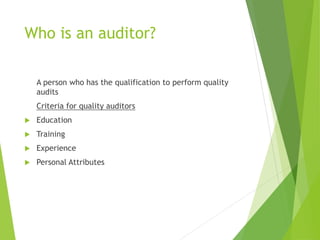
Who is an auditor?
A person who has the qualification to perform quality
audits
Criteria for quality auditors
 Education
 Training
 Experience
 Personal Attributes
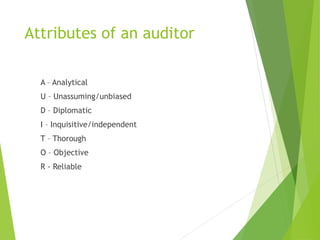
Attributes of an auditor
A – Analytical
U – Unassuming/unbiased
D – Diplomatic
I – Inquisitive/independent
T – Thorough
O – Objective
R - Reliable
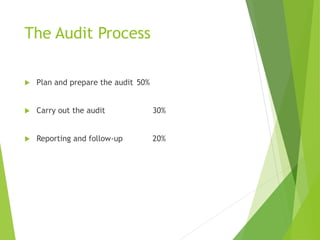
The Audit Process
 Plan and prepare the audit 50%
 Carry out the audit 30%
 Reporting and follow-up 20%
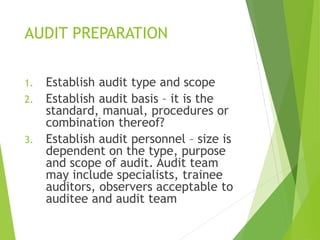
AUDIT PREPARATION
1. Establish audit type and scope
2. Establish audit basis – it is the
standard, manual, procedures or
combination thereof?
3. Establish audit personnel – size is
dependent on the type, purpose
and scope of audit. Audit team
may include specialists, trainee
auditors, observers acceptable to
auditee and audit team
AUDIT PREPARATION
4. Read basis documentation as well as previous audit
reports and determine what records shall be pulled in
advance
5. Prepare process model – identifying the expected
results of the process to be audited
6. Prepare an audit plan
AUDIT PREPARATION
7. Notify the auditee in advance of: time, date, the
scope, the basis, timetable of the audit
8. Prepare checklists – use open ended questions what?
Why? Who? How? Which?
PERFORMING THE AUDIT
Before the start of audit:
 Auditee's management informs personnel in the involved
departments about expected audit
 Lead auditor and rest of the team must be acceptable
to auditee management
FOUR PHASES OF AN AUDIT
Opening meeting
Execution of audit
Auditors’ meeting
Closing meeting
Typical opening meeting
agenda
 Introduction of members and observers
and recording of those present
 Confirm objectives, scope, basis,
reasons and benefits of the audit
 Review of audit plan
 Explanation of the audit method and
documentation to be used
 Explain the tasks of the accompanying
auditee’s representatives (i.e guide)
Typical opening meeting
agenda
 Confirm method of communication
 Confirm availability of facilities
 Explain closing meeting/format
 Assure auditee of confidentiality
 Invite questions
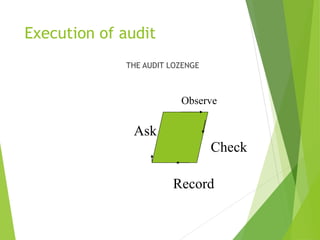
Execution of audit
THE AUDIT LOZENGE
Ask
Record
Check
Observe
EXECUTION OF AUDIT
 Must be done according to timetable
 Only ask open, factual questions
 Verify answer through observation
 Follow an audit trail
 Do more listening than talking 2 ear 1 month; therefore
listen 2/3 of the time
Some rules for auditors
 Keep calm and relaxed
 Look at the other person-eye contact
 Keep discussion factual
 Ask one question at a time
 Do not lecture
 Let the other person finish talking
Some rules for audit
 Keep the right distance from the person
 Be friendly without being too familiar
 If your question causes uneasiness or uncertainty,
formulate it differently
 Involve all participants
 Use the right gestures/expressions
 Keep personal opinions to yourself
Objective evidence
 Remember ---- SHOW ME
 Check for documents, records, reports, data in
computers etc
 Ensure auditees statements are cross checked by
supporting evidence e.g. statements by other personnel
with specified authority, records, documentary evidence
e.t.c.
AUDITORS’ MEETING
 Compilation of
findings/observations
 Recording of non-conformities
 Preparation of summary report
 Formation of opinion to be
presented at closing meeting
Typical closing meeting
agenda
 Introductions and recording of attendance
 Thank the auditee
 Mention the principles of sampling followed during the
audit
 Summarize audit observations
(positive, general observations and
nonconformities)
 Give non – conformities in details
Typical Closing Meeting
Agenda
 Present overall summary and conclusions
 Allow for discussion
 Request corrective actions and corrective action dates
 Agree on follow-up date
 Close meeting
Corrective Action Follow-up
It is important to ensure that the auditee implements: -
1. Effective correction
2. Effective corrective actions
REPORTING OF AUDITS
 A standard proforma for the reporting of audit should be
used.
 Using the standard audit report sheets prepare a
narrative summary of the audit
 Ensure the positive as well as the negative findings are
summarized
REPORTING OF AUDITS
Report should cover the following headings: -
1. Title
2. Scope
3. Basis
4. Audit team
5. Introduction (opening meeting)
6. Findings
7. Debriefing (closing meeting)
8. Summary
The audit report including any non-conformity
report,
Corrective action notices are issued to the auditee &
MR
REPORTING OF AUDITS
 ISO 19011:2002 includes recommendations for report
contents
 Audit reports should be kept confidential lest
 Auditors lose respect
 Auditees are less willing to identify areas for improvement
ANALYSIS OF AUDITS
 Management Representative will analyze audit reports
to identify areas of common deficiency within QMS
 This will initiate changes to the audit schedule
 A full analysis of audit reports is presented to
management review meeting
Records & Administration of
Audits
 The MR should enter the audits in the audit log.
 Following documents be retained in departmental QMS
files as records: -
 Original checklists
 Audit reports
 Related documents
Thank You

Auditing

  • 1.
  • 2.
    Outline  Definition ofa quality Audit  Types of audit  Qualifications of quality auditors  The audit process
  • 3.
    What is qualityaudit? A quality audit is a systematic, independent and documented process for obtaining audit evidence and evaluating it objectively to determine the extent to which agreed criteria are fulfilled (ISO 9000:2005 clause 3.9.1)
  • 4.
    Why Audit?  Todetermine whether the quality system conforms to specified requirements  To determine the effectiveness of the implemented system  To initiate improvements in the system  To compare practice with procedure  To provide objective evidence that the system is in compliance with the standard (i.e for certification purpose) intake per set criteria
  • 5.
    Who is anauditor? A person who has the qualification to perform quality audits Criteria for quality auditors  Education  Training  Experience  Personal Attributes
  • 6.
    Attributes of anauditor A – Analytical U – Unassuming/unbiased D – Diplomatic I – Inquisitive/independent T – Thorough O – Objective R - Reliable
  • 7.
    The Audit Process Plan and prepare the audit 50%  Carry out the audit 30%  Reporting and follow-up 20%
  • 8.
    AUDIT PREPARATION 1. Establishaudit type and scope 2. Establish audit basis – it is the standard, manual, procedures or combination thereof? 3. Establish audit personnel – size is dependent on the type, purpose and scope of audit. Audit team may include specialists, trainee auditors, observers acceptable to auditee and audit team
  • 9.
    AUDIT PREPARATION 4. Readbasis documentation as well as previous audit reports and determine what records shall be pulled in advance 5. Prepare process model – identifying the expected results of the process to be audited 6. Prepare an audit plan
  • 10.
    AUDIT PREPARATION 7. Notifythe auditee in advance of: time, date, the scope, the basis, timetable of the audit 8. Prepare checklists – use open ended questions what? Why? Who? How? Which?
  • 11.
    PERFORMING THE AUDIT Beforethe start of audit:  Auditee's management informs personnel in the involved departments about expected audit  Lead auditor and rest of the team must be acceptable to auditee management
  • 12.
    FOUR PHASES OFAN AUDIT Opening meeting Execution of audit Auditors’ meeting Closing meeting
  • 13.
    Typical opening meeting agenda Introduction of members and observers and recording of those present  Confirm objectives, scope, basis, reasons and benefits of the audit  Review of audit plan  Explanation of the audit method and documentation to be used  Explain the tasks of the accompanying auditee’s representatives (i.e guide)
  • 14.
    Typical opening meeting agenda Confirm method of communication  Confirm availability of facilities  Explain closing meeting/format  Assure auditee of confidentiality  Invite questions
  • 15.
    Execution of audit THEAUDIT LOZENGE Ask Record Check Observe
  • 16.
    EXECUTION OF AUDIT Must be done according to timetable  Only ask open, factual questions  Verify answer through observation  Follow an audit trail  Do more listening than talking 2 ear 1 month; therefore listen 2/3 of the time
  • 17.
    Some rules forauditors  Keep calm and relaxed  Look at the other person-eye contact  Keep discussion factual  Ask one question at a time  Do not lecture  Let the other person finish talking
  • 18.
    Some rules foraudit  Keep the right distance from the person  Be friendly without being too familiar  If your question causes uneasiness or uncertainty, formulate it differently  Involve all participants  Use the right gestures/expressions  Keep personal opinions to yourself
  • 19.
    Objective evidence  Remember---- SHOW ME  Check for documents, records, reports, data in computers etc  Ensure auditees statements are cross checked by supporting evidence e.g. statements by other personnel with specified authority, records, documentary evidence e.t.c.
  • 20.
    AUDITORS’ MEETING  Compilationof findings/observations  Recording of non-conformities  Preparation of summary report  Formation of opinion to be presented at closing meeting
  • 21.
    Typical closing meeting agenda Introductions and recording of attendance  Thank the auditee  Mention the principles of sampling followed during the audit  Summarize audit observations (positive, general observations and nonconformities)  Give non – conformities in details
  • 22.
    Typical Closing Meeting Agenda Present overall summary and conclusions  Allow for discussion  Request corrective actions and corrective action dates  Agree on follow-up date  Close meeting
  • 23.
    Corrective Action Follow-up Itis important to ensure that the auditee implements: - 1. Effective correction 2. Effective corrective actions
  • 24.
    REPORTING OF AUDITS A standard proforma for the reporting of audit should be used.  Using the standard audit report sheets prepare a narrative summary of the audit  Ensure the positive as well as the negative findings are summarized
  • 25.
    REPORTING OF AUDITS Reportshould cover the following headings: - 1. Title 2. Scope 3. Basis 4. Audit team 5. Introduction (opening meeting) 6. Findings 7. Debriefing (closing meeting) 8. Summary The audit report including any non-conformity report, Corrective action notices are issued to the auditee & MR
  • 26.
    REPORTING OF AUDITS ISO 19011:2002 includes recommendations for report contents  Audit reports should be kept confidential lest  Auditors lose respect  Auditees are less willing to identify areas for improvement
  • 27.
    ANALYSIS OF AUDITS Management Representative will analyze audit reports to identify areas of common deficiency within QMS  This will initiate changes to the audit schedule  A full analysis of audit reports is presented to management review meeting
  • 28.
    Records & Administrationof Audits  The MR should enter the audits in the audit log.  Following documents be retained in departmental QMS files as records: -  Original checklists  Audit reports  Related documents
  • 29.