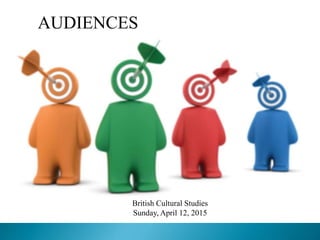
AUDIENCES
British Cultural Studies
Sunday, April 12, 2015
 Audience Theory
 Ethnography
 David Morley’s Nationwide Study
 Dorothy Hobson: Crossroads: The Drama of a Soap Opera
 Ethnography vs. Anthropology
 Terms to Remember
 An audience to a film is the crucial component that makes a
film successful. Without an audience there is no film.
 When targeting your audience for your film, it is important
to look at these factors:
- The construction of audience
- The way audiences view text
- The audience motivation
- The effect on the audience
Audience can be constructed by:
 Age
 Gender
 Sexuality
 Social Class
 Income
 Ethnicity
 Educational Background
 Rural/Urban
 Cultural/Religious Background
When categorising an audience it is always important to
consider these factors.
 Ethnography is a method of study and data collection
involving a trained observer documenting the life of an
extant people or group using a participant/observe
strategy and then describe the ways in which it makes
sense for those within it.
 David Morley is a sociologist who specialises in the
sociology of TV audiences. In 1980 he arranged for
differing socio/economic groups to watch an episode of
Nationwide.
 What is Nationwide?
Nationwide was a popular magazine programme which
discussed current media affairs. This programme was
aired on BBC1.
 David Morley’s research involving Nationwide has become an important
study when concerning audiences.
 What was the study?
Morley outlined three hypothetical position which the reader might
occupy:
- Dominant (or ‘hegemonic’) reading: This is where the reader shares
the programmes ‘code’ (Its meaning system of values, attitudes, beliefs
and assumptions) and fully accepts the programmes ‘preferred reading’
- Negotiated reading: This is where the reader partially shares the
programmes code and its preferred reading, however they modify it
which reflects their position and interest.
- Oppositional (‘Counter-hegemonic’) reading: This is where the reader
does not share the programme’s code and completely rejects the
preferred reading, which brings an alternative frame of interpretation.
 Sociologist David Morley argues that ‘members of a given
sub-culture will tend to share a cultural orientation towards
decoding messages in particular ways. Their individual
“readings” of messages will be framed by shared cultural
formations and practices’.
 In conclusion Morley claims that an individuals ‘decoding’
of TV programmes are not reduced to a direct consequence
of social class position.
 Therefore, the meaning of text will be constructed
differently according to the discourses brought by the reader.
 Individuals that are in different social positions that are
defined according to sex, race etc will be likely to inhabit
disposable different codes and subcultures.
 However, media critic Sujeong Kim in Re-reading David
Morley's The 'Nationwide' Audience, a statistical re-
analysis of the project's findings, suggests that this may
have been an underinterpretation. For example, Kim
observes that middle class viewers produced negotiated
readings of one particular program, while working class
viewers produced dominant or oppositional readings
dependent on their gender and race.
An type of audience is separated into different categories.
 A - higher managerial and professional
 B - middle managerial and professional
 C1 - supervisory, junior management and professional
 C2 - skilled manual worker
 D - semi-skilled and unskilled manual workers
 E - pensioners, lower grade workers and the unemployed
 Crossroads was an early evening soap opera shown in
Britain on a commercial channel. It was widely
acknowledged as the rock bottom of technical quality in
British television drama, and was the object of warnings
from Britain’s regulatory authorities about its low standards
on a number of occasions.
 Hobson’s book Crossroads: The Drama of a Soap Opera is
often discussed as if it is a study of the program’s audience,
but it was only one part of the project.
 The book begins with a discussion of TV soaps and their
history, and then moves into a closely observed study of the
production of Crossroads itself.
 Hobson’s research is quite similar to that of Morley.
 The key strategic difference between her approach and
that of David Morley in The ‘Nationwide’Audience is
that instead of bringing audiences into her academic
researcher’s world, she goes into theirs.
 She watches television with her audience subjects, in
their own homes, at the normal time.
 Her research data come from interviews and
observations made while watching episodes and from
the ‘long, unstructured conversations’ she had with her
subjects after the program is finished.
 The results were similar; like Morley, she was
convinced that audiences ‘work on’ television texts to
change their specific meanings. (Limited Effect
Theory)
 As mentioned earlier, in ethnographic research, the
researcher is to enter another culture, participate in it
and observe it; therefore, Hobson’s research was more
ethnographic than that of Morley’s due to the element
of getting submerged into another culture and
atmosphere.
 Ethnography is a method of study and data collection
involving a trained observer documenting the life of an
extant people or group using a participant/observe strategy
and then describe the ways in which it makes sense for
those within it.
 Anthropology is the scientific discipline that focuses on the
human species, its origins, its evolution, distribution,
commonalities and diversity in the way human organize and
adapt over time and space.
Simply put, Ethnography is for the living, Anthropology is
rather for the dead.
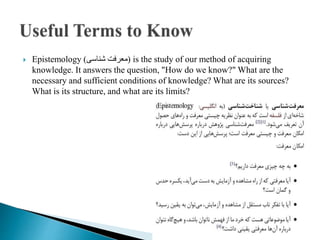
 Epistemology )‫شناسی‬ ‫معرفت‬( is the study of our method of acquiring
knowledge. It answers the question, "How do we know?" What are the
necessary and sufficient conditions of knowledge? What are its sources?
What is its structure, and what are its limits?
 Semiotics )‫شناسی‬ ‫نماد‬( is closely related to the field of linguistics,
which, for its part, studies the structure and meaning of language
more specifically. The Semiotic Tradition explores the study of
signs and symbols as a significant part of communications. As
different from linguistics, however, semiotics also studies non-
linguistic sign systems. Semiotics often is divided into three
branches:
 Semantics )‫شناسی‬ ‫معنا‬ ‫علم‬( : relation between signs and the things
to which they refer; their denotata, or meaning
 Syntactics )‫نحو‬( : relations among signs in formal structures
 Pragmatics )‫شناسی‬ ‫کاربرد‬( : relation between signs and sign-using
agents
 Semitotics and Semiology are used interchangeably in Merriam
Webster’s Dictionary.
 Hermeneutics )‫تفسیر‬ ‫علم‬( was initially applied to the
interpretation, or exegesis, of biblical writings. It
emerged as a theory of human understanding in the late
eighteenth and early nineteenth centuries through the
work of Friedrich Schleiermacher and Wilhelm Dilthey.
 The terms "hermeneutics" and "exegesis" are
sometimes used interchangeably. Hermeneutics is a
wider discipline which includes written, verbal, and
nonverbal communication. Exegesis focuses primarily
upon texts.
• Quantitative– Including
surveys and customer
questionnaires — can help
small firms to improve their
products and services by
enabling them to make
informed decisions
• Qualitative – is a method of
inquiry employed in many
different academic disciplines,
traditionally in the social
sciences
• Deductive – characterized by
or based on the inference of
particular instances from a
general law.
• Polysomic – the ambiguity of
an individual word or phrase
that can be used (in different
contexts) to express two or
more different meanings.
• Dominant reading – is the reading that
seems to be, for the majority of people in
society, the natural or normal way to
interpret a text.
• Negotiated reading – The process of give and
take by which members of the audience
interpret, deconstruct and find meaning
within a media text.
• Oppositional reading – A reading of a media
text that rejects the ideological positioning
and apparent meaning intended by the
producers of the text and substitutes a
radical alternative.
• Socio/economic group – Social class, as in a
class society, is a set of concepts in the
social sciences and political theory centred
on models of social stratification in which
people are grouped into a set of hierarchical
social categories, the most common being
the upper, middle, and lower classes.
• Demographic – Measurable characteristics of
media consumers such as age, gender, race,
education and income level.
 Turner. G (2002), British Cultural Studies, New York
and London, Routledge. P.109-139
 http://thesuperorganic.blogspot.com/2014/08/what-is-
difference-between-ethnography.html
 Caesar, Michael (1999). Umberto Eco: Philosophy,
Semiotics, and the Work of Fiction. Wiley-Blackwell.
p. 55.
 http://en.wikipedia.org/wiki/Hermeneutics
 http://www.merriam-webster.com/dictionary/semiology
 http://visual-
memory.co.uk/daniel/Documents/short/morleynw.html

Audiences

  • 1.
  • 2.
     Audience Theory Ethnography  David Morley’s Nationwide Study  Dorothy Hobson: Crossroads: The Drama of a Soap Opera  Ethnography vs. Anthropology  Terms to Remember
  • 3.
     An audienceto a film is the crucial component that makes a film successful. Without an audience there is no film.  When targeting your audience for your film, it is important to look at these factors: - The construction of audience - The way audiences view text - The audience motivation - The effect on the audience
  • 4.
    Audience can beconstructed by:  Age  Gender  Sexuality  Social Class  Income  Ethnicity  Educational Background  Rural/Urban  Cultural/Religious Background When categorising an audience it is always important to consider these factors.
  • 5.
     Ethnography isa method of study and data collection involving a trained observer documenting the life of an extant people or group using a participant/observe strategy and then describe the ways in which it makes sense for those within it.
  • 6.
     David Morleyis a sociologist who specialises in the sociology of TV audiences. In 1980 he arranged for differing socio/economic groups to watch an episode of Nationwide.  What is Nationwide? Nationwide was a popular magazine programme which discussed current media affairs. This programme was aired on BBC1.
  • 7.
     David Morley’sresearch involving Nationwide has become an important study when concerning audiences.  What was the study? Morley outlined three hypothetical position which the reader might occupy: - Dominant (or ‘hegemonic’) reading: This is where the reader shares the programmes ‘code’ (Its meaning system of values, attitudes, beliefs and assumptions) and fully accepts the programmes ‘preferred reading’ - Negotiated reading: This is where the reader partially shares the programmes code and its preferred reading, however they modify it which reflects their position and interest. - Oppositional (‘Counter-hegemonic’) reading: This is where the reader does not share the programme’s code and completely rejects the preferred reading, which brings an alternative frame of interpretation.
  • 8.
     Sociologist DavidMorley argues that ‘members of a given sub-culture will tend to share a cultural orientation towards decoding messages in particular ways. Their individual “readings” of messages will be framed by shared cultural formations and practices’.  In conclusion Morley claims that an individuals ‘decoding’ of TV programmes are not reduced to a direct consequence of social class position.  Therefore, the meaning of text will be constructed differently according to the discourses brought by the reader.  Individuals that are in different social positions that are defined according to sex, race etc will be likely to inhabit disposable different codes and subcultures.
  • 9.
     However, mediacritic Sujeong Kim in Re-reading David Morley's The 'Nationwide' Audience, a statistical re- analysis of the project's findings, suggests that this may have been an underinterpretation. For example, Kim observes that middle class viewers produced negotiated readings of one particular program, while working class viewers produced dominant or oppositional readings dependent on their gender and race.
  • 10.
    An type ofaudience is separated into different categories.  A - higher managerial and professional  B - middle managerial and professional  C1 - supervisory, junior management and professional  C2 - skilled manual worker  D - semi-skilled and unskilled manual workers  E - pensioners, lower grade workers and the unemployed
  • 11.
     Crossroads wasan early evening soap opera shown in Britain on a commercial channel. It was widely acknowledged as the rock bottom of technical quality in British television drama, and was the object of warnings from Britain’s regulatory authorities about its low standards on a number of occasions.  Hobson’s book Crossroads: The Drama of a Soap Opera is often discussed as if it is a study of the program’s audience, but it was only one part of the project.  The book begins with a discussion of TV soaps and their history, and then moves into a closely observed study of the production of Crossroads itself.
  • 12.
     Hobson’s researchis quite similar to that of Morley.  The key strategic difference between her approach and that of David Morley in The ‘Nationwide’Audience is that instead of bringing audiences into her academic researcher’s world, she goes into theirs.  She watches television with her audience subjects, in their own homes, at the normal time.  Her research data come from interviews and observations made while watching episodes and from the ‘long, unstructured conversations’ she had with her subjects after the program is finished.
  • 13.
     The resultswere similar; like Morley, she was convinced that audiences ‘work on’ television texts to change their specific meanings. (Limited Effect Theory)  As mentioned earlier, in ethnographic research, the researcher is to enter another culture, participate in it and observe it; therefore, Hobson’s research was more ethnographic than that of Morley’s due to the element of getting submerged into another culture and atmosphere.
  • 14.
     Ethnography isa method of study and data collection involving a trained observer documenting the life of an extant people or group using a participant/observe strategy and then describe the ways in which it makes sense for those within it.  Anthropology is the scientific discipline that focuses on the human species, its origins, its evolution, distribution, commonalities and diversity in the way human organize and adapt over time and space. Simply put, Ethnography is for the living, Anthropology is rather for the dead.
  • 15.
     Epistemology )‫شناسی‬‫معرفت‬( is the study of our method of acquiring knowledge. It answers the question, "How do we know?" What are the necessary and sufficient conditions of knowledge? What are its sources? What is its structure, and what are its limits?
  • 16.
     Semiotics )‫شناسی‬‫نماد‬( is closely related to the field of linguistics, which, for its part, studies the structure and meaning of language more specifically. The Semiotic Tradition explores the study of signs and symbols as a significant part of communications. As different from linguistics, however, semiotics also studies non- linguistic sign systems. Semiotics often is divided into three branches:  Semantics )‫شناسی‬ ‫معنا‬ ‫علم‬( : relation between signs and the things to which they refer; their denotata, or meaning  Syntactics )‫نحو‬( : relations among signs in formal structures  Pragmatics )‫شناسی‬ ‫کاربرد‬( : relation between signs and sign-using agents  Semitotics and Semiology are used interchangeably in Merriam Webster’s Dictionary.
  • 17.
     Hermeneutics )‫تفسیر‬‫علم‬( was initially applied to the interpretation, or exegesis, of biblical writings. It emerged as a theory of human understanding in the late eighteenth and early nineteenth centuries through the work of Friedrich Schleiermacher and Wilhelm Dilthey.  The terms "hermeneutics" and "exegesis" are sometimes used interchangeably. Hermeneutics is a wider discipline which includes written, verbal, and nonverbal communication. Exegesis focuses primarily upon texts.
  • 18.
    • Quantitative– Including surveysand customer questionnaires — can help small firms to improve their products and services by enabling them to make informed decisions • Qualitative – is a method of inquiry employed in many different academic disciplines, traditionally in the social sciences • Deductive – characterized by or based on the inference of particular instances from a general law. • Polysomic – the ambiguity of an individual word or phrase that can be used (in different contexts) to express two or more different meanings. • Dominant reading – is the reading that seems to be, for the majority of people in society, the natural or normal way to interpret a text. • Negotiated reading – The process of give and take by which members of the audience interpret, deconstruct and find meaning within a media text. • Oppositional reading – A reading of a media text that rejects the ideological positioning and apparent meaning intended by the producers of the text and substitutes a radical alternative. • Socio/economic group – Social class, as in a class society, is a set of concepts in the social sciences and political theory centred on models of social stratification in which people are grouped into a set of hierarchical social categories, the most common being the upper, middle, and lower classes. • Demographic – Measurable characteristics of media consumers such as age, gender, race, education and income level.
  • 19.
     Turner. G(2002), British Cultural Studies, New York and London, Routledge. P.109-139  http://thesuperorganic.blogspot.com/2014/08/what-is- difference-between-ethnography.html  Caesar, Michael (1999). Umberto Eco: Philosophy, Semiotics, and the Work of Fiction. Wiley-Blackwell. p. 55.  http://en.wikipedia.org/wiki/Hermeneutics  http://www.merriam-webster.com/dictionary/semiology  http://visual- memory.co.uk/daniel/Documents/short/morleynw.html