From Effects to Reception
              Theory
• Learning Objectives:

• To understand newer ways of thinking about
  audiences
  – To discuss Stuart Hall’s Encoding / Decoding
    Theory
  – To understand the notion of Global Village
  – To discuss whether Media is becoming more
    democratic and consider current debates.
Jürgen Habermas
• “The advanced capitalist phase of modernity
  transformed the public sphere from a culture-
  debating one to a culture-consumer one”
• Advertising and PR have diluted the public
  sphere and dragged it into the ‘levelling down’
  pit of mass-media.
• Modern day consumers are ‘hoodwinked’ into
  ‘constant consumption training’ that shapes
  public opinions into a soft exchange of views.
  (1989)
Stuart Hall, 1982

• The meanings of messages are able to be
  distorted and interpreted differently by
  audiences than intended by the producers.

• Language / messages are encoded (=made
  to mean something) by those with ‘the
  means of meaning production’ and are then
  decoded(=made to mean something) by
  audiences
Reception of
text:
Dominant code
Negociated code
Oppositional
code
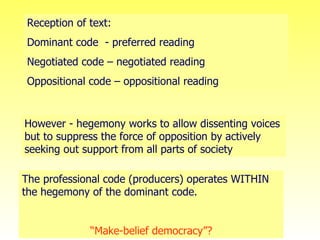
Reception of text:
Dominant code - preferred reading
Negotiated code – negotiated reading
Oppositional code – oppositional reading


However - hegemony works to allow dissenting voices
but to suppress the force of opposition by actively
seeking out support from all parts of society

The professional code (producers) operates WITHIN
the hegemony of the dominant code.


             “Make-belief democracy”?
Resistance to dominant ideologies

• Sub-cultures operate through a system of
  oppositional codes that offend the majority
  and threaten the status quo.
• Aim to resist incorporation into the
  mainstream

• Role of new media – helpful or destructive for
  sub cultures?
• Also, more and more niche audiences.
McLuhan’s Global Village
• Telephone, TV and now the internet are
  shrinking the world and bringing people
  closer together.
• Eg. The world’s online Marketplace, Ebay,
  MySpace, Facebook etc… as global
  villages where users spatially distant from
  each other can converge around common
  tastes and interests.
• But social and economic exclusion for
  many.
Democratisation of the media?
Is the media more
              democratised?
• Buckingham on Media/Web 2.0

  http://www.englishandmedia.co.uk/mm/subscribers/mmclips/b

• McDougall on Media 2.0

  http://www.englishandmedia.co.uk/mm/subscribers/_mmclips/

• http://www.englishandmedia.co.uk/mm/subscribers/_mmclips/
About New Media Democracy and new era journalism
                Posted by businge

Imagine a world where all journalism was of the people, by
the people, for the people. Where all people have a chance to
participate, where anyone has a chance for their voice to be
heard, where all participations in the media are geared
towards the people, and where people (general public
interest) are the center of all media interactions. That, while
not perfect, would be the best journalism.

New information and communication tools are already almost
developing this ideal. There are new media tools enabling all
to communicate, engage, offer feedback, have their say etc.
But the noise in the crowd is too much to facilitate any
substantial conversation and understanding necessary for
informed decisions-the essence of democracy and free
participation. So we still need the people who specialize in
gathering information on particular issues and disseminating
distilled information in the public interest.
Opinion 1
• In many ways, it helps to look at new media as a
  form of media democracy where there is better
  chance that what the media does is of the
  people, by the people and for the people. So
  while it is unsettling for many media houses and
  journalists, I have come to accept that the new
  media tools and trends present the best chance
  for the media and journalism to do their best in
  informing, educating and entertaining while
  providing the best chance for audience
  engagement and citizen participation.
Opinion 2
•   I've been rather busy of late, but I did manage to read some articles on
    how social media have promoted democracy, and how people are
    more involved with politics, elections, campaigns ... and with one
    another... due to web 2.0 tools. I also had a read about democracy and
    social media.
    I believe that the Internet has given an opportunity to all people to be
    more involved, share their views and take action ...oh and donate
    money...
    So, people are more engaged and their views are out there for
    politicians to take them into consideration. But wait... just because I
    Blog and use facebook and social groups or use twitter to write what
    I'm doing does not make me an active citizen in my community in real
    life. Sure, it makes me an active member, but, in an online
    constituency, sharing my views with like minded people.
    Participatory democracy needs people to be involved, and YES you
    can be involved through social media. You will also need to act in real
    life.
Opinion 3
Data traffic indicates that, online, we are increasingly
talking to people just like ourselves, relying on our
friends' directions to navigate the web. It's ironic that,
rather than opening us up to an ever-greater number of
opinions and attitudes, social networking sites such as
Facebook and Twitter may actually be narrowing our
worldview, confirming what we already believe and
reinforcing attitudes we hold already.

So what happens when we only communicate with people
like ourselves, and the messages we share only reinforce
our mutual hatred? It's a technique radical religious and
racist organisations have always used to make sure their
members conform, but now they're employing
technological tools to create global communities of like-
minded ideologues.
Research topics
• Eastenders cot death plot line
• Untangling the Net webpages – hate and
  bullying
• Weakileaks
• Tunisia
• UK Uncut
• Trolls
• Mumsnet

From effects to reception theory slides

  • 1.
    From Effects toReception Theory • Learning Objectives: • To understand newer ways of thinking about audiences – To discuss Stuart Hall’s Encoding / Decoding Theory – To understand the notion of Global Village – To discuss whether Media is becoming more democratic and consider current debates.
  • 3.
    Jürgen Habermas • “Theadvanced capitalist phase of modernity transformed the public sphere from a culture- debating one to a culture-consumer one” • Advertising and PR have diluted the public sphere and dragged it into the ‘levelling down’ pit of mass-media. • Modern day consumers are ‘hoodwinked’ into ‘constant consumption training’ that shapes public opinions into a soft exchange of views. (1989)
  • 6.
    Stuart Hall, 1982 •The meanings of messages are able to be distorted and interpreted differently by audiences than intended by the producers. • Language / messages are encoded (=made to mean something) by those with ‘the means of meaning production’ and are then decoded(=made to mean something) by audiences
  • 7.
  • 8.
    Reception of text: Dominantcode - preferred reading Negotiated code – negotiated reading Oppositional code – oppositional reading However - hegemony works to allow dissenting voices but to suppress the force of opposition by actively seeking out support from all parts of society The professional code (producers) operates WITHIN the hegemony of the dominant code. “Make-belief democracy”?
  • 10.
    Resistance to dominantideologies • Sub-cultures operate through a system of oppositional codes that offend the majority and threaten the status quo. • Aim to resist incorporation into the mainstream • Role of new media – helpful or destructive for sub cultures? • Also, more and more niche audiences.
  • 11.
    McLuhan’s Global Village •Telephone, TV and now the internet are shrinking the world and bringing people closer together. • Eg. The world’s online Marketplace, Ebay, MySpace, Facebook etc… as global villages where users spatially distant from each other can converge around common tastes and interests. • But social and economic exclusion for many.
  • 13.
  • 15.
    Is the mediamore democratised? • Buckingham on Media/Web 2.0 http://www.englishandmedia.co.uk/mm/subscribers/mmclips/b • McDougall on Media 2.0 http://www.englishandmedia.co.uk/mm/subscribers/_mmclips/ • http://www.englishandmedia.co.uk/mm/subscribers/_mmclips/
  • 16.
    About New MediaDemocracy and new era journalism Posted by businge Imagine a world where all journalism was of the people, by the people, for the people. Where all people have a chance to participate, where anyone has a chance for their voice to be heard, where all participations in the media are geared towards the people, and where people (general public interest) are the center of all media interactions. That, while not perfect, would be the best journalism. New information and communication tools are already almost developing this ideal. There are new media tools enabling all to communicate, engage, offer feedback, have their say etc. But the noise in the crowd is too much to facilitate any substantial conversation and understanding necessary for informed decisions-the essence of democracy and free participation. So we still need the people who specialize in gathering information on particular issues and disseminating distilled information in the public interest.
  • 17.
    Opinion 1 • Inmany ways, it helps to look at new media as a form of media democracy where there is better chance that what the media does is of the people, by the people and for the people. So while it is unsettling for many media houses and journalists, I have come to accept that the new media tools and trends present the best chance for the media and journalism to do their best in informing, educating and entertaining while providing the best chance for audience engagement and citizen participation.
  • 18.
    Opinion 2 • I've been rather busy of late, but I did manage to read some articles on how social media have promoted democracy, and how people are more involved with politics, elections, campaigns ... and with one another... due to web 2.0 tools. I also had a read about democracy and social media. I believe that the Internet has given an opportunity to all people to be more involved, share their views and take action ...oh and donate money... So, people are more engaged and their views are out there for politicians to take them into consideration. But wait... just because I Blog and use facebook and social groups or use twitter to write what I'm doing does not make me an active citizen in my community in real life. Sure, it makes me an active member, but, in an online constituency, sharing my views with like minded people. Participatory democracy needs people to be involved, and YES you can be involved through social media. You will also need to act in real life.
  • 19.
    Opinion 3 Data trafficindicates that, online, we are increasingly talking to people just like ourselves, relying on our friends' directions to navigate the web. It's ironic that, rather than opening us up to an ever-greater number of opinions and attitudes, social networking sites such as Facebook and Twitter may actually be narrowing our worldview, confirming what we already believe and reinforcing attitudes we hold already. So what happens when we only communicate with people like ourselves, and the messages we share only reinforce our mutual hatred? It's a technique radical religious and racist organisations have always used to make sure their members conform, but now they're employing technological tools to create global communities of like- minded ideologues.
  • 20.
    Research topics • Eastenderscot death plot line • Untangling the Net webpages – hate and bullying • Weakileaks • Tunisia • UK Uncut • Trolls • Mumsnet