RECEPTION ANALYSIS
5.31.16
some of the
Chapter 10 was
familiar …
COM 110 / 160,
right?
“hypodermic needle” approach
“two-step flow model”
cultivation theory
uses and gratifications
are there
problems
with these
theories??
remember in the very first lecture:
the trouble with ‘mass media’?
https://www.youtube.com/watch?v=Qt5MjBlvGcY
For example:
You may recall this from COM160. It
was a guiding theory for awhile, until
the models of communication
presented earlier.
You’ll see it again in Chapter 10 …
but it’s not intended to be taken up in
our stock house of critical theories;
And you may also see the passive,
gullible masses argument used
again in Marxist Analysis, but in the
tradition of critical theory.
Whereas this, this is what we call the
‘dominant paradigm.’
Can read more in this article: http://www.cwanderson.org/wp-content/uploads/2014/01/1353087053-
potter_paradigms_mass_media_research_1993.pdf
‘dominant paradigm’
“
”Potter, W.J., Cooper, R. & Dupagne, M. (1993). The Three Paradigms of Mass Media
Research in Mainstream Communication Journals, Communication Theory, 3(4), 317-335.
p. 317
http://www.cwanderson.org/wp-content/uploads/2014/01/1353087053-potter_paradigms_mass_media_research_1993.pdf
‘dominant paradigm’
“
”Potter, W.J., Cooper, R. & Dupagne, M. (1993). The Three Paradigms of Mass Media
Research in Mainstream Communication Journals, Communication Theory, 3(4), 317-335.
http://www.cwanderson.org/wp-content/uploads/2014/01/1353087053-potter_paradigms_mass_media_research_1993.pdf
p. 317
‘dominant paradigm’
defined for mass communication research
The ‘dominant paradigm’ combines a view of powerful mass
media in a mass society with the typical research practices of
the emerging social sciences …. The underlying view of society
in the dominant paradigm is essentially normative. It
presumes a certain kind of normally functioning ‘good society.’
Denis McQuial, p. 63
“
”
so what are the assumptions in the
dominant paradigm?
‘dominant paradigm’
‘critical paradigm’ a.k.a what we’ve been doing in this class
McQuail, p. 66
McQuail, p. 68
‘dominant paradigm’
Ok, so what are the “taken-
for-granted assumptions” that
guide researchers in the
dominant paradigm, who had
developed these theories?
“hypodermic needle” approach
“two-step flow model”
cultivation theory
uses and gratifications
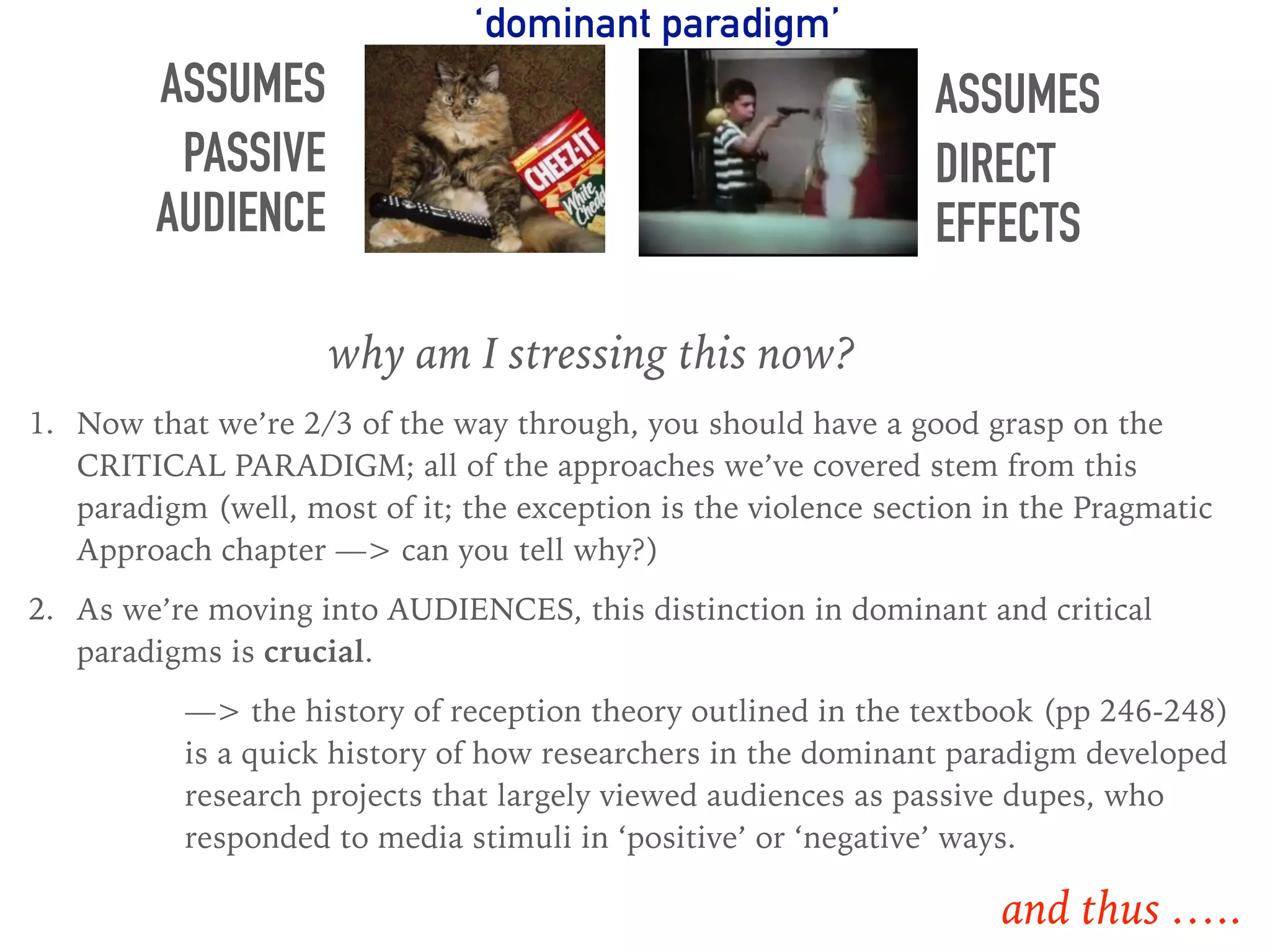
ASSUMES
PASSIVE
AUDIENCE
ASSUMES
DIRECT
EFFECTS
or in the case of Uses and Gratifications, new assumption! audiences can be active
… but … optimistically gives full control to the individual (see p 248 in textbook)
ASSUMES
PASSIVE
AUDIENCE
ASSUMES
DIRECT
EFFECTS
why am I stressing this now?
1. Now that we’re 2/3 of the way through, you should have a good grasp on the
CRITICAL PARADIGM; all of the approaches we’ve covered stem from this
paradigm (well, most of it; the exception is the violence section in the Pragmatic
Approach chapter —> can you tell why?)
2. As we’re moving into AUDIENCES, this distinction in dominant and critical
paradigms is crucial.
—> the history of reception theory outlined in the textbook (pp 246-248)
is a quick history of how researchers in the dominant paradigm developed
research projects that largely viewed audiences as passive dupes, who
responded to media stimuli in ‘positive’ or ‘negative’ ways.
‘dominant paradigm’
and thus …..
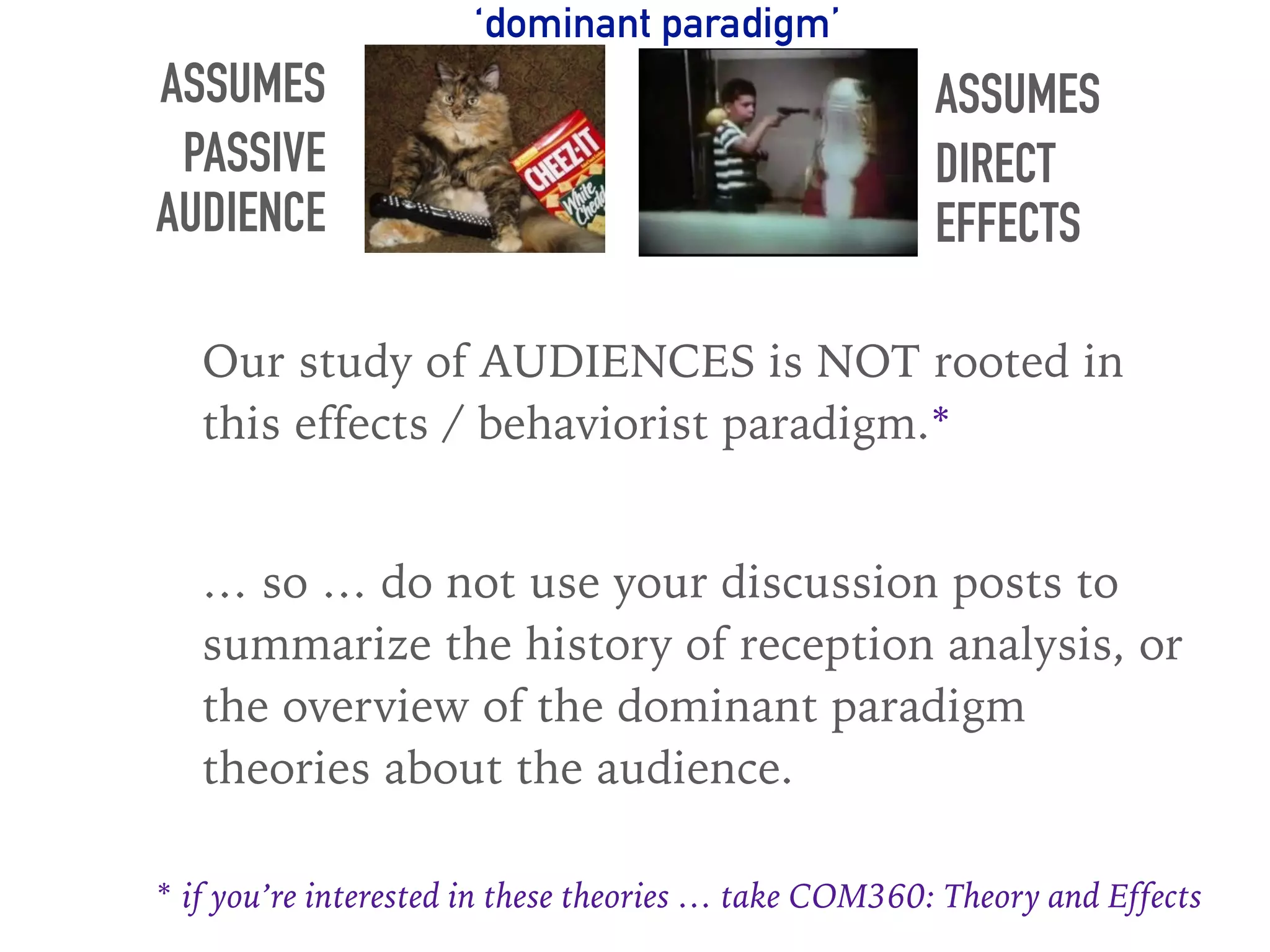
ASSUMES
PASSIVE
AUDIENCE
ASSUMES
DIRECT
EFFECTS
Our study of AUDIENCES is NOT rooted in
this effects / behaviorist paradigm.*
… so … do not use your discussion posts to
summarize the history of reception analysis, or
the overview of the dominant paradigm
theories about the audience.
‘dominant paradigm’
* if you’re interested in these theories … take COM360: Theory and Effects
RECEPTION ANALYSIS
It’s about how audiences (we) make meaning …
differs from the traditional media effects paradigm
which brings us back to …
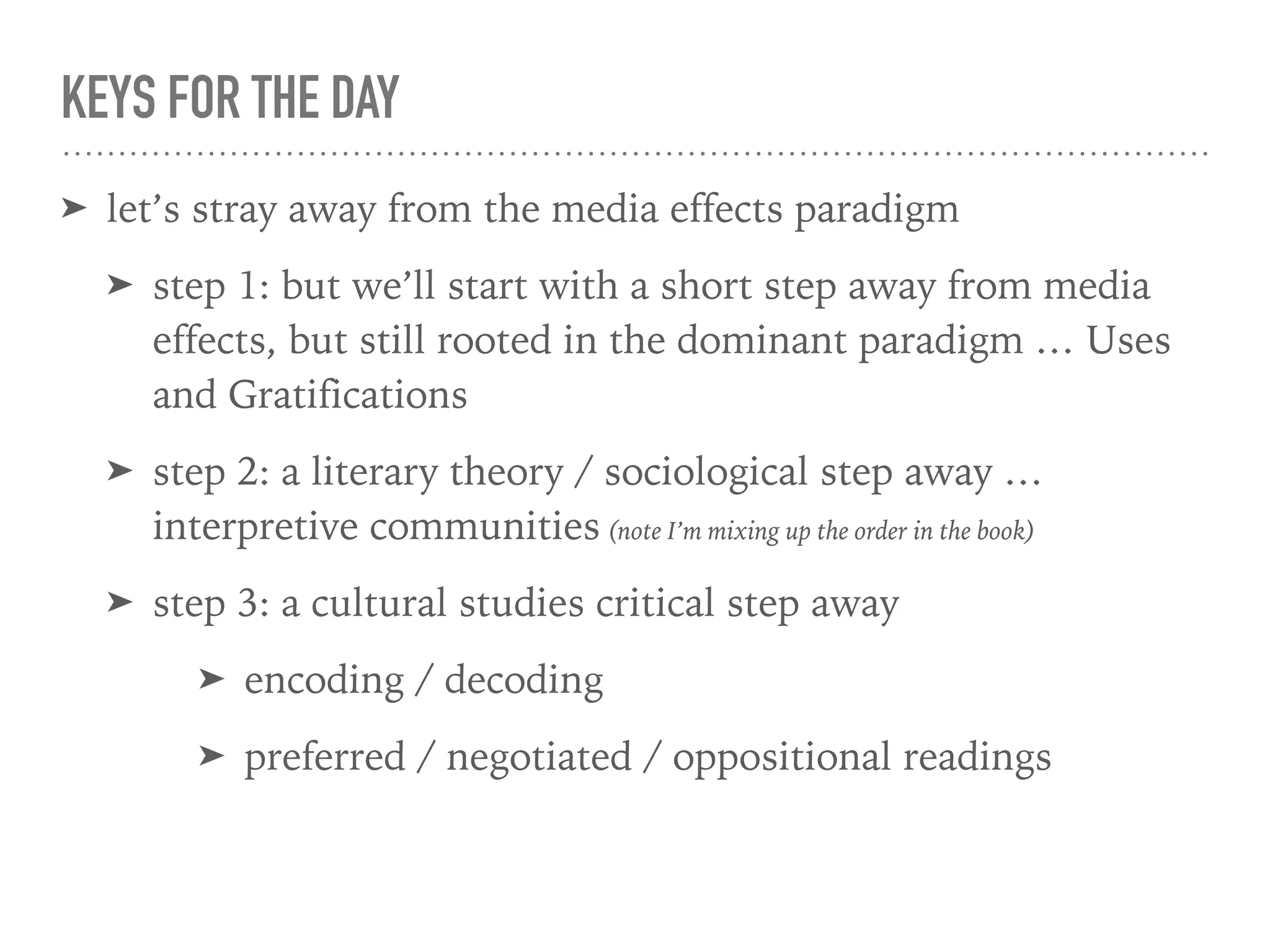
KEYS FOR THE DAY
➤ let’s stray away from the media effects paradigm
➤ step 1: but we’ll start with a short step away from media
effects, but still rooted in the dominant paradigm … Uses
and Gratifications
➤ step 2: a literary theory / sociological step away …
interpretive communities (note I’m mixing up the order in the book)
➤ step 3: a cultural studies critical step away
➤ encoding / decoding
➤ preferred / negotiated / oppositional readings
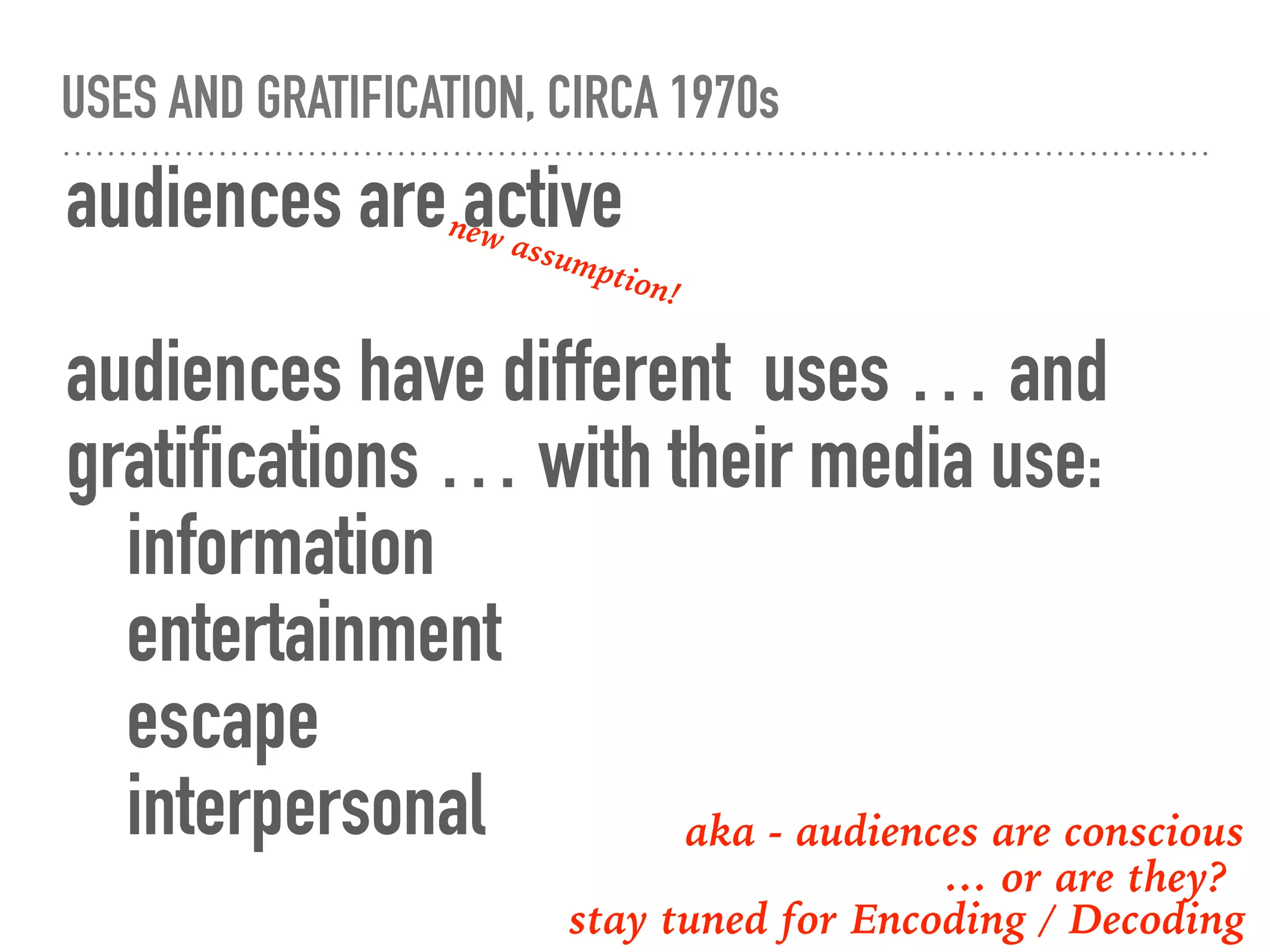
USES AND GRATIFICATION, CIRCA 1970s
audiences are active
audiences have different uses … and
gratifications … with their media use:
information
entertainment
escape
interpersonal
new assumption!
aka - audiences are conscious
… or are they?
stay tuned for Encoding / Decoding
USES AND GRATIFICATION
“ ESPN show Sportscenter. Some people use it to catch up on what happened during
that day in the sports world while others might just watch it for the top plays at the
end or to see the score of their favorite teams game.” - previous COM320 student
For example: various
uses for watching
Sportscenter?
ok … so yes; there’s a gut-level clarity about uses and grats.
But … 1) how is this different than market research (that’s
the critical researcher perspective) and 2) what about the
frameworks for a viewer to make meaning from this text?
… the conscious and unconscious ones (… see where I’m
getting at this? … we’re moving towards cultural studies)
INTERPRETIVE COMMUNITIES
“interpretive communities is a fancy word for
saying that people who live similar lifestyles
interpret messages in similar ways …. A small
scale example of interpretive communities is the
below youtube video where older generation
women try to define common slang words that
younger generations are currently using.
Their definitions are funny to those who use the
slang words, but these women base their
definitions on their own experiences.”
- previous COM320 student
https://
www.youtube.com/
watch?v=VRTeNN6UAzc
WATCH this clip:
INTERPRETIVE COMMUNITIES
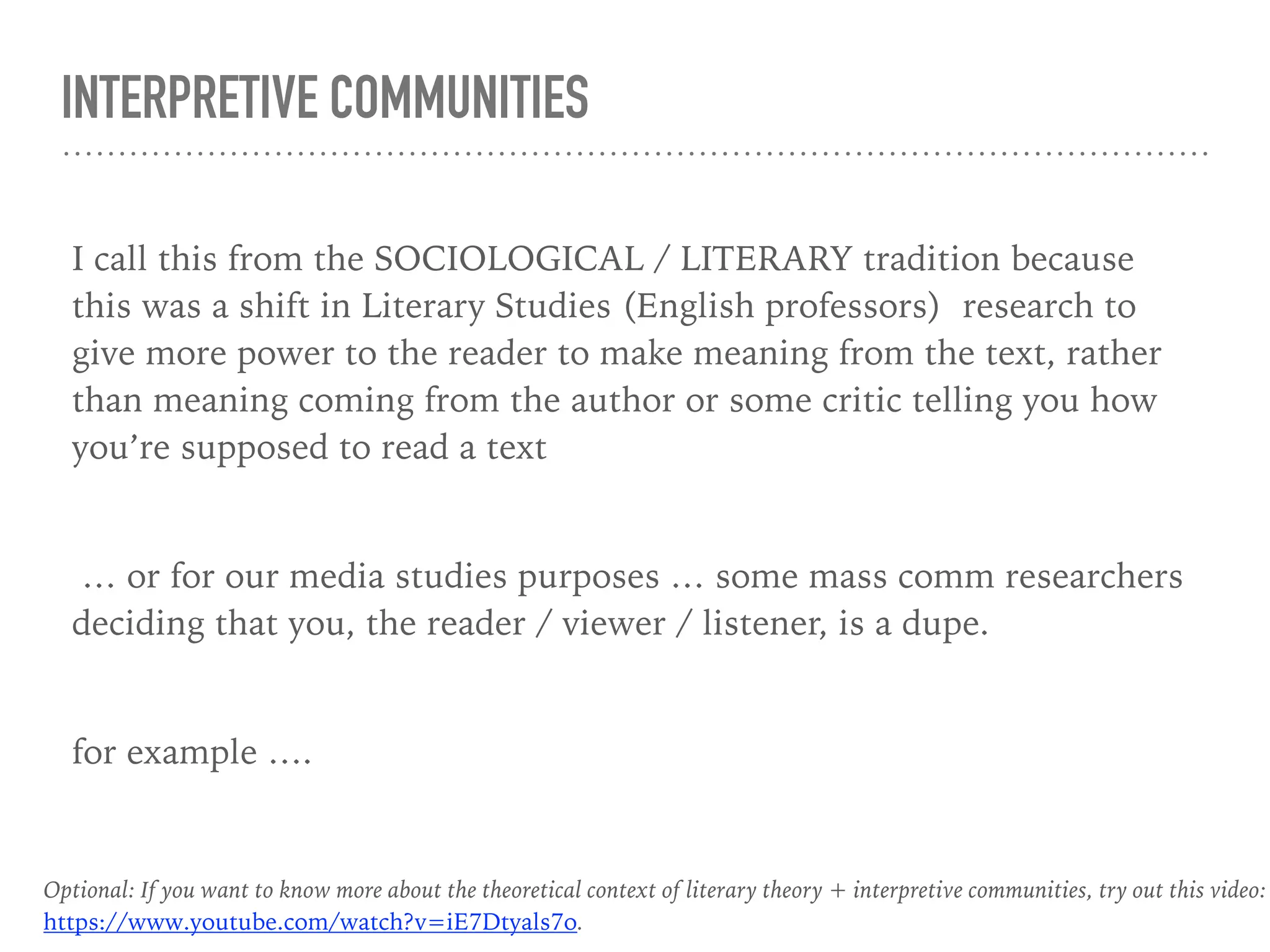
I call this from the SOCIOLOGICAL / LITERARY tradition because
this was a shift in Literary Studies (English professors) research to
give more power to the reader to make meaning from the text, rather
than meaning coming from the author or some critic telling you how
you’re supposed to read a text
… or for our media studies purposes … some mass comm researchers
deciding that you, the reader / viewer / listener, is a dupe.
for example ….
Optional: If you want to know more about the theoretical context of literary theory + interpretive communities, try out this video:
https://www.youtube.com/watch?v=iE7Dtyals7o.
ROMANCE NOVELS
BEFORE JANICE RADWAY: Why bother even studying these? The people
who read these (mostly women) are dupes;
This is a mass produced trash with no intrinsic
value that reproduce hegemonic gender roles.
ROMANCE NOVELS
JANICE RADWAY:
Oh yes we should study these; not only because it is a
major facet in the culture industry (that’s the marxist
approach), but more importantly, who are the readers?
What is the importance of the interpretive community?
And we should not assume that women = dupes (that’s a
consequence of academic research being mostly male and patriarchal …)
(I’m summarizing)
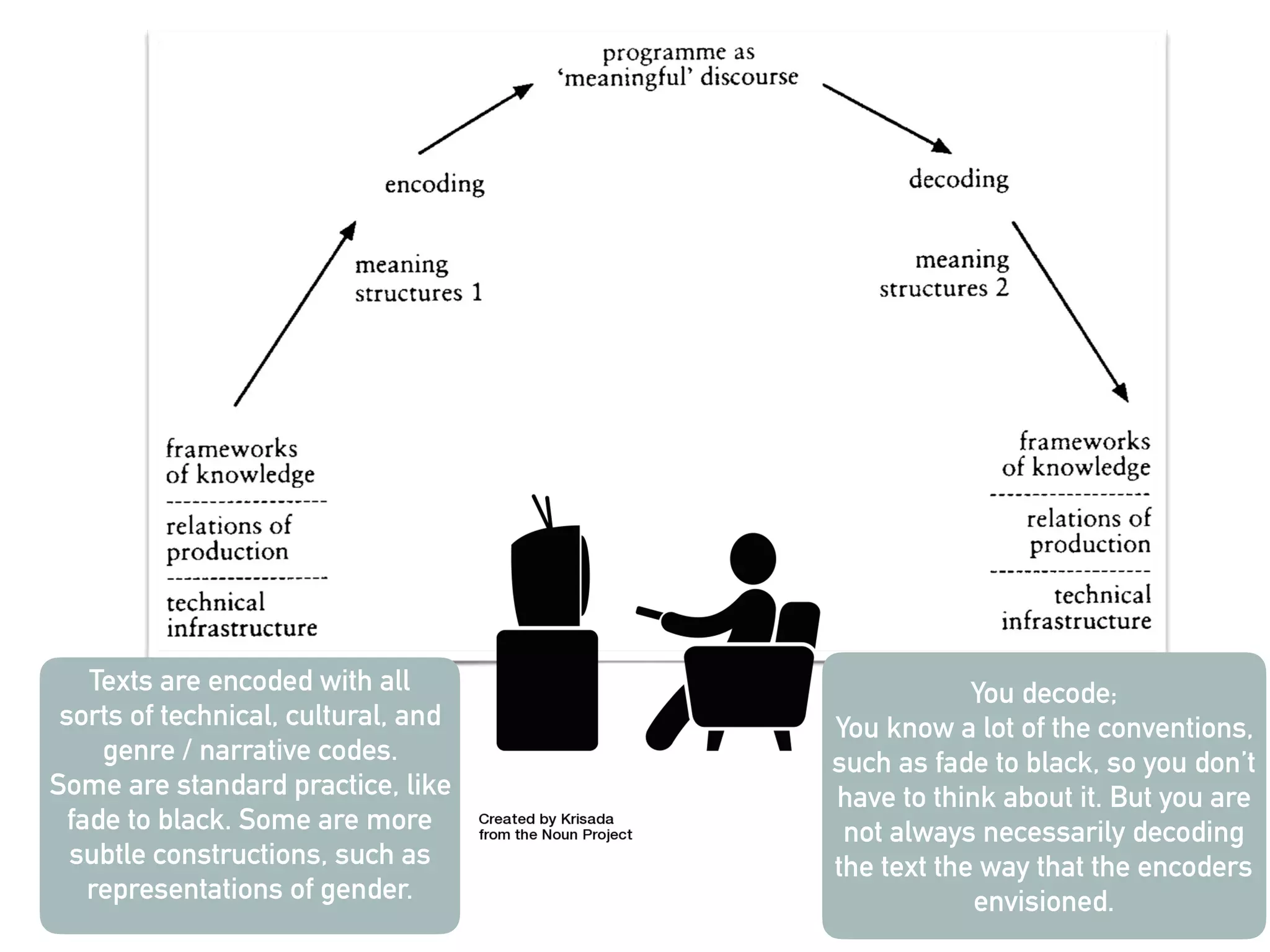
ENCODING
DECODING
A core model, or even a method, for cultural studies
Stuart Hall, Encoding, Decoding article posted on Reggienet. , p. 94
REVIEW FROM THE TEXTBOOK:
WHAT IS A CODE?
code: “set of rules that govern the use of
visual and linguistic signs within a culture”
p. 248
LET’S USE BASEBALL AS AN EXAMPLE
WHAT ARE THE CODES ASSOCIATED WITH BASEBALL?
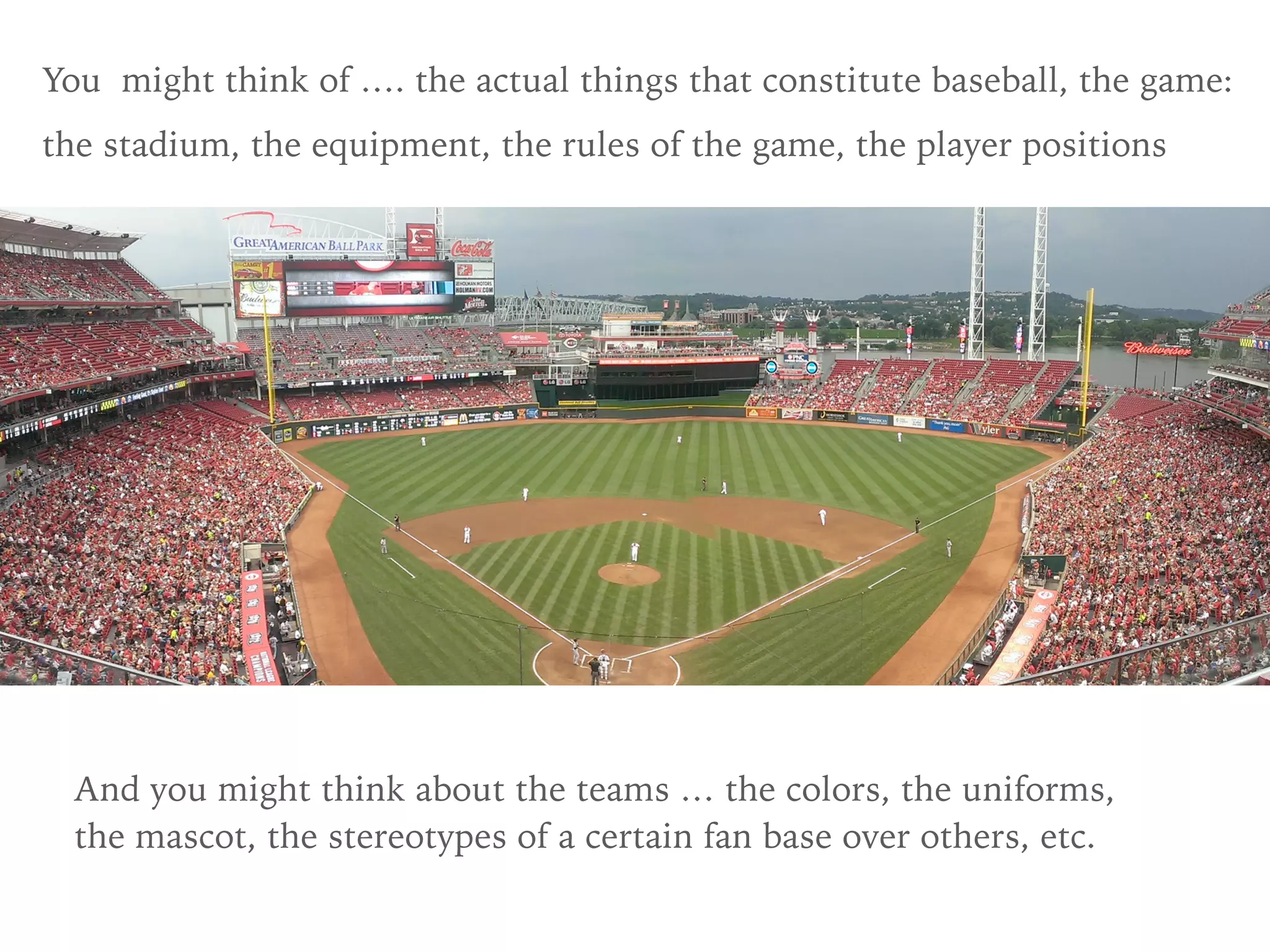
You might think of …. the actual things that constitute baseball, the game:
the stadium, the equipment, the rules of the game, the player positions
And you might think about the teams … the colors, the uniforms,
the mascot, the stereotypes of a certain fan base over others, etc.
You might think of the codes involved in the broadcasting of a game:
the announcers, the score / stats boxes, the display of those boxes,
the camera angles (for example, the shot above being
the center field camera, the angle from behind the
pitcher), the editing of the game (such as the
convention of center field camera, follow the ball, cut
to the runner heading to base, etc.), the replays.
You might think about the things in baseball that are not necessarily related to
the actual game of baseball, but have come to be known as baseball-ness
http://www.todayifoundout.com/
index.php/2013/12/story-u-s-
national-anthem-became-part-
national-pastime/
just a few many examples,
also note how American-focused these are; perhaps these
codes would be different in Latin America, Korea, or Japan.
THESE ARE ALL CODES.
Knowledge frameworks about how the game works, but also
what team colors / mascots mean, of what happens at a ball
game (e.g. what happens in the 7th inning?), of what
baseball-ness in America means.
Relations of the teams, of teams-fans, of ball players-team
owners, of teams-leagues, of MLB-tv contracts, etc. etc. etc.
Technical infrastructure of making baseball possible; more
specific to broadcasting baseball — the technical
infrastructure and knowledge frameworks to produce a tv or
radio broadcast.
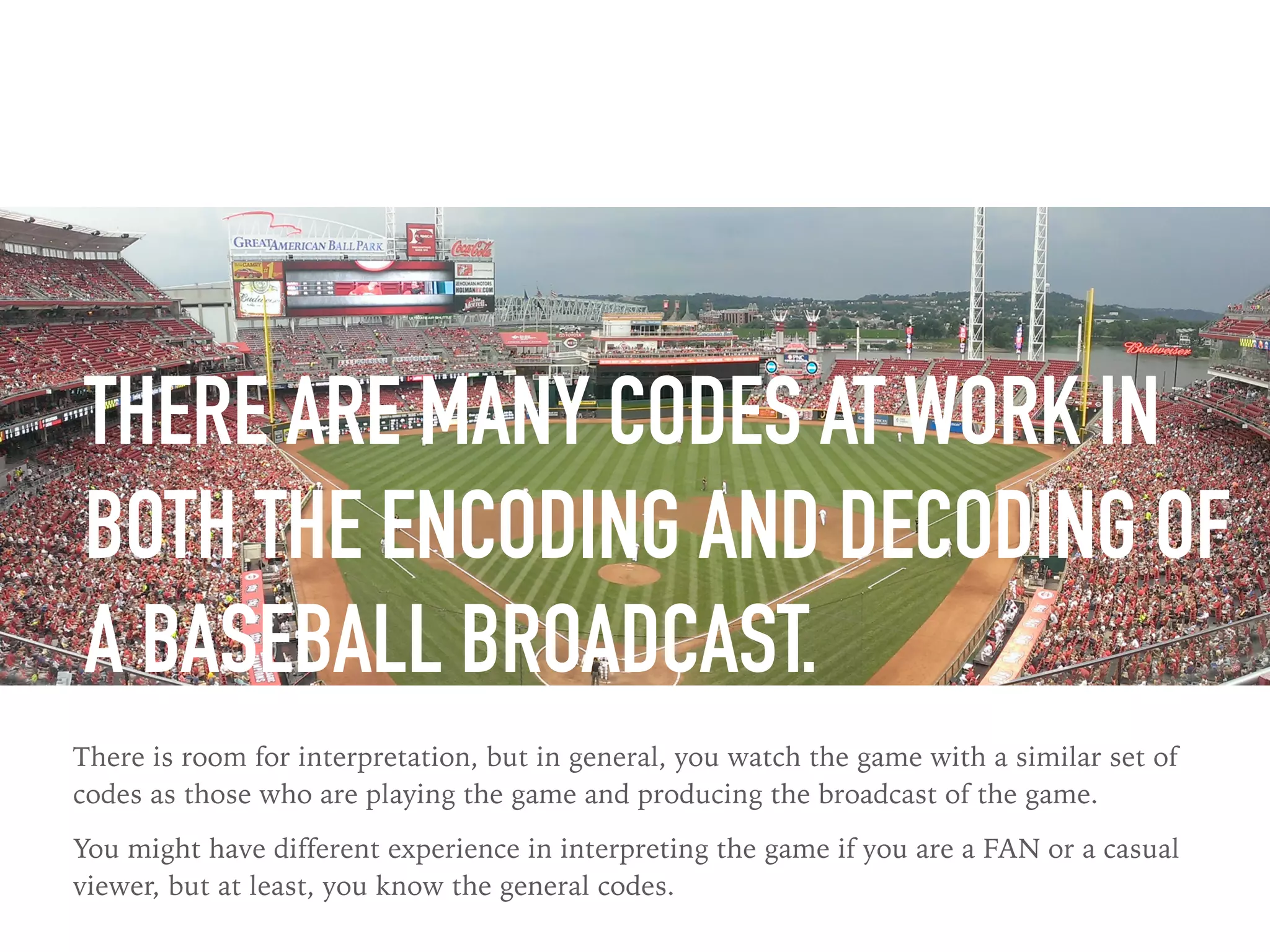
THERE ARE MANY CODES AT WORK IN
BOTH THE ENCODING AND DECODING OF
A BASEBALL BROADCAST.
There is room for interpretation, but in general, you watch the game with a similar set of
codes as those who are playing the game and producing the broadcast of the game.
You might have different experience in interpreting the game if you are a FAN or a casual
viewer, but at least, you know the general codes.
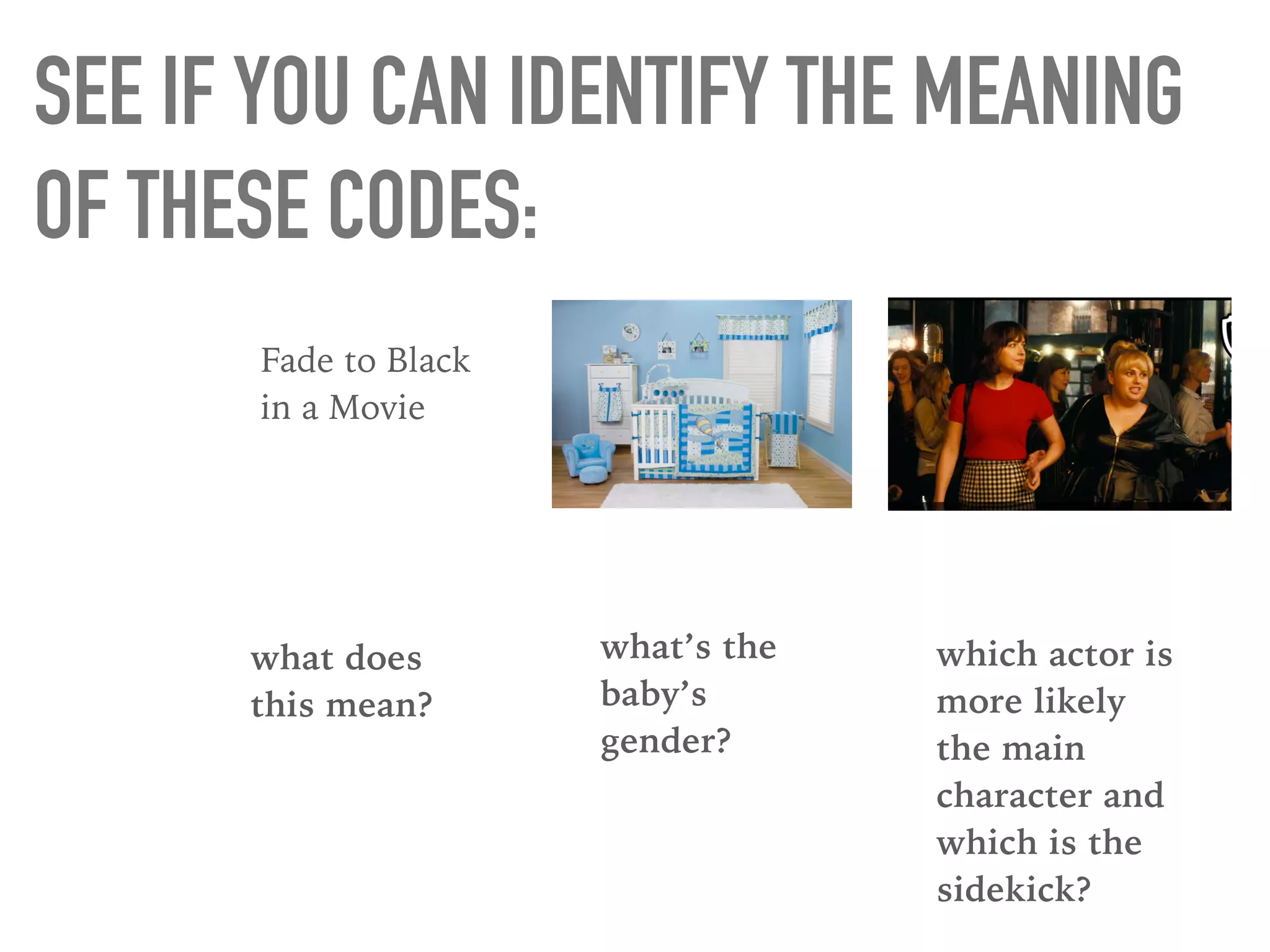
SEE IF YOU CAN IDENTIFY THE MEANING
OF THESE CODES:
Fade to Black
in a Movie
what does
this mean?
what’s the
baby’s
gender?
which actor is
more likely
the main
character and
which is the
sidekick?
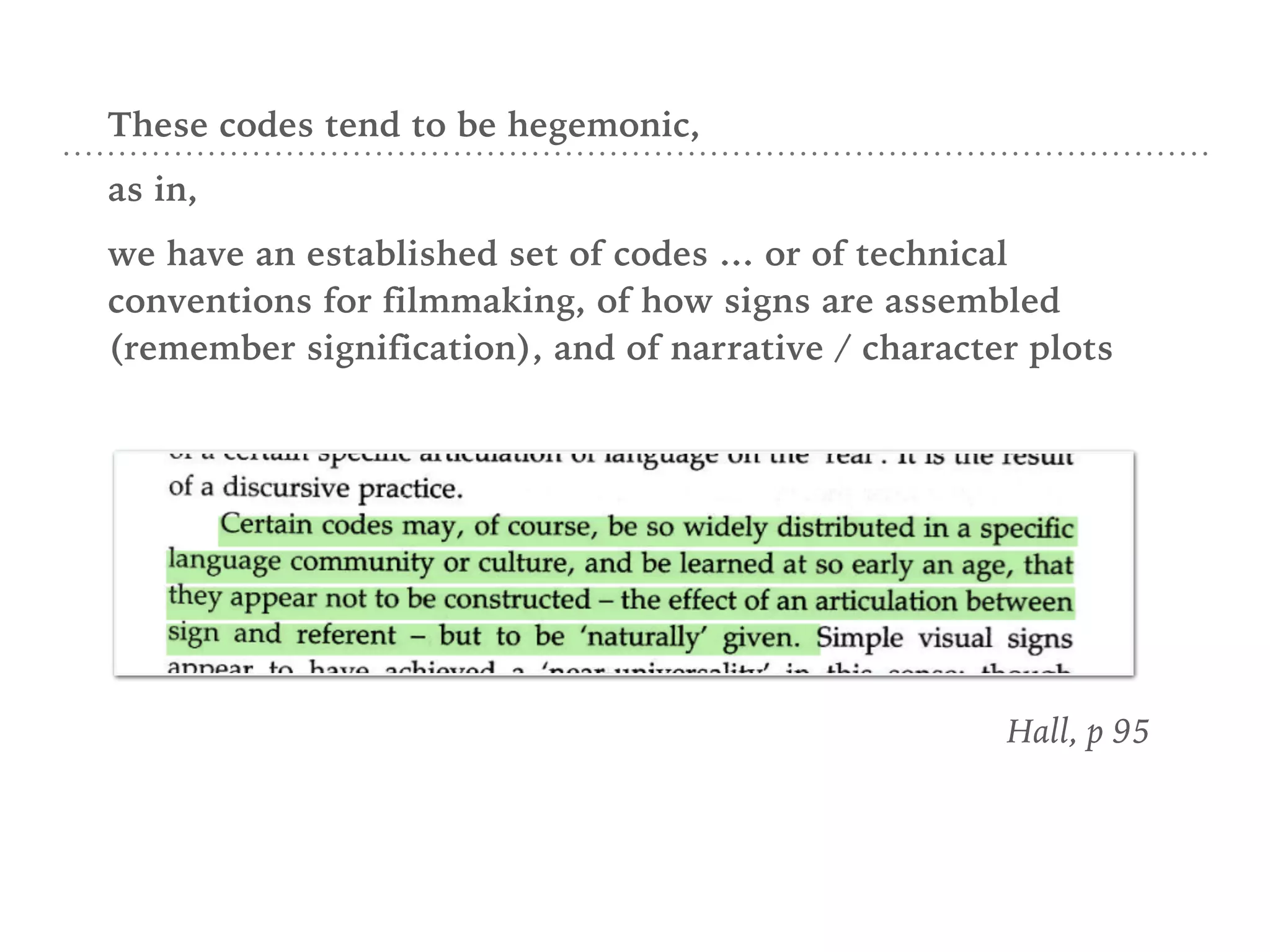
These codes tend to be hegemonic,
as in,
we have an established set of codes … or of technical
conventions for filmmaking, of how signs are assembled
(remember signification), and of narrative / character plots
Hall, p 95
Texts are encoded with all
sorts of technical, cultural, and
genre / narrative codes.
Some are standard practice, like
fade to black. Some are more
subtle constructions, such as
representations of gender.
You decode;
You know a lot of the conventions,
such as fade to black, so you don’t
have to think about it. But you are
not always necessarily decoding
the text the way that the encoders
envisioned.
WE’LL COME BACK TO ENCODING / DECODING,
BUT FIRST. …
POLYSEMY “polysemy refers to the relative
openness of media texts to multiple
interpretation” Ott + Mack, p251
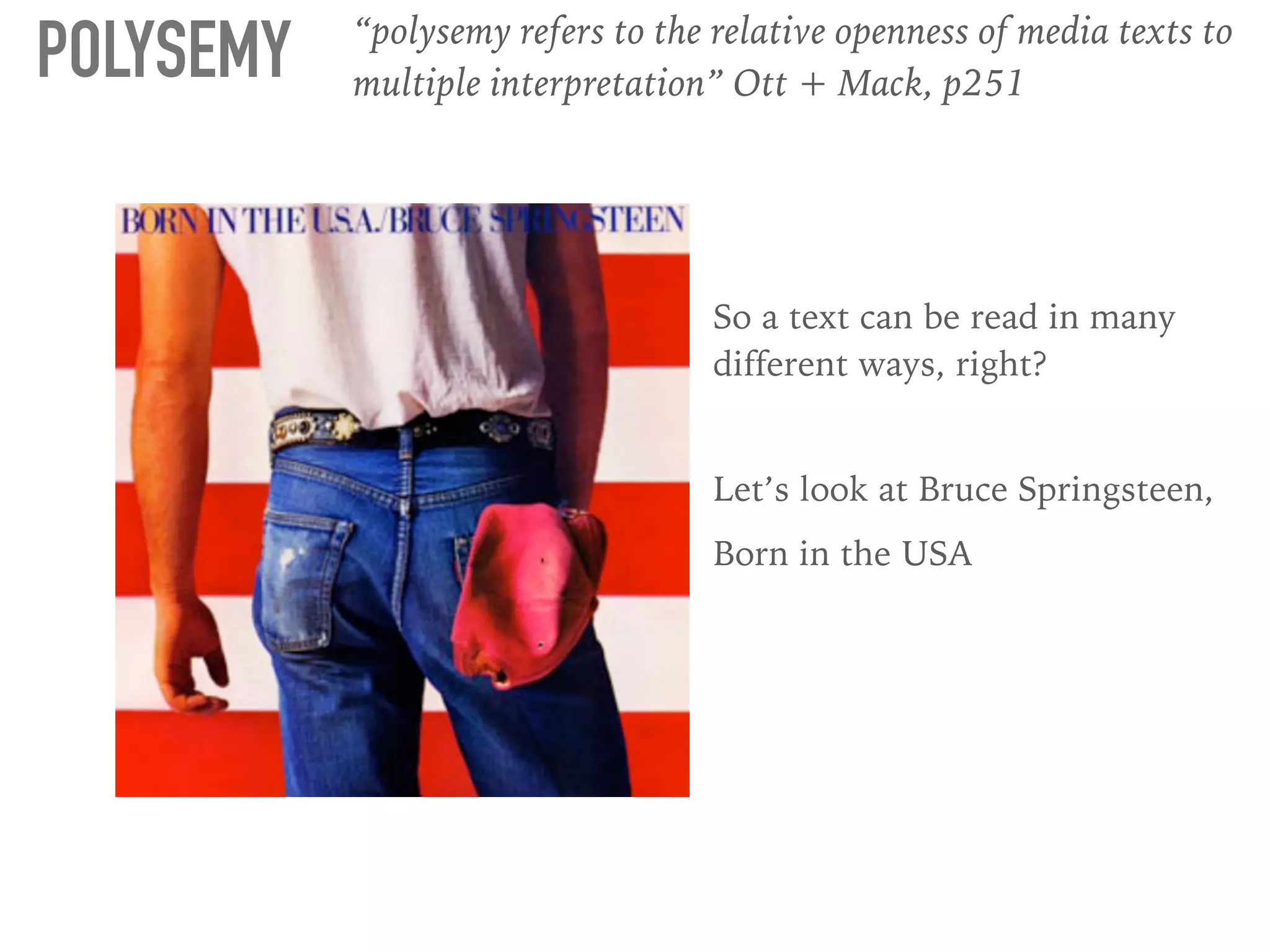
POLYSEMY “polysemy refers to the relative openness of media texts to
multiple interpretation” Ott + Mack, p251
So a text can be read in many
different ways, right?
Let’s look at Bruce Springsteen,
Born in the USA
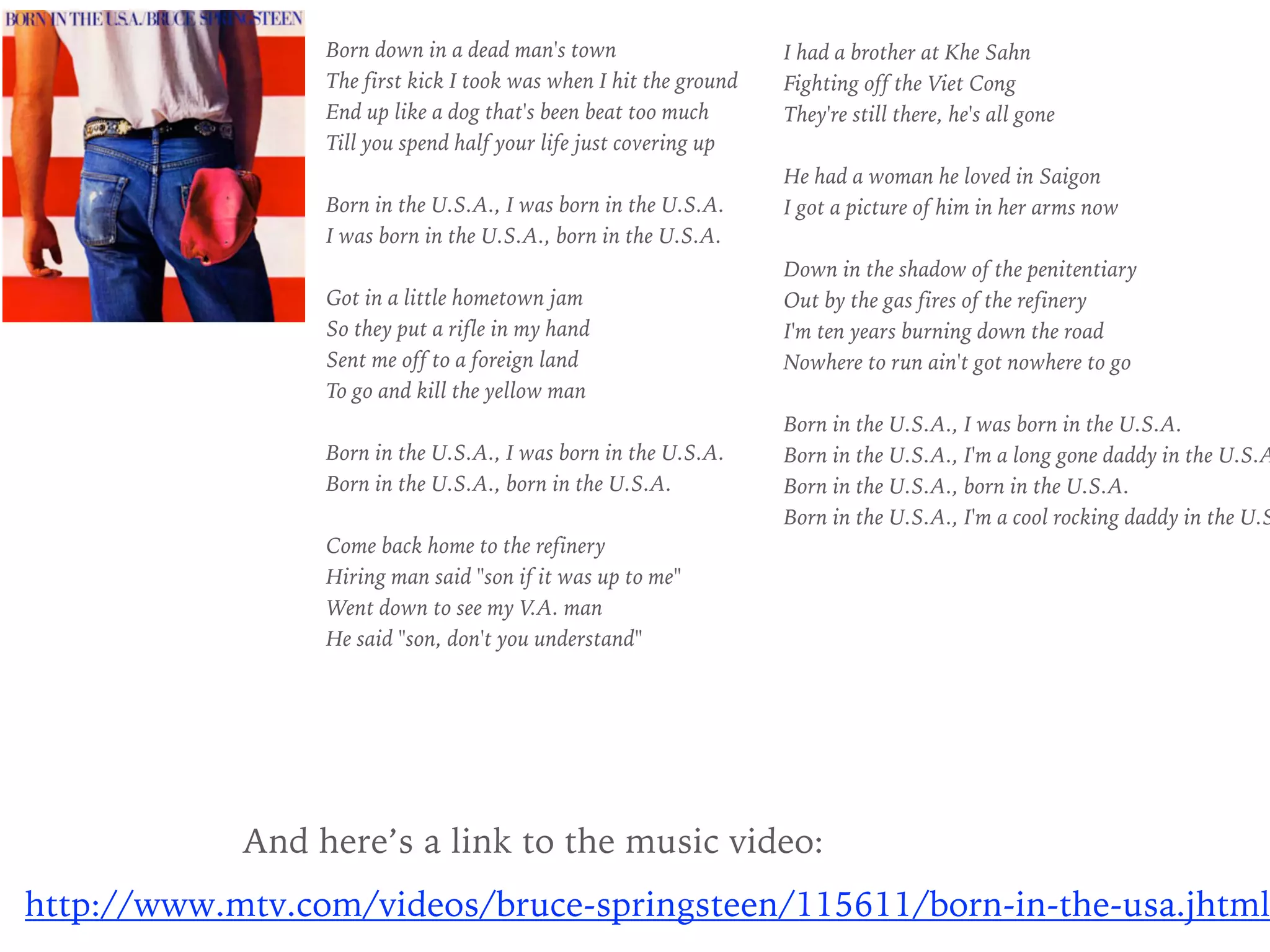
Born down in a dead man's town
The first kick I took was when I hit the ground
End up like a dog that's been beat too much
Till you spend half your life just covering up
Born in the U.S.A., I was born in the U.S.A.
I was born in the U.S.A., born in the U.S.A.
Got in a little hometown jam
So they put a rifle in my hand
Sent me off to a foreign land
To go and kill the yellow man
Born in the U.S.A., I was born in the U.S.A.
Born in the U.S.A., born in the U.S.A.
Come back home to the refinery
Hiring man said "son if it was up to me"
Went down to see my V.A. man
He said "son, don't you understand"
I had a brother at Khe Sahn
Fighting off the Viet Cong
They're still there, he's all gone
He had a woman he loved in Saigon
I got a picture of him in her arms now
Down in the shadow of the penitentiary
Out by the gas fires of the refinery
I'm ten years burning down the road
Nowhere to run ain't got nowhere to go
Born in the U.S.A., I was born in the U.S.A.
Born in the U.S.A., I'm a long gone daddy in the U.S.A
Born in the U.S.A., born in the U.S.A.
Born in the U.S.A., I'm a cool rocking daddy in the U.S
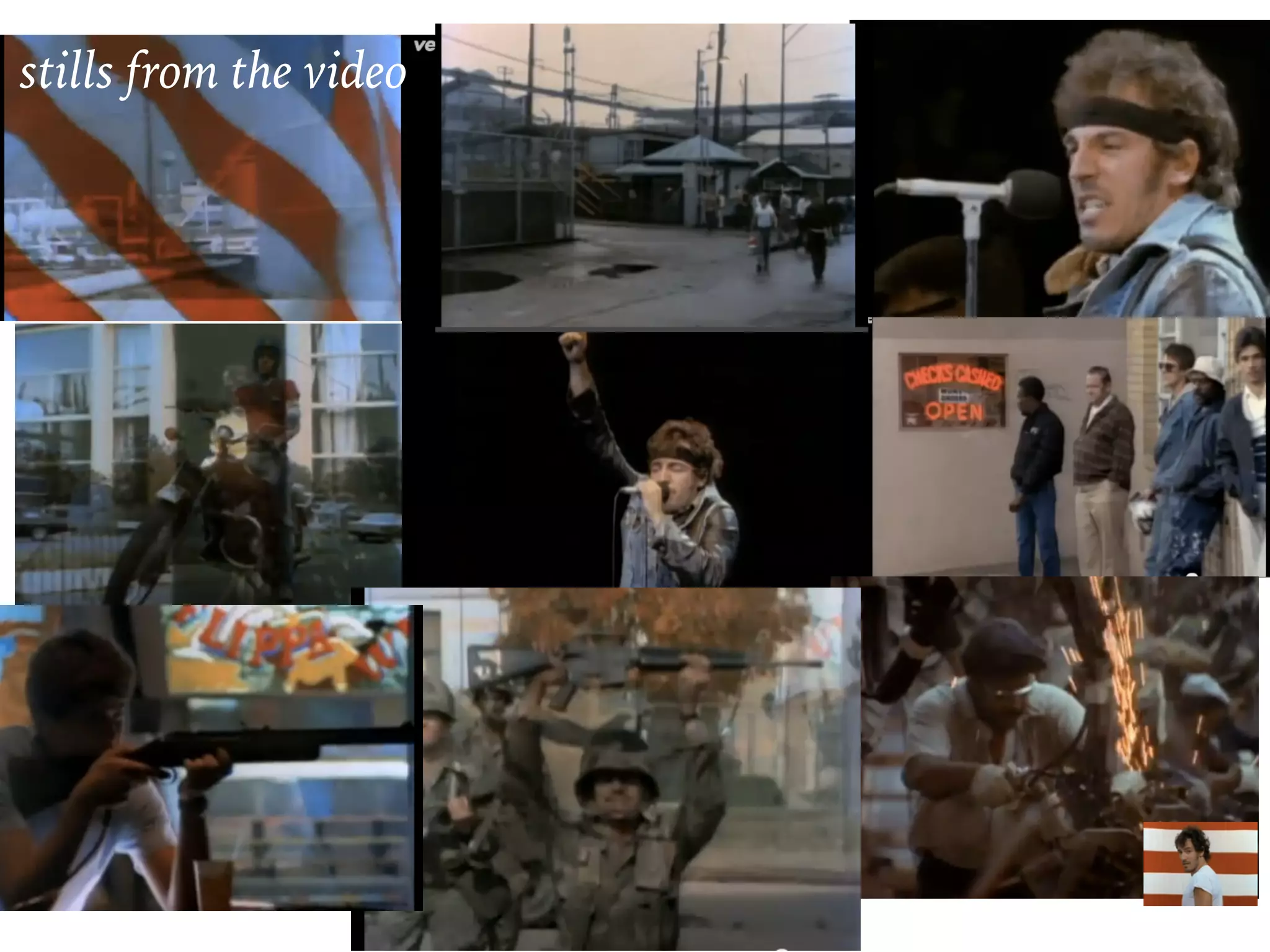
And here’s a link to the music video:
http://www.mtv.com/videos/bruce-springsteen/115611/born-in-the-usa.jhtml
stills from the video
Is this an open text for interpretation?
Yes and no.
Of course, anyone can interpret this song
how ever he/she would like to,
interpreting this song based on things like:
if they listen to all the lyrics, or just the chorus,
if they watch the music video and which imagery sticks out at them more
if they like Bruce Springsteen or not
if they like rock and roll or not
if they have similar experiences to the ones in the lyrics
etc.
etc.
etc.
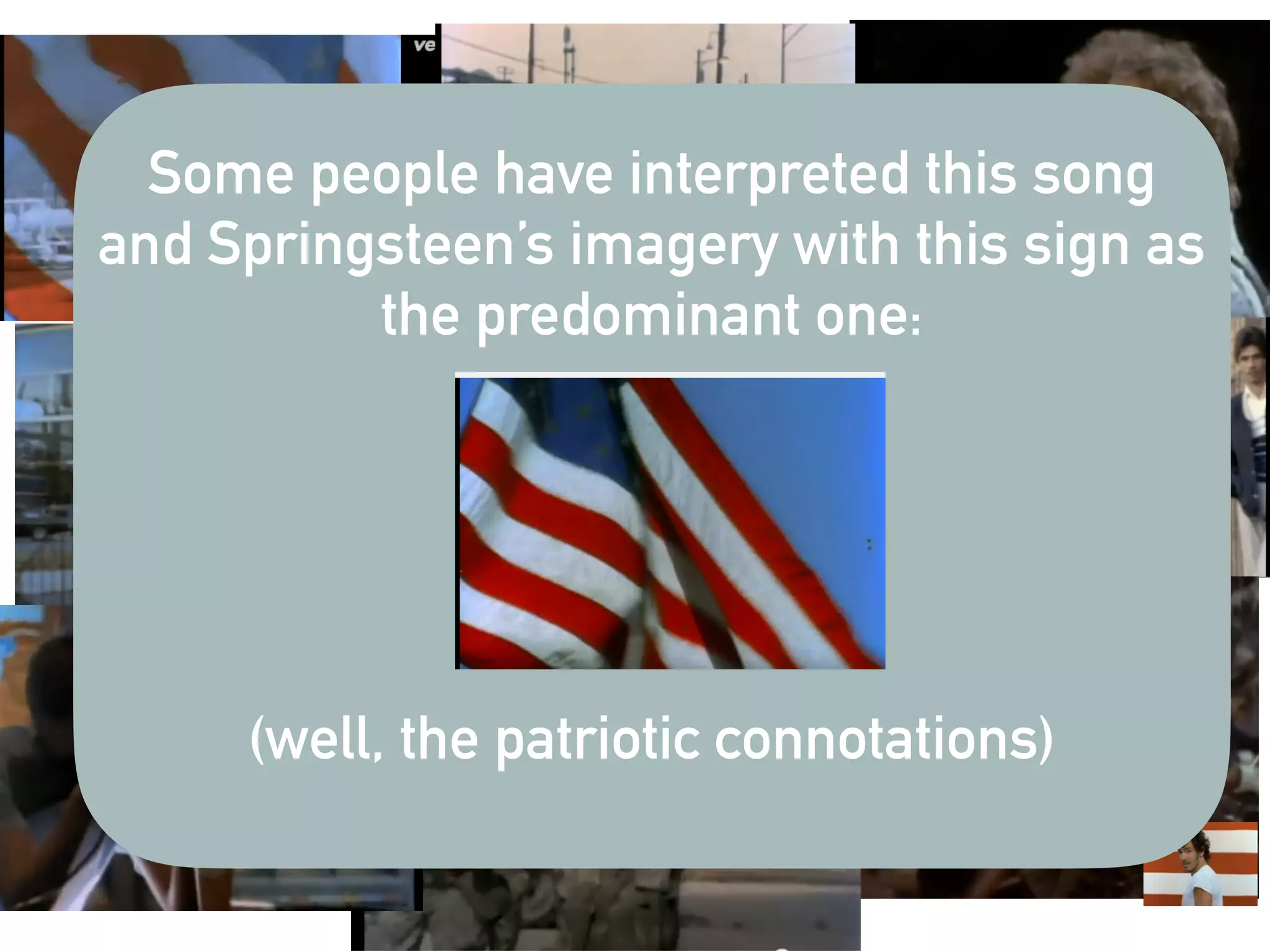
Some people have interpreted this song
and Springsteen’s imagery with this sign as
the predominant one:
(well, the patriotic connotations)
In 1984, when the song came out and Ronald Reagan
was running for reelection, a popular conservative
newspaper columnist, George Will, wrote:
“I have not got a clue about Springsteen’s politics, if any, but
flags get waved at his concerts while he sings songs about hard
times. He is no whiner, and the recitation of closed factories and
other problems always seems punctuated by a grand, cheerful
affirmation: “Born in the U.S.A.!”
Reagan used the song in his campaign; Springsteen said,
please stop, you’re not getting the point of the song.
http://www.pophistorydig.com/topics/reagan-springsteen-1984/
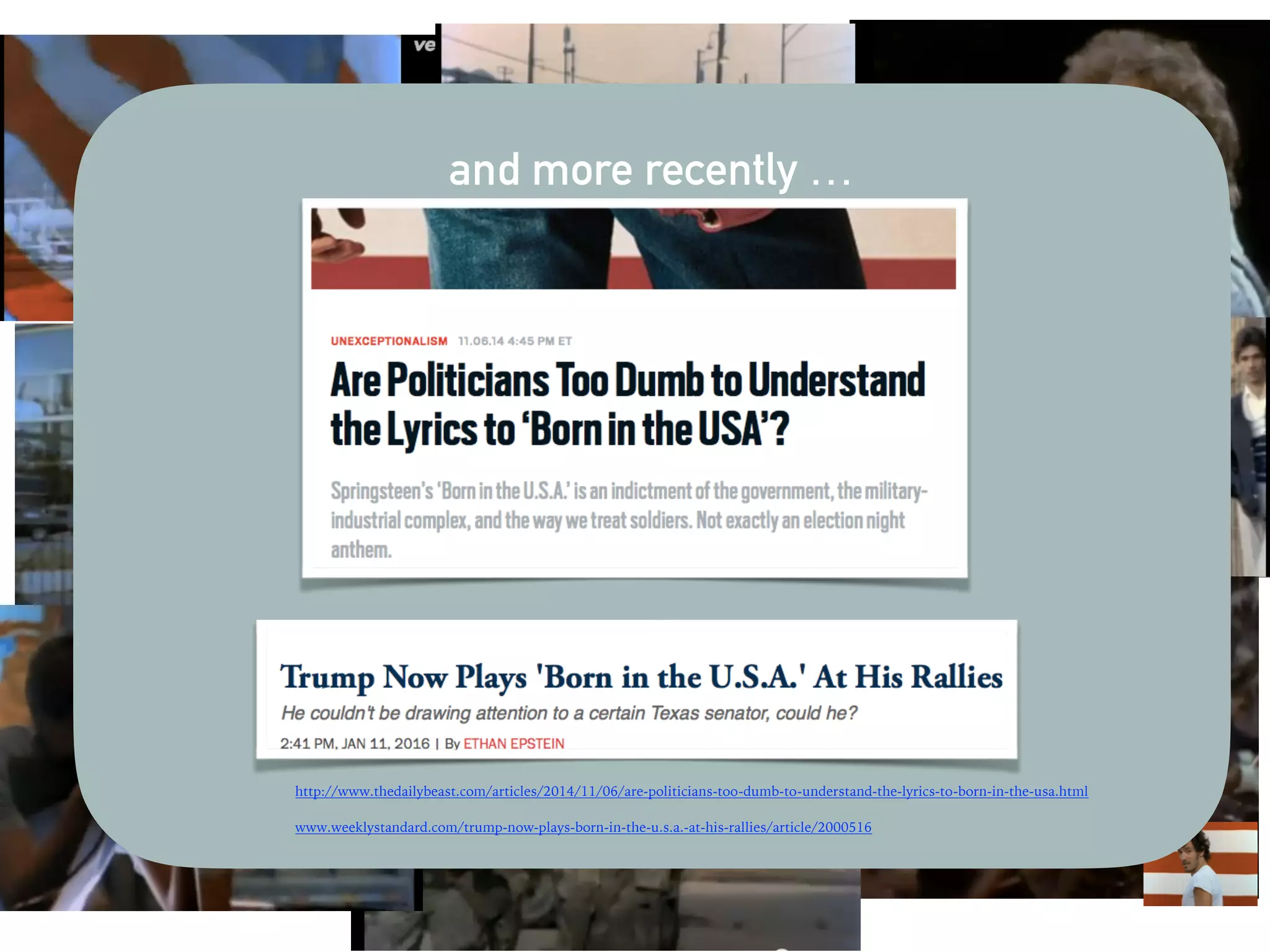
and more recently …
http://www.thedailybeast.com/articles/2014/11/06/are-politicians-too-dumb-to-understand-the-lyrics-to-born-in-the-usa.html
www.weeklystandard.com/trump-now-plays-born-in-the-u.s.a.-at-his-rallies/article/2000516
So,
is a text completely open to interpretation?
Not really.
But! There’s still lots of room to openly read
texts, especially if the encoders made the
text to be interpreted on different levels
(like the textbook example).
PAUSE FOR
IDENTIFICATION OF ASSUMPTIONS:
audiences are ACTIVE
We actively interpret and interact with texts (and with
people …. interpretive communities) to make meaning.
Great! Then why does the textbook have different discussions about audiences as active?
Hall: there’s a lot going on with ideology and dominant, hegemonic, ‘common
sense’ ways of interpreting meaning.
Fiske (polysemy): individuals have the ultimate power in deciding meaning.
Hall: no they don’t.
Fiske and Fish: yes they do; it’s all the individual and the interpretive communities
Hall and Morley: Fine, to a degree. But those of you who only focus on the agency (the
power) of the individual to freely make meaning lose sight of ideological and socializing
functions of media. What about the preferred, or at least, negotiated, readings?
(an imaginary conversation ….)
BACK TO ENCODING / DECODING.
Hall’s idea of 3 ways that audiences ‘read’ a text
was developed
1) as a reaction against the linear model of
communication
2) from his and others in cultural studies ideas
about ideology and articulations of imagery,
narratives, etc. to align with particular viewpoints
but! warning: these are not intended as exact
categories, but as a framework to work through
the complexity of audience reception.
PREFERRED
OPPOSITIONAL
NEGOTIATED
how do you understand these?
write down your notes about what these mean.
EXAMPLE:
Listen to the On the Media story,
“Michael Bay’s Benghazi Blockbuster Flop.”
http://www.wnyc.org/story/michael-bays-benghazi-blockbuster-flop
(posted on Reggienet lesson page as well).
Brooke Gladstone is interviewing Peter Maass about the movie, 13
Hours. Which of the three reading positions best fits Maass’s
interpretation of the movie? Why? What codes does he draw on as
he ‘read’ the movie?
1 MORE KEY TERM
RESISTIVE READING
Definition and examples from a past COM320
student:
“shows how certain groups can accept the meaning that
a content creator was trying to portray and yet find
other meanings that become prevalent when looking
deeper into the content”
http://www.telegraph.co.uk/women/womens-life/11565200/Protein-World-beach-body-ready-ad-vandalised-by-women-for-body-shaming.html
“active, audience-based creation of textual meaning
that is contrary to the meaning intended” p. 254
ENCODING / DECODING
VIEWING EXERCISE
Watch 2 videos; it’s the same text but different treatments.
Purpose:
identify the PREFERRED, OPPOSITIONAL, and NEGOTIATED for these 2
videos and identify how version #2 is an example of a resistive reading.
Directions and links on next slide:
PREFERRED
OPPOSITIONAL
NEGOTIATED
…circa 1950s (when made)
In version 1, watch this and identify the codes with the era of
the video in mind - 1950s and the genre in mind - instructional/
educational film distributed by Encyclopedia Britannica and viewed
in classrooms.
What are the messages about family, gender roles, and
overall imagery about 1950s life?
What is the interpretation of the video from each of the
following positions? (I encourage you to think in the mindset of a student in
1950 … but that might be difficult … still, try!)
PREFERRED
OPPOSITIONAL
NEGOTIATED
Version 1:
https://www.youtube.com/watch?v=XEtaaW3UFZA
WATCH this clip:
PREFERRED
OPPOSITIONAL
NEGOTIATED
…circa 1950s (when made)
In version 2, what are the codes? What are some ideas you
have about the encoding process (how the text was
produced) and the decoding process?
How is resistive reading demonstrated?
Also, run through the 3 positions again.
What is the …
PREFERRED reading?
OPPOSITIONAL reading?
NEGOTIATED reading? (…. or you might think of this in
terms of what, what jokes do you agree with and jokes you
disagree with, maybe?)
Version 2:
https://www.youtube.com/watch?v=_Hh4M4vipAo
WATCH this clip:

320su16 reception

  • 1.
  • 2.
    some of the Chapter10 was familiar … COM 110 / 160, right? “hypodermic needle” approach “two-step flow model” cultivation theory uses and gratifications
  • 3.
  • 4.
    remember in thevery first lecture: the trouble with ‘mass media’? https://www.youtube.com/watch?v=Qt5MjBlvGcY For example: You may recall this from COM160. It was a guiding theory for awhile, until the models of communication presented earlier. You’ll see it again in Chapter 10 … but it’s not intended to be taken up in our stock house of critical theories; And you may also see the passive, gullible masses argument used again in Marxist Analysis, but in the tradition of critical theory. Whereas this, this is what we call the ‘dominant paradigm.’ Can read more in this article: http://www.cwanderson.org/wp-content/uploads/2014/01/1353087053- potter_paradigms_mass_media_research_1993.pdf
  • 5.
    ‘dominant paradigm’ “ ”Potter, W.J.,Cooper, R. & Dupagne, M. (1993). The Three Paradigms of Mass Media Research in Mainstream Communication Journals, Communication Theory, 3(4), 317-335. p. 317 http://www.cwanderson.org/wp-content/uploads/2014/01/1353087053-potter_paradigms_mass_media_research_1993.pdf
  • 6.
    ‘dominant paradigm’ “ ”Potter, W.J.,Cooper, R. & Dupagne, M. (1993). The Three Paradigms of Mass Media Research in Mainstream Communication Journals, Communication Theory, 3(4), 317-335. http://www.cwanderson.org/wp-content/uploads/2014/01/1353087053-potter_paradigms_mass_media_research_1993.pdf p. 317
  • 7.
    ‘dominant paradigm’ defined formass communication research The ‘dominant paradigm’ combines a view of powerful mass media in a mass society with the typical research practices of the emerging social sciences …. The underlying view of society in the dominant paradigm is essentially normative. It presumes a certain kind of normally functioning ‘good society.’ Denis McQuial, p. 63 “ ” so what are the assumptions in the dominant paradigm?
  • 8.
    ‘dominant paradigm’ ‘critical paradigm’a.k.a what we’ve been doing in this class McQuail, p. 66 McQuail, p. 68
  • 9.
    ‘dominant paradigm’ Ok, sowhat are the “taken- for-granted assumptions” that guide researchers in the dominant paradigm, who had developed these theories? “hypodermic needle” approach “two-step flow model” cultivation theory uses and gratifications
  • 10.
    ASSUMES PASSIVE AUDIENCE ASSUMES DIRECT EFFECTS or in thecase of Uses and Gratifications, new assumption! audiences can be active … but … optimistically gives full control to the individual (see p 248 in textbook)
  • 11.
    ASSUMES PASSIVE AUDIENCE ASSUMES DIRECT EFFECTS why am Istressing this now? 1. Now that we’re 2/3 of the way through, you should have a good grasp on the CRITICAL PARADIGM; all of the approaches we’ve covered stem from this paradigm (well, most of it; the exception is the violence section in the Pragmatic Approach chapter —> can you tell why?) 2. As we’re moving into AUDIENCES, this distinction in dominant and critical paradigms is crucial. —> the history of reception theory outlined in the textbook (pp 246-248) is a quick history of how researchers in the dominant paradigm developed research projects that largely viewed audiences as passive dupes, who responded to media stimuli in ‘positive’ or ‘negative’ ways. ‘dominant paradigm’ and thus …..
  • 12.
    ASSUMES PASSIVE AUDIENCE ASSUMES DIRECT EFFECTS Our study ofAUDIENCES is NOT rooted in this effects / behaviorist paradigm.* … so … do not use your discussion posts to summarize the history of reception analysis, or the overview of the dominant paradigm theories about the audience. ‘dominant paradigm’ * if you’re interested in these theories … take COM360: Theory and Effects
  • 13.
    RECEPTION ANALYSIS It’s abouthow audiences (we) make meaning … differs from the traditional media effects paradigm which brings us back to …
  • 14.
    KEYS FOR THEDAY ➤ let’s stray away from the media effects paradigm ➤ step 1: but we’ll start with a short step away from media effects, but still rooted in the dominant paradigm … Uses and Gratifications ➤ step 2: a literary theory / sociological step away … interpretive communities (note I’m mixing up the order in the book) ➤ step 3: a cultural studies critical step away ➤ encoding / decoding ➤ preferred / negotiated / oppositional readings
  • 15.
    USES AND GRATIFICATION,CIRCA 1970s audiences are active audiences have different uses … and gratifications … with their media use: information entertainment escape interpersonal new assumption! aka - audiences are conscious … or are they? stay tuned for Encoding / Decoding
  • 16.
    USES AND GRATIFICATION “ESPN show Sportscenter. Some people use it to catch up on what happened during that day in the sports world while others might just watch it for the top plays at the end or to see the score of their favorite teams game.” - previous COM320 student For example: various uses for watching Sportscenter? ok … so yes; there’s a gut-level clarity about uses and grats. But … 1) how is this different than market research (that’s the critical researcher perspective) and 2) what about the frameworks for a viewer to make meaning from this text? … the conscious and unconscious ones (… see where I’m getting at this? … we’re moving towards cultural studies)
  • 17.
    INTERPRETIVE COMMUNITIES “interpretive communitiesis a fancy word for saying that people who live similar lifestyles interpret messages in similar ways …. A small scale example of interpretive communities is the below youtube video where older generation women try to define common slang words that younger generations are currently using. Their definitions are funny to those who use the slang words, but these women base their definitions on their own experiences.” - previous COM320 student https:// www.youtube.com/ watch?v=VRTeNN6UAzc WATCH this clip:
  • 18.
    INTERPRETIVE COMMUNITIES I callthis from the SOCIOLOGICAL / LITERARY tradition because this was a shift in Literary Studies (English professors) research to give more power to the reader to make meaning from the text, rather than meaning coming from the author or some critic telling you how you’re supposed to read a text … or for our media studies purposes … some mass comm researchers deciding that you, the reader / viewer / listener, is a dupe. for example …. Optional: If you want to know more about the theoretical context of literary theory + interpretive communities, try out this video: https://www.youtube.com/watch?v=iE7Dtyals7o.
  • 19.
    ROMANCE NOVELS BEFORE JANICERADWAY: Why bother even studying these? The people who read these (mostly women) are dupes; This is a mass produced trash with no intrinsic value that reproduce hegemonic gender roles.
  • 20.
    ROMANCE NOVELS JANICE RADWAY: Ohyes we should study these; not only because it is a major facet in the culture industry (that’s the marxist approach), but more importantly, who are the readers? What is the importance of the interpretive community? And we should not assume that women = dupes (that’s a consequence of academic research being mostly male and patriarchal …) (I’m summarizing)
  • 21.
    ENCODING DECODING A core model,or even a method, for cultural studies
  • 22.
    Stuart Hall, Encoding,Decoding article posted on Reggienet. , p. 94
  • 23.
    REVIEW FROM THETEXTBOOK: WHAT IS A CODE? code: “set of rules that govern the use of visual and linguistic signs within a culture” p. 248
  • 24.
    LET’S USE BASEBALLAS AN EXAMPLE WHAT ARE THE CODES ASSOCIATED WITH BASEBALL?
  • 25.
    You might thinkof …. the actual things that constitute baseball, the game: the stadium, the equipment, the rules of the game, the player positions And you might think about the teams … the colors, the uniforms, the mascot, the stereotypes of a certain fan base over others, etc.
  • 26.
    You might thinkof the codes involved in the broadcasting of a game: the announcers, the score / stats boxes, the display of those boxes, the camera angles (for example, the shot above being the center field camera, the angle from behind the pitcher), the editing of the game (such as the convention of center field camera, follow the ball, cut to the runner heading to base, etc.), the replays.
  • 27.
    You might thinkabout the things in baseball that are not necessarily related to the actual game of baseball, but have come to be known as baseball-ness http://www.todayifoundout.com/ index.php/2013/12/story-u-s- national-anthem-became-part- national-pastime/ just a few many examples, also note how American-focused these are; perhaps these codes would be different in Latin America, Korea, or Japan.
  • 28.
    THESE ARE ALLCODES. Knowledge frameworks about how the game works, but also what team colors / mascots mean, of what happens at a ball game (e.g. what happens in the 7th inning?), of what baseball-ness in America means. Relations of the teams, of teams-fans, of ball players-team owners, of teams-leagues, of MLB-tv contracts, etc. etc. etc. Technical infrastructure of making baseball possible; more specific to broadcasting baseball — the technical infrastructure and knowledge frameworks to produce a tv or radio broadcast.
  • 29.
    THERE ARE MANYCODES AT WORK IN BOTH THE ENCODING AND DECODING OF A BASEBALL BROADCAST. There is room for interpretation, but in general, you watch the game with a similar set of codes as those who are playing the game and producing the broadcast of the game. You might have different experience in interpreting the game if you are a FAN or a casual viewer, but at least, you know the general codes.
  • 30.
    SEE IF YOUCAN IDENTIFY THE MEANING OF THESE CODES: Fade to Black in a Movie what does this mean? what’s the baby’s gender? which actor is more likely the main character and which is the sidekick?
  • 31.
    These codes tendto be hegemonic, as in, we have an established set of codes … or of technical conventions for filmmaking, of how signs are assembled (remember signification), and of narrative / character plots Hall, p 95
  • 32.
    Texts are encodedwith all sorts of technical, cultural, and genre / narrative codes. Some are standard practice, like fade to black. Some are more subtle constructions, such as representations of gender. You decode; You know a lot of the conventions, such as fade to black, so you don’t have to think about it. But you are not always necessarily decoding the text the way that the encoders envisioned.
  • 33.
    WE’LL COME BACKTO ENCODING / DECODING, BUT FIRST. … POLYSEMY “polysemy refers to the relative openness of media texts to multiple interpretation” Ott + Mack, p251
  • 34.
    POLYSEMY “polysemy refersto the relative openness of media texts to multiple interpretation” Ott + Mack, p251 So a text can be read in many different ways, right? Let’s look at Bruce Springsteen, Born in the USA
  • 35.
    Born down ina dead man's town The first kick I took was when I hit the ground End up like a dog that's been beat too much Till you spend half your life just covering up Born in the U.S.A., I was born in the U.S.A. I was born in the U.S.A., born in the U.S.A. Got in a little hometown jam So they put a rifle in my hand Sent me off to a foreign land To go and kill the yellow man Born in the U.S.A., I was born in the U.S.A. Born in the U.S.A., born in the U.S.A. Come back home to the refinery Hiring man said "son if it was up to me" Went down to see my V.A. man He said "son, don't you understand" I had a brother at Khe Sahn Fighting off the Viet Cong They're still there, he's all gone He had a woman he loved in Saigon I got a picture of him in her arms now Down in the shadow of the penitentiary Out by the gas fires of the refinery I'm ten years burning down the road Nowhere to run ain't got nowhere to go Born in the U.S.A., I was born in the U.S.A. Born in the U.S.A., I'm a long gone daddy in the U.S.A Born in the U.S.A., born in the U.S.A. Born in the U.S.A., I'm a cool rocking daddy in the U.S And here’s a link to the music video: http://www.mtv.com/videos/bruce-springsteen/115611/born-in-the-usa.jhtml
  • 36.
  • 37.
    Is this anopen text for interpretation? Yes and no.
  • 38.
    Of course, anyonecan interpret this song how ever he/she would like to, interpreting this song based on things like: if they listen to all the lyrics, or just the chorus, if they watch the music video and which imagery sticks out at them more if they like Bruce Springsteen or not if they like rock and roll or not if they have similar experiences to the ones in the lyrics etc. etc. etc.
  • 39.
    Some people haveinterpreted this song and Springsteen’s imagery with this sign as the predominant one: (well, the patriotic connotations)
  • 40.
    In 1984, whenthe song came out and Ronald Reagan was running for reelection, a popular conservative newspaper columnist, George Will, wrote: “I have not got a clue about Springsteen’s politics, if any, but flags get waved at his concerts while he sings songs about hard times. He is no whiner, and the recitation of closed factories and other problems always seems punctuated by a grand, cheerful affirmation: “Born in the U.S.A.!” Reagan used the song in his campaign; Springsteen said, please stop, you’re not getting the point of the song. http://www.pophistorydig.com/topics/reagan-springsteen-1984/
  • 41.
    and more recently… http://www.thedailybeast.com/articles/2014/11/06/are-politicians-too-dumb-to-understand-the-lyrics-to-born-in-the-usa.html www.weeklystandard.com/trump-now-plays-born-in-the-u.s.a.-at-his-rallies/article/2000516
  • 42.
    So, is a textcompletely open to interpretation? Not really. But! There’s still lots of room to openly read texts, especially if the encoders made the text to be interpreted on different levels (like the textbook example).
  • 43.
    PAUSE FOR IDENTIFICATION OFASSUMPTIONS: audiences are ACTIVE We actively interpret and interact with texts (and with people …. interpretive communities) to make meaning. Great! Then why does the textbook have different discussions about audiences as active? Hall: there’s a lot going on with ideology and dominant, hegemonic, ‘common sense’ ways of interpreting meaning. Fiske (polysemy): individuals have the ultimate power in deciding meaning. Hall: no they don’t. Fiske and Fish: yes they do; it’s all the individual and the interpretive communities Hall and Morley: Fine, to a degree. But those of you who only focus on the agency (the power) of the individual to freely make meaning lose sight of ideological and socializing functions of media. What about the preferred, or at least, negotiated, readings? (an imaginary conversation ….)
  • 44.
    BACK TO ENCODING/ DECODING. Hall’s idea of 3 ways that audiences ‘read’ a text was developed 1) as a reaction against the linear model of communication 2) from his and others in cultural studies ideas about ideology and articulations of imagery, narratives, etc. to align with particular viewpoints but! warning: these are not intended as exact categories, but as a framework to work through the complexity of audience reception.
  • 45.
    PREFERRED OPPOSITIONAL NEGOTIATED how do youunderstand these? write down your notes about what these mean.
  • 46.
    EXAMPLE: Listen to theOn the Media story, “Michael Bay’s Benghazi Blockbuster Flop.” http://www.wnyc.org/story/michael-bays-benghazi-blockbuster-flop (posted on Reggienet lesson page as well). Brooke Gladstone is interviewing Peter Maass about the movie, 13 Hours. Which of the three reading positions best fits Maass’s interpretation of the movie? Why? What codes does he draw on as he ‘read’ the movie?
  • 47.
  • 48.
    RESISTIVE READING Definition andexamples from a past COM320 student: “shows how certain groups can accept the meaning that a content creator was trying to portray and yet find other meanings that become prevalent when looking deeper into the content” http://www.telegraph.co.uk/women/womens-life/11565200/Protein-World-beach-body-ready-ad-vandalised-by-women-for-body-shaming.html “active, audience-based creation of textual meaning that is contrary to the meaning intended” p. 254
  • 49.
    ENCODING / DECODING VIEWINGEXERCISE Watch 2 videos; it’s the same text but different treatments. Purpose: identify the PREFERRED, OPPOSITIONAL, and NEGOTIATED for these 2 videos and identify how version #2 is an example of a resistive reading. Directions and links on next slide:
  • 50.
    PREFERRED OPPOSITIONAL NEGOTIATED …circa 1950s (whenmade) In version 1, watch this and identify the codes with the era of the video in mind - 1950s and the genre in mind - instructional/ educational film distributed by Encyclopedia Britannica and viewed in classrooms. What are the messages about family, gender roles, and overall imagery about 1950s life? What is the interpretation of the video from each of the following positions? (I encourage you to think in the mindset of a student in 1950 … but that might be difficult … still, try!) PREFERRED OPPOSITIONAL NEGOTIATED Version 1: https://www.youtube.com/watch?v=XEtaaW3UFZA WATCH this clip:
  • 51.
    PREFERRED OPPOSITIONAL NEGOTIATED …circa 1950s (whenmade) In version 2, what are the codes? What are some ideas you have about the encoding process (how the text was produced) and the decoding process? How is resistive reading demonstrated? Also, run through the 3 positions again. What is the … PREFERRED reading? OPPOSITIONAL reading? NEGOTIATED reading? (…. or you might think of this in terms of what, what jokes do you agree with and jokes you disagree with, maybe?) Version 2: https://www.youtube.com/watch?v=_Hh4M4vipAo WATCH this clip: