Key Concepts - Audience
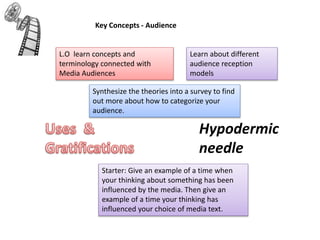
L.O learn concepts and
terminology connected with
Media Audiences
Starter: Give an example of a time when
your thinking about something has been
influenced by the media. Then give an
example of a time your thinking has
influenced your choice of media text.
Synthesize the theories into a survey to find
out more about how to categorize your
audience.
Learn about different
audience reception
models
Hypodermic
needle
The traditional segmentation model
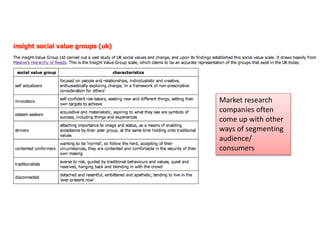
Market research
companies often
come up with other
ways of segmenting
audience/
consumers
Hypodermic Needle Model Uses & Gratifications Model
Audiences are passive
Easily led, influenced & manipulated
Gullible, sheep-like fashion-followers
Media consumption influences
the attitudes and behaviour of
audiences
Sometimes called ‘magic bullet’ theory
Linked to propaganda & advertising
Behaviourist models of human behaviour
Audiences are active in
choosing media for their own
‘gratifications’ (pleasure)
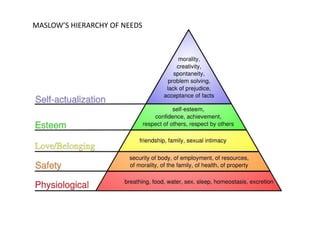
Links to Maslow’s Hierarchy of Needs
Developed by Blumler & Katz
Main reasons for using media:
Personal Identity – to define who we are
(sometimes called self-surveillance)
Information
Entertainment – includes escape, distraction
Social Interaction – to help us socialise with
like-minded people
Uses and Gratifications
Read the document, which provides a full walk-
through of the theory applied to television.
Using the different aspects, as applied to
different forms of television, write a list of all the
uses and gratifications you predict are
associated with:
• Watching films
• Watching thrillers specifically
MASLOW’S HIERARCHY OF NEEDS
(Young & Rubicam’s 4Cs model) cross cultural consumer characterization model
Task
• Read through the media pack for Empire
magazine that I have posted on the blog.
• This provides detailed information to
advertisers who might want to place adverts
in the magazine.
• Considering yourself as a film producer, what
use can you make of this information when
‘designing’ your thriller?
Designing a survey
When sitting down to design an advert, advertisers
will think carefully about who their target audience
is using a range of different theories and
frameworks. They will design surveys to capture
information which relates to them, for example
posing questions to deduce which of the 4Cs their
potential audience relates to. A survey like this
helped create the Empire audience profile. YOU
need to design your surveys along these lines
(though in a little less detail). How?
Example Questions
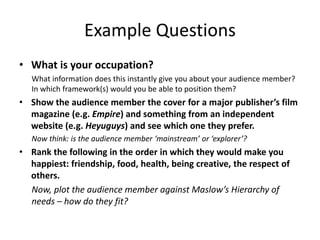
• What is your occupation?
What information does this instantly give you about your audience member?
In which framework(s) would you be able to position them?
• Show the audience member the cover for a major publisher’s film
magazine (e.g. Empire) and something from an independent
website (e.g. Heyuguys) and see which one they prefer.
Now think: is the audience member ‘mainstream’ or ‘explorer’?
• Rank the following in the order in which they would make you
happiest: friendship, food, health, being creative, the respect of
others.
Now, plot the audience member against Maslow’s Hierarchy of
needs – how do they fit?
Lesson 2
• Complete your draft survey.
• Swap with another group and review,
suggesting improvements.
• Write a blog entry in which you ‘justify’ each
question, linking back to an appropriate
audience theory.
Homework
• Carry out the survey.
• Get at least 10 responses as a group.
• Complete your questionnaire justification if
you haven’t done it yet.
• To be done by Monday 16th November.

Audience Theory AS Media

  • 1.
    Key Concepts -Audience L.O learn concepts and terminology connected with Media Audiences Starter: Give an example of a time when your thinking about something has been influenced by the media. Then give an example of a time your thinking has influenced your choice of media text. Synthesize the theories into a survey to find out more about how to categorize your audience. Learn about different audience reception models Hypodermic needle
  • 2.
  • 3.
    Market research companies often comeup with other ways of segmenting audience/ consumers
  • 4.
    Hypodermic Needle ModelUses & Gratifications Model Audiences are passive Easily led, influenced & manipulated Gullible, sheep-like fashion-followers Media consumption influences the attitudes and behaviour of audiences Sometimes called ‘magic bullet’ theory Linked to propaganda & advertising Behaviourist models of human behaviour Audiences are active in choosing media for their own ‘gratifications’ (pleasure) Links to Maslow’s Hierarchy of Needs Developed by Blumler & Katz Main reasons for using media: Personal Identity – to define who we are (sometimes called self-surveillance) Information Entertainment – includes escape, distraction Social Interaction – to help us socialise with like-minded people
  • 5.
    Uses and Gratifications Readthe document, which provides a full walk- through of the theory applied to television. Using the different aspects, as applied to different forms of television, write a list of all the uses and gratifications you predict are associated with: • Watching films • Watching thrillers specifically
  • 6.
  • 7.
    (Young & Rubicam’s4Cs model) cross cultural consumer characterization model
  • 8.
    Task • Read throughthe media pack for Empire magazine that I have posted on the blog. • This provides detailed information to advertisers who might want to place adverts in the magazine. • Considering yourself as a film producer, what use can you make of this information when ‘designing’ your thriller?
  • 9.
    Designing a survey Whensitting down to design an advert, advertisers will think carefully about who their target audience is using a range of different theories and frameworks. They will design surveys to capture information which relates to them, for example posing questions to deduce which of the 4Cs their potential audience relates to. A survey like this helped create the Empire audience profile. YOU need to design your surveys along these lines (though in a little less detail). How?
  • 10.
    Example Questions • Whatis your occupation? What information does this instantly give you about your audience member? In which framework(s) would you be able to position them? • Show the audience member the cover for a major publisher’s film magazine (e.g. Empire) and something from an independent website (e.g. Heyuguys) and see which one they prefer. Now think: is the audience member ‘mainstream’ or ‘explorer’? • Rank the following in the order in which they would make you happiest: friendship, food, health, being creative, the respect of others. Now, plot the audience member against Maslow’s Hierarchy of needs – how do they fit?
  • 11.
    Lesson 2 • Completeyour draft survey. • Swap with another group and review, suggesting improvements. • Write a blog entry in which you ‘justify’ each question, linking back to an appropriate audience theory.
  • 12.
    Homework • Carry outthe survey. • Get at least 10 responses as a group. • Complete your questionnaire justification if you haven’t done it yet. • To be done by Monday 16th November.