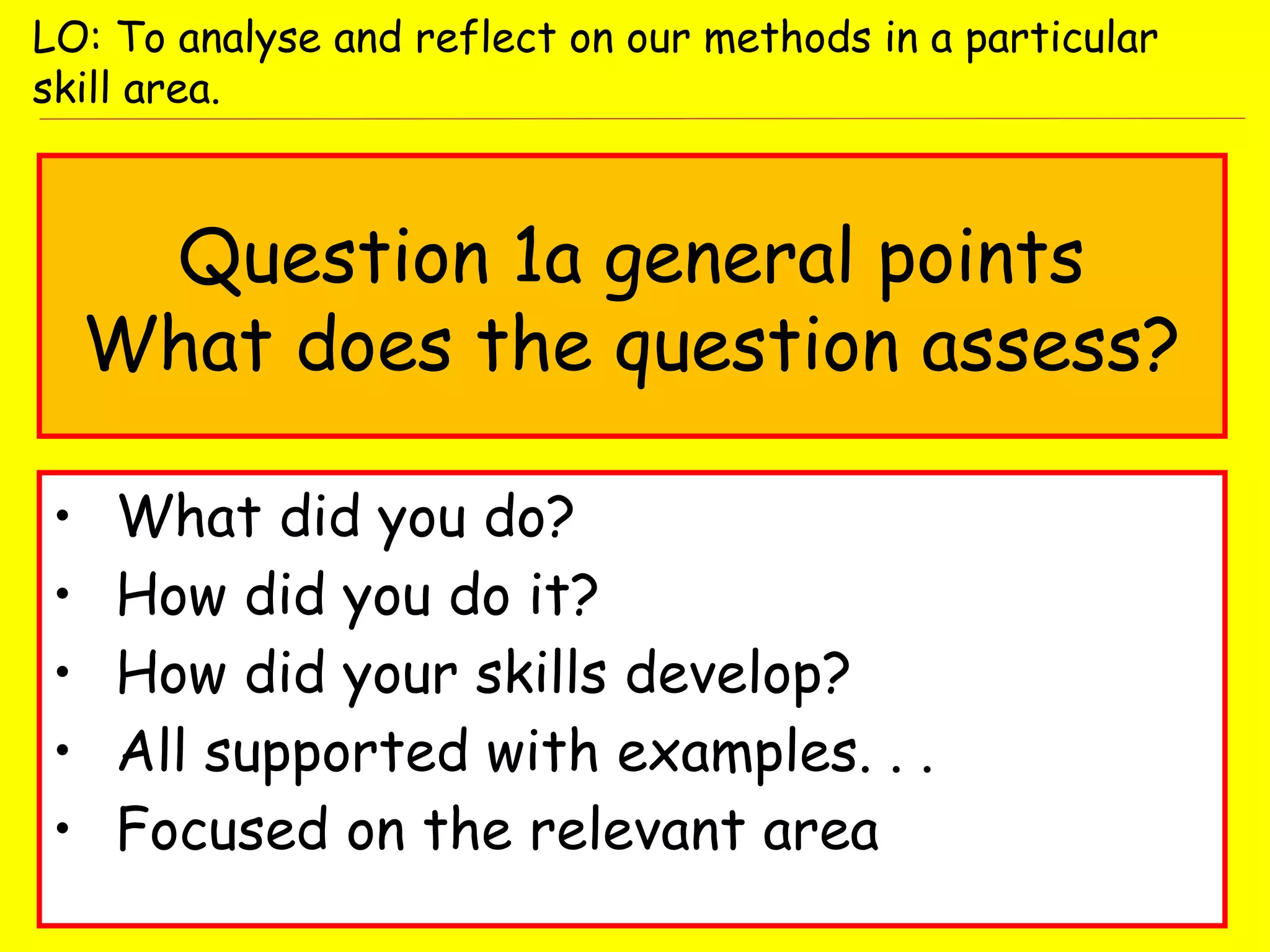
Question 1a general points
What does the question assess?
• What did you do?
• How did you do it?
• How did your skills develop?
• All supported with examples. . .
• Focused on the relevant area
LO: To analyse and reflect on our methods in a particular
skill area.
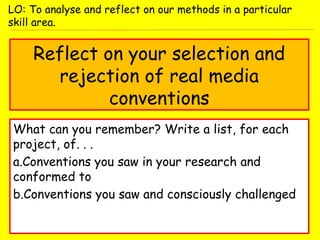
Reflect on your selection and
rejection of real media
conventions
What can you remember? Write a list, for each
project, of. . .
a.Conventions you saw in your research and
conformed to
b.Conventions you saw and consciously challenged
LO: To analyse and reflect on our methods in a particular
skill area.
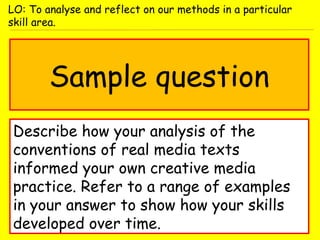
Sample question
Describe how your analysis of the
conventions of real media texts
informed your own creative media
practice. Refer to a range of examples
in your answer to show how your skills
developed over time.
LO: To analyse and reflect on our methods in a particular
skill area.
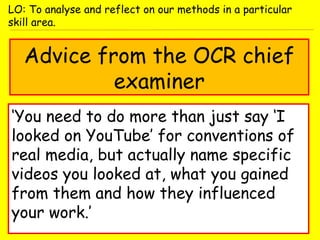
Advice from the OCR chief
examiner
‘You need to do more than just say ‘I
looked on YouTube’ for conventions of
real media, but actually name specific
videos you looked at, what you gained
from them and how they influenced
your work.’
LO: To analyse and reflect on our methods in a particular
skill area.
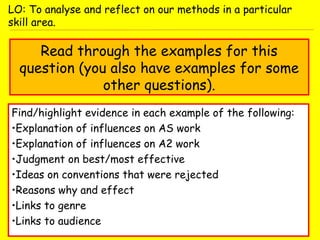
Read through the examples for this
question (you also have examples for some
other questions).
Find/highlight evidence in each example of the following:
•Explanation of influences on AS work
•Explanation of influences on A2 work
•Judgment on best/most effective
•Ideas on conventions that were rejected
•Reasons why and effect
•Links to genre
•Links to audience
LO: To analyse and reflect on our methods in a particular
skill area.
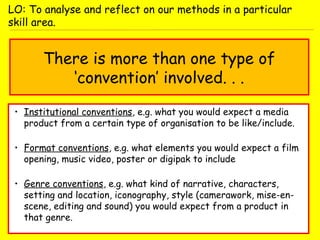
There is more than one type of
‘convention’ involved. . .
• Institutional conventions, e.g. what you would expect a media
product from a certain type of organisation to be like/include.
• Format conventions, e.g. what elements you would expect a film
opening, music video, poster or digipak to include
• Genre conventions, e.g. what kind of narrative, characters,
setting and location, iconography, style (camerawork, mise-en-
scene, editing and sound) you would expect from a product in
that genre.
LO: To analyse and reflect on our methods in a particular
skill area.
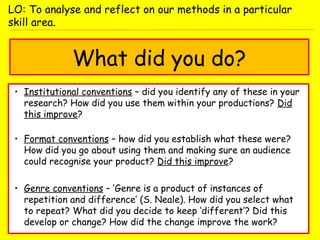
What did you do?
• Institutional conventions – did you identify any of these in your
research? How did you use them within your productions? Did
this improve?
• Format conventions – how did you establish what these were?
How did you go about using them and making sure an audience
could recognise your product? Did this improve?
• Genre conventions – ‘Genre is a product of instances of
repetition and difference’ (S. Neale). How did you select what
to repeat? What did you decide to keep ‘different’? Did this
develop or change? How did the change improve the work?
LO: To analyse and reflect on our methods in a particular
skill area.
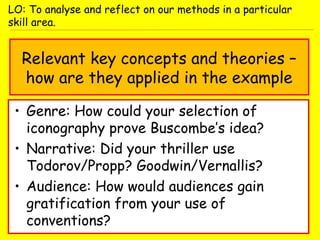
Relevant key concepts and theories –
how are they applied in the example
• Genre: How could your selection of
iconography prove Buscombe’s idea?
• Narrative: Did your thriller use
Todorov/Propp? Goodwin/Vernallis?
• Audience: How would audiences gain
gratification from your use of
conventions?
LO: To analyse and reflect on our methods in a particular
skill area.

G325 1a - real media conventions

  • 1.
    Question 1a generalpoints What does the question assess? • What did you do? • How did you do it? • How did your skills develop? • All supported with examples. . . • Focused on the relevant area LO: To analyse and reflect on our methods in a particular skill area.
  • 2.
    Reflect on yourselection and rejection of real media conventions What can you remember? Write a list, for each project, of. . . a.Conventions you saw in your research and conformed to b.Conventions you saw and consciously challenged LO: To analyse and reflect on our methods in a particular skill area.
  • 3.
    Sample question Describe howyour analysis of the conventions of real media texts informed your own creative media practice. Refer to a range of examples in your answer to show how your skills developed over time. LO: To analyse and reflect on our methods in a particular skill area.
  • 4.
    Advice from theOCR chief examiner ‘You need to do more than just say ‘I looked on YouTube’ for conventions of real media, but actually name specific videos you looked at, what you gained from them and how they influenced your work.’ LO: To analyse and reflect on our methods in a particular skill area.
  • 5.
    Read through theexamples for this question (you also have examples for some other questions). Find/highlight evidence in each example of the following: •Explanation of influences on AS work •Explanation of influences on A2 work •Judgment on best/most effective •Ideas on conventions that were rejected •Reasons why and effect •Links to genre •Links to audience LO: To analyse and reflect on our methods in a particular skill area.
  • 6.
    There is morethan one type of ‘convention’ involved. . . • Institutional conventions, e.g. what you would expect a media product from a certain type of organisation to be like/include. • Format conventions, e.g. what elements you would expect a film opening, music video, poster or digipak to include • Genre conventions, e.g. what kind of narrative, characters, setting and location, iconography, style (camerawork, mise-en- scene, editing and sound) you would expect from a product in that genre. LO: To analyse and reflect on our methods in a particular skill area.
  • 7.
    What did youdo? • Institutional conventions – did you identify any of these in your research? How did you use them within your productions? Did this improve? • Format conventions – how did you establish what these were? How did you go about using them and making sure an audience could recognise your product? Did this improve? • Genre conventions – ‘Genre is a product of instances of repetition and difference’ (S. Neale). How did you select what to repeat? What did you decide to keep ‘different’? Did this develop or change? How did the change improve the work? LO: To analyse and reflect on our methods in a particular skill area.
  • 8.
    Relevant key conceptsand theories – how are they applied in the example • Genre: How could your selection of iconography prove Buscombe’s idea? • Narrative: Did your thriller use Todorov/Propp? Goodwin/Vernallis? • Audience: How would audiences gain gratification from your use of conventions? LO: To analyse and reflect on our methods in a particular skill area.