Audience Theory
Section A Question 1 B
What is audience?
 All mediaproductshave atarget audience
 Theyalsosometimes(particularlyinthe case of propaganda) tryto constructand audience.
 Mass or niche audience.
The first audience Theory
 Frankfurtschool 1920’s 1930’s
 Developedhypodermicsyringe.
 Contentsof the mediawere injectedintothe thoughtof the audience whoacceptedthe
attitudesopinionsandbeliefsbythe medium, withoutquestion.
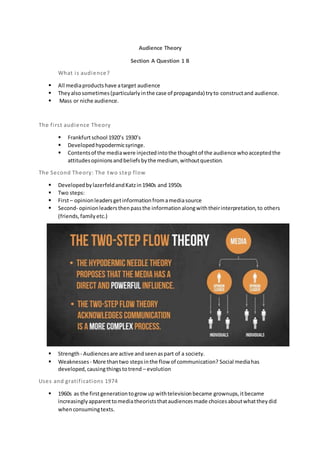
The Second Theory: The two step flow
 DevelopedbylazerfeldandKatzin1940s and 1950s
 Two steps:
 First– opinionleadersgetinformationfromamediasource
 Second- opinionleadersthenpassthe informationalongwiththeirinterpretation,to others
(friends,familyetc.)
 Strength- Audiencesare active andseenaspart of a society.
 Weaknesses - More thantwo stepsinthe flow of communication? Social mediahas
developed,causingthingstotrend – evolution
Uses and gratifications 1974
 1960s as the firstgenerationtogrow up withtelevisionbecame grownups,itbecame
increasinglyapparenttomediatheoriststhataudiencesmade choicesaboutwhattheydid
whenconsumingtexts.
 Far from beingpassive mass,audienceswere made upof individualswhoactivelyconsumed
textsfordifferentreasonsandindifferentways.
 BlulmerandKatzexpandedthistheoryandpublishedtheirownin1974, statigthat
indivdualsmightchoose anduse a textforthe followingpurposes.
1. Diversion –Escape from moderndayproblemsorroutine.(cinema)
2. Personal Relationships –usingthe mediaforemotional andotherinteraction
(substitutingsoapoperasforfamilylife)
3. Personal Identity–Findingyourselfreflectedintexts,learningbehaviourandvalues
fromtexts’. (acharacter representsyourself)
4. Surveillance –Informationwhich couldbe useful forliving(weatherreports,
financial news,holidaybargains). Trafficnewsetc.
Since thenthe listof usesand gratificationshasbeenextended,particularlyasnew
mediaformshave come along.
Applying usesof gratifications Spice Girls - wannabe
Usesof gratification Example How does it appeal to the
audience
Diversion:Entertainmentand
escapism
Music videosare a formof
diversionaswe stopped
everythingtowatchit,and
weren’tdistractedbyanything
else.
Teenage Girls,outfits, having
fun.
Personal Relationships SuperFans,posters
advertisement.
Posters,art.
Personal Identify Harassingthe members.
Havingfun,wild.Boisterous
Girlsmightcopy their
behaviour.Follow one of the
spice girls.
Surveillance andinformation None None
Slightly more modern: David Morley The nationwide Audience 1980s
 Dominant(orhegemonic) reading.The readersharesthe programmescode andfully
acceptsthe programmespreferredreading.
 Negotiatedreading –The readersharesthe programmescode andbroadlyacceptsthe
preferredreading.Butmodifiesitina waywhichreflectstheirpositionandinterests.
 Oppositionalreading –The readerdoesnotshare the programmescodesandrejectsthe
preferredreading.Bringingtobearan alternative frame of interpretation.

Audience theory

  • 1.
    Audience Theory Section AQuestion 1 B What is audience?  All mediaproductshave atarget audience  Theyalsosometimes(particularlyinthe case of propaganda) tryto constructand audience.  Mass or niche audience. The first audience Theory  Frankfurtschool 1920’s 1930’s  Developedhypodermicsyringe.  Contentsof the mediawere injectedintothe thoughtof the audience whoacceptedthe attitudesopinionsandbeliefsbythe medium, withoutquestion. The Second Theory: The two step flow  DevelopedbylazerfeldandKatzin1940s and 1950s  Two steps:  First– opinionleadersgetinformationfromamediasource  Second- opinionleadersthenpassthe informationalongwiththeirinterpretation,to others (friends,familyetc.)  Strength- Audiencesare active andseenaspart of a society.  Weaknesses - More thantwo stepsinthe flow of communication? Social mediahas developed,causingthingstotrend – evolution Uses and gratifications 1974  1960s as the firstgenerationtogrow up withtelevisionbecame grownups,itbecame increasinglyapparenttomediatheoriststhataudiencesmade choicesaboutwhattheydid whenconsumingtexts.
  • 2.
     Far frombeingpassive mass,audienceswere made upof individualswhoactivelyconsumed textsfordifferentreasonsandindifferentways.  BlulmerandKatzexpandedthistheoryandpublishedtheirownin1974, statigthat indivdualsmightchoose anduse a textforthe followingpurposes. 1. Diversion –Escape from moderndayproblemsorroutine.(cinema) 2. Personal Relationships –usingthe mediaforemotional andotherinteraction (substitutingsoapoperasforfamilylife) 3. Personal Identity–Findingyourselfreflectedintexts,learningbehaviourandvalues fromtexts’. (acharacter representsyourself) 4. Surveillance –Informationwhich couldbe useful forliving(weatherreports, financial news,holidaybargains). Trafficnewsetc. Since thenthe listof usesand gratificationshasbeenextended,particularlyasnew mediaformshave come along. Applying usesof gratifications Spice Girls - wannabe Usesof gratification Example How does it appeal to the audience Diversion:Entertainmentand escapism Music videosare a formof diversionaswe stopped everythingtowatchit,and weren’tdistractedbyanything else. Teenage Girls,outfits, having fun. Personal Relationships SuperFans,posters advertisement. Posters,art. Personal Identify Harassingthe members. Havingfun,wild.Boisterous Girlsmightcopy their behaviour.Follow one of the spice girls. Surveillance andinformation None None Slightly more modern: David Morley The nationwide Audience 1980s  Dominant(orhegemonic) reading.The readersharesthe programmescode andfully acceptsthe programmespreferredreading.  Negotiatedreading –The readersharesthe programmescode andbroadlyacceptsthe preferredreading.Butmodifiesitina waywhichreflectstheirpositionandinterests.  Oppositionalreading –The readerdoesnotshare the programmescodesandrejectsthe preferredreading.Bringingtobearan alternative frame of interpretation.