1
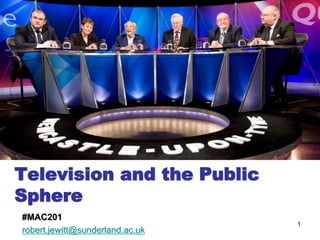
Television and the Public
Sphere
#MAC201
robert.jewitt@sunderland.ac.uk
2
Overview
1. Jurgen Habermas and the public
sphere
2. Testing the political public sphere
3. Levels of coverage
4. Newspaper discourse
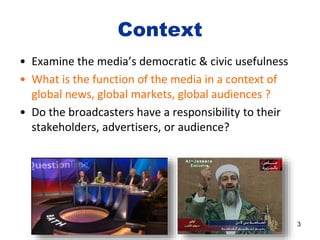
Context
• Examine the media’s democratic & civic usefulness
• What is the function of the media in a context of
global news, global markets, global audiences ?
• Do the broadcasters have a responsibility to their
stakeholders, advertisers, or audience?
3
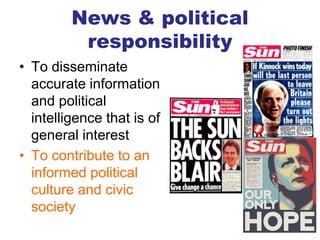
News & political
responsibility
• To disseminate
accurate information
and political
intelligence that is of
general interest
• To contribute to an
informed political
culture and civic
society
4
5
6
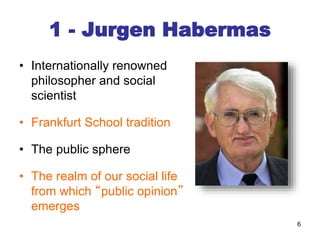
1 - Jurgen Habermas
• Internationally renowned
philosopher and social
scientist
• Frankfurt School tradition
• The public sphere
• The realm of our social life
from which “public opinion”
emerges
7
Public sphere
• Civic space in which private citizens could
meet to discuss matters of political
importance
• Work towards the formation of a collective
opinion for the benefit of the citizenry
– ‘communicative rationality’
– knowledge, language and validity claims
8
Conditions for the public
sphere
• Free from the influences of:
– the market place
– the state
– the family
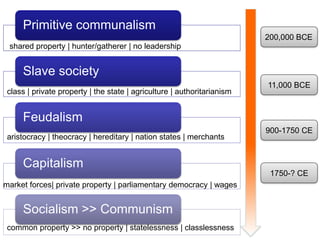
200,000 BCE
Primitive communalism
Slave society
Feudalism
Capitalism
Socialism >> Communism
shared property | hunter/gatherer | no leadership
class | private property | the state | agriculture | authoritarianism
aristocracy | theocracy | hereditary | nation states | merchants
market forces| private property | parliamentary democracy | wages
1750-? CE
900-1750 CE
11,000 BCE
common property >> no property | statelessness | classlessness
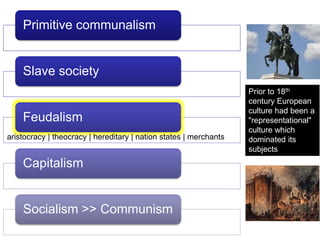
Primitive communalism
Slave society
Feudalism
Capitalism
Socialism >> Communism
aristocracy | theocracy | hereditary | nation states | merchants
Prior to 18th
century European
culture had been a
"representational"
culture which
dominated its
subjects
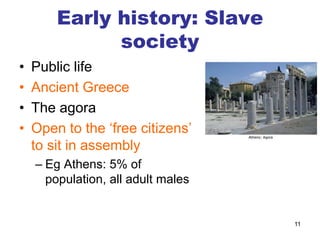
Early history: Slave
society
• Public life
• Ancient Greece
• The agora
• Open to the ‘free citizens’
to sit in assembly
– Eg Athens: 5% of
population, all adult males
11
• “The public life ... went on in the market place
(agora), but of course this did not mean that it
occurred necessarily only in this specific locale.
The public sphere was constituted in discussion
(lexis), which could also assume the forms of
consultation and of sitting in the court of law, as
well as in common action (praxis), be it the
waging of war or competition in athletic games.”
– The Structural Transformation of the Public Sphere:
An inquiry into a category of bourgeois society,
Cambridge (MA), MIT, 1989, p. 3
12
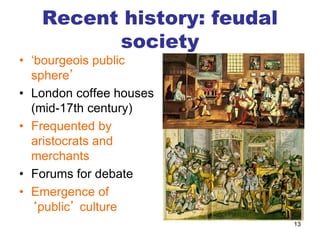
Recent history: feudal
society
• ‘bourgeois public
sphere’
• London coffee houses
(mid-17th century)
• Frequented by
aristocrats and
merchants
• Forums for debate
• Emergence of
‘public’ culture
13
The public sphere
• Active participants met to check powers of
state
• Formation owed much to burgeoning
capitalism and economic freedoms –
‘bourgeois public sphere’
• ‘Notional space’ – arena for public debate
• Lies between ‘basis’ (private lives of citizens)
and ‘top’ (political institutions)
14
Democracy?
• Public sphere = public opinion?
• ‘the critical state of a democracy can be
measured by taking the pulse of the life of
its political public sphere’
(Habermas, 2004, p10)
15
16
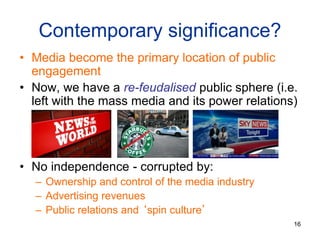
Contemporary significance?
• Media become the primary location of public
engagement
• Now, we have a re-feudalised public sphere (i.e.
left with the mass media and its power relations)
• No independence - corrupted by:
– Ownership and control of the media industry
– Advertising revenues
– Public relations and ‘spin culture’
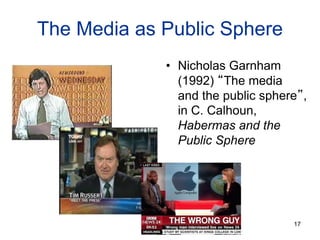
The Media as Public Sphere
• Nicholas Garnham
(1992) “The media
and the public sphere”,
in C. Calhoun,
Habermas and the
Public Sphere
17
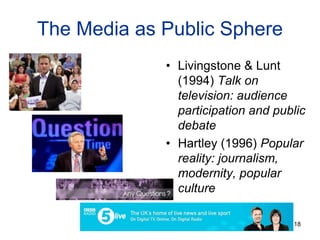
The Media as Public Sphere
• Livingstone & Lunt
(1994) Talk on
television: audience
participation and public
debate
• Hartley (1996) Popular
reality: journalism,
modernity, popular
culture
18
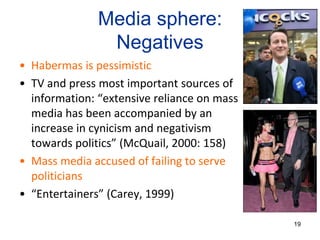
Media sphere:
Negatives
• Habermas is pessimistic
• TV and press most important sources of
information: “extensive reliance on mass
media has been accompanied by an
increase in cynicism and negativism
towards politics” (McQuail, 2000: 158)
• Mass media accused of failing to serve
politicians
• “Entertainers” (Carey, 1999)
19
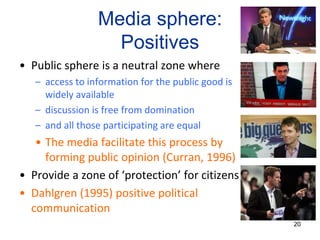
Media sphere:
Positives
• Public sphere is a neutral zone where
– access to information for the public good is
widely available
– discussion is free from domination
– and all those participating are equal
• The media facilitate this process by
forming public opinion (Curran, 1996)
• Provide a zone of ‘protection’ for citizens
• Dahlgren (1995) positive political
communication
20
Ideal?
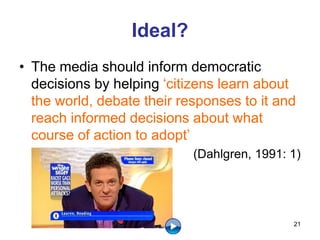
• The media should inform democratic
decisions by helping ‘citizens learn about
the world, debate their responses to it and
reach informed decisions about what
course of action to adopt’
(Dahlgren, 1991: 1)
21
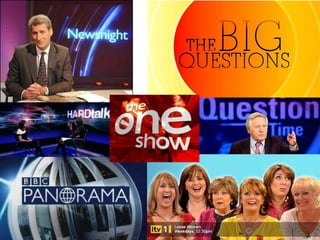
Panelists
TV Audience
23
2 - Testing the political public
sphere
• See Higgins, 2006 (on Sunspace)
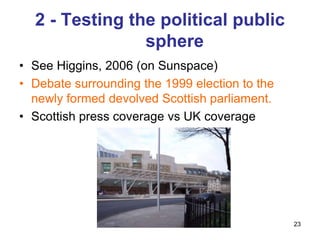
• Debate surrounding the 1999 election to the
newly formed devolved Scottish parliament.
• Scottish press coverage vs UK coverage
24
Method
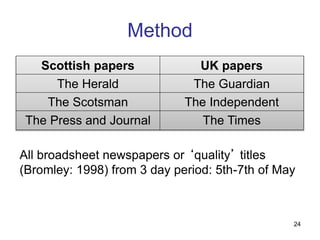
Scottish papers UK papers
The Herald The Guardian
The Scotsman The Independent
The Press and Journal The Times
All broadsheet newspapers or ‘quality’ titles
(Bromley: 1998) from 3 day period: 5th-7th of May
25
3 - Levels of coverage
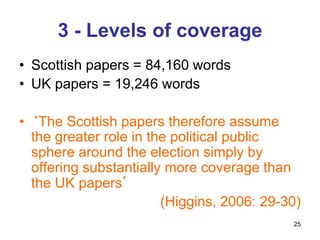
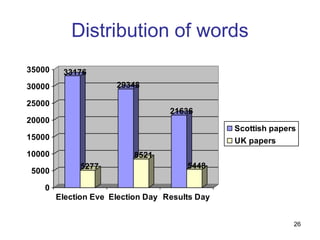
• Scottish papers = 84,160 words
• UK papers = 19,246 words
• ‘The Scottish papers therefore assume
the greater role in the political public
sphere around the election simply by
offering substantially more coverage than
the UK papers’
(Higgins, 2006: 29-30)
26
Distribution of words
33176
5277
29348
8521
21636
5448
0
5000
10000
15000
20000
25000
30000
35000
Election Eve Election Day Results Day
Scottish papers
UK papers
27
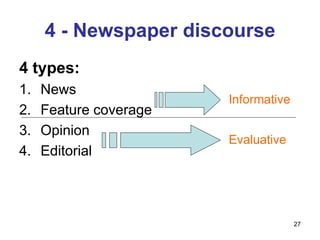
4 - Newspaper discourse
4 types:
1. News
2. Feature coverage
3. Opinion
4. Editorial
Informative
Evaluative
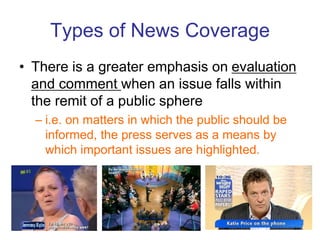
Types of News Coverage
• There is a greater emphasis on evaluation
and comment when an issue falls within
the remit of a public sphere
– i.e. on matters in which the public should be
informed, the press serves as a means by
which important issues are highlighted.
28
29
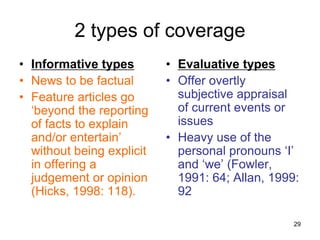
2 types of coverage
• Informative types
• News to be factual
• Feature articles go
‘beyond the reporting
of facts to explain
and/or entertain’
without being explicit
in offering a
judgement or opinion
(Hicks, 1998: 118).
• Evaluative types
• Offer overtly
subjective appraisal
of current events or
issues
• Heavy use of the
personal pronouns ‘I’
and ‘we’ (Fowler,
1991: 64; Allan, 1999:
92
30
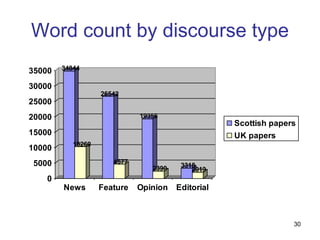
34844
10260
26542
4577
19356
2390 3318
2019
0
5000
10000
15000
20000
25000
30000
35000
News Feature Opinion Editorial
Scottish papers
UK papers
Word count by discourse type
31
The Scottish papers….
1. demonstrate a significantly greater quantity of election
coverage
2. ‘present a pattern consistent with voter deliberation by
providing the bulk of election material when it is able to
inform democratic action’ (Higgins, 2006: 39)
3. attempt to engage via an emphasis on feature and
opinion coverage whereby ‘the greater stress of
informative material [comes] at a time where it can be
used to substantiate voting decisions’ (ibid).
4. place their coverage in the most prominent parts of the
paper.
32
Conclusion
• Democratic society needs some kind of space in
which the important issues of the day can be
discussed so that the public can make informed
decisions.
• Cultural proximity impacts upon how information
is presented to the public
• Higgins suggests that the ‘public sphere’ that
Habermas identifies is manifest in the civil
institution of the press.
News as social and political agent?
• Should we think of the business of news as
reporting facts or seeking out and bringing us
material we should know about?
• Is it a role of the news to make us more socially
and politically aware, or to distract and entertain
us?
• Can it do both? (Think of the role of news
values.)
33
Points for discussion
• In your judgement, is the media as a
public sphere driven by consideration of:
– Political and democratic responsibility on the
part of the media institutions and journalists?
– The need to appeal to a given audience?
34
Bibliography
• Allan, S. (1999/2004) News culture. Buckingham: Open University Press.
• Bell, A. (1991) The language of news media. Oxford: Blackwell.
• Bromley, M. (1998) ‘The ‘tabloiding’ of Britain: ‘Quality’ newspapers in the 1990s’, in M. Bromley and H. Stephenson (eds)
Sex, lies and democracy: the press and the public, pp. 25-38. London: Longman.
• Curran, J. ((1996), ‘Mass Media and Democracy Revisited’, in Curran and M. Gurevitch, eds. (2000) Mass Media and
Society,
• Dahlgren, P. (1991) ‘Introduction’, in P. Dahlgren and C. Sparks (eds) Communication and citizenship: journalism and the
public sphere, pp. 1-24. London: Routledge.
• Deacon, D., M. Pickering, P. Golding and G. Murdock (1999) Researching communications. London: Arnold.
• Fowler, R. (1991) Language in the news: discourse and ideology in the press. London: Routledge.
• Franklin, B. (1997) Newszak and news media. London: Arnold.
• Franklin, B. (2004) Packaging politics, 2nd edition. London: Arnold.
• Galtung, J. and M. Ruge (1973) ‘Structuring and selecting news’, in S. Cohen and J. Young (eds) The manufacture of news:
deviance, social problems and the media, pp. 62-72. London: Constable.
• Garnham, N. (1992) ‘The media and the public sphere’, in C. Calhoun (ed) Habermas and the public sphere, pp. 359-376.
Cambridge, MA: MIT Press.
• Habermas, J. (1989) The structural transformation of the public sphere. Cambridge: Polity Press.
• Habermas, J. (2004) ‘Public space and political public sphere – the biographical roots of two motifs in my thought’,
Commemorative Lecture, Kyoto, November 11.
• Hartley, J. (1996) Popular reality: journalism, modernity, popular culture. London: Arnold.
• Hicks, W. (1998) English for journalists, 2nd edition. London: Routledge.
• Higgins, M. (2006) ‘Substantiating a political public sphere in the Scottish press: a comparative analysis’, in Journalism, Vol.
7, No. 1, pp 25-44.
• Livingstone, S. and P. Lunt (1994) Talk on television: audience participation and public debate. London: Routledge.
• Negrine, R. (1998) Parliament and the media: a study of Britain, Germany and France. London: Pinter.
• Walzer, M (1995), Toward A Global Civil Society, Oxford: Berghahn Books
35

Television and the public sphere

  • 1.
    1 Television and thePublic Sphere #MAC201 robert.jewitt@sunderland.ac.uk
  • 2.
    2 Overview 1. Jurgen Habermasand the public sphere 2. Testing the political public sphere 3. Levels of coverage 4. Newspaper discourse
  • 3.
    Context • Examine themedia’s democratic & civic usefulness • What is the function of the media in a context of global news, global markets, global audiences ? • Do the broadcasters have a responsibility to their stakeholders, advertisers, or audience? 3
  • 4.
    News & political responsibility •To disseminate accurate information and political intelligence that is of general interest • To contribute to an informed political culture and civic society 4
  • 5.
  • 6.
    6 1 - JurgenHabermas • Internationally renowned philosopher and social scientist • Frankfurt School tradition • The public sphere • The realm of our social life from which “public opinion” emerges
  • 7.
    7 Public sphere • Civicspace in which private citizens could meet to discuss matters of political importance • Work towards the formation of a collective opinion for the benefit of the citizenry – ‘communicative rationality’ – knowledge, language and validity claims
  • 8.
    8 Conditions for thepublic sphere • Free from the influences of: – the market place – the state – the family
  • 9.
    200,000 BCE Primitive communalism Slavesociety Feudalism Capitalism Socialism >> Communism shared property | hunter/gatherer | no leadership class | private property | the state | agriculture | authoritarianism aristocracy | theocracy | hereditary | nation states | merchants market forces| private property | parliamentary democracy | wages 1750-? CE 900-1750 CE 11,000 BCE common property >> no property | statelessness | classlessness
  • 10.
    Primitive communalism Slave society Feudalism Capitalism Socialism>> Communism aristocracy | theocracy | hereditary | nation states | merchants Prior to 18th century European culture had been a "representational" culture which dominated its subjects
  • 11.
    Early history: Slave society •Public life • Ancient Greece • The agora • Open to the ‘free citizens’ to sit in assembly – Eg Athens: 5% of population, all adult males 11
  • 12.
    • “The publiclife ... went on in the market place (agora), but of course this did not mean that it occurred necessarily only in this specific locale. The public sphere was constituted in discussion (lexis), which could also assume the forms of consultation and of sitting in the court of law, as well as in common action (praxis), be it the waging of war or competition in athletic games.” – The Structural Transformation of the Public Sphere: An inquiry into a category of bourgeois society, Cambridge (MA), MIT, 1989, p. 3 12
  • 13.
    Recent history: feudal society •‘bourgeois public sphere’ • London coffee houses (mid-17th century) • Frequented by aristocrats and merchants • Forums for debate • Emergence of ‘public’ culture 13
  • 14.
    The public sphere •Active participants met to check powers of state • Formation owed much to burgeoning capitalism and economic freedoms – ‘bourgeois public sphere’ • ‘Notional space’ – arena for public debate • Lies between ‘basis’ (private lives of citizens) and ‘top’ (political institutions) 14
  • 15.
    Democracy? • Public sphere= public opinion? • ‘the critical state of a democracy can be measured by taking the pulse of the life of its political public sphere’ (Habermas, 2004, p10) 15
  • 16.
    16 Contemporary significance? • Mediabecome the primary location of public engagement • Now, we have a re-feudalised public sphere (i.e. left with the mass media and its power relations) • No independence - corrupted by: – Ownership and control of the media industry – Advertising revenues – Public relations and ‘spin culture’
  • 17.
    The Media asPublic Sphere • Nicholas Garnham (1992) “The media and the public sphere”, in C. Calhoun, Habermas and the Public Sphere 17
  • 18.
    The Media asPublic Sphere • Livingstone & Lunt (1994) Talk on television: audience participation and public debate • Hartley (1996) Popular reality: journalism, modernity, popular culture 18
  • 19.
    Media sphere: Negatives • Habermasis pessimistic • TV and press most important sources of information: “extensive reliance on mass media has been accompanied by an increase in cynicism and negativism towards politics” (McQuail, 2000: 158) • Mass media accused of failing to serve politicians • “Entertainers” (Carey, 1999) 19
  • 20.
    Media sphere: Positives • Publicsphere is a neutral zone where – access to information for the public good is widely available – discussion is free from domination – and all those participating are equal • The media facilitate this process by forming public opinion (Curran, 1996) • Provide a zone of ‘protection’ for citizens • Dahlgren (1995) positive political communication 20
  • 21.
    Ideal? • The mediashould inform democratic decisions by helping ‘citizens learn about the world, debate their responses to it and reach informed decisions about what course of action to adopt’ (Dahlgren, 1991: 1) 21
  • 22.
  • 23.
    23 2 - Testingthe political public sphere • See Higgins, 2006 (on Sunspace) • Debate surrounding the 1999 election to the newly formed devolved Scottish parliament. • Scottish press coverage vs UK coverage
  • 24.
    24 Method Scottish papers UKpapers The Herald The Guardian The Scotsman The Independent The Press and Journal The Times All broadsheet newspapers or ‘quality’ titles (Bromley: 1998) from 3 day period: 5th-7th of May
  • 25.
    25 3 - Levelsof coverage • Scottish papers = 84,160 words • UK papers = 19,246 words • ‘The Scottish papers therefore assume the greater role in the political public sphere around the election simply by offering substantially more coverage than the UK papers’ (Higgins, 2006: 29-30)
  • 26.
  • 27.
    27 4 - Newspaperdiscourse 4 types: 1. News 2. Feature coverage 3. Opinion 4. Editorial Informative Evaluative
  • 28.
    Types of NewsCoverage • There is a greater emphasis on evaluation and comment when an issue falls within the remit of a public sphere – i.e. on matters in which the public should be informed, the press serves as a means by which important issues are highlighted. 28
  • 29.
    29 2 types ofcoverage • Informative types • News to be factual • Feature articles go ‘beyond the reporting of facts to explain and/or entertain’ without being explicit in offering a judgement or opinion (Hicks, 1998: 118). • Evaluative types • Offer overtly subjective appraisal of current events or issues • Heavy use of the personal pronouns ‘I’ and ‘we’ (Fowler, 1991: 64; Allan, 1999: 92
  • 30.
    30 34844 10260 26542 4577 19356 2390 3318 2019 0 5000 10000 15000 20000 25000 30000 35000 News FeatureOpinion Editorial Scottish papers UK papers Word count by discourse type
  • 31.
    31 The Scottish papers…. 1.demonstrate a significantly greater quantity of election coverage 2. ‘present a pattern consistent with voter deliberation by providing the bulk of election material when it is able to inform democratic action’ (Higgins, 2006: 39) 3. attempt to engage via an emphasis on feature and opinion coverage whereby ‘the greater stress of informative material [comes] at a time where it can be used to substantiate voting decisions’ (ibid). 4. place their coverage in the most prominent parts of the paper.
  • 32.
    32 Conclusion • Democratic societyneeds some kind of space in which the important issues of the day can be discussed so that the public can make informed decisions. • Cultural proximity impacts upon how information is presented to the public • Higgins suggests that the ‘public sphere’ that Habermas identifies is manifest in the civil institution of the press.
  • 33.
    News as socialand political agent? • Should we think of the business of news as reporting facts or seeking out and bringing us material we should know about? • Is it a role of the news to make us more socially and politically aware, or to distract and entertain us? • Can it do both? (Think of the role of news values.) 33
  • 34.
    Points for discussion •In your judgement, is the media as a public sphere driven by consideration of: – Political and democratic responsibility on the part of the media institutions and journalists? – The need to appeal to a given audience? 34
  • 35.
    Bibliography • Allan, S.(1999/2004) News culture. Buckingham: Open University Press. • Bell, A. (1991) The language of news media. Oxford: Blackwell. • Bromley, M. (1998) ‘The ‘tabloiding’ of Britain: ‘Quality’ newspapers in the 1990s’, in M. Bromley and H. Stephenson (eds) Sex, lies and democracy: the press and the public, pp. 25-38. London: Longman. • Curran, J. ((1996), ‘Mass Media and Democracy Revisited’, in Curran and M. Gurevitch, eds. (2000) Mass Media and Society, • Dahlgren, P. (1991) ‘Introduction’, in P. Dahlgren and C. Sparks (eds) Communication and citizenship: journalism and the public sphere, pp. 1-24. London: Routledge. • Deacon, D., M. Pickering, P. Golding and G. Murdock (1999) Researching communications. London: Arnold. • Fowler, R. (1991) Language in the news: discourse and ideology in the press. London: Routledge. • Franklin, B. (1997) Newszak and news media. London: Arnold. • Franklin, B. (2004) Packaging politics, 2nd edition. London: Arnold. • Galtung, J. and M. Ruge (1973) ‘Structuring and selecting news’, in S. Cohen and J. Young (eds) The manufacture of news: deviance, social problems and the media, pp. 62-72. London: Constable. • Garnham, N. (1992) ‘The media and the public sphere’, in C. Calhoun (ed) Habermas and the public sphere, pp. 359-376. Cambridge, MA: MIT Press. • Habermas, J. (1989) The structural transformation of the public sphere. Cambridge: Polity Press. • Habermas, J. (2004) ‘Public space and political public sphere – the biographical roots of two motifs in my thought’, Commemorative Lecture, Kyoto, November 11. • Hartley, J. (1996) Popular reality: journalism, modernity, popular culture. London: Arnold. • Hicks, W. (1998) English for journalists, 2nd edition. London: Routledge. • Higgins, M. (2006) ‘Substantiating a political public sphere in the Scottish press: a comparative analysis’, in Journalism, Vol. 7, No. 1, pp 25-44. • Livingstone, S. and P. Lunt (1994) Talk on television: audience participation and public debate. London: Routledge. • Negrine, R. (1998) Parliament and the media: a study of Britain, Germany and France. London: Pinter. • Walzer, M (1995), Toward A Global Civil Society, Oxford: Berghahn Books 35

Editor's Notes

  • #4 Examine the media’s usefulness for engaging its public in informed discussion. Also looking at its political realm and its citizenship Raises a number of questions regarding the media’s function in the 21st century
  • #5 Basic level – press have a political responsibility to...
  • #7 Jurgen Habermas is an internationally renowned philosopher and social scientist Follows in the tradition of the Frankfurt School scholars such as Theodore Adorno, Walter Benjamin, etc. Strong influence of Marxist philosophy. Access to this space was free and freedom of assembly, association and expression were guaranteed
  • #10 Marx’s theory of history SLAVE The slave-owning class "own" the land and slaves, which are the main means of producing wealth, whilst the vast majority have very little or nothing FEUDALISM Out of the merchants' riches, a capitalist class emerges within this feudal society. However there are immediate conflicts with the aristocracy CAPITALISM In capitalism, the profit motive rules and people, freed from serfdom, work for the capitalists for wages. The capitalist class are free to spread their laissez faire practices around the world. In the capitalist-controlled parliament, laws are made to protect wealth.
  • #11 Marx’s theory of history SLAVE The slave-owning class "own" the land and slaves, which are the main means of producing wealth, whilst the vast majority have very little or nothing FEUDALISM Out of the merchants' riches, a capitalist class emerges within this feudal society. However there are immediate conflicts with the aristocracy CAPITALISM In capitalism, the profit motive rules and people, freed from serfdom, work for the capitalists for wages. The capitalist class are free to spread their laissez faire practices around the world. In the capitalist-controlled parliament, laws are made to protect wealth.
  • #15 Active participants in political life met, discussed and formed political projects Imp task – way of keeping a check on the government by way of creating and forming an informed influential public opinion Formation of public sphere ... Public sphere was a notional space which provided an autonomous and open arena for public debate The space, arena, lies between basis (private life of individual citizens) and the top (political institutions which are part of public life)
  • #20 Habermas was pessimistic – information is manipulated by the media rather than allowing us to form opinions – rational way Because we rely on media to inform us on political issues, grown to posses a negative view of politics To add to this, mass media fail to serve politicians - media prefer to entertain, sensationalise and follow the money. E.g. Political scandals – lembit opik and cheeky girls
  • #21 Media as public sphere – neutral or imparital – present news fairly and unbiased. Media used as a tool to generate public discussion When organised correctly – provide a zone of ‘protection’ for citizens in their relations with the state Contradicts Carey and McQuail’s arguments
  • #22 Dahlgren suggesting that the media act as an information supply – help us make decisions that matter to us With this in mind, show a clip from the Wright Stuff – they are debating what humour is acceptable in modern day society – could argue – for aid of society? Now, move onto a case study of the political public sphere in the press by Dr Michael Higgins However, can anyone think of examples of the public sphere as seen on television or on the radio – where the public get their say?
  • #23 Frequently the public are given access to formats which mimic the civic construction of society – to what extent are the audience allowed access to engage and on what terms?