
PG PRESENTATION
ON
SEPSIS
Deptt. of Emergency Medicine
Sher-I-Kashmir Institute of Medical Sciences, Soura
PRESENTED BY DR SHAMI KUMAR (PG2Y)
• ONE OF THE MOST DYNAMIC & CONTROVERSIAL TOPICS
IN MEDICAL SCIENCE
• DEFINED IN 1991, UPDATED IN 2001 & 2016 BY SOCIETY OF
CRITICAL CARE MEDICINE & EUROPEAN SOCIETY OF
INTENSIVE CARE MEDICINE.
SEPSIS .. As a term
• SEPSIS IS NOT A SPECIFIC ILLNESS BUT RATHER A
SYNDROME ENCOMPASSING A STILL-UNCERTAIN
PATHOBIOLOGY.
• AT PRESENT, IT CAN BE IDENTIFIED BY A CONSTELLATION
OF CLINICAL SIGNS AND SYMPTOMS IN A PATIENT WITH
SUSPECTED INFECTION.
• BECAUSE NO GOLD STANDARD TEXT EXISTS, THE TASK
FORCE SOUGHT DEFINITIONS AND SUPPORTING CLINICAL
CRITERIA THAT WERE CLEAR AND FULFILLED MULTIPLE
DOMAINS OF USEFULNESS AND VALIDITY.
Sepsis.. Identified challenges and oppurtunities
(1991 consensus conference in which SIRS criteria
were established)
Four SIRS criteria were defined, namely
•Tachycardia (heart rate >90 beats/min),
•Tachypnea (respiratory rate >20 breaths/min) or
PaCO2<32mmHg,
•Fever or hypothermia (temperature >38 or <36 ℃),
•And leukocytosis, leukopenia, or bandemia (white blood
cells >1,2000/mm3 Or <4,000/mm3 or bandemia ≥10%).
Patients who met two or more of these criteria fulfilled the definition of SIRS,
and
Sepsis was defined as infection or suspected infection leading to the onset of
SIRS.
Severe Sepsis = Sepsis + Evidence of Organ dysfunction
Sepsis-1
A 2001 task force recognized the limitations with
these definitions, but did not offer alternatives due to a lack of
supporting evidence. However, they did expand the list of diagnostic
criteria, resulting in the introduction of Sepsis-2.
Therefore, in order to be diagnosed with sepsis under the Sepsis-2
definition, as with Sepsis-1,
An individual must have at least 2 SIRS criteria and a
confirmed or suspected infection.
In effect, the definitions of sepsis and septic shock remained
unchanged for more than two decades.
Sepsis-2
Redefining sepsis 3…2016
SEPSIS 3
THIRD INTERNATIONAL CONSENSUS
DEFINITION FOR SEPSIS & SEPTIC SHOCK
• DEFINITIONS OF SEPSIS AND SEPTIC SHOCK WERE LAST
REVISED IN 2001. CONSIDERABLE ADVANCES HAVE SINCE
BEEN MADE INTO THE PATHOBIOLOGY (CHANGES IN
ORGAN FUNCTION, MORPHOLOGY, CELL BIOLOGY,
BIOCHEMISTRY, IMMUNOLOGY, AND CIRCULATION)
MANAGEMENT AND EPIDEMIOLOGY OF SEPSIS,
SUGGESTING THE NEED FOR RE-EXAMINATION .
IMPORTANCE
• TO EVALUATE AND, AS NEEDED, UPDATE DEFINITIONS OF
SEPSIS AND SEPTIC SHOCK
OBJECTIVE
• WORLD WIDE AND INDIAN PERSPECTIVE
• INCIDENCE 7,50,000/YR
• ACCOUNTS FOR MORE THAN $20 BILLION(5.2%) OF TOTAL US
HOSPITAL COSTS IN 2011
• LEADING CAUSE OF DEATH IN ICU
• NEARLY 1 OUT OF 4 PATIENTS IN INDIAN ICU DEVELOP SEPSIS
• 20000 PATIENTS DIE/DAY BECAUSE OF SEPSIS WORLDWIDE
• SIGNIFICANT MORTALITY/MORBIDITY UPTO 5 YRS IN SEPSIS
SURVIVORS
Sepsis burden
WHY THERE WAS NEED TO REDEFINE SEPSIS…
1) PREVIOUS DEFINITION FOCUSED ON INFLAMMATION (SIRS)
2) SEPSIS WAS THOUGHT TO FOLLOW A CONTINUUM
FROM SEPSIS >SEVERE SEPSIS> SHOCK
3) MULTIPLE DEFINITIONS & TERMINOLOGIES LEADING TO
DISCREPANCY IN REPORTED INCIDENCE AND OBSERVED
MORTALITY. THE TASK FORCE CONCLUDED THE TERM
SEVERE SEPSIS WAS REDUNDANT.
Sepsis def previous and now
• THE CURRENT USE OF 2 OR MORE SIRS CRITERIA TO
IDENTIFY SEPSIS WAS UNANIMOUSLY CONSIDERED BY
THE TASK FORCE TO BE NOT HELPFUL.
• CHANGES IN WBC COUNT, TEMPERATURE AND HEART
RATE REFLECT INFLAMMATION, THE HOST RESPONSE TO
‘DANGER’ IN THE FORM OF INFECTION OR OTHER
INSULTS.
• DAMAGE TO ORGANS LOCALLY AND AT DISTANT SITE IS
WHAT DIFFERENTIATES SEPSIS FROM UNCOMPLICATED
INFECTION
Not every infection is sepsis
• A DEFINITION WHICH HAS HARDLY CHANGED IN LAST 2
DECADES, LAST REVISED IN 2001
• CURRENT FOCUS IS ON IMMUNE DYSREGULATION
• AND ORGAN DYSFUNCTION
Current update is to redefine sepsis
• SEPSIS IS DEFINED AS ….
- LIFE THREATENING ORGAN DYSFUNCTION
- CAUSED BY A DYSREGULATED HOST RESPONSE TO
INFECTION
Sepsis definition
• ACUTE CHANGE IN TOTAL SOFA SCORE >2 POINTS
CONSEQUENT TO THE INFECTION.
• A SOFA SCORE >2 REFLECTS AN OVERALL MORTALITY OF
APPROXIMATELY 10% IN GENERAL HOSPITAL POPULATION
WITH SUSPECTED INFECTION.
Organ Dysfunction
• TO DEFINE SEPSIS (nearly 1 million cases reviewed)
• ACUTE CHANGE IN SOFA SCORE BY 2 OR MORE IN A PATIENT
WITH SUSPECTED OR DOCUMENTED INFECTION
• BASELINE SCORE CONSIDERED ZERO IN PREVIOUS APPARENTLY
NORMAL INDIVIDUAL
• INCLUDES PARAMETERS..
SOFA
(sequential organ failure assessment)
SOFA score
• MOST IDEAL SCORE FOR DEFINING SEPSIS BETTER THAN
SIRS
• IDEAL FOR AN ICU SET UP
BUT…LIMITING FACTOR
• MULTIPLE PARAMETERS ASSESSED
• LAB TESTS REQUIRED
• CAN’T BE REASSESSED FREQUENTLY
SOFA score
Bedside, easy, clinical & can be used by paramedics
• AS EFFICIENT AS SOFA OUTSIDE ICU
• CAN IDENTIFY PATIENTS IN NEED OF ICU CARE
• ONLY INCLUDES CLINICAL PARAMETERS & CAN BE
FREQUENTLY REASSESSED
LIMITATIONS:
• qSOFA HAS A POOR SENSITIVITY
• qSOFA IS A LATE INDICATOR OF DETERIORATION
• qSOFA IS INFERIOR TO THE NEWS SCORE
q SOFA (quick SOFA)
• SEPSIS
• SEVERE SEPSIS
• SEPTIC SHOCK
SEVERE SEPSIS no longer used
• DEFINITION: IT IS A SUBSET OF SEPSIS IN WHICH UNDERLYING
CIRCULATORY & CELLULAR METABOLISM ABNORMALITIES ARE
PROFOUND ENOUGH TO SUBSTAINTIALLY INCREASE MORTALITY
• CLINICAL CRITERIA
• CLINICALLY DEFINED AS
• SEPSIS AND
• VASOPRESSOR THERAPY NEEDED TO ELEVATE MAP ≥65 mmHG
• AND
• HYPERLACTATEMIA >2MMOL/L (18mg/dl) DESPITE ADEQUATE
FLUID RESUSCITATION
Septic shock
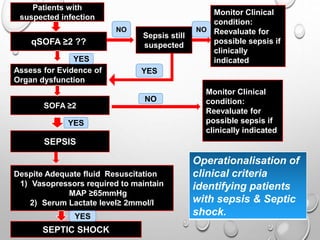
Patients with
suspected infection
qSOFA ≥2 ??
Assess for Evidence of
Organ dysfunction
SOFA ≥2
SEPSIS
Despite Adequate fluid Resuscitation
1) Vasopressors required to maintain
MAP ≥65mmHg
2) Serum Lactate level≥ 2mmol/l
Sepsis still
suspected
Monitor Clinical
condition:
Reevaluate for
possible sepsis if
clinically
indicated
Monitor Clinical
condition:
Reevaluate for
possible sepsis if
clinically indicated
SEPTIC SHOCK
NO
YES
NO
YES
YES
YES
NO
Operationalisation of
clinical criteria
identifying patients
with sepsis & Septic
shock.
• SEPSIS IS NOT FULLY UNDERSTOOD
• SOFA NEEDS TO BE VALIDATED OUTSIDE US ALSO
• NEGATIVE SOFA SCREEN FOR SEPSIS SHOULD NOT HINDER
CLINICAL JUDGEMENT
• qSOFA & SOFA CAN MISS OCCULT ORGAN DYSFUNCTION .
• ROLE OF LACTATE IN DEFINING SEPSIS (NON-AVAILABILITY OF
LACTATE MEASUREMENT IN RESOURCE POOR SETTING).
Controversies & limitations
• NOT EVERY INFECTION IS SEPSIS
• MORE FOCUS ON EARLY TIMELY DIAGNOSIS
• CURRENT UPDATE FOCUSES ON ORGAN DYSFUNCTION AND
IMMUNE DYSREGULATION
• TERMS LIKE SIRS, SEVERE SEPSIS & MODS DISCOURAGED
• QSOFA & SOFA CRITERIA TO DIAGNOSE SEPSIS
Summary
• RESPIRATORY 38%
• URINARY TRACT 21%
• INTRA-ABDOMINAL 16.5%
• CRBSI 2.3%
• DEVICE 1.3%
• CNS 0.8%
• OTHERS 11.3%
SOURCES OF SEPSIS
MANAGEMENT OF SEPSIS
IMMEDIATE EVALUATION AND MANAGEMENT
•Stabilize respiration
Supplemental oxygen should be supplied to all patients with sepsis and oxygenation
should be monitored continuously.
Intubation and mechanical ventilation may be required.
•Establish venous access
(preferably central venous access, can be used to monitor the therapeutic response by
measuring the central venous pressure (CVP) and the central venous oxyhemoglobin
saturation (ScvO2))
•Initial investigations
An initial brief history and examination, as well as laboratory, microbiologic, and imaging
studies are often obtained simultaneously while access is being established and the
airway stabilized.
Quickly obtaining the following is preferable (within 45
minutes of presentation) but should not delay the
administration of fluids and antibiotics:
Complete blood counts with differential, chemistries, liver function tests, and coagulation
studies including D-dimer level.
Serum lactate ・An elevated serum lactate (eg, >2 mmol/L) may indicate the severity of
sepsis and is used to follow the therapeutic response
Arterial blood gas (ABG) analysis
Peripheral blood cultures (aerobic and anaerobic cultures from at least two different
sites), urinalysis, and microbiologic cultures (eg, sputum, urine, intravascular catheter,
wound or surgical site, body fluids) from readily accessible sites ・For patients with a
vascular catheter, blood should be obtained both from the catheter and from peripheral
sites.
Imaging targeted at the suspected site of infection is warranted
Procalcitonin ・While we are not proponents of measuring procalcitonin, it has become
increasingly popular. Its diagnostic value and value in deescalating antibiotic therapy are
controversial and poorly supported by evidence.
INITIAL RESUSCITATIVE THERAPY
Rapid restoration of perfusion
usually crystalloids (balanced crystalloids or normal saline) given at 30 mL/kg (actual
body weight) within the first three hours following presentation.
Early administration of antibiotics
Empiric antibiotic therapy is targeted at the suspected organism(s) and site(s) of
infection and preferably administered within the first hour.
ANTIBIOTIC THERAPY IN SEPSIS WILL BE
DISCUSSED TOMORROW
Intravenous fluids (first three hours)
Volume:
Intravascular hypovolemia is typical and may be severe in sepsis. Rapid, large volume
infusions of IVF (30 mL/kg) are indicated as initial therapy for sepsis or septic shock,
unless there is convincing evidence of significant pulmonary edema.
Choice of fluid:
No convincing difference between using crystalloid solutions (eg, normal saline,
Ringer's lactate) and albumin solutions in the treatment of sepsis or septic shock, but
they have identified potential harm from using pentastarch or hydroxyethyl starch.
However due to lack of clear benefit and higher cost of albumin, albumin solutions are
not preferred. It can be used as an additive or maintenance fluid if there is a perceived
need to avoid or treat the hyperchloremia that occurs when large volumes of crystalloid
are
administered
MONITOR RESPONSE
Monitoring catheters
(central venous catheter and an arterial catheter)
Clinical
Mean arterial pressure (MAP), urine output, heart rate, respiratory rate, skin color,
temperature, pulse oximetry, and mental status.
Among these, a MAP ≥65 mmHg (MAP = [(2 x diastolic) + systolic]/3), and urine output
≥0.5 mL/kg per hour are common targets used in clinical practice.
Hemodynamic
Static ・Traditionally, in addition to MAP, the following static CVC measurements were
used to determine adequate fluid management:
•CVP at a target of 8 to 12 mmHg
•ScvO2 ≥70 percent (≥65 percent if sample is drawn off a PAC)
Dynamic ・Respiratory changes in the vena caval diameter, radial artery pulse
pressure, aortic blood flow peak velocity, left ventricular outflow tract velocity-time
integral, and brachial artery blood flow velocity are considered dynamic measures of
fluid responsiveness.
Laboratory
Lactate clearance, ABG, routine lab investigations, microbiological inv.
Laboratory
Lactate clearance ・serum lactate ( every six hours) in patients with sepsis until the
lactate value has clearly fallen.
The lactate clearance is defined by the equation
[(initial lactate – lactate at >2 hours later)/initial lactate] x 100.
The lactate clearance and interval change in lactate over the first 12 hours of
resuscitation has been evaluated as a potential marker for effective resuscitation.
Arterial blood gases ・monitor PaO2:FiO2 ratio as well as severity and type of
acidosis (resolution of metabolic acidosis and avoidance of hyperchloremic acidosis).
Worsening gas exchange may indicate pulmonary edema from fluid resuscitation or
other complications including pneumothorax from central catheter placement, ARDS , or
venous thromboembolism.
Routine laboratories ・Follow up laboratory studies, in particular platelet count, serum
chemistries, and liver function tests are often performed (eg, every six hours) until
values have reached normal or baseline. Hyperchloremia should be avoided, but if
detected, switching to low chloride-containing (ie, buffered) solutions may be indicated.
Microbiology ・Follow up indices of infection, including complete blood count and
additional cultures
SEPTIC FOCUS IDENTIFICATION
a focused history and examination is the most valuable method for source
detection.
Identification ・Additional investigations targeted at the suspected source(s)
should be considered in patients with sepsis, within the first 12 hours. This may
include
imaging (eg, computed tomography, ultrasonography)
and sample acquisition (eg, bronchoalveolar lavage, aspirating fluid collections
or joints), and may incur risk if an intervention is involved and the patient remains
unstable.
Source control ・Source control (ie, physical measures to eradicate a focus of
infection and eliminate or treat microbial proliferation and infection) should be
undertaken since undrained foci of infection may not respond to antibiotics alone.
PATIENTS WHO FAIL INITIAL THERAPY
Patients having persistent hypoperfusion despite adequate fluid
resuscitation and antimicrobial treatment should be reassessed for
•fluid responsiveness,
•adequacy of the antimicrobial regimen
•and septic focus control
•as well as the accuracy of the diagnosis
•and the possibility that unexpected complications or coexisting
problems have occurred (eg, pneumothorax following CVC insertion.
PATIENTS WHO FAIL INITIAL THERAPY
Vasopressors:
Intravenous vasopressors are useful in patients who remain hypotensive
despite adequate fluid resuscitation or who develop cardiogenic pulmonary
edema.
Norepinephrine preferred as the first-line agent.
In general avoid
•Dopamine, unless
Relative or absolute bradycardia and low risk of tachyarrhythmias .
•Phenylephrine, unless
Norepinephrine associated with serious arrhythmias
Cardiac output is known to be high and blood pressure target
difficult to achieve
As salvage therapy
PATIENTS WHO FAIL INITIAL THERAPY
Glucocorticoids: corticosteroid therapy is appropriate in patients with
septic shock that is refractory to adequate fluid resuscitation and
vasopressor administration.
Inotropic therapy: in patients who fail to respond to adequate fluids
and vasopressors, particularly those who also have diminished cardiac .
Dobutamine is a suitable firstchoice agent; epinephrine is a suitable
alternative.
Red blood cell transfusions: in critically ill patients, reserve red blood
cell transfusion for patients with a hemoglobin level ≤7 g per deciliter.
Exceptions include suspicion of concurrent hemorrhagic shock or active
myocardial ischemia.
PATIENTS WHO RESPOND TO THERAPY
Identification and control of the septis.
De-escalation fluids: Patients who respond to therapy (ie, clinical hemodynamic
and laboratory targets are met; usually hours to days) should have
the rate of fluid administration reduced or stopped,
vasopressor support weaned,
and, if necessary, diuretics administered (patients with sepsis may develop
cardiogenic and noncardiogenic pulmonary edema).
De-escalation and duration of antibiotics: It is appropriate that de-escalation
and duration of antimicrobial agents be assessed daily. Once pathogen
identification and susceptibility data return and/or patients clinically improve, It is
recommended that antimicrobial therapy be narrowed (typically a few days).
While there is no consensus on de-escalation criteria, most experts use follow-up
clinical (improved vital signs), laboratory and imaging data, and a fixed course of
broad-spectrum therapy (eg, 3 to 5 days).
Duration ・For most patients, the duration of therapy is typically 7 to 10
days , although longer courses are appropriate in patients who have a
slow clinical response, an undrainable focus of infection, bacteremia with
S. aureus, some fungal (eg, deep Candida infections) or viral infections
(eg, herpes or cytomegalovirus), endocarditis, osteomyelitis, large
abscesses, highly resistant gram-negative pathogens with marginal or
limited sensitivities, neutropenia, or immunologic deficiencies. In patients
who are neutropenic, antibiotic treatment should continue until the
neutropenia has resolved or the planned antibiotic course is complete,
whichever is longer.
Role of procalcitonin - studies suggest that procalcitonin may
distinguish infectious from noninfectious conditions and may therefore
facilitate the decision to deescalate empiric therapy, but the evidence to
support this practice is limited.
PATIENTS WHO RESPOND TO THERAPY
•Blood product infusion
•Nutrition
•Stress ulcer prophylaxis
•Neuromuscular blocking agents
•Venous thromboembolism prophylaxis
•Intensive insulin therapy
•External cooling or antipyretics
•Mechanical ventilation, sedation, weaning
SUPPORTIVE THERAPIES
SURVIVING SEPSIS CAMPAIGN
European Society of Intensive Care Medicine & society of critical
care medicine spearheaded the SSC more than two decades ago
and published the initial SSC guidelines in 2004 with intention of
providing guidance for the clinician caring for the adult patients with
sepsis / septic shock. Guidelines were updated in 2008, in 2012
then in 2016.
TO BE COMPLETED WITHIN 3 HOURS:
1) MEASURE LACTATE LEVEL
2) OBTAIN BLOOD CULTURES PRIOR TO ADMINISTRATION OF ANTIBIOTICS
3) ADMINISTER BROAD SPECTRUM ANTIBIOTICS
4) ADMINISTER 30 ML/KG CRYSTALLOID FOR HYPOTENSION OR LACTATE 4MMOL/L
TO BE COMPLETED WITHIN 6 HOURS:
5) APPLY VASOPRESSORS (FOR HYPOTENSION THAT DOES NOT RESPOND TO INITIAL
FLUID RESUSCITATION
TO MAINTAIN A MEAN ARTERIAL PRESSURE [MAP] 65 MM HG)
6) IN THE EVENT OF PERSISTENT ARTERIAL HYPOTENSION DESPITE VOLUME
RESUSCITATION (SEPTIC
SHOCK) OR INITIAL LACTATE ≥ 4 MMOL/L (36 MG/DL):
- MEASURE CENTRAL VENOUS PRESSURE (CVP)*
- MEASURE CENTRAL VENOUS OXYGEN SATURATION (SCVO2)*
7) REMEASURE LACTATE IF INITIAL LACTATE WAS ELEVATED*
SURVIVING SEPSIS CAMPAIGN BUNDLES (NOT MUCH
EVIDENCE)
THANK YOU

Sepsis presentation by shami

  • 1.
    PG PRESENTATION ON SEPSIS Deptt. ofEmergency Medicine Sher-I-Kashmir Institute of Medical Sciences, Soura PRESENTED BY DR SHAMI KUMAR (PG2Y)
  • 2.
    • ONE OFTHE MOST DYNAMIC & CONTROVERSIAL TOPICS IN MEDICAL SCIENCE • DEFINED IN 1991, UPDATED IN 2001 & 2016 BY SOCIETY OF CRITICAL CARE MEDICINE & EUROPEAN SOCIETY OF INTENSIVE CARE MEDICINE. SEPSIS .. As a term
  • 3.
    • SEPSIS ISNOT A SPECIFIC ILLNESS BUT RATHER A SYNDROME ENCOMPASSING A STILL-UNCERTAIN PATHOBIOLOGY. • AT PRESENT, IT CAN BE IDENTIFIED BY A CONSTELLATION OF CLINICAL SIGNS AND SYMPTOMS IN A PATIENT WITH SUSPECTED INFECTION. • BECAUSE NO GOLD STANDARD TEXT EXISTS, THE TASK FORCE SOUGHT DEFINITIONS AND SUPPORTING CLINICAL CRITERIA THAT WERE CLEAR AND FULFILLED MULTIPLE DOMAINS OF USEFULNESS AND VALIDITY. Sepsis.. Identified challenges and oppurtunities
  • 4.
    (1991 consensus conferencein which SIRS criteria were established) Four SIRS criteria were defined, namely •Tachycardia (heart rate >90 beats/min), •Tachypnea (respiratory rate >20 breaths/min) or PaCO2<32mmHg, •Fever or hypothermia (temperature >38 or <36 ℃), •And leukocytosis, leukopenia, or bandemia (white blood cells >1,2000/mm3 Or <4,000/mm3 or bandemia ≥10%). Patients who met two or more of these criteria fulfilled the definition of SIRS, and Sepsis was defined as infection or suspected infection leading to the onset of SIRS. Severe Sepsis = Sepsis + Evidence of Organ dysfunction Sepsis-1
  • 5.
    A 2001 taskforce recognized the limitations with these definitions, but did not offer alternatives due to a lack of supporting evidence. However, they did expand the list of diagnostic criteria, resulting in the introduction of Sepsis-2. Therefore, in order to be diagnosed with sepsis under the Sepsis-2 definition, as with Sepsis-1, An individual must have at least 2 SIRS criteria and a confirmed or suspected infection. In effect, the definitions of sepsis and septic shock remained unchanged for more than two decades. Sepsis-2
  • 6.
  • 7.
    SEPSIS 3 THIRD INTERNATIONALCONSENSUS DEFINITION FOR SEPSIS & SEPTIC SHOCK
  • 8.
    • DEFINITIONS OFSEPSIS AND SEPTIC SHOCK WERE LAST REVISED IN 2001. CONSIDERABLE ADVANCES HAVE SINCE BEEN MADE INTO THE PATHOBIOLOGY (CHANGES IN ORGAN FUNCTION, MORPHOLOGY, CELL BIOLOGY, BIOCHEMISTRY, IMMUNOLOGY, AND CIRCULATION) MANAGEMENT AND EPIDEMIOLOGY OF SEPSIS, SUGGESTING THE NEED FOR RE-EXAMINATION . IMPORTANCE
  • 9.
    • TO EVALUATEAND, AS NEEDED, UPDATE DEFINITIONS OF SEPSIS AND SEPTIC SHOCK OBJECTIVE
  • 10.
    • WORLD WIDEAND INDIAN PERSPECTIVE • INCIDENCE 7,50,000/YR • ACCOUNTS FOR MORE THAN $20 BILLION(5.2%) OF TOTAL US HOSPITAL COSTS IN 2011 • LEADING CAUSE OF DEATH IN ICU • NEARLY 1 OUT OF 4 PATIENTS IN INDIAN ICU DEVELOP SEPSIS • 20000 PATIENTS DIE/DAY BECAUSE OF SEPSIS WORLDWIDE • SIGNIFICANT MORTALITY/MORBIDITY UPTO 5 YRS IN SEPSIS SURVIVORS Sepsis burden
  • 11.
    WHY THERE WASNEED TO REDEFINE SEPSIS… 1) PREVIOUS DEFINITION FOCUSED ON INFLAMMATION (SIRS) 2) SEPSIS WAS THOUGHT TO FOLLOW A CONTINUUM FROM SEPSIS >SEVERE SEPSIS> SHOCK 3) MULTIPLE DEFINITIONS & TERMINOLOGIES LEADING TO DISCREPANCY IN REPORTED INCIDENCE AND OBSERVED MORTALITY. THE TASK FORCE CONCLUDED THE TERM SEVERE SEPSIS WAS REDUNDANT. Sepsis def previous and now
  • 12.
    • THE CURRENTUSE OF 2 OR MORE SIRS CRITERIA TO IDENTIFY SEPSIS WAS UNANIMOUSLY CONSIDERED BY THE TASK FORCE TO BE NOT HELPFUL. • CHANGES IN WBC COUNT, TEMPERATURE AND HEART RATE REFLECT INFLAMMATION, THE HOST RESPONSE TO ‘DANGER’ IN THE FORM OF INFECTION OR OTHER INSULTS.
  • 13.
    • DAMAGE TOORGANS LOCALLY AND AT DISTANT SITE IS WHAT DIFFERENTIATES SEPSIS FROM UNCOMPLICATED INFECTION Not every infection is sepsis
  • 14.
    • A DEFINITIONWHICH HAS HARDLY CHANGED IN LAST 2 DECADES, LAST REVISED IN 2001 • CURRENT FOCUS IS ON IMMUNE DYSREGULATION • AND ORGAN DYSFUNCTION Current update is to redefine sepsis
  • 15.
    • SEPSIS ISDEFINED AS …. - LIFE THREATENING ORGAN DYSFUNCTION - CAUSED BY A DYSREGULATED HOST RESPONSE TO INFECTION Sepsis definition
  • 16.
    • ACUTE CHANGEIN TOTAL SOFA SCORE >2 POINTS CONSEQUENT TO THE INFECTION. • A SOFA SCORE >2 REFLECTS AN OVERALL MORTALITY OF APPROXIMATELY 10% IN GENERAL HOSPITAL POPULATION WITH SUSPECTED INFECTION. Organ Dysfunction
  • 17.
    • TO DEFINESEPSIS (nearly 1 million cases reviewed) • ACUTE CHANGE IN SOFA SCORE BY 2 OR MORE IN A PATIENT WITH SUSPECTED OR DOCUMENTED INFECTION • BASELINE SCORE CONSIDERED ZERO IN PREVIOUS APPARENTLY NORMAL INDIVIDUAL • INCLUDES PARAMETERS.. SOFA (sequential organ failure assessment)
  • 18.
  • 19.
    • MOST IDEALSCORE FOR DEFINING SEPSIS BETTER THAN SIRS • IDEAL FOR AN ICU SET UP BUT…LIMITING FACTOR • MULTIPLE PARAMETERS ASSESSED • LAB TESTS REQUIRED • CAN’T BE REASSESSED FREQUENTLY SOFA score
  • 20.
    Bedside, easy, clinical& can be used by paramedics
  • 21.
    • AS EFFICIENTAS SOFA OUTSIDE ICU • CAN IDENTIFY PATIENTS IN NEED OF ICU CARE • ONLY INCLUDES CLINICAL PARAMETERS & CAN BE FREQUENTLY REASSESSED LIMITATIONS: • qSOFA HAS A POOR SENSITIVITY • qSOFA IS A LATE INDICATOR OF DETERIORATION • qSOFA IS INFERIOR TO THE NEWS SCORE q SOFA (quick SOFA)
  • 22.
    • SEPSIS • SEVERESEPSIS • SEPTIC SHOCK SEVERE SEPSIS no longer used
  • 23.
    • DEFINITION: ITIS A SUBSET OF SEPSIS IN WHICH UNDERLYING CIRCULATORY & CELLULAR METABOLISM ABNORMALITIES ARE PROFOUND ENOUGH TO SUBSTAINTIALLY INCREASE MORTALITY • CLINICAL CRITERIA • CLINICALLY DEFINED AS • SEPSIS AND • VASOPRESSOR THERAPY NEEDED TO ELEVATE MAP ≥65 mmHG • AND • HYPERLACTATEMIA >2MMOL/L (18mg/dl) DESPITE ADEQUATE FLUID RESUSCITATION Septic shock
  • 24.
    Patients with suspected infection qSOFA≥2 ?? Assess for Evidence of Organ dysfunction SOFA ≥2 SEPSIS Despite Adequate fluid Resuscitation 1) Vasopressors required to maintain MAP ≥65mmHg 2) Serum Lactate level≥ 2mmol/l Sepsis still suspected Monitor Clinical condition: Reevaluate for possible sepsis if clinically indicated Monitor Clinical condition: Reevaluate for possible sepsis if clinically indicated SEPTIC SHOCK NO YES NO YES YES YES NO Operationalisation of clinical criteria identifying patients with sepsis & Septic shock.
  • 25.
    • SEPSIS ISNOT FULLY UNDERSTOOD • SOFA NEEDS TO BE VALIDATED OUTSIDE US ALSO • NEGATIVE SOFA SCREEN FOR SEPSIS SHOULD NOT HINDER CLINICAL JUDGEMENT • qSOFA & SOFA CAN MISS OCCULT ORGAN DYSFUNCTION . • ROLE OF LACTATE IN DEFINING SEPSIS (NON-AVAILABILITY OF LACTATE MEASUREMENT IN RESOURCE POOR SETTING). Controversies & limitations
  • 26.
    • NOT EVERYINFECTION IS SEPSIS • MORE FOCUS ON EARLY TIMELY DIAGNOSIS • CURRENT UPDATE FOCUSES ON ORGAN DYSFUNCTION AND IMMUNE DYSREGULATION • TERMS LIKE SIRS, SEVERE SEPSIS & MODS DISCOURAGED • QSOFA & SOFA CRITERIA TO DIAGNOSE SEPSIS Summary
  • 27.
    • RESPIRATORY 38% •URINARY TRACT 21% • INTRA-ABDOMINAL 16.5% • CRBSI 2.3% • DEVICE 1.3% • CNS 0.8% • OTHERS 11.3% SOURCES OF SEPSIS
  • 28.
  • 29.
    IMMEDIATE EVALUATION ANDMANAGEMENT •Stabilize respiration Supplemental oxygen should be supplied to all patients with sepsis and oxygenation should be monitored continuously. Intubation and mechanical ventilation may be required. •Establish venous access (preferably central venous access, can be used to monitor the therapeutic response by measuring the central venous pressure (CVP) and the central venous oxyhemoglobin saturation (ScvO2)) •Initial investigations An initial brief history and examination, as well as laboratory, microbiologic, and imaging studies are often obtained simultaneously while access is being established and the airway stabilized.
  • 30.
    Quickly obtaining thefollowing is preferable (within 45 minutes of presentation) but should not delay the administration of fluids and antibiotics: Complete blood counts with differential, chemistries, liver function tests, and coagulation studies including D-dimer level. Serum lactate ・An elevated serum lactate (eg, >2 mmol/L) may indicate the severity of sepsis and is used to follow the therapeutic response Arterial blood gas (ABG) analysis Peripheral blood cultures (aerobic and anaerobic cultures from at least two different sites), urinalysis, and microbiologic cultures (eg, sputum, urine, intravascular catheter, wound or surgical site, body fluids) from readily accessible sites ・For patients with a vascular catheter, blood should be obtained both from the catheter and from peripheral sites. Imaging targeted at the suspected site of infection is warranted Procalcitonin ・While we are not proponents of measuring procalcitonin, it has become increasingly popular. Its diagnostic value and value in deescalating antibiotic therapy are controversial and poorly supported by evidence.
  • 31.
    INITIAL RESUSCITATIVE THERAPY Rapidrestoration of perfusion usually crystalloids (balanced crystalloids or normal saline) given at 30 mL/kg (actual body weight) within the first three hours following presentation. Early administration of antibiotics Empiric antibiotic therapy is targeted at the suspected organism(s) and site(s) of infection and preferably administered within the first hour.
  • 32.
    ANTIBIOTIC THERAPY INSEPSIS WILL BE DISCUSSED TOMORROW
  • 33.
    Intravenous fluids (firstthree hours) Volume: Intravascular hypovolemia is typical and may be severe in sepsis. Rapid, large volume infusions of IVF (30 mL/kg) are indicated as initial therapy for sepsis or septic shock, unless there is convincing evidence of significant pulmonary edema. Choice of fluid: No convincing difference between using crystalloid solutions (eg, normal saline, Ringer's lactate) and albumin solutions in the treatment of sepsis or septic shock, but they have identified potential harm from using pentastarch or hydroxyethyl starch. However due to lack of clear benefit and higher cost of albumin, albumin solutions are not preferred. It can be used as an additive or maintenance fluid if there is a perceived need to avoid or treat the hyperchloremia that occurs when large volumes of crystalloid are administered
  • 34.
    MONITOR RESPONSE Monitoring catheters (centralvenous catheter and an arterial catheter) Clinical Mean arterial pressure (MAP), urine output, heart rate, respiratory rate, skin color, temperature, pulse oximetry, and mental status. Among these, a MAP ≥65 mmHg (MAP = [(2 x diastolic) + systolic]/3), and urine output ≥0.5 mL/kg per hour are common targets used in clinical practice. Hemodynamic Static ・Traditionally, in addition to MAP, the following static CVC measurements were used to determine adequate fluid management: •CVP at a target of 8 to 12 mmHg •ScvO2 ≥70 percent (≥65 percent if sample is drawn off a PAC) Dynamic ・Respiratory changes in the vena caval diameter, radial artery pulse pressure, aortic blood flow peak velocity, left ventricular outflow tract velocity-time integral, and brachial artery blood flow velocity are considered dynamic measures of fluid responsiveness. Laboratory Lactate clearance, ABG, routine lab investigations, microbiological inv.
  • 35.
    Laboratory Lactate clearance ・serumlactate ( every six hours) in patients with sepsis until the lactate value has clearly fallen. The lactate clearance is defined by the equation [(initial lactate – lactate at >2 hours later)/initial lactate] x 100. The lactate clearance and interval change in lactate over the first 12 hours of resuscitation has been evaluated as a potential marker for effective resuscitation. Arterial blood gases ・monitor PaO2:FiO2 ratio as well as severity and type of acidosis (resolution of metabolic acidosis and avoidance of hyperchloremic acidosis). Worsening gas exchange may indicate pulmonary edema from fluid resuscitation or other complications including pneumothorax from central catheter placement, ARDS , or venous thromboembolism. Routine laboratories ・Follow up laboratory studies, in particular platelet count, serum chemistries, and liver function tests are often performed (eg, every six hours) until values have reached normal or baseline. Hyperchloremia should be avoided, but if detected, switching to low chloride-containing (ie, buffered) solutions may be indicated. Microbiology ・Follow up indices of infection, including complete blood count and additional cultures
  • 36.
    SEPTIC FOCUS IDENTIFICATION afocused history and examination is the most valuable method for source detection. Identification ・Additional investigations targeted at the suspected source(s) should be considered in patients with sepsis, within the first 12 hours. This may include imaging (eg, computed tomography, ultrasonography) and sample acquisition (eg, bronchoalveolar lavage, aspirating fluid collections or joints), and may incur risk if an intervention is involved and the patient remains unstable. Source control ・Source control (ie, physical measures to eradicate a focus of infection and eliminate or treat microbial proliferation and infection) should be undertaken since undrained foci of infection may not respond to antibiotics alone.
  • 38.
    PATIENTS WHO FAILINITIAL THERAPY Patients having persistent hypoperfusion despite adequate fluid resuscitation and antimicrobial treatment should be reassessed for •fluid responsiveness, •adequacy of the antimicrobial regimen •and septic focus control •as well as the accuracy of the diagnosis •and the possibility that unexpected complications or coexisting problems have occurred (eg, pneumothorax following CVC insertion.
  • 39.
    PATIENTS WHO FAILINITIAL THERAPY Vasopressors: Intravenous vasopressors are useful in patients who remain hypotensive despite adequate fluid resuscitation or who develop cardiogenic pulmonary edema. Norepinephrine preferred as the first-line agent. In general avoid •Dopamine, unless Relative or absolute bradycardia and low risk of tachyarrhythmias . •Phenylephrine, unless Norepinephrine associated with serious arrhythmias Cardiac output is known to be high and blood pressure target difficult to achieve As salvage therapy
  • 47.
    PATIENTS WHO FAILINITIAL THERAPY Glucocorticoids: corticosteroid therapy is appropriate in patients with septic shock that is refractory to adequate fluid resuscitation and vasopressor administration. Inotropic therapy: in patients who fail to respond to adequate fluids and vasopressors, particularly those who also have diminished cardiac . Dobutamine is a suitable firstchoice agent; epinephrine is a suitable alternative. Red blood cell transfusions: in critically ill patients, reserve red blood cell transfusion for patients with a hemoglobin level ≤7 g per deciliter. Exceptions include suspicion of concurrent hemorrhagic shock or active myocardial ischemia.
  • 48.
    PATIENTS WHO RESPONDTO THERAPY Identification and control of the septis. De-escalation fluids: Patients who respond to therapy (ie, clinical hemodynamic and laboratory targets are met; usually hours to days) should have the rate of fluid administration reduced or stopped, vasopressor support weaned, and, if necessary, diuretics administered (patients with sepsis may develop cardiogenic and noncardiogenic pulmonary edema). De-escalation and duration of antibiotics: It is appropriate that de-escalation and duration of antimicrobial agents be assessed daily. Once pathogen identification and susceptibility data return and/or patients clinically improve, It is recommended that antimicrobial therapy be narrowed (typically a few days). While there is no consensus on de-escalation criteria, most experts use follow-up clinical (improved vital signs), laboratory and imaging data, and a fixed course of broad-spectrum therapy (eg, 3 to 5 days).
  • 49.
    Duration ・For mostpatients, the duration of therapy is typically 7 to 10 days , although longer courses are appropriate in patients who have a slow clinical response, an undrainable focus of infection, bacteremia with S. aureus, some fungal (eg, deep Candida infections) or viral infections (eg, herpes or cytomegalovirus), endocarditis, osteomyelitis, large abscesses, highly resistant gram-negative pathogens with marginal or limited sensitivities, neutropenia, or immunologic deficiencies. In patients who are neutropenic, antibiotic treatment should continue until the neutropenia has resolved or the planned antibiotic course is complete, whichever is longer. Role of procalcitonin - studies suggest that procalcitonin may distinguish infectious from noninfectious conditions and may therefore facilitate the decision to deescalate empiric therapy, but the evidence to support this practice is limited. PATIENTS WHO RESPOND TO THERAPY
  • 50.
    •Blood product infusion •Nutrition •Stressulcer prophylaxis •Neuromuscular blocking agents •Venous thromboembolism prophylaxis •Intensive insulin therapy •External cooling or antipyretics •Mechanical ventilation, sedation, weaning SUPPORTIVE THERAPIES
  • 51.
    SURVIVING SEPSIS CAMPAIGN EuropeanSociety of Intensive Care Medicine & society of critical care medicine spearheaded the SSC more than two decades ago and published the initial SSC guidelines in 2004 with intention of providing guidance for the clinician caring for the adult patients with sepsis / septic shock. Guidelines were updated in 2008, in 2012 then in 2016.
  • 52.
    TO BE COMPLETEDWITHIN 3 HOURS: 1) MEASURE LACTATE LEVEL 2) OBTAIN BLOOD CULTURES PRIOR TO ADMINISTRATION OF ANTIBIOTICS 3) ADMINISTER BROAD SPECTRUM ANTIBIOTICS 4) ADMINISTER 30 ML/KG CRYSTALLOID FOR HYPOTENSION OR LACTATE 4MMOL/L TO BE COMPLETED WITHIN 6 HOURS: 5) APPLY VASOPRESSORS (FOR HYPOTENSION THAT DOES NOT RESPOND TO INITIAL FLUID RESUSCITATION TO MAINTAIN A MEAN ARTERIAL PRESSURE [MAP] 65 MM HG) 6) IN THE EVENT OF PERSISTENT ARTERIAL HYPOTENSION DESPITE VOLUME RESUSCITATION (SEPTIC SHOCK) OR INITIAL LACTATE ≥ 4 MMOL/L (36 MG/DL): - MEASURE CENTRAL VENOUS PRESSURE (CVP)* - MEASURE CENTRAL VENOUS OXYGEN SATURATION (SCVO2)* 7) REMEASURE LACTATE IF INITIAL LACTATE WAS ELEVATED* SURVIVING SEPSIS CAMPAIGN BUNDLES (NOT MUCH EVIDENCE)
  • 54.