


Faculty of Engineering & Technology
Department of Civil Engineering
Semester 4th
Subject: Geotechnical Engineering
Submitted to : Dr Muneeb
Group No. 1
Registraion No.s
82-FET/BSCE/F16
83-FET/BSCE/F16
84-FET/BSCE/F16
85-FET/BSCE/F16
86-FET/BSCE/F16

In early 1900’s, a Swedish scientist named Atterberg developed
a method to describe the consistency of fine grained soils with varrying
moisture contents. So on arbitrary basis, depending on the moisture
content, the behaviour of soil can be divided into 4 basic states.
 Solid
 Semisolid
 Plastic
 Liquid
 The moisture content at the point of transition from soild to semisolid
state is called SHRINKAGE LIMIT.
 The moisture content at the point of transition from semisolid state to
plastic state is called PLASTIC LIMIT.
 The moisture content at the point of transition from plastic to liquid
state is called LIQUID LIMIT.
 These moisture conditions are referred to as the "Atterberg Limits"
Background

The liquid limit of a soil is the moisture
content, expressed as a percentage of the weight of the
oven-dried soil, at the boundary between the liquid and
plastic states of consistency. The moisture content at
this boundary is arbitrarily defined as the water content
at which two halves of a soil cake will flow together, for
a distance of ½ in. (12.7 mm) along the bottom of a
groove of standard dimensions separating the two
halves, when the cup of a standard liquid limit
apparatus is dropped 25 times from a height of 0.3937
in. (10 mm) at the rate of two drops/second.
What is Liquid Limit?

 Prepare soil specimen as per specification.
 Find the relationship between water content and
number of blows.
 Draw flow curve.
 Find out liquid limit.
Objective

 Liquid limit is significant to know the stress history
and general properties of the soil met with
construction.
 From the results of liquid limit the compression
index may be estimated. The compression index
value will help us in settlement analysis.
 If the natural moisture content of soil is closer to
liquid limit, the soil can be considered as soft.
 if the moisture content is lesser than liquid limit.
The soil is brittle and stiffer.
Aim and Scope

Apparatus
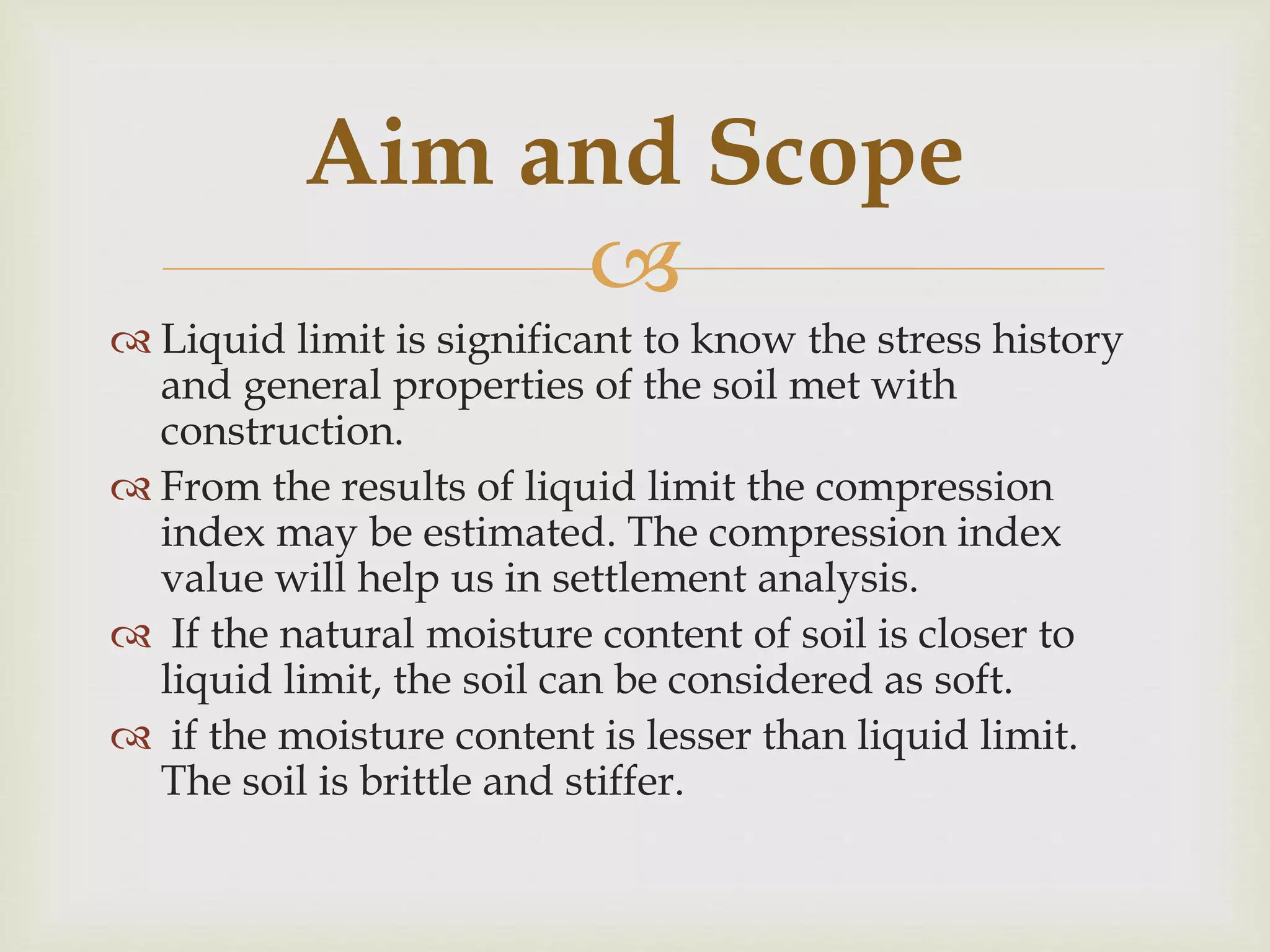
 Porcelain dish  U.S. No. 40 (0.425 mm)
sieve.

Apparatus
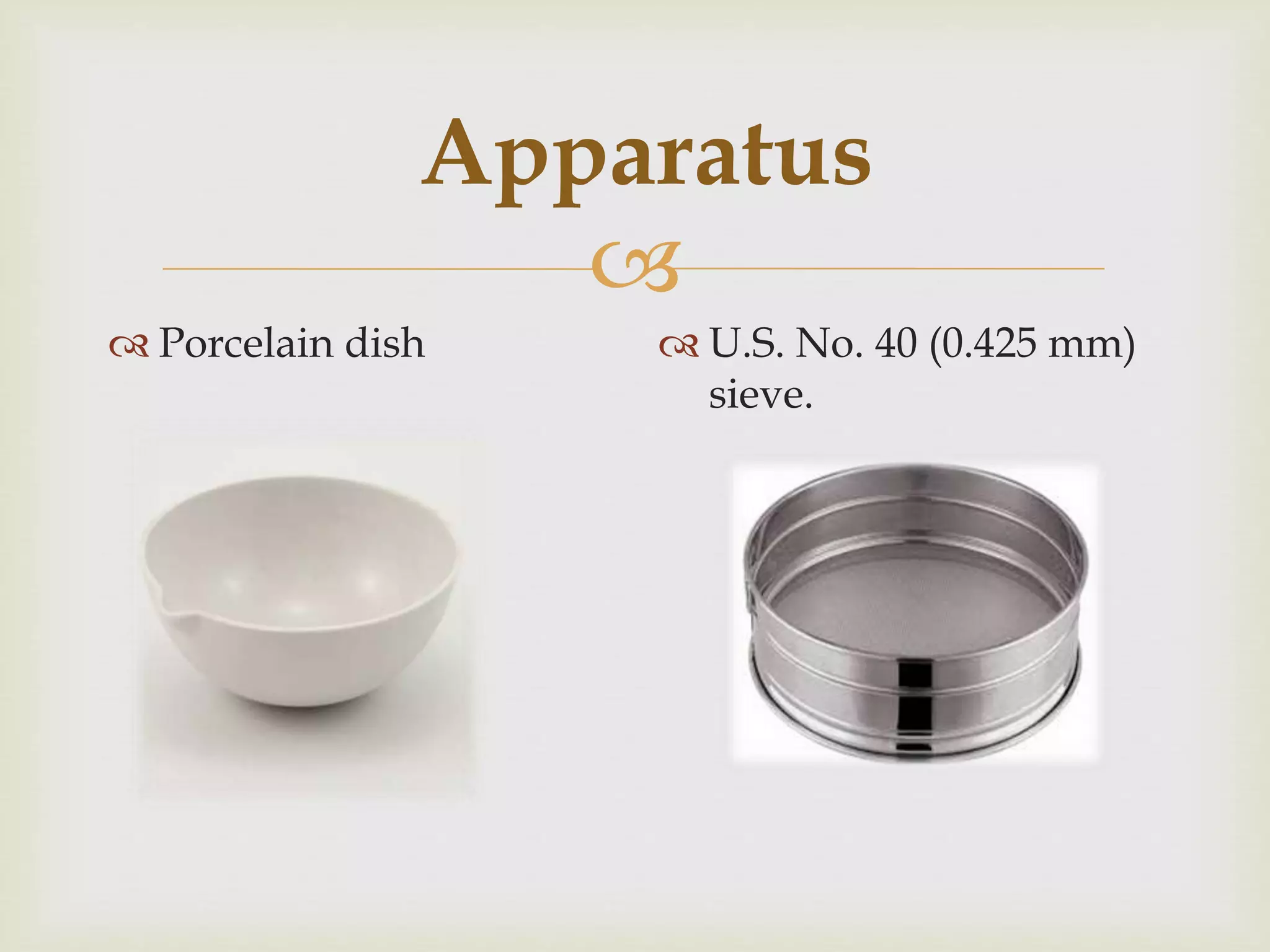
 Spatula or knife  Grooving tool

Apparatus
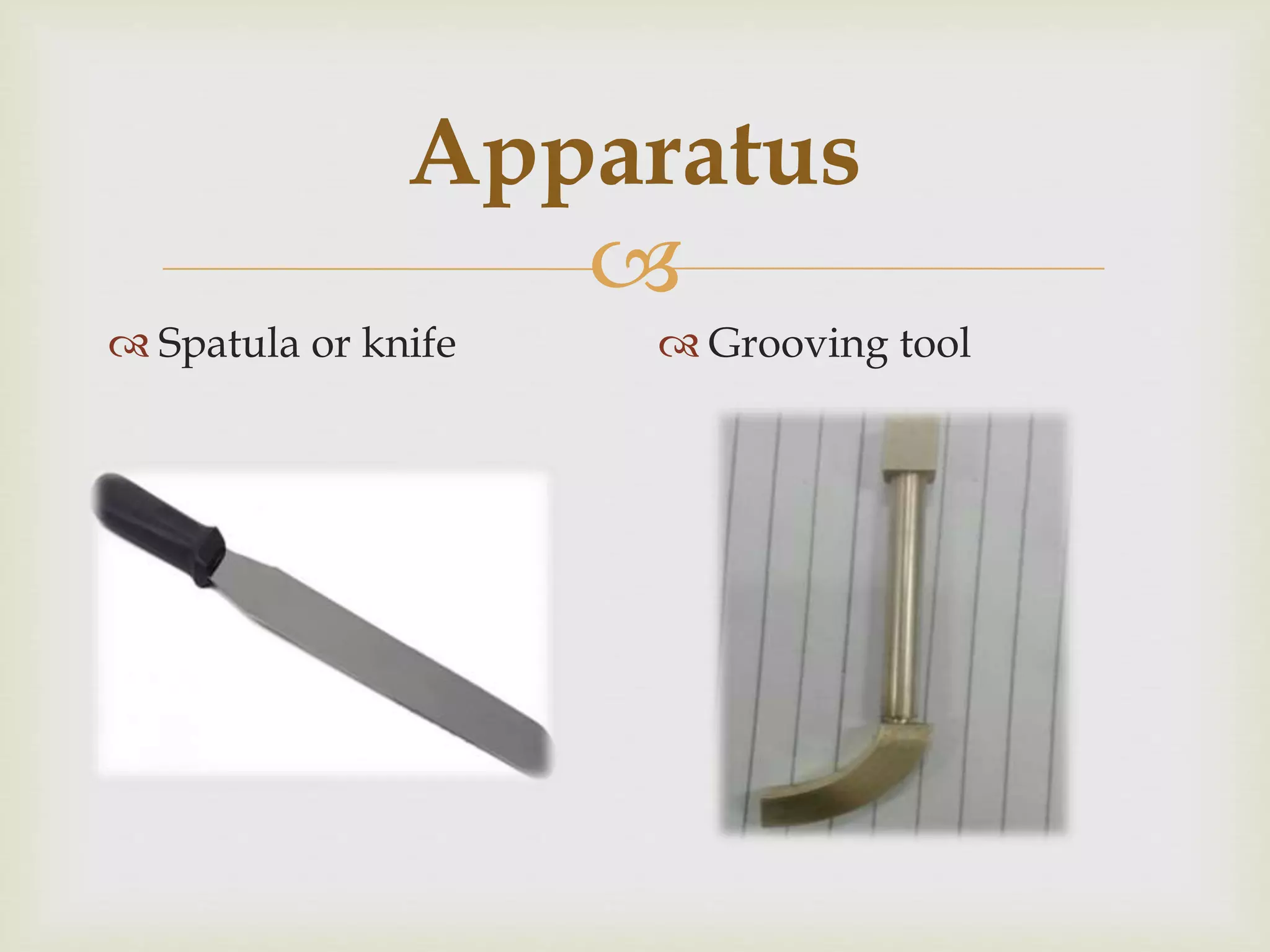
 Liquid limit apparatus
or Casagrande
apparatus
 Drying oven

Apparatus
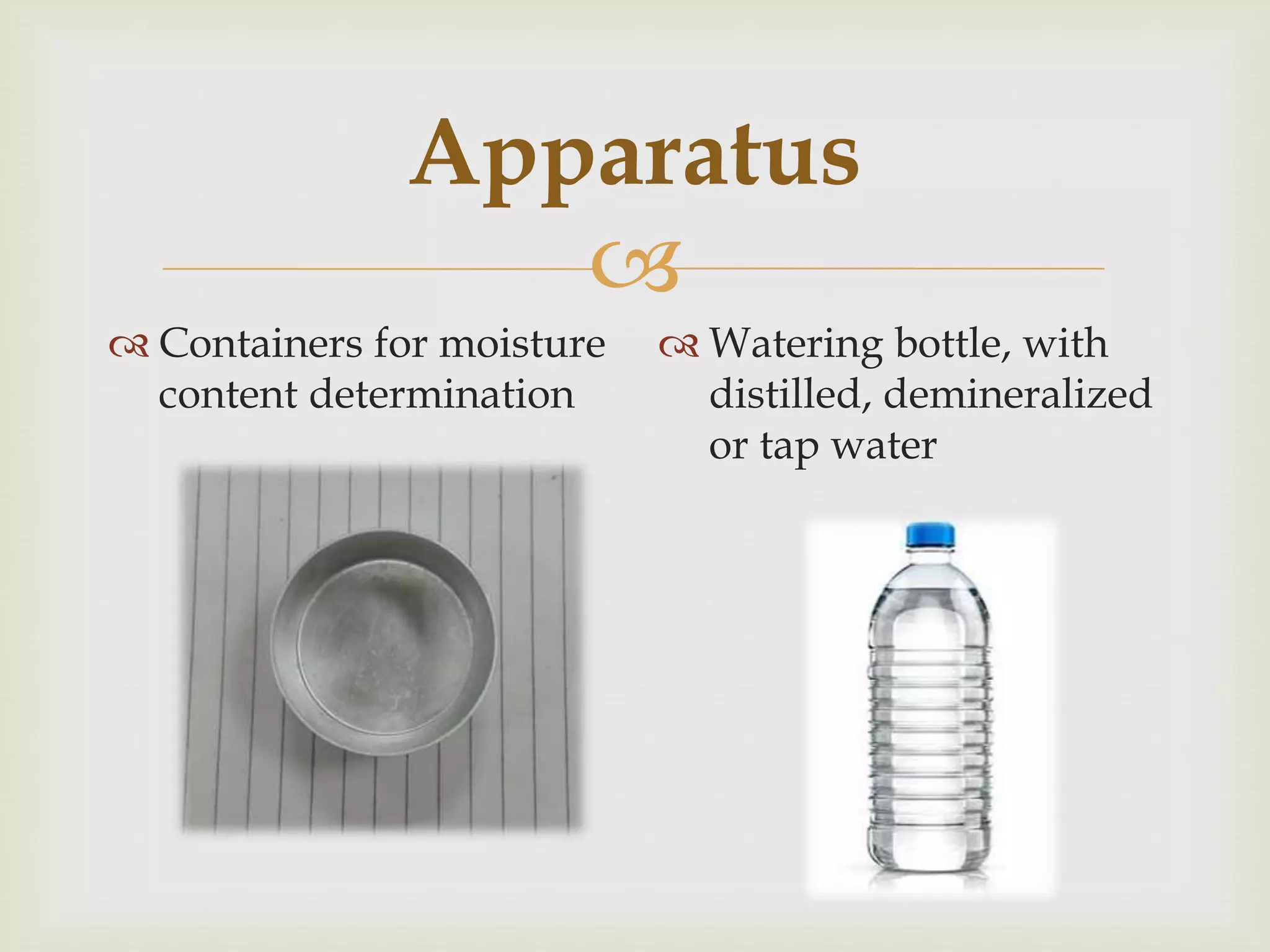
 Containers for moisture
content determination
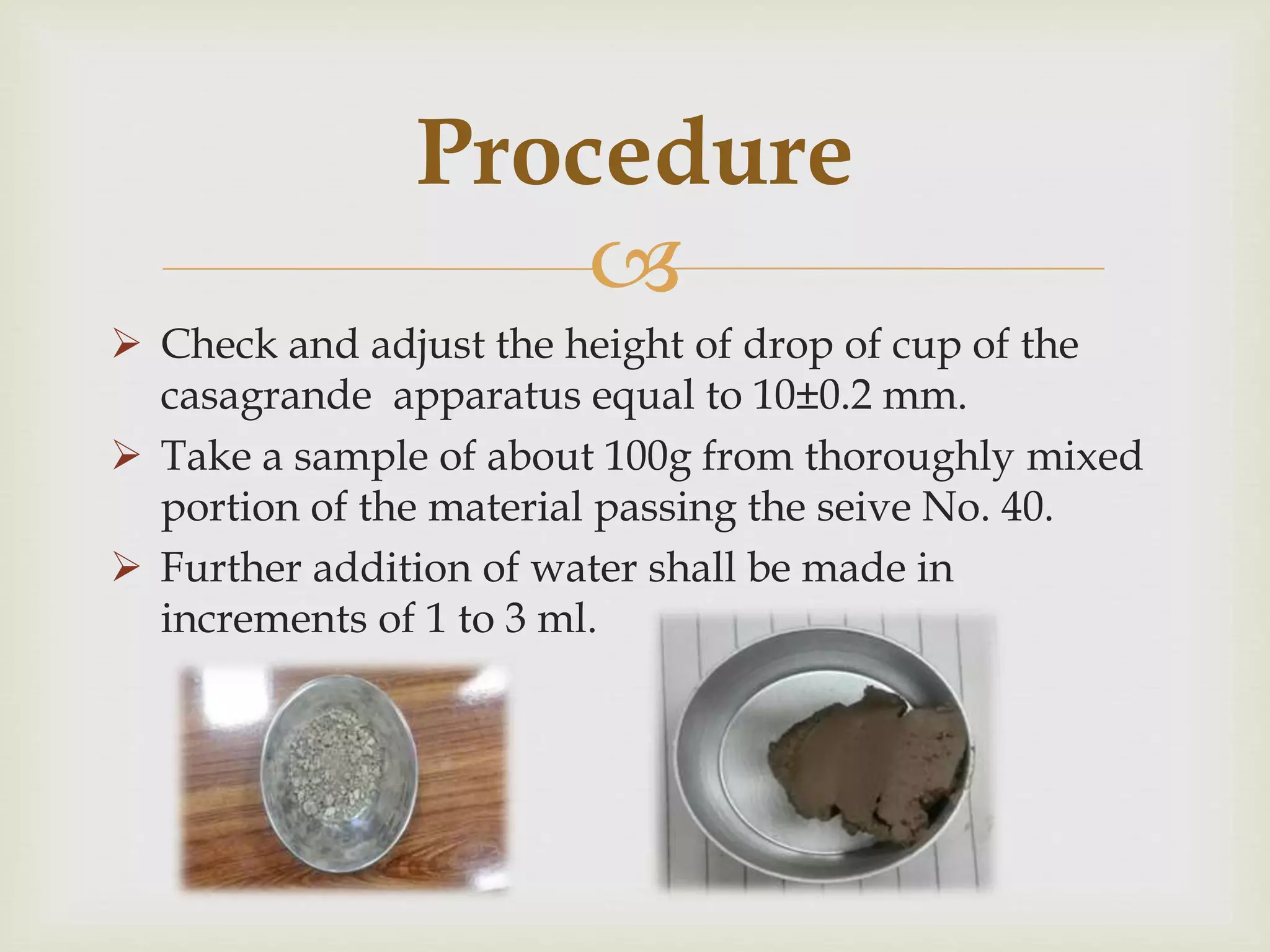
 Watering bottle, with
distilled, demineralized
or tap water

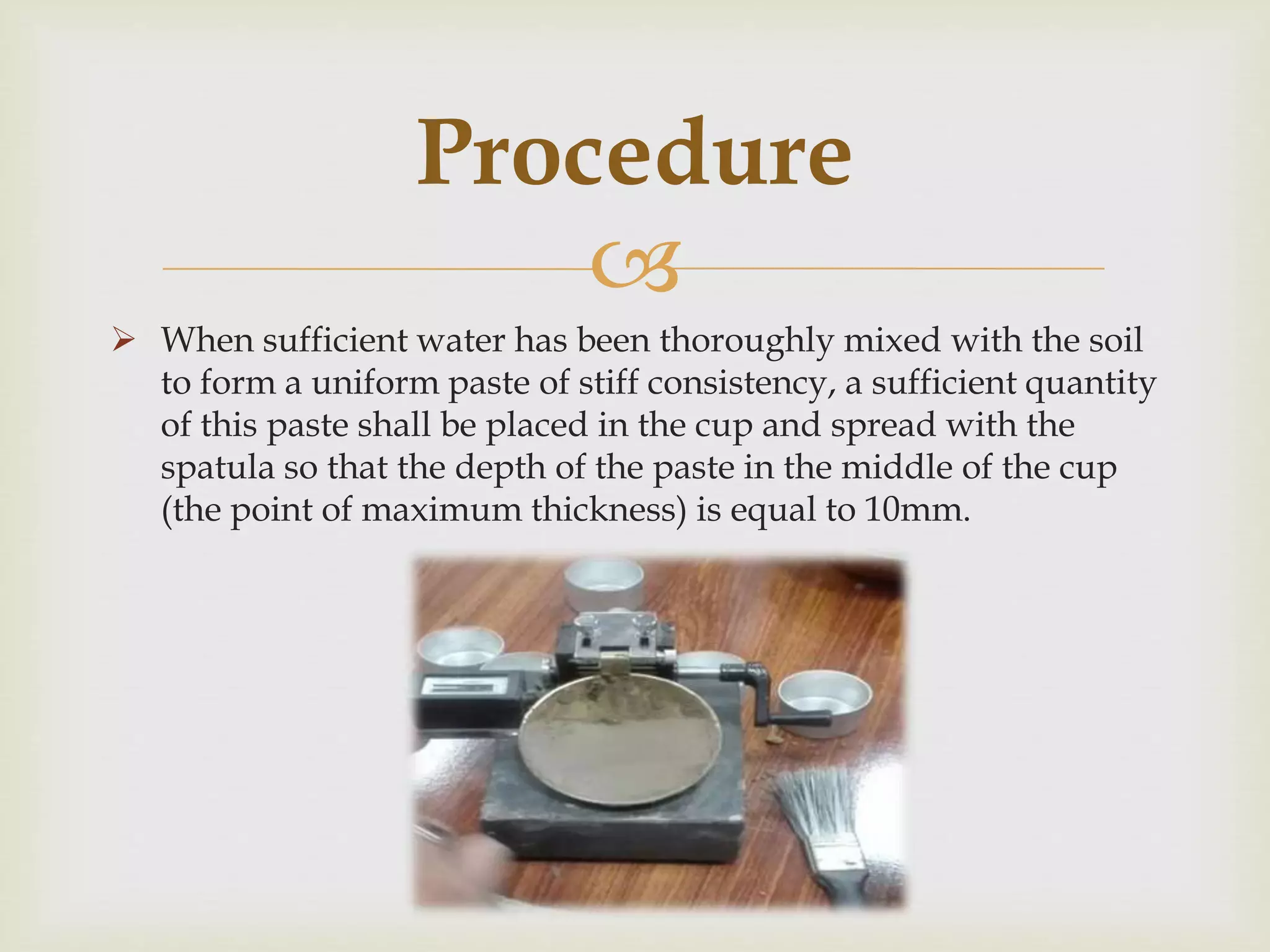
 Check and adjust the height of drop of cup of the
casagrande apparatus equal to 10±0.2 mm.
 Take a sample of about 100g from thoroughly mixed
portion of the material passing the seive No. 40.
 Further addition of water shall be made in
increments of 1 to 3 ml.
Procedure

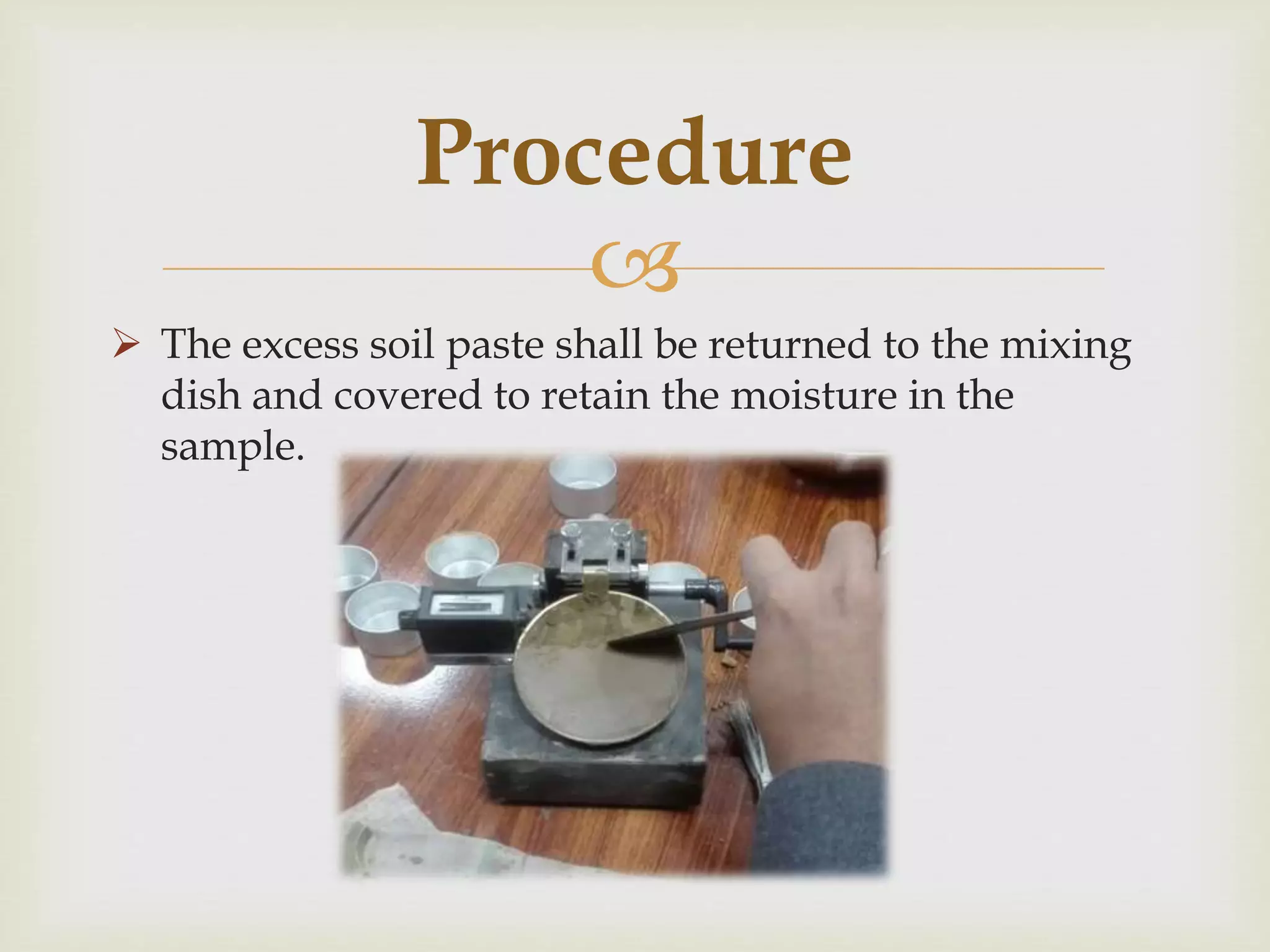
 When sufficient water has been thoroughly mixed with the soil
to form a uniform paste of stiff consistency, a sufficient quantity
of this paste shall be placed in the cup and spread with the
spatula so that the depth of the paste in the middle of the cup
(the point of maximum thickness) is equal to 10mm.
Procedure

 The excess soil paste shall be returned to the mixing
dish and covered to retain the moisture in the
sample.
Procedure

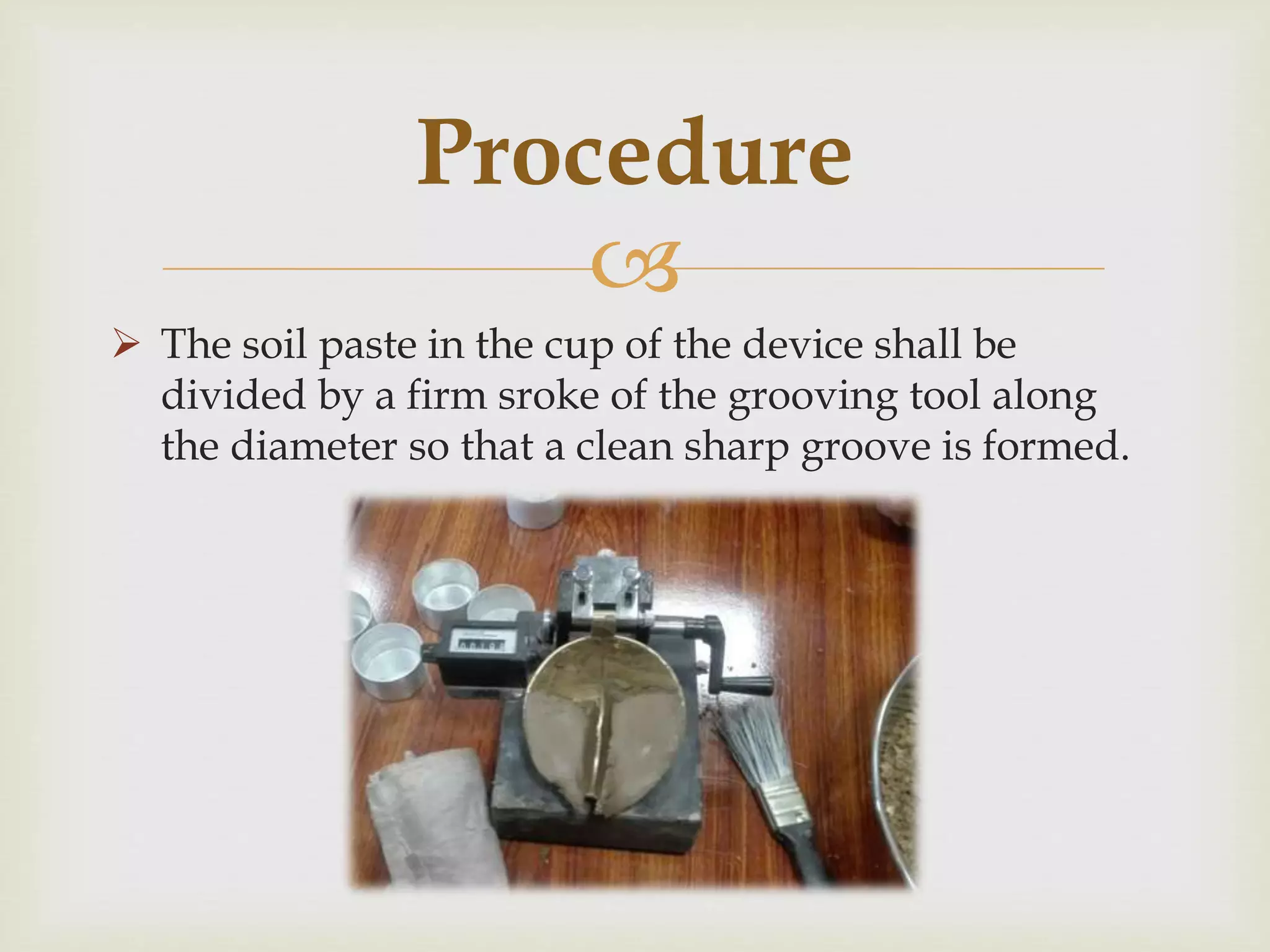
 The soil paste in the cup of the device shall be
divided by a firm sroke of the grooving tool along
the diameter so that a clean sharp groove is formed.
Procedure

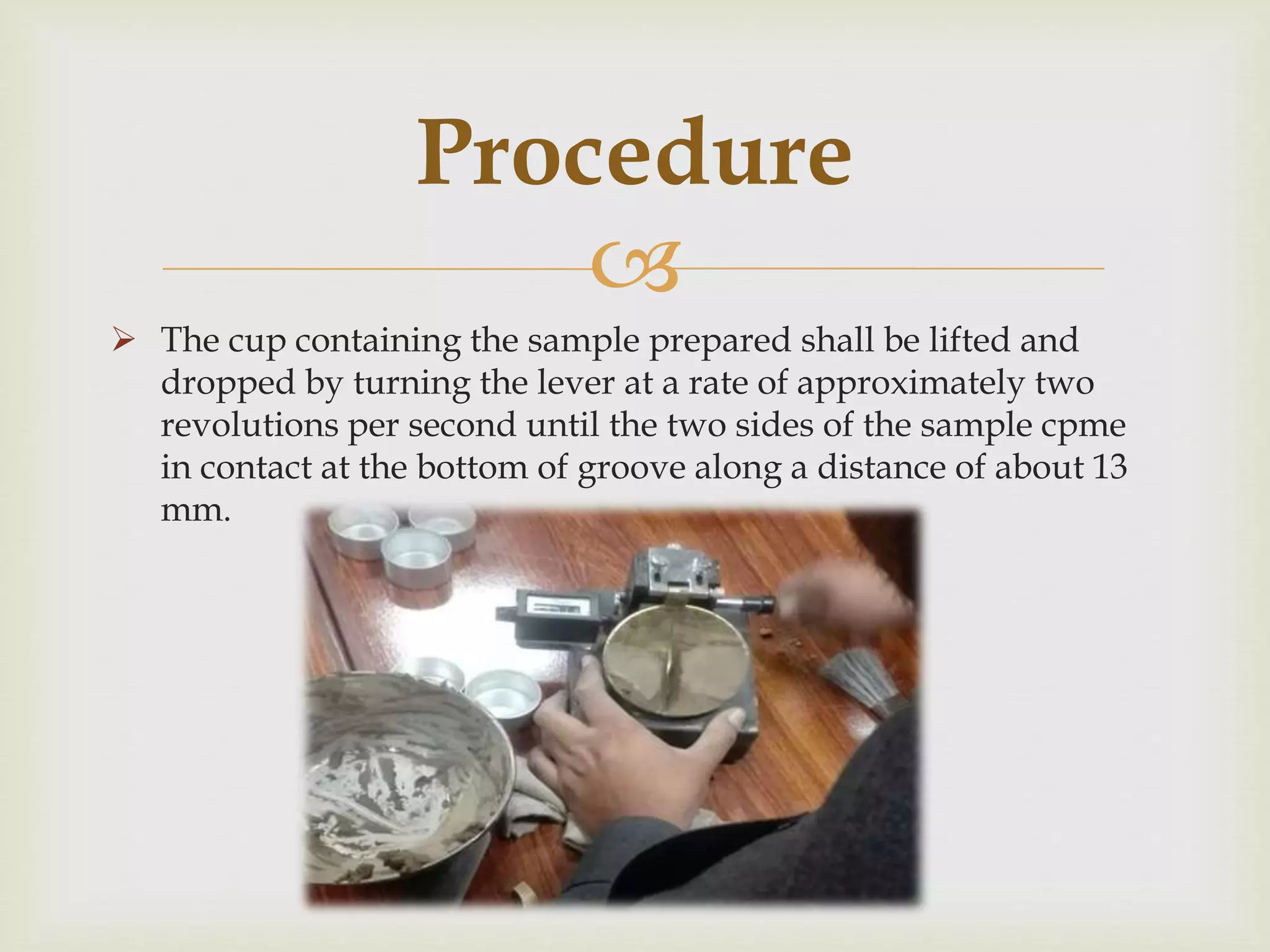
 The cup containing the sample prepared shall be lifted and
dropped by turning the lever at a rate of approximately two
revolutions per second until the two sides of the sample cpme
in contact at the bottom of groove along a distance of about 13
mm.
Procedure

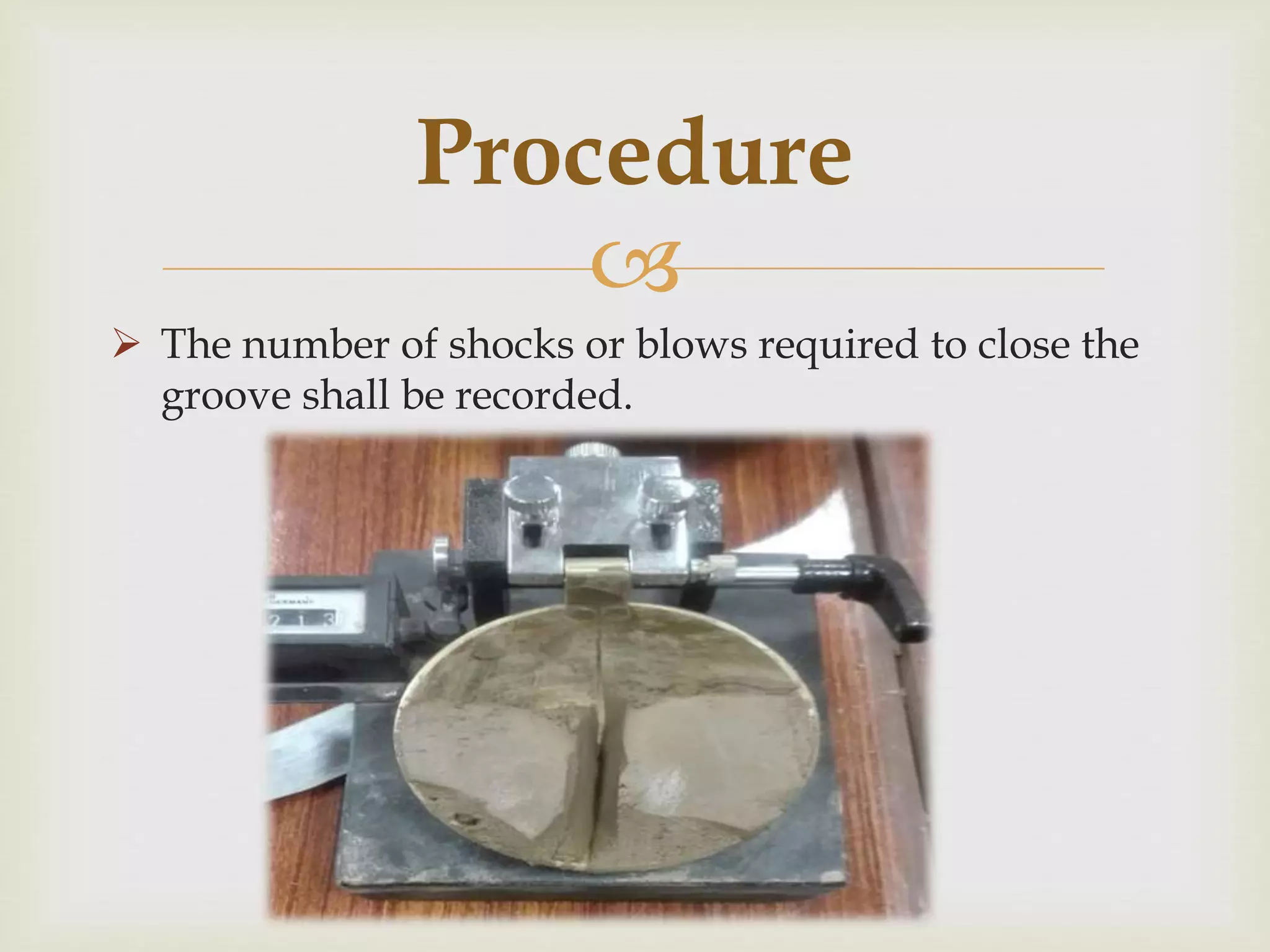
 The number of shocks or blows required to close the
groove shall be recorded.
Procedure

 Take a sanple to determine the moisture content.
 The remaining soil in the cup shall be transferred to
the mixing dish.The cup and the grooving tool shall
then be washed and dried for preparation of the next
trial.
 Repeat the procedue for at least 4 times and record
the number of blows and the corresponding
moisture content in each case.
Procedure

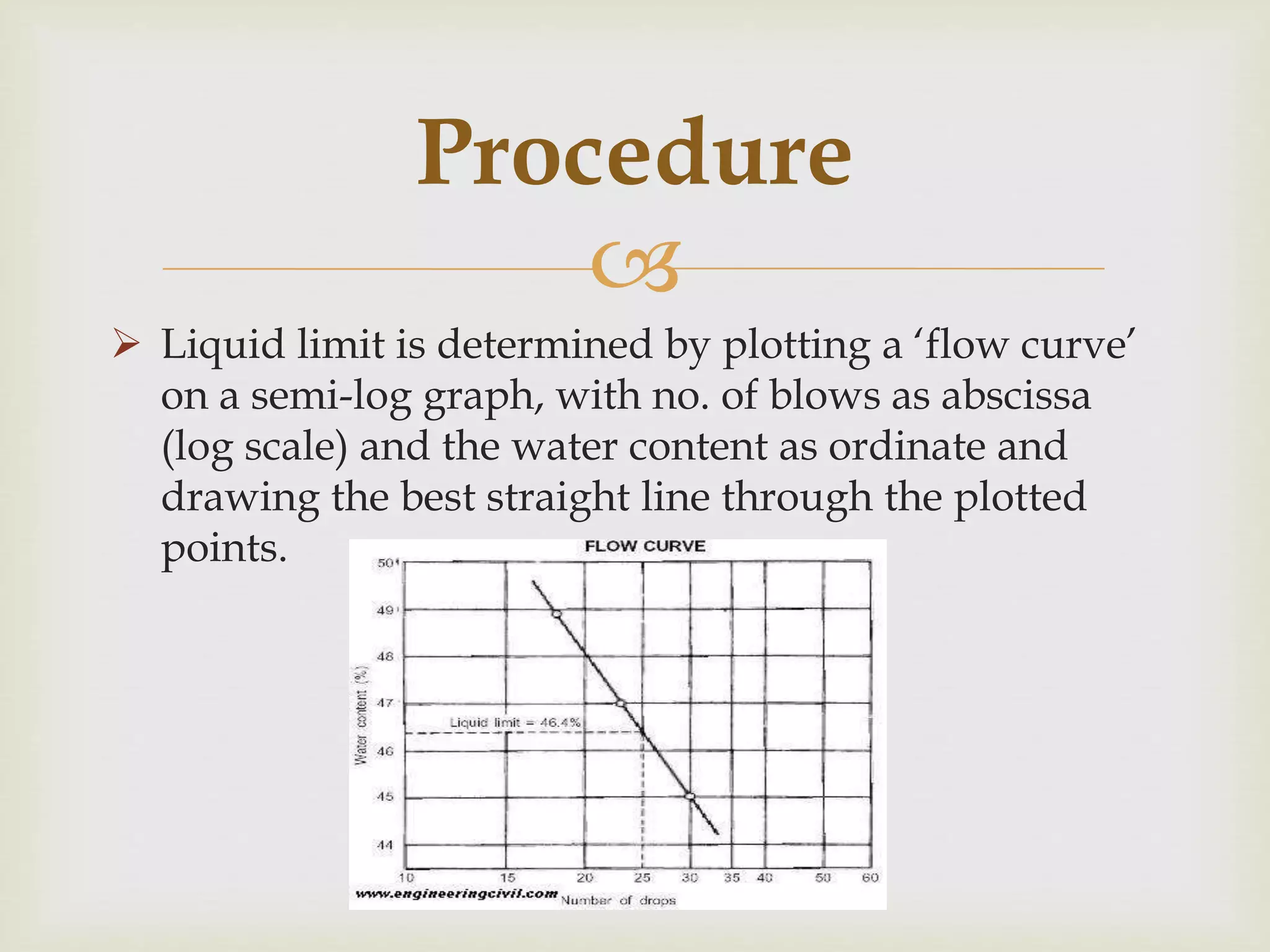
 Liquid limit is determined by plotting a ‘flow curve’
on a semi-log graph, with no. of blows as abscissa
(log scale) and the water content as ordinate and
drawing the best straight line through the plotted
points.
Procedure

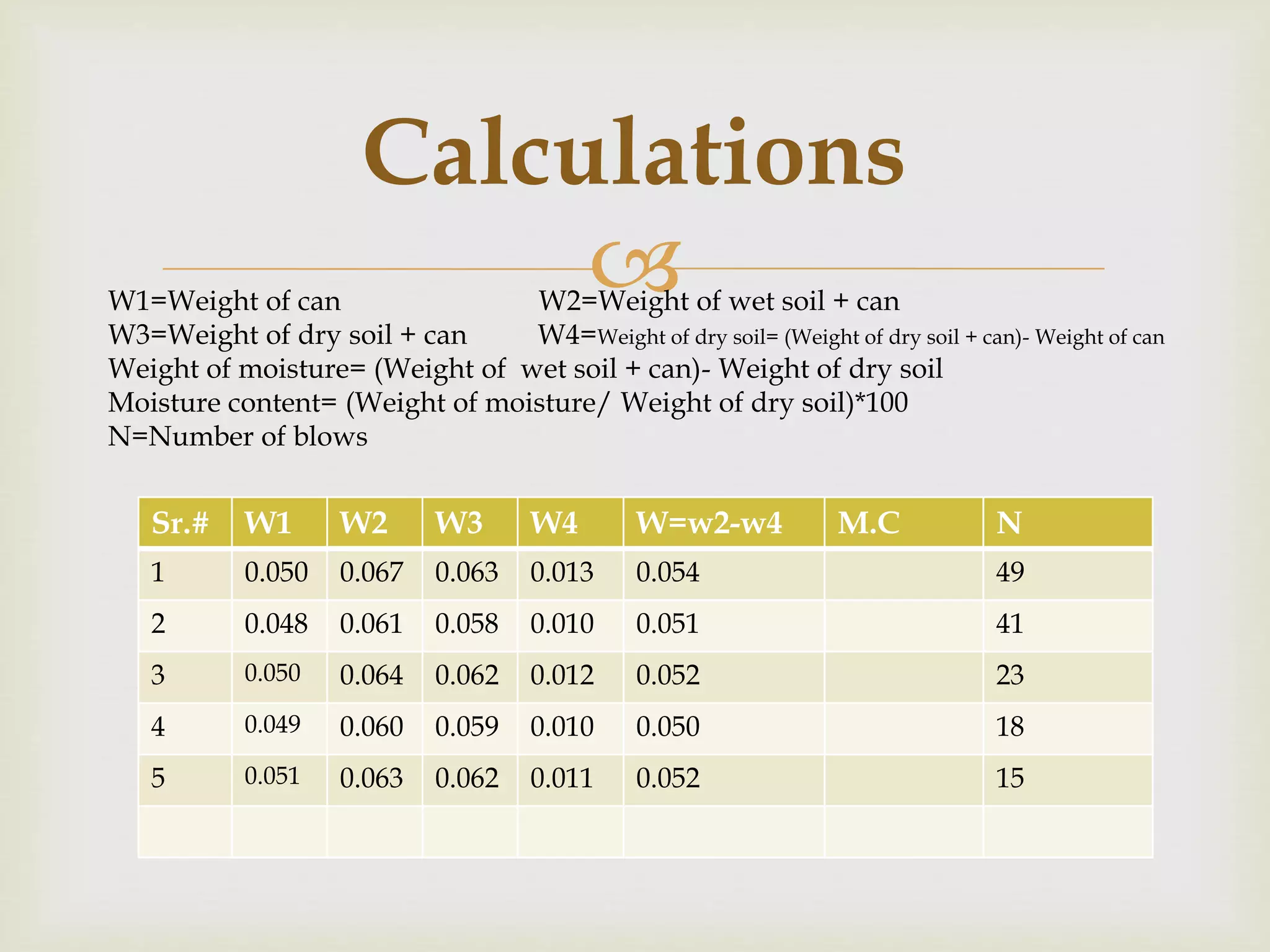
Sr.# W1 W2 W3 W4 W=w2-w4 M.C N
1 0.050 0.067 0.063 0.013 0.054 49
2 0.048 0.061 0.058 0.010 0.051 41
3 0.050 0.064 0.062 0.012 0.052 23
4 0.049 0.060 0.059 0.010 0.050 18
5 0.051 0.063 0.062 0.011 0.052 15
Calculations
W1=Weight of can W2=Weight of wet soil + can
W3=Weight of dry soil + can W4=Weight of dry soil= (Weight of dry soil + can)- Weight of can
Weight of moisture= (Weight of wet soil + can)- Weight of dry soil
Moisture content= (Weight of moisture/ Weight of dry soil)*100
N=Number of blows

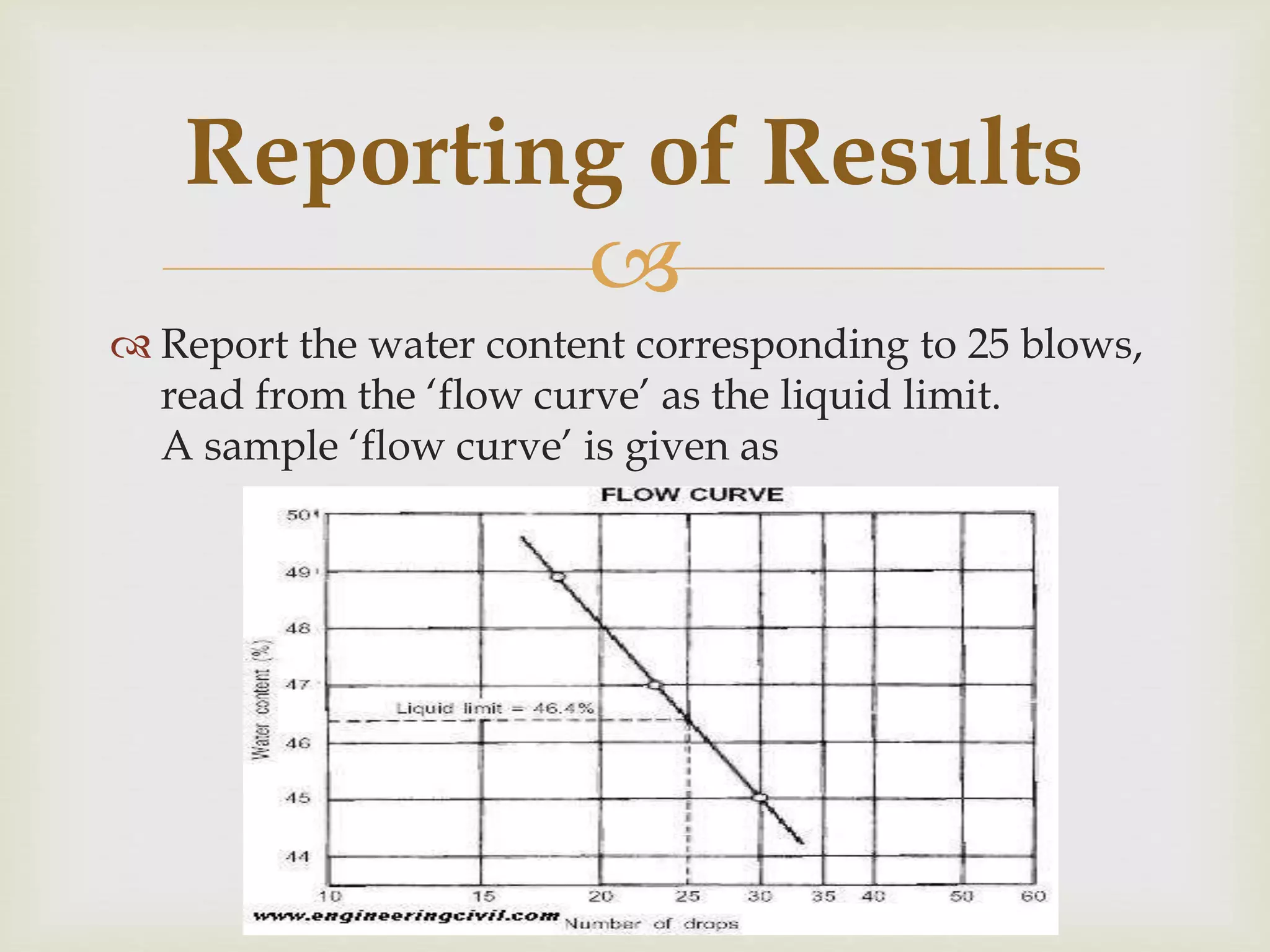
 Report the water content corresponding to 25 blows,
read from the ‘flow curve’ as the liquid limit.
A sample ‘flow curve’ is given as
Reporting of Results

 ~Lab manual (Prof Shaukat Ali Khan)
 ~GTM-7B
 ~www.engineeringcivil.com
 ~Google images
 ~www.ASTM.org
References

Questions are Welcome

Determination of Liquid Limit of Soil : Civil Engineering

  • 1.
    Faculty of Engineering& Technology Department of Civil Engineering Semester 4th Subject: Geotechnical Engineering
  • 2.
    Submitted to :Dr Muneeb Group No. 1 Registraion No.s 82-FET/BSCE/F16 83-FET/BSCE/F16 84-FET/BSCE/F16 85-FET/BSCE/F16 86-FET/BSCE/F16
  • 3.
     In early 1900’s,a Swedish scientist named Atterberg developed a method to describe the consistency of fine grained soils with varrying moisture contents. So on arbitrary basis, depending on the moisture content, the behaviour of soil can be divided into 4 basic states.  Solid  Semisolid  Plastic  Liquid  The moisture content at the point of transition from soild to semisolid state is called SHRINKAGE LIMIT.  The moisture content at the point of transition from semisolid state to plastic state is called PLASTIC LIMIT.  The moisture content at the point of transition from plastic to liquid state is called LIQUID LIMIT.  These moisture conditions are referred to as the "Atterberg Limits" Background
  • 4.
     The liquid limitof a soil is the moisture content, expressed as a percentage of the weight of the oven-dried soil, at the boundary between the liquid and plastic states of consistency. The moisture content at this boundary is arbitrarily defined as the water content at which two halves of a soil cake will flow together, for a distance of ½ in. (12.7 mm) along the bottom of a groove of standard dimensions separating the two halves, when the cup of a standard liquid limit apparatus is dropped 25 times from a height of 0.3937 in. (10 mm) at the rate of two drops/second. What is Liquid Limit?
  • 5.
      Prepare soilspecimen as per specification.  Find the relationship between water content and number of blows.  Draw flow curve.  Find out liquid limit. Objective
  • 6.
      Liquid limitis significant to know the stress history and general properties of the soil met with construction.  From the results of liquid limit the compression index may be estimated. The compression index value will help us in settlement analysis.  If the natural moisture content of soil is closer to liquid limit, the soil can be considered as soft.  if the moisture content is lesser than liquid limit. The soil is brittle and stiffer. Aim and Scope
  • 7.
     Apparatus  Porcelain dish U.S. No. 40 (0.425 mm) sieve.
  • 8.
     Apparatus  Spatula orknife  Grooving tool
  • 9.
     Apparatus  Liquid limitapparatus or Casagrande apparatus  Drying oven
  • 10.
     Apparatus  Containers formoisture content determination  Watering bottle, with distilled, demineralized or tap water
  • 11.
      Check andadjust the height of drop of cup of the casagrande apparatus equal to 10±0.2 mm.  Take a sample of about 100g from thoroughly mixed portion of the material passing the seive No. 40.  Further addition of water shall be made in increments of 1 to 3 ml. Procedure
  • 12.
      When sufficientwater has been thoroughly mixed with the soil to form a uniform paste of stiff consistency, a sufficient quantity of this paste shall be placed in the cup and spread with the spatula so that the depth of the paste in the middle of the cup (the point of maximum thickness) is equal to 10mm. Procedure
  • 13.
      The excesssoil paste shall be returned to the mixing dish and covered to retain the moisture in the sample. Procedure
  • 14.
      The soilpaste in the cup of the device shall be divided by a firm sroke of the grooving tool along the diameter so that a clean sharp groove is formed. Procedure
  • 15.
      The cupcontaining the sample prepared shall be lifted and dropped by turning the lever at a rate of approximately two revolutions per second until the two sides of the sample cpme in contact at the bottom of groove along a distance of about 13 mm. Procedure
  • 16.
      The numberof shocks or blows required to close the groove shall be recorded. Procedure
  • 17.
      Take asanple to determine the moisture content.  The remaining soil in the cup shall be transferred to the mixing dish.The cup and the grooving tool shall then be washed and dried for preparation of the next trial.  Repeat the procedue for at least 4 times and record the number of blows and the corresponding moisture content in each case. Procedure
  • 18.
      Liquid limitis determined by plotting a ‘flow curve’ on a semi-log graph, with no. of blows as abscissa (log scale) and the water content as ordinate and drawing the best straight line through the plotted points. Procedure
  • 19.
     Sr.# W1 W2W3 W4 W=w2-w4 M.C N 1 0.050 0.067 0.063 0.013 0.054 49 2 0.048 0.061 0.058 0.010 0.051 41 3 0.050 0.064 0.062 0.012 0.052 23 4 0.049 0.060 0.059 0.010 0.050 18 5 0.051 0.063 0.062 0.011 0.052 15 Calculations W1=Weight of can W2=Weight of wet soil + can W3=Weight of dry soil + can W4=Weight of dry soil= (Weight of dry soil + can)- Weight of can Weight of moisture= (Weight of wet soil + can)- Weight of dry soil Moisture content= (Weight of moisture/ Weight of dry soil)*100 N=Number of blows
  • 20.
      Report thewater content corresponding to 25 blows, read from the ‘flow curve’ as the liquid limit. A sample ‘flow curve’ is given as Reporting of Results
  • 21.
      ~Lab manual(Prof Shaukat Ali Khan)  ~GTM-7B  ~www.engineeringcivil.com  ~Google images  ~www.ASTM.org References
  • 23.

Editor's Notes

  • #7 Laboratory data is used to construct a plot of strain or void ratio versus effective stress where the effective stress axis is on a logarithmic scale. The plot's slope is the compression index or recompression index.