1. Recap Atomic Structure
2. Isotopes
Lesson Objectives
1. Recap Atomic Structure
2. Isotopes
Lesson Objectives
C. Chemical symbols
B. Relative masses and charges of proton, neutron
and electron
A. Structure of atom
D. Electronic configuration
Recap on Atomic Structure
C. Chemical symbols
B. Relative masses and charges of proton, neutron
and electron
A. Structure of atom
D. Electronic configuration
Recap on Atomic Structure
The Atomic Structure
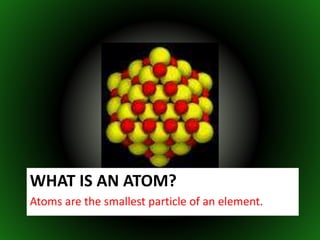
WHAT IS AN ATOM?
Atoms are the smallest particle of an element.
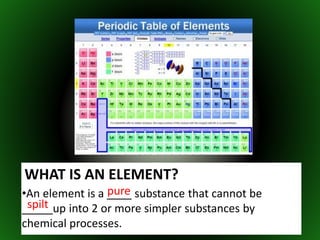
WHAT IS AN ELEMENT?
•An element is a ____ substance that cannot be
_____up into 2 or more simpler substances by
chemical processes.
pure
spilt
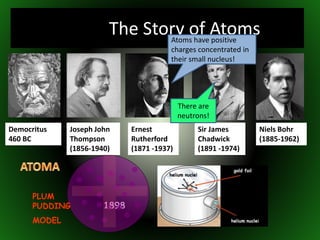
The Story of Atoms
Ernest
Rutherford
(1871 -1937)
Democritus
460 BC
Sir James
Chadwick
(1891 -1974)
1898
Joseph John
Thompson
(1856-1940)
Atoms have positive
charges concentrated in
their small nucleus!
There are
neutrons!
PLUM
PUDDING
MODEL
Niels Bohr
(1885-1962)
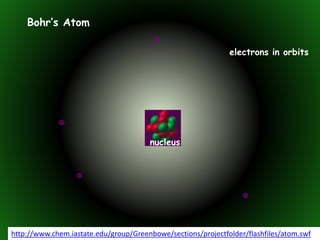
Bohr’s Atom
electrons in orbits
nucleus
http://www.chem.iastate.edu/group/Greenbowe/sections/projectfolder/flashfiles/atom.swf
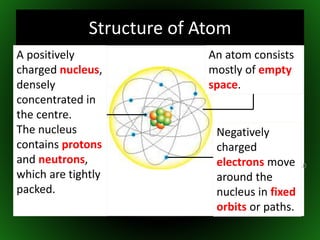
Structure of Atom
10
An atom consists
mostly of empty
space.
Negatively
charged
electrons move
around the
nucleus in fixed
orbits or paths.
A positively
charged nucleus,
densely
concentrated in
the centre.
The nucleus
contains protons
and neutrons,
which are tightly
packed.
C. Chemical symbols
B. Relative masses and charges of proton,
neutron and electron
A. Structure of atom
D. Electronic configuration
Recap on Atomic Structure
C. Chemical symbols
B. Relative masses and charges of proton,
neutron and electron
A. Structure of atom
D. Electronic configuration
Recap on Atomic Structure
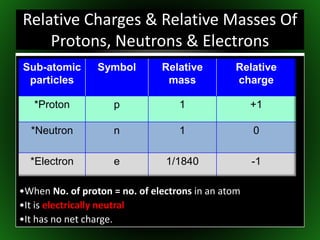
Relative Charges & Relative Masses Of
Protons, Neutrons & Electrons
Sub-atomic
particles
Symbol Relative
mass
Relative
charge
*Proton p 1 +1
*Neutron n 1 0
*Electron e 1/1840 -1
•When No. of proton = no. of electrons in an atom
•It is electrically neutral
•It has no net charge.
C. Chemical symbols
B. Relative masses and charges of proton, neutron
and electron
A. Structure of atom
D. Electronic configuration
Recap on Atomic Structure
C. Chemical symbols
B. Relative masses and charges of proton, neutron
and electron
A. Structure of atom
D. Electronic configuration
Recap on Atomic Structure
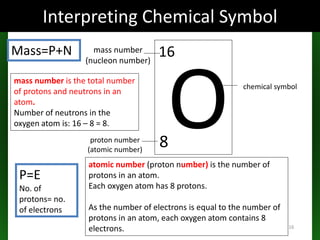
16
O
16
8
chemical symbol
mass number
(nucleon number)
proton number
(atomic number)
P=E
No. of
protons= no.
of electrons
atomic number (proton number) is the number of
protons in an atom.
Each oxygen atom has 8 protons.
As the number of electrons is equal to the number of
protons in an atom, each oxygen atom contains 8
electrons.
Mass=P+N
mass number is the total number
of protons and neutrons in an
atom.
Number of neutrons in the
oxygen atom is: 16 – 8 = 8.
Interpreting Chemical Symbol
C. Chemical symbols
B. Relative masses and charges of proton, neutron
and electron
A. Structure of atom
D. Electronic configuration
Recap on Atomic Structure
C. Chemical symbols
B. Relative masses and charges of proton, neutron
and electron
A. Structure of atom
D. Electronic configuration
Recap on Atomic Structure
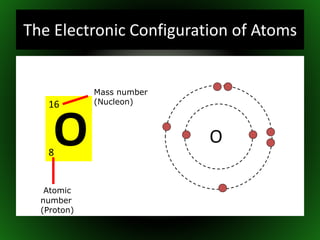
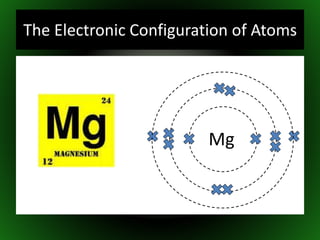
The Electronic Configuration of Atoms
OO
16
8
Mass number
(Nucleon)
Atomic
number
(Proton)
The Electronic Configuration of Atoms
Mg
Summary for Atomic Structure (I)
• The structure of an atom
• The relative charges & relative masses of
proton, neutron & electron
• Defined mass number & atomic number
• Learnt how to interpret chemical symbols
• The electronic configuration of atoms
1. Recap Atomic Structure
2. Isotopes
Lesson Objectives
Today…
Isotopes
Isotopes
1. Definition of Isotopes
2. Uses of Isotopes
Isotopes
1. Definition of Isotopes
2. Uses of Isotopes
Activity
• Find your fellow group members! (1min)
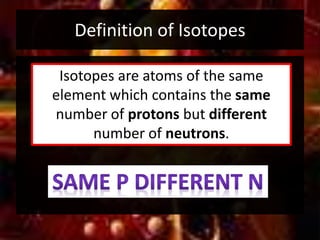
Definition of Isotopes
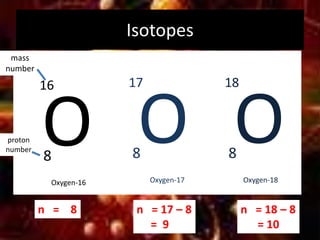
Isotopes are atoms of the same
element which contains the same
number of protons but different
number of neutrons.
Isotopes
O
16
8
mass
number
proton
number
Oxygen-16 Oxygen-17 Oxygen-18
O O
17
8
18
8
n = 8 n = 17 – 8
= 9
n = 18 – 8
= 10
Isotopes
Isotopes have the same chemical
properties but slightly different
physical properties
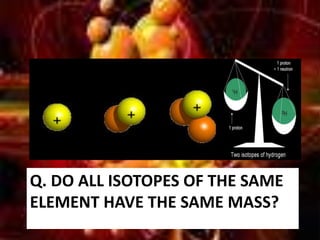
Q. DO ALL ISOTOPES OF THE SAME
ELEMENT HAVE THE SAME MASS?
Isotopes
1. Definition of Isotopes
2. Uses of Isotopes
Pair Work
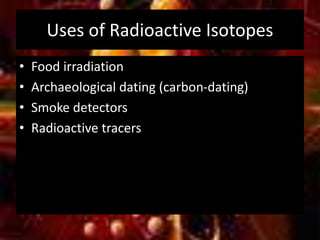
Uses of Radioactive Isotopes
• Food irradiation
• Archaeological dating (carbon-dating)
• Smoke detectors
• Radioactive tracers
Summary
1. Definition of Isotopes
2. Uses of Isotopes
Recap on Atomic Structure
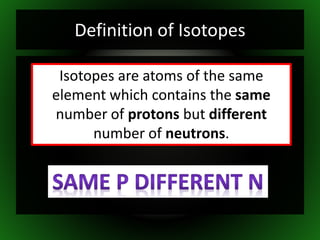
Definition of Isotopes
Isotopes are atoms of the same
element which contains the same
number of protons but different
number of neutrons.
Quiz
• http://chemistry.about.com/library/weekly/bli
onquiz.htm

Atomicstructure isotopes-100312015827-phpapp02

  • 1.
    1. Recap AtomicStructure 2. Isotopes Lesson Objectives
  • 2.
    1. Recap AtomicStructure 2. Isotopes Lesson Objectives
  • 3.
    C. Chemical symbols B.Relative masses and charges of proton, neutron and electron A. Structure of atom D. Electronic configuration Recap on Atomic Structure
  • 4.
    C. Chemical symbols B.Relative masses and charges of proton, neutron and electron A. Structure of atom D. Electronic configuration Recap on Atomic Structure
  • 5.
  • 6.
    WHAT IS ANATOM? Atoms are the smallest particle of an element.
  • 7.
    WHAT IS ANELEMENT? •An element is a ____ substance that cannot be _____up into 2 or more simpler substances by chemical processes. pure spilt
  • 8.
    The Story ofAtoms Ernest Rutherford (1871 -1937) Democritus 460 BC Sir James Chadwick (1891 -1974) 1898 Joseph John Thompson (1856-1940) Atoms have positive charges concentrated in their small nucleus! There are neutrons! PLUM PUDDING MODEL Niels Bohr (1885-1962)
  • 9.
    Bohr’s Atom electrons inorbits nucleus http://www.chem.iastate.edu/group/Greenbowe/sections/projectfolder/flashfiles/atom.swf
  • 10.
    Structure of Atom 10 Anatom consists mostly of empty space. Negatively charged electrons move around the nucleus in fixed orbits or paths. A positively charged nucleus, densely concentrated in the centre. The nucleus contains protons and neutrons, which are tightly packed.
  • 11.
    C. Chemical symbols B.Relative masses and charges of proton, neutron and electron A. Structure of atom D. Electronic configuration Recap on Atomic Structure
  • 12.
    C. Chemical symbols B.Relative masses and charges of proton, neutron and electron A. Structure of atom D. Electronic configuration Recap on Atomic Structure
  • 13.
    Relative Charges &Relative Masses Of Protons, Neutrons & Electrons Sub-atomic particles Symbol Relative mass Relative charge *Proton p 1 +1 *Neutron n 1 0 *Electron e 1/1840 -1 •When No. of proton = no. of electrons in an atom •It is electrically neutral •It has no net charge.
  • 14.
    C. Chemical symbols B.Relative masses and charges of proton, neutron and electron A. Structure of atom D. Electronic configuration Recap on Atomic Structure
  • 15.
    C. Chemical symbols B.Relative masses and charges of proton, neutron and electron A. Structure of atom D. Electronic configuration Recap on Atomic Structure
  • 16.
    16 O 16 8 chemical symbol mass number (nucleonnumber) proton number (atomic number) P=E No. of protons= no. of electrons atomic number (proton number) is the number of protons in an atom. Each oxygen atom has 8 protons. As the number of electrons is equal to the number of protons in an atom, each oxygen atom contains 8 electrons. Mass=P+N mass number is the total number of protons and neutrons in an atom. Number of neutrons in the oxygen atom is: 16 – 8 = 8. Interpreting Chemical Symbol
  • 17.
    C. Chemical symbols B.Relative masses and charges of proton, neutron and electron A. Structure of atom D. Electronic configuration Recap on Atomic Structure
  • 18.
    C. Chemical symbols B.Relative masses and charges of proton, neutron and electron A. Structure of atom D. Electronic configuration Recap on Atomic Structure
  • 19.
    The Electronic Configurationof Atoms OO 16 8 Mass number (Nucleon) Atomic number (Proton)
  • 20.
  • 21.
    Summary for AtomicStructure (I) • The structure of an atom • The relative charges & relative masses of proton, neutron & electron • Defined mass number & atomic number • Learnt how to interpret chemical symbols • The electronic configuration of atoms
  • 22.
    1. Recap AtomicStructure 2. Isotopes Lesson Objectives
  • 23.
  • 24.
    Isotopes 1. Definition ofIsotopes 2. Uses of Isotopes
  • 25.
    Isotopes 1. Definition ofIsotopes 2. Uses of Isotopes
  • 26.
    Activity • Find yourfellow group members! (1min)
  • 27.
    Definition of Isotopes Isotopesare atoms of the same element which contains the same number of protons but different number of neutrons.
  • 28.
    Isotopes O 16 8 mass number proton number Oxygen-16 Oxygen-17 Oxygen-18 OO 17 8 18 8 n = 8 n = 17 – 8 = 9 n = 18 – 8 = 10
  • 29.
    Isotopes Isotopes have thesame chemical properties but slightly different physical properties
  • 30.
    Q. DO ALLISOTOPES OF THE SAME ELEMENT HAVE THE SAME MASS?
  • 31.
    Isotopes 1. Definition ofIsotopes 2. Uses of Isotopes
  • 32.
  • 33.
    Uses of RadioactiveIsotopes • Food irradiation • Archaeological dating (carbon-dating) • Smoke detectors • Radioactive tracers
  • 34.
    Summary 1. Definition ofIsotopes 2. Uses of Isotopes Recap on Atomic Structure
  • 35.
    Definition of Isotopes Isotopesare atoms of the same element which contains the same number of protons but different number of neutrons.
  • 36.