Learning objective: To be able to Identify
and describe the basic structure of an atom.
identify- to recognize and distinguish the different
types of matter based on their unique characteristics
and properties.
Command word/s
Lesson 1: The Atomic
7H: Atoms, Elements and
Molecules
Tool box – key words
atoms, protons, electrons, neutrons, charge
Textbook: pages 120-
The Atomic Structure
Think about these questions when you rate yourself
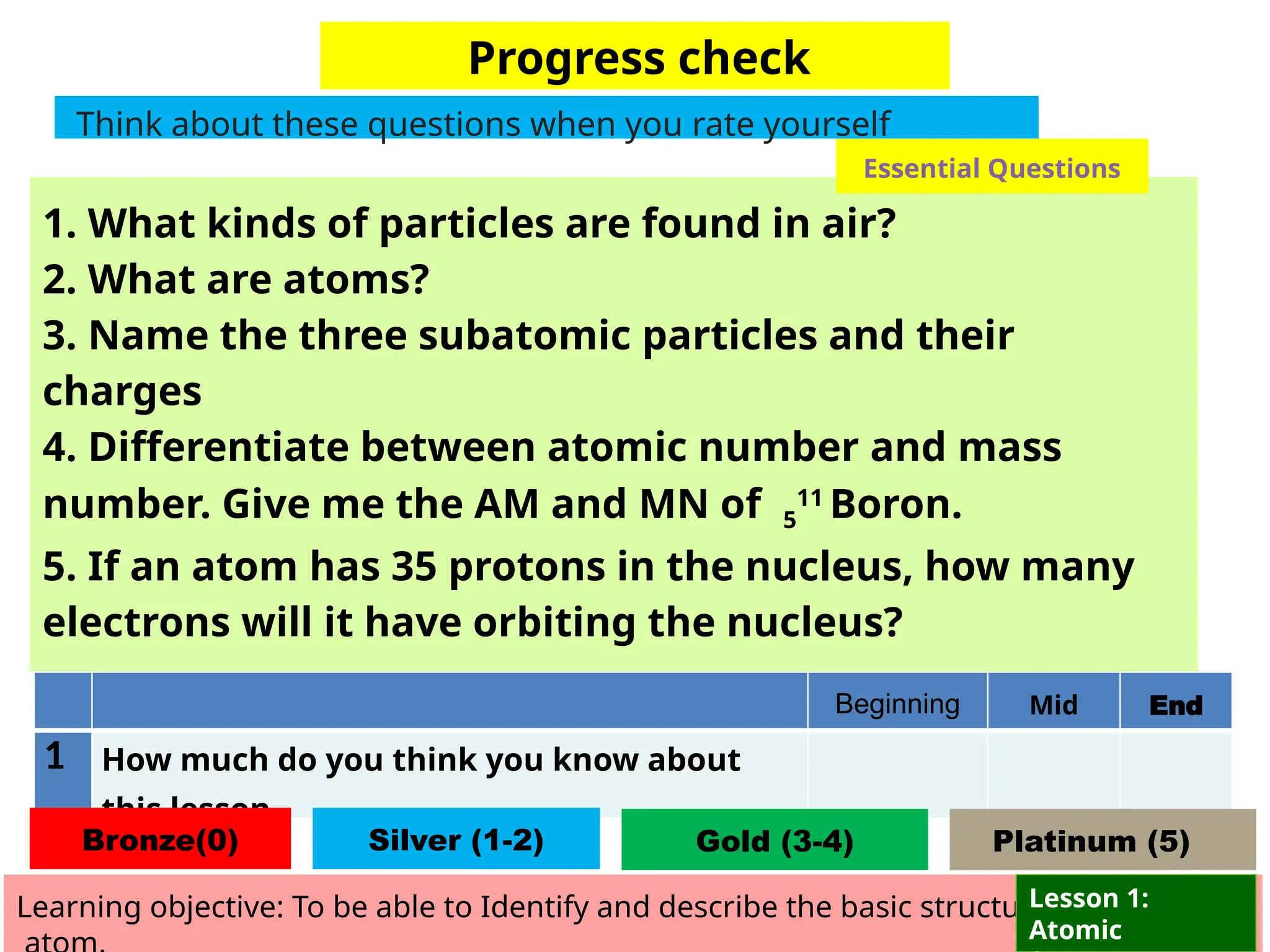
Progress check
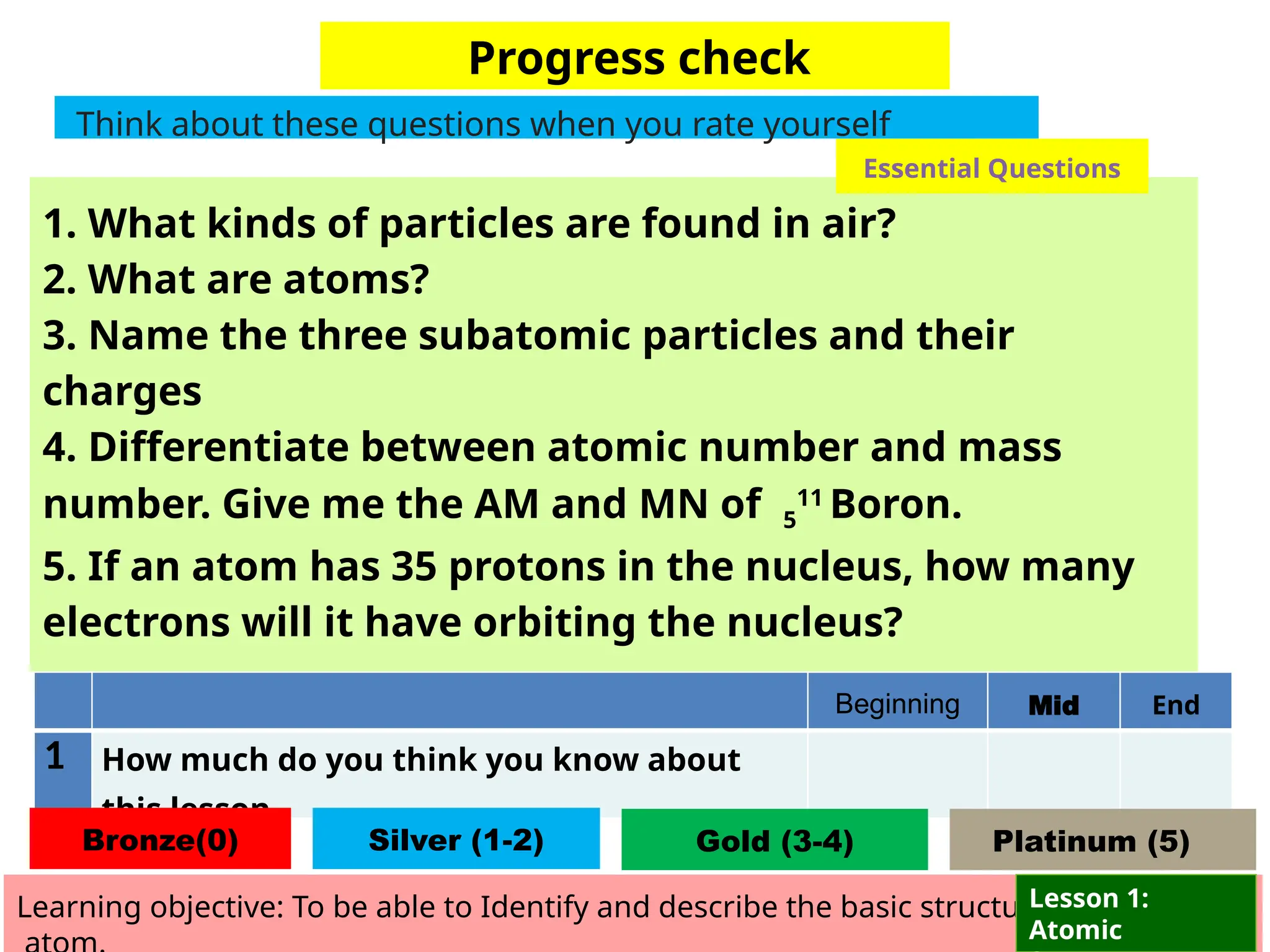
1. What kinds of particles are found in air?
2. What are atoms?
3. Name the three subatomic particles and their
charges
4. Differentiate between atomic number and mass
number. Give me the AN and MN of 5
11
Boron.
5. If an atom has 35 protons in the nucleus, how many
electrons will it have orbiting the nucleus?
Essential Questions
Beginning Mid End
1 How much do you think you know about
this lesson
Learning objective: To be able to Identify and describe the basic structure of an
Silver (1-2) Gold (3-4)
Bronze(0) Platinum (5)
Lesson 1:
Atomic
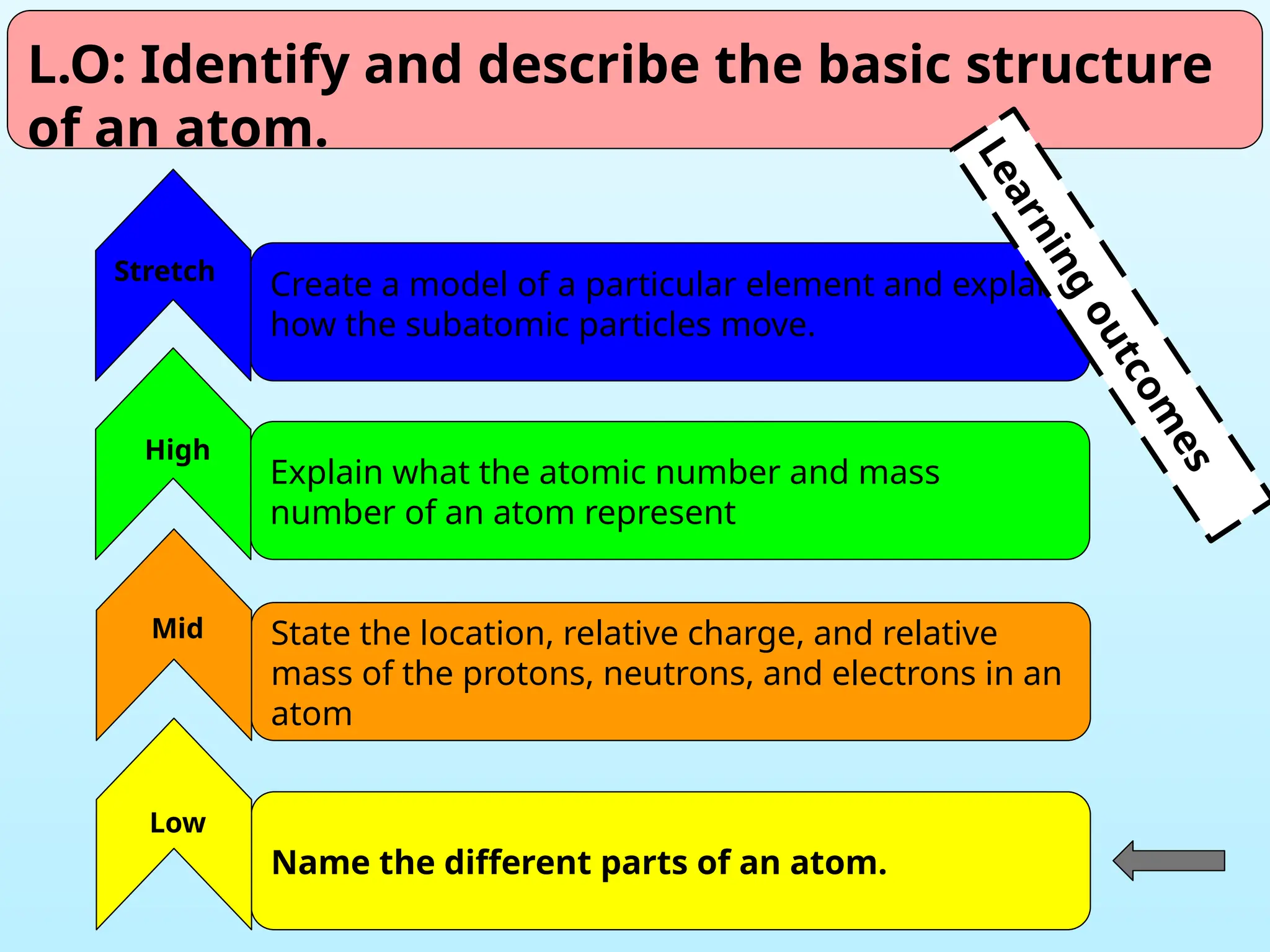
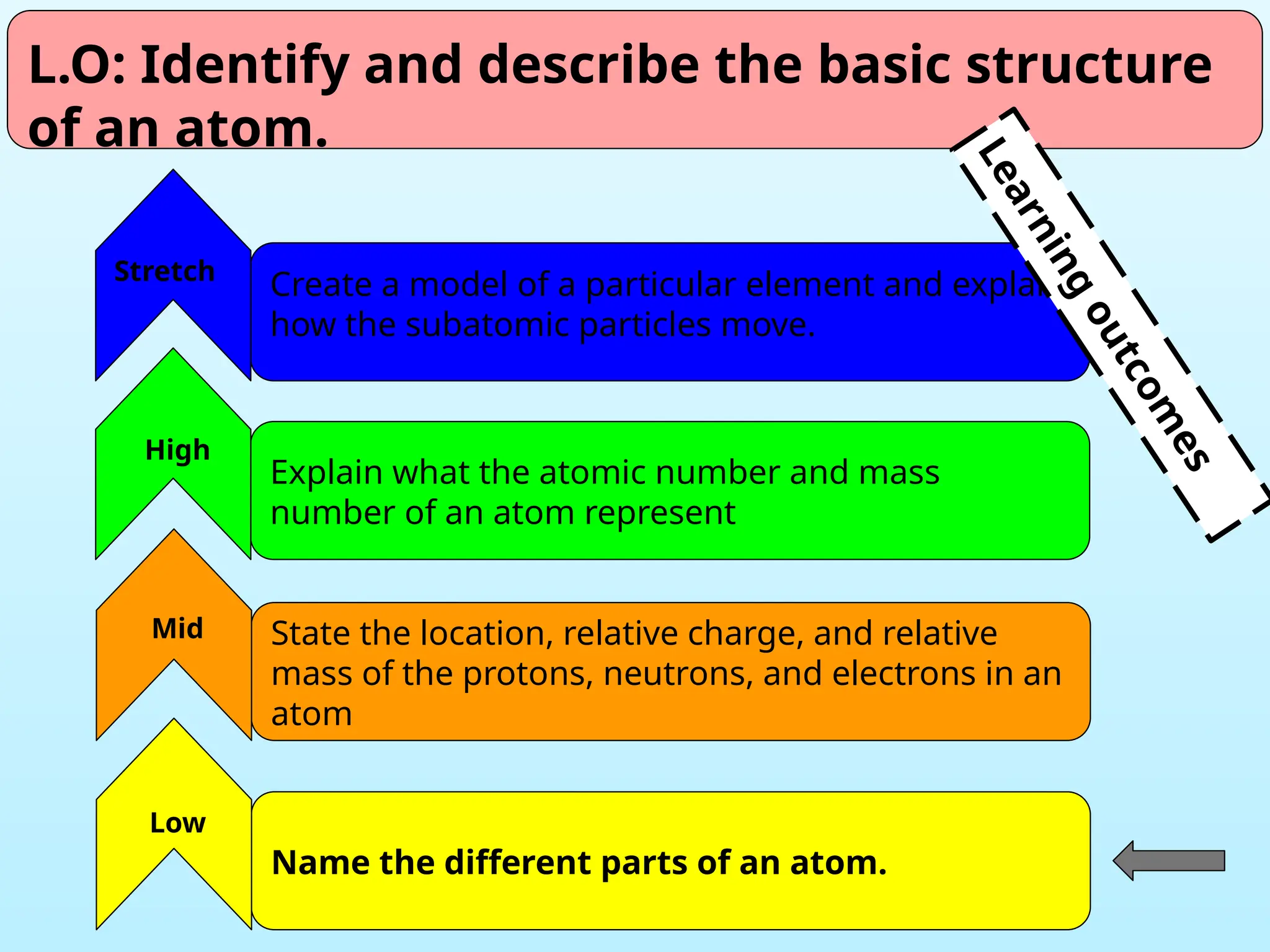
Name the different parts of an atom.
State the location, relative charge, and relative
mass of the protons, neutrons, and electrons in an
atom
Explain what the atomic number and mass
number of an atom represent
Create a model of a particular element and explain
how the subatomic particles move.
Low
Mid
High
Stretch
L.O: Identify and describe the basic structure
of an atom.
L
e
a
r
n
i
n
g
o
u
t
c
o
m
e
s
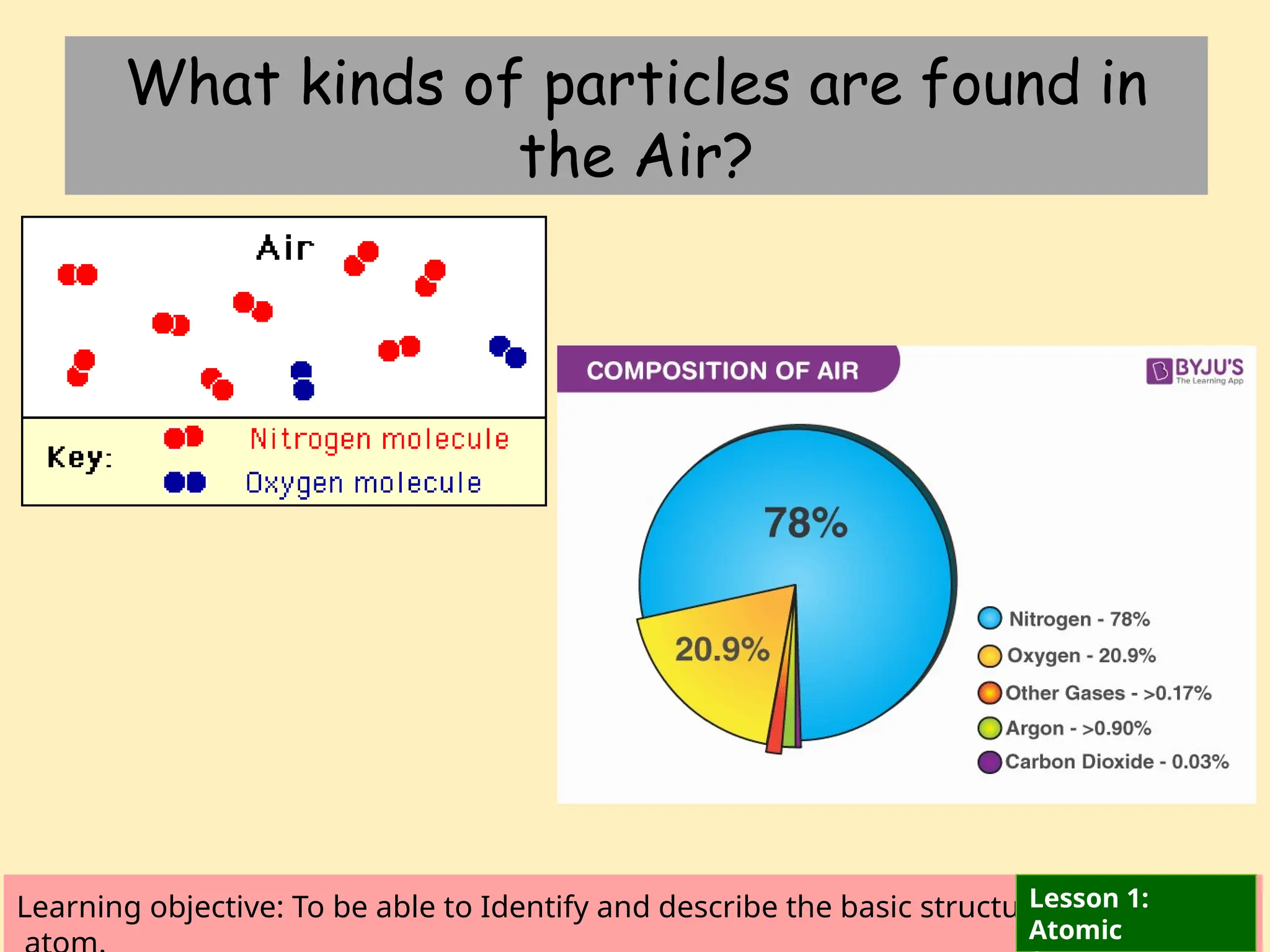
What kinds of particles are found in
the Air?
Learning objective: To be able to Identify and describe the basic structure of an
Lesson 1:
Atomic
© Boardworks Ltd 2004
1 of © Boardworks Ltd 2005
5 of 24
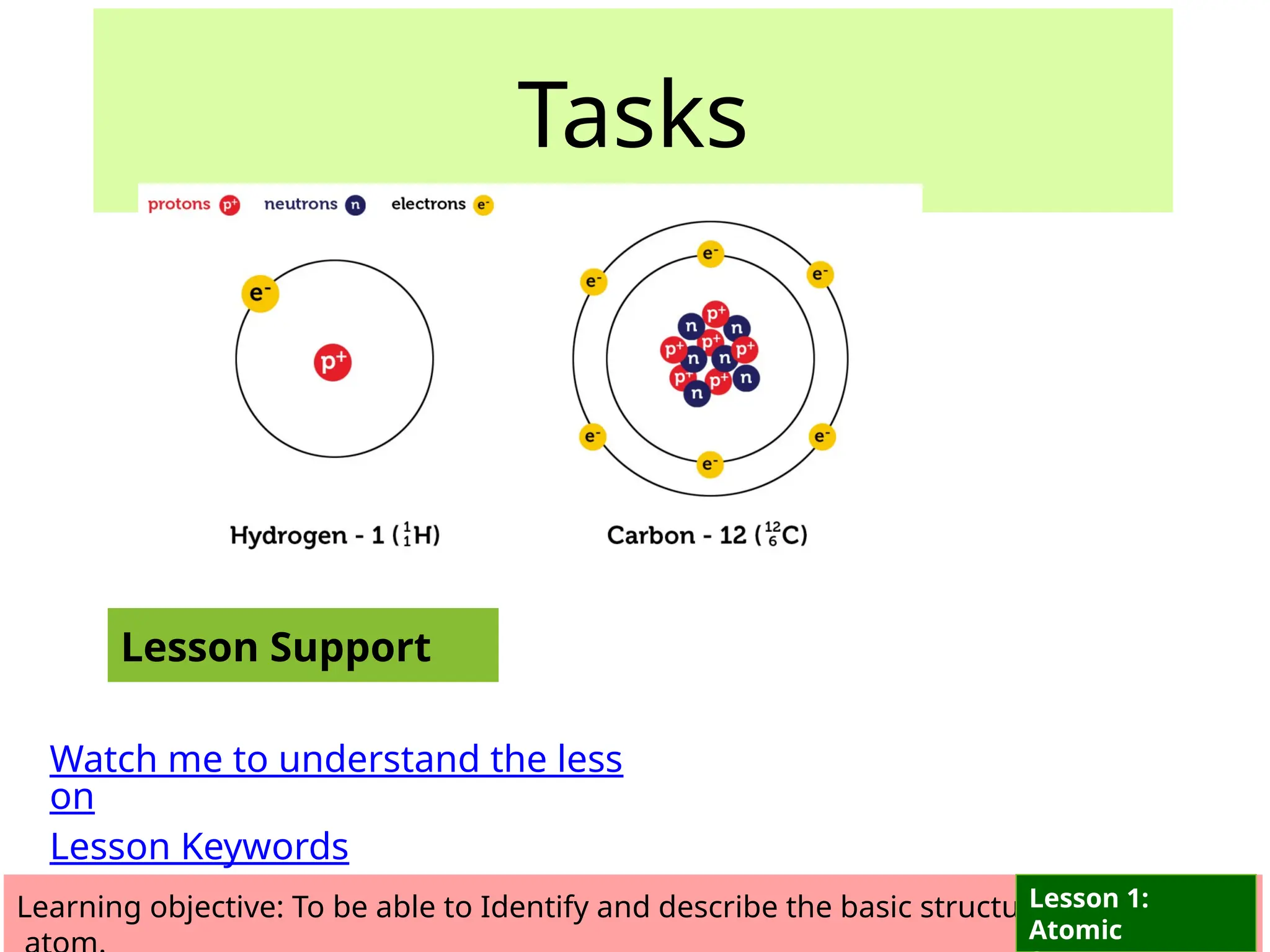
What particles are atoms made of?
Atoms are the building blocks of matter. For some time,
people thought that atoms were the smallest particles and
could not be broken into anything smaller.
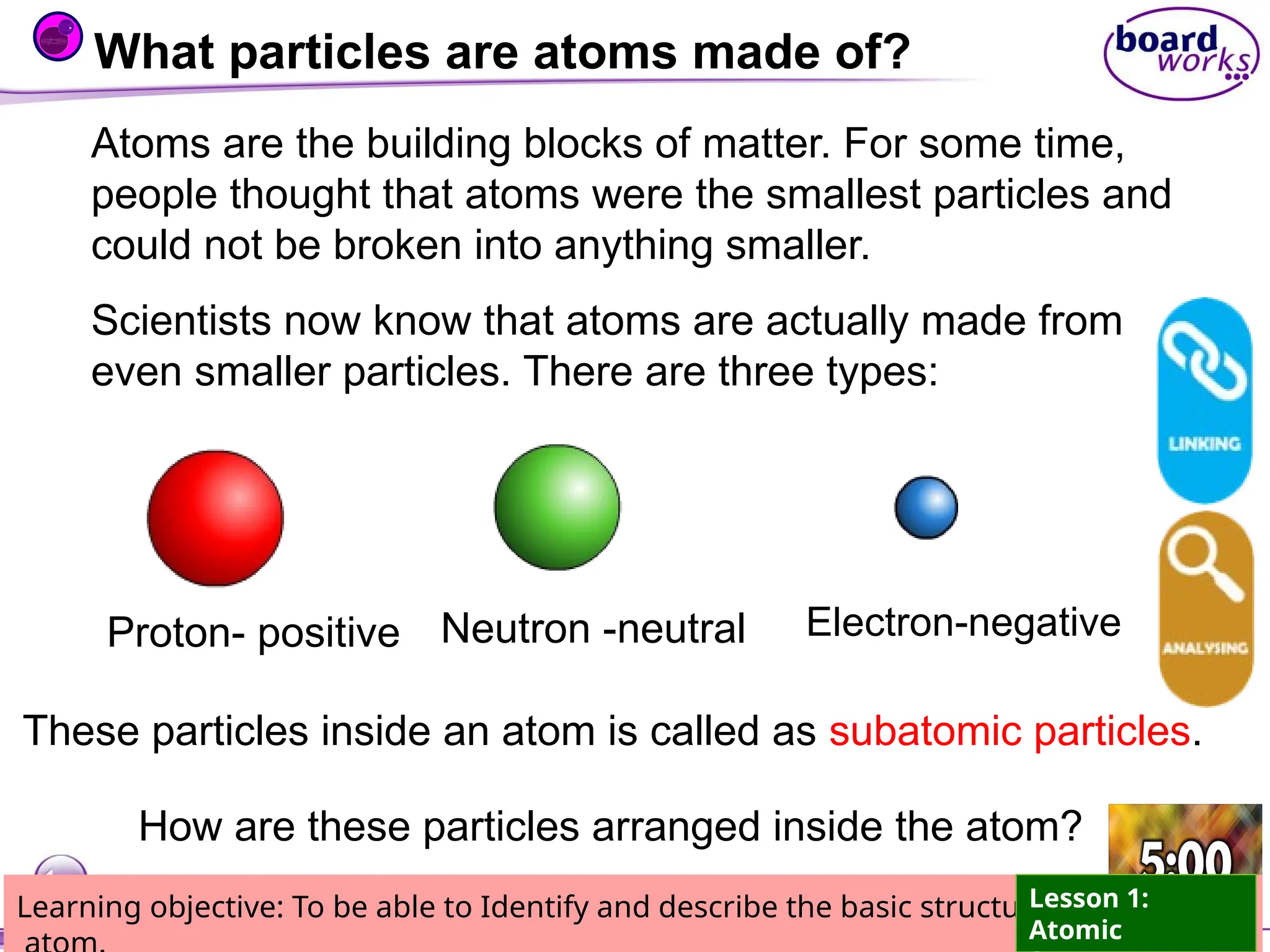
Proton- positive Neutron -neutral Electron-negative
Scientists now know that atoms are actually made from
even smaller particles. There are three types:
These particles inside an atom is called as subatomic particles.
How are these particles arranged inside the atom?
Learning objective: To be able to Identify and describe the basic structure of an
Lesson 1:
Atomic
© Boardworks Ltd 2004
1 of © Boardworks Ltd 2005
6 of 24
How are these particles arranged inside the atom?
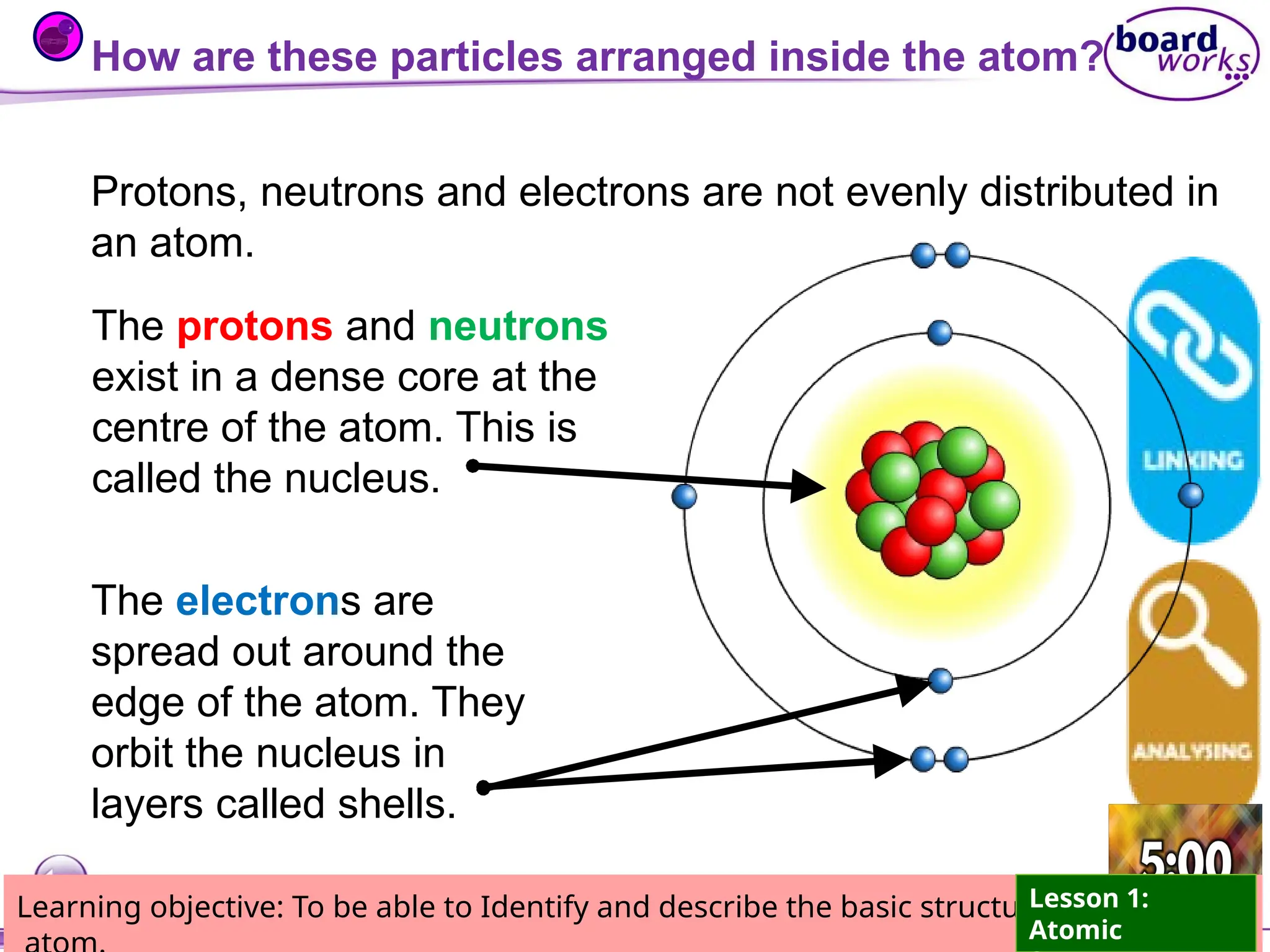
Protons, neutrons and electrons are not evenly distributed in
an atom.
The electrons are
spread out around the
edge of the atom. They
orbit the nucleus in
layers called shells.
The protons and neutrons
exist in a dense core at the
centre of the atom. This is
called the nucleus.
Learning objective: To be able to Identify and describe the basic structure of an
Lesson 1:
Atomic
© Boardworks Ltd 2004
1 of © Boardworks Ltd 2005
7 of 24
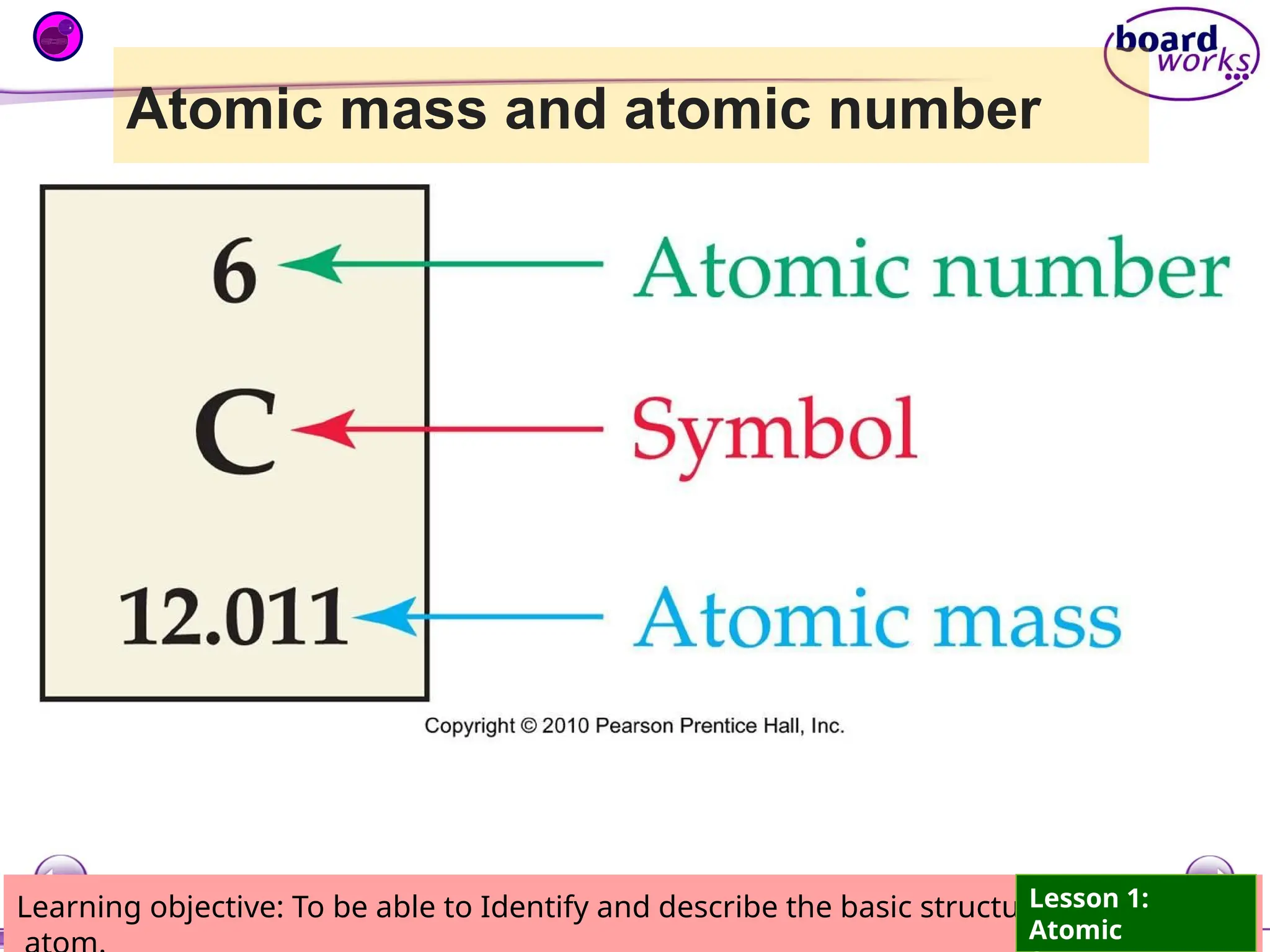
Atomic mass and atomic number
Learning objective: To be able to Identify and describe the basic structure of an
Lesson 1:
Atomic
© Boardworks Ltd 2004
1 of © Boardworks Ltd 2005
8 of 24
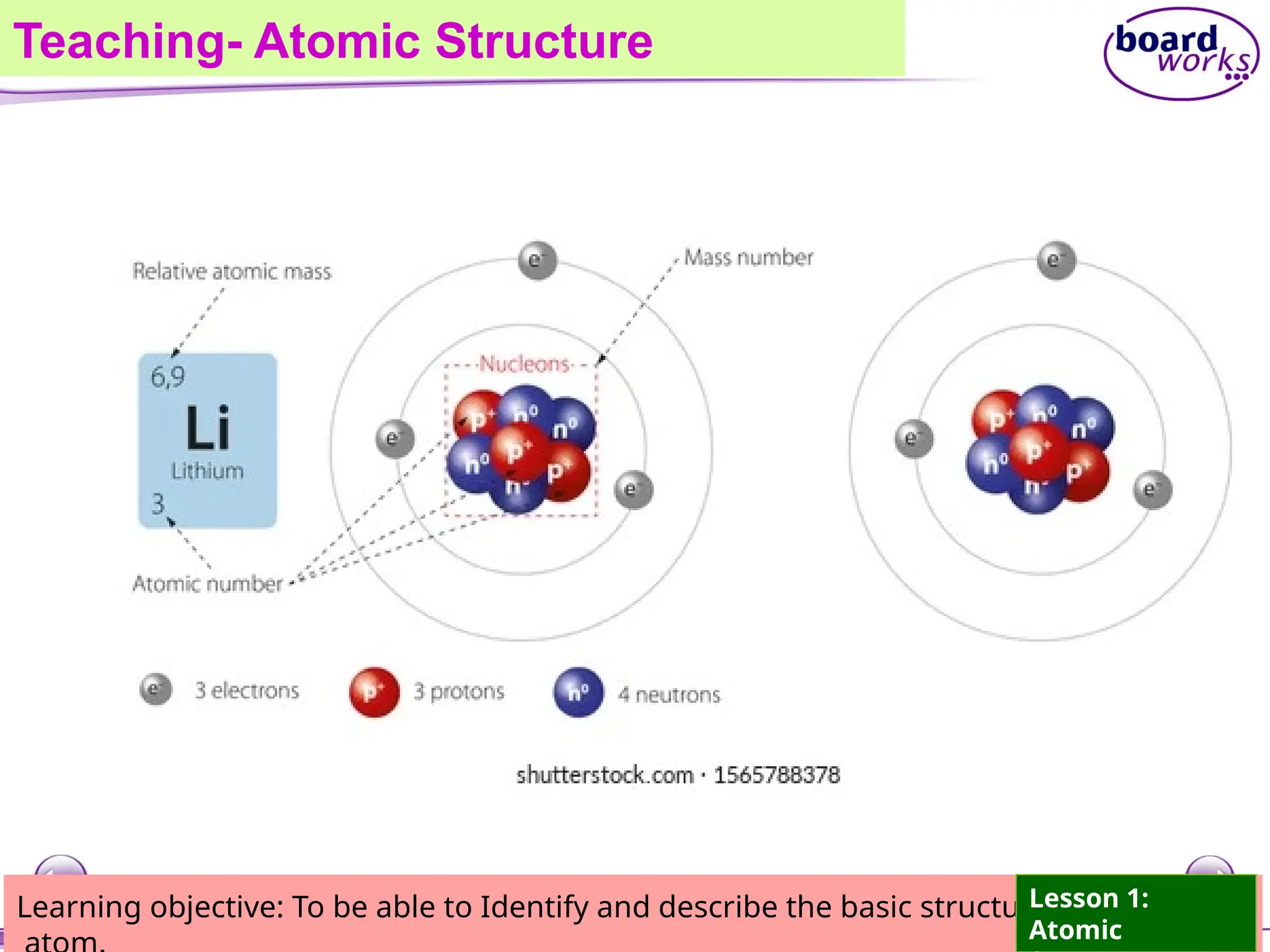
Teaching- Atomic Structure
Learning objective: To be able to Identify and describe the basic structure of an
Lesson 1:
Atomic
© Boardworks Ltd 2004
1 of © Boardworks Ltd 2005
9 of 24
Learning objective: To be able to Identify and describe the basic structure of an
Lesson 1:
Atomic
© Boardworks Ltd 2004
1 of © Boardworks Ltd 2005
10 of 24
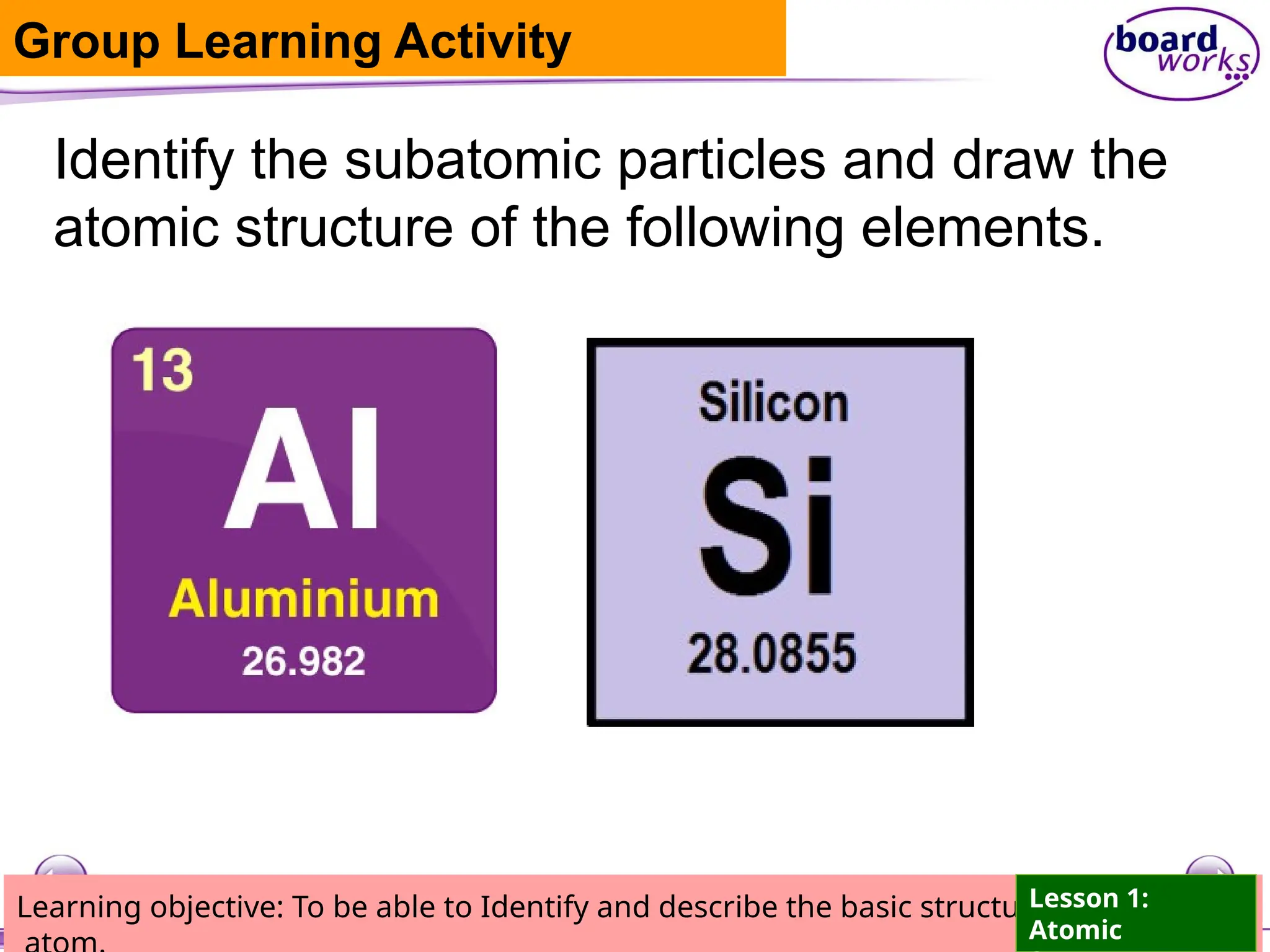
Group Learning Activity
Identify the subatomic particles and draw the
atomic structure of the following elements.
Learning objective: To be able to Identify and describe the basic structure of an
Lesson 1:
Atomic
© Boardworks Ltd 2004
1 of © Boardworks Ltd 2005
11 of 24
© Boardworks Ltd 2004
1 of © Boardworks Ltd 2005
12 of 24
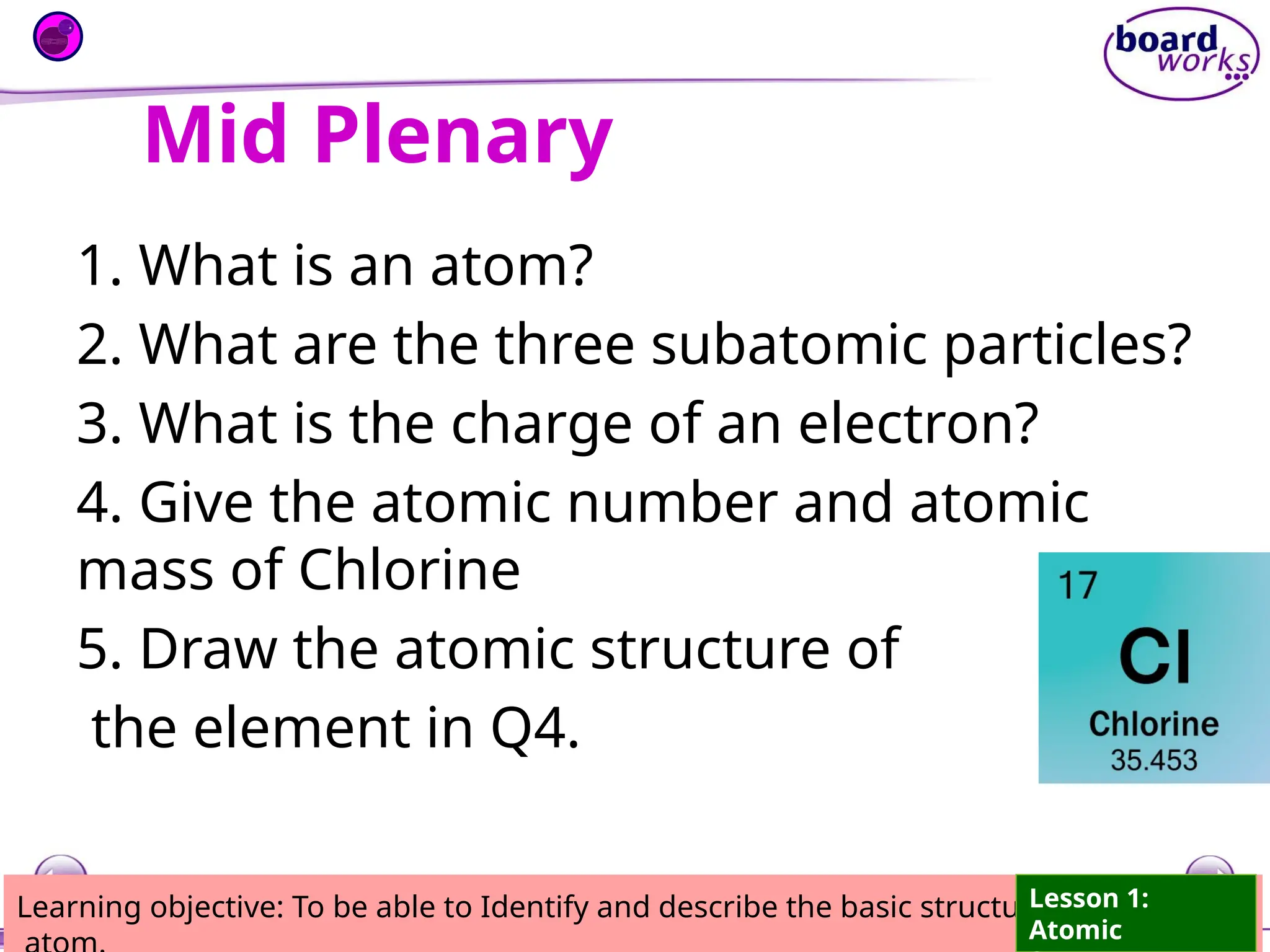
Mid Plenary
1. What is an atom?
2. What are the three subatomic particles?
3. What is the charge of an electron?
4. Give the atomic number and atomic
mass of Chlorine
5. Draw the atomic structure of
the element in Q4.
Learning objective: To be able to Identify and describe the basic structure of an
Lesson 1:
Atomic
© Boardworks Ltd 2004
1 of © Boardworks Ltd 2005
13 of 24
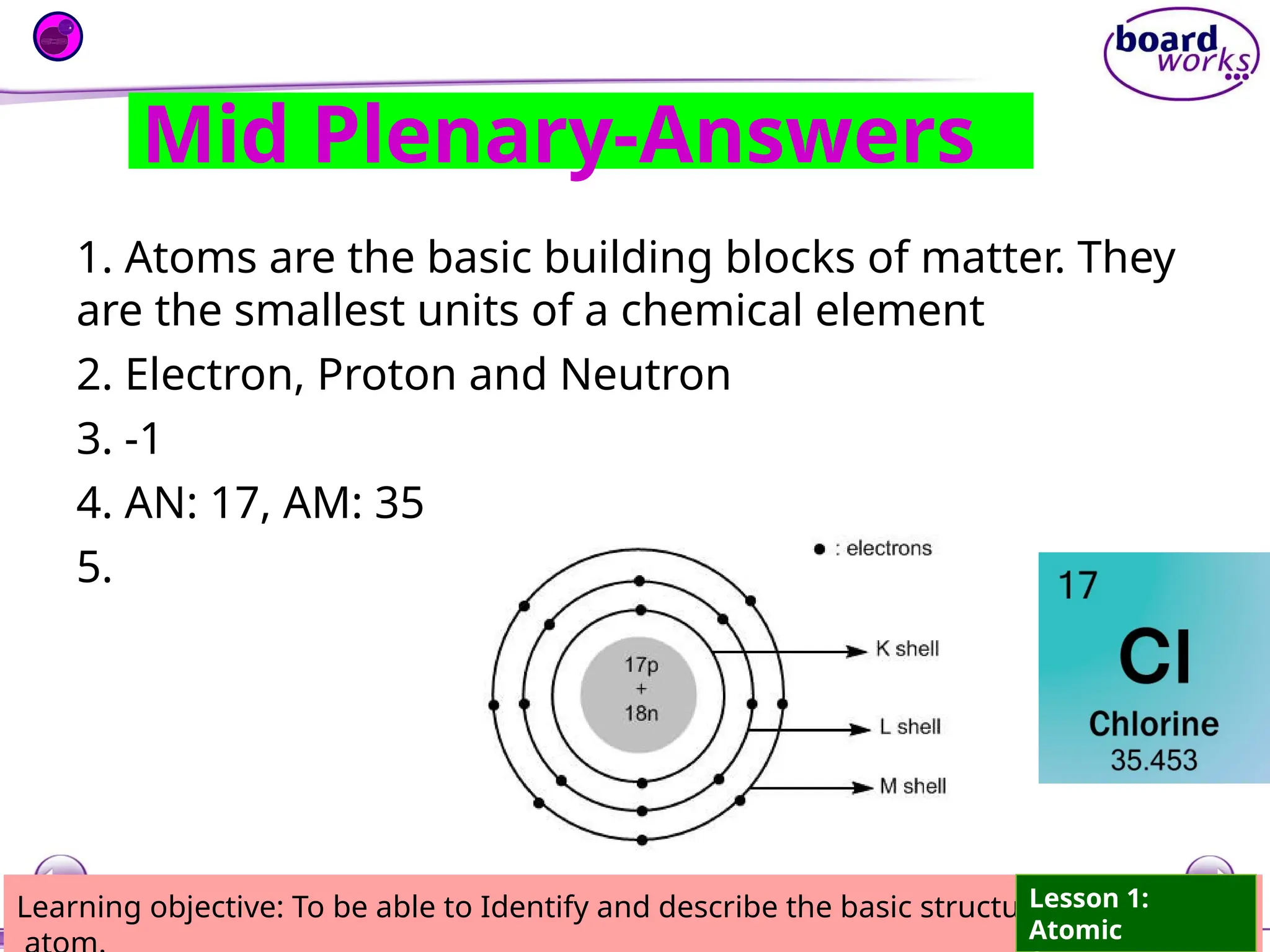
Mid Plenary-Answers
1. Atoms are the basic building blocks of matter. They
are the smallest units of a chemical element
2. Electron, Proton and Neutron
3. -1
4. AN: 17, AM: 35
5.
Learning objective: To be able to Identify and describe the basic structure of an
Lesson 1:
Atomic
Think about these questions when you rate yourself
Progress check
1. What kinds of particles are found in air?
2. What are atoms?
3. Name the three subatomic particles and their
charges
4. Differentiate between atomic number and mass
number. Give me the AM and MN of 5
11
Boron.
5. If an atom has 35 protons in the nucleus, how many
electrons will it have orbiting the nucleus?
Essential Questions
Beginning Mid End
1 How much do you think you know about
this lesson
Learning objective: To be able to Identify and describe the basic structure of an
Silver (1-2) Gold (3-4)
Bronze(0) Platinum (5)
Lesson 1:
Atomic
Name the different parts of an atom.
State the location, relative charge, and relative
mass of the protons, neutrons, and electrons in an
atom
Explain what the atomic number and mass
number of an atom represent
Create a model of a particular element and explain
how the subatomic particles move.
Low
Mid
High
Stretch
L.O: Identify and describe the basic structure
of an atom.
L
e
a
r
n
i
n
g
o
u
t
c
o
m
e
s
Tasks
Lesson Support
Watch me to understand the less
on
Lesson Keywords
Learning objective: To be able to Identify and describe the basic structure of an
Lesson 1:
Atomic
Starting Task Li
nk
Learning objective: To be able to Identify and describe the basic structure of an
Lesson 1:
Atomic
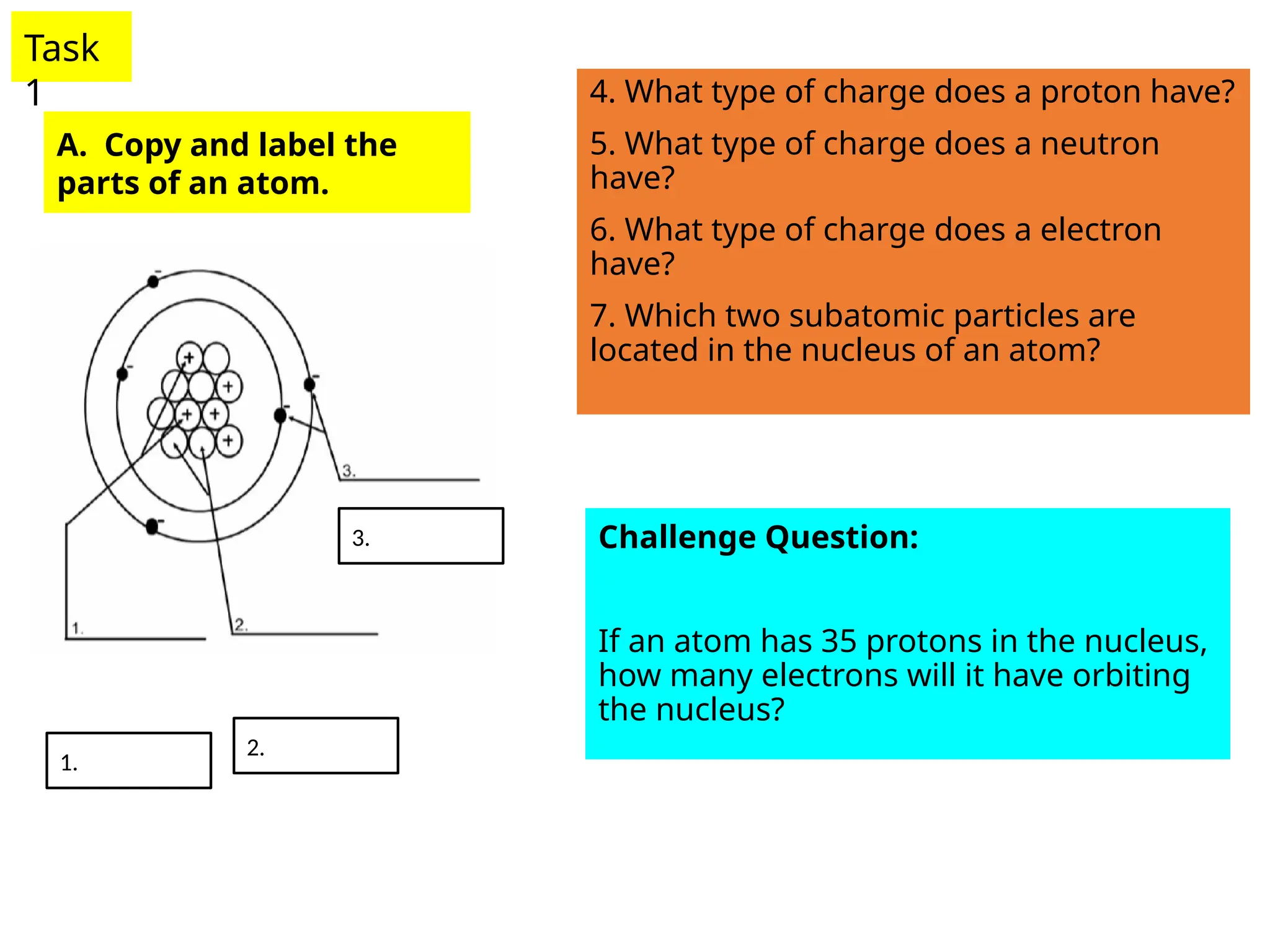
4. What type of charge does a proton have?
5. What type of charge does a neutron
have?
6. What type of charge does a electron
have?
7. Which two subatomic particles are
located in the nucleus of an atom?
1.
2.
3.
A. Copy and label the
parts of an atom.
Challenge Question:
If an atom has 35 protons in the nucleus,
how many electrons will it have orbiting
the nucleus?
Task
1
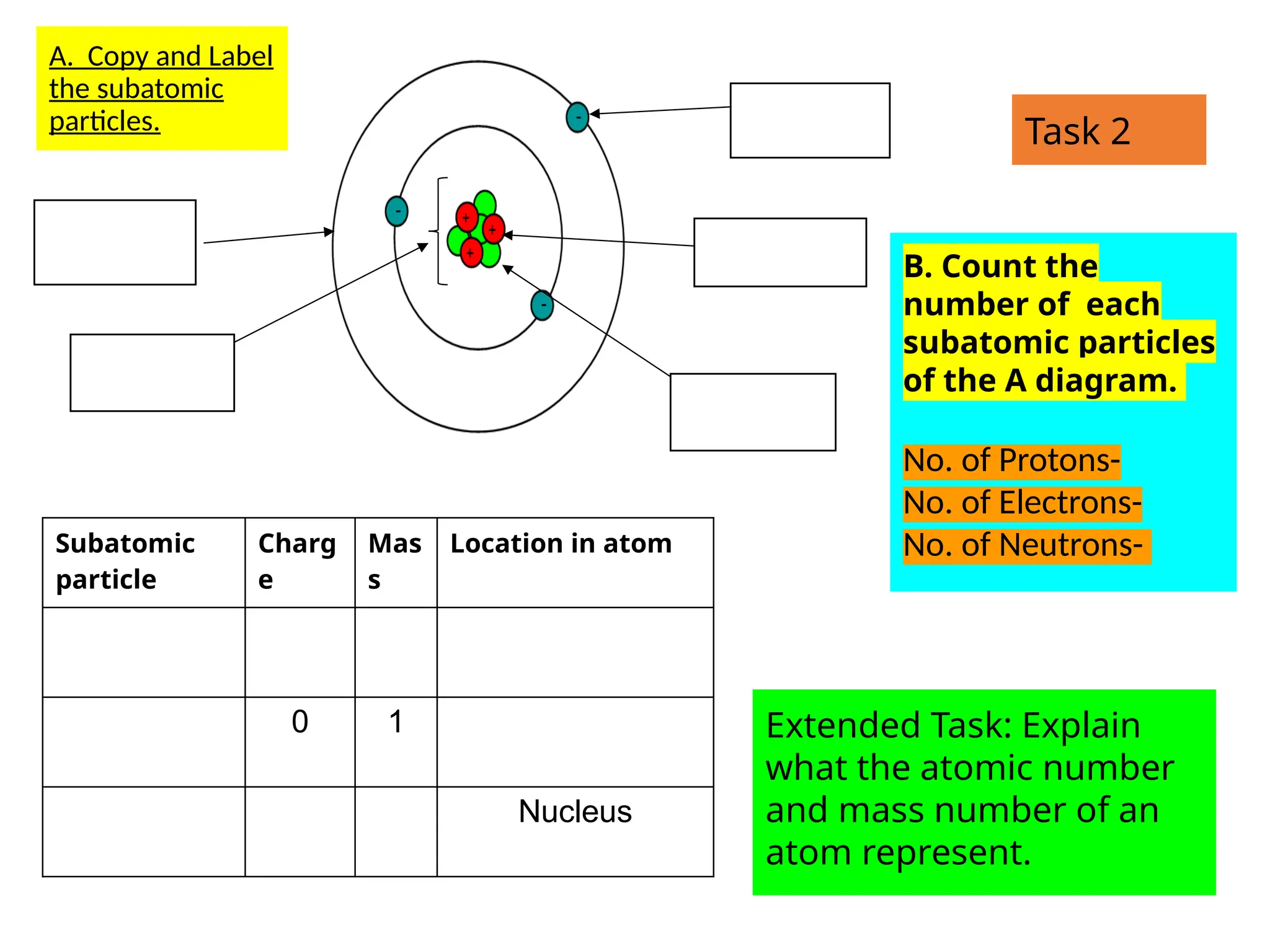
A. Copy and Label
the subatomic
particles.
Subatomic
particle
Charg
e
Mas
s
Location in atom
0 1
Nucleus
Extended Task: Explain
what the atomic number
and mass number of an
atom represent.
Task 2
B. Count the
number of each
subatomic particles
of the A diagram.
No. of Protons-
No. of Electrons-
No. of Neutrons-
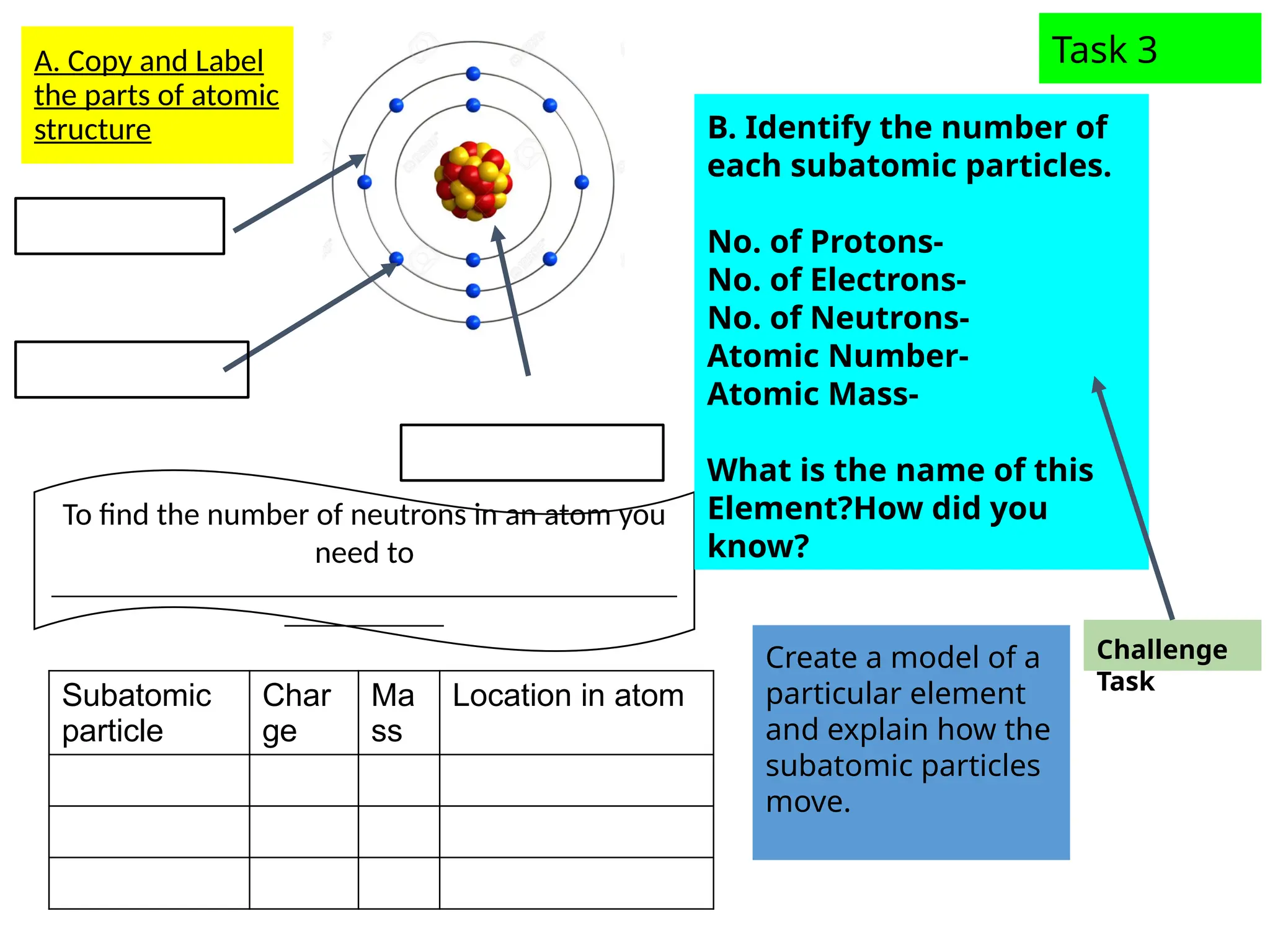
A. Copy and Label
the parts of atomic
structure
Subatomic
particle
Char
ge
Ma
ss
Location in atom
To find the number of neutrons in an atom you
need to
___________________________________________________
_____________
Challenge
Task
Task 3
B. Identify the number of
each subatomic particles.
No. of Protons-
No. of Electrons-
No. of Neutrons-
Atomic Number-
Atomic Mass-
What is the name of this
Element?How did you
know?
Create a model of a
particular element
and explain how the
subatomic particles
move.
Stretch Task
Draw the atomic structure of the following:
1. Calcium
2. Potassium
3. Germanium
Choose one element from the first 20 elements of
the PT then create an atomic structure 3D model of
it. Deadline this Monday, May 22, 2023.
Why do atoms have no
overall charge?
Challenge Question
Learning objective: To be able to Identify and describe the basic structure of an
Lesson 1:
Atomic
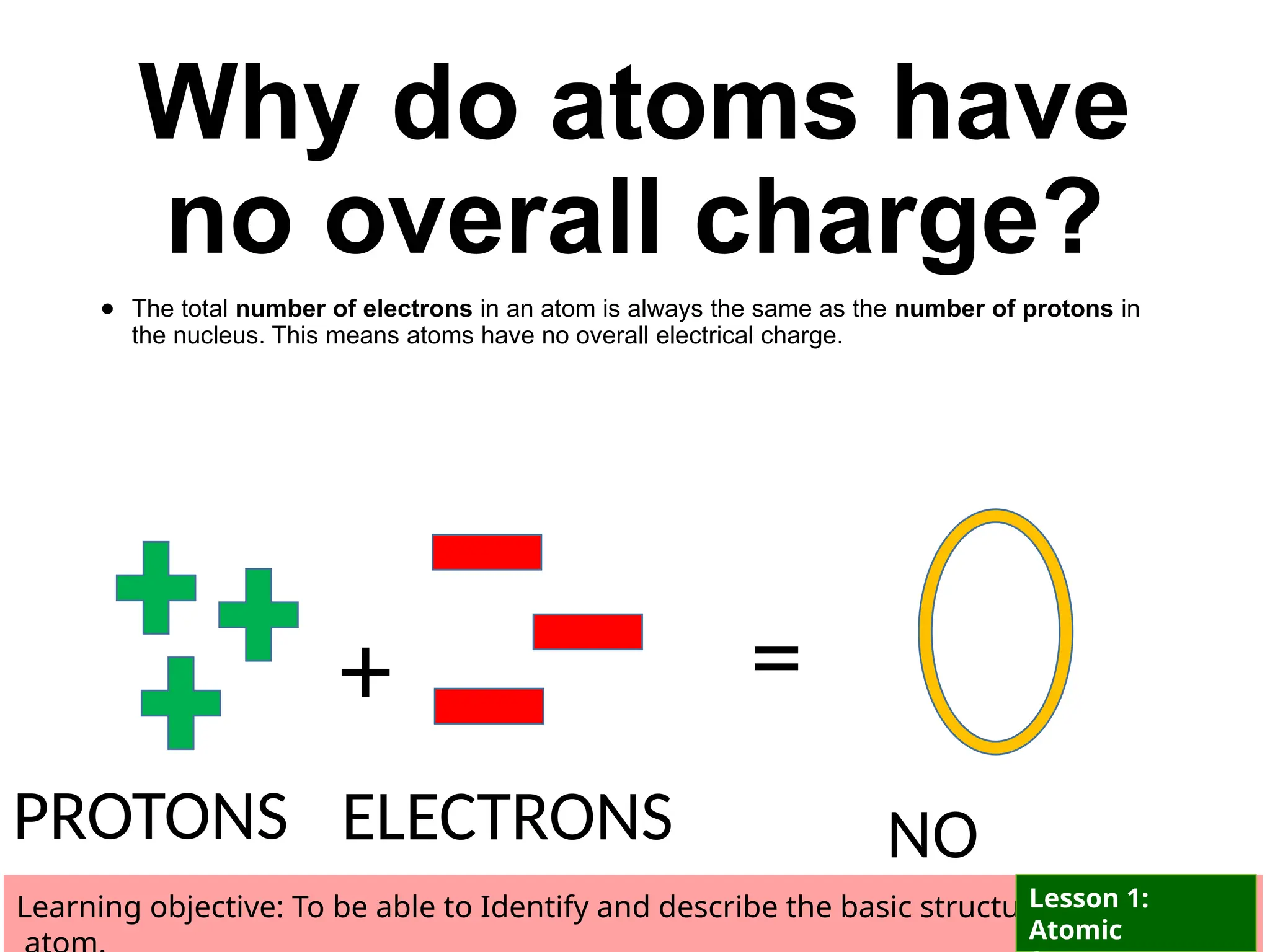
Why do atoms have
no overall charge?
● The total number of electrons in an atom is always the same as the number of protons in
the nucleus. This means atoms have no overall electrical charge.
=
PROTONS
+
ELECTRONS NO
CHARGE
Learning objective: To be able to Identify and describe the basic structure of an
Lesson 1:
Atomic
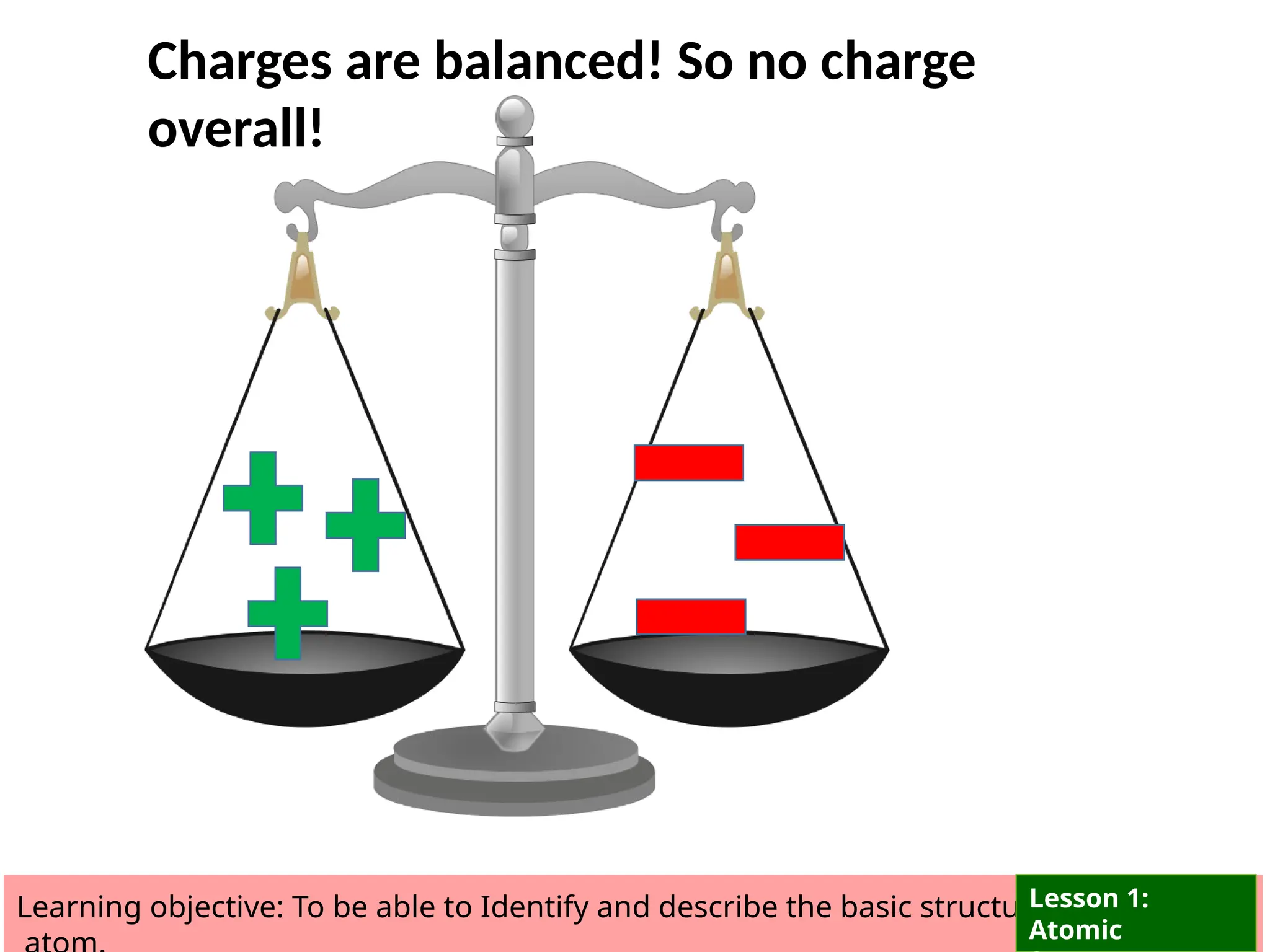
Charges are balanced! So no charge
overall!
Learning objective: To be able to Identify and describe the basic structure of an
Lesson 1:
Atomic
© Boardworks Ltd 2004
1 of © Boardworks Ltd 2005
26 of 24
Why are the atoms electrically neutral?
How many orbits will be there for an atom?
CRITICAL THINKING
What is the relation between the number of protons
and electrons in an atom?
Think about these questions when you rate yourself
Progress check
1. What kinds of particles are found in air?
2. What are atoms?
3. Name the three subatomic particles and their
charges
4. Differentiate between atomic number and mass
number. Give me the AM and MN of 5
11
Boron.
5. If an atom has 35 protons in the nucleus, how many
electrons will it have orbiting the nucleus?
Essential Questions
Beginning Mid End
1 How much do you think you know about
this lesson
Learning objective: To be able to Identify and describe the basic structure of an
Silver (1-2) Gold (3-4)
Bronze(0) Platinum (5)
Lesson 1:
Atomic
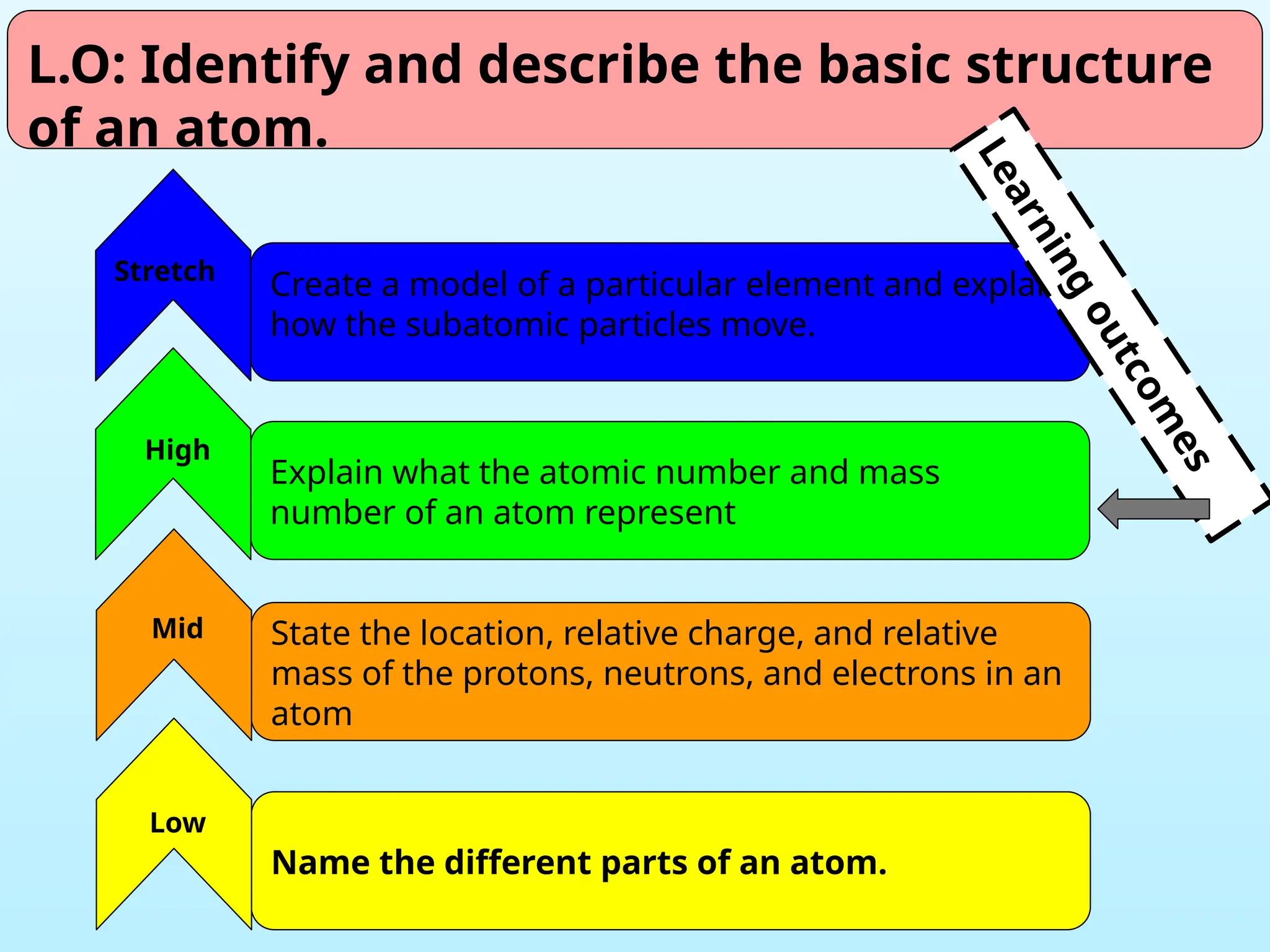
Name the different parts of an atom.
State the location, relative charge, and relative
mass of the protons, neutrons, and electrons in an
atom
Explain what the atomic number and mass
number of an atom represent
Create a model of a particular element and explain
how the subatomic particles move.
Low
Mid
High
Stretch
L.O: Identify and describe the basic structure
of an atom.
L
e
a
r
n
i
n
g
o
u
t
c
o
m
e
s
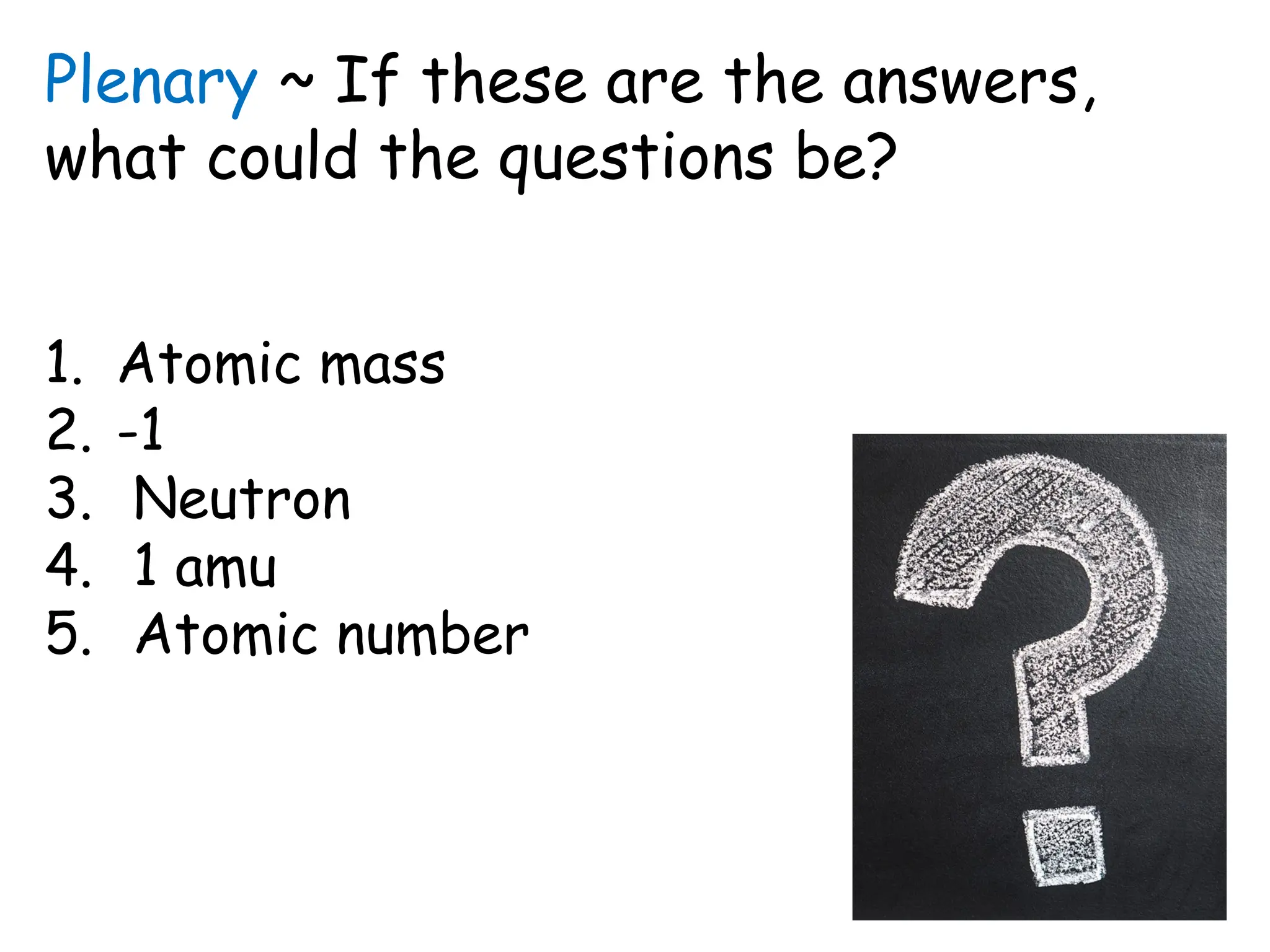
Plenary ~ If these are the answers,
what could the questions be?
1. Atomic mass
2. -1
3. Neutron
4. 1 amu
5. Atomic number
Name the different parts of an atom.
State the location, relative charge, and relative
mass of the protons, neutrons, and electrons in an
atom
Explain what the atomic number and mass
number of an atom represent
Create a model of a particular element and explain
how the subatomic particles move.
Low
Mid
High
Stretch
L.O: Identify and describe the basic structure
of an atom.
L
e
a
r
n
i
n
g
o
u
t
c
o
m
e
s

Atomic Structure- Lesson for Grade 7 students

  • 1.
    Learning objective: Tobe able to Identify and describe the basic structure of an atom. identify- to recognize and distinguish the different types of matter based on their unique characteristics and properties. Command word/s Lesson 1: The Atomic 7H: Atoms, Elements and Molecules Tool box – key words atoms, protons, electrons, neutrons, charge Textbook: pages 120- The Atomic Structure
  • 2.
    Think about thesequestions when you rate yourself Progress check 1. What kinds of particles are found in air? 2. What are atoms? 3. Name the three subatomic particles and their charges 4. Differentiate between atomic number and mass number. Give me the AN and MN of 5 11 Boron. 5. If an atom has 35 protons in the nucleus, how many electrons will it have orbiting the nucleus? Essential Questions Beginning Mid End 1 How much do you think you know about this lesson Learning objective: To be able to Identify and describe the basic structure of an Silver (1-2) Gold (3-4) Bronze(0) Platinum (5) Lesson 1: Atomic
  • 3.
    Name the differentparts of an atom. State the location, relative charge, and relative mass of the protons, neutrons, and electrons in an atom Explain what the atomic number and mass number of an atom represent Create a model of a particular element and explain how the subatomic particles move. Low Mid High Stretch L.O: Identify and describe the basic structure of an atom. L e a r n i n g o u t c o m e s
  • 4.
    What kinds ofparticles are found in the Air? Learning objective: To be able to Identify and describe the basic structure of an Lesson 1: Atomic
  • 5.
    © Boardworks Ltd2004 1 of © Boardworks Ltd 2005 5 of 24 What particles are atoms made of? Atoms are the building blocks of matter. For some time, people thought that atoms were the smallest particles and could not be broken into anything smaller. Proton- positive Neutron -neutral Electron-negative Scientists now know that atoms are actually made from even smaller particles. There are three types: These particles inside an atom is called as subatomic particles. How are these particles arranged inside the atom? Learning objective: To be able to Identify and describe the basic structure of an Lesson 1: Atomic
  • 6.
    © Boardworks Ltd2004 1 of © Boardworks Ltd 2005 6 of 24 How are these particles arranged inside the atom? Protons, neutrons and electrons are not evenly distributed in an atom. The electrons are spread out around the edge of the atom. They orbit the nucleus in layers called shells. The protons and neutrons exist in a dense core at the centre of the atom. This is called the nucleus. Learning objective: To be able to Identify and describe the basic structure of an Lesson 1: Atomic
  • 7.
    © Boardworks Ltd2004 1 of © Boardworks Ltd 2005 7 of 24 Atomic mass and atomic number Learning objective: To be able to Identify and describe the basic structure of an Lesson 1: Atomic
  • 8.
    © Boardworks Ltd2004 1 of © Boardworks Ltd 2005 8 of 24 Teaching- Atomic Structure Learning objective: To be able to Identify and describe the basic structure of an Lesson 1: Atomic
  • 9.
    © Boardworks Ltd2004 1 of © Boardworks Ltd 2005 9 of 24 Learning objective: To be able to Identify and describe the basic structure of an Lesson 1: Atomic
  • 10.
    © Boardworks Ltd2004 1 of © Boardworks Ltd 2005 10 of 24 Group Learning Activity Identify the subatomic particles and draw the atomic structure of the following elements. Learning objective: To be able to Identify and describe the basic structure of an Lesson 1: Atomic
  • 11.
    © Boardworks Ltd2004 1 of © Boardworks Ltd 2005 11 of 24
  • 12.
    © Boardworks Ltd2004 1 of © Boardworks Ltd 2005 12 of 24 Mid Plenary 1. What is an atom? 2. What are the three subatomic particles? 3. What is the charge of an electron? 4. Give the atomic number and atomic mass of Chlorine 5. Draw the atomic structure of the element in Q4. Learning objective: To be able to Identify and describe the basic structure of an Lesson 1: Atomic
  • 13.
    © Boardworks Ltd2004 1 of © Boardworks Ltd 2005 13 of 24 Mid Plenary-Answers 1. Atoms are the basic building blocks of matter. They are the smallest units of a chemical element 2. Electron, Proton and Neutron 3. -1 4. AN: 17, AM: 35 5. Learning objective: To be able to Identify and describe the basic structure of an Lesson 1: Atomic
  • 14.
    Think about thesequestions when you rate yourself Progress check 1. What kinds of particles are found in air? 2. What are atoms? 3. Name the three subatomic particles and their charges 4. Differentiate between atomic number and mass number. Give me the AM and MN of 5 11 Boron. 5. If an atom has 35 protons in the nucleus, how many electrons will it have orbiting the nucleus? Essential Questions Beginning Mid End 1 How much do you think you know about this lesson Learning objective: To be able to Identify and describe the basic structure of an Silver (1-2) Gold (3-4) Bronze(0) Platinum (5) Lesson 1: Atomic
  • 15.
    Name the differentparts of an atom. State the location, relative charge, and relative mass of the protons, neutrons, and electrons in an atom Explain what the atomic number and mass number of an atom represent Create a model of a particular element and explain how the subatomic particles move. Low Mid High Stretch L.O: Identify and describe the basic structure of an atom. L e a r n i n g o u t c o m e s
  • 16.
    Tasks Lesson Support Watch meto understand the less on Lesson Keywords Learning objective: To be able to Identify and describe the basic structure of an Lesson 1: Atomic
  • 17.
    Starting Task Li nk Learningobjective: To be able to Identify and describe the basic structure of an Lesson 1: Atomic
  • 18.
    4. What typeof charge does a proton have? 5. What type of charge does a neutron have? 6. What type of charge does a electron have? 7. Which two subatomic particles are located in the nucleus of an atom? 1. 2. 3. A. Copy and label the parts of an atom. Challenge Question: If an atom has 35 protons in the nucleus, how many electrons will it have orbiting the nucleus? Task 1
  • 19.
    A. Copy andLabel the subatomic particles. Subatomic particle Charg e Mas s Location in atom 0 1 Nucleus Extended Task: Explain what the atomic number and mass number of an atom represent. Task 2 B. Count the number of each subatomic particles of the A diagram. No. of Protons- No. of Electrons- No. of Neutrons-
  • 20.
    A. Copy andLabel the parts of atomic structure Subatomic particle Char ge Ma ss Location in atom To find the number of neutrons in an atom you need to ___________________________________________________ _____________ Challenge Task Task 3 B. Identify the number of each subatomic particles. No. of Protons- No. of Electrons- No. of Neutrons- Atomic Number- Atomic Mass- What is the name of this Element?How did you know? Create a model of a particular element and explain how the subatomic particles move.
  • 21.
    Stretch Task Draw theatomic structure of the following: 1. Calcium 2. Potassium 3. Germanium Choose one element from the first 20 elements of the PT then create an atomic structure 3D model of it. Deadline this Monday, May 22, 2023.
  • 23.
    Why do atomshave no overall charge? Challenge Question Learning objective: To be able to Identify and describe the basic structure of an Lesson 1: Atomic
  • 24.
    Why do atomshave no overall charge? ● The total number of electrons in an atom is always the same as the number of protons in the nucleus. This means atoms have no overall electrical charge. = PROTONS + ELECTRONS NO CHARGE Learning objective: To be able to Identify and describe the basic structure of an Lesson 1: Atomic
  • 25.
    Charges are balanced!So no charge overall! Learning objective: To be able to Identify and describe the basic structure of an Lesson 1: Atomic
  • 26.
    © Boardworks Ltd2004 1 of © Boardworks Ltd 2005 26 of 24 Why are the atoms electrically neutral? How many orbits will be there for an atom? CRITICAL THINKING What is the relation between the number of protons and electrons in an atom?
  • 27.
    Think about thesequestions when you rate yourself Progress check 1. What kinds of particles are found in air? 2. What are atoms? 3. Name the three subatomic particles and their charges 4. Differentiate between atomic number and mass number. Give me the AM and MN of 5 11 Boron. 5. If an atom has 35 protons in the nucleus, how many electrons will it have orbiting the nucleus? Essential Questions Beginning Mid End 1 How much do you think you know about this lesson Learning objective: To be able to Identify and describe the basic structure of an Silver (1-2) Gold (3-4) Bronze(0) Platinum (5) Lesson 1: Atomic
  • 28.
    Name the differentparts of an atom. State the location, relative charge, and relative mass of the protons, neutrons, and electrons in an atom Explain what the atomic number and mass number of an atom represent Create a model of a particular element and explain how the subatomic particles move. Low Mid High Stretch L.O: Identify and describe the basic structure of an atom. L e a r n i n g o u t c o m e s
  • 29.
    Plenary ~ Ifthese are the answers, what could the questions be? 1. Atomic mass 2. -1 3. Neutron 4. 1 amu 5. Atomic number
  • 30.
    Name the differentparts of an atom. State the location, relative charge, and relative mass of the protons, neutrons, and electrons in an atom Explain what the atomic number and mass number of an atom represent Create a model of a particular element and explain how the subatomic particles move. Low Mid High Stretch L.O: Identify and describe the basic structure of an atom. L e a r n i n g o u t c o m e s