ATM WITH AN EYE
Presented By:
Vishnu Parsi
Guided By:
OUTLINE
 Introduction
 What is an ATM
 History
 Need of Facial Recognition at ATM
 Where technology is used
 Working
 Advantages & Disadvantages
 Conclusion
INTRODUCTION
 ATM made money transaction easy.
 Other side is enhancement of culprit’s action
to get unauthentic access.
 Improved Technology is used.
 Facial Recognition is recent technology used
at ATMs.
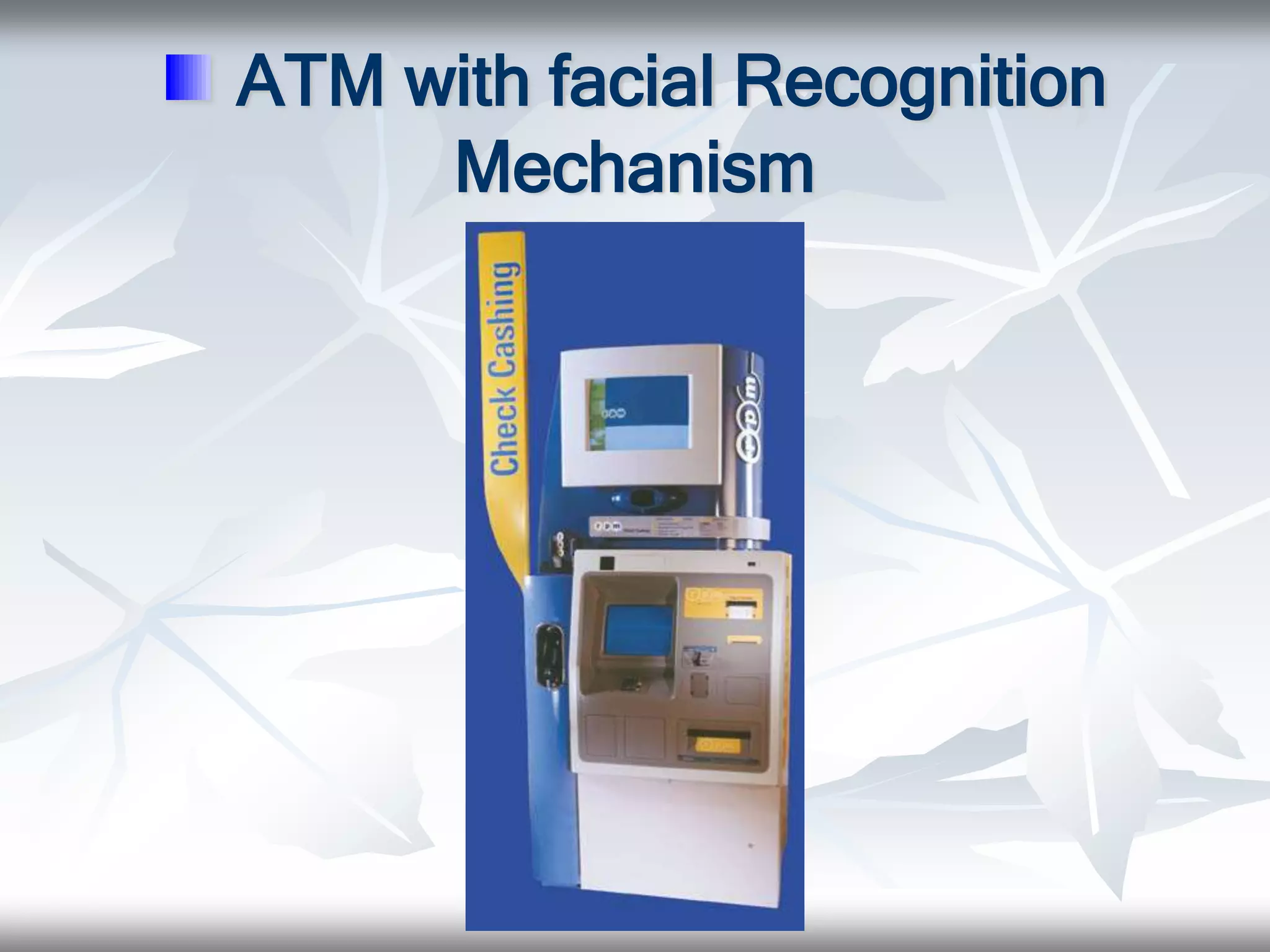
ATM with facial Recognition
Mechanism
History of an ATM
 Many inventors contribute to the invention.
 Don Wetzel invented first successful and modern
ATM.
 But Luther GEORGE started patenting earlier in
1939.
 A working prototype was ready in 1969 & was
installed in New York.
Don Wetzel's ATM
 He got the idea while waiting in line at Dallas Bank.
 It was not in a lobby.
 It was actually in the wall of the Bank.
 Had a canopy over IT for protection.
 ATM was cash dispenser only.
 First ATM’s were off-line machines.
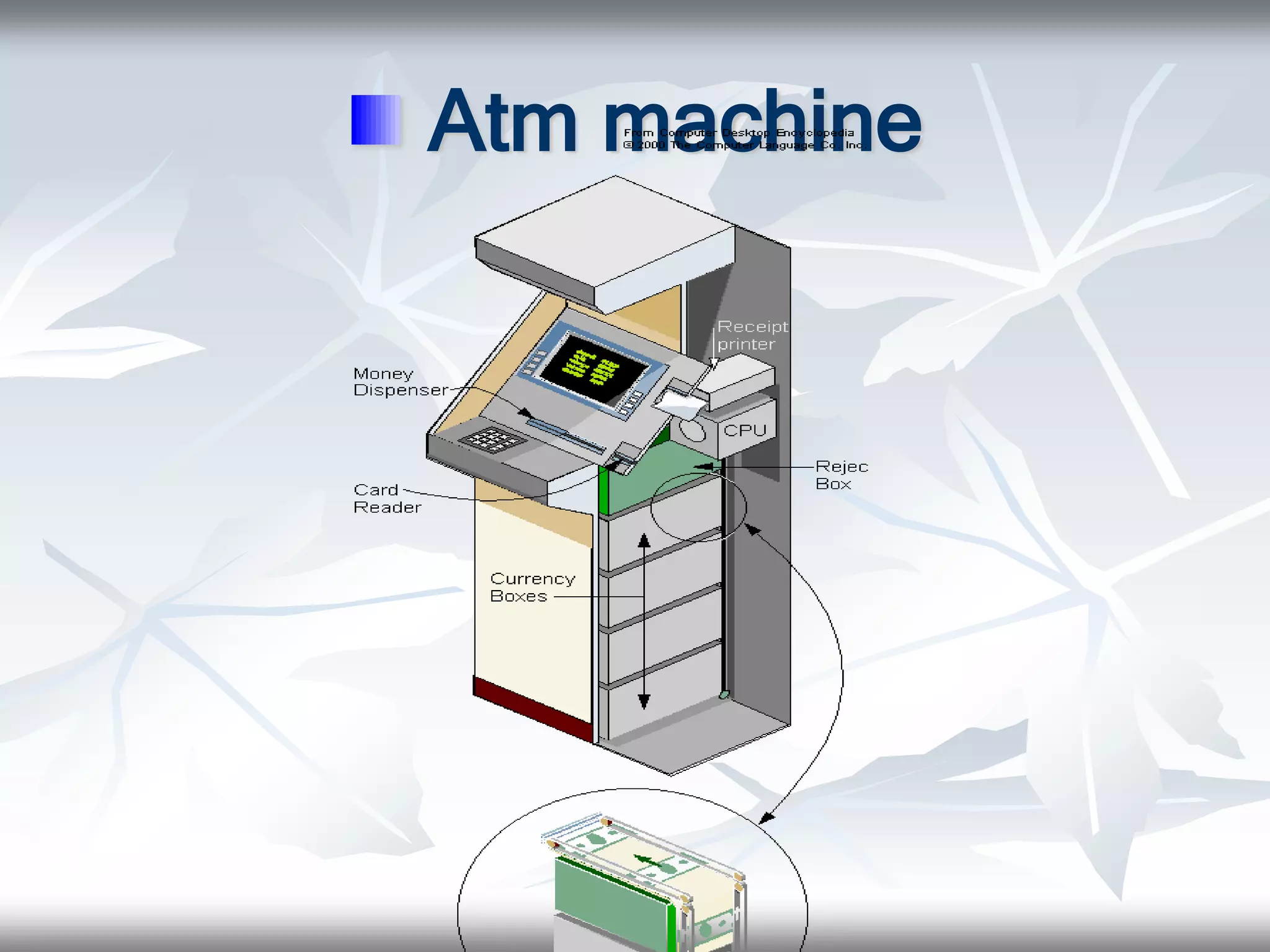
What is an ATM
 A Banking Terminal that accepts deposits &
dispenses cash.
 It has two input devices viz ;
1. A card reader that reads
magnetic strip.
2. A keypad.
 It has four output devices viz ;
1. A speaker.
2. A display screen.
3. A printer.
4. A safe & cash dispensing
mechanism.
Atm machine
ATM
 Networking
ATMs are connected to interbank network
enabling people to withdraw and deposit money from
machines not belonging to the bank where they have
their account.
 Hardware
ATMs contain secure cryptoprocessors,
generally within an IBM PC compatible host
computer in a secure enclosure.
CONTINUE…
 Software
ATMs are moving away from custom
circuit boards and into full-fledged with
commodity operating systems such as
Windows 2000 and Linux .
 Reliability
ATMs are generally reliable, but if
they do go wrong customers will be left
without cash or giving out higher value notes.
CONTINUE…
 ATM Frauds
These had two common forms.
1. In the low-tech form, the user's PIN is observed by
someone watching as they use the machine.
2. By contrast, the most common high-tech modus operandi
involves the installation of a magnetic card reader over
the real ATM's card slot, and the use of a wireless
surveillance camera to observe the user's PIN.
ATM’s in Operation
Need of Facial
Recognition at ATM
 Traditionally, card & PIN is used to access
account.
 ATM frauds are increasing.
 By forcing ATM to match live image with an
image stored in a bank database, frauds can be
minimized.
 Only when PIN & image matches, user is
considered fully verified.
Where Facial Recognition
Technology is used
 Used mainly in Law Enforcement Agencies &
Security Surveillance.
 Also has several other uses :
1. Eliminating voter fraud.
2. Check-Cashing identity
verification.
3. Computer security.
 Also used to pinpoint the face in the crowd &
measure its features.
Computer Security
 Facial Recognition
software can be used to
lock your computer.
Used to pinpoint faces in
crowd
 Facial Recognition
mechanism is also
used to pinpoint a
face in the crowd &
measure its features.
Working
 Facial Recognition analyzes Characteristics of face
through digital camera.
 There are peaks & valleys on face called nodal
points.
 There are around 80 nodal points on face.
 Some of them are :
1. Distance between eyes.
2. Width of nose.
3. Depth of eye sockets.
4. Cheekbones.
5. Jaw line.
6. Chin.
 These nodal points are measured to create a
numerical code that represents face in database.
 This code is called face-print.
 These measurements are then used for
comparison when user stands before camera.
 Does not require physical contact with image
capturing device.
Identification Steps
 Take a photo of the individual & encode it.
 Match the encoding against database.
 Display the result (i.e. verified or not-
verified).
Verification
Advantages
 Frauds are minimized.
 It does not require any physical contact with
image capture device.
 Does not require any advance hardware.
 Convenient to use because additional security
information (smart cards, pwd. etc) can be
skipped.
 Usually helps in situation where certain biometric
feature is not optimal. e.g. hard workers may
have raw finger prints.
Disadvantages
 Face is not so unique, so its recognition
reliability is slightly lower.
 To match with the database image, it
requires lot of time.
Conclusion
 As ATM frauds are increasing, or the
culprit’s probability to get the ‘unauthentic
access’ is increasing, additional security
like Facial Recognition mechanism is
necessity.
REFERENCES
 http:///www.atmmachine.com/atmmachine.html
 www.bls.gov/oco/ocos186.html
 www.diebold.com/solutions/atms/default.htm
 www.encyclopedia.com/html/a1/autotel.asp
 www.legis.state.wi.us/lrb/pubs/ttp-10-2000.html
 www.answers.com/topic/automatic-teller-machine
 www.infoplease.com/ce6/sci/AO805407.html
 Questions ???
Atm with an eye

Atm with an eye

  • 1.
    ATM WITH ANEYE Presented By: Vishnu Parsi Guided By:
  • 2.
    OUTLINE  Introduction  Whatis an ATM  History  Need of Facial Recognition at ATM  Where technology is used  Working  Advantages & Disadvantages  Conclusion
  • 3.
    INTRODUCTION  ATM mademoney transaction easy.  Other side is enhancement of culprit’s action to get unauthentic access.  Improved Technology is used.  Facial Recognition is recent technology used at ATMs.
  • 4.
    ATM with facialRecognition Mechanism
  • 5.
    History of anATM  Many inventors contribute to the invention.  Don Wetzel invented first successful and modern ATM.  But Luther GEORGE started patenting earlier in 1939.  A working prototype was ready in 1969 & was installed in New York.
  • 6.
    Don Wetzel's ATM He got the idea while waiting in line at Dallas Bank.  It was not in a lobby.  It was actually in the wall of the Bank.  Had a canopy over IT for protection.  ATM was cash dispenser only.  First ATM’s were off-line machines.
  • 7.
    What is anATM  A Banking Terminal that accepts deposits & dispenses cash.  It has two input devices viz ; 1. A card reader that reads magnetic strip. 2. A keypad.  It has four output devices viz ; 1. A speaker. 2. A display screen. 3. A printer. 4. A safe & cash dispensing mechanism.
  • 8.
  • 9.
    ATM  Networking ATMs areconnected to interbank network enabling people to withdraw and deposit money from machines not belonging to the bank where they have their account.  Hardware ATMs contain secure cryptoprocessors, generally within an IBM PC compatible host computer in a secure enclosure.
  • 10.
    CONTINUE…  Software ATMs aremoving away from custom circuit boards and into full-fledged with commodity operating systems such as Windows 2000 and Linux .  Reliability ATMs are generally reliable, but if they do go wrong customers will be left without cash or giving out higher value notes.
  • 11.
    CONTINUE…  ATM Frauds Thesehad two common forms. 1. In the low-tech form, the user's PIN is observed by someone watching as they use the machine. 2. By contrast, the most common high-tech modus operandi involves the installation of a magnetic card reader over the real ATM's card slot, and the use of a wireless surveillance camera to observe the user's PIN.
  • 12.
  • 13.
    Need of Facial Recognitionat ATM  Traditionally, card & PIN is used to access account.  ATM frauds are increasing.  By forcing ATM to match live image with an image stored in a bank database, frauds can be minimized.  Only when PIN & image matches, user is considered fully verified.
  • 14.
    Where Facial Recognition Technologyis used  Used mainly in Law Enforcement Agencies & Security Surveillance.  Also has several other uses : 1. Eliminating voter fraud. 2. Check-Cashing identity verification. 3. Computer security.  Also used to pinpoint the face in the crowd & measure its features.
  • 15.
    Computer Security  FacialRecognition software can be used to lock your computer.
  • 16.
    Used to pinpointfaces in crowd  Facial Recognition mechanism is also used to pinpoint a face in the crowd & measure its features.
  • 17.
    Working  Facial Recognitionanalyzes Characteristics of face through digital camera.  There are peaks & valleys on face called nodal points.  There are around 80 nodal points on face.  Some of them are : 1. Distance between eyes. 2. Width of nose. 3. Depth of eye sockets. 4. Cheekbones. 5. Jaw line. 6. Chin.
  • 18.
     These nodalpoints are measured to create a numerical code that represents face in database.  This code is called face-print.  These measurements are then used for comparison when user stands before camera.  Does not require physical contact with image capturing device.
  • 19.
    Identification Steps  Takea photo of the individual & encode it.  Match the encoding against database.  Display the result (i.e. verified or not- verified).
  • 20.
  • 21.
    Advantages  Frauds areminimized.  It does not require any physical contact with image capture device.  Does not require any advance hardware.  Convenient to use because additional security information (smart cards, pwd. etc) can be skipped.  Usually helps in situation where certain biometric feature is not optimal. e.g. hard workers may have raw finger prints.
  • 22.
    Disadvantages  Face isnot so unique, so its recognition reliability is slightly lower.  To match with the database image, it requires lot of time.
  • 23.
    Conclusion  As ATMfrauds are increasing, or the culprit’s probability to get the ‘unauthentic access’ is increasing, additional security like Facial Recognition mechanism is necessity.
  • 24.
    REFERENCES  http:///www.atmmachine.com/atmmachine.html  www.bls.gov/oco/ocos186.html www.diebold.com/solutions/atms/default.htm  www.encyclopedia.com/html/a1/autotel.asp  www.legis.state.wi.us/lrb/pubs/ttp-10-2000.html  www.answers.com/topic/automatic-teller-machine  www.infoplease.com/ce6/sci/AO805407.html
  • 25.