Group security
ATM Card Skimming & PIN Capturing
   Customer Awareness Guide
What is ATM card skimming?

ATM Skimming is a world-wide problem

Skimming is a method used by criminals to capture data
from the magnetic strip on the back of an ATM card

The devices used are smaller than a deck of cards and are
fastened in close proximity to, or over the top of, the ATM’s
factory-installed card reader
What is PIN capturing?

Personal Identification Number (“PIN”) capturing is a world-
wide problem

PIN capturing refers to a method of strategically attaching
cameras and various other imaging devices to ATMs in
order to fraudulently capture the ATM user’s PIN

Once captured, the electronic data is encoded onto
fraudulent cards and the captured PINs are used to
withdraw money from customers’ accounts
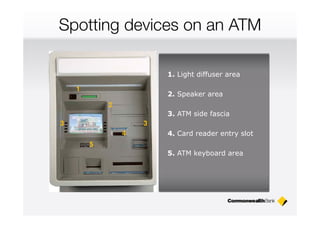
Spotting devices on an ATM

                        1. Light diffuser area

    1
                        2. Speaker area
            2
                        3. ATM side fascia
3                   3
                4       4. Card reader entry slot
        5
                        5. ATM keyboard area
Skimming devices


Can you tell if this ATM has a skimming
   device fitted to the card reader?
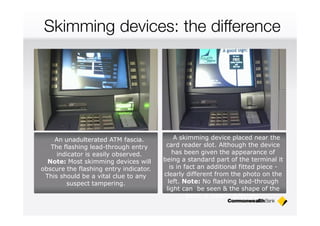
Skimming devices: the difference


    An unadulterated ATM fascia.             A skimming device placed near the
   The flashing lead-through entry       card reader slot. Although the device
     indicator is easily observed.          has been given the appearance of
  Note: Most skimming devices will      being a standard part of the terminal it
obscure the flashing entry indicator.      is in fact an additional fitted piece -
 This should be a vital clue to any     clearly different from the photo on the
        suspect tampering.                left. Note: No flashing lead-through
                                         light can be seen & the shape of the
                                                  bezel is clearly different.
Skimming devices


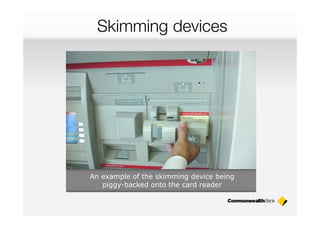
An example of the skimming device being
   piggy-backed onto the card reader
Skimming devices


Another example of a skimming device
installed on the card reader of this ATM
Skimming devices


    Take a closer look
Skimming devices


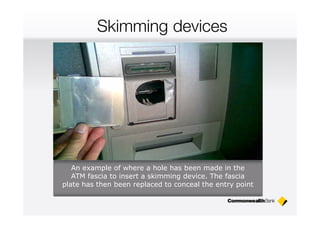
   An example of where a hole has been made in the
   ATM fascia to insert a skimming device. The fascia
plate has then been replaced to conceal the entry point
PIN capturing devices


  In this case an ATM fascia plate (located above the
screen) has a PIN capturing device fitted to the top
     of the ATM. It is very difficult to establish
PIN capturing devices


Let’s remove the ATM fascia plate for a closer look
PIN capturing devices


 Here you can see the PIN capturing device
installed on the inner side of the fascia plate
PIN capturing devices


  Here we have an another example of an
 additional fascia piece fitted to the speaker
        area directly above the screen
PIN capturing devices


 A brochure holder has been placed
     on the side ATM fascia wall
PIN capturing devices


 Upon closer inspection of the brochure holder, you can
 see a pin hole camera installed. This is used to capture
images of the keypad and customers inputting their PINs
PIN capturing devices


 The last area of focus is the ATM keyboard
 fascia. A skimmer plate can be placed over
the top of the existing keyboard as a method
               of PIN capturing.
PIN capturing devices


 An example of what an ATM keyboard
      skimmer plate can look like
Facts on ATM skimming attacks

Skimming devices are normally affixed to ATMs during
periods of low traffic, e.g. early morning/late evening

Length of time skimming devices can be affixed can vary,
but normally are no more than for 24 hours

Successful skimming requires both a card skimmer (card
reader) & camera (PIN capturing device) to be fitted to the
ATM in order to steal card data
Facts on ATM skimming attacks

Criminals may stay nearby to observe proceedings &
remove equipment at short notice in order to later
download information. In some cases this data may be
transmitted wirelessly to other devices located nearby
Mitigating risk
Get to know the appearance of your ATM

 Inspect the front of the ATM for unusual or non-standard
appearance. scratches, marks, adhesive or tape residues
could be indicators of tampering

Familiarise yourself with the look and feel of the ATM fascia
on the machines you commonly use. Pay particular attention
to all of the touch and action points (e.g. keypad, customer
card entry slot, lighting diffusers)

Always use your hand to shield your PIN when entering it
Mitigating risk
Inspect all areas of the fascia

Look at the card reader entry slot & regions immediately
above the ATM screen & keyboard area for anything unusual

Report any unusual appearance immediately to branch staff
(if the ATM is located at a branch). For non-branch ATMs
contact the Police immediately


       By being vigilant YOU can help
      reduce the risk of ATM skimming!

ATM Skimming Devices

  • 1.
    Group security ATM CardSkimming & PIN Capturing Customer Awareness Guide
  • 2.
    What is ATMcard skimming? ATM Skimming is a world-wide problem Skimming is a method used by criminals to capture data from the magnetic strip on the back of an ATM card The devices used are smaller than a deck of cards and are fastened in close proximity to, or over the top of, the ATM’s factory-installed card reader
  • 3.
    What is PINcapturing? Personal Identification Number (“PIN”) capturing is a world- wide problem PIN capturing refers to a method of strategically attaching cameras and various other imaging devices to ATMs in order to fraudulently capture the ATM user’s PIN Once captured, the electronic data is encoded onto fraudulent cards and the captured PINs are used to withdraw money from customers’ accounts
  • 4.
    Spotting devices onan ATM 1. Light diffuser area 1 2. Speaker area 2 3. ATM side fascia 3 3 4 4. Card reader entry slot 5 5. ATM keyboard area
  • 5.
    Skimming devices Can youtell if this ATM has a skimming device fitted to the card reader?
  • 6.
    Skimming devices: thedifference An unadulterated ATM fascia. A skimming device placed near the The flashing lead-through entry card reader slot. Although the device indicator is easily observed. has been given the appearance of Note: Most skimming devices will being a standard part of the terminal it obscure the flashing entry indicator. is in fact an additional fitted piece - This should be a vital clue to any clearly different from the photo on the suspect tampering. left. Note: No flashing lead-through light can be seen & the shape of the bezel is clearly different.
  • 7.
    Skimming devices An exampleof the skimming device being piggy-backed onto the card reader
  • 8.
    Skimming devices Another exampleof a skimming device installed on the card reader of this ATM
  • 9.
    Skimming devices Take a closer look
  • 10.
    Skimming devices An example of where a hole has been made in the ATM fascia to insert a skimming device. The fascia plate has then been replaced to conceal the entry point
  • 11.
    PIN capturing devices In this case an ATM fascia plate (located above the screen) has a PIN capturing device fitted to the top of the ATM. It is very difficult to establish
  • 12.
    PIN capturing devices Let’sremove the ATM fascia plate for a closer look
  • 13.
    PIN capturing devices Here you can see the PIN capturing device installed on the inner side of the fascia plate
  • 14.
    PIN capturing devices Here we have an another example of an additional fascia piece fitted to the speaker area directly above the screen
  • 15.
    PIN capturing devices A brochure holder has been placed on the side ATM fascia wall
  • 16.
    PIN capturing devices Upon closer inspection of the brochure holder, you can see a pin hole camera installed. This is used to capture images of the keypad and customers inputting their PINs
  • 17.
    PIN capturing devices The last area of focus is the ATM keyboard fascia. A skimmer plate can be placed over the top of the existing keyboard as a method of PIN capturing.
  • 18.
    PIN capturing devices An example of what an ATM keyboard skimmer plate can look like
  • 19.
    Facts on ATMskimming attacks Skimming devices are normally affixed to ATMs during periods of low traffic, e.g. early morning/late evening Length of time skimming devices can be affixed can vary, but normally are no more than for 24 hours Successful skimming requires both a card skimmer (card reader) & camera (PIN capturing device) to be fitted to the ATM in order to steal card data
  • 20.
    Facts on ATMskimming attacks Criminals may stay nearby to observe proceedings & remove equipment at short notice in order to later download information. In some cases this data may be transmitted wirelessly to other devices located nearby
  • 21.
    Mitigating risk Get toknow the appearance of your ATM Inspect the front of the ATM for unusual or non-standard appearance. scratches, marks, adhesive or tape residues could be indicators of tampering Familiarise yourself with the look and feel of the ATM fascia on the machines you commonly use. Pay particular attention to all of the touch and action points (e.g. keypad, customer card entry slot, lighting diffusers) Always use your hand to shield your PIN when entering it
  • 22.
    Mitigating risk Inspect allareas of the fascia Look at the card reader entry slot & regions immediately above the ATM screen & keyboard area for anything unusual Report any unusual appearance immediately to branch staff (if the ATM is located at a branch). For non-branch ATMs contact the Police immediately By being vigilant YOU can help reduce the risk of ATM skimming!