ASTM Bolt Specifications The American Society for Testing and Materials, is an international standards organization that develops and publishes voluntary consensus technical standards for a wide range of materials, products, systems, and services.  A153 - Hot dip galvanizing specification.  A193 - Alloy steel and stainless steel bolting materials for high temperature service.  A194 - Carbon and alloy nuts for bolts for high pressure and high temperature service.  A307 - Carbon steel bolts and studs ranging from 1/4" through 4" diameter.  A320 - Alloy steel and stainless steel bolting materials for low temperature service.  A325 - Structural bolts, steel, heat treated, 120/105 ksi minimum tensile strength.  A354 - Quenched and tempered alloy bolts, studs, and other externally threaded fasteners.  A449 - Quenched and tempered steel bolts and studs.  A490 - Structural bolts, alloy steel, heat treated, 150 ksi tensile strength.  A563 - Standard specification for carbon and alloy steel nuts.  F1554 - Anchor bolts designed to anchor structural supports to concrete foundations.  F2329 - New specification covering hot dip galvanizing. ASTM A153 Quick Links  Galvanizing  FAQ: Galvanizing High Strength Bolts  FAQ: Galvanized Nuts Tapped Oversize Scope The ASTM A153 specification covers zinc coating (hot-dip) on iron and steel hardware. A newer and more appropriate specification developed in 2005 covering the requirement for hot-dip galvanizing of bolts, screws, nuts, washers and other threaded fasteners is ASTM F2329. It is not yet widely used since many of the ASTM specifications covering bolts, nuts and washers do not reference it. As soon as revisions referencing F2329 are made to these fastener specifications, F2329 will become more common. ASTM A123 is a related hot-dip galvanizing specification covering iron and steel products made from rolled pressed and forged shapes, castings, plates, bars, and strips. The equivalent AASHTO specification to ASTM A153 is AASHTO M232. ASTM A193 Quick Links  Hex Bolts  A193 All Thread Rod  ASTM A194  Thread Pitch Chart
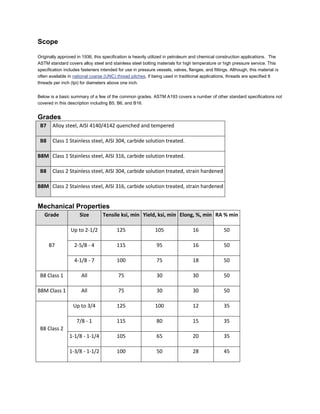
Scope Originally approved in 1936, this specification is heavily utilized in petroleum and chemical construction applications. The ASTM standard covers alloy steel and stainless steel bolting materials for high temperature or high pressure service. This specification includes fasteners intended for use in pressure vessels, valves, flanges, and fittings. Although, this material is often available in national coarse (UNC) thread pitches, if being used in traditional applications, threads are specified 8 threads per inch (tpi) for diameters above one inch. Below is a basic summary of a few of the common grades. ASTM A193 covers a number of other standard specifications not covered in this description including B5, B6, and B16. Grades B7 
Alloy steel, AISI 4140/4142 quenched and tempered B8 
Class 1 Stainless steel, AISI 304, carbide solution treated. B8M 
Class 1 Stainless steel, AISI 316, carbide solution treated. B8 
Class 2 Stainless steel, AISI 304, carbide solution treated, strain hardened B8M 
Class 2 Stainless steel, AISI 316, carbide solution treated, strain hardened Mechanical Properties Grade Size Tensile ksi, min Yield, ksi, min Elong, %, min RA % min 
B7 
Up to 2-1/2 
125 
105 
16 
50 
2-5/8 - 4 
115 
95 
16 
50 
4-1/8 - 7 
100 
75 
18 
50 
B8 Class 1 
All 
75 
30 
30 
50 
B8M Class 1 
All 
75 
30 
30 
50 
B8 Class 2 
Up to 3/4 
125 
100 
12 
35 
7/8 - 1 
115 
80 
15 
35 
1-1/8 - 1-1/4 
105 
65 
20 
35 
1-3/8 - 1-1/2 
100 
50 
28 
45
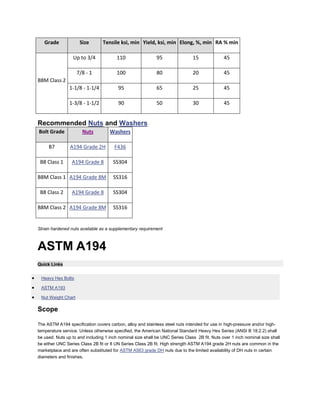
Grade Size Tensile ksi, min Yield, ksi, min Elong, %, min RA % min 
B8M Class 2 
Up to 3/4 
110 
95 
15 
45 
7/8 - 1 
100 
80 
20 
45 
1-1/8 - 1-1/4 
95 
65 
25 
45 
1-3/8 - 1-1/2 
90 
50 
30 
45 Recommended Nuts and Washers Bolt Grade Nuts Washers 
B7 
A194 Grade 2H 
F436 
B8 Class 1 
A194 Grade 8 
SS304 
B8M Class 1 
A194 Grade 8M 
SS316 
B8 Class 2 
A194 Grade 8 
SS304 
B8M Class 2 
A194 Grade 8M 
SS316 Strain hardened nuts available as a supplementary requirement ASTM A194 Quick Links  Heavy Hex Bolts  ASTM A193  Nut Weight Chart Scope The ASTM A194 specification covers carbon, alloy and stainless steel nuts intended for use in high-pressure and/or high- temperature service. Unless otherwise specified, the American National Standard Heavy Hex Series (ANSI B 18.2.2) shall be used. Nuts up to and including 1 inch nominal size shall be UNC Series Class 2B fit. Nuts over 1 inch nominal size shall be either UNC Series Class 2B fit or 8 UN Series Class 2B fit. High strength ASTM A194 grade 2H nuts are common in the marketplace and are often substituted for ASTM A563 grade DH nuts due to the limited availability of DH nuts in certain diameters and finishes.
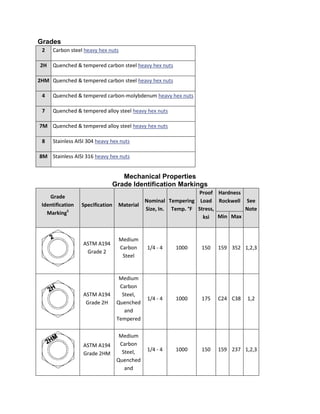
Grades 2 
Carbon steel heavy hex nuts 2H 
Quenched & tempered carbon steel heavy hex nuts 2HM 
Quenched & tempered carbon steel heavy hex nuts 4 
Quenched & tempered carbon-molybdenum heavy hex nuts 7 
Quenched & tempered alloy steel heavy hex nuts 7M 
Quenched & tempered alloy steel heavy hex nuts 8 
Stainless AISI 304 heavy hex nuts 8M 
Stainless AISI 316 heavy hex nuts Mechanical Properties Grade Identification Markings Grade Identification Marking5 Specification Material Nominal Size, In. Tempering Temp. °F Proof Load Stress, ksi Hardness Rockwell See Note Min Max 
ASTM A194 Grade 2 
Medium Carbon Steel 
1/4 - 4 
1000 
150 
159 
352 
1,2,3 
ASTM A194 Grade 2H 
Medium Carbon Steel, Quenched and Tempered 
1/4 - 4 
1000 
175 
C24 
C38 
1,2 
ASTM A194 Grade 2HM 
Medium Carbon Steel, Quenched and 
1/4 - 4 
1000 
150 
159 
237 
1,2,3
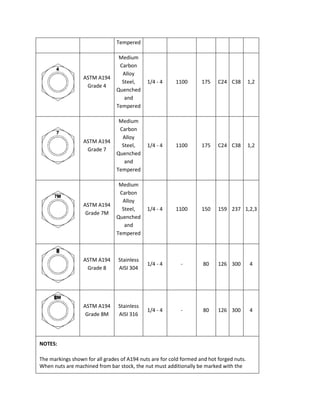
Tempered 
ASTM A194 Grade 4 
Medium Carbon Alloy Steel, Quenched and Tempered 
1/4 - 4 
1100 
175 
C24 
C38 
1,2 
ASTM A194 Grade 7 
Medium Carbon Alloy Steel, Quenched and Tempered 
1/4 - 4 
1100 
175 
C24 
C38 
1,2 
ASTM A194 Grade 7M 
Medium Carbon Alloy Steel, Quenched and Tempered 
1/4 - 4 
1100 
150 
159 
237 
1,2,3 
ASTM A194 Grade 8 
Stainless AISI 304 
1/4 - 4 
- 
80 
126 
300 
4 
ASTM A194 Grade 8M 
Stainless AISI 316 
1/4 - 4 
- 
80 
126 
300 
4 
NOTES: 
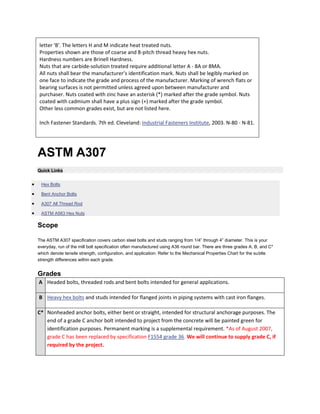
1. The markings shown for all grades of A194 nuts are for cold formed and hot forged nuts. When nuts are machined from bar stock, the nut must additionally be marked with the
letter 'B'. The letters H and M indicate heat treated nuts. 
2. Properties shown are those of coarse and 8-pitch thread heavy hex nuts. 
3. Hardness numbers are Brinell Hardness. 
4. Nuts that are carbide-solution treated require additional letter A - 8A or 8MA. 
5. All nuts shall bear the manufacturer’s identification mark. Nuts shall be legibly marked on one face to indicate the grade and process of the manufacturer. Marking of wrench flats or bearing surfaces is not permitted unless agreed upon between manufacturer and purchaser. Nuts coated with zinc have an asterisk (*) marked after the grade symbol. Nuts coated with cadmium shall have a plus sign (+) marked after the grade symbol. 
6. Other less common grades exist, but are not listed here. 
Inch Fastener Standards. 7th ed. Cleveland: Industrial Fasteners Institute, 2003. N-80 - N-81. ASTM A307 Quick Links  Hex Bolts  Bent Anchor Bolts  A307 All Thread Rod  ASTM A563 Hex Nuts Scope The ASTM A307 specification covers carbon steel bolts and studs ranging from 1/4” through 4” diameter. This is your everyday, run of the mill bolt specification often manufactured using A36 round bar. There are three grades A, B, and C* which denote tensile strength, configuration, and application. Refer to the Mechanical Properties Chart for the subtle strength differences within each grade. Grades A 
Headed bolts, threaded rods and bent bolts intended for general applications. B 
Heavy hex bolts and studs intended for flanged joints in piping systems with cast iron flanges. C* 
Nonheaded anchor bolts, either bent or straight, intended for structural anchorage purposes. The end of a grade C anchor bolt intended to project from the concrete will be painted green for identification purposes. Permanent marking is a supplemental requirement. *As of August 2007, grade C has been replaced by specification F1554 grade 36. We will continue to supply grade C, if required by the project.
Mechanical Properties Grade Tensile, ksi Yield, min, ksi Elong %, min 
A 
60 min 
-- 
18 
B 
60 - 100 
-- 
18 
C* 
58 - 80 
36 
23 Recommended Nuts and Washers Nuts Washers A307 Grades A & C* A307 Grade B 1/4 - 1-1/2 1-5/8 - 4 1/4 - 4 
A563A Hex 
A563A Heavy Hex 
A563A Heavy Hex 
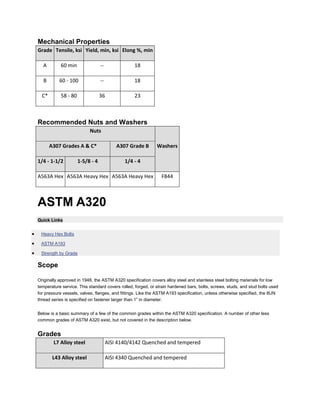
F844 ASTM A320 Quick Links  Heavy Hex Bolts  ASTM A193  Strength by Grade Scope Originally approved in 1948, the ASTM A320 specification covers alloy steel and stainless steel bolting materials for low temperature service. This standard covers rolled, forged, or strain hardened bars, bolts, screws, studs, and stud bolts used for pressure vessels, valves, flanges, and fittings. Like the ASTM A193 specification, unless otherwise specified, the 8UN thread series is specified on fastener larger than 1” in diameter. Below is a basic summary of a few of the common grades within the ASTM A320 specification. A number of other less common grades of ASTM A320 exist, but not covered in the description below. Grades L7 Alloy steel 
AISI 4140/4142 Quenched and tempered L43 Alloy steel 
AISI 4340 Quenched and tempered
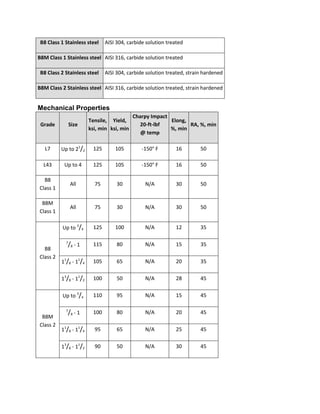
B8 Class 1 Stainless steel 
AISI 304, carbide solution treated B8M Class 1 Stainless steel 
AISI 316, carbide solution treated B8 Class 2 Stainless steel 
AISI 304, carbide solution treated, strain hardened B8M Class 2 Stainless steel 
AISI 316, carbide solution treated, strain hardened Mechanical Properties Grade Size Tensile, ksi, min Yield, ksi, min Charpy Impact 20-ft-lbf @ temp Elong, %, min RA, %, min 
L7 
Up to 21/2 
125 
105 
-150° F 
16 
50 
L43 
Up to 4 
125 
105 
-150° F 
16 
50 
B8 Class 1 
All 
75 
30 
N/A 
30 
50 
B8M Class 1 
All 
75 
30 
N/A 
30 
50 
B8 Class 2 
Up to 3/4 
125 
100 
N/A 
12 
35 
7/8 - 1 
115 
80 
N/A 
15 
35 
11/8 - 11/4 
105 
65 
N/A 
20 
35 
13/8 - 11/2 
100 
50 
N/A 
28 
45 
B8M Class 2 
Up to 3/4 
110 
95 
N/A 
15 
45 
7/8 - 1 
100 
80 
N/A 
20 
45 
11/8 - 11/4 
95 
65 
N/A 
25 
45 
13/8 - 11/2 
90 
50 
N/A 
30 
45
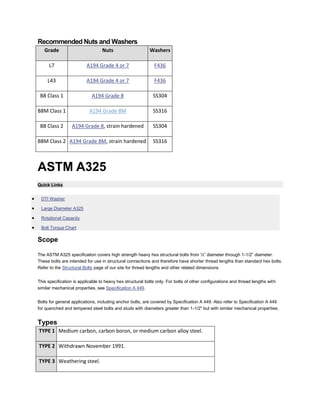
Recommended Nuts and Washers Grade Nuts Washers 
L7 
A194 Grade 4 or 7 
F436 
L43 
A194 Grade 4 or 7 
F436 
B8 Class 1 
A194 Grade 8 
SS304 
B8M Class 1 
A194 Grade 8M 
SS316 
B8 Class 2 
A194 Grade 8, strain hardened 
SS304 
B8M Class 2 
A194 Grade 8M, strain hardened 
SS316 ASTM A325 Quick Links  DTI Washer  Large Diameter A325  Rotational Capacity  Bolt Torque Chart Scope The ASTM A325 specification covers high strength heavy hex structural bolts from ½” diameter through 1-1/2” diameter. These bolts are intended for use in structural connections and therefore have shorter thread lengths than standard hex bolts. Refer to the Structural Bolts page of our site for thread lengths and other related dimensions. This specification is applicable to heavy hex structural bolts only. For bolts of other configurations and thread lengths with similar mechanical properties, see Specification A 449. Bolts for general applications, including anchor bolts, are covered by Specification A 449. Also refer to Specification A 449 for quenched and tempered steel bolts and studs with diameters greater than 1-1/2" but with similar mechanical properties. Types TYPE 1 
Medium carbon, carbon boron, or medium carbon alloy steel. TYPE 2 
Withdrawn November 1991. TYPE 3 
Weathering steel.
T 
Fully threaded A325. (Restricted to 4 times the diameter in length) M 
Metric A325. Connection Types SC 
Slip critical connection. N 
Bearing type connection with threads included in the shear plane. X 
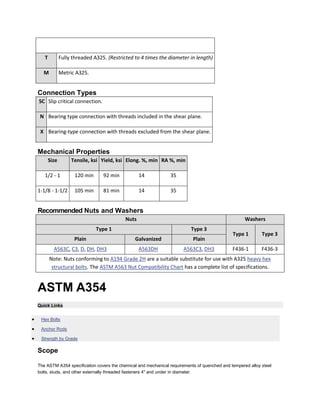
Bearing-type connection with threads excluded from the shear plane. Mechanical Properties Size Tensile, ksi Yield, ksi Elong. %, min RA %, min 
1/2 - 1 
120 min 
92 min 
14 
35 
1-1/8 - 1-1/2 
105 min 
81 min 
14 
35 Recommended Nuts and Washers Nuts Washers Type 1 Type 3 Type 1 Type 3 Plain Galvanized Plain 
A563C, C3, D, DH, DH3 
A563DH 
A563C3, DH3 
F436-1 
F436-3 
Note: Nuts conforming to A194 Grade 2H are a suitable substitute for use with A325 heavy hex structural bolts. The ASTM A563 Nut Compatibility Chart has a complete list of specifications. ASTM A354 Quick Links  Hex Bolts  Anchor Rods  Strength by Grade Scope The ASTM A354 specification covers the chemical and mechanical requirements of quenched and tempered alloy steel bolts, studs, and other externally threaded fasteners 4" and under in diameter.
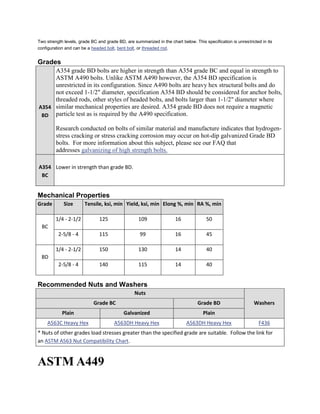
Two strength levels, grade BC and grade BD, are summarized in the chart below. This specification is unrestricted in its configuration and can be a headed bolt, bent bolt, or threaded rod. Grades A354 BD 
A354 grade BD bolts are higher in strength than A354 grade BC and equal in strength to ASTM A490 bolts. Unlike ASTM A490 however, the A354 BD specification is unrestricted in its configuration. Since A490 bolts are heavy hex structural bolts and do not exceed 1-1/2" diameter, specification A354 BD should be considered for anchor bolts, threaded rods, other styles of headed bolts, and bolts larger than 1-1/2" diameter where similar mechanical properties are desired. A354 grade BD does not require a magnetic particle test as is required by the A490 specification. 
Research conducted on bolts of similar material and manufacture indicates that hydrogen- stress cracking or stress cracking corrosion may occur on hot-dip galvanized Grade BD bolts. For more information about this subject, please see our FAQ that addresses galvanizing of high strength bolts. A354 BC 
Lower in strength than grade BD. Mechanical Properties Grade Size Tensile, ksi, min Yield, ksi, min Elong %, min RA %, min 
BC 
1/4 - 2-1/2 
125 
109 
16 
50 
2-5/8 - 4 
115 
99 
16 
45 
BD 
1/4 - 2-1/2 
150 
130 
14 
40 
2-5/8 - 4 
140 
115 
14 
40 Recommended Nuts and Washers Nuts Washers Grade BC Grade BD Plain Galvanized Plain 
A563C Heavy Hex 
A563DH Heavy Hex 
A563DH Heavy Hex 
F436 
* Nuts of other grades load stresses greater than the specified grade are suitable. Follow the link for an ASTM A563 Nut Compatibility Chart. ASTM A449
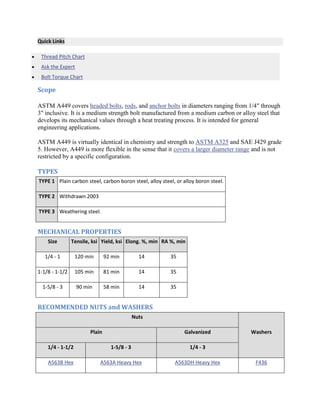
Quick Links  Thread Pitch Chart  Ask the Expert  Bolt Torque Chart Scope ASTM A449 covers headed bolts, rods, and anchor bolts in diameters ranging from 1/4" through 3" inclusive. It is a medium strength bolt manufactured from a medium carbon or alloy steel that develops its mechanical values through a heat treating process. It is intended for general engineering applications. ASTM A449 is virtually identical in chemistry and strength to ASTM A325 and SAE J429 grade 5. However, A449 is more flexible in the sense that it covers a larger diameter range and is not restricted by a specific configuration. TYPES TYPE 1 
Plain carbon steel, carbon boron steel, alloy steel, or alloy boron steel. TYPE 2 
Withdrawn 2003 TYPE 3 
Weathering steel. MECHANICAL PROPERTIES Size Tensile, ksi Yield, ksi Elong. %, min RA %, min 
1/4 - 1 
120 min 
92 min 
14 
35 
1-1/8 - 1-1/2 
105 min 
81 min 
14 
35 
1-5/8 - 3 
90 min 
58 min 
14 
35 RECOMMENDED NUTS and WASHERS Nuts Washers Plain Galvanized 1/4 - 1-1/2 1-5/8 - 3 1/4 - 3 
A563B Hex 
A563A Heavy Hex 
A563DH Heavy Hex 
F436
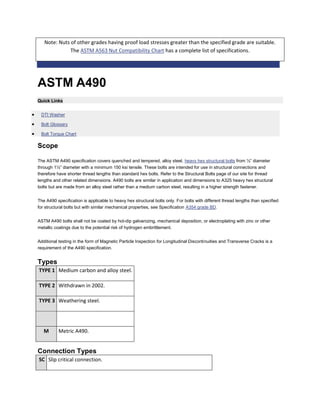
Note: Nuts of other grades having proof load stresses greater than the specified grade are suitable. The ASTM A563 Nut Compatibility Chart has a complete list of specifications. ASTM A490 Quick Links  DTI Washer  Bolt Glossary  Bolt Torque Chart Scope The ASTM A490 specification covers quenched and tempered, alloy steel, heavy hex structural bolts from ½” diameter through 1½” diameter with a minimum 150 ksi tensile. These bolts are intended for use in structural connections and therefore have shorter thread lengths than standard hex bolts. Refer to the Structural Bolts page of our site for thread lengths and other related dimensions. A490 bolts are similar in application and dimensions to A325 heavy hex structural bolts but are made from an alloy steel rather than a medium carbon steel, resulting in a higher strength fastener. The A490 specification is applicable to heavy hex structural bolts only. For bolts with different thread lengths than specified for structural bolts but with similar mechanical properties, see Specification A354 grade BD. ASTM A490 bolts shall not be coated by hot-dip galvanizing, mechanical deposition, or electroplating with zinc or other metallic coatings due to the potential risk of hydrogen embrittlement. Additional testing in the form of Magnetic Particle Inspection for Longitudinal Discontinuities and Transverse Cracks is a requirement of the A490 specification. Types TYPE 1 
Medium carbon and alloy steel. TYPE 2 
Withdrawn in 2002. TYPE 3 
Weathering steel. 
M 
Metric A490. Connection Types SC 
Slip critical connection.
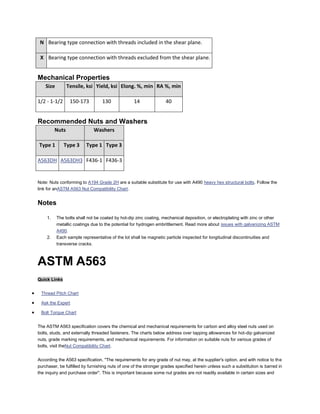
N 
Bearing type connection with threads included in the shear plane. X 
Bearing type connection with threads excluded from the shear plane. Mechanical Properties Size Tensile, ksi Yield, ksi Elong. %, min RA %, min 
1/2 - 1-1/2 
150-173 
130 
14 
40 Recommended Nuts and Washers Nuts Washers Type 1 Type 3 Type 1 Type 3 
A563DH 
A563DH3 
F436-1 
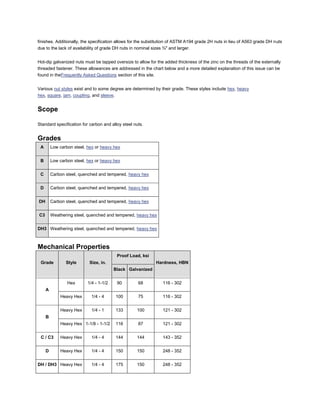
F436-3 Note: Nuts conforming to A194 Grade 2H are a suitable substitute for use with A490 heavy hex structural bolts. Follow the link for anASTM A563 Nut Compatibility Chart. Notes 1. The bolts shall not be coated by hot-dip zinc coating, mechanical deposition, or electroplating with zinc or other metallic coatings due to the potential for hydrogen embrittlement. Read more about issues with galvanizing ASTM A490. 2. Each sample representative of the lot shall be magnetic particle inspected for longitudinal discontinuities and transverse cracks. ASTM A563 Quick Links  Thread Pitch Chart  Ask the Expert  Bolt Torque Chart The ASTM A563 specification covers the chemical and mechanical requirements for carbon and alloy steel nuts used on bolts, studs, and externally threaded fasteners. The charts below address over tapping allowances for hot-dip galvanized nuts, grade marking requirements, and mechanical requirements. For information on suitable nuts for various grades of bolts, visit theNut Compatibility Chart. According the A563 specification, "The requirements for any grade of nut may, at the supplier's option, and with notice to the purchaser, be fulfilled by furnishing nuts of one of the stronger grades specified herein unless such a substitution is barred in the inquiry and purchase order". This is important because some nut grades are not readily available in certain sizes and
finishes. Additionally, the specification allows for the substitution of ASTM A194 grade 2H nuts in lieu of A563 grade DH nuts due to the lack of availability of grade DH nuts in nominal sizes ¾" and larger. Hot-dip galvanized nuts must be tapped oversize to allow for the added thickness of the zinc on the threads of the externally threaded fastener. These allowances are addressed in the chart below and a more detailed explanation of this issue can be found in theFrequently Asked Questions section of this site. Various nut styles exist and to some degree are determined by their grade. These styles include hex, heavy hex, square, jam, coupling, and sleeve. Scope Standard specification for carbon and alloy steel nuts. Grades A Low carbon steel, hex or heavy hex B Low carbon steel, hex or heavy hex C Carbon steel, quenched and tempered, heavy hex D Carbon steel, quenched and tempered, heavy hex DH Carbon steel, quenched and tempered, heavy hex C3 Weathering steel, quenched and tempered, heavy hex DH3 Weathering steel, quenched and tempered, heavy hex Mechanical Properties Grade Style Size, in. Proof Load, ksi Hardness, HBN Black Galvanized A Hex 1/4 - 1-1/2 90 68 116 - 302 Heavy Hex 1/4 - 4 100 75 116 - 302 B Heavy Hex 1/4 - 1 133 100 121 - 302 Heavy Hex 1-1/8 - 1-1/2 116 87 121 - 302 C / C3 Heavy Hex 1/4 - 4 144 144 143 - 352 D Heavy Hex 1/4 - 4 150 150 248 - 352 DH / DH3 Heavy Hex 1/4 - 4 175 150 248 - 352
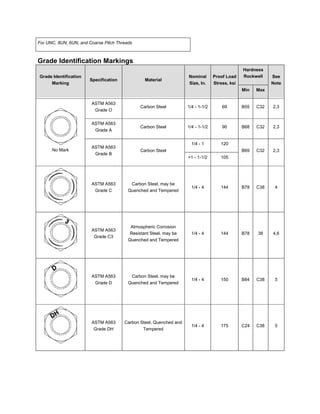
For UNC, 8UN, 6UN, and Coarse Pitch Threads Grade Identification Markings Grade Identification Marking Specification Material Nominal Size, In. Proof Load Stress, ksi Hardness Rockwell See Note Min Max No Mark ASTM A563 Grade O Carbon Steel 1/4 - 1-1/2 69 B55 C32 2,3 ASTM A563 Grade A Carbon Steel 1/4 - 1-1/2 90 B68 C32 2,3 ASTM A563 Grade B Carbon Steel 1/4 - 1 120 B69 C32 2,3 >1 - 1-1/2 105 ASTM A563 Grade C Carbon Steel, may be Quenched and Tempered 1/4 - 4 144 B78 C38 4 ASTM A563 Grade C3 Atmospheric Corrosion Resistant Steel, may be Quenched and Tempered 1/4 - 4 144 B78 38 4,6 ASTM A563 Grade D Carbon Steel, may be Quenched and Tempered 1/4 - 4 150 B84 C38 5 ASTM A563 Grade DH Carbon Steel, Quenched and Tempered 1/4 - 4 175 C24 C38 5
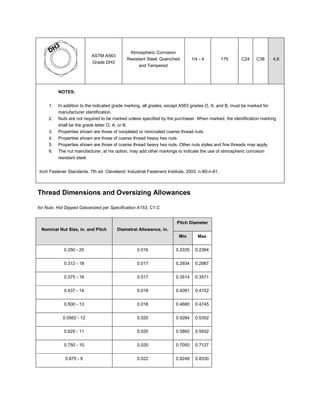
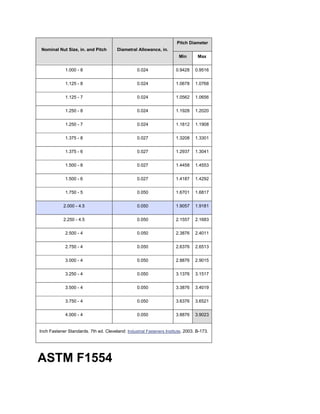
ASTM A563 Grade DH3 Atmospheric Corrosion Resistant Steel, Quenched and Tempered 1/4 - 4 175 C24 C38 4,6 NOTES: 1. In addition to the indicated grade marking, all grades, except A563 grades O, A, and B, must be marked for manufacturer identification. 2. Nuts are not required to be marked unless specified by the purchaser. When marked, the identification marking shall be the grade letter O, A, or B. 3. Properties shown are those of nonplated or noncoated coarse thread nuts. 4. Properties shown are those of coarse thread heavy hex nuts. 5. Properties shown are those of coarse thread heavy hex nuts. Other nuts styles and fine threads may apply. 6. The nut manufacturer, at his option, may add other markings to indicate the use of atmospheric corrosion resistant steel. Inch Fastener Standards. 7th ed. Cleveland: Industrial Fasteners Institute, 2003. n-80-n-81. Thread Dimensions and Oversizing Allowances for Nuts: Hot Dipped Galvanized per Specification A153, C1.C Nominal Nut Size, in. and Pitch Diametral Allowance, in. Pitch Diameter Min Max 0.250 - 20 0.016 0.2335 0.2384 0.312 - 18 0.017 0.2934 0.2987 0.375 - 16 0.017 0.3514 0.3571 0.437 - 14 0.018 0.4091 0.4152 0.500 - 13 0.018 0.4680 0.4745 0.0562 - 12 0.020 0.5284 0.5352 0.625 - 11 0.020 0.5860 0.5932 0.750 - 10 0.020 0.7050 0.7127 0.875 - 9 0.022 0.8248 0.8330
Nominal Nut Size, in. and Pitch Diametral Allowance, in. Pitch Diameter Min Max 1.000 - 8 0.024 0.9428 0.9516 1.125 - 8 0.024 1.0678 1.0768 1.125 - 7 0.024 1.0562 1.0656 1.250 - 8 0.024 1.1928 1.2020 1.250 - 7 0.024 1.1812 1.1908 1.375 - 8 0.027 1.3208 1.3301 1.375 - 6 0.027 1.2937 1.3041 1.500 - 8 0.027 1.4458 1.4553 1.500 - 6 0.027 1.4187 1.4292 1.750 - 5 0.050 1.6701 1.6817 2.000 - 4.5 0.050 1.9057 1.9181 2.250 - 4.5 0.050 2.1557 2.1683 2.500 - 4 0.050 2.3876 2.4011 2.750 - 4 0.050 2.6376 2.6513 3.000 - 4 0.050 2.8876 2.9015 3.250 - 4 0.050 3.1376 3.1517 3.500 - 4 0.050 3.3876 3.4019 3.750 - 4 0.050 3.6376 3.6521 4.000 - 4 0.050 3.8876 3.9023 Inch Fastener Standards. 7th ed. Cleveland: Industrial Fasteners Institute, 2003. B-173. ASTM F1554
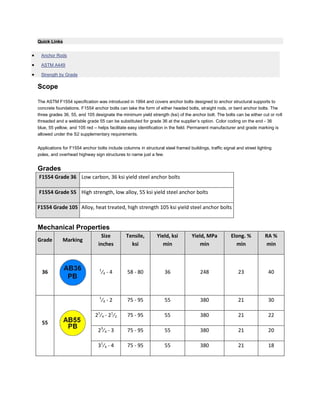
Quick Links  Anchor Rods  ASTM A449  Strength by Grade Scope The ASTM F1554 specification was introduced in 1994 and covers anchor bolts designed to anchor structural supports to concrete foundations. F1554 anchor bolts can take the form of either headed bolts, straight rods, or bent anchor bolts. The three grades 36, 55, and 105 designate the minimum yield strength (ksi) of the anchor bolt. The bolts can be either cut or roll threaded and a weldable grade 55 can be substituted for grade 36 at the supplier’s option. Color coding on the end - 36 blue, 55 yellow, and 105 red – helps facilitate easy identification in the field. Permanent manufacturer and grade marking is allowed under the S2 supplementary requirements. Applications for F1554 anchor bolts include columns in structural steel framed buildings, traffic signal and street lighting poles, and overhead highway sign structures to name just a few. Grades F1554 Grade 36 
Low carbon, 36 ksi yield steel anchor bolts F1554 Grade 55 
High strength, low alloy, 55 ksi yield steel anchor bolts F1554 Grade 105 
Alloy, heat treated, high strength 105 ksi yield steel anchor bolts Mechanical Properties Grade Marking Size inches Tensile, ksi Yield, ksi min Yield, MPa min Elong. % min RA % min 
36 
1⁄4 - 4 
58 - 80 
36 
248 
23 
40 
55 
1⁄4 - 2 
75 - 95 
55 
380 
21 
30 
21⁄4 - 21⁄2 
75 - 95 
55 
380 
21 
22 
23⁄4 - 3 
75 - 95 
55 
380 
21 
20 
31⁄4 - 4 
75 - 95 
55 
380 
21 
18
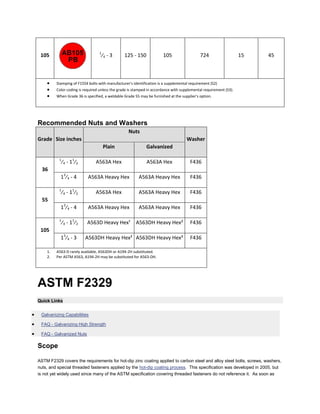
105 
1⁄4 - 3 
125 - 150 
105 
724 
15 
45 
 Stamping of F1554 bolts with manufacturer's identification is a supplemental requirement (S2) 
 Color coding is required unless the grade is stamped in accordance with supplemental requirement (S3). 
 When Grade 36 is specified, a weldable Grade 55 may be furnished at the supplier's option. Recommended Nuts and Washers Grade Size inches Nuts Washer Plain Galvanized 
36 
1⁄4 - 11⁄2 
A563A Hex 
A563A Hex 
F436 
13⁄4 - 4 
A563A Heavy Hex 
A563A Heavy Hex 
F436 
55 
1⁄4 - 11⁄2 
A563A Hex 
A563A Heavy Hex 
F436 
13⁄4 - 4 
A563A Heavy Hex 
A563A Heavy Hex 
F436 
105 
1⁄4 - 11⁄2 
A563D Heavy Hex¹ 
A563DH Heavy Hex² 
F436 
13⁄4 - 3 
A563DH Heavy Hex² 
A563DH Heavy Hex² 
F436 
1. A563-D rarely available, A563DH or A194-2H substituted. 
2. Per ASTM A563, A194-2H may be substituted for A563-DH. ASTM F2329 Quick Links  Galvanizing Capabilities  FAQ - Galvanizing High Strength  FAQ - Galvanized Nuts Scope ASTM F2329 covers the requirements for hot-dip zinc coating applied to carbon steel and alloy steel bolts, screws, washers, nuts, and special threaded fasteners applied by the hot-dip coating process. This specification was developed in 2005, but is not yet widely used since many of the ASTM specification covering threaded fasteners do not reference it. As soon as
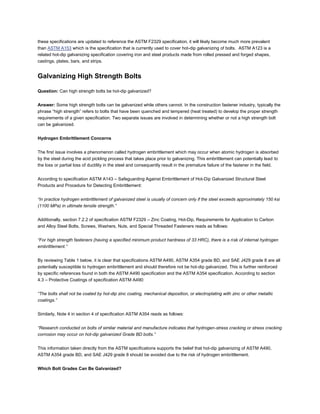
these specifications are updated to reference the ASTM F2329 specification, it will likely become much more prevalent than ASTM A153 which is the specification that is currently used to cover hot-dip galvanizing of bolts. ASTM A123 is a related hot-dip galvanizing specification covering iron and steel products made from rolled pressed and forged shapes, castings, plates, bars, and strips. Galvanizing High Strength Bolts Question: Can high strength bolts be hot-dip galvanized? Answer: Some high strength bolts can be galvanized while others cannot. In the construction fastener industry, typically the phrase “high strength” refers to bolts that have been quenched and tempered (heat treated) to develop the proper strength requirements of a given specification. Two separate issues are involved in determining whether or not a high strength bolt can be galvanized. Hydrogen Embrittlement Concerns The first issue involves a phenomenon called hydrogen embrittlement which may occur when atomic hydrogen is absorbed by the steel during the acid pickling process that takes place prior to galvanizing. This embrittlement can potentially lead to the loss or partial loss of ductility in the steel and consequently result in the premature failure of the fastener in the field. According to specification ASTM A143 – Safeguarding Against Embrittlement of Hot-Dip Galvanized Structural Steel Products and Procedure for Detecting Embrittlement: “In practice hydrogen embrittlement of galvanized steel is usually of concern only if the steel exceeds approximately 150 ksi (1100 MPa) in ultimate tensile strength.” Additionally, section 7.2.2 of specification ASTM F2329 – Zinc Coating, Hot-Dip, Requirements for Application to Carbon and Alloy Steel Bolts, Screws, Washers, Nuts, and Special Threaded Fasteners reads as follows: “For high strength fasteners (having a specified minimum product hardness of 33 HRC), there is a risk of internal hydrogen embrittlement.” By reviewing Table 1 below, it is clear that specifications ASTM A490, ASTM A354 grade BD, and SAE J429 grade 8 are all potentially susceptible to hydrogen embrittlement and should therefore not be hot-dip galvanized. This is further reinforced by specific references found in both the ASTM A490 specification and the ASTM A354 specification. According to section 4.3 – Protective Coatings of specification ASTM A490: “The bolts shall not be coated by hot-dip zinc coating, mechanical deposition, or electroplating with zinc or other metallic coatings.” Similarly, Note 4 in section 4 of specification ASTM A354 reads as follows: “Research conducted on bolts of similar material and manufacture indicates that hydrogen-stress cracking or stress cracking corrosion may occur on hot-dip galvanized Grade BD bolts.” This information taken directly from the ASTM specifications supports the belief that hot-dip galvanizing of ASTM A490, ASTM A354 grade BD, and SAE J429 grade 8 should be avoided due to the risk of hydrogen embrittlement. Which Bolt Grades Can Be Galvanized?
Grade Can I Galvanize? Raw material Nominal Size Minimum Yield Strength Minimum Tensile Strength Minimum Hardness 
ASTM A325 
Yes 
Medium Carbon Steel, Quenched and Tempered 
1/2″ – 1″ 1 1/8″ – 1 1/2″ 
92 81 
120 105 
C24 C19 
ASTM A449 
Yes 
1/4″ – 1″ 1 1/8″ – 1 1/2″ 1 5/8″ – 3″ 
92 81 58 
120 105 90 
C25 C19 B91 
SAE J429 Grade 5 
Yes 
1/4″ – 1″ 1 1/8″ – 1 1/2″ 
92 81 
120 105 
C25 C19 
ASTM A193 Grade B7 
Yes 
Medium Carbon Alloy Steel, Quenched and Tempered 
1/4″ – 2 1/2″ 2 5/8″ – 4″ 
105 95 
125 115 
NA 
ASTM A354 Grade BC 
Yes 
1/4″ – 2 1/2″ 2 5/8″ – 4″ 
109 94 
125 115 
C26 C22 
ASTM F1554 Grade 105 
Yes 
1/4″ – 3″ 
105 
125 
NA 
ASTM A320 Grade L7 
Yes 
1/4″ – 2 1/2″ 
105 
125 
NA 
ASTM A490 
No 
1/2″ – 1 1/2″ 
130 
150 
C33 
ASTM A354 Grade BD 
No 
1/4″ – 2 1/2″ 2 5/8″ – 4″ 
130 115 
150 140 
C33 C31 
SAE J429 Grade 8 
No 
1/4″ – 1 1/2″ 
130 
150 
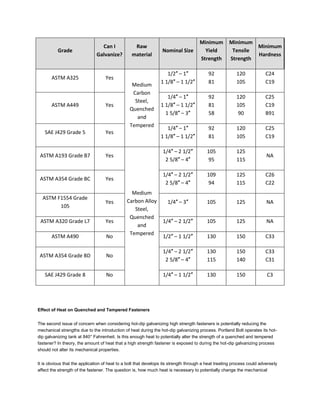
C3 Effect of Heat on Quenched and Tempered Fasteners The second issue of concern when considering hot-dip galvanizing high strength fasteners is potentially reducing the mechanical strengths due to the introduction of heat during the hot-dip galvanizing process. Portland Bolt operates its hot- dip galvanizing tank at 840° Fahrenheit. Is this enough heat to potentially alter the strength of a quenched and tempered fastener? In theory, the amount of heat that a high strength fastener is exposed to during the hot-dip galvanizing process should not alter its mechanical properties. It is obvious that the application of heat to a bolt that develops its strength through a heat treating process could adversely affect the strength of the fastener. The question is, how much heat is necessary to potentially change the mechanical
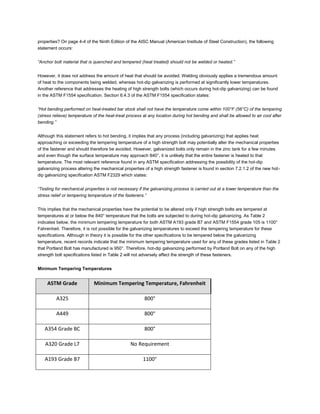
properties? On page 4-4 of the Ninth Edition of the AISC Manual (American Institute of Steel Construction), the following statement occurs: “Anchor bolt material that is quenched and tempered (heat treated) should not be welded or heated.” However, it does not address the amount of heat that should be avoided. Welding obviously applies a tremendous amount of heat to the components being welded, whereas hot-dip galvanizing is performed at significantly lower temperatures. Another reference that addresses the heating of high strength bolts (which occurs during hot-dip galvanizing) can be found in the ASTM F1554 specification. Section 6.4.3 of the ASTM F1554 specification states: “Hot bending performed on heat-treated bar stock shall not have the temperature come within 100°F (56°C) of the tempering (stress relieve) temperature of the heat-treat process at any location during hot bending and shall be allowed to air cool after bending.” Although this statement refers to hot bending, it implies that any process (including galvanizing) that applies heat approaching or exceeding the tempering temperature of a high strength bolt may potentially alter the mechanical properties of the fastener and should therefore be avoided. However, galvanized bolts only remain in the zinc tank for a few minutes and even though the surface temperature may approach 840°, it is unlikely that the entire fastener is heated to that temperature. The most relevant reference found in any ASTM specification addressing the possibility of the hot-dip galvanizing process altering the mechanical properties of a high strength fastener is found in section 7.2.1.2 of the new hot- dip galvanizing specification ASTM F2329 which states: “Testing for mechanical properties is not necessary if the galvanizing process is carried out at a lower temperature than the stress relief or tempering temperature of the fasteners.” This implies that the mechanical properties have the potential to be altered only if high strength bolts are tempered at temperatures at or below the 840° temperature that the bolts are subjected to during hot-dip galvanizing. As Table 2 indicates below, the minimum tempering temperature for both ASTM A193 grade B7 and ASTM F1554 grade 105 is 1100° Fahrenheit. Therefore, it is not possible for the galvanizing temperatures to exceed the tempering temperature for these specifications. Although in theory it is possible for the other specifications to be tempered below the galvanizing temperature, recent records indicate that the minimum tempering temperature used for any of these grades listed in Table 2 that Portland Bolt has manufactured is 950°. Therefore, hot-dip galvanizing performed by Portland Bolt on any of the high strength bolt specifications listed in Table 2 will not adversely affect the strength of these fasteners. Minimum Tempering Temperatures ASTM Grade Minimum Tempering Temperature, Fahrenheit 
A325 
800° 
A449 
800° 
A354 Grade BC 
800° 
A320 Grade L7 
No Requirement 
A193 Grade B7 
1100°
F1554 Grade 105 
1100°

Astm bolt-nuts

  • 1.
    ASTM Bolt SpecificationsThe American Society for Testing and Materials, is an international standards organization that develops and publishes voluntary consensus technical standards for a wide range of materials, products, systems, and services.  A153 - Hot dip galvanizing specification.  A193 - Alloy steel and stainless steel bolting materials for high temperature service.  A194 - Carbon and alloy nuts for bolts for high pressure and high temperature service.  A307 - Carbon steel bolts and studs ranging from 1/4" through 4" diameter.  A320 - Alloy steel and stainless steel bolting materials for low temperature service.  A325 - Structural bolts, steel, heat treated, 120/105 ksi minimum tensile strength.  A354 - Quenched and tempered alloy bolts, studs, and other externally threaded fasteners.  A449 - Quenched and tempered steel bolts and studs.  A490 - Structural bolts, alloy steel, heat treated, 150 ksi tensile strength.  A563 - Standard specification for carbon and alloy steel nuts.  F1554 - Anchor bolts designed to anchor structural supports to concrete foundations.  F2329 - New specification covering hot dip galvanizing. ASTM A153 Quick Links  Galvanizing  FAQ: Galvanizing High Strength Bolts  FAQ: Galvanized Nuts Tapped Oversize Scope The ASTM A153 specification covers zinc coating (hot-dip) on iron and steel hardware. A newer and more appropriate specification developed in 2005 covering the requirement for hot-dip galvanizing of bolts, screws, nuts, washers and other threaded fasteners is ASTM F2329. It is not yet widely used since many of the ASTM specifications covering bolts, nuts and washers do not reference it. As soon as revisions referencing F2329 are made to these fastener specifications, F2329 will become more common. ASTM A123 is a related hot-dip galvanizing specification covering iron and steel products made from rolled pressed and forged shapes, castings, plates, bars, and strips. The equivalent AASHTO specification to ASTM A153 is AASHTO M232. ASTM A193 Quick Links  Hex Bolts  A193 All Thread Rod  ASTM A194  Thread Pitch Chart
  • 2.
    Scope Originally approvedin 1936, this specification is heavily utilized in petroleum and chemical construction applications. The ASTM standard covers alloy steel and stainless steel bolting materials for high temperature or high pressure service. This specification includes fasteners intended for use in pressure vessels, valves, flanges, and fittings. Although, this material is often available in national coarse (UNC) thread pitches, if being used in traditional applications, threads are specified 8 threads per inch (tpi) for diameters above one inch. Below is a basic summary of a few of the common grades. ASTM A193 covers a number of other standard specifications not covered in this description including B5, B6, and B16. Grades B7 Alloy steel, AISI 4140/4142 quenched and tempered B8 Class 1 Stainless steel, AISI 304, carbide solution treated. B8M Class 1 Stainless steel, AISI 316, carbide solution treated. B8 Class 2 Stainless steel, AISI 304, carbide solution treated, strain hardened B8M Class 2 Stainless steel, AISI 316, carbide solution treated, strain hardened Mechanical Properties Grade Size Tensile ksi, min Yield, ksi, min Elong, %, min RA % min B7 Up to 2-1/2 125 105 16 50 2-5/8 - 4 115 95 16 50 4-1/8 - 7 100 75 18 50 B8 Class 1 All 75 30 30 50 B8M Class 1 All 75 30 30 50 B8 Class 2 Up to 3/4 125 100 12 35 7/8 - 1 115 80 15 35 1-1/8 - 1-1/4 105 65 20 35 1-3/8 - 1-1/2 100 50 28 45
  • 3.
    Grade Size Tensileksi, min Yield, ksi, min Elong, %, min RA % min B8M Class 2 Up to 3/4 110 95 15 45 7/8 - 1 100 80 20 45 1-1/8 - 1-1/4 95 65 25 45 1-3/8 - 1-1/2 90 50 30 45 Recommended Nuts and Washers Bolt Grade Nuts Washers B7 A194 Grade 2H F436 B8 Class 1 A194 Grade 8 SS304 B8M Class 1 A194 Grade 8M SS316 B8 Class 2 A194 Grade 8 SS304 B8M Class 2 A194 Grade 8M SS316 Strain hardened nuts available as a supplementary requirement ASTM A194 Quick Links  Heavy Hex Bolts  ASTM A193  Nut Weight Chart Scope The ASTM A194 specification covers carbon, alloy and stainless steel nuts intended for use in high-pressure and/or high- temperature service. Unless otherwise specified, the American National Standard Heavy Hex Series (ANSI B 18.2.2) shall be used. Nuts up to and including 1 inch nominal size shall be UNC Series Class 2B fit. Nuts over 1 inch nominal size shall be either UNC Series Class 2B fit or 8 UN Series Class 2B fit. High strength ASTM A194 grade 2H nuts are common in the marketplace and are often substituted for ASTM A563 grade DH nuts due to the limited availability of DH nuts in certain diameters and finishes.
  • 4.
    Grades 2 Carbonsteel heavy hex nuts 2H Quenched & tempered carbon steel heavy hex nuts 2HM Quenched & tempered carbon steel heavy hex nuts 4 Quenched & tempered carbon-molybdenum heavy hex nuts 7 Quenched & tempered alloy steel heavy hex nuts 7M Quenched & tempered alloy steel heavy hex nuts 8 Stainless AISI 304 heavy hex nuts 8M Stainless AISI 316 heavy hex nuts Mechanical Properties Grade Identification Markings Grade Identification Marking5 Specification Material Nominal Size, In. Tempering Temp. °F Proof Load Stress, ksi Hardness Rockwell See Note Min Max ASTM A194 Grade 2 Medium Carbon Steel 1/4 - 4 1000 150 159 352 1,2,3 ASTM A194 Grade 2H Medium Carbon Steel, Quenched and Tempered 1/4 - 4 1000 175 C24 C38 1,2 ASTM A194 Grade 2HM Medium Carbon Steel, Quenched and 1/4 - 4 1000 150 159 237 1,2,3
  • 5.
    Tempered ASTM A194Grade 4 Medium Carbon Alloy Steel, Quenched and Tempered 1/4 - 4 1100 175 C24 C38 1,2 ASTM A194 Grade 7 Medium Carbon Alloy Steel, Quenched and Tempered 1/4 - 4 1100 175 C24 C38 1,2 ASTM A194 Grade 7M Medium Carbon Alloy Steel, Quenched and Tempered 1/4 - 4 1100 150 159 237 1,2,3 ASTM A194 Grade 8 Stainless AISI 304 1/4 - 4 - 80 126 300 4 ASTM A194 Grade 8M Stainless AISI 316 1/4 - 4 - 80 126 300 4 NOTES: 1. The markings shown for all grades of A194 nuts are for cold formed and hot forged nuts. When nuts are machined from bar stock, the nut must additionally be marked with the
  • 6.
    letter 'B'. Theletters H and M indicate heat treated nuts. 2. Properties shown are those of coarse and 8-pitch thread heavy hex nuts. 3. Hardness numbers are Brinell Hardness. 4. Nuts that are carbide-solution treated require additional letter A - 8A or 8MA. 5. All nuts shall bear the manufacturer’s identification mark. Nuts shall be legibly marked on one face to indicate the grade and process of the manufacturer. Marking of wrench flats or bearing surfaces is not permitted unless agreed upon between manufacturer and purchaser. Nuts coated with zinc have an asterisk (*) marked after the grade symbol. Nuts coated with cadmium shall have a plus sign (+) marked after the grade symbol. 6. Other less common grades exist, but are not listed here. Inch Fastener Standards. 7th ed. Cleveland: Industrial Fasteners Institute, 2003. N-80 - N-81. ASTM A307 Quick Links  Hex Bolts  Bent Anchor Bolts  A307 All Thread Rod  ASTM A563 Hex Nuts Scope The ASTM A307 specification covers carbon steel bolts and studs ranging from 1/4” through 4” diameter. This is your everyday, run of the mill bolt specification often manufactured using A36 round bar. There are three grades A, B, and C* which denote tensile strength, configuration, and application. Refer to the Mechanical Properties Chart for the subtle strength differences within each grade. Grades A Headed bolts, threaded rods and bent bolts intended for general applications. B Heavy hex bolts and studs intended for flanged joints in piping systems with cast iron flanges. C* Nonheaded anchor bolts, either bent or straight, intended for structural anchorage purposes. The end of a grade C anchor bolt intended to project from the concrete will be painted green for identification purposes. Permanent marking is a supplemental requirement. *As of August 2007, grade C has been replaced by specification F1554 grade 36. We will continue to supply grade C, if required by the project.
  • 7.
    Mechanical Properties GradeTensile, ksi Yield, min, ksi Elong %, min A 60 min -- 18 B 60 - 100 -- 18 C* 58 - 80 36 23 Recommended Nuts and Washers Nuts Washers A307 Grades A & C* A307 Grade B 1/4 - 1-1/2 1-5/8 - 4 1/4 - 4 A563A Hex A563A Heavy Hex A563A Heavy Hex F844 ASTM A320 Quick Links  Heavy Hex Bolts  ASTM A193  Strength by Grade Scope Originally approved in 1948, the ASTM A320 specification covers alloy steel and stainless steel bolting materials for low temperature service. This standard covers rolled, forged, or strain hardened bars, bolts, screws, studs, and stud bolts used for pressure vessels, valves, flanges, and fittings. Like the ASTM A193 specification, unless otherwise specified, the 8UN thread series is specified on fastener larger than 1” in diameter. Below is a basic summary of a few of the common grades within the ASTM A320 specification. A number of other less common grades of ASTM A320 exist, but not covered in the description below. Grades L7 Alloy steel AISI 4140/4142 Quenched and tempered L43 Alloy steel AISI 4340 Quenched and tempered
  • 8.
    B8 Class 1Stainless steel AISI 304, carbide solution treated B8M Class 1 Stainless steel AISI 316, carbide solution treated B8 Class 2 Stainless steel AISI 304, carbide solution treated, strain hardened B8M Class 2 Stainless steel AISI 316, carbide solution treated, strain hardened Mechanical Properties Grade Size Tensile, ksi, min Yield, ksi, min Charpy Impact 20-ft-lbf @ temp Elong, %, min RA, %, min L7 Up to 21/2 125 105 -150° F 16 50 L43 Up to 4 125 105 -150° F 16 50 B8 Class 1 All 75 30 N/A 30 50 B8M Class 1 All 75 30 N/A 30 50 B8 Class 2 Up to 3/4 125 100 N/A 12 35 7/8 - 1 115 80 N/A 15 35 11/8 - 11/4 105 65 N/A 20 35 13/8 - 11/2 100 50 N/A 28 45 B8M Class 2 Up to 3/4 110 95 N/A 15 45 7/8 - 1 100 80 N/A 20 45 11/8 - 11/4 95 65 N/A 25 45 13/8 - 11/2 90 50 N/A 30 45
  • 9.
    Recommended Nuts andWashers Grade Nuts Washers L7 A194 Grade 4 or 7 F436 L43 A194 Grade 4 or 7 F436 B8 Class 1 A194 Grade 8 SS304 B8M Class 1 A194 Grade 8M SS316 B8 Class 2 A194 Grade 8, strain hardened SS304 B8M Class 2 A194 Grade 8M, strain hardened SS316 ASTM A325 Quick Links  DTI Washer  Large Diameter A325  Rotational Capacity  Bolt Torque Chart Scope The ASTM A325 specification covers high strength heavy hex structural bolts from ½” diameter through 1-1/2” diameter. These bolts are intended for use in structural connections and therefore have shorter thread lengths than standard hex bolts. Refer to the Structural Bolts page of our site for thread lengths and other related dimensions. This specification is applicable to heavy hex structural bolts only. For bolts of other configurations and thread lengths with similar mechanical properties, see Specification A 449. Bolts for general applications, including anchor bolts, are covered by Specification A 449. Also refer to Specification A 449 for quenched and tempered steel bolts and studs with diameters greater than 1-1/2" but with similar mechanical properties. Types TYPE 1 Medium carbon, carbon boron, or medium carbon alloy steel. TYPE 2 Withdrawn November 1991. TYPE 3 Weathering steel.
  • 10.
    T Fully threadedA325. (Restricted to 4 times the diameter in length) M Metric A325. Connection Types SC Slip critical connection. N Bearing type connection with threads included in the shear plane. X Bearing-type connection with threads excluded from the shear plane. Mechanical Properties Size Tensile, ksi Yield, ksi Elong. %, min RA %, min 1/2 - 1 120 min 92 min 14 35 1-1/8 - 1-1/2 105 min 81 min 14 35 Recommended Nuts and Washers Nuts Washers Type 1 Type 3 Type 1 Type 3 Plain Galvanized Plain A563C, C3, D, DH, DH3 A563DH A563C3, DH3 F436-1 F436-3 Note: Nuts conforming to A194 Grade 2H are a suitable substitute for use with A325 heavy hex structural bolts. The ASTM A563 Nut Compatibility Chart has a complete list of specifications. ASTM A354 Quick Links  Hex Bolts  Anchor Rods  Strength by Grade Scope The ASTM A354 specification covers the chemical and mechanical requirements of quenched and tempered alloy steel bolts, studs, and other externally threaded fasteners 4" and under in diameter.
  • 11.
    Two strength levels,grade BC and grade BD, are summarized in the chart below. This specification is unrestricted in its configuration and can be a headed bolt, bent bolt, or threaded rod. Grades A354 BD A354 grade BD bolts are higher in strength than A354 grade BC and equal in strength to ASTM A490 bolts. Unlike ASTM A490 however, the A354 BD specification is unrestricted in its configuration. Since A490 bolts are heavy hex structural bolts and do not exceed 1-1/2" diameter, specification A354 BD should be considered for anchor bolts, threaded rods, other styles of headed bolts, and bolts larger than 1-1/2" diameter where similar mechanical properties are desired. A354 grade BD does not require a magnetic particle test as is required by the A490 specification. Research conducted on bolts of similar material and manufacture indicates that hydrogen- stress cracking or stress cracking corrosion may occur on hot-dip galvanized Grade BD bolts. For more information about this subject, please see our FAQ that addresses galvanizing of high strength bolts. A354 BC Lower in strength than grade BD. Mechanical Properties Grade Size Tensile, ksi, min Yield, ksi, min Elong %, min RA %, min BC 1/4 - 2-1/2 125 109 16 50 2-5/8 - 4 115 99 16 45 BD 1/4 - 2-1/2 150 130 14 40 2-5/8 - 4 140 115 14 40 Recommended Nuts and Washers Nuts Washers Grade BC Grade BD Plain Galvanized Plain A563C Heavy Hex A563DH Heavy Hex A563DH Heavy Hex F436 * Nuts of other grades load stresses greater than the specified grade are suitable. Follow the link for an ASTM A563 Nut Compatibility Chart. ASTM A449
  • 12.
    Quick Links Thread Pitch Chart  Ask the Expert  Bolt Torque Chart Scope ASTM A449 covers headed bolts, rods, and anchor bolts in diameters ranging from 1/4" through 3" inclusive. It is a medium strength bolt manufactured from a medium carbon or alloy steel that develops its mechanical values through a heat treating process. It is intended for general engineering applications. ASTM A449 is virtually identical in chemistry and strength to ASTM A325 and SAE J429 grade 5. However, A449 is more flexible in the sense that it covers a larger diameter range and is not restricted by a specific configuration. TYPES TYPE 1 Plain carbon steel, carbon boron steel, alloy steel, or alloy boron steel. TYPE 2 Withdrawn 2003 TYPE 3 Weathering steel. MECHANICAL PROPERTIES Size Tensile, ksi Yield, ksi Elong. %, min RA %, min 1/4 - 1 120 min 92 min 14 35 1-1/8 - 1-1/2 105 min 81 min 14 35 1-5/8 - 3 90 min 58 min 14 35 RECOMMENDED NUTS and WASHERS Nuts Washers Plain Galvanized 1/4 - 1-1/2 1-5/8 - 3 1/4 - 3 A563B Hex A563A Heavy Hex A563DH Heavy Hex F436
  • 13.
    Note: Nuts ofother grades having proof load stresses greater than the specified grade are suitable. The ASTM A563 Nut Compatibility Chart has a complete list of specifications. ASTM A490 Quick Links  DTI Washer  Bolt Glossary  Bolt Torque Chart Scope The ASTM A490 specification covers quenched and tempered, alloy steel, heavy hex structural bolts from ½” diameter through 1½” diameter with a minimum 150 ksi tensile. These bolts are intended for use in structural connections and therefore have shorter thread lengths than standard hex bolts. Refer to the Structural Bolts page of our site for thread lengths and other related dimensions. A490 bolts are similar in application and dimensions to A325 heavy hex structural bolts but are made from an alloy steel rather than a medium carbon steel, resulting in a higher strength fastener. The A490 specification is applicable to heavy hex structural bolts only. For bolts with different thread lengths than specified for structural bolts but with similar mechanical properties, see Specification A354 grade BD. ASTM A490 bolts shall not be coated by hot-dip galvanizing, mechanical deposition, or electroplating with zinc or other metallic coatings due to the potential risk of hydrogen embrittlement. Additional testing in the form of Magnetic Particle Inspection for Longitudinal Discontinuities and Transverse Cracks is a requirement of the A490 specification. Types TYPE 1 Medium carbon and alloy steel. TYPE 2 Withdrawn in 2002. TYPE 3 Weathering steel. M Metric A490. Connection Types SC Slip critical connection.
  • 14.
    N Bearing typeconnection with threads included in the shear plane. X Bearing type connection with threads excluded from the shear plane. Mechanical Properties Size Tensile, ksi Yield, ksi Elong. %, min RA %, min 1/2 - 1-1/2 150-173 130 14 40 Recommended Nuts and Washers Nuts Washers Type 1 Type 3 Type 1 Type 3 A563DH A563DH3 F436-1 F436-3 Note: Nuts conforming to A194 Grade 2H are a suitable substitute for use with A490 heavy hex structural bolts. Follow the link for anASTM A563 Nut Compatibility Chart. Notes 1. The bolts shall not be coated by hot-dip zinc coating, mechanical deposition, or electroplating with zinc or other metallic coatings due to the potential for hydrogen embrittlement. Read more about issues with galvanizing ASTM A490. 2. Each sample representative of the lot shall be magnetic particle inspected for longitudinal discontinuities and transverse cracks. ASTM A563 Quick Links  Thread Pitch Chart  Ask the Expert  Bolt Torque Chart The ASTM A563 specification covers the chemical and mechanical requirements for carbon and alloy steel nuts used on bolts, studs, and externally threaded fasteners. The charts below address over tapping allowances for hot-dip galvanized nuts, grade marking requirements, and mechanical requirements. For information on suitable nuts for various grades of bolts, visit theNut Compatibility Chart. According the A563 specification, "The requirements for any grade of nut may, at the supplier's option, and with notice to the purchaser, be fulfilled by furnishing nuts of one of the stronger grades specified herein unless such a substitution is barred in the inquiry and purchase order". This is important because some nut grades are not readily available in certain sizes and
  • 15.
    finishes. Additionally, thespecification allows for the substitution of ASTM A194 grade 2H nuts in lieu of A563 grade DH nuts due to the lack of availability of grade DH nuts in nominal sizes ¾" and larger. Hot-dip galvanized nuts must be tapped oversize to allow for the added thickness of the zinc on the threads of the externally threaded fastener. These allowances are addressed in the chart below and a more detailed explanation of this issue can be found in theFrequently Asked Questions section of this site. Various nut styles exist and to some degree are determined by their grade. These styles include hex, heavy hex, square, jam, coupling, and sleeve. Scope Standard specification for carbon and alloy steel nuts. Grades A Low carbon steel, hex or heavy hex B Low carbon steel, hex or heavy hex C Carbon steel, quenched and tempered, heavy hex D Carbon steel, quenched and tempered, heavy hex DH Carbon steel, quenched and tempered, heavy hex C3 Weathering steel, quenched and tempered, heavy hex DH3 Weathering steel, quenched and tempered, heavy hex Mechanical Properties Grade Style Size, in. Proof Load, ksi Hardness, HBN Black Galvanized A Hex 1/4 - 1-1/2 90 68 116 - 302 Heavy Hex 1/4 - 4 100 75 116 - 302 B Heavy Hex 1/4 - 1 133 100 121 - 302 Heavy Hex 1-1/8 - 1-1/2 116 87 121 - 302 C / C3 Heavy Hex 1/4 - 4 144 144 143 - 352 D Heavy Hex 1/4 - 4 150 150 248 - 352 DH / DH3 Heavy Hex 1/4 - 4 175 150 248 - 352
  • 16.
    For UNC, 8UN,6UN, and Coarse Pitch Threads Grade Identification Markings Grade Identification Marking Specification Material Nominal Size, In. Proof Load Stress, ksi Hardness Rockwell See Note Min Max No Mark ASTM A563 Grade O Carbon Steel 1/4 - 1-1/2 69 B55 C32 2,3 ASTM A563 Grade A Carbon Steel 1/4 - 1-1/2 90 B68 C32 2,3 ASTM A563 Grade B Carbon Steel 1/4 - 1 120 B69 C32 2,3 >1 - 1-1/2 105 ASTM A563 Grade C Carbon Steel, may be Quenched and Tempered 1/4 - 4 144 B78 C38 4 ASTM A563 Grade C3 Atmospheric Corrosion Resistant Steel, may be Quenched and Tempered 1/4 - 4 144 B78 38 4,6 ASTM A563 Grade D Carbon Steel, may be Quenched and Tempered 1/4 - 4 150 B84 C38 5 ASTM A563 Grade DH Carbon Steel, Quenched and Tempered 1/4 - 4 175 C24 C38 5
  • 17.
    ASTM A563 GradeDH3 Atmospheric Corrosion Resistant Steel, Quenched and Tempered 1/4 - 4 175 C24 C38 4,6 NOTES: 1. In addition to the indicated grade marking, all grades, except A563 grades O, A, and B, must be marked for manufacturer identification. 2. Nuts are not required to be marked unless specified by the purchaser. When marked, the identification marking shall be the grade letter O, A, or B. 3. Properties shown are those of nonplated or noncoated coarse thread nuts. 4. Properties shown are those of coarse thread heavy hex nuts. 5. Properties shown are those of coarse thread heavy hex nuts. Other nuts styles and fine threads may apply. 6. The nut manufacturer, at his option, may add other markings to indicate the use of atmospheric corrosion resistant steel. Inch Fastener Standards. 7th ed. Cleveland: Industrial Fasteners Institute, 2003. n-80-n-81. Thread Dimensions and Oversizing Allowances for Nuts: Hot Dipped Galvanized per Specification A153, C1.C Nominal Nut Size, in. and Pitch Diametral Allowance, in. Pitch Diameter Min Max 0.250 - 20 0.016 0.2335 0.2384 0.312 - 18 0.017 0.2934 0.2987 0.375 - 16 0.017 0.3514 0.3571 0.437 - 14 0.018 0.4091 0.4152 0.500 - 13 0.018 0.4680 0.4745 0.0562 - 12 0.020 0.5284 0.5352 0.625 - 11 0.020 0.5860 0.5932 0.750 - 10 0.020 0.7050 0.7127 0.875 - 9 0.022 0.8248 0.8330
  • 18.
    Nominal Nut Size,in. and Pitch Diametral Allowance, in. Pitch Diameter Min Max 1.000 - 8 0.024 0.9428 0.9516 1.125 - 8 0.024 1.0678 1.0768 1.125 - 7 0.024 1.0562 1.0656 1.250 - 8 0.024 1.1928 1.2020 1.250 - 7 0.024 1.1812 1.1908 1.375 - 8 0.027 1.3208 1.3301 1.375 - 6 0.027 1.2937 1.3041 1.500 - 8 0.027 1.4458 1.4553 1.500 - 6 0.027 1.4187 1.4292 1.750 - 5 0.050 1.6701 1.6817 2.000 - 4.5 0.050 1.9057 1.9181 2.250 - 4.5 0.050 2.1557 2.1683 2.500 - 4 0.050 2.3876 2.4011 2.750 - 4 0.050 2.6376 2.6513 3.000 - 4 0.050 2.8876 2.9015 3.250 - 4 0.050 3.1376 3.1517 3.500 - 4 0.050 3.3876 3.4019 3.750 - 4 0.050 3.6376 3.6521 4.000 - 4 0.050 3.8876 3.9023 Inch Fastener Standards. 7th ed. Cleveland: Industrial Fasteners Institute, 2003. B-173. ASTM F1554
  • 19.
    Quick Links Anchor Rods  ASTM A449  Strength by Grade Scope The ASTM F1554 specification was introduced in 1994 and covers anchor bolts designed to anchor structural supports to concrete foundations. F1554 anchor bolts can take the form of either headed bolts, straight rods, or bent anchor bolts. The three grades 36, 55, and 105 designate the minimum yield strength (ksi) of the anchor bolt. The bolts can be either cut or roll threaded and a weldable grade 55 can be substituted for grade 36 at the supplier’s option. Color coding on the end - 36 blue, 55 yellow, and 105 red – helps facilitate easy identification in the field. Permanent manufacturer and grade marking is allowed under the S2 supplementary requirements. Applications for F1554 anchor bolts include columns in structural steel framed buildings, traffic signal and street lighting poles, and overhead highway sign structures to name just a few. Grades F1554 Grade 36 Low carbon, 36 ksi yield steel anchor bolts F1554 Grade 55 High strength, low alloy, 55 ksi yield steel anchor bolts F1554 Grade 105 Alloy, heat treated, high strength 105 ksi yield steel anchor bolts Mechanical Properties Grade Marking Size inches Tensile, ksi Yield, ksi min Yield, MPa min Elong. % min RA % min 36 1⁄4 - 4 58 - 80 36 248 23 40 55 1⁄4 - 2 75 - 95 55 380 21 30 21⁄4 - 21⁄2 75 - 95 55 380 21 22 23⁄4 - 3 75 - 95 55 380 21 20 31⁄4 - 4 75 - 95 55 380 21 18
  • 20.
    105 1⁄4 -3 125 - 150 105 724 15 45  Stamping of F1554 bolts with manufacturer's identification is a supplemental requirement (S2)  Color coding is required unless the grade is stamped in accordance with supplemental requirement (S3).  When Grade 36 is specified, a weldable Grade 55 may be furnished at the supplier's option. Recommended Nuts and Washers Grade Size inches Nuts Washer Plain Galvanized 36 1⁄4 - 11⁄2 A563A Hex A563A Hex F436 13⁄4 - 4 A563A Heavy Hex A563A Heavy Hex F436 55 1⁄4 - 11⁄2 A563A Hex A563A Heavy Hex F436 13⁄4 - 4 A563A Heavy Hex A563A Heavy Hex F436 105 1⁄4 - 11⁄2 A563D Heavy Hex¹ A563DH Heavy Hex² F436 13⁄4 - 3 A563DH Heavy Hex² A563DH Heavy Hex² F436 1. A563-D rarely available, A563DH or A194-2H substituted. 2. Per ASTM A563, A194-2H may be substituted for A563-DH. ASTM F2329 Quick Links  Galvanizing Capabilities  FAQ - Galvanizing High Strength  FAQ - Galvanized Nuts Scope ASTM F2329 covers the requirements for hot-dip zinc coating applied to carbon steel and alloy steel bolts, screws, washers, nuts, and special threaded fasteners applied by the hot-dip coating process. This specification was developed in 2005, but is not yet widely used since many of the ASTM specification covering threaded fasteners do not reference it. As soon as
  • 21.
    these specifications areupdated to reference the ASTM F2329 specification, it will likely become much more prevalent than ASTM A153 which is the specification that is currently used to cover hot-dip galvanizing of bolts. ASTM A123 is a related hot-dip galvanizing specification covering iron and steel products made from rolled pressed and forged shapes, castings, plates, bars, and strips. Galvanizing High Strength Bolts Question: Can high strength bolts be hot-dip galvanized? Answer: Some high strength bolts can be galvanized while others cannot. In the construction fastener industry, typically the phrase “high strength” refers to bolts that have been quenched and tempered (heat treated) to develop the proper strength requirements of a given specification. Two separate issues are involved in determining whether or not a high strength bolt can be galvanized. Hydrogen Embrittlement Concerns The first issue involves a phenomenon called hydrogen embrittlement which may occur when atomic hydrogen is absorbed by the steel during the acid pickling process that takes place prior to galvanizing. This embrittlement can potentially lead to the loss or partial loss of ductility in the steel and consequently result in the premature failure of the fastener in the field. According to specification ASTM A143 – Safeguarding Against Embrittlement of Hot-Dip Galvanized Structural Steel Products and Procedure for Detecting Embrittlement: “In practice hydrogen embrittlement of galvanized steel is usually of concern only if the steel exceeds approximately 150 ksi (1100 MPa) in ultimate tensile strength.” Additionally, section 7.2.2 of specification ASTM F2329 – Zinc Coating, Hot-Dip, Requirements for Application to Carbon and Alloy Steel Bolts, Screws, Washers, Nuts, and Special Threaded Fasteners reads as follows: “For high strength fasteners (having a specified minimum product hardness of 33 HRC), there is a risk of internal hydrogen embrittlement.” By reviewing Table 1 below, it is clear that specifications ASTM A490, ASTM A354 grade BD, and SAE J429 grade 8 are all potentially susceptible to hydrogen embrittlement and should therefore not be hot-dip galvanized. This is further reinforced by specific references found in both the ASTM A490 specification and the ASTM A354 specification. According to section 4.3 – Protective Coatings of specification ASTM A490: “The bolts shall not be coated by hot-dip zinc coating, mechanical deposition, or electroplating with zinc or other metallic coatings.” Similarly, Note 4 in section 4 of specification ASTM A354 reads as follows: “Research conducted on bolts of similar material and manufacture indicates that hydrogen-stress cracking or stress cracking corrosion may occur on hot-dip galvanized Grade BD bolts.” This information taken directly from the ASTM specifications supports the belief that hot-dip galvanizing of ASTM A490, ASTM A354 grade BD, and SAE J429 grade 8 should be avoided due to the risk of hydrogen embrittlement. Which Bolt Grades Can Be Galvanized?
  • 22.
    Grade Can IGalvanize? Raw material Nominal Size Minimum Yield Strength Minimum Tensile Strength Minimum Hardness ASTM A325 Yes Medium Carbon Steel, Quenched and Tempered 1/2″ – 1″ 1 1/8″ – 1 1/2″ 92 81 120 105 C24 C19 ASTM A449 Yes 1/4″ – 1″ 1 1/8″ – 1 1/2″ 1 5/8″ – 3″ 92 81 58 120 105 90 C25 C19 B91 SAE J429 Grade 5 Yes 1/4″ – 1″ 1 1/8″ – 1 1/2″ 92 81 120 105 C25 C19 ASTM A193 Grade B7 Yes Medium Carbon Alloy Steel, Quenched and Tempered 1/4″ – 2 1/2″ 2 5/8″ – 4″ 105 95 125 115 NA ASTM A354 Grade BC Yes 1/4″ – 2 1/2″ 2 5/8″ – 4″ 109 94 125 115 C26 C22 ASTM F1554 Grade 105 Yes 1/4″ – 3″ 105 125 NA ASTM A320 Grade L7 Yes 1/4″ – 2 1/2″ 105 125 NA ASTM A490 No 1/2″ – 1 1/2″ 130 150 C33 ASTM A354 Grade BD No 1/4″ – 2 1/2″ 2 5/8″ – 4″ 130 115 150 140 C33 C31 SAE J429 Grade 8 No 1/4″ – 1 1/2″ 130 150 C3 Effect of Heat on Quenched and Tempered Fasteners The second issue of concern when considering hot-dip galvanizing high strength fasteners is potentially reducing the mechanical strengths due to the introduction of heat during the hot-dip galvanizing process. Portland Bolt operates its hot- dip galvanizing tank at 840° Fahrenheit. Is this enough heat to potentially alter the strength of a quenched and tempered fastener? In theory, the amount of heat that a high strength fastener is exposed to during the hot-dip galvanizing process should not alter its mechanical properties. It is obvious that the application of heat to a bolt that develops its strength through a heat treating process could adversely affect the strength of the fastener. The question is, how much heat is necessary to potentially change the mechanical
  • 23.
    properties? On page4-4 of the Ninth Edition of the AISC Manual (American Institute of Steel Construction), the following statement occurs: “Anchor bolt material that is quenched and tempered (heat treated) should not be welded or heated.” However, it does not address the amount of heat that should be avoided. Welding obviously applies a tremendous amount of heat to the components being welded, whereas hot-dip galvanizing is performed at significantly lower temperatures. Another reference that addresses the heating of high strength bolts (which occurs during hot-dip galvanizing) can be found in the ASTM F1554 specification. Section 6.4.3 of the ASTM F1554 specification states: “Hot bending performed on heat-treated bar stock shall not have the temperature come within 100°F (56°C) of the tempering (stress relieve) temperature of the heat-treat process at any location during hot bending and shall be allowed to air cool after bending.” Although this statement refers to hot bending, it implies that any process (including galvanizing) that applies heat approaching or exceeding the tempering temperature of a high strength bolt may potentially alter the mechanical properties of the fastener and should therefore be avoided. However, galvanized bolts only remain in the zinc tank for a few minutes and even though the surface temperature may approach 840°, it is unlikely that the entire fastener is heated to that temperature. The most relevant reference found in any ASTM specification addressing the possibility of the hot-dip galvanizing process altering the mechanical properties of a high strength fastener is found in section 7.2.1.2 of the new hot- dip galvanizing specification ASTM F2329 which states: “Testing for mechanical properties is not necessary if the galvanizing process is carried out at a lower temperature than the stress relief or tempering temperature of the fasteners.” This implies that the mechanical properties have the potential to be altered only if high strength bolts are tempered at temperatures at or below the 840° temperature that the bolts are subjected to during hot-dip galvanizing. As Table 2 indicates below, the minimum tempering temperature for both ASTM A193 grade B7 and ASTM F1554 grade 105 is 1100° Fahrenheit. Therefore, it is not possible for the galvanizing temperatures to exceed the tempering temperature for these specifications. Although in theory it is possible for the other specifications to be tempered below the galvanizing temperature, recent records indicate that the minimum tempering temperature used for any of these grades listed in Table 2 that Portland Bolt has manufactured is 950°. Therefore, hot-dip galvanizing performed by Portland Bolt on any of the high strength bolt specifications listed in Table 2 will not adversely affect the strength of these fasteners. Minimum Tempering Temperatures ASTM Grade Minimum Tempering Temperature, Fahrenheit A325 800° A449 800° A354 Grade BC 800° A320 Grade L7 No Requirement A193 Grade B7 1100°
  • 24.