Rigging Safety

johnanewquist@gmail.com
Hit by Pulley
• Event Date: 07/27/2010
• Inspection: 314807090
• Employee #1 was struck in the head by a metal
  pulley when the nylon sling to which it was
  connected broke.
• The pulley was being used to drag felled trees.
• When the rigging was put under tension, the
  nylon sling broke, releasing the pulley, hitting the
  employee in the head.
• 50 M
Struck by Form
• Event Date: 04/21/2010
• Inspection: 314374182
• An employee was struck by a falling 20'
  column form weighing approximately 2,000
  pounds that broke loose from its rigging while
  being moved by crane from one location to
  another location on the construction site.
• 27 M
Pipe Fell
• Event Date: 04/29/2010
• Inspection: 314409277
• On 4/29/10 , an employee was struck on the head by a
  drilling pipe which resulted in fatal injuries.
• The employee rigged a 20 foot section of pipe and as it
  was being lifted by the operator, the pipe came loose
  from the rigging and fell approximately 10 to 15 feet
  onto the head of the employee.
• The employee died as a result of his injuries.
• 50 M Fatality
•
10 Rules for Rigging Safety #1
•   Know the weight of the load
•   Concrete slab
•   Steel Beam
•   Concrete form
•   Tree
Bulk Density
•   Building material Unit weight
•   Aluminum 171 pounds per cubic foot
•   Cast Iron 450 pounds per cubic foot
•   Cement 94 pounds per cubic foot
•   Concrete 150 pounds per cubic foot
•   Crushed Stone 2,500 pounds per cubic yard
•   Gravel 2,700 pounds per cubic yard
10 Rules for Rigging Safety #2
• Know the center of gravity of the load.
Center of Gravity
A load is stable when:
– The hook is directly above the center of gravity of the
  load
Estimate the center of gravity
Lift the load just enough to clear the ground
If the hook is not over the center of gravity the hook
will travel to the center of gravity
                                              CG?
Center of Gravity
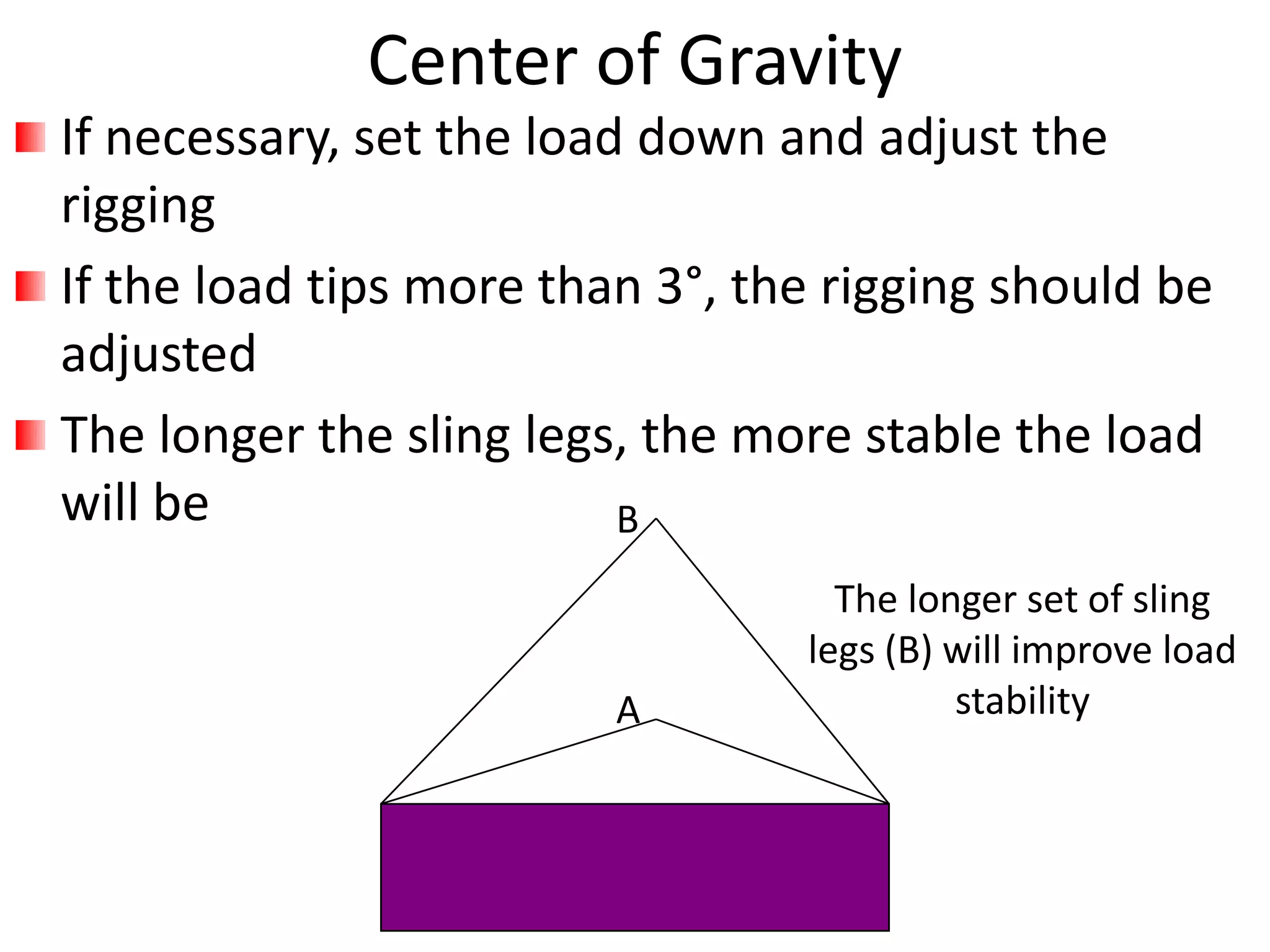
If necessary, set the load down and adjust the
rigging
If the load tips more than 3°, the rigging should be
adjusted
The longer the sling legs, the more stable the load
will be                   B
                                   The longer set of sling
                                 legs (B) will improve load
                         A                stability
How Would You Rig This?


What would you need in the
 way of rigging materials?
How Would You Rig This?


Would it matter if
the tank were full
or empty?
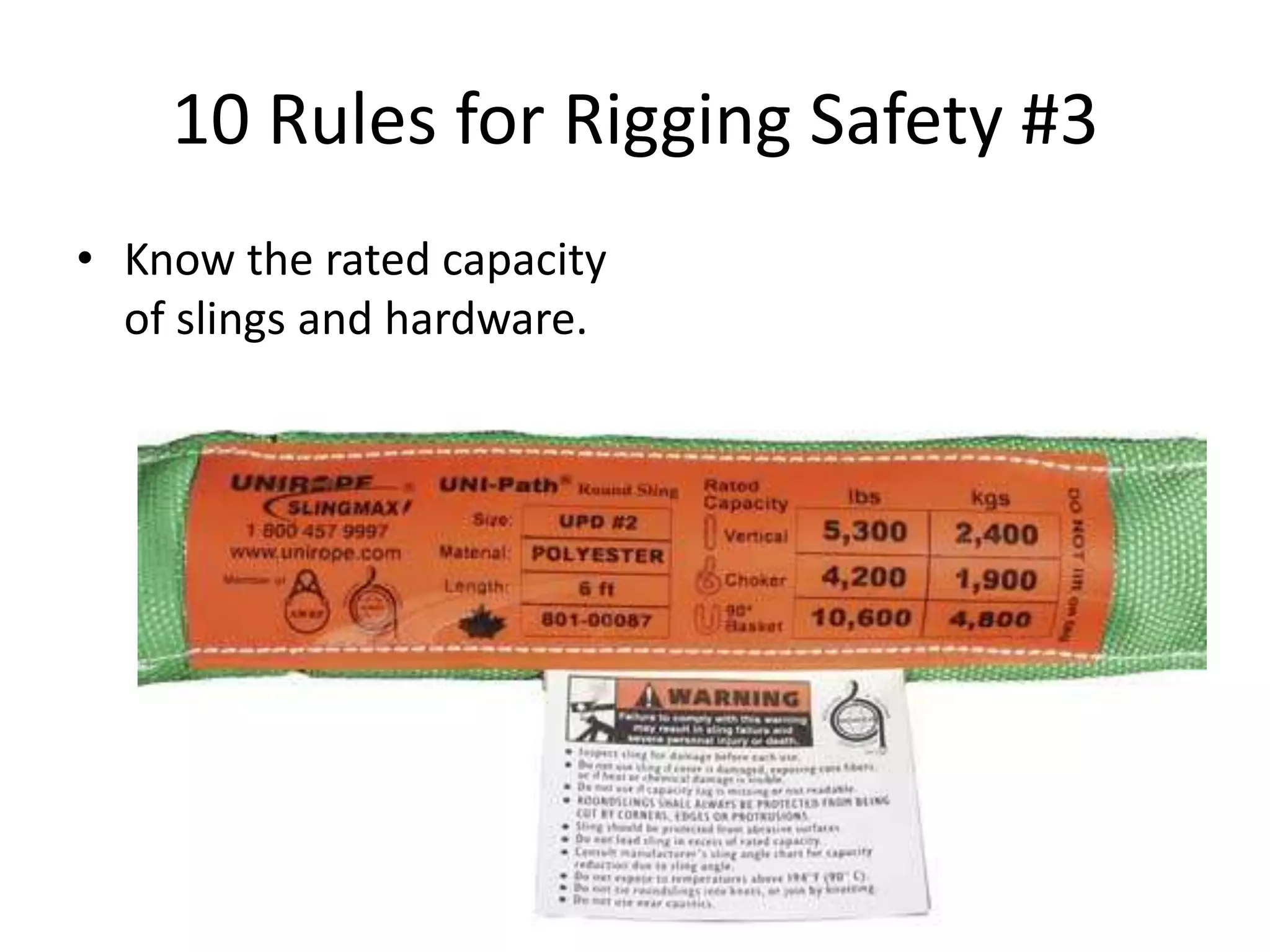
10 Rules for Rigging Safety #3
• Know the rated capacity
  of slings and hardware.
10 Rules for Rigging Safety #4
• Inspect all rigging
  before use.
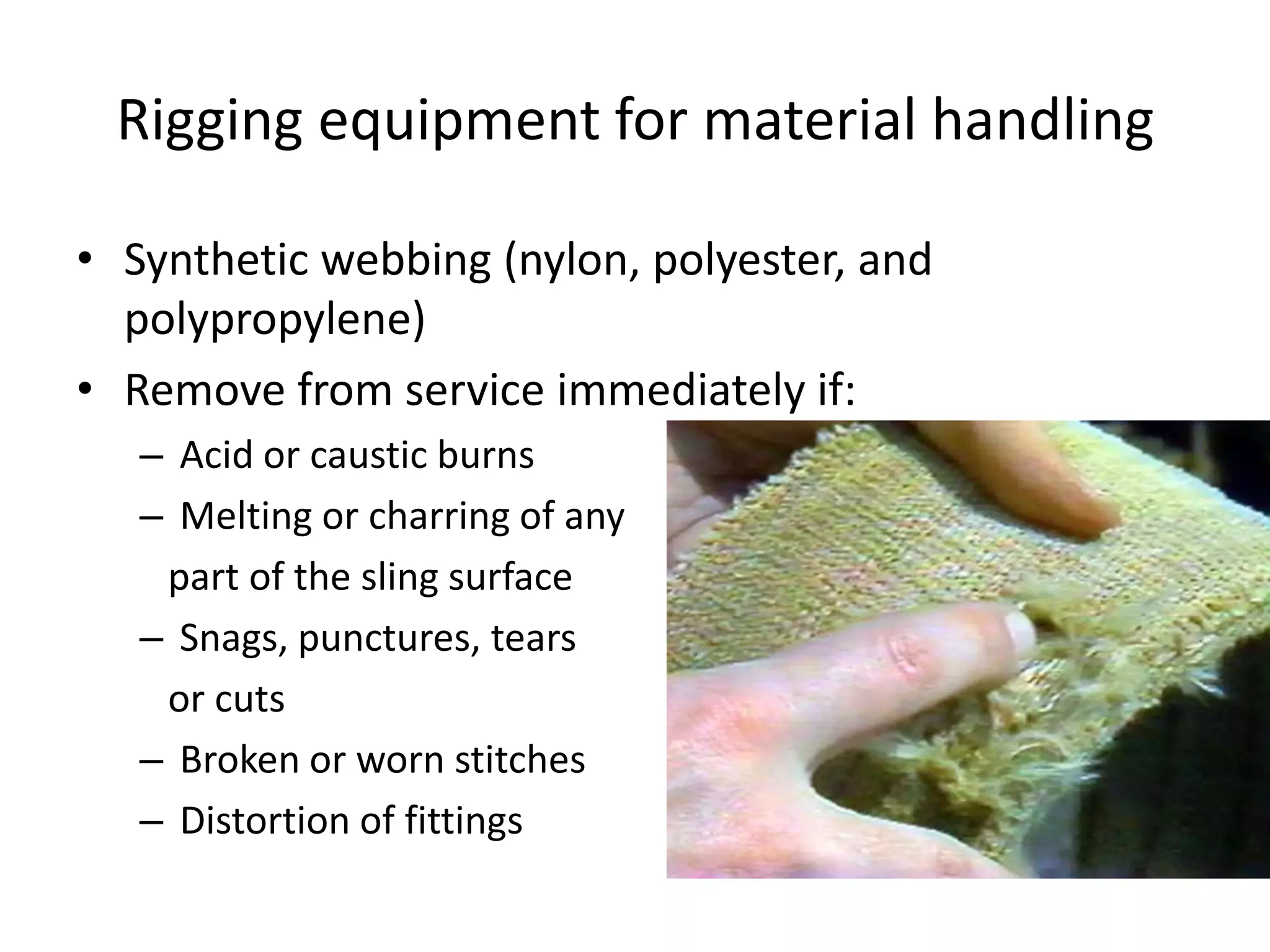
Rigging equipment for material handling

• Synthetic webbing (nylon, polyester, and
  polypropylene)
• Remove from service immediately if:
   – Acid or caustic burns
   – Melting or charring of any
    part of the sling surface
   – Snags, punctures, tears
    or cuts
   – Broken or worn stitches
   – Distortion of fittings
10 Rules for Rigging Safety #5
• Allow for D/d ratio on all wire rope slings.
Rigging equipment for material handling

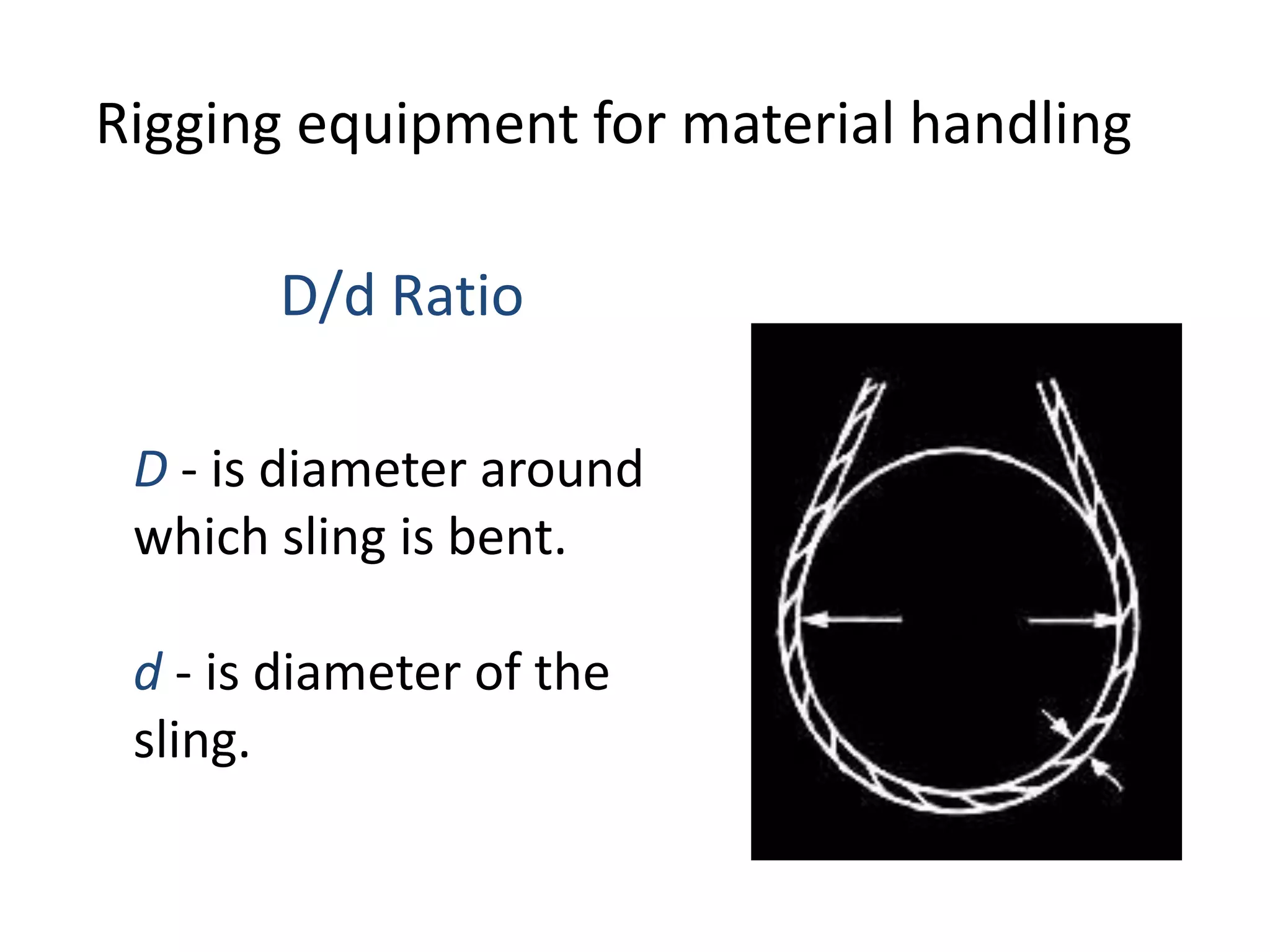
       D/d Ratio

 D - is diameter around
 which sling is bent.
                               D
 d - is diameter of the
 sling.
                                          d
10 Rules for Rigging Safety #6
• Protect sling from sharp
  surfaces

• Dekalb accident


• Photo is an example
Rigging Protection From
   Cutting or Slipping

 Softeners, padding or use of blocking..
10 Rules for Rigging Safety #7
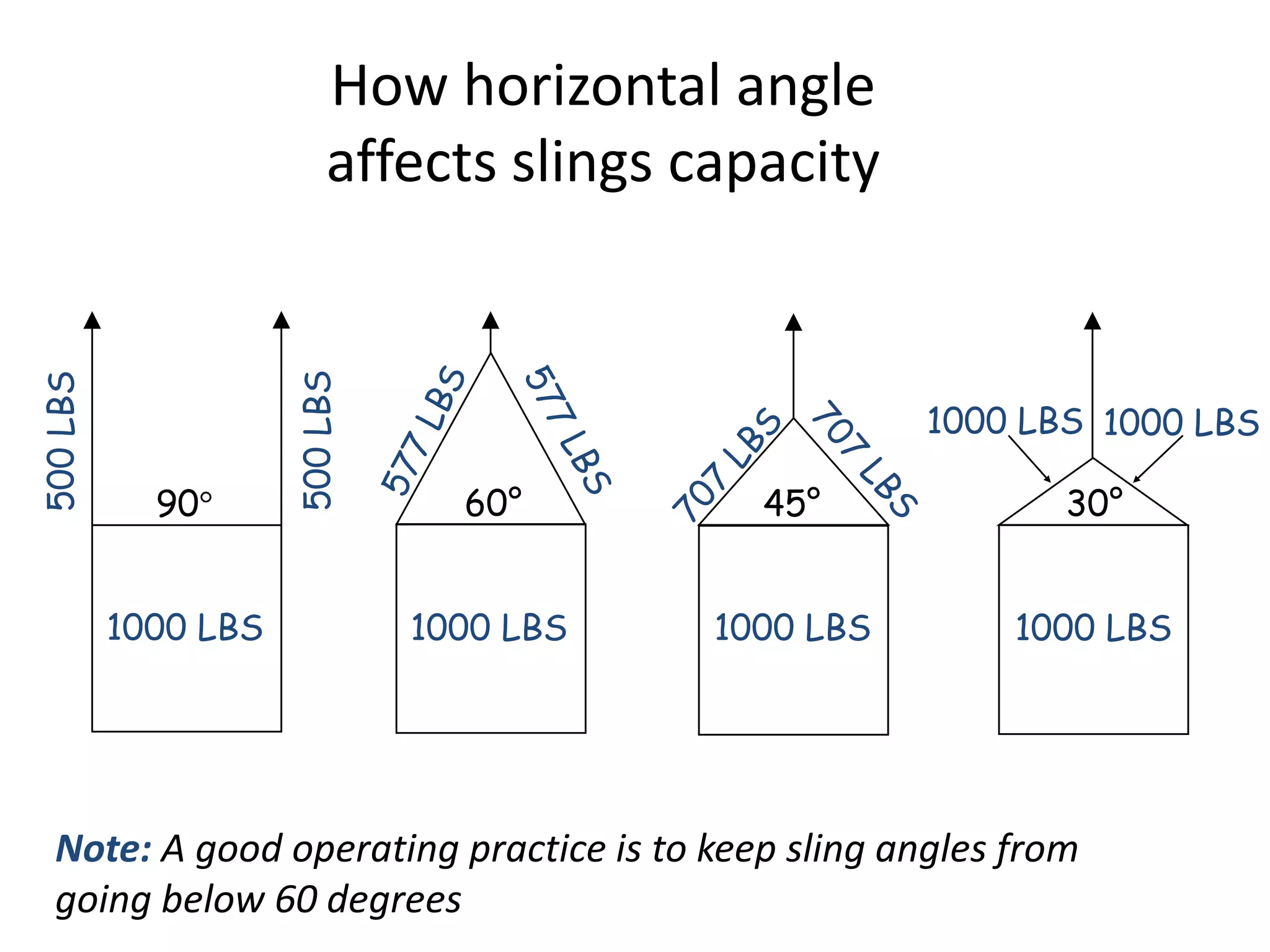
• Proper calculation of increased tension caused
  by sling angles (on all rigging components!).
How horizontal angle
                          affects slings capacity

                     500 LBS
500 LBS


                                                     1000 LBS 1000 LBS

            90                   60°        45°              30°


          1000 LBS             1000 LBS   1000 LBS        1000 LBS


  Note: A good operating practice is to keep sling angles from
  going below 60 degrees
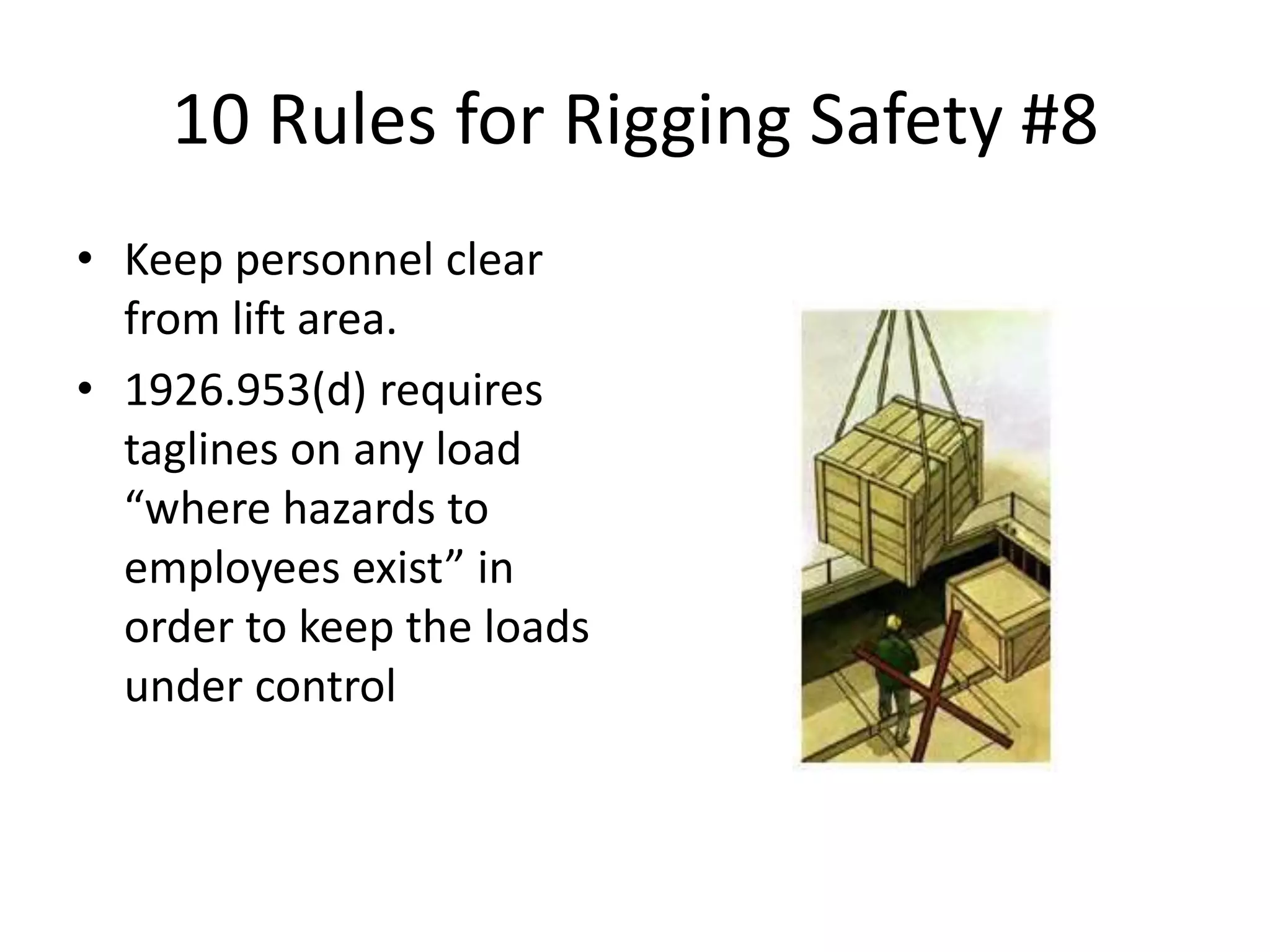
10 Rules for Rigging Safety #8
• Keep personnel clear
  from lift area.
• 1926.953(d) requires
  taglines on any load
  “where hazards to
  employees exist” in
  order to keep the loads
  under control
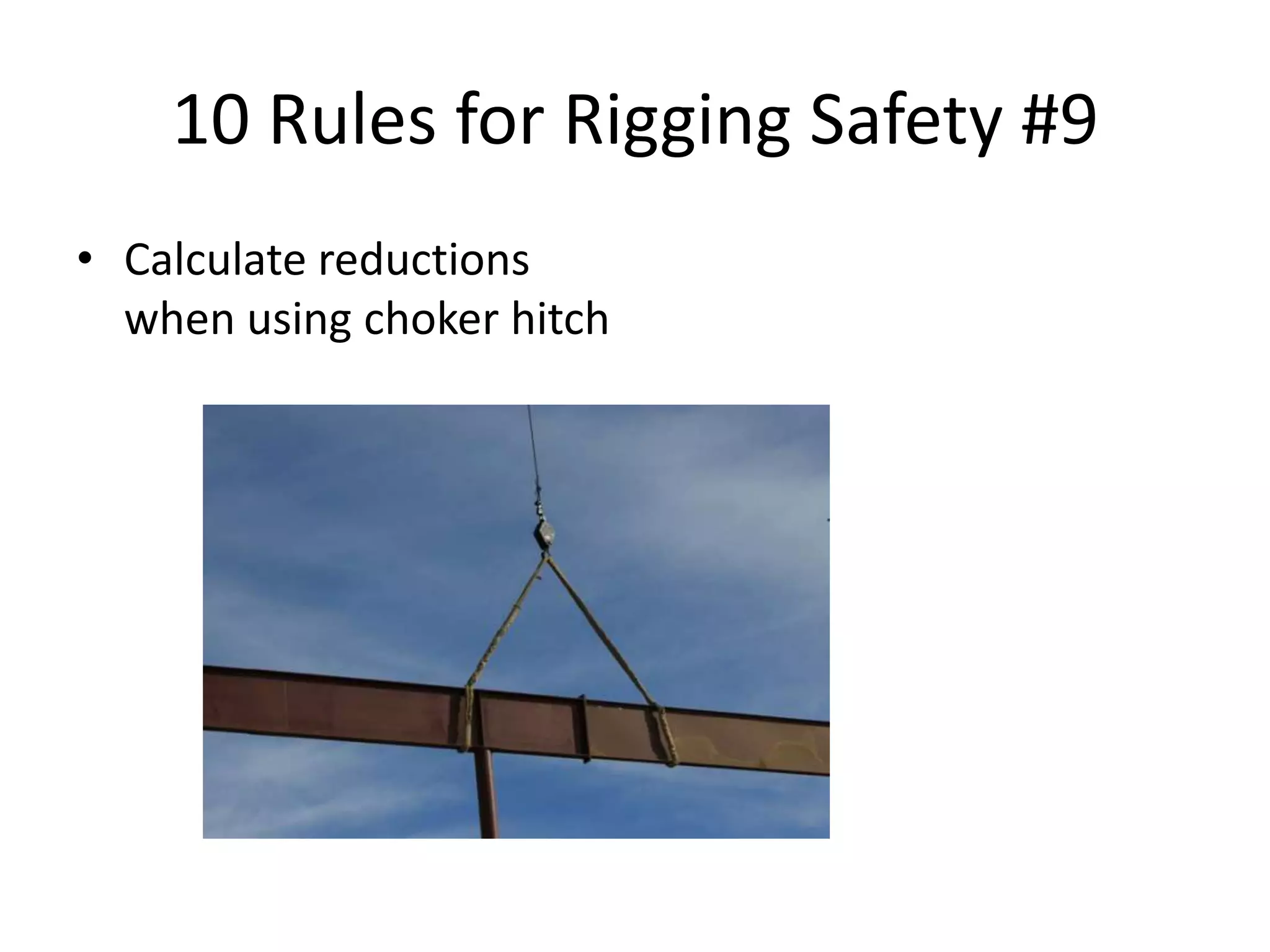
10 Rules for Rigging Safety #9
• Calculate reductions
  when using choker hitch
Wire Rope Sling Choker Adjustments
10 Rules for Rigging Safety #10
• Know the proper crane signals
• A signal person is required
  when:
• The point of operation is not in
  full view of the operator
  (1926.1419(a)).
• The operator’s view is
  obstructed in the direction the
  equipment is traveling.
• Either the operator or the
  person handling the load
  determines that a signal
  person is needed because of
  site-specific safety concerns.
Questions

Rigging safety 7

  • 1.
  • 2.
    Hit by Pulley •Event Date: 07/27/2010 • Inspection: 314807090 • Employee #1 was struck in the head by a metal pulley when the nylon sling to which it was connected broke. • The pulley was being used to drag felled trees. • When the rigging was put under tension, the nylon sling broke, releasing the pulley, hitting the employee in the head. • 50 M
  • 3.
    Struck by Form •Event Date: 04/21/2010 • Inspection: 314374182 • An employee was struck by a falling 20' column form weighing approximately 2,000 pounds that broke loose from its rigging while being moved by crane from one location to another location on the construction site. • 27 M
  • 4.
    Pipe Fell • EventDate: 04/29/2010 • Inspection: 314409277 • On 4/29/10 , an employee was struck on the head by a drilling pipe which resulted in fatal injuries. • The employee rigged a 20 foot section of pipe and as it was being lifted by the operator, the pipe came loose from the rigging and fell approximately 10 to 15 feet onto the head of the employee. • The employee died as a result of his injuries. • 50 M Fatality •
  • 5.
    10 Rules forRigging Safety #1 • Know the weight of the load • Concrete slab • Steel Beam • Concrete form • Tree
  • 6.
    Bulk Density • Building material Unit weight • Aluminum 171 pounds per cubic foot • Cast Iron 450 pounds per cubic foot • Cement 94 pounds per cubic foot • Concrete 150 pounds per cubic foot • Crushed Stone 2,500 pounds per cubic yard • Gravel 2,700 pounds per cubic yard
  • 7.
    10 Rules forRigging Safety #2 • Know the center of gravity of the load.
  • 8.
    Center of Gravity Aload is stable when: – The hook is directly above the center of gravity of the load Estimate the center of gravity Lift the load just enough to clear the ground If the hook is not over the center of gravity the hook will travel to the center of gravity CG?
  • 9.
    Center of Gravity Ifnecessary, set the load down and adjust the rigging If the load tips more than 3°, the rigging should be adjusted The longer the sling legs, the more stable the load will be B The longer set of sling legs (B) will improve load A stability
  • 10.
    How Would YouRig This? What would you need in the way of rigging materials?
  • 11.
    How Would YouRig This? Would it matter if the tank were full or empty?
  • 12.
    10 Rules forRigging Safety #3 • Know the rated capacity of slings and hardware.
  • 13.
    10 Rules forRigging Safety #4 • Inspect all rigging before use.
  • 14.
    Rigging equipment formaterial handling • Synthetic webbing (nylon, polyester, and polypropylene) • Remove from service immediately if: – Acid or caustic burns – Melting or charring of any part of the sling surface – Snags, punctures, tears or cuts – Broken or worn stitches – Distortion of fittings
  • 15.
    10 Rules forRigging Safety #5 • Allow for D/d ratio on all wire rope slings.
  • 16.
    Rigging equipment formaterial handling D/d Ratio D - is diameter around which sling is bent. D d - is diameter of the sling. d
  • 17.
    10 Rules forRigging Safety #6 • Protect sling from sharp surfaces • Dekalb accident • Photo is an example
  • 18.
    Rigging Protection From Cutting or Slipping Softeners, padding or use of blocking..
  • 19.
    10 Rules forRigging Safety #7 • Proper calculation of increased tension caused by sling angles (on all rigging components!).
  • 20.
    How horizontal angle affects slings capacity 500 LBS 500 LBS 1000 LBS 1000 LBS 90 60° 45° 30° 1000 LBS 1000 LBS 1000 LBS 1000 LBS Note: A good operating practice is to keep sling angles from going below 60 degrees
  • 21.
    10 Rules forRigging Safety #8 • Keep personnel clear from lift area. • 1926.953(d) requires taglines on any load “where hazards to employees exist” in order to keep the loads under control
  • 22.
    10 Rules forRigging Safety #9 • Calculate reductions when using choker hitch
  • 23.
    Wire Rope SlingChoker Adjustments
  • 24.
    10 Rules forRigging Safety #10 • Know the proper crane signals • A signal person is required when: • The point of operation is not in full view of the operator (1926.1419(a)). • The operator’s view is obstructed in the direction the equipment is traveling. • Either the operator or the person handling the load determines that a signal person is needed because of site-specific safety concerns.
  • 25.

Editor's Notes

  • #7 http://pubs.cas.psu.edu/freepubs/pdfs/h20.pdf
  • #16 http://www.unirope.com/wireropeslings/wrs_ddratioeffects.shtml