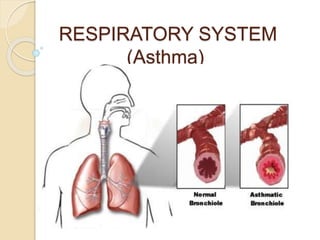
RESPIRATORY SYSTEM
(Asthma)
INTRODUCTION
 Asthma is an inflammatory disease of the airways
associated with episodes of reversible over-
reactivity of the airway smooth muscle.
 According to WHO,
Asthma attacks all age groups but often starts in
childhood.
It is a disease characterized by recurrent attacks of
breathlessness and wheezing, which vary in severity
and frequency from person to person.
In an individual, they may occur from hour to hour
and day to day.
 In asthmatic patients, airways are always
inflamed.
 The mucous membrane and muscle
layers of bronchi thickened and the
muscle gland enlarge, reducing airflow in
the lower respiratory tract.
 They become even more swollen and the
muscles around the airways can tighten
when something triggers your symptoms.
 During an asthmatic attack, spasmodic
contraction of bronchial muscle
(bronchospasm) constricts the airway,
 There is excessive secretion of thick
sticky mucus, which further narrows the
airway.
 The duration of attacks usually varies
from a few minutes to hours.
 In sever acute attacks the bronchi may be
obstructed by mucus plugs, leading to
acute respiratory failure, hypoxia and
possibly death.
Non-specific factors that may precipitate
asthma attacks include:
1. Cold air
2. Cigarette smoking
3. Air pollution
4. Upper respiratory tract infection
5. Strenuous exercise.
There are two clinical categories of
asthma
ATOPIC
 Childhood onset,
extrinsic asthma.
 Occurs who have (type
1) hypersensitivity to
foreign proteins, e.g.
pollen, dust mites,
fungi, animals (cats &
dogs).
 Have history of infantile
eczema or food
allergies with family
history.
NON-ATOPIC
 Adult onset, intrinsic
asthma.
 Occurs later in adult
life.
 No history of childhood
allergic reactions.
 Associated with:-
1. Chronic inflammation
in upper respiratory
tract, e.g. chronic
bronchitis, nasal
polyps.
 Occurs as in hay fever.
Ag are inhaled &
absorbed by bronchial
mucus.
stimulates production of
IgE Ab.
which encountered again
results in  histamine
 mucus secretion &
mucus contraction 
narrow airways.
1. Exercise & occupational
exposure; e.g. inhaled
paints & fumes.
2. Aspirin triggers &
asthmatic reactions, tend
to lungs damage (i.e.
irreversible)  impaired
lungs ventilation 
hypoxia, pulmonary
hypertension & right
sided heart failure.
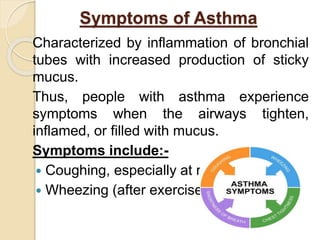
Symptoms of Asthma
Characterized by inflammation of bronchial
tubes with increased production of sticky
mucus.
Thus, people with asthma experience
symptoms when the airways tighten,
inflamed, or filled with mucus.
Symptoms include:-
 Coughing, especially at night,
 Wheezing (after exercise),
 Shortness of breath,
 Chest tightness, pain or pressure,
 Cold allergies (sneezing, runny nose & sore
throat).
Not everybody will experience the same
symptoms, like mentioned.
Some people may go for extended periods
without having any symptoms, interrupted by
periodic worsening of their asthma attacks.
Some have asthma symptom everyday.
Some only have during exercise.
Some have with viral infections like cold.
CAUSES
Factors that contribute to asthma include:-
 Environmental allergens (e.g., hose dust mites;
animal allergens, especially cat and dog; cockroach
allergens; and fungi)
 Viral respiratory tract infections
 Exercise, hyperventilation
 Gastro esophageal reflux disease
 Chronic sinusitis or rhinitis
 Aspirin or NSAID hypersensitivity, sulfite sensitivity
 Use of beta-adrenergic receptor blockers (including
ophthalmics)
 Environmental pollutants, tobacco smoke
 Occupational exposure
 Irritants (eg, household sprays, paints)
 Hay fever (allergic rhinitis).
Pathological Tests
 Lung function test:-
Assess lung function,
two types:
1. Spirometry
->simple breathing test.
->measures how much & how fast you can
blow air out of your lungs.
->give the reading of FVC (forced vital
capacity).
1. Methacholine
->is asthma trigger.
-> if you react to it, you have asthma.
 Chest X-Ray:-
Performed to make sure nothing is
causing asthma symptoms.
To see the structured of your chest, heart,
lungs and bones.
 Evaluation of Sinuses:-
sinuses is inflammation/ swelling of
sinuses.
When become blocked/ filled bacteria grow,
causing inflammation.
Thus, perform X-Ray, CT-scan to evaluate
& treated with antibiotics for 10-12 days.
 Sputum eosinophil:-
Looks for certain WBC (eosinophil) in
the mixture of saliva & mucus (sputum)
you discharge during coughing.
Eosinophil are present when symptoms
develop & become visible when satin
with rose- colored dye (eosin).
Treatment
Asthma is a long term disease that cannot
be cure but can be controlled. Good
asthma control will:
1. Prevent chronic & troublesome
symptoms.
2. Reduce your need for quick-relief
medicines.
3. Help maintain good lung function.
4. Prevents asthma attacks.
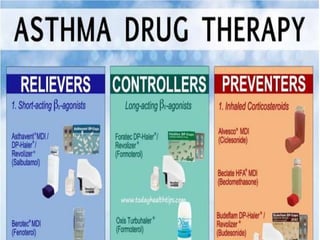
Asthma is treated with 2 types of medications:-
1. Long term medications
2. Quick-relief medications
 Long term medications:-
1. Inhaled corticosteroids. fluticasone, budesonide,
flunisolide, beclomethasone, momentasone.
2. Leukotriene modifiers. These oral medications-
including montelukast & zafirlukast help relieve asthma
symptoms for up to 24 hours.
3. Long-acting beta agonists. which include salmetrol
and formoterol , open the airways.
4. Theophylline. Theophylline(Theo-
24,Elixophyllin,others) is a daily pill helps keep the
airways open(bronchodilator) by relaxing the muscles
around the airways.
 Quick-relief medications:-
1. Short-acting beta agonists. These inhale are
quick relief bronchodilator. They include
albuterol and levalbuterol.
2. Ipratropium (Atrovent). Ipratropium acts
quickly to immediately relax your airway. Used
for emphysema and chronic bronchitis.
3. Oral and intravenous corticosteroids.
Include prednisone and methylprednisolone-
relieve airway inflammation. They can cause
serious side effect when used long term, so
they’re used only on a short-term basis to treat
severe asthma symptoms.
Complementary & alternative Treatment
 Acupuncture:- Acupuncture involves the
insertion of very thin needles into your skin
at specific points on your body.
 Breathing exercises:- Breathing
techniques used for asthma, include
breathing exercise yoga breathing
(pranayama), Don't seem to improve the
underlying allergic reactions.
 Vitamins Vitamin use includes
consuming vitamins or provitamins in
addition to food eaten to treat asthma. E.g.

Asthma Presentation by Dr. Arun Kumar

  • 1.
  • 2.
    INTRODUCTION  Asthma isan inflammatory disease of the airways associated with episodes of reversible over- reactivity of the airway smooth muscle.  According to WHO, Asthma attacks all age groups but often starts in childhood. It is a disease characterized by recurrent attacks of breathlessness and wheezing, which vary in severity and frequency from person to person. In an individual, they may occur from hour to hour and day to day.
  • 3.
     In asthmaticpatients, airways are always inflamed.  The mucous membrane and muscle layers of bronchi thickened and the muscle gland enlarge, reducing airflow in the lower respiratory tract.  They become even more swollen and the muscles around the airways can tighten when something triggers your symptoms.
  • 4.
     During anasthmatic attack, spasmodic contraction of bronchial muscle (bronchospasm) constricts the airway,  There is excessive secretion of thick sticky mucus, which further narrows the airway.  The duration of attacks usually varies from a few minutes to hours.  In sever acute attacks the bronchi may be obstructed by mucus plugs, leading to acute respiratory failure, hypoxia and possibly death.
  • 5.
    Non-specific factors thatmay precipitate asthma attacks include: 1. Cold air 2. Cigarette smoking 3. Air pollution 4. Upper respiratory tract infection 5. Strenuous exercise.
  • 6.
    There are twoclinical categories of asthma ATOPIC  Childhood onset, extrinsic asthma.  Occurs who have (type 1) hypersensitivity to foreign proteins, e.g. pollen, dust mites, fungi, animals (cats & dogs).  Have history of infantile eczema or food allergies with family history. NON-ATOPIC  Adult onset, intrinsic asthma.  Occurs later in adult life.  No history of childhood allergic reactions.  Associated with:- 1. Chronic inflammation in upper respiratory tract, e.g. chronic bronchitis, nasal polyps.
  • 7.
     Occurs asin hay fever. Ag are inhaled & absorbed by bronchial mucus. stimulates production of IgE Ab. which encountered again results in  histamine  mucus secretion & mucus contraction  narrow airways. 1. Exercise & occupational exposure; e.g. inhaled paints & fumes. 2. Aspirin triggers & asthmatic reactions, tend to lungs damage (i.e. irreversible)  impaired lungs ventilation  hypoxia, pulmonary hypertension & right sided heart failure.
  • 8.
    Symptoms of Asthma Characterizedby inflammation of bronchial tubes with increased production of sticky mucus. Thus, people with asthma experience symptoms when the airways tighten, inflamed, or filled with mucus. Symptoms include:-  Coughing, especially at night,  Wheezing (after exercise),
  • 9.
     Shortness ofbreath,  Chest tightness, pain or pressure,  Cold allergies (sneezing, runny nose & sore throat). Not everybody will experience the same symptoms, like mentioned. Some people may go for extended periods without having any symptoms, interrupted by periodic worsening of their asthma attacks. Some have asthma symptom everyday. Some only have during exercise. Some have with viral infections like cold.
  • 10.
    CAUSES Factors that contributeto asthma include:-  Environmental allergens (e.g., hose dust mites; animal allergens, especially cat and dog; cockroach allergens; and fungi)  Viral respiratory tract infections  Exercise, hyperventilation  Gastro esophageal reflux disease  Chronic sinusitis or rhinitis  Aspirin or NSAID hypersensitivity, sulfite sensitivity  Use of beta-adrenergic receptor blockers (including ophthalmics)  Environmental pollutants, tobacco smoke  Occupational exposure  Irritants (eg, household sprays, paints)  Hay fever (allergic rhinitis).
  • 11.
    Pathological Tests  Lungfunction test:- Assess lung function, two types: 1. Spirometry ->simple breathing test. ->measures how much & how fast you can blow air out of your lungs. ->give the reading of FVC (forced vital capacity). 1. Methacholine ->is asthma trigger. -> if you react to it, you have asthma.
  • 12.
     Chest X-Ray:- Performedto make sure nothing is causing asthma symptoms. To see the structured of your chest, heart, lungs and bones.  Evaluation of Sinuses:- sinuses is inflammation/ swelling of sinuses. When become blocked/ filled bacteria grow, causing inflammation. Thus, perform X-Ray, CT-scan to evaluate & treated with antibiotics for 10-12 days.
  • 13.
     Sputum eosinophil:- Looksfor certain WBC (eosinophil) in the mixture of saliva & mucus (sputum) you discharge during coughing. Eosinophil are present when symptoms develop & become visible when satin with rose- colored dye (eosin).
  • 14.
    Treatment Asthma is along term disease that cannot be cure but can be controlled. Good asthma control will: 1. Prevent chronic & troublesome symptoms. 2. Reduce your need for quick-relief medicines. 3. Help maintain good lung function. 4. Prevents asthma attacks.
  • 16.
    Asthma is treatedwith 2 types of medications:- 1. Long term medications 2. Quick-relief medications  Long term medications:- 1. Inhaled corticosteroids. fluticasone, budesonide, flunisolide, beclomethasone, momentasone. 2. Leukotriene modifiers. These oral medications- including montelukast & zafirlukast help relieve asthma symptoms for up to 24 hours. 3. Long-acting beta agonists. which include salmetrol and formoterol , open the airways. 4. Theophylline. Theophylline(Theo- 24,Elixophyllin,others) is a daily pill helps keep the airways open(bronchodilator) by relaxing the muscles around the airways.
  • 17.
     Quick-relief medications:- 1.Short-acting beta agonists. These inhale are quick relief bronchodilator. They include albuterol and levalbuterol. 2. Ipratropium (Atrovent). Ipratropium acts quickly to immediately relax your airway. Used for emphysema and chronic bronchitis. 3. Oral and intravenous corticosteroids. Include prednisone and methylprednisolone- relieve airway inflammation. They can cause serious side effect when used long term, so they’re used only on a short-term basis to treat severe asthma symptoms.
  • 18.
    Complementary & alternativeTreatment  Acupuncture:- Acupuncture involves the insertion of very thin needles into your skin at specific points on your body.  Breathing exercises:- Breathing techniques used for asthma, include breathing exercise yoga breathing (pranayama), Don't seem to improve the underlying allergic reactions.  Vitamins Vitamin use includes consuming vitamins or provitamins in addition to food eaten to treat asthma. E.g.