Associative Memory Model について
2020/10/04
1
Referrence
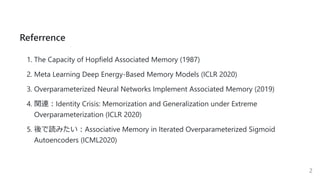
1. The Capacity of Hopfield Associated Memory (1987)
2. Meta Learning Deep Energy-Based Memory Models (ICLR 2020)
3. Overparameterized Neural Networks Implement Associated Memory (2019)
4. 関連︓Identity Crisis: Memorization and Generalization under Extreme
Overparameterization (ICLR 2020)
5. 後で読みたい︓Associative Memory in Iterated Overparameterized Sigmoid
Autoencoders (ICML2020)
2
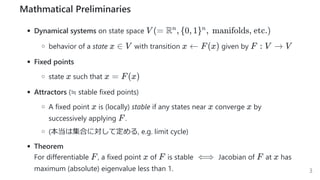
Mathmatical Preliminaries
Dynamical systems on state space
behavior of a state with transition given by
Fixed points
state such that
Attractors (≒ stable fixed points)
A fixed point is (locally) stable if any states near converge by
successively applying .
(本当は集合に対して定める, e.g. limit cycle)
Theorem
For differentiable , a fixed point of is stable Jacobian of at has
maximum (absolute) eigenvalue less than 1.
V (= R , {0, 1} ,  manifolds, etc.)n n
x ∈ V x ← F(x) F : V → V
x x = F(x)
x x x
F
F x F ⟺ F x
3
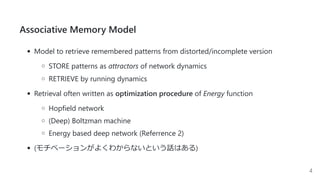
Associative Memory Model
Model to retrieve remembered patterns from distorted/incomplete version
STORE patterns as attractors of network dynamics
RETRIEVE by running dynamics
Retrieval often written as optimization procedure of Energy function
Hopfield network
(Deep) Boltzman machine
Energy based deep network (Referrence 2)
(モチベーションがよくわからないという話はある)
4
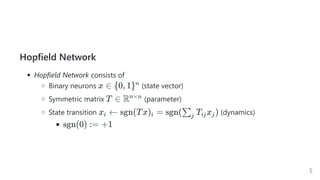
Hopfield Network
Hopfield Network consists of
Binary neurons (state vector)
Symmetric matrix (parameter)
State transition (dynamics)
x ∈ {0, 1}n
T ∈ Rn×n
x ←i sgn(Tx) =i sgn( T x )∑j ij j
sgn(0) := +1
5
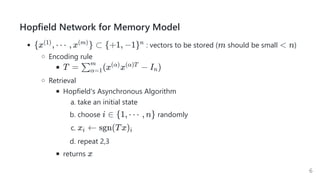
Hopfield Network for Memory Model
: vectors to be stored ( should be small )
Encoding rule
Retrieval
Hopfield's Asynchronous Algorithm
a. take an initial state
b. choose randomly
c.
d. repeat 2,3
returns
{x , ⋯ , x } ⊂(1) (m)
{+1, −1}n
m < n
T = (x x −∑α=1
m (α) (α)T
I )n
i ∈ {1, ⋯ , n}
x ←i sgn(Tx)i
x
6
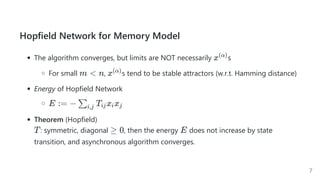
Hopfield Network for Memory Model
The algorithm converges, but limits are NOT necessarily s
For small , s tend to be stable attractors (w.r.t. Hamming distance)
Energy of Hopfield Network
Theorem (Hopfield)
: symmetric, diagonal , then the energy does not increase by state
transition, and asynchronous algorithm converges.
x(α)
m < n x(α)
E := − T x x∑i,j ij i j
T ≥ 0 E
7
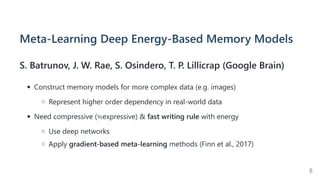
Meta-Learning Deep Energy-Based Memory Models
S. Batrunov, J. W. Rae, S. Osindero, T. P. Lillicrap (Google Brain)
Construct memory models for more complex data (e.g. images)
Represent higher order dependency in real-world data
Need compressive (≒expressive) & fast writing rule with energy
Use deep networks
Apply gradient-based meta-learning methods (Finn et al., 2017)
8
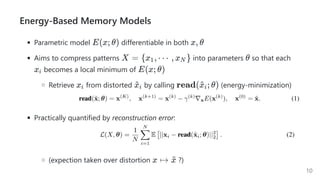
Energy-Based Memory Models
9
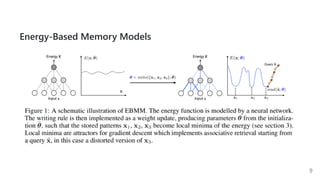
Energy-Based Memory Models
Parametric model differentiable in both
Aims to compress patterns into parameters so that each
becomes a local minimum of
Retrieve from distorted by calling (energy-minimization)
Practically quantified by reconstruction error:
(expection taken over distortion ?)
E(x; θ) x, θ
X = {x , ⋯ , x }1 N θ
xi E(x; θ)
xi x~i read( ; θ)x~i
x ↦ x~
10
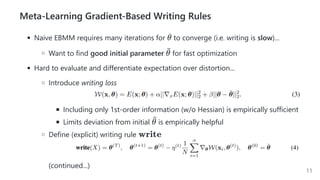
Meta-Learning Gradient-Based Writing Rules
Naive EBMM requires many iterations for to converge (i.e. writing is slow)...
Want to find good initial parameter for fast optimization
Hard to evaluate and differentiate expectation over distortion...
Introduce writing loss
Including only 1st-order information (w/o Hessian) is empirically sufficient
Limits deviation from initial is empirically helpful
Define (explicit) writing rule
(continued...)
θ
θˉ
θˉ
write
11
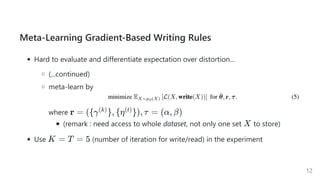
Meta-Learning Gradient-Based Writing Rules
Hard to evaluate and differentiate expectation over distortion...
(...continued)
meta-learn by
where
(remark : need access to whole dataset, not only one set to store)
Use (number of iteration for write/read) in the experiment
r = ({γ }, {η }), τ =(k) (t)
(α, β)
X
K = T = 5
12
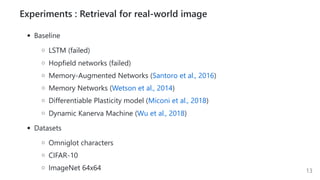
Experiments : Retrieval for real-world image
Baseline
LSTM (failed)
Hopfield networks (failed)
Memory-Augmented Networks (Santoro et al., 2016)
Memory Networks (Wetson et al., 2014)
Differentiable Plasticity model (Miconi et al., 2018)
Dynamic Kanerva Machine (Wu et al., 2018)
Datasets
Omniglot characters
CIFAR-10
ImageNet 64x64 13
Experiments : Retrieval for real-world image
Procedure (varying memory size)
Write a fixed-sized batch of images
Form queries by corrupting a random block of the images
Retrieve the original image.
Use FC (only for Omniglot) or Conv in 3-block ResNet for proposed model.
Energy is computed as a linear combination of units in the last layer.
14
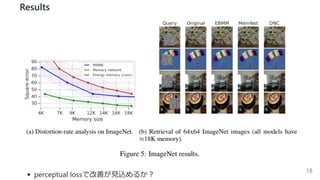
Results
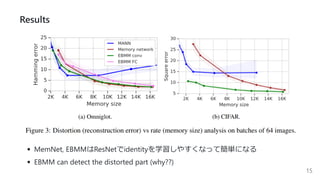
MemNet, EBMMはResNetでidentityを学習しやすくなって簡単になる
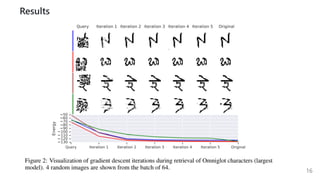
EBMM can detect the distorted part (why??)
15
Results
16
Results
17
Results
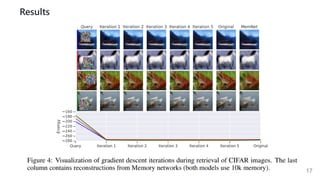
perceptual lossで改善が⾒込めるか︖
18
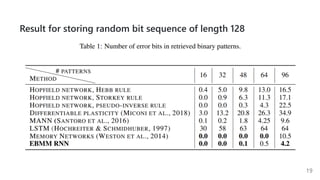
Result for storing random bit sequence of length 128
19
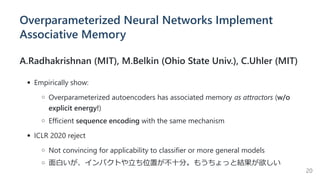
Overparameterized Neural Networks Implement
Associative Memory
A.Radhakrishnan (MIT), M.Belkin (Ohio State Univ.), C.Uhler (MIT)
Empirically show:
Overparameterized autoencoders has associated memory as attractors (w/o
explicit energy!)
Efficient sequence encoding with the same mechanism
ICLR 2020 reject
Not convincing for applicability to classifier or more general models
⾯⽩いが、インパクトや⽴ち位置が不⼗分。もうちょっと結果が欲しい
20
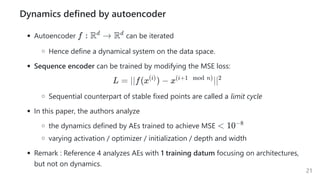
Dynamics defined by autoencoder
Autoencoder can be iterated
Hence define a dynamical system on the data space.
Sequence encoder can be trained by modifying the MSE loss:
L = ∣∣f(x ) −(i)
x ∣∣(i+1 mod n) 2
Sequential counterpart of stable fixed points are called a limit cycle
In this paper, the authors analyze
the dynamics defined by AEs trained to achieve MSE
varying activation / optimizer / initialization / depth and width
Remark : Reference 4 analyzes AEs with 1 training datum focusing on architectures,
but not on dynamics.
f : R →d
Rd
< 10−8
21
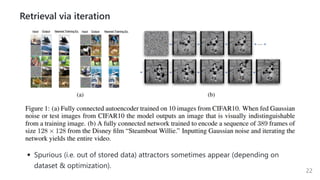
Retrieval via iteration
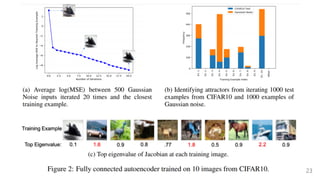
Spurious (i.e. out of stored data) attractors sometimes appear (depending on
dataset & optimization).
22
23
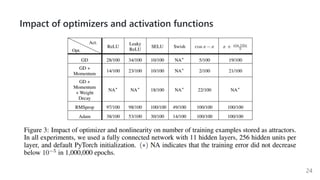
Impact of optimizers and activation functions
24
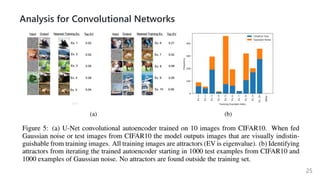
Analysis for Convolutional Networks
25
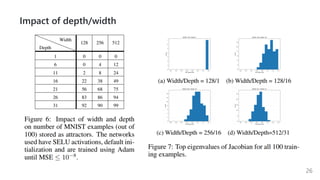
Impact of depth/width
26
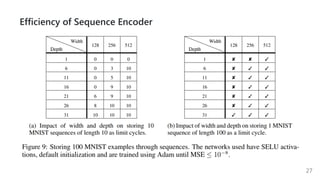
Efficiency of Sequence Encoder
27

Associative Memory Model について

  • 1.
    Associative Memory Modelについて 2020/10/04 1
  • 2.
    Referrence 1. The Capacityof Hopfield Associated Memory (1987) 2. Meta Learning Deep Energy-Based Memory Models (ICLR 2020) 3. Overparameterized Neural Networks Implement Associated Memory (2019) 4. 関連︓Identity Crisis: Memorization and Generalization under Extreme Overparameterization (ICLR 2020) 5. 後で読みたい︓Associative Memory in Iterated Overparameterized Sigmoid Autoencoders (ICML2020) 2
  • 3.
    Mathmatical Preliminaries Dynamical systemson state space behavior of a state with transition given by Fixed points state such that Attractors (≒ stable fixed points) A fixed point is (locally) stable if any states near converge by successively applying . (本当は集合に対して定める, e.g. limit cycle) Theorem For differentiable , a fixed point of is stable Jacobian of at has maximum (absolute) eigenvalue less than 1. V (= R , {0, 1} ,  manifolds, etc.)n n x ∈ V x ← F(x) F : V → V x x = F(x) x x x F F x F ⟺ F x 3
  • 4.
    Associative Memory Model Modelto retrieve remembered patterns from distorted/incomplete version STORE patterns as attractors of network dynamics RETRIEVE by running dynamics Retrieval often written as optimization procedure of Energy function Hopfield network (Deep) Boltzman machine Energy based deep network (Referrence 2) (モチベーションがよくわからないという話はある) 4
  • 5.
    Hopfield Network Hopfield Networkconsists of Binary neurons (state vector) Symmetric matrix (parameter) State transition (dynamics) x ∈ {0, 1}n T ∈ Rn×n x ←i sgn(Tx) =i sgn( T x )∑j ij j sgn(0) := +1 5
  • 6.
    Hopfield Network forMemory Model : vectors to be stored ( should be small ) Encoding rule Retrieval Hopfield's Asynchronous Algorithm a. take an initial state b. choose randomly c. d. repeat 2,3 returns {x , ⋯ , x } ⊂(1) (m) {+1, −1}n m < n T = (x x −∑α=1 m (α) (α)T I )n i ∈ {1, ⋯ , n} x ←i sgn(Tx)i x 6
  • 7.
    Hopfield Network forMemory Model The algorithm converges, but limits are NOT necessarily s For small , s tend to be stable attractors (w.r.t. Hamming distance) Energy of Hopfield Network Theorem (Hopfield) : symmetric, diagonal , then the energy does not increase by state transition, and asynchronous algorithm converges. x(α) m < n x(α) E := − T x x∑i,j ij i j T ≥ 0 E 7
  • 8.
    Meta-Learning Deep Energy-BasedMemory Models S. Batrunov, J. W. Rae, S. Osindero, T. P. Lillicrap (Google Brain) Construct memory models for more complex data (e.g. images) Represent higher order dependency in real-world data Need compressive (≒expressive) & fast writing rule with energy Use deep networks Apply gradient-based meta-learning methods (Finn et al., 2017) 8
  • 9.
  • 10.
    Energy-Based Memory Models Parametricmodel differentiable in both Aims to compress patterns into parameters so that each becomes a local minimum of Retrieve from distorted by calling (energy-minimization) Practically quantified by reconstruction error: (expection taken over distortion ?) E(x; θ) x, θ X = {x , ⋯ , x }1 N θ xi E(x; θ) xi x~i read( ; θ)x~i x ↦ x~ 10
  • 11.
    Meta-Learning Gradient-Based WritingRules Naive EBMM requires many iterations for to converge (i.e. writing is slow)... Want to find good initial parameter for fast optimization Hard to evaluate and differentiate expectation over distortion... Introduce writing loss Including only 1st-order information (w/o Hessian) is empirically sufficient Limits deviation from initial is empirically helpful Define (explicit) writing rule (continued...) θ θˉ θˉ write 11
  • 12.
    Meta-Learning Gradient-Based WritingRules Hard to evaluate and differentiate expectation over distortion... (...continued) meta-learn by where (remark : need access to whole dataset, not only one set to store) Use (number of iteration for write/read) in the experiment r = ({γ }, {η }), τ =(k) (t) (α, β) X K = T = 5 12
  • 13.
    Experiments : Retrievalfor real-world image Baseline LSTM (failed) Hopfield networks (failed) Memory-Augmented Networks (Santoro et al., 2016) Memory Networks (Wetson et al., 2014) Differentiable Plasticity model (Miconi et al., 2018) Dynamic Kanerva Machine (Wu et al., 2018) Datasets Omniglot characters CIFAR-10 ImageNet 64x64 13
  • 14.
    Experiments : Retrievalfor real-world image Procedure (varying memory size) Write a fixed-sized batch of images Form queries by corrupting a random block of the images Retrieve the original image. Use FC (only for Omniglot) or Conv in 3-block ResNet for proposed model. Energy is computed as a linear combination of units in the last layer. 14
  • 15.
  • 16.
  • 17.
  • 18.
  • 19.
    Result for storingrandom bit sequence of length 128 19
  • 20.
    Overparameterized Neural NetworksImplement Associative Memory A.Radhakrishnan (MIT), M.Belkin (Ohio State Univ.), C.Uhler (MIT) Empirically show: Overparameterized autoencoders has associated memory as attractors (w/o explicit energy!) Efficient sequence encoding with the same mechanism ICLR 2020 reject Not convincing for applicability to classifier or more general models ⾯⽩いが、インパクトや⽴ち位置が不⼗分。もうちょっと結果が欲しい 20
  • 21.
    Dynamics defined byautoencoder Autoencoder can be iterated Hence define a dynamical system on the data space. Sequence encoder can be trained by modifying the MSE loss: L = ∣∣f(x ) −(i) x ∣∣(i+1 mod n) 2 Sequential counterpart of stable fixed points are called a limit cycle In this paper, the authors analyze the dynamics defined by AEs trained to achieve MSE varying activation / optimizer / initialization / depth and width Remark : Reference 4 analyzes AEs with 1 training datum focusing on architectures, but not on dynamics. f : R →d Rd < 10−8 21
  • 22.
    Retrieval via iteration Spurious(i.e. out of stored data) attractors sometimes appear (depending on dataset & optimization). 22
  • 23.
  • 24.
    Impact of optimizersand activation functions 24
  • 25.
  • 26.
  • 27.