Maria Daniels
• Assistive technology is an umbrella term that
includes assistive, adaptive, and rehabilitative
devices for people with disabilities. The term
assistive technology also includes the process of
selecting, locating, and using the technology.
• Assistive technology provides people with
disabilities the opportunity to complete tasks that
they would normally be unable to complete or
that they would normally have a hard time
completing.
 IDEA requires local education agencies to ensure that assistive
technology devices and/or services are made available to a student
with a disability at no charge to the family of the student.
 if the IEP team determines that a student needs a particular assistive
technology device at home to meet the goals and objectives that are
listed on the IEP, the equipment must be provided for use at home.
 An IEP for a student who is at least 14 must have a statement of the
transition service needs of the student that focuses on the individual’s
courses of study.
 An IEP for a student who is at least 16 must have a statement of needed
transition services for the student.
 If assistive technology and services have been provided as part of the
student’s school program, a determination regarding continued need
after graduation must be made by the IEP team.
 Provisions for interagency support for assistive technology devices and
services should be specified as part of the transition.
• FAPE mandates that school districts provide access
to general education and specialized educational
services.
• FAPE also requires that children with disabilities
receive support free of charge as is provided to
non-disabled students.
• It provides access to general education services for
children with disabilities by encouraging that
support and related services be provided to
children in the least restrictive environment as
much as possible.
 ADA assures full civil rights to individuals
with disabilities; it also assures access to
and accommodations in preschools and
child care settings.
 According to the ADA, child care centers
cannot discriminate against parents or
children with special needs.
 Nor can they charge more for a special
needs child than they would for any other
child.
• PL 100-146 requires that all funded services be aimed
at providing opportunities and assistance for persons
with developmental disabilities to allow them to
"achieve their maximum potential through increased
independence, productivity and integration into the
community."
• The amendments require that each state submits an
annual report that includes descriptions of the
currently unavailable assistive technology services that
could be of benefit to persons with developmental
disabilities.
Technology-Related Assistance for Individuals
with Disabilities Act of 1988 (PL 100-407)
 It was signed into law by President Reagan on
August 19, 1988.
 This law provides funding to develop statewide,
consumer-responsive information and training
programs that are designed to meet the assistive
technology needs of individuals with disabilities.
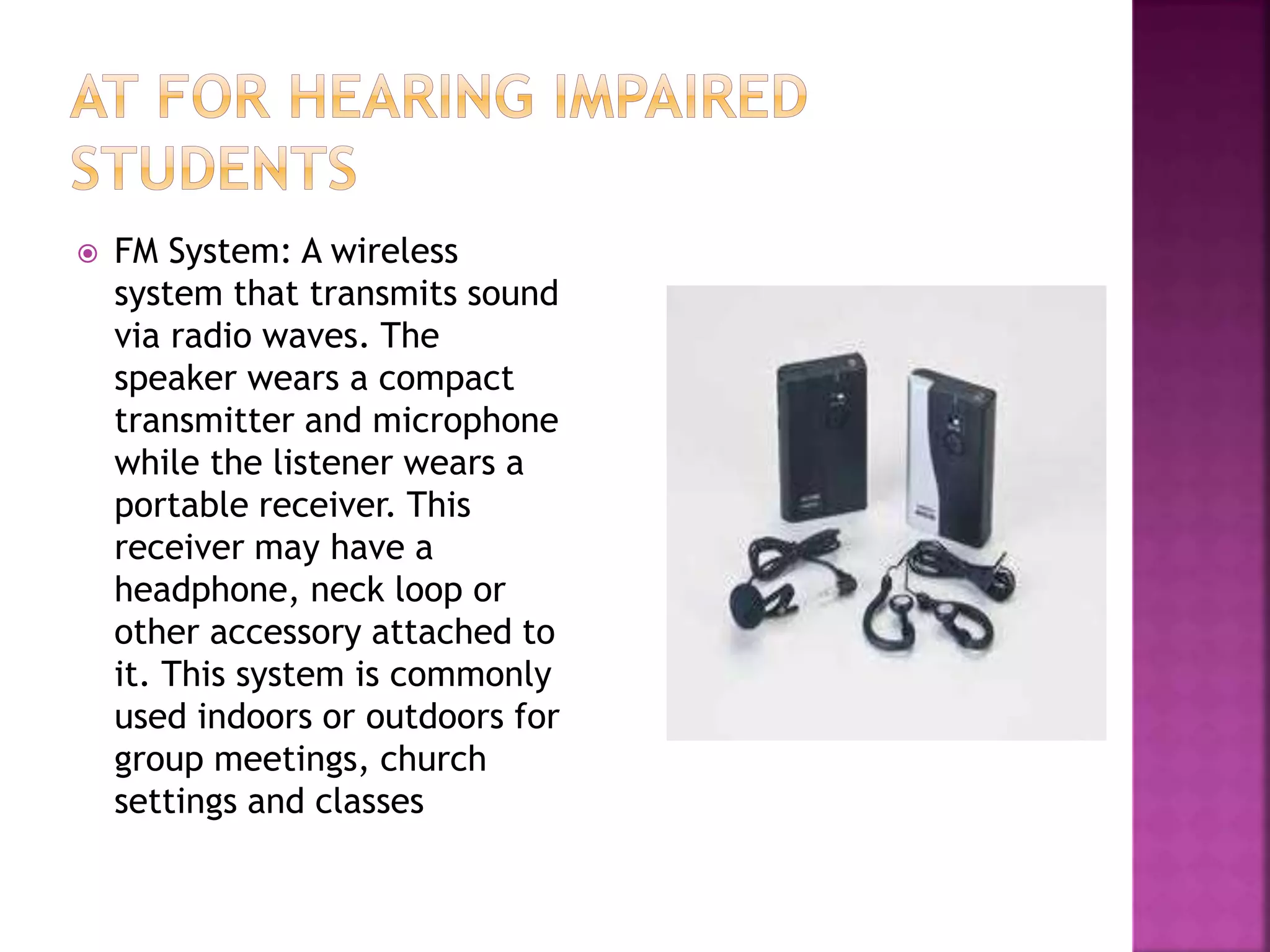
 FM System: A wireless
system that transmits sound
via radio waves. The
speaker wears a compact
transmitter and microphone
while the listener wears a
portable receiver. This
receiver may have a
headphone, neck loop or
other accessory attached to
it. This system is commonly
used indoors or outdoors for
group meetings, church
settings and classes
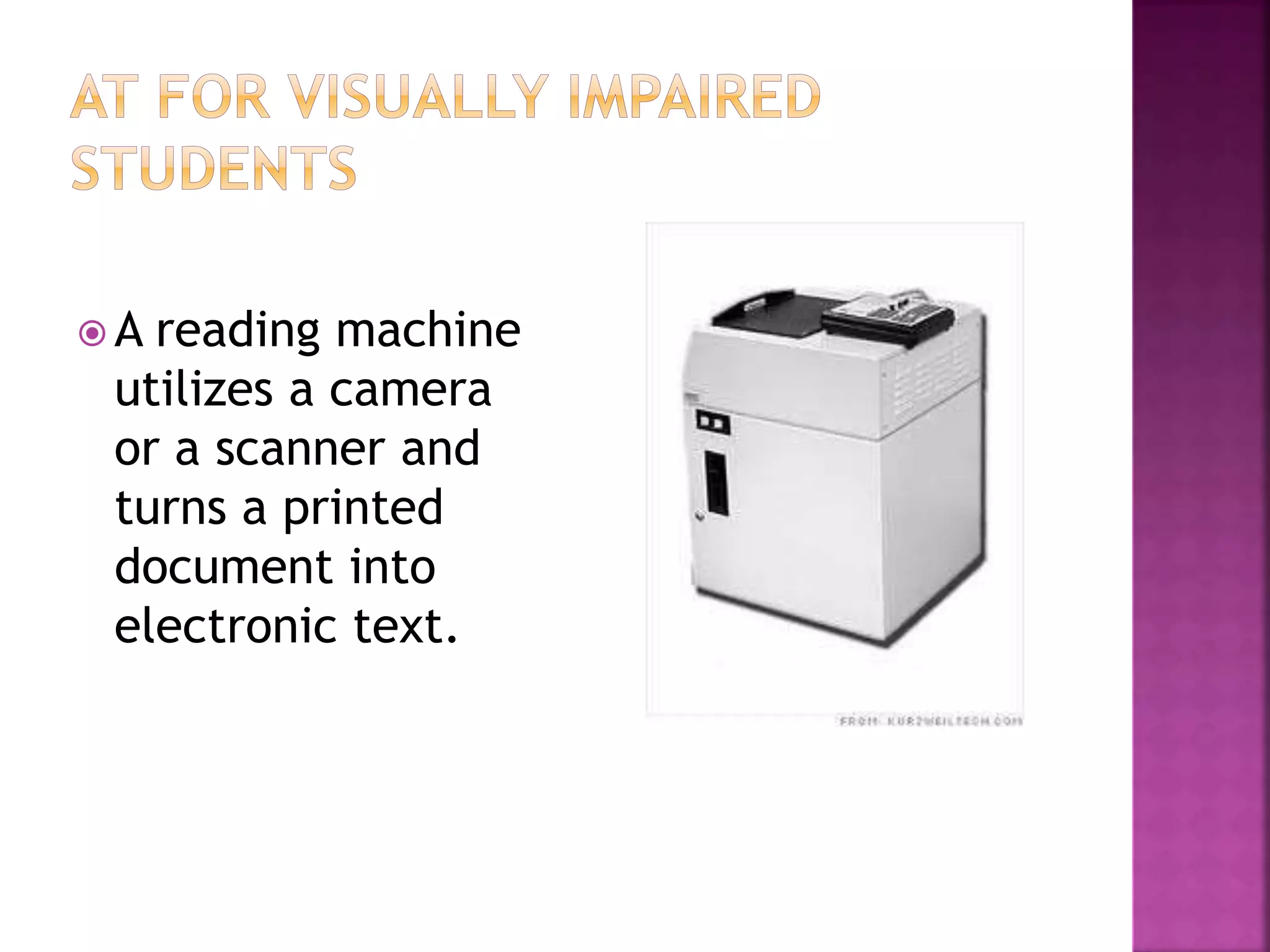
 A reading machine
utilizes a camera
or a scanner and
turns a printed
document into
electronic text.
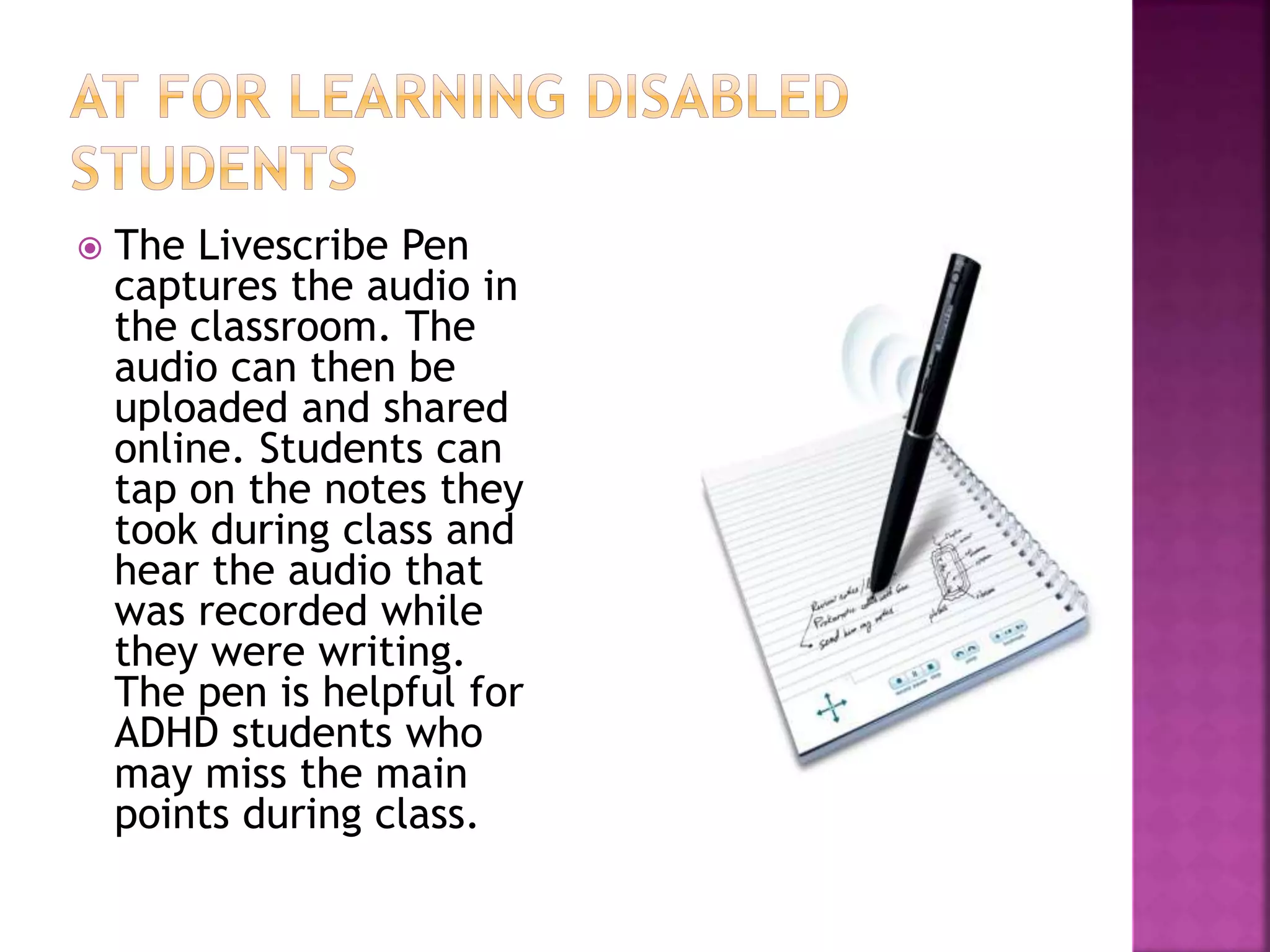
 The Livescribe Pen
captures the audio in
the classroom. The
audio can then be
uploaded and shared
online. Students can
tap on the notes they
took during class and
hear the audio that
was recorded while
they were writing.
The pen is helpful for
ADHD students who
may miss the main
points during class.
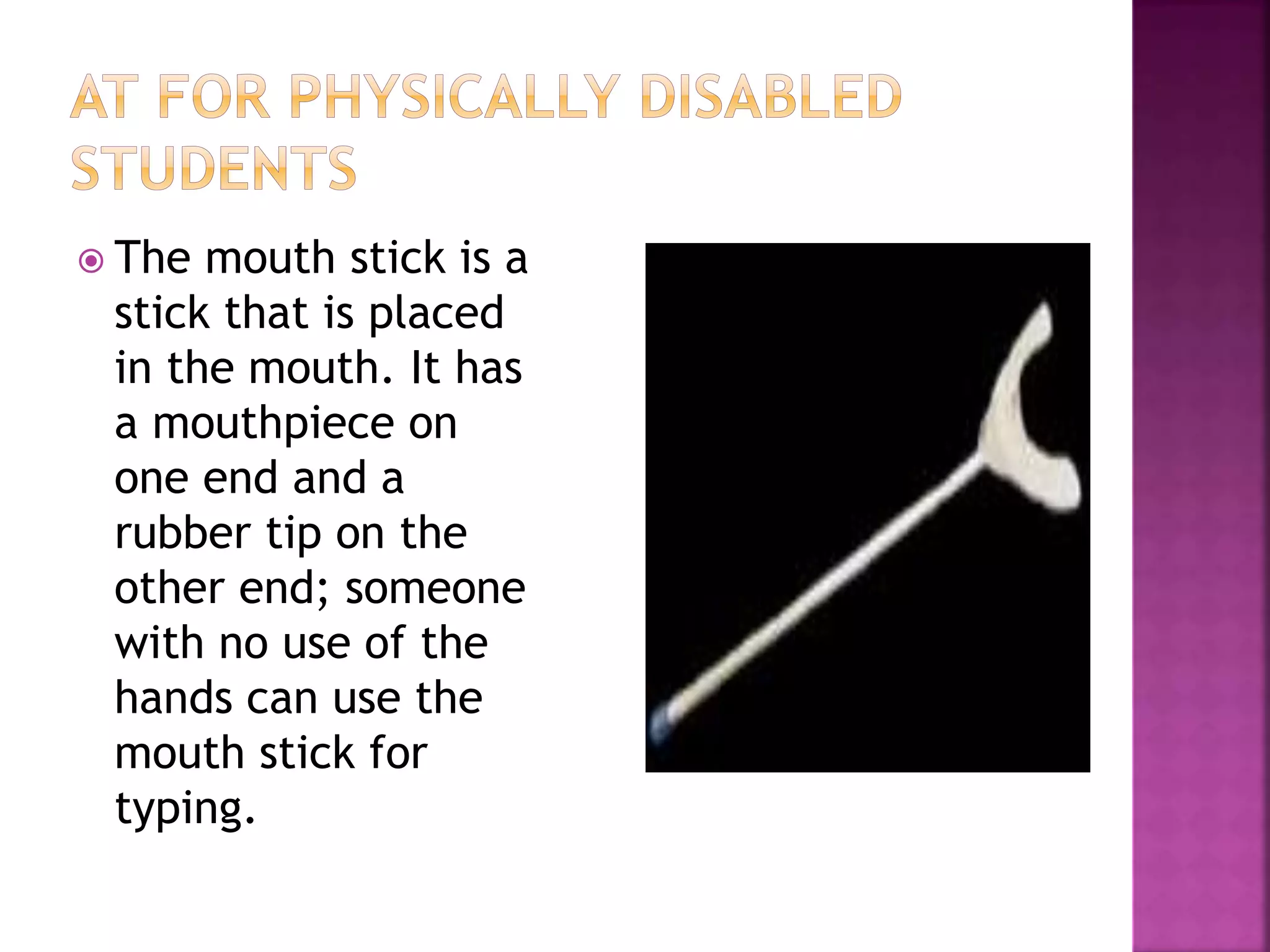
 The mouth stick is a
stick that is placed
in the mouth. It has
a mouthpiece on
one end and a
rubber tip on the
other end; someone
with no use of the
hands can use the
mouth stick for
typing.
 http://www.ncld.org/parents-child-disabilities/ld-
rights/what-is-fape-what-can-it-mean-my-child
 http://www.fctd.info/resources/techlaws.php
 http://www.additudemag.com/adhd/article/9365.html
 http://iris.peabody.vanderbilt.edu/at/chalcycle.htm

Assistive technology_ED505

  • 1.
  • 2.
    • Assistive technologyis an umbrella term that includes assistive, adaptive, and rehabilitative devices for people with disabilities. The term assistive technology also includes the process of selecting, locating, and using the technology. • Assistive technology provides people with disabilities the opportunity to complete tasks that they would normally be unable to complete or that they would normally have a hard time completing.
  • 3.
     IDEA requireslocal education agencies to ensure that assistive technology devices and/or services are made available to a student with a disability at no charge to the family of the student.  if the IEP team determines that a student needs a particular assistive technology device at home to meet the goals and objectives that are listed on the IEP, the equipment must be provided for use at home.  An IEP for a student who is at least 14 must have a statement of the transition service needs of the student that focuses on the individual’s courses of study.  An IEP for a student who is at least 16 must have a statement of needed transition services for the student.  If assistive technology and services have been provided as part of the student’s school program, a determination regarding continued need after graduation must be made by the IEP team.  Provisions for interagency support for assistive technology devices and services should be specified as part of the transition.
  • 4.
    • FAPE mandatesthat school districts provide access to general education and specialized educational services. • FAPE also requires that children with disabilities receive support free of charge as is provided to non-disabled students. • It provides access to general education services for children with disabilities by encouraging that support and related services be provided to children in the least restrictive environment as much as possible.
  • 5.
     ADA assuresfull civil rights to individuals with disabilities; it also assures access to and accommodations in preschools and child care settings.  According to the ADA, child care centers cannot discriminate against parents or children with special needs.  Nor can they charge more for a special needs child than they would for any other child.
  • 6.
    • PL 100-146requires that all funded services be aimed at providing opportunities and assistance for persons with developmental disabilities to allow them to "achieve their maximum potential through increased independence, productivity and integration into the community." • The amendments require that each state submits an annual report that includes descriptions of the currently unavailable assistive technology services that could be of benefit to persons with developmental disabilities.
  • 7.
    Technology-Related Assistance forIndividuals with Disabilities Act of 1988 (PL 100-407)  It was signed into law by President Reagan on August 19, 1988.  This law provides funding to develop statewide, consumer-responsive information and training programs that are designed to meet the assistive technology needs of individuals with disabilities.
  • 8.
     FM System:A wireless system that transmits sound via radio waves. The speaker wears a compact transmitter and microphone while the listener wears a portable receiver. This receiver may have a headphone, neck loop or other accessory attached to it. This system is commonly used indoors or outdoors for group meetings, church settings and classes
  • 9.
     A readingmachine utilizes a camera or a scanner and turns a printed document into electronic text.
  • 10.
     The LivescribePen captures the audio in the classroom. The audio can then be uploaded and shared online. Students can tap on the notes they took during class and hear the audio that was recorded while they were writing. The pen is helpful for ADHD students who may miss the main points during class.
  • 11.
     The mouthstick is a stick that is placed in the mouth. It has a mouthpiece on one end and a rubber tip on the other end; someone with no use of the hands can use the mouth stick for typing.
  • 12.
     http://www.ncld.org/parents-child-disabilities/ld- rights/what-is-fape-what-can-it-mean-my-child  http://www.fctd.info/resources/techlaws.php http://www.additudemag.com/adhd/article/9365.html  http://iris.peabody.vanderbilt.edu/at/chalcycle.htm