News 1
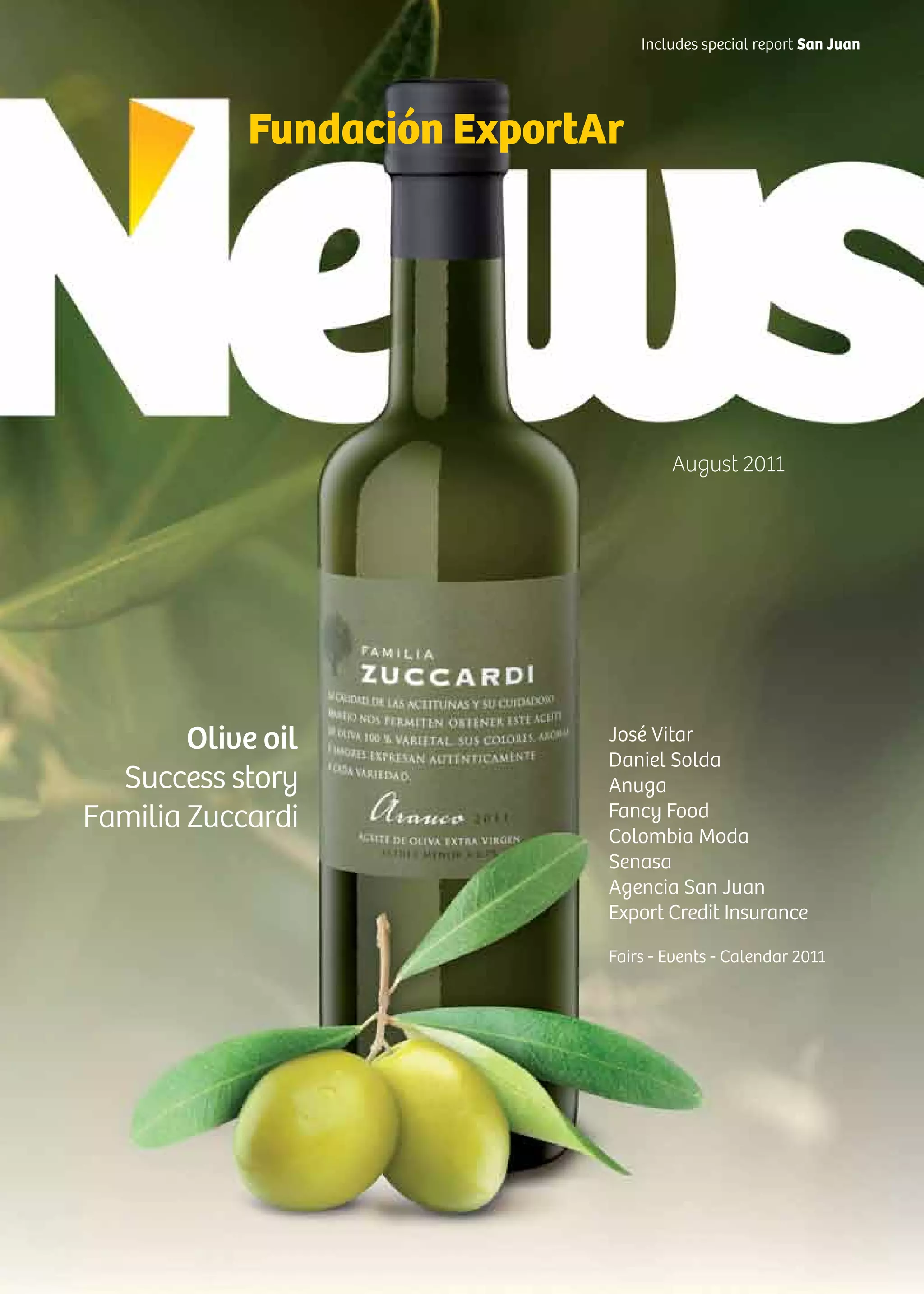
Fundación ExportAr
José Vitar
Daniel Solda
Anuga
Fancy Food
Colombia Moda
Senasa
Agencia San Juan
Fairs - Events - Calendar 2011
San Juan
Olive oil
Success story
Familia Zuccardi
Export Credit Insurance
Includes special report
August 2011
2 News
News 3
During the first 7 months of the year, with shipments for 47,339 billion dollars, at a year-on-year average sales growth
rate of 24%, around 14.000 Argentine exporting companies are leading our country towards a new record as regards
exports.
That effort must be consolidated by trade promotion organizations through a joint and collaborative work in accor-
dance with productive development policies set forth by the National Government, with special focus on value chains
and differentiated products of companies from each region of our country.
Within this framework, it is highly important the trade promotion strategy designed by the Argentine Foreign Affairs
Ministry, that along with the rest of the Ministries according to their specific sectoral competences, sets the referen-
ce structure for actions, in a joint manner, that are carried out in order to position Argentine products and services
worldwide.
Right articulation between export promotion agents from diverse fields and regions, by universalizing commercial
information and coordinating actions, is a fundamental stage for our work which resumes in a benefit not only for
government actors but for local companies as well.
In this sense, Fundación ExportAr works to carry out strategies agreed on with agencies and organizations aimed
at fostering province and municipal exports, and also with the most representative chambers and institutions of the
country, in order to become privileged partners within a federal framework, when it comes to bringing Argentine
products and services worldwide.
Just to mention a few examples that highlight the importance of organizing joint and coordinated actions, training
activities stand out due to massive participation of Argentine companies in Expocruz Fair and the joint work that is
being carried out towards the promotion of education services.
•	 As regards training, and joint work with different regional agencies and institutions, through courses and semi-
nars carried out along 14 Argentine provinces, 800 entrepreneurs have been trained, allowing coordination bet-
ween organizers by combining the potential of selecting the best trainer according to a specific topic of interest
for producers taking into account the profound knowledge of local organizations and the characteristics of the
region.
•	 In the case of Expocruz International Fair, held in Bolivia, a joint organization and a combination of finance sup-
port from Fundación ExportAr, province and municipal organizations, binational and sectoral chambers, ProAr-
gentina, Federal Investment Council, Improtur, and the Mining Secretariat of the nation, has allowed 228 Ar-
gentine companies, coming from 11 provinces of the country, to participate in the most important multisectoral
showroom of Latin America.
•	 As regards actions developed to the positioning of education services abroad, 30 Argentine universities and edu-
cation institutions have taken part in a dozen of sectoral actions worldwide. These activities, which could have
not been possible to be organized without the support and cooperation from the Argentine diplomatic represen-
tations abroad, are the result of a joint effort with the University Policies Secretariat of the Ministry of Education,
and the synergy between different actors that allow to work on the one hand, with knowledge of the sectoral
realities, and on the other, with regard to exports promotion and presence in foreign markets.
In ExportAr we understand that the development of authentic synergies between government organizations, promo-
tion agencies, institutions, chambers and companies, is fundamental when fostering the exporting performance of
national SMEs and our commitment is to continue working in a joint and coordinated manner to unify efforts and
increase the possibilities of Argentine companies.
FOREWORD
Juan Usandivaras
4 News
Newsletter of Fundación ExportAr
August 2011
STAFF
Administrative Board - President
Lic. Miguel Acevedo
Administrative Board -Secretary
International Trade and
Economic Relations
Amb. Luis María Kreckler
Undersecretary of International Trade
Amb. Ariel Esteban Schale
Executive Director
Lic. Juan Usandivaras
Manager
Cdor. Diego Nelli
Editorial and contents
Santiago Mantelli
Dr. Héctor Lorenzo
Lic. Nilda Bordón
Lic. Verónica Scornik
Lic. Javier González Ojeda
Lic. Verónica Biganzoli
Design
DG. Pablo Caruso
DG. Sebastián Feinsilber
DG. Omar Baldo
Julieta Pratesi
English version
Gabriela A. Buonomo
Laura Rajchman
Lawrence Wheeler
Typography: Bree, © Type together
Complete or partial reproduction of the content and photographs herein is
permitted by mentioning the source: News, Fundación ExportAr Newsletter.
w w w . e x p o r t a r . o r g . a r
Ministerio de
Relaciones Exteriores,
Comercio Internacional y Culto
4
8
10
12
13
14
16
20
22
30
34
35
SUMMARY
Anuga 2011
Interview | Ambassador José Vitar
Services Promotion | Colombia Moda
Colombia Moda | Narciso
Colombia Moda | Ruma
Succesful multisectorial mission to Colombia
Interview | Jorge Amaya, SENASA
Interview Daniel Solda, AIERA
Succesful story Familia Zuccardi
QUality olive oil
Summer Fancy Food Show 2011
Summer Fancy Food Show 2011 | Cuna de Olivares
Summer Fancy Food Show 2011 | Cachamai
News 5
69
70
70
71
71
72
72
73
73
74
74
75
75
76
77
77
78
78
79
79
80
80
81
81
82
82
Fairs
Bienal Do Livro 2011
Asia Fruit Logistic 2011
106th Expo Prado 2011
World Food Moscow 2011
EXPOCRUZ 2011
Expoalimentaria Peru 2011
Services Promotion
Gartner Outsourcing Summit 2011
EAIE 2011
Education Workshop Amsterdam 2011
2nd Edition of the Program for the Promotion of
Fashion in Paris 2011
Rounds
4th International Business Round of Security
Products and Service Buyers 2011
10th International Business Round of Food and
Beverages 2011
9th International Business Round of Shoes 2011
International Business Round Expo Rural
MERCOSUR 2011
1st International Business Round Olive Sector
Argoliva 2011
7th Inetrnational Business Round of Wines 2011
Training
“First steps in exporting”, Alberti
“Exporting costs and price”, S.Francisco, Córdoba
“How to participate successfully in an
International Business Round”, Jujuy
“Pulling together and export on behalf and
request of third parties”, San Juan
“First steps in exporting”, Salta
“First steps in exporting”, Lules, Tucumán
“How to successfully participate in an
International Fair”, City of Buenos Aires
“How to design a successfulbusiness plan” Las
Parejas, Santa Fe
“SWOT analysis on agricultural machinery and
inetrnationalmarketsectors”,LasParejas,SantaFe
“First steps in exporting”, La Rioja
Activities36
38
40
42
44
52
60
62
66
Training in Corrientes Strategies to be successful in an
international negotiation
Agreement with the Spanish Chamber of Commerce to
articulate efforts
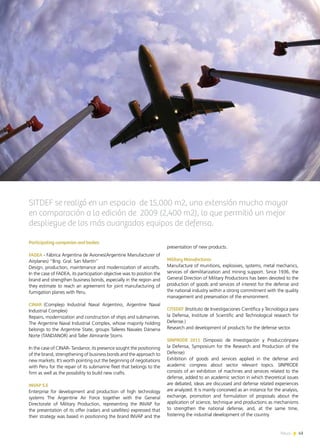
SITDEF 2011
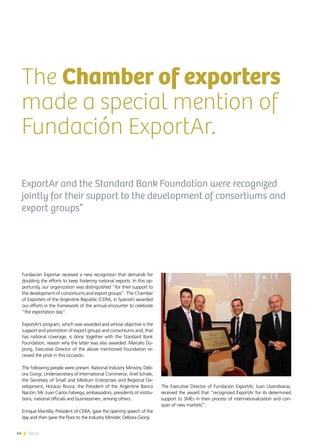
Special mention from CERA
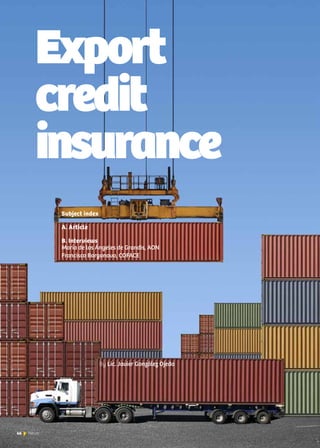
Dossier Export credit insurance
Special report San Juan
Interview Minister Raúl Benítez
Interview Lic. Leonardo Cesar Gioja
Export Group Conexport
5News
Erratum: on page 24 of the previous newsletter (July 2011), the article
about MICA should have said: “Fundación Exportarcoordinated jointly with
PROARGENTINA, and the Secretary of Culture a business space”.
6 News
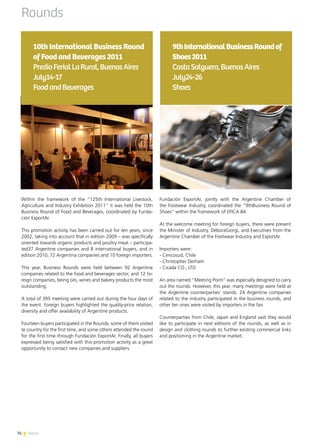
Anuga 2011 will take place in Colonia, Germany. It is a biennial
Fair on its 31st edition and it is considered one of the biggest of
the world for encompassing ten Fairs or specialized Pavilions under
the same ceiling, dedicated to the world of beverages and food.
Almost 300,000 square meters in the exhibition area and 150 pro-
fessional visitors and over 6,500 exhibitors from around 100 coun-
tries, make Anuga an interesting and attractive date for the pro-
motion and commercialization of products at a professional level.
Visitors will find monographic contests there. Anuga Fine Food,
sector dedicated to gourmet and delicatessen products, Anuga
Drinks, where all types of beverages will be exhibited, wines, non-
alcoholic beverages, beers, spirituous drinks, liquors, etc. In Anuga
Meat, attendants will find a big window dedicated to meat pro-
ducts and by-products. In Anuga Frozen Food, the star foods will
be frozen ones, Anuga Chilled & Fresh Food offers a wide space
regarding last edition, dedicated exclusively to fresh products, such
as vegetables, fruits, cold meat products, and fish, among others.
The exhibiting area of Anuga Dairy is the sector for dairy and by-
products, Anuga Bread & Bakery, Hot Beverages is the section
dedicated to hot beverages and patisserie and bakery, in Anuga
Organic the name speaks for itself, ecologic foods and products,
this is one of the spaces that capture most attention of German
professional visitors. In Anuga Retail Tec the technological equip-
ment and services for retail sales will be exposed. The tenth Pavi-
lion is Anuga Food Service, a place established for technological
applications for the world of foods and beverages, this sector also
encompasses services and products for catering and restoration.
Likewise, during the exhibition, the last trends in markets that are
becoming stronger will be exhibited, that’s why it’s not surprising
to see an area for white brands (own brands). Also, Halal foods
will be exhibited, the so-called functional foods, selected gourmet
products, regional specialties and exclusive foods for vegetarians,
among others.
Anuga 2011 will have an international business platform, a space
enabled to facilitate business transactions, tasting and presenta-
tion of new products.
Given the fact that 80% of exhibitors do not come from Germany,
the Fair becomes very international. Together with the most im-
portant European producing countries, during the last years, the
number of participants coming from Latin America has increased
continuously. According to the organizers themselves, Brazil, Ar-
gentina and even Mexico are the Latin American countries with
more presence.
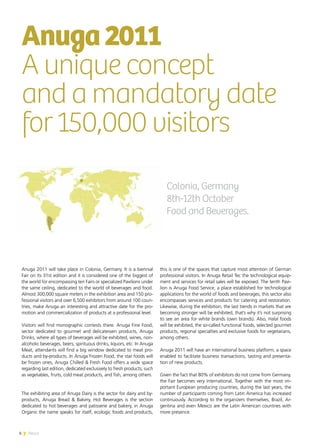
Anuga2011
A unique concept
and a mandatory date
for 150,000 visitors
Colonia, Germany
8th-12th October
Food and Beverages.
6 News
News 7
The concept of business Fair and the program that supports it are
designed in line with the products and needs of the sector of foods
and beverages coinciding with those of the companies. The con-
cept behind Anuga, introduced in 2003 and developed since then,
is unique and is designed to harmonize the needs of exhibitors and
visitors with those of the sector, producing a synergy that does not
take place anywhere else.
The event introduces the last trends of the sector. All products and
relevant concepts are present and it is only open for professionals
of the industry, where the purchasing power of visitors is the hig-
hest to be expected at a Fair.
Argentine Participation
Fundación Exportar and the Argentine Ministry of Agriculture, Li-
vestock and Fisheries, through the Promotion Project of Exports of
Argentine Agrofoods (PROARGEX) organize the National Pavilion
in the Fine sector, in Frozen Food and Bread and Bakery, in which
around 60 exporting firms will participate.
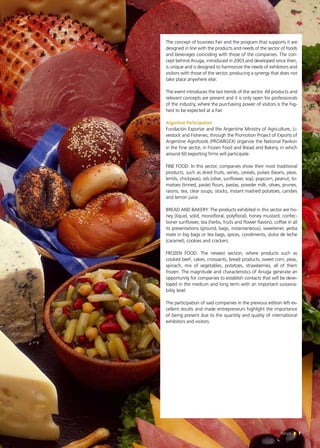
FINE FOOD: In this sector, companies show their most traditional
products, such as dried fruits, wines, cereals, pulses (beans, peas,
lentils, chickpeas), oils (olive, sunflower, soy), popcorn, peanut, to-
matoes (tinned, paste) flours, pastas, powder milk, olives, prunes,
raisins, tea, clear soups, stocks, instant mashed potatoes, candies
and lemon juice.
BREAD AND BAKERY: The products exhibited in this sector are ho-
ney (liquid, solid, monofloral, polyfloral), honey mustard, confec-
tioner sunflower, tea (herbs, fruits and flower flavors), coffee in all
its presentations (ground, bags, instantaneous), sweetener, yerba
mate in big bags or tea bags, spices, condiments, dulce de leche
(caramel), cookies and crackers.
FROZEN FOOD: The newest section, where products such as
cooked beef, cakes, croissants, bread products, sweet corn, peas,
spinach, mix of vegetables, potatoes, strawberries, all of them
frozen. The magnitude and characteristics of Anuga generate an
opportunity for companies to establish contacts that will be deve-
loped in the medium and long term with an important sustaina-
bility level.
The participation of said companies in the previous edition left ex-
cellent results and made entrepreneurs highlight the importance
of being present due to the quantity and quality of international
exhibitors and visitors.
7News
8 News
Germany presents the economic structure of a highly developed
country, where agriculture plays a small role in the GDP. The
industrial sector is in comparison much more important than in
other countries, but it is also losing importance compared to the
services sector, both in occupation as well as generation of added
value.
The primary German sector (agriculture, livestock, fisheries)
generates around 2.4% of the GDP. The national production can
cover approximately 80% of the domestic consumption needs;
the rest is covered with imports. The main crop is the cereal,
highlighting wheat, rye and barley; right after, comes forage
plants and oilseeds.
The industrial sector, mining industry, construction and water
supply and energy are grouped in the German statistics under the
name of production sector (Produzieren des Gewerbe). Its main
characteristics are high productivity, predominance of small and
medium enterprise and the strong orientation towards external
markets.
By activity branches the main importance corresponds to the most
classic industries like automobile, chemical sector, machinery,
electronic and electrical technology. Among other industries
at the peak, biotechnology can also be highlighted. It’s worth
mentioning that the main virtue of the German industry lays
probably in the capacity to apply most modern technologies to
most classic products.
The industrial sector in general and energy in particular has
been determined in the last few years by saving needs and
environmental standards. This can be translated in an ever-
increasing taxation of fossil fuels and the limitation in the rights
for emission of gas with greenhouse effect. On the other hand,
the use of renewable energies is being fostered for which very
cheap instruments have been created at the same time that the
research of these energies is subsidized.
Business exchange
The international trade of Germany is one of the most outstanding
ones in the world, only exceeded by United States and China. In
2010 its exports to all destinations reached records of 1, 27 billion
dollars while its imports exceeded 1, 06 billions.
Regarding sales, most part of them, 60% are sold to countries
within the UE, this is common for member countries, although in
most of them the percentage is 70%.
Among third countries to which Germany sells, we can find
United States and Eastern European countries. By products, the
great concentration of industrial goods is at the center, among
them, items of high added value. However, the German export is
much diversified.
The geographic distribution of international purchases is similar
to that of exports. The progression of imports from old Eastern
Countries calls the attention, as well as the progression registered
in the commerce with China. On the contrary, purchases from
Southeast Asia are comparatively less important.
Regarding bilateral exchange with Argentina, it’s worth pointing
out that Germany is currently the seventh destination of our
sales in importance. Argentine exports towards that country
reached amounts of 1,832 billion dollars in 2010, experiencing
Anuga2011
8 News
News 9
an outstanding performance in the last years, with increases of
+31.7% during the period (2009-2010) and of +35.2% during
the first semester of 2011.
The main exported item is the mineral of copper, which in 2010
represented 24% of all sales to Germany. However, there are
many food products that stand out among exports. The most
important ones are Meats, with sales of 350 million dollars in the
last year, Honey, Fresh Fruits and Wines.
Marketing and Logistics
There are numerous channels in the destination country, which
vary according to the different sectors. However, in general it
is possible to have agents or distributors, who act as retailers,
wholesalers and importers.
The mentioned agents usually resort to agency and distribution
agreements and impose exclusivity and competition clauses. Other
exporters prefer to avoid intermediaries and resort to options like
joint venture, franchises or licenses, or simply establish their own
offices in the target destination. In the same way, other links
of the distribution chain are e-commerce and phone sales for
most consumption products, widely spread among the German
population.
The available access network for logistics in Germany is very good;
in fact, it has the 7th biggest airport in the world, Frankfurt, and
a great range of sea and air services.
It’s worth pointing out that its airports, in general, are connected
to the rest of the cities by a wide network of highways and
railroads that speed up the delivery of goods. In general, the offer
Germanmarket
of services allows for all types of loading transport, although there
are some difficulties for bulk cargo transports.
Due to its strategic location, Germany has a wide and modern
port infrastructure, with over 60 ports and auxiliary subports,
open to manage loads. At the same time, it has over 18 airports
with customs facilities, and they have an infrastructure for the
administration and storage of loads, including cold storage and
protection of valuables.
Keys for a successful negotiation
The business culture in Germany stands out mainly because of
its formality, therefore it is extremely important to wear proper
clothing for a business meeting, be very formal in the treatment
and careful not to interrupt the speaker. It is also advisable to have
printed information available or brochures about the company
and/or the products offered.
Other aspects to keep in mind are punctuality and neatness, trying
to organize meetings many weeks ahead of time and during them
limit following the agenda agreed as well as strictly keeping the
times scheduled for the meetings.
9News
10 News
What are the main responsibilities of the Undersecretariat of Ameri-
can Economic Integration and MERCOSUR?
The Undersecretariat of American Economic Integration and
MERCOSUR, is carrying out the insertion of Argentina in the
global economic scene, through commercial exchanges and
economic agreements with the countries that integrate the
American continent, putting special emphasis on MERCOSUR.
The main objective is to intensify the presence of Argentine
products in existing economic markets, and of course work
to create new opportunities. Therefore, it is very important to
have a constant and direct contact with our businessmen.
Regarding the region, how do you characterize the current economic
and integration scenario?
I think that since the Administration of Néstor Kirchner and
Lula da Silva there was a strong momentum to integrate and
develop in the region that went hand in hand with progressive
governments, which makes Latin America to have a strategic
opportunity and to have abandoned the submission to any
other dominant power. At MERCOSUR level, our priority is to
perfect the Customs Union and consolidate the Common Fo-
reign Fee. We work assuming the asymmetries that exist within
the region, the gaps to the interior of each one of the countries,
to obtain clear standards for all the partners and generate the
highest possible balances. Regarding Argentina in particular,
our President has always defended balanced commerce and a
better distribution of globalization benefits. It is paramount to
keep building an inclusive MERCOSUR, with developed regio-
nal economies, common social policies and putting emphasis
on infrastructure, energetic integration and education.
Interview | Ambassador José Vitar
So keeping in mind what you are telling us, has this last period been
one of the most productive ones as far as international relations for
Argentina?
We have a government that has a very clear concept of regio-
nal and Latin American identity, and that has chosen an inser-
tion model linked to MERCOSUR and the region, our country
has never been more integrated to South America before. The
relationship with Brazil is strategic and paramount; it is our
main market and natural partner. We must jointly organize and
execute business promotion actions and programs. But the re-
lationship with other South American countries is also para-
mount, for instance the relationship with Chile, with which we
have a plan to develop bioceanic connectors that will connect
the region horizontally. Today, Argentina has a relationship
with the rest of the world that it had never imagined before:
presidential visits, business missions, participation in internatio-
nal organizations, presence in the G20 and the presidency of
the country in the G77 show that high insertion degree of our
country in the current international framework.
In case of adding Venezuela, how can that fact change, for instance,
the relationship with the United States?
With Venezuela, the MERCOSUR for us will be a true food
power, since our countries are among the main food expor-
ters of the planet. But, the incorporation of Venezuela to the
MERCOSUR will allow, above all, converting MERCOSUR in
an energetic power, something requested constantly by the
world. With the United States we want a mature and respect-
ful relationship, but we don’t share the action approach of
some countries of the region that sign Free Trade Agreement
with the United States, which complicates the integration and
keeps Latin American countries in a subordinated situation.
The region currently has a new opportunity to reverse certain
historic conditioning factors, and position ourselves as a bloc
with great quality and quantity of natural resources, and we
should take advantage of these.
We must build an
inclusiveMERCOSUR
10 News
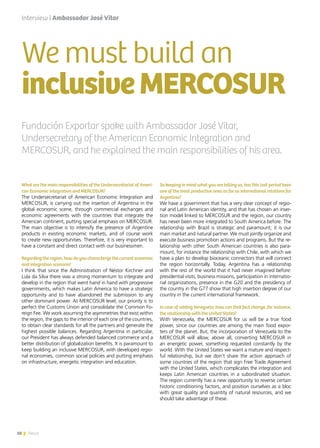
Fundación Exportar spoke with Ambassador José Vitar,
Undersecretary of the American Economic Integration and
MERCOSUR, and he explained the main responsibilities of his area.
News 11
How can the consolidation of UNASUR modify MERCOSUR objec-
tives?
Latin American integration and development must be carried
out taking advantage of all the organizations and tools that
the situation offers us. The UNASUR has a previous version in
the South American Community of Nations, and from its start
it was clear that the idea was to work in line and in a comple-
mentary manner with the existing organizations. In one of the
first meetings to debate this great regional endeavor, Cristina
Fernández de Kirchner, being a national Senator at that time,
debated with her colleagues Marco Aurelio García, from Brazil
and the former Chilean Ambassador Luis María, for instance,
about the importance of working together in infrastructure,
energy, social inclusion and education.
There is also the ALADI (Latin American Association for Integra-
tion), which had been somewhat negligent during the past but
has been given strong momentum appointing Chacho Álvarez
as General Secretary. This is a very important organization at a
regional level since almost all Latin American countries are in
it, and the incorporation of Panama and Nicaragua is currently
being analyzed and approved. Therefore, these three organiza-
tions shall jointly foster our region, open new negotiation and
business opportunities, with balanced and inclusive standards
for all member countries.
Talking about national economy, last month, a Delegation led by
you and other Ambassadors of the Chancellery, went to Tucuman,
what were the objectives of said trip?
The idea is that the Chancellery will not only act in the diplo-
macy sphere but that will also bring tools to entrepreneurs, in
this particular case the Undersecretary of American Economic
Integration and MERCOSUR. Provinces and regional econo-
mies must access the markets with increased productions. The
idea was to carry out a working day with different speeches
given by Ambassadors and Ministers. Then, each one of them,
with the members of their teams, gathered in different wor-
king tables to learn deeply about topics interesting for local
businessmen and that could be included in the working agen-
da of the Undersecretariat.
Is the Undersecretariat planning on continuing these trips throug-
hout the country under this same dynamic?
We are planning on going to the Argentine Northwest and
adding provinces like Entre Rios. From the Undersecretariat we
believe that speaking with businessmen is not only possible but
also necessary, a mechanism through which they tell us their
problems and needs of their business models so that Chance-
llery will be able to generate the necessary diplomatic relation-
ships, under the presidential mandate that Argentine exports
play an important role.
As a conclusion which do you think is the international economic
task that Argentina must work on?
It’s paramount to keep strengthening MERCOSUR, favoring
balances, assisting the industry and widening markets. In a
multipolar world, Argentina must continue being an intelli-
gent actor, reindustrializing and adding value to its exports, for
which the bilateral relationship with Brazil should be stronger;
but without setting aside social justice, equality and building
fairer societies.
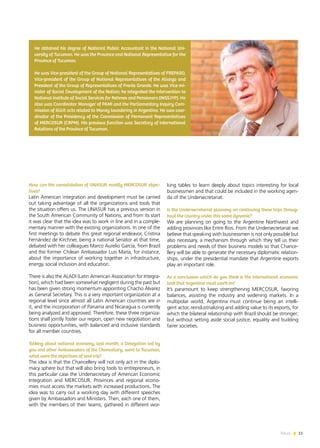
He obtained his degree of National Public Accountant in the National Uni-
versity of Tucuman. He was the Province and National Representative for the
Province of Tucuman.
He was Vice-president of the Group of National Representatives of FREPASO,
Vice-president of the Group of National Representatives of the Alianza and
President of the Group of Representatives of Frente Grande. He was Vice-mi-
nister of Social Development of the Nation; he integrated the Intervention to
National Institute of Social Services for Retirees and Pensioners (INSSJYP). He
also was Coordinator Manager of PAMI and the Parliamentary Inquiry Com-
mission of illicit acts related to Money laundering in Argentina. He was coor-
dinator of the Presidency of the Commission of Permanent Representatives
of MERCOSUR (CRPM). His previous function was Secretary of International
Relations of the Province of Tucuman.
11News
12 News
They stood out among their competitors due to quality and added
value. The company Owoko, of children’s clothing closed an
important business: they will open a store in Bogota.
The twenty-second edition of Colombia Moda took place in the
Center of Conventions Plaza Mayor in Medellin, Colombia. This
fair groups the international supply of the industry, being the
most important event of Latin America for professionals of the
sector.
Colombia Moda takes places annually and is conceived as an
international exhibition platform for all actors of the textile sec-
tor: clothing industry, distribution channels and other relevant
products for design and fashion.
In this opportunity, the Fair reached a total of 1,415 international
buyers, from 51 countries and a total of 9,428 visitors. Among
those who visited the Fair stood out Portugal, Argentina, Mexico,
South Africa, Russia, Arab Emirates, Italy, France, Spain, Great
Britain, Japan, Australia, Germany, Canada, Morocco and Tunisia.
Likewise, important groups of specialized buyers participated
such as boutiques and showrooms.
Fundación ExportAr, together with UPAEX and the Metropolitan
Center of Design of the City of Buenos Aires, participated with
a stand of 100 square meters, distributed in 4 sectored Argen-
tine Pavilions, together with designers selected by the Director
of Marketing, Clara Hernríquez. The selected designers were
Mariana Calve, Mariana Arbusti, Vestidor de Re inas, Ruma Za-
patos, Greta Flora Shoes, Alicia Fuhr, PuroZapatillas, Cosecha
Prendas Vintage Jesús Fernández, Leandro Domínguez, Narciso
Underwear, Cheeky, Mimo & CO, Grisino, Pwoko, Chelar Kids,
Pat-US, Chibel and Gato Tomas.
Promotion of Services | Colombia Moda
ArgentineDesigners
make a difference
inColombiaModa
12 News
News 13
Colombia Moda turned out to be a good market for Argentine
businessmen, who, were able to make a difference before their
competitors due to the quality of their products and added value
of the design. The general opinion of those who participated in
the stand was that the Fair turned out to be a great opportunity
to promote their products in the international fashion market,
which has shown constant growth in the last few years. The in-
sertion of new products is at the peak, contrary to what is hap-
pening in the European market.
Starting from a more democratic concept of what fashion is and
from acknowledging the diversity in the sector, Inexmoda de-
cided to renew and redesign the structure of Colombia Moda
reinforcing its commercial aspect and adding the sector “New
Business and Franchises”, where Owoko, Cheeky, Grisino, Narci-
so Underwear, Mimo and Chibel, were able to offer their franchi-
sing projects through meetings. There was a success story there
since Owoko will be opening a store in the city of Bogota.
Among the gathered data in the fair, it is worth pointing out that
there were 3,759 national buyers and 3,786 national visitors. The
total of visitors was 8,013 people, while there was a record of
709 independent buyers and 1,415 foreign people visited the
fair. The total number of people that entered the fair was 9,428,
according to what organizers registered.
Regarding the business balance, according to organizers of the
Fair, 92% of these buyers declared to be satisfied with Colombia
Moda and did businesses. Likewise, for 35% of them it was their
first experience in the Fair.
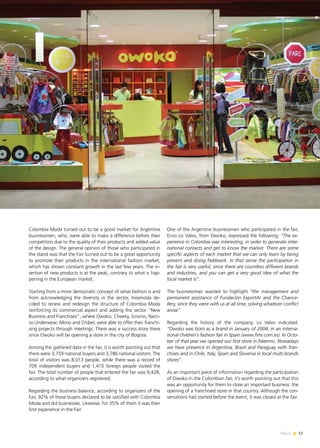
One of the Argentine businessmen who participated in the fair,
Enzo Lo Valvo, from Owoko, expressed the following: “The ex-
perience in Colombia was interesting, in order to generate inter-
national contacts and get to know the market. There are some
specific aspects of each market that we can only learn by being
present and doing fieldwork. In that sense the participation in
the fair is very useful, since there are countless different brands
and industries, and you can get a very good idea of what the
local market is”.
The businessman wanted to highlight “the management and
permanent assistance of Fundación ExportAr and the Chance-
llery, since they were with us at all time, solving whatever conflict
arose”.
Regarding the history of the company, Lo Valvo indicated:
“Owoko was born as a brand in January of 2004, in an interna-
tional children’s fashion fair in Spain (www.fimi.com.es). In Octo-
ber of that year we opened our first store in Palermo. Nowadays
we have presence in Argentina, Brazil and Paraguay with fran-
chises and in Chile, Italy, Spain and Slovenia in local multi-brands
stores”.
As an important piece of information regarding the participation
of Owoko in the Colombian fair, it’s worth pointing out that this
was an opportunity for them to close an important business: the
opening of a franchised store in that country. Although the con-
versations had started before the event, it was closed at the fair.
13News
Narciso overcame a
great challenge
One of the Argentine companies that attended Colombia Moda
and came back very satisfied due to their achievements in the
event was Narciso Underwear, an innovating company that does
lingerie. Although in the host country and in Venezuela there
is great development of this industry, since the market is very
demanding regarding quality and variety, Narciso trusted their
product and went there with the intention of conquering new
markets. The result was great, according to what Sabina Tolaba
told us.
“It was actually a very good experience from the commercial
perspective and any other aspect. We were somewhat hesitant
taking into account that our industry, lingerie, is very strong in
Colombia. But being there and carrying out a market research,
we were able to identify the advantages of our product
compared to the more relevant products and brands known in
that country, and that encouraged us more to continue with our
participation”, indicated Sabina.
Regarding the fair in particular, the representative of Narciso said:
“We had good space to show our product. Our brand is particularly
characterized by the variety of designs and colors, which we
had to highlight when bringing our brand to other countries. In
previous fairs, where, we had the chance to participate through
Fundación ExportAr (for instance, in Panama) we have earned a
lot of experience in order to have solid foundations. Therefore,
we armed ourselves with tools such as banners, flyers, promotion
material, dummies, decoration, and exhibitors, trying to obtain
the same concept of our stores and take it into a stand. The
result was naturally derived from all this: we had the presence
of potential customers from different parts of the world, such
as Costa Rica, Spain, Ecuador, Peru, among others. They showed
great interest in the acquisition of our product, since upon seeing
them they were able to identify what they were lacking in their
own markets.
We are talking about companies that have been around over
ten years in the lingerie business, and who, upon seeing and
analyzing Narciso’s products, focused on niche markets that they
hadn’t considered before. Therefore, we put special emphasis
on those aspects that the market has nowadays left aside and
we were able to point out the ways to recover them, and take
advantage of the benefit that this industry might represent to
them”.
“So we are working precisely on the database of potential
customers, trying to generate results with the contacts that we
have identified and creating business opportunities that might
be carried out, depending on the need of each one of them”,
added Tolaba, who also highlighted “the great work done by the
Chancellery and the assistance of Fundación ExportAr”.
“One of our advantages, that we cannot forget to mention,
was being able to give product samples to potential customers.
That guarantees, in the first place, that we’ll be able to take the
second step with them. The fact that they have the end product
in their hands and they can feel it and try it on is a tool that we
also use to captivate our customer. We were able to give out a
lot for that purpose in this fair”, Sabina concluded, and she did
not hide her eagerness to keep participating in this and other
International Fairs with the intention of enlarging the markets of
Narciso. “We feel like we have more and more tools and a better
preparation to attend these events”, she pointed out.
They weren’t sure about participating because they thought it
would be very difficult to sell lingerie in a market where the industry
is very developed, but they did great and seduced buyers with their
original and colorful designs.
Promotion of Services | Colombia Moda
14 News
Quality, innovation, originality… those are some of the attributes
of Ruma, a company that was born in early 2003 to produce “hau-
te-couture shoes”. María Giannone, designer, coordinator and
owner of the company, has come back very excited after her par-
ticipation in Colombia Moda, where she went with the assistan-
ce of ExportAr. The “customized” shoes they make attracted the
interest of buyers from the United States, Ecuador, Peru, Puerto
Rico, among others. What do you mean by “personalized” shoes?
María explains it like this: “A woman should have the proper hair
and the proper shoes, my mom used to say and that’s the leitmotiv
of my professional career. That’s why I grew up with customized
shoes, ever since I was little”.
How was the company born?
Ruma shoes were created from the need of doing a different pro-
duct for today’s women. It’s a brand that worried and took care of
design from the very beginning, as well as the quality and dura-
bility of their pieces, turning them into exclusive and personalized
designs for each person who came to Ruma.
Why did you get involved in this industry?
I made incursions in the fashion world learning from the best social
photographers, the publishing production and the artistic make
up. The roots helped me learn deeply about this art. My grand-
mother designed wedding dresses and my mother embroidered
trousseaus. “A woman must have the proper hair and the proper
shoes”, that was my mom’s motto and is the leitmotiv of my pro-
fessional career. That is why I grew up with customized shoes, ever
since I was little. It is cultural, it is tradition, and it is life.
What characterizes Ruma?
Ruma is characterized by designs that are extremely feminine,
fancy and with their unique twist, using the seeding technique.
Thanks to our craftsmen’s labor we manage to revalue craftwork,
recreating true pieces of Haute Couture in shoes. That is why we
are pioneers; nobody has done Haute couture in shoes before.
Can you explain the seeding technique?
Seeding is the technique that craftsmen use when making the
shoes. The seed is a small lead nail to be clinched between the
insole and the panel of the shoetree.
What goals have you met up to now?
During the past few years, we have met some very significant
goals for us. We have been invited by haute couture designers to
share the runway, as well as different places like: movies, theater
and TV. Ruma shoes have been recently invited again to be the
brand of BAAM 35 Argentina Fashion Week.
Which TV show are you currently working with?
We are pleased to be making shoes for the characters played by
Leticia Brédice, Mónica Antonópulos, Paula Kohan, Calu Rivero
and María Carámbula, among others, of the daily TV show “El
Elegido” in Telefé channel.
What are Ruma’s immediate projects?
One of our projects is to expand Ruma in the interior of the coun-
try and abroad. Here I want to share our experience in Colombia
Moda 2011, since we were able to show what we do in Argentina
in other country and to other places. Ruma is the first brand that
was incorporated in the world of Swarosvki Elements Partners,
achieving products of excellence.
How was the experience in Colombia?
It was great to see how people came to the stand of Argentine
Leather Goods Design, where five brands with very different styles co-
habitated. In Ruma we received potential buyers from countries such
as the United States, Ecuador, Peru and Puerto Rico among others.
I can tell you, in my case in particular, we had visits from haute
couture designers, image consultants from Bogota and the head
of sales from a well-known store chain from Guayaquil, among
others. We hope to see this new experience reflected in the next
months in new businesses.
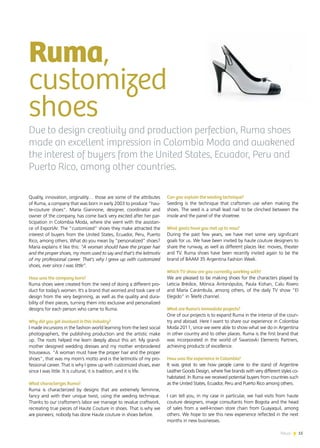
Ruma,
customized
shoes
Due to design creativity and production perfection, Ruma shoes
made an excellent impression in Colombia Moda and awakened
the interest of buyers from the United States, Ecuador, Peru and
Puerto Rico, among other countries.
15News
16 News
Around twenty food companies from the province of Buenos
Aires closed businesses with their Colombian counterparts in a
commercial mission to Bogota. Companies had the support, both
technically and economically, from the province, and the mission
was organized together by the Ministry of Production, the Minis-
try of Agriculture, Livestock and Fisheries of the country, through
the Project for the Promotion of Exports of Agri Argentinos
(PROARGEX) and Fundación ExporAr.
According to what the Minister of the provincial Production ex-
plained, “nowadays Buenos Aires has what it takes to be one of
the main food suppliers in the world, with high quality and great
added value and, in the case of this mission, many businessmen
already contacted Colombian distributing chains and many have
started certification processes to position their products”. Minister
Martín Ferré explained “from our side we are developing a plan
for services and activities for the production sector, fostering com-
petitive insertion of the Province in international markets”.
The commercial mission was led by the Undersecretary of Interna-
tional Economic Relations of the provincial production portfolio,
Bruno Tomaselli, and had the participation of around twenty food
companies from Quilmes, Tandil, Coronel Dorrego, Tornquist, Es-
cobar, San Isidro, Vicente Lopez, Bahia Blanca, Lomas de Zamora,
La Matanza and La Plata, and took part in about 120 business
meetings with their local counterparts.
The Argentine Ambassador in Colombia, Martín Balza, greeted
members of the mission. There was a breakfast event in which
the Ambassador spoke about the economic, political and social
situation of the country and he put special emphasis on every
single sector involved in the business trip.
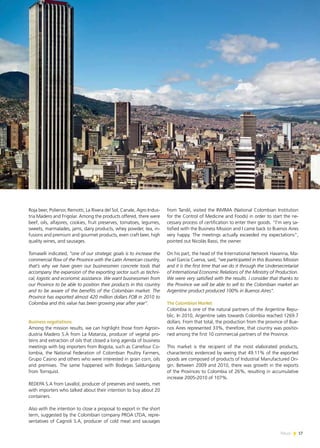
Among the ones with most notable presence, we can mention
Havanna, Oligra, Cagnoli, Biolive, Bodegas Sadungarav, Barba
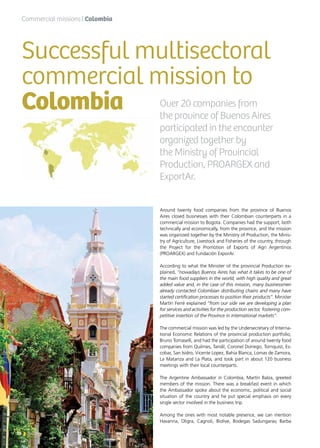
Successful multisectoral
commercial mission to
Colombia Over 20 companies from
the province of Buenos Aires
participated in the encounter
organized together by
the Ministry of Provincial
Production, PROARGEX and
ExportAr.
Commercial missions | Colombia
16 News
News 17
Roja beer, Polienor, Remotti, La Rivera del Sol, Canale, Agro Indus-
tria Madero and Frigolar. Among the products offered, there were
beef, oils, alfajores, cookies, fruit preserves, tomatoes, legumes,
sweets, marmalades, jams, dairy products, whey powder, tea, in-
fusions and premium and gourmet products, even craft beer, high
quality wines, and sausages.
Tomaselli indicated, “one of our strategic goals is to increase the
commercial flow of the Province with the Latin American country,
that’s why we have given our businessmen concrete tools that
accompany the expansion of the exporting sector such as techni-
cal, logistic and economic assistance. We want businessmen from
our Province to be able to position their products in this country
and to be aware of the benefits of the Colombian market. The
Province has exported almost 420 million dollars FOB in 2010 to
Colombia and this value has been growing year after year”.
Business negotiations
Among the mission results, we can highlight those from Agroin-
dustria Madero S.A from La Matanza, producer of vegetal pro-
teins and extraction of oils that closed a long agenda of business
meetings with big importers from Bogota, such as Carrefour Co-
lombia, the National Federation of Colombian Poultry Farmers,
Grupo Casino and others who were interested in grain corn, oils
and premixes. The same happened with Bodegas Saldungaray
from Tornquist.
REDEPA S.A from Lavallol, producer of preserves and sweets, met
with importers who talked about their intention to buy about 20
containers.
Also with the intention to close a proposal to export in the short
term, suggested by the Colombian company PROA LTDA, repre-
sentatives of Cagnoli S.A, producer of cold meat and sausages
from Tandil, visited the INVIMA (National Colombian Institution
for the Control of Medicine and Foods) in order to start the ne-
cessary process of certification to enter their goods. “I’m very sa-
tisfied with the Business Mission and I came back to Buenos Aires
very happy. The meetings actually exceeded my expectations”,
pointed out Nicolás Bassi, the owner.
On his part, the head of the International Network Havanna, Ma-
nuel García Cuerva, said, “we participated in this Business Mission
and it is the first time that we do it through the Undersecretariat
of International Economic Relations of the Ministry of Production.
We were very satisfied with the results. I consider that thanks to
the Province we will be able to sell to the Colombian market an
Argentine product produced 100% in Buenos Aires”.
The Colombian Market
Colombia is one of the natural partners of the Argentine Repu-
blic. In 2010, Argentine sales towards Colombia reached 1269.7
dollars. From that total, the production from the province of Bue-
nos Aires represented 33%, therefore, that country was positio-
ned among the first 10 commercial partners of the Province.
This market is the recipient of the most elaborated products,
characteristic evidenced by seeing that 49.11% of the exported
goods are composed of products of Industrial Manufactured Ori-
gin. Between 2009 and 2010, there was growth in the exports
of the Provinces to Colombia of 26%, resulting in accumulative
increase 2005-2010 of 107%.
17News
18 News
What tasks do you perform to improve food quality?
The National Service of Agrifood Health and Quality (SENASA) is a
decentralized agency of the Ministry of Agriculture, Livestock and
Fisheries.
Its mission is to implement policies regarding health and quality
of animals and vegetables towards the agriculture sector for the
production of safe food for human and animal consumption. It is
also under its scope to maintain and improve animal and vegeta-
ble health, control federal traffic, imports and exports of products,
subproducts, and derivatives or animal and vegetable origin, agri-
food, pharmaceutical-veterinary, agrochemicals, and fertilizers
products.
In this regard, it designs, organizes, and executes rules, programs
and specific plans that regulate production towards safe foods for
human and animal consumption. Our work is crucial to maximize
the management of competitiveness of value chains that make up
national production and agroindustry.
What controls are being implemented?
There are many and different controls according to different fields.
SENASA controls federal traffic, imports and exports of products,
subproducts, and derivatives or animal and vegetable origin, agri-
food, pharmaceutical-veterinary, agrochemicals, and fertilizers
products. Controls are applied by national directorates and regio-
nal centers.
Given the role of Argentina as one of the principal producers of
safe and quality food in the world, SENASA works actively to satis-
fy the demand of its functions adapting its institutional capacity by
strengthening its vast technical network and support services for
the national agriculture production, which is reflected on the near
5000 agents working in different areas throughout the country,
the creation of the National Laboratory Network – integrated by
more than 400 authorised public and private laboratories, own la-
boratories and regional experimental fields, integrally coordinated
by the General Directorate of Laboratories and Technical Control,
digital connection of all regions by taking advantage of new com-
munication and information technologies, provision of equipment
and automobiles to perform the full exercise of its duties.
What is the role SENASA performs when going to fairs with
ExportAr?
During 2011, SENASA participates in many international fairs and
exhibitions worldwide with the purpose of giving assistance to ex-
porters and importers on health food requirements imposed by
the Argentine Republic. Likewise, the agency widens its regional
vision while attending these international events and furthering
its main goal that is to strengthen the role of the State as regards
animal and vegetable health, food safety, and protection of the
environment.
Definite insertion of Argentina in the international food market
and due attention to the domestic market applying similar requi-
rements to those of foreign markets, depend on the adoption of
modern trends in food quality and its institutional designs. This is
what we disseminate in international fairs.
How do you coordinate tasks with different sanitary control
agenciesfromothercountriestofacilitatetheexportofourproducts
to international markets?
SENASA carries out, together with the Ministry of Agriculture, Li-
vestock and Fisheries and the Ministry of Foreign Affairs, Interna-
tional Trade and Worship, the steps to maintain the markets of
agrifood products for our country and to further new destinations.
Within this framework, we receive auditing missions to verify pro-
duction systems in our country and the control SENASA exercises
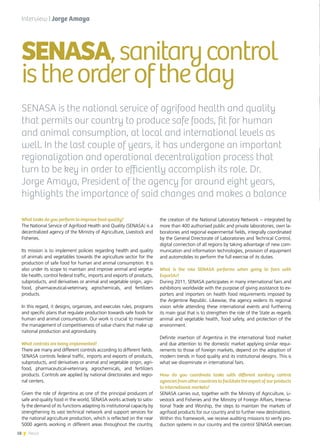
SENASA,sanitarycontrol
istheorderoftheday
SENASA is the national service of agrifood health and quality
that permits our country to produce safe foods, fit for human
and animal consumption, at local and international levels as
well. In the last couple of years, it has undergone an important
regionalization and operational decentralization process that
turn to be key in order to efficiently accomplish its role. Dr.
Jorge Amaya, President of the agency for around eight years,
highlights the importance of said changes and makes a balance
Interview | Jorge Amaya
18 News
News 19
over them. Our agency is responsible for establishing, together
with sanitary services from buyer countries, sanitary protocols that
export products of animal and vegetable origin must meet.
What are the different areas of SENASA?
SENASA is organized under a Directive Board made up by the Pre-
sident, Vice President and General Manager, and different perfor-
ming units organized under national directorates, directorates and
coordination divisions divided according to fields of competence
such as animal and vegetable health, food safety, agrochemicals,
veterinary products and foods for human and animal consump-
tion, laboratory and technical control.
Since 2003, SENASA started a transformation process which inclu-
ded its institutional stabilization, regionalization and operational
decentralization, computerizing its offices and permanent training
of staff, thereby consolidating this new organization structure. Our
agency has to be continuously under a training process.
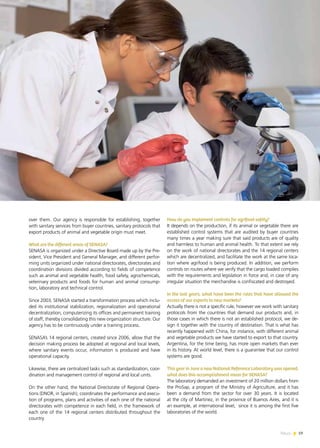
SENASA’s 14 regional centers, created since 2006, allow that the
decision making process be adopted at regional and local levels,
where sanitary events occur, information is produced and have
operational capacity.
Likewise, there are centralized tasks such as standardization, coor-
dination and management control of regional and local units.
On the other hand, the National Directorate of Regional Opera-
tions (DNOR, in Spanish), coordinates the performance and execu-
tion of programs, plans and activities of each one of the national
directorates with competence in each field, in the framework of
each one of the 14 regional centers distributed throughout the
country.
How do you implement controls for agrifood safety?
It depends on the production, if its animal or vegetable there are
established control systems that are audited by buyer countries
many times a year making sure that said products are of quality
and harmless to human and animal health. To that extent we rely
on the work of national directorates and the 14 regional centers
which are decentralized, and facilitate the work at the same loca-
tion where agrifood is being produced. In addition, we perform
controls on routes where we verify that the cargo loaded complies
with the requirements and legislation in force and, in case of any
irregular situation the merchandise is confiscated and destroyed.
In the last years, what have been the rules that have allowed the
access of our exports to new markets?
Actually there is not a specific rule, however we work with sanitary
protocols from the countries that demand our products and, in
those cases in which there is not an established protocol, we de-
sign it together with the country of destination. That is what has
recently happened with China, for instance, with different animal
and vegetable products we have started to export to that country.
Argentina, for the time being, has more open markets than ever
in its history. At world level, there is a guarantee that our control
systems are good.
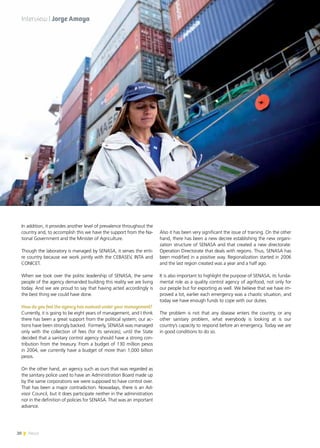
This year in June a new National Reference Laboratory was opened,
what does this accomplishment mean for SENASA?
The laboratory demanded an investment of 20 million dollars from
the ProSap, a program of the Ministry of Agriculture, and it has
been a demand from the sector for over 30 years. It is located
at the city of Martinez, in the province of Buenos Aires, and it is
an example, at international level, since it is among the first five
laboratories of the world.
19News
20 News
In addition, it provides another level of prevalence throughout the
country and, to accomplish this we have the support from the Na-
tional Government and the Minister of Agriculture.
Though the laboratory is managed by SENASA, it serves the enti-
re country because we work jointly with the CEBASEV, INTA and
CONICET.
When we took over the politic leadership of SENASA, the same
people of the agency demanded building this reality we are living
today. And we are proud to say that having acted accordingly is
the best thing we could have done.
How do you feel the agency has evolved under your management?
Currently, it is going to be eight years of management, and I think
there has been a great support from the political system; our ac-
tions have been strongly backed. Formerly, SENASA was managed
only with the collection of fees (for its services); until the State
decided that a sanitary control agency should have a strong con-
tribution from the treasury. From a budget of 130 million pesos
in 2004, we currently have a budget of more than 1,000 billion
pesos.
On the other hand, an agency such as ours that was regarded as
the sanitary police used to have an Administration Board made up
by the same corporations we were supposed to have control over.
That has been a major contradiction. Nowadays, there is an Ad-
visor Council, but it does participate neither in the administration
nor in the definition of policies for SENASA. That was an important
advance.
Also it has been very significant the issue of training. On the other
hand, there has been a new decree establishing the new organi-
zation structure of SENASA and that created a new directorate:
Operation Directorate that deals with regions. Thus, SENASA has
been modified in a positive way. Regionalization started in 2006
and the last region created was a year and a half ago.
It is also important to highlight the purpose of SENASA, its funda-
mental role as a quality control agency of agrifood, not only for
our people but for exporting as well. We believe that we have im-
proved a lot, earlier each emergency was a chaotic situation, and
today we have enough funds to cope with our duties.
The problem is not that any disease enters the country, or any
other sanitary problem, what everybody is looking at is our
country’s capacity to respond before an emergency. Today we are
in good conditions to do so.
20 News
Interview | Jorge Amaya
News 21News News 21
For further information:
www.senasa.gov.ar
0800-999-2386
Fundación ExportAr Agreement
Senasa at
international
exhibitions
The National Service of Agrifood Health and Quality (Senasa) takes part in
different national and international exhibitions, in order to give advice to
exporters and importers of agrifood on phytosanitary requirements that the
Argentine Republic and buyer countries of said products demand.
Under the agreement between Fundación ExportAr and Senasa, a decentralized organization of the Ministry
of Agriculture, Livestock and Fisheries of the nation, during 2011 Senasa will participate in different fairs and
exhibitions at national and international levels, to give advice to agrifood exporters and importers about phytos-
anitary requirements that the Argentine Republic and buyer countries demand of said products.
It is very common for the Senasa to show its activities in different national fairs. With this agreement the au-
thorities of this organization decided to widen the scope and participate in well known international exhibitions
related to the agrifood industry and contribute to the development of the international trade for these products.
The purpose of this agreement between the two organizations is to implement the necessary means and actions
to reach a mutual technical complementation and carry out in a coordinated way projects in areas of mutual
interest, working in cooperation through different activities.
To this regard, the Senasa and Fundación ExportAr jointly assist to the small and medium agrifood exporter
abroad, as well as boosting imports, in matters related to quality and health in agrifood.
This joint work permits to collaborate in the design of the necessary conditions for the development of actions
towards the fulfilment of the policies set forth by the national government as regards exports.
Thus the Senasa widens its regional scope by participating at these international meetings, adapting and accom-
panying its main goal that is to strengthen the role of the state on animal and vegetable health, food safety and
environment care.
22 News
What is the mission of the Association?
To protect production, national workforce, and the Argentine eco-
nomic sovereignty in every aspect related to international trade
through an inter-institutional work free of any political position,
political party or industry, which is based on the founding ideas of
AIERA. Our vision is to foster entrepreneurial participation within
the widest range of national thinking. Our management is made
up by those who share the same ideals of the association and
show commitment, honesty and civic courage.
What are the objectives of AIERA?
To contribute fostering Argentine international trade throughout
its different sectors: primary, industrial and services; fostering the
competitive capability of national companies in external markets
focusing on national manufacturers and SMEs. Establishing and
strengthening foreign trade relations. Promoting state policies that
allow Argentine exports to have a fair treatment in foreign mar-
kets. Increase the diversification of exportable goods and services.
Foster the Common Latin-American Market. Cooperate with the
State while studying and solving problems related to international
trade acting in our capacity as agents of our associates. Envisa-
ge an Importers Regime that promotes a favorable competition
towards Argentine production and the provision of inputs neces-
sary for the Argentine industry. Support Argentine representations
abroad and foreign representations in our country in promotion
activities such as: congresses, conventions, fairs, exhibitions and
commercial missions abroad. Conduct and publish surveys related
to Argentine international trade. Teach specialization courses in
International trade in the country and abroad by means of conven-
tional classroom classes, distance classes, virtual classes and by any
electronic means. Develop innovations in international trade such
as issuance of Certificates of Origin and Export not only printed
but in electronic format as well, from MERCOSUR and Extra-zone.
Interact with other entrepreneurial union entities in order to achie-
ve shared objectives, maintaining the necessary independence of
actions.
What are the pending issues for AIERA?
Though in the last years exports of industrial origin have been
growing (this year we have had an increase of 3 more points) we
Addedvaluetoexports
togrowandachievea
betterqualityoflife
Interview | Daniel Solda, AIERA
“It has been years since SMEs lived a welfare situation
such as the current one”, stated Lic. Daniel Solda, President
of the Association of Importers and Exporters of the
Argentine Republic (AIERA, in Spanish). This entity was
one of the founders of ExportAr and is also member of the
Administration Board.
22 News
News 23
still have to overcome the deficit we have. We are growing and it
shows. The Ministry of Industry works very well towards that end.
Deficit cannot be fixed overnight, but if we increase 3 points every
year it is very important. We want to accept the challenge the
model proposes: bet towards a country with more added value in
exports. That is a political decision of AIERA, based on a real situa-
tion. As regards this, we are already thinking to propose a course
so the provinces can be incorporated to added value exports. This
is something we owe to the society: that provinces be at a same
level. We believe that export with greater added value and a balan-
ced production system and trade will make our country continue
growing and that society improves more and more its level of life.
We strongly believe that we can have a better country, with ba-
lance and equity.
What are the main activities of the Association?
In AIERA we have a certain amount of partners and give advice to
entrepreneurs of SMEs seeking markets, to do so we count with
the support from the Ministry of Foreign Affairs and Fundación
ExportAr. We have a consulting department available for all entre-
preneurs, whether members or not.
As regards training, how do you work?
Regarding training we have a division for training entrepreneurs.
For more than 22 years we have been offering an intensive cour-
se in international trade, that it is always updated. There are two
modalities of the course: conventional classroom classes 4 times a
year, and distance classes 8 times a year. We also have seminars
about the latest regulations in force.
What are other services you provide for entrepreneurs?
We issue certificates of origin that state the product is made in
Argentina and comes from Argentina. We are one of the 4 or 5
entities that issue certificates highly appreciated by companies. We
also take on the defense of union actions for the sector. If there is a
problem or there is something wrong we demand a modification.
What is your opinion about the current economic model?
We really agree with the model which has been implemented in
recent years and believe that added value to exports generates a
better distribution of income and a wider demand of highly skilled
workforce. So employment increases and makes the country grow.
We think when there is greater added value the society’s level of
life improves. This makes the country richer, in the broadest sense
of the term.
What is your analysis about the current moment of the economy?
I think SMEs are having a great moment. For many years I have not
sensed a moment like this. Exports are growing steadily. We have
to be aware of the crisis going on in those countries we traditio-
nally export to. We are suggesting entrepreneurs to start focusing
on emerging markets, where 80 percent of the growth has taken
place in the last four years, such as BRIC and Eastern countries.
Do you think the European and American crisis will have an impact
in our country?
I do not think it will affect us profoundly because the current eco-
nomic model is aimed at developing the domestic market. We
strongly support this model. I think we are well prepared with re-
serves and trade surplus and fiscal surplus as well.
We are neither indebted at the figures we were before nor are we
dependent on international lending bodies, all which is very good.
And I think we have a good defense. Now is up to entrepreneurs
to react and start seeking other non-traditional markets. In this
regard, it is worth mentioning that delegations and commercial
missions are departing to BRICs and Eastern countries. If there is
support, entrepreneurs wishing to grow and have more profits,
will take advantage of this support.
There are some unshakeable figures from the real life: for instan-
ce, in 2002 we had half the production apparatus without any
demand. Nowadays 85 percent of the production is working. Of
course, we have to take provisions to continue growing. Inves-
tment is also necessary too. We have to go out and seek new
markets without neglecting the old ones. The support from the
State is there and entrepreneurs are taking advantage of it. They
should also take some risks in investments.
Do you think that the current regional economic situation makes us
more competitive?
The exchange rate is pretty good. Our neighbors are appreciating
their currencies. We are in a mix that makes us become competi-
tive. Small devaluations allow us to be better. We do believe it is
necessary to introduce some modifications related to the financial
system, since the old regulation is not prepared for SMEs to enjoy
affordable and cost-effective loans. They prefer to extend loans to
credit card holders, because it is less risky and has a higher interest
rate. There is a bill at the Congress that should be pursued.
This is a special year for you, isn’t it?
Yes, it is because we turn 45 and we have initiated a call for uni-
versities and institutions, and we will give three awards between
those who present the best project related to the promotion of
added value exports. A total of twenty companies and 68 uni-
versities from all over the country submitted their projects, so we
are very happy about the great interest displayed. I would like to
highlight the support we have received from Banco Nación Argen-
tina, SEPYME, Federal Council of Investment and the Argentine
Foreign Affairs Ministry, through ExportAr. This is an opportunity
we are very proud of and makes us feel very optimistic towards
the future.
AIERA is a business union organization made up by small
and medium national companies, as well as regional and
sectoral Chambers. The companies that are members of
the entity are mainly SMEs of national capital that carry
out activities related to imports and/or exports. They be-
long to a variety of fields including manufacturers and
services providers in foreign trade. In this opportunity we
interviewed their president, Daniel Solda.
23News
24 News24 News
News 25
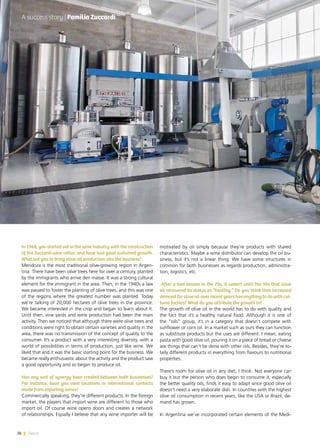
Olive oil
Familia
Zuccardi,
quality as
strategy
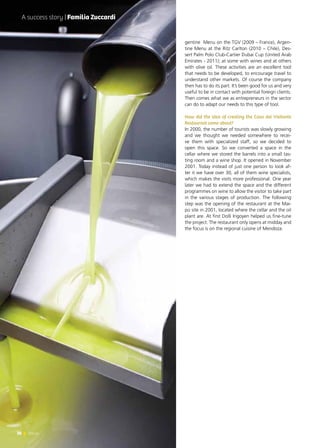
In 1968, Familia Zuccardi started out in the wine
industry in Mendoza and, since 1999, has been
producing top-of-the-range wines. Recognized around
the world for its policy on quality, Familia Zuccardi felt
it could do more and so diversified in 2004 by entering
the extra virgin olive oil business under the leadership
of Miguel Zuccardi, the youngest member of the new
generation. In a face-to-face interview, this agricultural
engineer reveals the company’s enthusiasm for the
activity. Qualities, limits and possibilities of a product
that is still finding its place in the world.
A success story
25News
26 News
motivated by oil simply because they’re products with shared
characteristics. Maybe a wine distributor can develop the oil bu-
siness, but it’s not a linear thing. We have some structures in
common for both businesses as regards production, administra-
tion, logistics, etc.
-After a bad season in the 70s, it wasn’t until the 90s that olive
oil recovered its status as “healthy.” Do you think that increased
demand for olive oil over recent years has anything to do with cul-
tural factors? What do you attribute the growth to?
The growth of olive oil in the world has to do with quality and
the fact that it’s a healthy natural food. Although it is one of
the “oils” group, it’s in a category that doesn’t compete with
sunflower or corn oil. In a market such as ours they can function
as substitute products but the uses are different. I mean, eating
pasta with good olive oil, pouring it on a piece of bread or cheese
are things that can’t be done with other oils. Besides, they’re to-
tally different products in everything from flavours to nutritional
properties.
There’s room for olive oil in any diet, I think. Not everyone can
buy it but the person who does begin to consume it, especially
the better quality oils, finds it easy to adapt since good olive oil
doesn’t need a very elaborate dish. In countries with the highest
olive oil consumption in recent years, like the USA or Brazil, de-
mand has grown.
In Argentina we’ve incorporated certain elements of the Medi-
In 1968, you started out in the wine industry with the construction
of the Zuccardi wine cellar, and have had good sustained growth.
What led you to bring olive oil production into the business?
Mendoza is the most traditional olive-growing region in Argen-
tina. There have been olive trees here for over a century, planted
by the immigrants who arrive den masse. It was a strong cultural
element for the immigrant in the area. Then, in the 1940s a law
was passed to foster the planting of olive trees, and this was one
of the regions where the greatest number was planted. Today
we’re talking of 20,000 hectares of olive trees in the province.
We became interested in the crop and began to learn about it.
Until then, vine yards and wine production had been the main
activity. Then we noticed that although there were olive trees and
conditions were right to obtain certain varieties and quality in the
area, there was no transmission of the concept of quality to the
consumer. It’s a product with a very interesting diversity, with a
world of possibilities in terms of production, just like wine. We
liked that and it was the basic starting point for the business. We
became really enthusiastic about the activity and the product saw
a good opportunity and so began to produce oil.
Has any sort of synergy been created between both businesses?
For instance, have you used locations or international contacts
made from exporting wines?
Commercially speaking, they’re different products. In the foreign
market, the players that import wine are different to those who
import oil. Of course wine opens doors and creates a network
of relationships. Equally I believe that any wine importer will be
A success story | Familia Zuccardi
26 News
News 27
terranean cuisine into our diet, meaning that as people get to
know olive oil, its use and demand increase. There are great pos-
sibilities for the product all over the country. Our challenge is to
boost consumption of olive oil, but high quality oil.
Was the increase in the local production of olive oil supported by
any tax incentives?
In the 1990s a series of tax incentives in certain provinces like
San Juan, La Rioja and Catamarca were introduced to support
the development of new olive-growing areas. It became one of
the most commonly planted crops at that time. Today the activity
is in a difficult position due to the agricultural subsidies paid in
the European Community. There are unreal prices in the market;
countries like Spain, for example, sell the product at prices ap-
proaching cost. When it comes to exporting, this makes things
difficult for producers in Argentina or any other country in South
America. The fall in values has been constant since November
2008; it’s a macro problem that is hard for the producer to ma-
nage. It’s a complicated moment but we should use to build insti-
tutionality. For Argentina olive oil’s a very interesting product be-
cause it can be easily differentiated when marketing, so adding
great value throughout the chain.
You’ve been producing extra virgin varietal olive oil since 2004.
What changes have you observed in national and international
demand for the product? Have many varieties been incorporated?
Have taste buds become more sophisticated?
Today’s consumer looks for quality and diversity in all products;
demand for Argentine wines wouldn’t be growing as it is
otherwise. But olive oil is a product with a long history in the Me-
diterranean. Countries like Italy have been present in the market
for many years. Argentine olive oil is new for the consumer but
today we’re proud to say that we’re producing oil in this country,
as with wine 20 years ago. At present, market conditions with
such low prices for oils from the Mediterranean mean it’s not so
easy to carry out this mission. When you enter a market you do
so with competitive prices. For example, Argentine wine started
out with a strategy of offering a very high quality product at very
reasonable prices. That’s an unavoidable door for any product.
Why are you going to pay more for Argentine oil when you can
buy an Italian or Spanish one? These are the two necessary con-
ditions for growth: on one hand, to work on constructing the
“Argentine oil” category, and on the other, to be more competi-
tive on a more massive scale.
People are slowly getting to know varietal wines. We work the
FAMILIA ZUCCARDI line of varietal wines that have limited volu-
me. Regardless of whether oil is single-varietal or not, our aim is
to help the consumer distinguish a good oil from a low quality
one. Although it’s still difficult today, there are preferences for
certain qualities over others. The consumer needs to take certain
steps prior to buying a varietal oil, like knowing which is extra
virgin, which is a good or bad oil, how to use it, etc. Varietal
oil targets a more demanding consumer, one who is looking for
something different, who identifies with this type of product.
Although this process of producing single-varietal oils identified
27News
28 News
by label has grown in the world market over the last 10 years, it
is also a recent process.
Which technological changes have accompanied the development
of the sector?
Today Argentina boasts top-of-the-range technology. In agricul-
ture, it has made great strides in the technology it uses. We need
to bear in mind that modern large-scale activity in olive oil is new,
and innovative technologies posing new challenges are continua-
lly being introduced.
In Mendoza, the situation varies since we have many hectares of
traditional olive trees planted between 1930 and 1950. It’s a little
more difficult for us to mechanize aspects like harvesting.
The agricultural aspects of the activity have changed a great deal
over the last 15 years and, for traditional areas like Mendoza or
certain regions of Italy and Spain with small-scale operations, it’s
not so easy to take such a step. The producer needs help to adapt
and become competitive in the long term.
Do the varieties consumed in the local market differ from those
that are exported?
There’s still no varietal differentiation between domestic con-
sumption and what is exported. Some of the most commonly
planted varieties in Argentina are the Arbequina Catalana and
the Coratina, but there are also more modern varieties. Regions
such as Mendoza have older varieties like Farga, Arauco, Neva-
dillo. The more modern types are the same as those planted in
many other places around the world, and they’ve arrived in Ar-
gentina in the last 15 years. In varietal oil we still have a lot to
do in our country, namely discovering the best varieties for the
different regions. This process occurs naturally as a result of the
experiences of each producer.
What quality policies have been implemented by the company?
As a company, Zuccardi has certified its quality management
system with DNV (Det Norske Veritas) under ISO 9001:2008, its
environmental management system under ISO 1400:2004 and
its food safety system under ISO 22000:2005.We have not yet
certified oil.
In 2009 we began to produce oils at our own establishment and
we are still developing the activity. The installations are appro-
priate and we’ll have no real difficulty certifying. Today we’re
trying to apply the concepts we’ve learnt from the processes we
have certified in wine production and the idea is to certify soon.
At Familia Zuccardi we have great respect for our quality philoso-
phy because it’s part of our identity.
What are the benefits of olive oil? Which qualities make it a
healthy product recommendable for consumption?
The most important quality of oil is the completely natural se-
paration it undergoes. It’s a process in which the oil is separated
by means of centrifugation or pressure (this takes an hour). El-
sewhere in the world, most seed oils are separated by solvents.
The other very important point is that, according to studies
made, this oil boosts good cholesterol (HDL) levels thanks to its
high oleic acid content. It also has a high antioxidant content,
A succes story | Familia Zuccardi
28 News
News 29
and many properties and health benefits. But not all consumers
are aware of this, there’s still no general culture on the importan-
ce of olive oil in the diet. Per capita consumption in Argentina is
less than 170 cubic centimetres per year. The country produces
25 million litres approximately and domestic consumption is bet-
ween 5 and 7 million, the difference is exported. I reckon that
consumption in the domestic market still has a long way to go.
You’ve won several international awards. Do you think the quality
of Argentine oils is comparable to that of producers with long ex-
perience in other countries like Spain or Italy?
There’s great potential in Argentina. What happens in the Medi-
terranean countries is that they generally have much more expe-
rience, and the commercial brands produce very acceptable oils.
But not all olive oil producing regions are the same, and certain
varieties will work better in some than in others. As a region
Mendoza is a quality producer.
What growth has the brand experienced over the years?
At the moment we’re a small business that is still at the product
development stage, offering new brands. We’re slowly growing
and our strategy is to be able to differentiate ourselves through
product quality. We’re building our distribution, our products
and brands. Perhaps we’re not yet a strong olive oil brand but
we feel we’re in a position to make a mark in the category. We’re
also working on the entire production process: planting the olive
trees, harvesting and producing at our own plant and selling.
This is major differentiation if we look at other competitors in the
area. We’re present throughout the chain and this makes quali-
ty our differential. It’s a recent process in which we are gaining
ground. We’re working very hard in the domestic market (85%)
and we’re gradually learning about the foreign market. Today we
export a little to Canada, Peru, Brazil and Colombia.
Our country ranks as the sixth largest exporter of olive oil, with
Portugal and Turkey as fourth and fifth. Do you think Argentina is
in a position to improve that position?
Conditions for obtaining high-yielding crops, achieving suitable
varieties and having access to better technologies to separate
the oil will come because the scenario in many regions is very
positive. But we need to keep an eye on what’s going on in the
international market and with European subsidies.
Is Argentina’s counter-seasonal production an advantage in the
oil business?
It’s a fundamental advantage that will become more important
in the long term because we still have to develop the consumer,
and this will require time, work and education.
You’ve been participating in the activities organised by Fundación
ExportAr since 2006.Do you feel they’ve helped you promote your
brand in the world?
We’ve been present at international fairs like Prowein (2008 &
2009 - Germany) or Fancy Food Show (2008 & 2010 –United
States); at international business rounds such as Vinos y Bode-
gas(2008 – Argentina), 9thInternational Business Round in Food
and Drink (2010 - Argentina); in product insertion programmes
such as Harrods(2006 – United Kingdom), Saboreá Argentina in
Super ABC (2009 – Brazil); or in the promotion of services like Ar-
About Zuccardi oils
Bodega Familia Zuccardi has been producing extra virgin varie-
tal olive oils since 2004. The quality of the olives and the careful
handling they receive give colours, aromas and flavours that are
an authentic expression of the characteristics of each of the three
varieties: Arauco, Manzanilla and Frantoio.
Familia Zuccardi Arauco: yellow oil with intense green tones. It
has a fruity flavour, with as light bitter spiciness that gives it a
very expressive, rather wild characteristic. It is ideal to accom-
pany green salads or game meat, or to sprinkle on strong cheeses.
Familia Zuccardi Manzanilla: Variety originating in Andalusia,
Spain, which was introduced into Argentina around 1940. It is ye-
llow with a slight greenish tone and a fruity flavour reminiscent of
apple peel. It has a pleasant bitterness, with a fresh slightly spicy
after taste. It is recommended as a seasoning for grilled fish, well-
seasoned soups and grilled vegetables.
Familia Zuccardi Frantoio: A variety originating in central Italy,
which was introduced into Argentina at the start of the 20th cen-
tury. It is yellow with green reflections and tastes of fresh olives,
accompanied by a sweet, rather spicy after taste. It is recommen-
ded as a basic dressing for bread and raw vegetables, and for pas-
ta sauces.
29News
30 News
gentine Menu on the TGV (2009 – France), Argen-
tine Menu at the Ritz Carlton (2010 – Chile), Des-
sert Palm Polo Club-Cartier Dubai Cup (United Arab
Emirates - 2011); at some with wines and at others
with olive oil. These activities are an excellent tool
that needs to be developed, to encourage travel to
understand other markets. Of course the company
then has to do its part. It’s been good for us and very
useful to be in contact with potential foreign clients.
Then comes what we as entrepreneurs in the sector
can do to adapt our needs to this type of tool.
How did the idea of creating the Casa del Visitante
Restaurant come about?
In 2000, the number of tourists was slowly growing
and we thought we needed somewhere to recei-
ve them with specialized staff, so we decided to
open this space. So we converted a space in the
cellar where we stored the barrels into a small tas-
ting room and a wine shop. It opened in November
2001. Today instead of just one person to look af-
ter it we have over 30, all of them wine specialists,
which makes the visits more professional. One year
later we had to extend the space and the different
programmes on wine to allow the visitor to take part
in the various stages of production. The following
step was the opening of the restaurant at the Mai-
pú site in 2001, located where the cellar and the oil
plant are. At first Dolli Irigoyen helped us fine-tune
the project. The restaurant only opens at midday and
the focus is on the regional cuisine of Mendoza.
A success story | Familia Zuccardi
30 News
News 31
	Argentinas
					food
					for export
Ministerio de
Relaciones Exteriores,
Comercio Internacional y Culto
32 News
The 57th International Fair of Foods and Beverages, Gourmet
Summer Fancy Food Show, took place in the facilities of the Walter
E. Washington Convention Center.
Considered the first event of the sector in the United States, one
of the most important ones of its type, it had the participation of
2400 exhibitors coming from over 80 countries, reaching a total of
180,000 products. Over 24,000 professionals visited it.
Fancy Foods is characterized by the important presence of North
American companies, both importers as well as producers, and by
their influences in the Canadian, Mexican and Caribbean markets.
It’s a Fair organized since 1995 by NASFT, National Association for
the Speciality Food Trade’s Fancy Food Show and it takes place
twice a year (Winter Fancy Food and Summer Fancy Food). This
event offers a program of technical and professional training,
which allows, among other things, to evaluate the sector trends.
The American agrifood market assists the demands of more than
300 million consumers and generates a business volume around
1.3 billion de dollars. Consumers’ diversity and the quick pace of
evolution and change in habits are constantly opening niches for
differentiated products and giving room for new competitors.
Having a privileged geography, climate and phytosanitary condi-
tions, in addition to very proactive business culture, Argentina has
consolidated a supply of high quality food and beverage products
with added value, which have gained the recognition and trust of
the American market.
The sector presents some specific characteristics that make it dis-
tinct from others. These products have at least one of these cha-
racteristics: unique or Premium character, differentiated quality,
exotic or remote origin, high price, packaging quality, differentia-
ted distribution channel. Therefore, within said industry, one can
SummerFancyFood
Show2011
find from meats and smoked fish, to exotic varieties of tea, going
through a wide range of products.
The companies of the sector have significant dynamism in terms
of employment. In fact, the average number of workers increased
over 50% in the last few years. Likewise, the good performance of
the sector and the perspectives of exports developments have in-
creased the number of investing companies. In that regard, among
the industries receiving investments, the ones that stand out are:
development of external markets, development of packaging and
advertising and purchase of new machinery. This last thing ac-
counts for the growing significance of sales (internal and external)
that have made most companies operate with high levels of use of
the installed capacity, which generates the constant need to obtain
new equipment in order to increase production volumes.
Generally, those who make incursions into this sector, do it from
small-sized projects, guided by a business vision of detecting po-
tentially attractive niches. Innovation and technological change are
key aspects to foster development in sectors like gourmet, where
quality and distinctive characteristics of the products are the main
axes of the production. Most companies have performed some
type of technological innovation in the last few years, which has
allowed them to offer new products or modify the existing ones.
Fundación ExportAr accompanies this sector participating in sec-
tor fairs or food and beverages fairs where they can exhibit their
products; an example of this is the presence in events in the Uni-
ted Sates, such as: Winter Fancy Food, Expo West, Summer Fancy
Food, PMA, America Food & Beverage which took place and will
take place this year.
Likewise, moving forward in a Plan for Promotion and Strategic
Positioning of the sector, Fundación ExportAr together with the
Standard Bank Foundation, work for the development of gour-
met exporting consortiums in order to increase their exports: these
With a varied exportable offer, Argentina participated in the
main event of the sector in the United States and one of the most
important ones of its type.
Washington DC, USA
July 10-12
Organics
32 News
News 33
are: Grupo Exportador de Alimentos ALL GOURMET- Buenos Aires,
Grupo Exportador Argentino de Alimentos Naturales & Gourmet
– GEAN, Bodegas Familiares Gourmet- Mendoza, Grupo Expor-
tador de Alimentos Delicatessen- FOOD CONCEPT- Buenos Aires,
Consorcio de Exportación, Apícola del Fin del Mundo- Santa Fe.
Among the International Pavilions that participated in the Fair, we
highlight the presence of Italy, Spain, Turkey, Greece, Egypt, India,
Korea, France, Canada, China and Germany. Other participating
countries were: Morocco, African countries that participated alto-
gether, Belgium, Austria and Jordan.
Argentine Participation
Among the Latin American participants, besides Chile and Mexico,
other present countries were Peru, Brazil, Ecuador and Caribbean
countries. Argentina had a National Pavilion of 182 m2 and 20
exhibiting companies.
Within the exportable supply that Argentine companies offered,
the following products stood out: olives, extra virgin olive oil, herb
teas, wines, honey, balsamic vinegar, prunes, and raisins, among
others.
Many of the companies that already have connections with the
American market look to strengthen them by being present in this
type of exhibitions or entering new unexplored niches of the mar-
ket or those not easy to penetrate, trying to enlarge their client
list. The companies that went for the first time had the objective
of approaching the United States market through the search of
distributors and representatives.
Results
Regarding the joint assessment of results, exhibitors said they have
obtained 396 business contacts. Out of the total number of com-
panies, 3 of them closed export transactions during the event, and
as a result from attending it companies expect to perform sales in
the medium and long term worth USD 3.850.000.
The next edition of the event will take place between 17th and
19th of June 2012 in the city of Washington DC.
Participatingcompanies,organizationsandprovinces:
•	 AGRO ACEITUNERA S.A.
•	 ALMA CUYANA S.A / CUNA DE OLIVARES
•	 BIOLIVE
•	 ARGENTINA OLIVE GROUP - AOG / VG S.A.
•	 DULCYPAS S.A.
•	 EL GANADO S.R.L.
•	 FARM PRODUCTS S.R.L.
•	 JOSE NUCETE E HIJOS SCA
•	 KISKALI S.A .
•	 PDP GROUP
PROVINCIA DE SANTA FE - MINISTERIO DE LA PRODUCCION, participated with
the following companies:
•	 PRODUCTOS FERRARIS S.R.L.
•	 CACHAY S.A.
•	 ULTRACONGELADOS ROSARIO S.A.
•	 CARA NEGRA
FUNDACION ProMendoza participated with the following companies:
•	 ALMAOLIVA S.A.
•	 AROMAS DE COCINA S.A.
•	 CIAMO S.A.
•	 OLIVÍCOLA LAUR S.A.
•	 ACEITES ELIA
•	 FAMILIA ZUCCARDI
33News
34 News
The market
The economy of the United States is the biggest in the world, with a GDP that represents near 24% of the world production.
The North American economy is highly dynamic based on high participation of services that represent 77% of the Gross
Domestic Product.
Regarding exports, United States was the third world exporter in 2010, right after China and Germany, with shipments to other
countries worth 1.289 million dollars. Their main exported products are capital goods such as, telecommunication equipment,
airplanes, vehicles and computers. However, since it is a highly diversified economy, the United States also is an important
exporter of agricultural and industrial products. The main destinations of North American exports are their business partners
from NAFTA (Canada reaches a share of 19.4% and Mexico 12.2%), followed by China (6.6%), Japan (4.8%), United Kingdom
(4.3%) and Germany with 4.1%.
Regarding imports, United States consolidated as the main world importer of purchases worth 1,936 billion dollars. The main
acquisitions from abroad were consumer goods, mainly clothes, furniture, toys and medicines. Their main providers are: China
(with a share of 19.3%), Canada (14.2%) Mexico (11.1%), Japan (6.1%) and Germany (4.5%).
Regarding bilateral commerce between Argentina and the United States, exports to that market reached 3,485 million dollars
in 2010. Among the main products exported to the North American market, we find crude oil exports worth 863 million dollars
and a share of 24.7%, followed by metals and its manufacturers (509 million dollars and a share of 14.6%) beverages and
alcoholic drinks (249 million dollars and a share of 7.1%), chemical products (178 million dollars and a share of 5.1%), fuels
(159 million dollars and a share of 4.6%) and at the end of the list, it is important to mention prepared shipments of legumes,
preparations of vegetables and fruits (154 million dollars and a share of 4.4%).
SummerFancyFoodShow2011
34 News
News 35
The sector
Our country is one of the main exporters of food and therefore its products are well known in all the main markets of
the world. In highly sophisticated markets such as that of the United States, the main challenge lies in the quality of
the product. In this context, it is estimated that almost a fifth of the food consumption of the population of developed
countries such as the United States, belong to high added value foods.
In the last years, Argentina has been able to develop and export a great amount of products with added value, which,
despite some customs difficulties, have had good reception in the North American country.
The main products are shipments of beverages and alcoholic drinks, prepared legumes, preparations of vegetables and
fruits, honey, fish, elaborated seafood, dried fruits and dairy products.
Within the United States, the main markets for foods with added value are concentrated in the main cities of New York,
Chicago, Los Angeles, Boston, Miami, San Francisco, Houston and Atlanta.
For more information about the market, we recommend to visit:
www.exportar.org.ar/informacion_comercial.html
35News
36 News
The pride of having
participated
“Cuna de Olivares”, with its Brands Vero Andino and Plikids,
takes pride in having participated in the fair “Fancy Food
Show 2011”. After many months of preparation, the fair and
its organization met our expectations, pointed out Patricio
Pereyra Iraola, Business Manager of the company.
“The organization by Fundación ExportAr was excellent, the
delivery system at the stand was timely and without any pro-
blem. When we arrived, the stand was assembled in perfect
conditions to start working. The help of Fundación ExportAr
was and is excellent”, he added.
“Supermarket owners and buyers from all over the world
were present there and we have made interesting contacts
to keep working and aiming at positioning our products in
the many aisles of Extra Virgin Olive Oil. We think that the
key distributors of the United States are at this Fair, therefore
it is an ideal environment to do business. Attending members
know that the exhibitors are very qualified, and that’s why
good opportunities can be generated”.
“The acceptance of our star product, Olikids (an extra vir-
gin varietal great because of its softness and aroma, produ-
ced for the entire family, including babies and kids) was very
good, we will keep negotiating to position it in the main Nor-
th American chains.”
“Other exhibitors and ourselves learned that it’s important to
go with more than two people, so we can respond to all the
requests, both at the stand as well as going around the Fair”,
concluded Pereyra Iraola.
Cuna de Olivares obtained important connections and managed
to impose their star product: “Olikids”, olive oil for the entire family.
Summer Fancy Food Show 2011 | Cuna de Olivares
36 News
News 37
An enriching
experience
“The Summer Fancy Food Show 2011, celebrated this year in
Washington DC, instead of in the traditional New York Jacob
Javitz Center, was an enriching experience. Even though the
two cities are close from each other, we received in our stand
the visit of potential customers located in states farther away
from that region, something that had not happened in the
previous editions of the fair in New York”, said Diego Trilnick,
Export Manager of Cachay S.A, producer of Cachamai teas
and Cachamate yerbas.
“On the other hand, we had our first experience to exhibit
two stands at the same time, since in this fair we attended to-
gether with one of our distributors, and for that, we decided
to take two of the spaces that Fundación ExportAr usually
offers in the Argentine Pavilion. The result was very good.
So much so, that in the next editions we’ll do this again. The
organization was excellent as always and we had everything
we needed.”
To conclude, Trilnick expressed: “Cachamai continues expan-
ding its presence abroad year after year, trying to go with the
explosive growth of sales that our products line have had lo-
cally in the last years. The continuous and growing acceptan-
ce of “Cachamai” teas and of “Cachamate” yerbas, is being
approved by permanent investments in all processes, such as
production, logistics and marketing that are constantly ai-
ming at complete customer satisfaction. Due to this growth,
our products are currently available in more than 10 countries
reaching, proudly, those consumers with different but discer-
ning palates such as Japan, Russia, Korea or France”.
Cachamai’s perspective about their successful participation
in Fancy Food
Summer Fancy Food Show 2011 | Cachamai
37News
38 News
A very dynamic and enriching training day took place in the
city of Corrientes with the organization of ExportAr and the
provincial body for the promotion of exports Corrientes Expor-
ta. The course offered “Tools for International Negotiations”
was far from being conventional, due to the speaker’s charac-
teristics: Diego Ortega Mendive. Diego is a psychologist gra-
duated from UBA, who then obtained his MBA in Universidad
de San Andrés, FLACSO and University of Barcelona.
Corrientes Exporta requested from Fundación Exportar a trai-
ning activity in order to continue training human resources of
companies in the province that want to explore for the first
time international markets or want to deepen the process of in-
ternationalization for their companies. In that framework, and
based on the exportable offer of Corrientes, ExportAr develo-
ped a content program that contemplated basic aspects of the
trade of goods and services in international scenes, including
the implementation of marketing tools to promote exports,
strategic planning, business management and negotiations.
Sebastian Quintana, from the Area of Technical Assistance of
the Fundación ExportAr, gave an institutional presentation,
contemplating programs, services and activities of ExportAr,
while Ortega Mendive gave the main presentation about how
to approach negotiations in international frameworks. The
professional provided various negotiation tools and introduced
commonly used models, such as Harvard, which is based in 7
principles: interests, options, alternatives, authentication, com-
munication, relationship and commitment.
The objective was to offer theoretical-practical knowledge for
attendants to understand what an international negotiation is
and how to approach it. The influence of cultural, protocol and
contractual aspects was also highlighted for the satisfaction of
interests of the parties involved.
Strategies to be
successful in an
international negotiation
Training
The course “Tools for negotiations” was given in the city of
Corrientes, with a dynamic and Interactive lecture of Diego Ortega
Mendive.
38 News
News 39
The presentation of Ortega Mendive, which also covered the
Area of Communication, was interactive and at a certain point,
it involved the participation of attendants, who had to work in
teams and also play against each other in symbolic games that
ended up being enthralling.
“The alternatives in a negotiation serve to clarify what we will
do if we don’t come to an agreement; to know when to come
to an agreement and when not to and to help ourselves obtain
the best agreement that we can get”, said the expert. “The
agreement shall be better than our MAAN (for its acronym
in Spanish) Mejor Alternativa a un Acuerdo Negociado (Best
alternative for a negotiated agreement). Otherwise, we shall
not sign the agreement, but choose our MAAN”, he added.
Regarding the “positions” in a negotiation process, Ortega
Mendive expressed that “they are useful to listen attentively
what the other party says and wants to identify to what extent
it is incompatible with ours”. As regards arguments, the pro-
fessional noted that they give room to get to know the person
and generate trust, at the same time that if we managed to
listen without reacting, the relationship would be better.
During his lecture, the speaker told the story of the orange to
illustrate the difference between “positions” and “interests”, in
which two girls fight for that fruit until their mother, disturbed
by the yelling, put them apart. When she asked what was going
on, they both gave the same answer: they wanted the orange.
The mother cut the orange in half and gave half orange to each
girl, convinced that she had executed justice. One of the girls
ate the fruit and threw the peel away. The other one threw the
fruit and kept the peel because she wanted to make jelly.
“The mother hadn’t been wrong. By getting involved she
managed to stop the yelling that was disturbing her, ended
the fight and without being unfair, gave each one a part of
what they wanted. But, if instead of working with the girls’
positions, she had investigated about their interests, she would
have been able to give them twice what she gave them. And
to do that, it was enough to ask them what they wanted the
orange for, in order to move from positions to interests”.
In that regard, Ortega Mendive highlighted the importance of
focusing on the parties’ interests. Firstly, be clear about your
own interests. Secondly and maybe most importantly, try to
understand the interests of the other party. This will increase
the comprehension of the problem and help plan the solutions
that will satisfy both parties.
For the speaker, it’s paramount “to think the positions as if they
were key to discover interests”. And he added: “Positions are a
way to satisfy the interest”. Ortega Mendive emphasized that
we should use leadership: “Get ready to take the lead to speak
about our own interests. If we are not willing to talk about our
own needs, wishes and fears, why should we expect the other
party to do it?”
An auditorium composed of specialists and professionals of
international trade witnessed this course. The different expe-
riences shared by consultants from the rice, citric and tech-
nological sectors of the province enriched the speech about
negotiation giving room for debate for conflict resolution and
decision-making.
39News
40 News
Institutional
Agreement with the
Spanish Chamber
of Commerce to
articulate efforts
ExportAr signed an agreement with the hundred-year-old body.
The goal is to promote with more and more strength the business
exchange between the two countries.
The Spanish Chamber of Commerce of the Argentine
Republic, a hundred-year-old institution known by its
activity to promote and develop the business exchange
between our country and Spain, signed an agreement with
Fundación ExportAr. The agreement celebrated by and
between Guillermo Ambrogi, President of said Chamber and
our Executive Director, Juan Usandivaras, will allow for the
articulation of efforts that will result in a higher business flow.
Founded in 1887, the Chamber has the task of fostering
and developing the foreign trade, as well as carrying out
the internationalization processes of the production system,
particularly for small and medium businesses, both individually
and collectively.
This aligns with the characteristics of ExportAr as an agency
that depends on the Argentine Chancellery, whose Board
of Directors is integrated both by the public and the private
sector, whose main goal is to help the Argentine business
system in its effort to commercialize effectively and reasonably
their products and/or services and in international competitive
sectors, in order to enlarge and diversify their own exports.
In that framework, both parties, in virtue of their respective
competences, attributions and means, considered it was timely
to celebrate and agreement, with the objective of strengthening
relations between the two bodies and fostering the economic,
commercial and business cooperation; as well as renewing
business contacts and developing new ways of collaboration,
generating a space aimed at the economic development of
both countries.
ExportAr and the Chamber will have periodic meetings in
order to evaluate the development of joint actions and to
establish more suitable and efficient strategies to meet the
goals determined in the agreement.
They will also exchange publications regularly, such as
information about their respective markets, particularly
regarding standards and procedures related to the
commercialization of products, with the intention of
promoting and expanding the bilateral commercial exchange.
Likewise, they will ensure reciprocal assistance regarding the
spreading of the available commercial information about
third party markets and whey will protect the right of the
commercial information exchanged whenever they are aimed
at the exclusive use of the two parties. An important item
agreed on was is to support and promote the exchange of
business missions between Spain and Argentina, as well as
visits of businessmen, both individually and in groups.
40 News
News 41
The Chamber and Fundación will contribute in the training
of their respective staff through the execution of advanced
courses. Likewise, they will foster the execution of seminars
for business operators of both countries. Training activities
will strengthen the actions foreseen in the agreement. The
contents will be defined based on the proposals of mutual
interests that will arise including, among other issues, the
ones related to exporting consortiums and particularly the
training of new directors or coordinators.
On the other hand, they highlighted the intention of favoring
contacts between businessmen and business companies in
order to obtain commercial and industrial collaboration as
well as the creation of joint societies to operate both in their
markets as well as in third party Countries.
Guillermo Ambrogi, president of the Chamber, wanted to
stress the satisfaction he felt by signing this agreement and he
also expressed his approval for the recognition that the work
of the Chamber, and especially the companies associated,
generates in the world of business and politics.
“Our Chamber has a voice, an opinion, that does not differ
from that of its companies associated and both the civil
society as well as the politic society are interested in knowing,
debating and confronting it”, he indicated.
Ambrogi wanted to remind us the four pillars on which the
Spanish investment has been based during the last fifteen
years in the country and which are: “Effective investment;
technological vanguard; business social liability and strict
respect of the law”.
“However, these four pillars, these four principles, are
conditional on a deeper feeling that goes beyond the
business world, to understand life in society and that are
represented by the effort, the work and the commitment
with the country”, explained the president of the Chamber.
41News
42 News
SITDEF 2011, the III International Technology Hall for the
Defense and Prevention of Natural Disasters, took place in the
Headquarters of the Peruvian Army.
This event is a commercial and cultural encounter, promoted
and organized jointly by the Ministry of Defense and Armed
Forces of Peru, with the objective of gathering every two years
since 2007 national and foreign companies dedicated to the
exhibition of state-of-the-art technology for the defense and
prevention of Natural Disasters.
This third version had the physical and virtual exhibition of
products and services that benefit the participating countries
and contribute with the modernization of the Armed Forces
and the Civil Defense System. Likewise, it promoted business
opportunities among the participating companies.
This event gathers the most important companies of the sector
that manufacture and develop technology that facilitates the
modernization of the sector. Also, it strengthens the regional
relationships and allows establishing business relationships
among the different countries.
SITDEF2011- IIIInternational
Technology Hall for the
Defense and Prevention of
Natural Disasters
Lima, Peru
May 11th-15th
Aeronautical, defense and naval
The Argentine Republic presented the National Pavilion exhibiting
breakthroughs in services and technology applied to the aeronauti-
cal, defense and naval sector.
The following countries have participated since the first edition:
United States, France, Spain, India, Colombia, Germany, Poland,
Bulgaria, China, Turkey, Israel, Belgium, Ecuador, Ukraine, Mexico,
Russia, Sweden, Italy, Korea, Brazil, Finland, Canada and Serbia.
In this opportunity, the Argentine Republic presented a National
Pavilion in which there were exhibited breakthroughs of services
and technology applied to the aeronautical, defense and naval
sector.
Just as it was mentioned by Oscar Julio Cuattromo, Secretary of
Planning of the National Ministry of Defense, the special importance
of this event was that it coincided with the meeting of Ministers of
the South American Defense Council, with the participation of 12
Defense Secretaries of the region.
Therefore, from Fundación ExportAr we considered it timely to
add efforts aimed at the presentation of the National Pavilion that
reached 190 m2, where scientific, technological and productive
potential of the sector was exposed, together with the National
Defense Department.
SITDEF2011
42 News
News 43
Participating companies and bodies:
FADEA - Fábrica Argentina de Aviones(Argentine Manufacturer of
Airplanes) “Brig. Gral. San Martín”
Design, production, maintenance and modernization of aircrafts.
In the case of FADEA, its participation objective was to position the
brand and strengthen business bonds, especially in the region and
they estimate to reach an agreement for joint manufacturing of
fumigation planes with Peru.
CINAR (Complejo Industrial Naval Argentino, Argentine Naval
Industrial Complex)
Repairs, modernization and construction of ships and submarines.
The Argentine Naval Industrial Complex, whose majority holding
belongs to the Argentine State, groups Talleres Navales Dársena
Norte (TANDANOR) and Taller Almirante Storni.
In the case of CINAR- Tandanor, its presence sought the positioning
of the brand, strengthening of business bonds and the approach to
new markets. It’s worth pointing out the beginning of negotiations
with Peru for the repair of its submarine fleet that belongs to the
firm as well as the possibility to build new crafts.
INVAP S.E
Enterprise for development and production of high technology
systems The Argentine Air Force together with the General
Directorate of Military Production, representing the INVAP for
the presentation of its offer (radars and satellites) expressed that
their strategy was based in positioning the brand INVAP and the
43News
presentation of new products.
Military Manufactures
Manufacture of munitions, explosives, systems, metal mechanics,
services of demilitarization and mining support. Since 1936, the
General Direction of Military Productions has been devoted to the
production of goods and services of interest for the defense and
the national industry within a strong commitment with the quality
management and preservation of the environment.
CITEDEF (Instituto de Investigaciones Científica y Tecnológica para
la Defensa, Institute of Scientific and Technological research for
Defense.)
Research and development of products for the defense sector.
SINPRODE 2011 (Simposio de Investigación y Producciónpara
la Defensa, Symposium for the Research and Production of the
Defense)
Exhibition of goods and services applied in the defense and
academic congress about sector relevant topics. SINPRODE
consists of an exhibition of machines and services related to the
defense, added to an academic section in which theoretical issues
are debated, ideas are discussed and defense related experiences
are analyzed. It is mainly conceived as an instance for the analysis,
exchange, promotion and formulation of proposals about the
application of science, technique and productions as mechanisms
to strengthen the national defense, and, at the same time,
fostering the industrial development of the country.
SITDEF se realizó en un espacio de 15,000 m2, una extensión mucho mayor
en comparación a la edición de 2009 (2,400 m2), lo que permitió un mejor
despliegue de los más avanzados equipos de defensa.
44 News
The Chamber of exporters
made a special mention of
Fundación ExportAr.
ExportAr and the Standard Bank Foundation were recognized
jointly for their support to the development of consortiums and
export groups”
Fundación Exportar received a new recognition that demands for
doubling the efforts to keep fostering national exports. In this op-
portunity, our organization was distinguished “for their support to
the development of consortiums and export groups”. The Chamber
of Exporters of the Argentine Republic (CERA, in Spanish) awarded
our efforts in the framework of the annual encounter to celebrate
“the exportation day”.
ExportAr’s program, which was awarded and whose objective is the
support and promotion of export groups and consortiums and, that
has national coverage, is done together with the Standard Bank
Foundation, reason why the latter was also awarded. Marcelo Du-
pong, Executive Director of the above mentioned Foundation re-
ceived the prize in this occasion.
The following people were presen: National Industry Ministry, Déb-
ora Giorgi; Undersecretary of International Commerce, Ariel Schale;
the Secretary of Small and Medium Enterprises and Regional De-
velopment, Horacio Roura; the President of the Argentine Banco
Nación, Mr. Juan Carlos Fabrega; ambassadors, presidents of institu-
tions, national officials and businessmen, among others.
Enrique Mantilla, President of CERA, gave the opening speech of the
day and then gave the floor to the Industry Minister, Débora Giorgi.
The Executive Director of Fundación ExportAr, Juan Usandivaras,
received the award that “recognized ExportAr for its determined
support to SMEs in their process of internationalization and con-
quer of new markets”.
44 News
News 45
The program of activities was followed by the presentation of CERA
awards, which are annually received by personalities, institutions
and young professionals who have stood out in different fields,
spreading and supporting the development of Argentine exports.
The Ambassador Ariel Schale, Elvio Baldinelli and Hugo Krajnc, Vice
President of CERA and Julián Rooney, Secretary Director of CERA,
gave the awards.
This year the awards were divided into two groups: the first one
was to the highest average in terms of Promotion of Exports of the
diplomacy course of studies from the Instituto del Servicio Exterior
de la Nación de la Cancillería Argentina (Institute of the Argentine
Chancellery Foreign Service), which, for the first time was given to
three young professionals who reached the same average: María
Soledad Bellavigna, Guido Crilchuk and Ezequiel Rodríguez Lamas.
After that, “Wines of Argentina” received an award for its Inter-
national Marketing Strategy, for the insertion of Argentine wines
in the world. The President of “Wines of Argentina”, Mr. Alberto
Arizu, received the award.
The activities had a large participation of authorities, businessmen,
general and specialized media and concluded with a seminar.
45News
46 News
Export
credit
insurance
Subject index
A. Article
B. Interviews
María de los Ángeles de Grandis, AON
Francisco Borgonovo, COFACE
46 News
By Lic. Javier González Ojeda
News 47
In any commercial activity, trust is a decisive
element when buying or selling. However, in foreign
trade, certain factors make it difficult to establish
a degree of trust between the buyer and the seller,
such as cultural and linguistic diversity, different
social customs, and long distances and, very often,
the impossibility of establishing frequent contact.
International operations are riskier than those in the
home market because of the longer time periods
involved. Likewise, foreign sales entail setting in
motion a production, commercial and logistics
structure which is highly onerous, especially for
SMEs, meaning that the risk of insolvency by the
buyer or the lack of payment can mean serious
damage for the enterprise. The possibility of having
to face such a situation is riskier when battling with
a different legal system that often involves applying
international legislation in the event of disputes, and
the impossibility of adequately following up the
moral and material solvency of a potential buyer.
47News
48 News
In questions of export credit insurance, besides the commercial risk faced by
any enterprise there is the probability that certain events that are difficult to
prevent or control by the foreign party may occur, such as natural catastrophes
or political risk.
In such a context, one option that entails protecting against unfamiliarity with
the buyer, and the possibility that certain events that are difficult to predict in
a foreign country may occur, could be export credit insurance, which protects
the exporter from certain risks that might prevent the collection of payments
on credits granted to buyers abroad.
In this regard, export credit insurance could be seen as a mechanism that
protects exporters against ordinary risks (of a commercial nature, such as
insolvency or non-payment) or extraordinary risks (of a catastrophic or political
nature), allowing them compensation for the damage caused by certain events
that might prevent collection or recovery of the credits awarded to buyers
abroad. Export credit insurance covers risks derived from the granting of credit
for sales on credit in foreign trade.
The kind of policy involved in these contracts is variable and depends on a
variety of factors like: the risk to cover (amount involved in the contract),
the type of operation, the buyer’s past record and his solvency, the payment
periods, the terms of the contract and the country.
An important point to bear in mind is that the insurer does not usually assume
the total risk of the operation, which is variable and can cover up to 85% or
90% of said risk. This encourages the exporter to be careful in the choice of
clients, concerned about collecting payments and interested in any eventuality
regarding recovery in cases of accident or bad debts. Export credit insurance
covers financial losses, but not damages, loss or theft of goods.
Export insurance should be handled by a specialized insurance company,
and involves completion of a form with a description of the operation to be
performed and other useful information to assess the risks of said operation.
After presenting the form, the insurance company assesses the buyer,
investigating the characteristics of the importer, seeking to determine
whether the amount of the credit bears a relationship with the solvency of the
enterprise. The client’s future payment capacity, his moral solvency, economic
and financial situation are also assessed, the company is classified and the
premium calculated.
In Argentina, export credit insurance is legally contained in Law N° 20,299,
Decrees N° 3145/73 and 1803/94 and Communication “A” N° 3314 of the BCRA.
In the case of extraordinary risks, the Banco de Inversión y Comercio Exterior
(BICE) is the enforcement authority for the export credit insurance programme
against extraordinary risks, on account and order of the National State.
Export credit insurance has two important functions. In many countries, an
export credit insurance policy has become a fundamental requirement to obtain
export financing and also means that business can be done with potential
new clients who are not well known to the exporter without the need to take
excessive risks regarding the seller’s assets.
48 News
News 49
Among the possible difficulties for SMEs when contracting the service,
mention should be made of the fact that in most cases payment of the policy
is required on the spot, i.e., a cost that must be disbursed in advance, since
values are in dollars, and for the compensation to take effect some of the
eventualities mentioned in the insurance contract2
must arise.
The risks covered by export credit insurance are of two kinds: ordinary or
commercial risks, and extraordinary risks, which cover catastrophic or political
events.
Extraordinary risks include losses that the policy holder may suffer due to3
:
a. 	 Natural disasters of a catastrophic nature, civil or international war, declared or
otherwise, revolution, uprising, confiscation, expropriation, import prohibition
or cancellation not attributable to the buyer of an import license that prevents
the payment of the debt or obtaining the legal availability of the goods by the
foreign buyer.
b. 	 Difficulty in transferring foreign currency leading to delays in the collection by
the policy holder of any sum owed, when the debtor has complied with the
steps required to make payment.
c. 	 General moratorium that means that compliance with the obligation cannot
be demanded.
d. 	 Suspension or cancellation of the contract, as a result of one of the events
contemplated in subsections a), b), and c) above, or impossibility of complying
as a consequence of the occurrence of such events or acts of Government in
the country of the debtor or of a unilateral or arbitrary act of resolution by the
debtor when either he or his guarantor is the State or a body afforded public
status by the enforcement authority.
e. 	 Non-payment when the buyer or his guarantor is the State or a body afforded
public status by the enforcement authority.
f. 	 Natural disasters of a catastrophic nature, civil or international war declared or
otherwise, revolution, uprising, confiscation, import prohibition or cancellation
not attributable to the policyholder of a re-export license that may cause
damage or the loss of legal or material availability of the goods.
g. 	 Undue execution of guarantees, lack or delay in the repayment of sureties on
execution of contracts, maintenance of the offer and retainer fees as required
from Argentine companies to participate in international public bidding
processes, for reasons not attributable to the Argentine company’s failure to
comply with its contractual obligations.
h. 	 A guarantee on all credits as capital and interest that the banks or credit bodies
grant for the prefinancing and financing of export operations or associated
operations, in the opinion of the enforcement authority.
Extraordinary
RiskCover
2
Rubén Pérez, Monthly Report by Fundación Export.Ar N° 6, 2003..
3
BICE; “Financiación de Exportaciones y credit insurance a la exportación”, en www.bice.org.ar
Export credit insurance
49News
50 News
As stated above, the BICE (Investment and Foreign Trade Bank) is the enforcement
authority in Argentina of the programme of Export Credit Insurance against
extraordinary risks, on account and order of the National State.
The policy is valid from the date of shipment to the last instrument with which the
credit has been documented, and covers 100% of private buyers.
CoverageofCommercialor
OrdinaryRisks
Coverage of commercial or ordinary risks protects export companies against the
impossibility of collecting payment of all or part of the credit awarded, as a direct
and exclusive consequence of the bankruptcy or insolvency of the importer, or of
its prolonged failure to comply with its obligations. Prolonged failure to comply is
considered to exist when a credit awarded has not been paid in total or in part six
months after its expiry or its extensions, and provided the policyholder can prove to
the buyer and his guarantors that he has completed the extrajudicial and/or judicial
procedures required to ensure payment4
in timely fashion.
To that end, he shall bring legal action to secure payment against the buyer/importer
and his guarantors 120 days at the latest after the original expiry or the extended
expiry. Should there be collateral warranties he shall also bring simultaneous legal
action on the same terms5
.
With the verification of damage, the amount of compensation is the difference
between the amounts unpaid plus net contested and pre-contested expenses of
the amounts paid by the policyholder by the date of the claim. To this net loss
thus calculated is applied the percentage of the cover, and this gives the amount
of compensation. After having paid the compensation, the insurance company
continues administering the recovery of the amounts owed as per the rights of
the policyholder or beneficiary or by continuing on his behalf legal actions already
brought6
.
One can choose between two kinds of policy: one is individual and the other global.
The latter insures the exporter against the commercial risks to all his short-term
operations. In general, the maximum percentages of cover can reach between 80%
and 85% of the credit amount.
In the market the cost of the premiums may range from 0.6% in operations of up
to 90days, 1% for operations of up to 180 days, 1.5% for operations of up to a
year, 5.5% for operations of up to 3 years and 8% for operations of up to 5 years.
To determine the final cost of the premium, to this must be added the country with
which the importer is operating and the solvency of the enterprise.
Bibliography
- Eduardo Morena, Carlos y Avaro, Rubén; La financiación del comercio y los negocios
internacionales; Editorial Pastorino; Buenos Aires, Argentina.
- BICE; “Financiación de Exportaciones y seguro de crédito a la exportación”.
- Proargentina; “Instrumentos financieros vinculados a la exportación”.
- Rubén Pérez, Monthly report of Fundación ExportAr N° 6, 2003.
4
Eduardo Morena, Carlos y Avaro, Rubén; La financiación del comercio y los negocios internacionales; Editorial
Pastorino; Buenos Aires, Argentina.
5
Eduardo Morena, Carlos y Avaro, Rubén; La financiación del comercio y los negocios internacionales; Editorial
Pastorino; Buenos Aires, Argentina; Third Edition
6
Rubén Pérez, Monthly report of Fundación ExportAr N° 6, 2003
50 News
News 51
Export credit insurance
Interview | María de los Ángeles de Grandis, AON
AON Corporation is a
leading global provider in
risk administration services,
insurance and reinsurance
brokerage, and solutions
in human resources. In
Argentina, AON has a large
portfolio of financial lines,
made up of a working team
with long experience in the
market for the design and
analysis of credit insurance
(domestic and for exports).
AON has a share of over
45%of the Argentine market.
In this interview, María de los
Ángeles de Grandis, Credit
Insurance Manager at AON,
introduces readers to this tool
of particular interest given
the current context.
What is export credit insurance?
It’s a tool that allows a company to protect itself against lack of compliance by a debtor
outside the country. Cover includes political risk (in the event of war, confiscation, impos-
sibility of transferring foreign currency, etc.) and commercial risk in cases of insolvency de
facto and de jure.
Insolvency may include insolvency de facto(prolonged arrears) or insolvency de jure. The
first case is when the debtor fails to meet the agreed payment period. Damage will be un-
derstood to exist within 180 days from the start of billing (subject to analysis in accordan-
ce with the average billing period). In the second, it will take place either when occurring
before a creditors’ meeting or when bankruptcy is declared.
Why is it important for a firm to insure itself?
The world economy and international trade are currently being affected by the growing
macroeconomic instability of the United States and Europe. Weak domestic demand,
stagnation of investment and slowing exports due to volatility in the reference currencies
of international trade, like the dollar and the euro, have had a detrimental effect on the
purchasing power of economies, especially the so-called developed economies. This inter-
national panorama has, of course, also impacted Argentine exporters, and we can see an
increase in delinquency, and in non-payment, affecting their interest in exports. In such a
context, export credit insurance is a solution to help neutralise the risks mentioned, assure
cash flow and continue operating in an increasingly volatile world market.
What possibilities does the market offer when contracting export credit insurance?
The Argentine market has today four credit insurance companies and the cover available
depends both on the sector and on the portfolio, destinations, lines and over drafts with
which each company operates.
Whataretherequirementsacompanymustsatisfytobeeligibleforexportcreditinsurance?
The applicant must provide information about total sales in the last 3years, whether cre-
dit notes have been issued, distribution of credits and sales periods to its clients (last
12 months),and a representative sample of the portfolio under analysis. As experts we
recommend the principle of globality when evaluating this alternative. This means we can
insure the whole export portfolio or a whole segment. It is essential that the concept of
diversity exists and that we avoid choosing certain clients from our portfolio.
Could you lead us through the steps a company must follow when taking out export credit
insurance?
The following are the stages in contracting this cover. The company must:
1) Inform us of the markets in which it wishes to operate.
2) Identify new or existing operations
3) Gather the requested financial information.
How long does the analysis of this type of policy take?
AON begins with the costing process by comparing prices in the market. This takes around
10 working days, and includes not only costs of policies (options) but also a credit analysis
of a sample of clients.
In the case of SMEs, this insurance is particularly attractive given the financial impact
of any negative event (lack of payment). In addition, first of all were commend insuring
total sales in order to obtain a more competitive proposal. In this segment this cover is
usually compared to a letter of credit, which although more onerous, does represent a
transfer of liability to the importer.
In an
increasingly
unstable
world, exporter
insurance credit
becomes a vital
trustworthy
tool for the
exporter
51News
52 News
French group Coface is a world leader in credit insurance. With over 65 years of experience, it offers
its 135,000 clients solutions concerning local credit insurance and export insurance, allowing them
to manage and protect their outstanding accounts effectively. It is present in 222 cities across 65
countries. Its data base includes information on 56 million enterprises qualified globally. Thanks to
the local quality service that Coface provides through its 6600 employees, it has over 45% of the 500
largest corporate groups in the world among its clients.
Coface has been present in Argentina since 1998, offering local enterprises the same protection and
services its competitors enjoy around the world. It has been the undeniable leader for 13 years with a
market share of 70%.
Creditinsurancereducesyourcompany’srisk
andbringsflexibilitywhennegotiatingin
foreignmarkets
What is export credit insurance? Why is it important for a company to insure itself?
Credit insurance protects a company from the risk of unpaid sales made on credit, both in Argentina and abroad. It is an
excellent tool to prevent risk and to protect the company against the negative consequences of lack of payment: loss of
the amount not received, possible lack of liquidity, costs of administering collection of payments and search for new clients.
With credit insurance the exporter can monitor his foreign client portfolio, have access to market information and quickly
know any change in his clients ‘payment rating, allowing the company’s credit manager to have a better administration
and control of its buyers’ credit risk.
It also offers flexibility when negotiating trading conditions. It is important to point out that with credit insurance it is not
necessary to demand a credit letter or additional guarantees from the buyer. By contracting this service the exporter can
operate through a current account with qualified clients.
This means that credit insurance is an excellent tool to open new markets with absolute security and/or achieve a better
and faster penetration in familiar markets.
Likewise, it means that cash flow is not interrupted, since when faced with lack of payment by a guaranteed client, Coface
pays compensation and manages the recovery in the debtor’s country.
Lastly, a very important benefit is access to financing. Export credit insurance is seen as a preferred guarantee and for this
reason may be discounted in financial bodies to achieve better credit conditions with banks or access additional lines.
What are the market possibilities when taking out export credit insurance?
Coface works with a contract named GlobAlliance, which guarantees the global nature of the operations the exporter
makes on credit. It protects both export and local sales, it covers commercial and political risk and guarantees sales with
payment periods of up to 180 days. It is a modular cover adaptable to the conditions and necessities of each company and
activity sector.
Interview | Francisco Borgonovo, COFACE
52 News
News 53
What are the prerequisites a company must satisfy in order to have access to export credit insurance?
Any company that sells its products or services on credit is in a position to access this tool.
Could you tell us the steps a company must take to access export credit insurance?
The steps are simple: the exporter must send us a completed application form containing all necessary details so that we
can make a diagnosis of the business, prepare a contract to cover his specific needs and determine the cost. On the form,
the company must provide details like: market to which it is, or will be exporting, segmentation of its portfolio, average
payment periods, instances of lack of payment registered in previous years and list of main clients.
Explain the approval process for a policy. How long does it take?
The approval and issuing process of a policy is both fast and simple. Once the exporter submits the application for credit,
Coface makes a pre-analysis of a sample of its clients and sends a quote with the general policy conditions.
From the moment the exporter submits the application form with full details, it takes two weeks to receive the policy and
begin to sell on credit with Coface protection.
Broadly speaking, what recommendations would you give to an SME which is planning to take out export credit insurance
for the first time?
Give it a try. This is a tool which is little known in the country but very common in Europe, while it is cheaper than the let-
ter of credit or other guarantees. It doesn’t affect the bank quota and access to financing. Coface becomes a partner in
exploring the export market, since it provides market information, analysis and follow-up of its clients’ solvency, it covers
transactions against the risk of non-payment, and works on recovery, including legal action if necessary and compensation
in the event of non-payment.
53News
Export credit insurance
54 News
SanJuan
54 News
News 55
In recent years, the Province of San Juan has undergone
a process of sustainable, and sustained, socioeconomic
development. In fact, the various policies implemented by
the Provincial Government mean that the province now
accounts for 1.2% of national GDP, a figure that different
studies expect to grow rapidly in the medium term.
The rapid development achieved by the province is
reflected in the rise in its gross product and, in particular,
in the volumes and values of exports, which have grown
considerably. This process is not merely the result of growth
in traditional economic activities in the Province, but is also
in response to investment in new production activities.
55News
56 News
The Province of San Juan is located in the centre west of our country. It borders the
Republic of Chile to the west, with the Andes mountain range forming a natural fron-
tier; the Province of Mendoza to the south, La Rioja to the north and San Luis to the
south-east. It has an area of 89,651 square kilometres, ranging from fertile valleys to
arid deserts, and some of the highest peaks in the Andes.
In recent times, the Province has become one of the most important development
poles in the country. In a context in which Argentina has enjoyed several consecutive
years of economic growth, San Juan has not only imitated the pattern but, according
to its own figures, has even exceeded national averages: growth of its local Gross
Geographic Product (GGP) between 2004 and 2008reached a mean annual rate of
24.8% with accumulated growth of 139%overthe five years. It should be noted that
the growth of recent years means that San Juan now accounts for 1.2% of national
GDP, a figure that different studies expect to grow rapidly in the medium term.
The tertiary sector represents around 52%of provincial GGP, followed in size by the
secondary sector, with a share of slightly above 34%, and by the primary, with 14%
of the value of production.
Primary activity in the province is 93% concentrated in agriculture (especially produc-
tions of grapes, vegetables, fruit and olives),and 7% in mines and quarries(in fact
mining production appears both in the primary sector, i.e., extraction of limestone
and bentonite, and in the secondary, i.e. exploitation of gold and lime production,
among others). Grapes are the most important crop, accounting for around 43% of
the primary sector, with a yield per hectare that is among the highest in the world.
Over 90% of the grapes harvested are destined to the production of wine and the
rest to obtaining by products, like table fruit, juices, vinegar, alcohol, must and for the
production of raisins. The province generates almost 40% of the national production
of grapes, and contributes a little over 10 % of the total of wines exported, the major-
ity to countries of America.
Although San Juan has traditionally been active in wine production, in recent years it
has reconverted its primary activity, partially substituting this crop for fruit production
such as table grapes, melon, olives, quince and apricots, and the incorporation of
horticultural crops for export, such as garlic, onion, maize, asparagus and tomatoes.
The manufacturing sector, in particular the production of food stuffs and beverages
(33% of the industrial product),is the base of the province’s production structure.
With the industrial promotion programme, a process of diversification took place,
giving rise to a structure that, besides the production of foods and beverages, mainly
includes the chemical, cement, plastics, ferro-alloys, textiles and autoparts sectors.
Nationally, the Province also stands out for its mining activity, in particular the pro-
duction of rocks for construction work like marbles, bentonite and basalt; and non-
metalliferous minerals like aluminium sulphate, calcite and gypsum. As of 2005 and
with the entry into production of the Veladerogold mine, manufacturing industry was
influenced its composition, due to the fact that basic metals now represent 33% of
the sector.
The rapid development achieved by the province is revealed in the increase of the
gross product and, in particular, in the volumes and values of exports, which have wit-
nessed remarkable growth. This process is not only the result of the rise in traditional
economic activities in the Province, but it also responded to investment in new pro-
duction activities in San Juan, like mining and tourism, a sector with a great present
and an even better potential. Chart 1below reflects the changes in the GGP and the
GGP per capita between1999 and 2008:
56 News
News 57
In order to know the impact of the different economic activities in the provincial economy, graphic 1
includes the following sectors:
A.	 Agricultural Sector
B. 	 Mines and querries Sector
C. 	 Manufactures Industry Sector
D. 	 Electricity, Gas and Water Sector
E. 	 Construction Sector
F. 	 Commerce, Restaurants, and Hotels Sector
G. 	 Transport and Communications Sector
H. 	 Finance Entities, Real Estate, and Services for Enterprises Sector
I. 	 Social, Community and Persons Services Sector
13%
1%
22%
2%
10%8%
6%
15%
23%
Graphic N° 1: Sectoral share in 2008 in San Juan’s GSP
Source: own data based on the Statistics Directorate of the province of San Juan.
Año	 GSP1
	 GSP per capita2
	 Employment rate3
1999	 2,573,778 	 4,137	 33.7
2000	 2,428,537	 3,752	 33.6
2001	 2,333,472 	 3,659	 32.8
2002	 2,457,282 	 3,853	 34.0
2003	 2,969,420 	 4,558	 33.8
2004	 3,876,047 	 5,902	 s/d
2005	 4,697,897 	 7,049	 s/d
2006	 6,155,104 	 9,102	 38.6
2007	 7,563,678 	 11,185	 37.2
2008	 9,284,714	 13,536	 40.0
Chart Nº 1. Principal Economic Indicators			
Source: own data based on the Ministry of Production and Economic Development of San Juan and INDEC.
1 GSP in thousands of Argentine pesos
2 GSP in Argentine pesos
3 Great San Juan Agglomeration
57News
Special report San Juan
Social, Community and Persons Services Sector
Agricultural Sector
Mines and querries Sector
Manufactures Industry Sector
Electricity, Gas, and Water Sector
Constructions SectorCommerce, Restaurants, and Hotels Sector
Transport and Communications Sector
Finance Entities, Real Estate, and Services
for Enterprises Sector
58 News
Mining sector
Mining in the province is made up of two sectors with different characteristics and
realities: the large international companies dedicated to exploration and future ex-
ploitation of metalliferous minerals and the mining SMEs of mostly national capital,
in charge of extracting and processing industrial minerals.
The industry is located in three large regions. The western region covers over 37,000
km² in which it is possible to extract minerals like gold, copper, lead, silver, zinc, mo-
lybdenum, arsenic and bismuth, and rocks for construction work like aluminium sul-
phate, gypsum, granite and rhyolite. The central region (23,000 km²) is where the
greatest mining activity occurs with the production of industrial minerals and rocks
for construction work, and where there is a favourable geological environment for
mineralisations for base and precious metals. Lastly, the eastern region covers over
16,000 km² and is a promising geological environment for precious and base metals.
Although mining in the province dates from the beginning of the 1800s, it was only
at the start of the 21st century that it began to develop more rapidly. The first large
project in operation was Veladero, with present reserves of 11.1 million ounces of
gold and 160 million ounces of silver. There are currently other projects in explora-
tion with different stages of progress and large-scale investment, including Pascua
Lama, Pachón, Casposo and Gualcamayo.
Wine sector
Although the Province of San Juan has historically been known for developing a
grape and wine industry in which quantity prevailed over quality (it is the second
provincial producer in the country), in recent years the percentage of hectares given
over to the cultivation of varieties of fine grapes is growing rapidly, a fact that led to
the reconversion of the industry in pursuit of higher-range wines. In Tulúm, particu-
larly, the production of internationally certified organic wines(system of agriculture
that tends to preserve resources, without using contaminating agents and feasible
only in ecologically healthy regions) is important, and exports ever more successfully,
especially to Germany. The high sugar content of the musts of certain regions of San
Juan puts them in first place in the local production of high alcohol wines. Some of
the most cultivated varieties in this region are: Bonarda, Nebbiolo,Lambrusco Mae-
stri, Cabernet Sauvignon, Barbera, Torrontés, Malbec, Moscatel,Chardonnay, Pedro
Giménez, Rieslina, and in particular, Syrah, the stock with which varietal wines are
produced and which proudly identify the region.
The province’s vine production is also destined to the production of grapes for direct
consumption and raisins, sectors in which there has been great development.
Olive sector
With16% of the total number of trees in the country, San Juan is the third larg-
est producer of olives nationally, after the provinces of Catamarca (28%) and La
Rioja(27%). However, the constant investment made in the province will help it
become the country’s leading producer. Olives from San Juan are known for their
natural qualities that give a higher yield than in other provinces, doubling produc-
tion per hectare cultivated. The relationship climate, water and soil is the base for
olive growing in San Juan. The climate, with more than 300 days of sun per year,
fixes the aromas and flavours, giving the oils very special characteristics. And the
quality of the water from the melting snows in the mountains and the rugged
nature of its soil enable the olives of San Juan to compete in conditions of equality
with traditional international producers. These qualities mean that 100% of the oils
produced in San Juan meet the standards of the International Olive Council (IOC),
which sets the standards for selling olive oil in the world.
Leadingproduction
chains
San Juan has various
industries with strong impact
in terms of wealth generation
and jobs. The four leading
economic activities whose
importance for the provincial
economy has grown over
recent years, while having
great potential for growth
are given below.
58 News
News 59
Fruit and horticultural sector
With almost 10,000 hectares in cultivation, vegetables are the third most important
crop in San Juan. Garlic and onion are the most important, with almost 3000 and
2500 hectares under cultivation respectively, while tomato, third in importance, has
nearly 1500 hectares.
In 2010, our country exported produce to a value of USD 67.3 billion. Of that total,
the province of San Juan accounted for 3.1%, by selling to the world to the sum of
USD 2.1 billion. That figure is 90.9% above that recorded for sales by the province
in 2009 (1.1 billion), the result of a provincial policy that attaches utmost impor-
tance to production destined to supply both the domestic and the foreign market.
In comparison with the figures for exports from the province in 2006, there has
been strong growth in shipments in this five-year period of around 211%.
Classification by large sectors reveals a strong concentration in the province’s ex-
ports: the sales of stones, precious metals and their manufactures account for
76.7% of total sales, with shipments that totalled USD 1.6 billion in 2010, while
the remaining products exported account for under 3.3%. Unprocessed vegetables
of all kinds (sales of USD 70.7 million in 2010, 3.3% of trade by the province); veg-
etable and fruit preparations (sales of USD 70.3 million, 3.3%); chemical products
and related products (64.2 million, 3%); and fresh fruit (64.1 million, 3%) are the
most important. The sum of these five groupings shows the great concentration
in San Juan’s exports, since they accounted for 89.3% of total shipments by the
province in 2010.
Analysisofexports
fromSanJuan
province
76,70%
3,30%
3,30%
3%
3%
10,70%
Source: own data based on Info-just
Graphic N° 2. San Juan: Principl export sectors. 2010
59News
Informe especial San Juan
Precious Metals
Rest
Chemicals
Fresh fruits
Preparations of legumes and fruits
Unprocessed vegetables and legumes
60 News
Disaggregating the above analysis to product level, it is worth highlighting that
the first five accounted for almost all (86.4%) the total sales value to all destina-
tions. The sales of rough gold for non-monetary use reached USD 1.6128 billion
and made it one of the main products sold by the province in 2010, accounting
for76.7% of the total. Next came shipments of fresh grapes (sales for USD 61.7
million; 2.9%share); grape juice (including must) (55.6 million; 6.6%); wines from
fresh grapes, in containers of equal to or less than 2 litres (45.1 million;2.1%); and
dried grapes (45 million; 2.1%). San Juan is a significant player in sales of these
products abroad, as witnessed by the province’s share of national exports. The table
below shows the five most exported products by district in 2010 and their impact
in national exports:
Considering that the two destinations with greatest demand during 2010
concentrated 77.3% of provincial exports, it can be claimed that sales by San Juan
are strongly concentrated. That year Canada purchased products from San Juan for
USD 1.0278 billion, i.e., it accounted for 48.9% of demand, making it the leading
destination. It was followed by Switzerland, a country which bought goods worth
USD 598.1 million (a 28.4% share). The remaining destinations were clearly less
important since none accounted for more than5.8% of total sales. Brazil (5.8%),
the United States (3.3%) and Chile (2.4%) stand out in this group.
48,9%
11,2%
28,4,4%
2,4%
5,8%
3,3%
Source: own data based on Info-just
M.C.N.	 National 	 Provincial	 impact on 	 Position
	sales(1)
	sales(1)
	 national sales	
7108.12.10 Gold in raw form, non-monetary use	 2.014,1	 1.612,8	 80%	 1º
0806.10.00 Fresh grapes	 70,8	 61,7	 87,1%	 1º
2009.69.00 Grapes juice (including grape must)	 115,2	 55,6	 48,2%	 2º
2204.21.00 Wines	 663,6	 45,1	 6,7%	 2º
0806.20.00 Dried grapes, including raisins	 46,8	 45	 96,1%	 1º
(1) in million dollars
Source: own data based on Info-just
Gráfico N° 3. San Juan: Principales destinos de exportación, 2010
Chart 2. San Juan: principal export products 2010
60 News
Switzerland
Brazil
USA
Chile
Rest
Canada
News 61
In 2010 San Juan benefited from the new programme of industrial
promotion. This new system defers payment of national taxes for
15 years until 40% of the payroll in enterprises that set up in the
province is covered. There is no restriction as to the number of
those benefiting in the province.
The National Government decided to extend the industrial
promotion programme in the four provinces that already had
it, including San Juan, and there will also be a tax quota to
attract new manufacturing plants to the province to enjoy the
deferment on the payment of taxes. This benefit will be available
for 15 years, like the previous promotion, but unlike it there are
no limits or quotas for the number of enterprises that can settle
here although there are limits to the benefit each firm can obtain,
in terms of the number of new jobs it creates.
The presidential decree establishes that the new firms that have
come to the province will be able to defer the payment of VAT,
Income and Import taxes for up to 40% of the total payroll of
the new undertaking. Another difference is that the new project
should be approved by the National Executive and not only by
the province as in the past.
Those companies already operating in the province under the
promotion have not been forgotten, since they were offered the
special programme for a period of two years, if they still have
a quota for tax deferment: i.e., a firm that was authorised to
defer payment of taxes for $1 million and has so far only used
$600,000, will be given a special extension o be able to use
up that tax benefit. On this occasion the extension establishes
that the percentage of benefits agreed under law 22,021 on
Industrial Promotion will be that of 2009 and may not exceed
“in any case” 45 per cent of the quota. At present, in San Juan
there are 87 such industries, employing some 10,000 people and
whose benefits expire in 2012.
It is important to note that other incentives to production
investments do exist, either by means of credits at subsidised
rates, tax exemptions, technical assistance, or facilities offered
to companies that set up in either of the two industrial parks in
the Province
Taxbenefits
Industrialpromotion
61News
Informe especial San Juan
62 News
SanJuan:
diversityand
addedvalue
Interview | Raúl Benítez, Minister of Production and Economic Development of San Juan
Set among beautiful landscapes with a favourable
climate and soils, industries in San Juan, e.g., the
agroindustrial complex, mining and tourism, are
growing steadily. The policies implemented by the
province pursue three objectives: growth of the economy,
strengthening of that economy and a fair distribution
of income. Raúl Benítez, Minister of Production and
Economic Development of San Juan, discusses the
actions carried out by the Ministry to reach these goals
and how the joint work done with Fundación ExportAr
contributes to that end.
62 News
News 63
To what do you attribute the success of ExportAr’s Exporter Groups
programme in the province of San Juan? What actions has the Minis-
try implemented to foster the formation of these groups?
The success of the exporter groups in the province is the result of
a collection of factors. On the one hand, the quality of the com-
panies: a particularity of San Juan is that a large percentage of
export companies are SMEs, mainly in the agroindustrial sector,
and they have found in the Export Groups programme an instru-
ment that offers them many advantages, especially because they
are part of an associative process with internal labour regulations
without being obliged to establish a specific legal type, except if
the group decides otherwise. Besides that, there are all the actions
being undertaken by the Government for the strengthening of the
province through the Directorate of Foreign Trade and the Agencia
San Juan de Desarrollo de Inversiones(San Juan Investment De-
velopment Agency) with training programmes, strengthening of
production chains, concrete actions of trade promotion, where we
also rely a great deal on the tools provided by Fundación ExportAr,
such as international fairs, international business rounds, or service
promotion. It is important to note that all these actions are highly
valued by businessmen in San Juan.
In September, the 1st International Business Round of the Olive Sec-
tor will be held, jointly organised by several provincial bodies and
our Foundation. What prospects do you envisage for this sector in
the short and medium term? How do you think the round can contri-
bute to the development of the sector?
Prospects are thought to be very good, since the olive sector has
undergone a profound reconversion over the last decade, with
new varietal oils and production technologies that give an olive oil
of excellent quality. This is the second most important production
chain in the economy of the province that generates a great deal
of labour. That’s why in acknowledging the merit of the olive sector
in San Juan and the region, the Ministry invited all provincial and
national bodies to assist in the organisationofARGOLIVA“1st Inter-
national Olive Growing Meeting” which has three focuses: firstly,
the Argoliva International Olive Round 2011 (7 & 8 September),
with the assistance of Fundación ExportAr, in which buyers from
Russia, Portugal, Mexico, Brazil and Indonesia will take part; se-
condly, the 4thNew Olive Growing Techniques Meeting – Grupo
CREA San Juan (9 September) with the topics :Experience of users
in mechanical harvesting; Commercial prospects for olive oil, ta-
ble oil and Argentine foodstuffs in general; and, Progress made
by INTA in olive research. This meeting will have top-level speakers
from Argentina and Chile. Thirdly, the1st International Olive Oil
Competition: Domingo Faustino Sarmiento Award. – U.C.Cuyo
Tasting Panel ratified by the International Olive Council(IOC) and
international juries from Portugal, Spain and the University of Ca-
lifornia, Davis, along with juries from the provinces of Catamarca
and Mendoza. For this competition 65 samples have already been
received from companies in Catamarca, La Rioja, Salta, Mendoza,
Córdoba, San Juan, Portugal and Uruguay. It is important to stress
that there is no record of an international tasting of this nature
with international IOC juries. Expectations are high because quality
competes for quality and each enterprise will have the chance for
an IOC jury to make a sensorial analysis of the oils it presented, and
to compete for the best position. None of this would be possible
without the support of the intervening institutions such as Fun-
dación ExportAr, CFI, INTA, Universidad Católica de Cuyo and the
Grupo Olivícola San Juan Crea.
How would you qualify the joint work done by the Ministry of Pro-
duction and Economic Development of San Juan and FundaciónEx-
portAr in the province?
The joint work done by Fundación ExportAr and the Government
of San Juan is excellent. Every year we have various international
business rounds, such as the International Round of the National
Sun Festival, in which the Ministry and the Foundation take part
in a festival which has a higher profile with every passing year.
It is also important to highlight the assistance of the Foundation
in questions of training with a schedule that includes different is-
sues that have to do with the problems faced by local exporters.
Another significant aspect is the commercial information offered
to our export sector by ExportAr, also disseminated by the Direc-
torate of Foreign Trade, together with the Fairs Calendar. Similarly,
the help extended to the many Export Groups in San Juan is crucial
and they have shown great consistency over the years, as is the
case ofSuria Export, an export group for raisins, and the SJFRUIT
group which exports table grapes.
-The policies fostered by the province pursue three important ob-
jectives: growth of the economy, its strengthening and a fair dis-
tribution of income. What progress do you believe has been made
towards meeting these objectives?
I think the objectives have been reached more than satisfactorily,
and this is not only reflected in the figures but also in qualitative
aspects: the economy of San Juan has undergone an unpreceden-
ted transformation in recent years. Not only has the volume of its
production grown, but there has been great diversification in the
production apparatus, and these economic improvements have
led to greater well-being for all the inhabitants of San Juan. We
have gained an economic space at national level, while exports
and investments show steady growth. These characteristics have
afforded the local economy considerable strength, which helped
us grow during one of the worst crises in the world economy. San
Juan also appears first in the ranking of growth of exports, which
have risen 14 times since 2003, and it is the second-largest expor-
ting province in terms of Gross Product. No doubt mining exports
have impacted these results, but if were move exports of gold, San
Juan still holds first place in the growth table. By way of example,
olive exports have risen11 times, those of raisins 6 and wine 5. But
it’s not only products of mining or agroindustrial origin that we
export. Foreign sales of industrialised products such as medicines
have multiplied almost 30 times, those of plates and panels for
construction12,while exports of machinery have risen fivefold.
Informe especial San Juan
63News
64 News
AgencyforInvestment
DevelopmentofSanJuan
The Agency for Investment Development of San Juan is a body that has as its ge-
neral goal to promote investment in the province by means of a better regional,
national and international integration to enable the identification and implemen-
tation of projects of high social profitability, while facilitating the mobilization and
capturing of resources to that end. The agency seeks to build provincial capacities
that will allow it to profit from the various development opportunities through the
strengtheningorcreationofspecificcompetitiveadvantagesandtheeliminationof
the barriers that limit existing investments in the province.
In turn, the agency was created to become a partner in facilitating the ideas of
investors, providing information and management services to support both the na-
tional and the international investor. Some of the services offered by the agency
are: consultancy, business opportunities and market information, and credit pro-
grammes.
The Ministry of Production and Economic Development of
San Juan has various offices that work together to foster the
province’s economic growth. We spoke to Leonardo César Gioja,
director of the Agency for Investment Development of San
Juan, about the activities carried out by the Agency to promote
investment in the province.
Interview | Leonardo César Gioja
64 News
News 65
-What competitive advantages do you think producers in San Juan
enjoy today?
Generally speaking, our agro-ecological and climatic conditions are
very good for certain products. For example, in questions related
to olive growing and grape and wine production, as a result of our
climate and soil productivity is considerably higher than in other
regions in Argentina, which gives us an important level of compe-
titiveness in certain sectors. To this should be added the question
of plant health, resulting from the dry climate that prevents the
proliferation of pests common in the agricultural sector. Another
important question is our skilled labour for practically all the eco-
nomic sectors. In San Juan, agroindustry accounts for a large share
of our Gross Geographic Product, but so does industry (plastic,
pharmaceutical, textile, autoparts). It is a strong, well-diversified
sector in which skilled labour is crucial.
Another important point has to do with our geographical charac-
teristics. In the province, 80% of the surface area is covered by
mountains and 17% desert, which means that only 3% is cultiva-
ble, so we have to implement policies that develop the production
structure so as not to depend on a single activity. For example, we
have a highly developed network of channels because we always
use artificial irrigation. These characteristics mean that we have
to focus our production sectors in certain niches: commodities in
the case of the mining sector, but we also have niche agriculture.
Water is our critical factor, which is why we permanently need to
incorporate technology to make our economy more productive.
What actions does the Agency perform to capitalise on these ad-
vantages?
We have various policy lines. An important consideration is that
the Agency is the Province’s counterpart of the multilateral lending
bodies (IDB, World Bank, etc.) for those programmes of direct cre-
dit to the province. When San Juan negotiates a programme di-
rectly with the multilateral bodies, with the province designing the
programme and obtaining finance, then the Agency intervenes.
When it is the Nation –the case of PROSAP, human development
programmes, social action, etc. –which implements the program-
me in the provinces, the corresponding body (Health, Education,
etc.) intervenes.
Today we have an important programme supported by the Inter-
American Development Bank (IDB) of “Cluster Competitiveness.”
In this programme we divide the provincial economy into its 11
main production links or clusters (grapes, fresh grapes, grape juice,
fine wines, etc.).It is a programme of competitiveness involving
different production sectors, and this first stage covers eleven. A
cluster is a grouping of companies from the primary sector, adding
value and selling, thus covering the whole chain. We develop the-
se eleven clusters with specific programmes, always seeking to
improve competitiveness in the entire sector from an integrated
point of view. We aim to boost the competitiveness of the primary
sector by incorporating quality, irrigation technologies, training,
etc. As regards the industrial sector, we develop issues of quality,
certifications and training, while for the commercial sector we aim
at training, traceability and the design of strategies.
65News
Informe especial San Juan
66 News66 News
News 67
This is complemented with medium and long-term financing. We
have implemented a finance programme for medium and long-
term investment, at a fixed rate, with a period of up to 15 years
and up to5 as a grace period. This is important because grapes
or olives, for example, need 4-5 years before they begin to pro-
duce. As a result, 20% of these credits are used to finance the
agricultural sector, one of the sectors that receives least financing.
The programme is for SMEs and its basic aim is investment. On
the other hand, we have successfully developed a working capital
line, which has been operational for two seasons now, in which
we help finance the working capital required in each one of the
farming seasons at subsidised rates. We start with vegetables in
September-October, then come fresh grapes, then grapes for wine
and so on with the different productions finishing in May. The idea
is to provide financing when each of the productions requires it:
financing inputs, agrochemicals, harvesting, etc. Another impor-
tant issue for the Agency is training for entrepreneurs. We develop
several training and stimulus lines for our own entrepreneurs.
What activities do you perform to attract foreign investment?
Although foreign investment is an important point, we prefer to
look at different investment lines. On the one hand to develop the
local investor: we’re a province that saves twice as much as it in-
vests, so we want it to be our own investors, dedicating our capital
to the provincial economy. We also aim at national investors from
other centres like La Plata, Mar del Plata, Córdoba, Rosario, and
all the humid Pampa in general, since they are important sources
of investors for us. As regards direct foreign investment, we look
fundamentally at capital from countries with similar productions to
ours, like Chile in the wine sector, Spain in olive growing, Canada
in the mining sector or Brazil, all large investors in the province.
So for each type of activity we aim at investors of different origin
according to our affinity with that activity. We first make contact
67News
Informe especial San Juan
The 1st International Business
Round of the Olive Sector
Olive growing in Argentine dates back over three centuries.
In recent decades, the Argentine olive sector has undergone
important changes, not only as regards the surface planted,
but also its varietal oils, technology and quality. Therefore, and
with the aim of making this significant progress known, San
Juan is to host “Argoliva–1stInternational Olive Meeting, San
Juan | Argentina 2011”.
This international event appears together with the need to
give protagonism to one of the most significant production
sectors in San Juan and to project it both nationally and in-
ternationally. The event comes as a valuable response to the
sector’s needs of promotion and excellence. Participating in
the event will be: the Ministry of Production and Economic
Development of San Juan; the Secretariat of Industry, Trade
and Services; the Secretariat of Agriculture, Stockbreeding and
Agroindustry; the Directorate of Foreign Trade; U.C.C. Tasting
Panel; Grupo CREA; Federal Investment Council and with the
contribution of numerous national and provincial bodies and
of the private sector.
Through its different activities, Argoliva has as its fundamental
mission to strengthen and promote the development of the
with the investor (local or international) and then we provide as-
sistance. We prepare all the basic information for decision-making
in matters of investment, giving guidance as to which sectors it is
profitable to invest in, and then we disseminate the information.
On the other hand, we provide services directly, basically manage-
ment, in reference to what the investor needs, in accordance with
the type of productor investment; from the basic contacts with
suppliers, the orientation regarding the installation of the business,
the network of contacts, the available credit lines or the training of
labour. Our goal here is to act in personalised fashion so that the
investor has a partner in the Agency to facilitate the elements ne-
cessary to start producing in the province (permits, authorisations,
service connections, etc.).
How has the joint work you undertake together with Fundación
ExportAr helped promote the products of the province?
We rely a great deal on Fundación ExportArf or developing the
commercial strategies of the clusters. Our aim is that our sectors
should make the most of all the tools available to them, both at
provincial and national level, regardless of who has them. Funda-
ción ExportAr’s support is very important in the commercialization
strategies of the clusters. We obtain a great deal of information
from the Foundation and we’ve had their support on numerous
missions, visits to trade fairs, etc. Whenever the province or the
producers in the province go abroad, we seek the support of Ex-
portAr. On the other hand, 10% of the export groups in the coun-
try are in the province of San Juan. It’s vital to get them working
together, to get our producers out into the world in partnership.
olive sector, seeking the active participation of the different pu-
blic and private actors in a single space of professionalism and
exchange of experiences.
In a more than favourable scenario, Fundación ExportAr, to-
gether with the Directorate of Foreign Trade of San Juan, have
organised the1st International Business Round of the Olive
Sector. It will be held 7-9 September as part of the Argoliva
Fair. This unusual meeting foresees commercial meetings bet-
ween international buyers of olive oil and olives and their lo-
cal counterparts, the companies producing these products in
the region. Four import companies will participate in the event:
OOO Friko- Origen (St Petersburg, Russia), Comercializa-
dora Mexport S.A. DE C.V. (Federal District, Mexico),Vital
Gourmet Imp ExpLtda / Caseus (São Paulo, Brazil),Gallo
Worldwide, LDA. (Lisbon, Portugal).
On the other hand, this is not the only point of shared work bet-
ween Fundación ExportAr and the Ministry of Production and
Economic Development of San Juan since our Programme of
Export Groups is a real success in this province. Six groups have
been formed: Fresh Fruit Exporter Group - SJ Fruits, Rai-
sins Exporter Group, Organic Exporter Group - Conexport,
Quality Grapes Exporter Group Cooperation Consortium,
Pumpkin and other vegetables Producers Group, and Gar-
lic Exporter Group.
68 News
Export groups
CONEXPORT,
a public Corporation with
cooperative spirit
68 News
News 69
All stockholders have right to one vote, regardless of
their economic unequal importance. Nowadays, it’s
among the first eight exporting companies of concentrat-
ed grape juice.
In this opportunity, our tour around the export groups takes us
to San Juan, to talk about the case of CONEXPORT. It is a pu-
blic corporation with cooperative spirit: its eleven stockholders
have the same amount of stocks and the right to one vote.
This criterion was agreed upon with the aim of giving equality
of conditions to its associates, regardless of their different eco-
nomic importance. The one who has the most, has ten times
more than the one who has least, the rest are in intermediate
magnitudes. They all contribute 100% of their primary produc-
tion for industrialization and exports.
CONEXPORT is a company with over ten years of experien-
ce constituted with the aim of developing the project of buil-
ding a manufacture of concentrated grape juice, aim that was
achieved 8 months ago. The same people who make up the
company, and have long experience in the business constitu-
te the group of associates. At the beginning, they bought a
concentration plant of first-class grape juice, the business was
developed and today it is positioned in the international mar-
kets as one of the eight most important exporting companies
of concentrated juice from Argentina, and our country is the
first world exporter of the product. The group now has its own
juice factory that started operating last January.
The group is composed of eleven agricultural producers. Their
vineyards cover 600 hectares of San Juan. There, they produce
organic and conventional grapes that are then commercialized
as concentrated grape juice. They also cultivate organic garlic
and then commercialize it fresh or dehydrated, besides aroma-
tic herbs.
It is worth pointing out that CONEXPORT is the marketing
company of the Grupo Exportador Orgánico de San Juan,
in the framework of the Sectoral Development Program for
Argentine Exports of Fundación Exportar and Standard Bank
Foundation.
In San Juan, the families devoted to agriculture, pass on their
knowledge and productive tradition from parents to children.
CONEXPORT producers belong to these types of families,
which have huge experience producing fruits and vegetables.
Said tradition of fieldwork guarantees the special and perso-
nalized care of crops, and in particular, of the environment in
which they live and work.
“ARGENCERT SRL approves the integrity of our raw material,
not just in its organic status, but also in the product traceabili-
ty; from the cultivation until its industrialization and commer-
cialization, giving the necessary certificates to export to the
European Union, United States, Canada, Dominican Republic,
South Africa and Japan”, highlights Francisco Márquez, group
coordinator.
SGS certifies the product traceability, through EU- REP GAP for
the primary production and HACCP for industrialization.
All the plants that render services to CONEXPORT are certified
by ARGENCERT SRL, in its status of organic processor, and au-
dited by group specialists who carry out the continuous follow
up of every product.
With the objective of controlling and directing all the steps of
the process of production and industrialization, CONEXPORT
has the following industrial plants to process their raw mate-
rial:
a) Cellar: Our grapes for fine, organic and conventional wines
are processed here.
b) Plant: It elaborates concentrated, organic, virgin and stan-
dard juice. It has state-of-the-art technology and guarantees the
necessary quality to access international markets.
c) Grape packaging: The group has its own packaging plants for
fresh grape. This offers direct control over the recently picked
grape and its prompt shipment to the cold store.
d) Cold store: the cold store is located very near the packaging
plants, offering an important service for the fresh grape.
e) Echohumus division plant: this plant splits dehydrated vege-
tables and aromatic herbs.
It is important to highlight that it is a totally integrated bu-
siness, since the group owns the raw material and it is the
end exporter, without having intermediaries in the production,
industrialization and commercialization process. “It is the way
in which we operate what has let us support ourselves”, con-
cluded Márquez.
69News
Informe especial San Juan
70 News
Activities
Fairs
Rounds
ServicesPromotion
Training
Inthissectionarelistedallactivitiespro-
gramedandcarriedoutbyFundaciónduring
themonthsofJuly,August,andSeptember.
Fairs
The book, present in this fair, was the star after 28 years of suc-
cessful businesses and cultural achievements. Since 1983, the In-
ternational Book Biennale of Rio de Janeiro was held at Copaca-
bana Palace Hotel, over a surface of 1,000 m². Two years later, it
moved to the fashion trade center of São Conrado. In 1987, the
Book Biennale arrived at Riocentro, to become the major publis-
hing event of the country every two years and a national cultural
mobilization event as well.
The Book Biennale of Rio is one of the most awaited events by
Brazilian readers. It shows the latest publishing news, bringing
together literary agents and authors, promoting the Exchange
between professionals and the general public. The Book Biennale
has a diversified cultural program, with rooms for the promotion
of Reading, bringing together authors and readers, round tables
between culture and literature representatives, dramatized rea-
dings and activities for children.
Fundación ExportAr and the Directorate for Promotion of Exports
of the Argentine Ministry of Foreign Affairs jointly with the Ar-
gentine Book Chamber, the General Consulate and the Trade
Promotion Center in Rio de Janeiro participated in the Argentine
Pavilion of 40 m2. Professional conferences, included among the
activities of the fair, will be held from September 1 to 3.
The Biennale of Rio is part of the big events calendar of the city.
It exceeds all expectations in as much as public attendance and
sales and has a 30 % growth in each edition.
27 Argentine publishers will be participating in the Argentine
Pavilion this edition.
Bienal Do Livro 2011
Rio de Janeiro, Brazil
September 1-11
Books
News 7171News
Asia Fruit Logistic will open its doors again at the HongKong
Convention and Exhibition Centre.
This trade show, as a result of the partnership between Fruit Lo-
gistic, world leader in exhibitions and conventions for fresh fruit
and vegetables industry, and organizers of Asia fruit Congress in
2007, will hold its 5th edition. This fair is the world leader of the
fresh fruits and vegetables industry and related activities in the
value chain that takes place in Asia, one of the markets with the
most dynamic and booming growth of the world.
“Hong Kong is a region of much importance for the fresh fruit
and the vegetables market as well”, says Gérald Lamusse, mana-
ger of Global Products Events GPE GmbH, organizer of the event.
For three days producers of fresh fruits, vegetables, flowers, or-
ganic products, transport and logistics, solutions and equipment
related to the industry will attend this fair.
Asia, a producer of tropical fruits, has an increasing demand of
fruits and vegetables, at the same time the trade of these pro-
ducts has expanded in the region and the rest of the world.
It is recognized as being a destination for fostering businesses. It
is the entrance to the Asian market, the second harbor and the
biggest cargo loading airport of Asia.
Fundación ExportAr, jointly with the Project for the Promotion
of Exports of AgriArgentinos (ProArgex), organize the Argentine
Pavilion of 90 m2 in this fair, which last year registered more than
4,100 visitors, professionals and exhibitors from 30 countries.
Asia Fruit Logística 2011
Hong Kong, China
September 7-9
Fresh fruit and vegetables
Fairs
Fundación ExportAr, jointly with La Rural S.A., coordinates the
participation of Argentine entrepreneurs in the Argentine Pavi-
lion, over a surface of 325 m2 divided into 13 stands, at the
106th edition of the Expo Prado Fair 2022.
Since 1913, the Rural Association of Uruguay organizes livestock
exhibitions, auctions, and events in general in this traditional ve-
nue.
This is the 106th edition of Expo Prado, and it is the major show
of the neighbor country, with an average attendance of 550,000
visitors, where more than 1,500 animals of different breeds and
kinds are exhibited under the framework of the agro-industry
and trade show that brings together more than 500 companies.
In the Argentine Pavilion, and escorting companies from their
respective districts, will participate the province of Santa Fe, Entre
Ríos – Ministry of Production, and the municipality of Junín.
This year, new projects and challenges will be added to the tradi-
tional ones, and it is worth mentioning: breeding lines of the best
genetics, livestock auctions, theme pavilions, large exhibition and
sale of machinery, and lectures, among others.
This is an annual exhibition organized by the Rural Association
of Uruguay (A.R.U., in Spanish) with the purpose to introduce
and award the advances on livestock production and agriculture
machinery in general.
In 2010 Argentine attendance to this fair increased 50% com-
pared to the previous edition, and the offer was mainly oriented
towards products related to the agriculture, highlighting its great
quality and industrial character.
106ª Expo Prado 2011
Uruguay, Montevideo
September 7-18
Multisectoral
72 News
Fairs
This fair is a reference of this sector for the region of former
USSR, mainly Russia, Baltic countries, Eastern Europe and Central
Asia.
Edition 2010 had 1,100 exhibitors between national and interna-
tional companies from more than 55 countries and 50 national
pavilions. The event attracted more than 50,000 professionals,
including wholesalers, retailers, distributors, owners and mana-
gers, directors, hotel entrepreneurs, sales and marketing mana-
gers, engineers, technicians, bottlers, hygiene and raw materials
managers, mainly from Russia, Eastern Europe and Central Asia.
In this edition there will be exhibited, among others, the fo-
llowing products: meat and poultry, frozen and prepared foods,
alcoholic beverages, tea and coffee, non-alcoholic beverages,
groceries and snacks, dairy, confectionary and sweets, catering
and technology, fish and sea food, oils, fats and sauces, fruits
and vegetables, bakery products.
Improvement of the standard of living of Russia’s population,
that is over 141 million persons, has had an effect on the increase
of consumption, and so forth a higher demand of imported pro-
ducts. This growth creates more and more interest in this exhibi-
tion and an opportunity for Argentine companies since it furthers
the production sale in that Eastern European country.
The Argentine Pavilion, organized by Fundación ExportAr, will
have a surface of 242 m2. At the same hall is going to be the
Federal Council of Investment. In addition, there will be participa-
ting the province of Misiones, Fundación ProMendoza, Instituto
Nacional de Yerba Mate, Institute for Productive Development of
Tucumán (IDEP), cooperatives and many companies of the sector.
World Food Moscú 2011
Moscow, Russia
September 13-16
Food
72 News
For 16 consecutive years Argentina has been participating in the
Expocruz Fair, held annually, and in this edition our country will
participate with the Argentine Pavilion over a surface of 1,612
m2 indoor space and 1,032 m2 of outdoor space on the show
grounds, in addition to an Institutional Stand jointly with the Ar-
gentine Embassy in Bolivia and the Consulate in Santa Cruz de la
Sierra. This initiative is supported by the All Invest Program of the
Argentine Industrial Union.
On this occasion will be participating companies from the provin-
ces of Santa Fe, Entre Ríos, Tucumán, Córdoba, Buenos Aires and
Santiago del Estero. Also, the Mining Secretariat, ProArgentina
and Inprotur, the Municipaities of Lomas de Zamora, Tigre, Mo-
rón, Florencio Varela, San Vicente, San Nicolás and San Martín.
The Industrial Union of Gral.San Martin and the Association of
Managers of Lanús.In addition to IDEP of Tucumán, EATT–Self-
governing Entity Tucumán Tourism-, ProCórdoba, Fundación Río
Cuarto para el Desarrollo Local y Regional, Argentine-Bolivian
Chamber of Commerce of the Argentine Republic, Argentine-
Bolivian Integration Chamber, Municipal Institution of Produc-
tion, Labor and Trade (Imptce, in Spanish).
The Exhibition of Santa Cruz was established in 1962 for acade-
mic purposes. Supported by local entrepreneurs grouped in the
Chamber of Industry and Commerce and the Agricultural Cham-
ber of Eastern Bolivia, has had a significant growth creating an
ideal spot to make trade and economic contacts between Bolivia
and the world, into what ii is today: the best window shell for
doing business in that country.
Entrepreneurs, Investors, Specialists, Government Authorities
and visitors in general attend this event. It is an effective opportu-
nity to maximize the number of potential buyers. Figures endorse
and confirm the prestige and leadership of this fair.
Expocruz 2011
Santa Cruz de la Sierra, Bolivia
September 16-25
Multisectoral
News 7373News
Expoalimentaria Perú 2011
Lima, Perú
September28-30
Agrifood
Expoalimentaria is one of the major International Fairs of foods,
beverages, machinery, equipment, inputs, containers and packa-
ging, services, restaurants and gastronomy in the region, that is
the meeting point for exporting companies and selected buyers
coming from the five continents. It will be held at the Cuartel
General del Ejército, located in the district of San Borja.
Over 15,000 visitors attend the fair, among which there are pro-
fessionals, producers, food manufacturers, importers, exporters,
suppliers of services and machinery for the food industry. In addi-
tion, more than 400 exporters from South America display their
exportable offer using innovative trends and state of the art te-
chnology.
Fundación ExportAr cooperates to disseminate this Fair that is
organized by the Project for the Promotion of Exports of AgriAr-
gentinos (ProArgex) that will participate for the second time in
this event with a stand of 70 m2 escorting Argentine companies
of the sector.
Likewise, during the fair there will be Seminars and Conventions,
such as the IV International Convention on Organic Products that
provides information about the potential and offer of organic
foods, the current situation, trends and international markets
while promoting the sector’s competitiveness.
Expoalimentaria is a trade show exclusively oriented towards pro-
fessionals, managers and decision makers of the agri-industrial
sector, fishery, inputs, packing, packaging, machinery, equip-
ment and services for the food industry.
The argentine Foreign Affairs Ministry, through Fundación Ex-
portAr, jointly with the Chamber of Enterprises of Software and
Computing Services of Argentina (CESSI, in Spanish), coordinates
the participation of sector companies in the next edition of Gart-
ner Outsourcing Summit 2011.
Business Process Outsourcing (BPO) is when a company contracts
an outside provider for services or business processes.
Leading BPO providers offer their services to big companies. Tra-
ditional BPO areas which have had a demand increase and de-
velopment are: Management and Finance that includes finance
analysis, report and planning, treasury and cash management,
payable and receivable accounts, risk and tax management and
human resources. Outsourcing is a trend that has been an impor-
tant aspect in management decisions in the last years in many
companies at world level.
This event is oriented towards professionals of digital techno-
logies businesses, including CIOs, IT managers, as well as pur-
chasing and suppliers managers, who will have access to a set
of best practices and tools for achieving long term results in the
companies outsourcing.
The Summit offers the possibility to explore innovations and
trends that guideline the best practices in the management of
providers and strategic supplies for companies.
Gartner Outsourcing Summit 2011
Orlando, USA
September 12-14
IT
Fairs Servicies Promotion
74 News
Fundación ExportAr, Export Promotion Agency of the Argenti-
ne Ministry of Foreign Affairs, jointly with the Program for the
Promotion of the Argentine University (PPUA, in Spanish) of the
University Policies Secretariat of the Ministry of Education, par-
ticipate again in the EAIE 2011 Conference at the Bella Center.
The purpose of this initiative is to deepen and widen the dissemi-
nation of academic activities of Argentine universities and stimu-
late cooperation and Exchange with institutions from America,
Asia, Africa and Europe.
The EAIE is a non-profit organization whose main aim is the sti-
mulation and facilitation of the internationalization of higher
education in Europe and around the world, and to meet the pro-
fessional needs of individuals active in international education. It
has a membership around 1,800 professionals, from rectors to
professors to international exchange coordinators.
For more than twenty years, EAIE has been holding International
Conferences and Exhibitions that rotate from different cities in
Europe. Last Edition, in 2010, was held in France and 3,600 de-
legates from 80 countries attended it.
This prestigious event is an excellent opportunity for our delega-
tion to disseminate research and development programs, specific
coursers, and graduate and postgraduate studies as well.
The EAIE has a permanent Office in Amsterdam, headed by an
Executive Director, and is governed by an elected Presidency. The
EAIE strives to link international education professionals together
in order to help create a global environment where there is mo-
bility and education for all.
Argentine institutions, 24 registered so far, will be welcomed by
leaders and decision makers of international education.
Education Workshop 2011
Amsterdam, The Netherlands
September 19-22
Education
Fundación ExportAr jointly with the Program for the Promotion
of the Argentine University under the University Policies Secreta-
riat of the Ministry of Education, and NUFFIC (Netherlands Orga-
nization for International Cooperation in Higher Education),will
coordinate the participation of Argentine universities for educa-
tion promotion that will be held in Amsterdam.
After ending the participation of Argentine universities in EAIE
2011 in Copenhagen, Denmark, Argentine universities will parti-
cipate in the NUFFIC.
The following universities will be part of the Argentine Delega-
tion: University of Buenos Aires, Universidad Nacional del Sur,
Universidad Nacional del Litoral, Universidad Nacional de Córdo-
ba, Universidad Nacional de Quilmes, Universidad Nacional de La
Pampa, Universidad Nacional del Nordeste, Universidad Nacional
de Río Cuarto, Universidad Nacional de Río Negro, Universidad
Nacional de Tres de Febrero, Universidad Nacionaldel Comahue,
Consorcio Interuniversitario ELSE, Ministry of Defense (on behalf
of the Armed Forces Universities), Universidad Nacional de La
Rioja, Universidad de Concepción del Uruguay, Universidad del
Congreso, Universidad Nacional de Rosario.
Likewise, there will be present rectors from the Universidad Na-
cional de Rosario, la Universidad Nacional de La Rioja, Universi-
dad Nacional del Litoral, who will lead the delegation together
with coordinators from the Ministry of Education and members
of Fundación ExportAr.
The provisional schedule will include a Seminar on Internatio-
nalization of Argentine Universities, Networking organized by
NUFFIC, and Workshop, under the framework of bilateral mee-
tings at different Dutch universities venues.
EAIE 2011
Copenhagen, Denmark
September 13-16
Education
Servicies Promotion
74 News
News 7575News
Within the framework of Seguriexpo Buenos Aires 2011, it was
held the 4thBusiness Round of Security Products and Service Bu-
yers. During three days, Argentine companies strengthened links
with their foreign counterparties devoted to the security industry.
Business Rounds, organized by Fundación ExportAr jointly with
Messe Frankfurt Argentina and ProArgentina, allowed Argentine
companies from the security industry to meet with foreign im-
porters and/or distributors while introducing their products and
developing commercial relations.
Seguriexpo Buenos Aires 2011, South American Integral Security
Fair convened the industry’s benchmarks that found information
and news on access control, intrusion and monitoring, security
video cameras, cards, monitoring and GPS, fire detection and
extinction, and physical security, among others.
During the rounds, there were held 54 meetings that generate
prospect businesses. Three Argentine companies, from the total
ones participating, told us they did transactions for an amount
of USD 135,000.
Argentine companies stated their product were very competitive
as regards the quality-price relation which gave them the possi-
bility to do sales during the rounds and perform future exports
in the short term.
The motivation behind Argentina companies was the chance of
generating commercial contacts and the positioning of products
in foreign markets.
4thInternationalBusinessRoundofSe-
curityProductsandServiceBuyers2011
PredioFerialLaRural,BuenosAires
July6-8
Security
Rounds
The Argentine Ministry of Foreign Affairs, through UPAEX and
Fundación ExportAr, will introduce for a second year in a row
“Argentine Design in Paris”. This activity will be held under the
framework of the Fashion Week in Paris, working together with
the Argentine Embassy in France and Mr. Rivas (Executive Producer
Argentina Fashion Week and High Fashion of Buenos Aires), in the
design of a schedule for Argentine designers.
On the 29th a fashion show will be conducted at the Gustave Eiffel
room with the participation of the following designers: Claudio
Cosano, Cardon, Di Domenico, Gabriel Lage, Iaia Cano, Jorge
Ibáñez, Laurencio Adot and Benito Fernández.
The Fashion Week is an event organized by the fashion industry
during which the latest fashion lines from different designers
and brands are displayed. Fashion Weeks take place at the most
important fashion capital cities such as Paris, New York, Milan, Sao
Paulo and London.
Buyers from major stores, magazine writers and mass media
attend this event. Fundación, within this context, promotes and
furthers Argentine fashion and designs.
Today, in the clothing industry and value chain, creates many job
positions and the export of textile products continues to increase.
The Argentine Ministry of Foreign Affairs promptly recognized this
trend and continues working, through Fundación ExportAr, with
an innovative sector that creates job positions of high added value
furthering competitiveness in the international arena.
Design and fashion are significant elements of our society’s
identity since they express the idiosyncrasy of a country. To foster
its development it is therefore essential to disseminate the Country
Brand.
2ndEditionoftheProgramforthePro-
motionofFashioninParis2011
Paris,France
September26-30
Fashion
Services Promotion
76 News
Within the framework of the “125th International Livestock,
Agriculture and Industry Exhibition 2011” it was held the 10th
Business Round of Food and Beverages, coordinated by Funda-
ción ExportAr.
This promotion activity has been carried out for ten years, since
2002, taking into account that in edition 2009 – was specifically
oriented towards organic products and poultry meat – participa-
ted37 Argentine companies and 8 international buyers, and in
edition 2010, 72 Argentina companies and 10 foreign importers.
This year, Business Rounds were held between 92 Argentine
companies related to the food and beverages sector, and 12 fo-
reign companies, being oils, wines and bakery products the most
outstanding.
A total of 395 meeting were carried out during the four days of
the event. Foreign buyers highlighted the quality-price relation,
diversity and offer availability of Argentine products.
Fourteen buyers participated in the Rounds, some of them visited
te country for the first time, and some others attended the round
for the first time through Fundación ExportAr. Finally, all buyers
expressed being satisfied with this promotion activity as a great
opportunity to contact new companies and suppliers.
10th International Business Round
of Food and Beverages 2011
PredioFerialLaRural,BuenosAires
July14-17
FoodandBeverages
Rounds
Fundación ExportAr, jointly with the Argentine Chamber of
the Footwear Industry, coordinated the “9thBusiness Round of
Shoes” within the framework of EFICA 84.
At the welcome meeting for foreign buyers, there were present
the Minister of Industry, DéboraGiorgi, and Executives from the
Argentine Chamber of the Footwear Industry and ExportAr.
Importers were:
- Cencosud, Chile
- Christopher Derham
- Cicada CO., LTD.
An area named “Meeting Point” was especially designed to carry
out the rounds. However, this year, many meetings were held at
the Argentine counterparties’ stands. 24 Argentine companies
related to the industry participated in the business rounds, and
other ten ones were visited by importers in the fair.
Counterparties from Chile, Japan and England said they would
like to participate in next editions of the rounds, as well as in
design and clothing rounds to further existing commercial links
and positioning in the Argentine market.
9thInternationalBusinessRoundof
Shoes2011
CostaSalguero,BuenosAires
July24-26
Shoes
76 News
News 7777News
Rounds
The first International Olive Sector Conference will be held at the
Centro Cívico of the province. Some scheduled activities included
are business rounds and a context of oils. Olive growers from all
around the world will have the possibility to meet and exchange
experiences during the first days of September.
Argoliva’s mission is to strengthen and further the olive sector,
through different activities, seeking the active participation of
public and private actors in a unique professional space for the
exchange of experience.
Entrepreneurs and local business, national and international, will
have the opportunity to upgrade their contact list and show their
products during business meetings. Under this framework, and
jointly with Directorate of International Trade of San Juan, Funda-
ción ExportAr coordinates the 1st International Business Round
of the olive sector, with buyers of olive oil and olives.
This business round will be attended by 25 Argentine compa-
nies from the sector that will meet 5 importers from different
countries, at the same time they participate in conferences and
activities during the fair.
IV Seminar for Updating CREA Olivícola will have the following
core topics: experience from users of mechanical harvesting;
commercial prospects for olive oil; olives and Argentine foods
in general; advances of INTA in olive research. This seminar is
destined for guests from Fundación ExportAr, olive producers,
entrepreneurs related to the sector and students as well.
1st International Business Round of
the Olive Sector Argoliva 2011
Centro Cívico, San Juan
September7-9
Olive sector
Fundación ExportAr is coordinating the Business Round Expo Ru-
ral Mercosur2011,in the province of Corrientes, that will take
place in the International Fair of same name within the premises
of Sociedad Rural, at provincial route Nº 14.
List of products of interest according to sector:
Forestry: pine and eucalyptus saw timber-sawn wood and beams
in general (kiln dried), plained wood (on 2 or 4 faces), wood
blanks, streamed wood: tongue and groove (finger joint or so-
lid), moldings (finger joint or solid), parquet –eucalyptus or other
wood, boards: laminated boards (with or without knots / finger
joint / solid)
Livestock / Livestock genetics: bovine semen, animal embryos. As
well as yerba, tea, rice, commercial and services sectors.
On the opening day of the Business Round there is going to be
a tour over the fair. International Guest buyers come from the
following countries: Uruguay, Colombia, Peru, Venezuela and
Bolivia.
The XVII Expo Rural of Mercosur is held over a premise of 46,400
m2 and more than 30,000 visitors are expected to attend it. It
has a wide variety of production and fosters rural, industrial and
commercial production. Based mainly on livestock breeding, agri-
culture and forestry, the regional economy is complemented by a
dynamic commercial sector supported by the workforce deman-
ded from these activities and industries.
Thus, Virasoro becomes the 1st Forestry, yerba, tea and industrial
spot of the province of Corrientes.
International Business Round Expo
Rural Mercosur 2011
Gobernador Virasoro, Corrientes
September2-3
Agroindustry
78 News
Rounds
Wines and Wineres2011 Harvest will became again a privileged
business center for wineries and those who offer products and
services related to the wine industry.
Large wineries, boutique wineries, gourmet food suppliers, as
well as schools, magazines, tourism agencies, and other com-
panies related to gastronomy and wines will be part of this ex-
hibition.
This event, with the purpose to “travel the country through its
wines”, is jointly coordinated by Bodegas de Argentina and La
Rural at the Predio Ferial of Buenos Aires. It is the major wine
exhibition of the country held annually and it has a significant
impact for the wine sector in general. This Fair is a clear indicator
of the wineries’ commitment to achieve excellence and satisfy
consumers.
The objective of the Fair is to, on one hand, attract current and
potential consumers, spread knowledge and wine culture, design
different activities, such as talks, tastings, and guided tours. On
the other, the exhibition is oriented towards the producer and
buyer to further doing business and opening new local and in-
ternational markets.
Wines and Wineries is also focused on the promotion of Argenti-
ne wine abroad by means of Business Rounds that are coordina-
ted jointly with Fundación ExportAr, where international buyers
do business upon a schedule agreed on previously with different
wineries and wine producers of the country.
As a result of the 6th Business Round, in 2010,it have been possi-
ble to arrange around 280 meetings between buyers from Korea,
Japan, Peru, Brazil, the US, and Chile, and more than the 60 %
of the exhibitors.
7th International Business
Round of Wines 2011
La Rural, Buenos Aires
September14-17
Wines
Within the framework of the Apimondia Congress 2011, Fun-
dación ExportAr coordinates the Business Round for the beekee-
ping sector. This Congress objective is to achieve “Sustainable
and development promotion apiculture”
Business Rounds give the opportunity to interact with possible
clients, and in accordance to specific offer interests of the sec-
tor, generate future businesses; so forth there have been invited
companies from 5 countries to contact counterparties.
Importer companies are interested in different products such as
conventional honey and organic honey, propolis, wax, honey ex-
traction machinery, hardware for beekeepers, tanks, filling ma-
chine and drums, beekeeper clothing, among others.
These countries are interested in our production due to some
of advantages it has: natural conditions and wide weather ran-
ge for production, pure geographic locations with autochtho-
nous flowers, good amount and quality of Argentine honey and
bee products, the interest of producers in diversification, more
quantity of inputs, stable offer, high healthy status, high tech
production in comparison with other competitor countries, good
image of the chain at international level, traceability system with
international recognition, among others.
International Business Round Api-
mondia 2011
La Rural, Buenos Aires
September 22-24
Apiculture
78 News
News 7979News
The Seminar on exporting costs and Price, held July 20 in San
Francisco, with an audience of 40 participants, was jointly coordi-
nated by Fundación ExportAr and Pro Córdoba, with the Cham-
ber of International Trade of San Francisco and the region.
The lecture was delivered byLic. Néstor Cagnoli, director of Glo-
bal Ideas, Markets Development consulting agency.
During the seminar the following topics were discussed: sales
conditions according to news clauses of Incoterms 2010, struc-
ture for the elaboration of exporting price, promotion incentives,
expenditures and costs in national currency, currencies and per-
centages.
Likewise, they were also evaluated costs outside the tax base for
export and the correct use of exchange rates, and exchange gap.
Lastly, participants were able to apply the export costs calculation
formula to a practical case.
In addition, Lic.Sebastián Quintana and Lic. Simón Blengino offe-
red information about the services provided by Fundación Expor-
tAr and Pro Córdoba, respectively.
Seminar “Exporting costs and
price” 2011
San Francisco, Córdoba
July 20
Training
Fundación ExportAr organized jointly with the Undersecretariat
for Production of the Municipality of Alberti, and the Underse-
cretariat for Economic Relations and International Trade of the
Province of Buenos Aires, a seminar on first steps in exporting,
oriented towards companies that will participate in the next Busi-
ness Round that will be take place at this municipality.
In this regard, Lic. Marcelo Wiñasky was in charge of designing
the content of a program that included basic aspect of exporting,
incoterms, international market, theoretical aspects on FOB Price,
and banking system, and institutional information about Funda-
ción ExportAr as well.
The purpose of the seminar was to provide theoretical and prac-
tical orientation to Argentine micro-entrepreneurs and SMES on
international trade as an essential tool for the internationaliza-
tion of companies.
The following entities were present: Cooperativa El Progreso, Ex-
trusados Deró S.A., Agrisud S.A., América Pampa, Agroindustrial
S.A, Las Tres A, Thyssen Plastic Solutions, Metalmecánica Zenobi,
Criadero and Semillero Don Pedro S.A. and Laboratorio Alterbio
S.A, among others.
Likewise, 14 local companies and municipalities from Hipólito
Irigoyen, Rivadavia, Deró y Saladillo attended the seminar too.
Seminar “First Steps
in Exporting” 2011
Municipalidad de Alberti,
Buenos Aires
July18
80 News
Fundación ExportAr and Agencia de Comercialización of Jujuy
jointly coordinated this seminar for companies in the region rela-
ted to the export sector to offer them the necessary tools towards
doing business with potential importers from other countries.
The lecturer was Cdor. Fernando Núñez of Fundación ExportAr,
and firstly he discussed about the services offered by Fundación
ExportAr, and then he continued with the topic “Basic sequence
for exporting”.
Likewise, he discussed about “Organization and Participation in
International Rounds”. By the end of the seminar, the audience
had the chance to do question about the topics covered.
Seminar “How to participate suc-
cessfully in a business round” 2011
San Salvador de Jujuy, Jujuy
July 27
In compliance with the Training Program of Fundación Expor-
tAr and jointly with the Chamber of Commerce of San Juan
coordinated the Seminar Pulling together and Export on behalf
and request of third parties, to learn the process involved for
this type of transaction when is convened by the owner of the
goods to agents or intermediaries to sell the goods abroad on
behalf and request of the owner (Art. 35, Tít.III, Res. Gral. AFIP
N° 2000/2006).
The lecture was given byLic. Marcelo Wiñazky, who in addition
introduce the Legal Framework (tax and accounting aspects) un-
der regulations of AFIP, BCRA and the necessary documents to be
signed by the third party and the agent.
Likewise, he discussed about the performance of the agent and
the third party.
In addition, Eng. Oscar AlexandroofFundaciónExportAr,introduc
ed the services offered by Fundación and how to form groups in
order to export. Lastly, the audience was able to ask question on
the topics discussed during the seminar.
Seminar “Pulling together and
Export on behalf and request of
third parties” 2011
Centro Cívico, San Juan
August12
Training
80 News
News 8181News
Fundación ExportAr jointly organized with the Institute for Pro-
ductive Development of Tucumán the seminar on first steps in
exporting.
The lecturer was Lic. Rubén Salandari, and explained, in the first
module, to inexperienced companies some topics such as regis-
tration in the exporters registry, basic information, necessary do-
cuments and customs vocabulary, as well as general aspects of
the customs Code. Likewise, he described Mercosur’s nomencla-
ture, products nomenclature, tariff position, glossary of COMEX
terms, among others.
In the second module, he explained the basic operation sequen-
ce of exporting, entrepreneurial decisions, factors to consider
for setting costs and prices of the product, Price clauses or sa-
les clauses (incoterms), offer quote-samples-acceptance of offer,
previous steps before shipment, post-shipment stage, export
process, customs documents and bill of lading, among others.
Likewise, Martín Poggi of Fundación ExportAr, gave a detail of
the services offered by Fundación to exporters or any person wis-
hing to start this activity.
Seminar “First steps in exporting”
2011
Lules, Tucumán
August 20
Training
Fundación ExportAr and the Argentine Industrial Union jointly
with Salta’s Industrial Union and the Chamber of Commerce con-
vened SMeS to participate in the seminar first steps in exporting
to provide information for companies in the internationalization
process.
Eng. Carlos Torrico, currently offers advice to companies on Inter-
national Trade, he was President of the Chamber of Arbitrators
of Bs. As. and Director of the Grains Exchange, among other
positions, was in charge of the seminar. He also gave seminars
on Marketing and Strategies in Bolivia, Brazil, Chile, Israel and
Switzerland. Eng. Torrico works with Fundación ExportAr since
1993 by providing training to national entrepreneurs.
The seminar consisted of 3 Modules. The first one was about
the first steps in exporting. The second was a theory-practice
workshop, and the third one was about the process of decision
making of exporting companies for SMeS.
The following topics were discussed during the seminar: product
internationalization, international trade barriers, external mar-
kets, development of the export activity, and international trade
deadlines for companies, and export price calculation, among
others.
Likewise, Lic. Juan Marcos Melo of Fundación ExportAr provided
information about the services offered by Fundación, for small
and medium companies.
Seminar “First steps in exporting”
Salta
August18-19
82 News
Fundación ExportAr jointly with UIA of Santa Fe, gave training
to cooperativists and entrepreneurs in the design of a successful
business plan.
Lic. Lucas Messina, of Fundación ExportAr, discussed about the
“Fundamental Aspects of a Business Plan”, Systemic Thinking,
Vision-Anlaysis and methodology in a real case of products ex-
port.
Likewise, he made reference to the analysis and methodology in
a real case of regional development of services; methodology for
a correct design of a business plan, and entering the world from
Argentina: how to evaluate the best destination to export.
In addition, a video was displayed and it was carried out the
analysis of a real case introduced during the seminar.
The program included a report on the services offered by Expor-
tAr and why a Business Plan, as well as different types and fun-
damental aspects. It was highlighted the importance of systemic
thinking, of having an integral view. There were real cases of
products export and of regional development of services analy-
zed too.
At the end of the seminar the audience was able to ask questions
to the lecturers.
Seminar “How to design a suc-
cessful Business Plan” 2011
Las Parejas, Santa Fe
August 27
Oriented towards Universities Publishers registered for attending
Guadalajara and Frankfurt Book Fairs this year, in the premises
of the Ministry of Education was held a Seminar on “How to
successfully participate in an International Fair”.
The seminar purpose was to discuss the main aspects to take into
account by universities publishers that will be present in both
fairs (design of schedules, catalogues, pre-post fair activities,
copyright, legal, accounting and administrative aspects, among
others) with specialist from the Argentine Book Chamber, Funda-
ción ExportAr and other experts.
The program included, firstly, a presentation by experts, and se-
cond, the tentative activities program by universities publishers.
There was also time for them to ask questions and make sugges-
tions.
Lic. Germán Corridoni, of Fundación Exportar, discussed Interna-
tional Trade tips and practical aspects of exporting. Lic. Martín
Mengucci, of the Argentine Book Chamber, explained “General
and specific aspects of participating at the Argentine pavilion in
FBF and FIL 2011s”. In addition, Dr. Mónica Boretto explained
“how to negotiate copyrights”. At the end of the seminar some
practical cases were discussed by the audience.
The closing of the seminar was in charge of Dr. Alberto Dibbern,
Universities Policies Secretary of the Ministry of Education, and
Lic. Juan Usandivaras, Executive Director of Fundación ExportAr.
Seminar “How to successfully parti-
cipate in an International Fair” 2011
Ministry of Education, CABA
August 25
Training
82 News
News 8383News
Fundación ExportAr jointly with UIA of La Rioja, coordinated a
seminar: firts steps in exporting.
Fernando Núñez and Lic. Carlos Torrico were in charge of desig-
ning a contents program that takes into account basic aspects of
international trade, incoterms, international marketing, theoreti-
cal aspects on FOB Price formation and banking system.
Institutional information about Fundación ExportAr was also
provided. The purpose of this seminar was to give theoretical
and practical orientation to Argentine micro-entrepreneurs and
SMeS in International Trade as a fundamental tool to internatio-
nalize their companies.
During the two days of the seminar, participants had the oppor-
tunity to ask all the questions and clear out any doubts.
Seminar“Firststepsinexporting”2011
La Rioja
August30-31
Training
Fundación ExportAr jointly with UIA of Santa Fe, coordinated the
seminar on SWOT analysis on agricultural machinery and inter-
national marketing.
Lic. Alicia Hernández of UIA, within the training seminars fra-
mework of Fundación ExportAr, discussed on International
Marketing, and marketing concepts and criteria, consumer mar-
keting, industrial products and services, inside view of the com-
pany: sales figures, quality, energy efficiency, technology develo-
pment, costs and prices.
She also talked about Promotion Policy, the importance of de-
veloping a Brand image; definition of attributes and support
mechanisms; country brand; advertising, sponsors; international
fairs, distributors.
Distribution policy, export departments, export groups, trading
companies, and sales channels: commercial agents, franchises
and licenses, were topics also included in the seminar.
Likewise, new forms of promotion and sales from the develop-
ment of internet and social networks were discussed too. Imple-
mentation in the agricultural machinery business, items, mecha-
nized services, industrial design, among others.
During the training activity a practical case, a Brand image, and
internet portals or platforms were introduced to the audience.
Seminar “SWOT Analysis on agri-
cultural machinery and interna-
tional marketing sectors” 2011
Las Parejas, Santa Fe
August 28
84 News84 News
Argentinas
					innovation 	
					for export
Ministerio de
Relaciones Exteriores,
Comercio Internacional y Culto
News 85
86 News
www.exportar.org.ar

Exportar Foundation Magazine #5 - English version

  • 1.
    News 1 Fundación ExportAr JoséVitar Daniel Solda Anuga Fancy Food Colombia Moda Senasa Agencia San Juan Fairs - Events - Calendar 2011 San Juan Olive oil Success story Familia Zuccardi Export Credit Insurance Includes special report August 2011
  • 2.
  • 3.
    News 3 During thefirst 7 months of the year, with shipments for 47,339 billion dollars, at a year-on-year average sales growth rate of 24%, around 14.000 Argentine exporting companies are leading our country towards a new record as regards exports. That effort must be consolidated by trade promotion organizations through a joint and collaborative work in accor- dance with productive development policies set forth by the National Government, with special focus on value chains and differentiated products of companies from each region of our country. Within this framework, it is highly important the trade promotion strategy designed by the Argentine Foreign Affairs Ministry, that along with the rest of the Ministries according to their specific sectoral competences, sets the referen- ce structure for actions, in a joint manner, that are carried out in order to position Argentine products and services worldwide. Right articulation between export promotion agents from diverse fields and regions, by universalizing commercial information and coordinating actions, is a fundamental stage for our work which resumes in a benefit not only for government actors but for local companies as well. In this sense, Fundación ExportAr works to carry out strategies agreed on with agencies and organizations aimed at fostering province and municipal exports, and also with the most representative chambers and institutions of the country, in order to become privileged partners within a federal framework, when it comes to bringing Argentine products and services worldwide. Just to mention a few examples that highlight the importance of organizing joint and coordinated actions, training activities stand out due to massive participation of Argentine companies in Expocruz Fair and the joint work that is being carried out towards the promotion of education services. • As regards training, and joint work with different regional agencies and institutions, through courses and semi- nars carried out along 14 Argentine provinces, 800 entrepreneurs have been trained, allowing coordination bet- ween organizers by combining the potential of selecting the best trainer according to a specific topic of interest for producers taking into account the profound knowledge of local organizations and the characteristics of the region. • In the case of Expocruz International Fair, held in Bolivia, a joint organization and a combination of finance sup- port from Fundación ExportAr, province and municipal organizations, binational and sectoral chambers, ProAr- gentina, Federal Investment Council, Improtur, and the Mining Secretariat of the nation, has allowed 228 Ar- gentine companies, coming from 11 provinces of the country, to participate in the most important multisectoral showroom of Latin America. • As regards actions developed to the positioning of education services abroad, 30 Argentine universities and edu- cation institutions have taken part in a dozen of sectoral actions worldwide. These activities, which could have not been possible to be organized without the support and cooperation from the Argentine diplomatic represen- tations abroad, are the result of a joint effort with the University Policies Secretariat of the Ministry of Education, and the synergy between different actors that allow to work on the one hand, with knowledge of the sectoral realities, and on the other, with regard to exports promotion and presence in foreign markets. In ExportAr we understand that the development of authentic synergies between government organizations, promo- tion agencies, institutions, chambers and companies, is fundamental when fostering the exporting performance of national SMEs and our commitment is to continue working in a joint and coordinated manner to unify efforts and increase the possibilities of Argentine companies. FOREWORD Juan Usandivaras
  • 4.
    4 News Newsletter ofFundación ExportAr August 2011 STAFF Administrative Board - President Lic. Miguel Acevedo Administrative Board -Secretary International Trade and Economic Relations Amb. Luis María Kreckler Undersecretary of International Trade Amb. Ariel Esteban Schale Executive Director Lic. Juan Usandivaras Manager Cdor. Diego Nelli Editorial and contents Santiago Mantelli Dr. Héctor Lorenzo Lic. Nilda Bordón Lic. Verónica Scornik Lic. Javier González Ojeda Lic. Verónica Biganzoli Design DG. Pablo Caruso DG. Sebastián Feinsilber DG. Omar Baldo Julieta Pratesi English version Gabriela A. Buonomo Laura Rajchman Lawrence Wheeler Typography: Bree, © Type together Complete or partial reproduction of the content and photographs herein is permitted by mentioning the source: News, Fundación ExportAr Newsletter. w w w . e x p o r t a r . o r g . a r Ministerio de Relaciones Exteriores, Comercio Internacional y Culto 4 8 10 12 13 14 16 20 22 30 34 35 SUMMARY Anuga 2011 Interview | Ambassador José Vitar Services Promotion | Colombia Moda Colombia Moda | Narciso Colombia Moda | Ruma Succesful multisectorial mission to Colombia Interview | Jorge Amaya, SENASA Interview Daniel Solda, AIERA Succesful story Familia Zuccardi QUality olive oil Summer Fancy Food Show 2011 Summer Fancy Food Show 2011 | Cuna de Olivares Summer Fancy Food Show 2011 | Cachamai
  • 5.
    News 5 69 70 70 71 71 72 72 73 73 74 74 75 75 76 77 77 78 78 79 79 80 80 81 81 82 82 Fairs Bienal DoLivro 2011 Asia Fruit Logistic 2011 106th Expo Prado 2011 World Food Moscow 2011 EXPOCRUZ 2011 Expoalimentaria Peru 2011 Services Promotion Gartner Outsourcing Summit 2011 EAIE 2011 Education Workshop Amsterdam 2011 2nd Edition of the Program for the Promotion of Fashion in Paris 2011 Rounds 4th International Business Round of Security Products and Service Buyers 2011 10th International Business Round of Food and Beverages 2011 9th International Business Round of Shoes 2011 International Business Round Expo Rural MERCOSUR 2011 1st International Business Round Olive Sector Argoliva 2011 7th Inetrnational Business Round of Wines 2011 Training “First steps in exporting”, Alberti “Exporting costs and price”, S.Francisco, Córdoba “How to participate successfully in an International Business Round”, Jujuy “Pulling together and export on behalf and request of third parties”, San Juan “First steps in exporting”, Salta “First steps in exporting”, Lules, Tucumán “How to successfully participate in an International Fair”, City of Buenos Aires “How to design a successfulbusiness plan” Las Parejas, Santa Fe “SWOT analysis on agricultural machinery and inetrnationalmarketsectors”,LasParejas,SantaFe “First steps in exporting”, La Rioja Activities36 38 40 42 44 52 60 62 66 Training in Corrientes Strategies to be successful in an international negotiation Agreement with the Spanish Chamber of Commerce to articulate efforts SITDEF 2011 Special mention from CERA Dossier Export credit insurance Special report San Juan Interview Minister Raúl Benítez Interview Lic. Leonardo Cesar Gioja Export Group Conexport 5News Erratum: on page 24 of the previous newsletter (July 2011), the article about MICA should have said: “Fundación Exportarcoordinated jointly with PROARGENTINA, and the Secretary of Culture a business space”.
  • 6.
    6 News Anuga 2011will take place in Colonia, Germany. It is a biennial Fair on its 31st edition and it is considered one of the biggest of the world for encompassing ten Fairs or specialized Pavilions under the same ceiling, dedicated to the world of beverages and food. Almost 300,000 square meters in the exhibition area and 150 pro- fessional visitors and over 6,500 exhibitors from around 100 coun- tries, make Anuga an interesting and attractive date for the pro- motion and commercialization of products at a professional level. Visitors will find monographic contests there. Anuga Fine Food, sector dedicated to gourmet and delicatessen products, Anuga Drinks, where all types of beverages will be exhibited, wines, non- alcoholic beverages, beers, spirituous drinks, liquors, etc. In Anuga Meat, attendants will find a big window dedicated to meat pro- ducts and by-products. In Anuga Frozen Food, the star foods will be frozen ones, Anuga Chilled & Fresh Food offers a wide space regarding last edition, dedicated exclusively to fresh products, such as vegetables, fruits, cold meat products, and fish, among others. The exhibiting area of Anuga Dairy is the sector for dairy and by- products, Anuga Bread & Bakery, Hot Beverages is the section dedicated to hot beverages and patisserie and bakery, in Anuga Organic the name speaks for itself, ecologic foods and products, this is one of the spaces that capture most attention of German professional visitors. In Anuga Retail Tec the technological equip- ment and services for retail sales will be exposed. The tenth Pavi- lion is Anuga Food Service, a place established for technological applications for the world of foods and beverages, this sector also encompasses services and products for catering and restoration. Likewise, during the exhibition, the last trends in markets that are becoming stronger will be exhibited, that’s why it’s not surprising to see an area for white brands (own brands). Also, Halal foods will be exhibited, the so-called functional foods, selected gourmet products, regional specialties and exclusive foods for vegetarians, among others. Anuga 2011 will have an international business platform, a space enabled to facilitate business transactions, tasting and presenta- tion of new products. Given the fact that 80% of exhibitors do not come from Germany, the Fair becomes very international. Together with the most im- portant European producing countries, during the last years, the number of participants coming from Latin America has increased continuously. According to the organizers themselves, Brazil, Ar- gentina and even Mexico are the Latin American countries with more presence. Anuga2011 A unique concept and a mandatory date for 150,000 visitors Colonia, Germany 8th-12th October Food and Beverages. 6 News
  • 7.
    News 7 The conceptof business Fair and the program that supports it are designed in line with the products and needs of the sector of foods and beverages coinciding with those of the companies. The con- cept behind Anuga, introduced in 2003 and developed since then, is unique and is designed to harmonize the needs of exhibitors and visitors with those of the sector, producing a synergy that does not take place anywhere else. The event introduces the last trends of the sector. All products and relevant concepts are present and it is only open for professionals of the industry, where the purchasing power of visitors is the hig- hest to be expected at a Fair. Argentine Participation Fundación Exportar and the Argentine Ministry of Agriculture, Li- vestock and Fisheries, through the Promotion Project of Exports of Argentine Agrofoods (PROARGEX) organize the National Pavilion in the Fine sector, in Frozen Food and Bread and Bakery, in which around 60 exporting firms will participate. FINE FOOD: In this sector, companies show their most traditional products, such as dried fruits, wines, cereals, pulses (beans, peas, lentils, chickpeas), oils (olive, sunflower, soy), popcorn, peanut, to- matoes (tinned, paste) flours, pastas, powder milk, olives, prunes, raisins, tea, clear soups, stocks, instant mashed potatoes, candies and lemon juice. BREAD AND BAKERY: The products exhibited in this sector are ho- ney (liquid, solid, monofloral, polyfloral), honey mustard, confec- tioner sunflower, tea (herbs, fruits and flower flavors), coffee in all its presentations (ground, bags, instantaneous), sweetener, yerba mate in big bags or tea bags, spices, condiments, dulce de leche (caramel), cookies and crackers. FROZEN FOOD: The newest section, where products such as cooked beef, cakes, croissants, bread products, sweet corn, peas, spinach, mix of vegetables, potatoes, strawberries, all of them frozen. The magnitude and characteristics of Anuga generate an opportunity for companies to establish contacts that will be deve- loped in the medium and long term with an important sustaina- bility level. The participation of said companies in the previous edition left ex- cellent results and made entrepreneurs highlight the importance of being present due to the quantity and quality of international exhibitors and visitors. 7News
  • 8.
    8 News Germany presentsthe economic structure of a highly developed country, where agriculture plays a small role in the GDP. The industrial sector is in comparison much more important than in other countries, but it is also losing importance compared to the services sector, both in occupation as well as generation of added value. The primary German sector (agriculture, livestock, fisheries) generates around 2.4% of the GDP. The national production can cover approximately 80% of the domestic consumption needs; the rest is covered with imports. The main crop is the cereal, highlighting wheat, rye and barley; right after, comes forage plants and oilseeds. The industrial sector, mining industry, construction and water supply and energy are grouped in the German statistics under the name of production sector (Produzieren des Gewerbe). Its main characteristics are high productivity, predominance of small and medium enterprise and the strong orientation towards external markets. By activity branches the main importance corresponds to the most classic industries like automobile, chemical sector, machinery, electronic and electrical technology. Among other industries at the peak, biotechnology can also be highlighted. It’s worth mentioning that the main virtue of the German industry lays probably in the capacity to apply most modern technologies to most classic products. The industrial sector in general and energy in particular has been determined in the last few years by saving needs and environmental standards. This can be translated in an ever- increasing taxation of fossil fuels and the limitation in the rights for emission of gas with greenhouse effect. On the other hand, the use of renewable energies is being fostered for which very cheap instruments have been created at the same time that the research of these energies is subsidized. Business exchange The international trade of Germany is one of the most outstanding ones in the world, only exceeded by United States and China. In 2010 its exports to all destinations reached records of 1, 27 billion dollars while its imports exceeded 1, 06 billions. Regarding sales, most part of them, 60% are sold to countries within the UE, this is common for member countries, although in most of them the percentage is 70%. Among third countries to which Germany sells, we can find United States and Eastern European countries. By products, the great concentration of industrial goods is at the center, among them, items of high added value. However, the German export is much diversified. The geographic distribution of international purchases is similar to that of exports. The progression of imports from old Eastern Countries calls the attention, as well as the progression registered in the commerce with China. On the contrary, purchases from Southeast Asia are comparatively less important. Regarding bilateral exchange with Argentina, it’s worth pointing out that Germany is currently the seventh destination of our sales in importance. Argentine exports towards that country reached amounts of 1,832 billion dollars in 2010, experiencing Anuga2011 8 News
  • 9.
    News 9 an outstandingperformance in the last years, with increases of +31.7% during the period (2009-2010) and of +35.2% during the first semester of 2011. The main exported item is the mineral of copper, which in 2010 represented 24% of all sales to Germany. However, there are many food products that stand out among exports. The most important ones are Meats, with sales of 350 million dollars in the last year, Honey, Fresh Fruits and Wines. Marketing and Logistics There are numerous channels in the destination country, which vary according to the different sectors. However, in general it is possible to have agents or distributors, who act as retailers, wholesalers and importers. The mentioned agents usually resort to agency and distribution agreements and impose exclusivity and competition clauses. Other exporters prefer to avoid intermediaries and resort to options like joint venture, franchises or licenses, or simply establish their own offices in the target destination. In the same way, other links of the distribution chain are e-commerce and phone sales for most consumption products, widely spread among the German population. The available access network for logistics in Germany is very good; in fact, it has the 7th biggest airport in the world, Frankfurt, and a great range of sea and air services. It’s worth pointing out that its airports, in general, are connected to the rest of the cities by a wide network of highways and railroads that speed up the delivery of goods. In general, the offer Germanmarket of services allows for all types of loading transport, although there are some difficulties for bulk cargo transports. Due to its strategic location, Germany has a wide and modern port infrastructure, with over 60 ports and auxiliary subports, open to manage loads. At the same time, it has over 18 airports with customs facilities, and they have an infrastructure for the administration and storage of loads, including cold storage and protection of valuables. Keys for a successful negotiation The business culture in Germany stands out mainly because of its formality, therefore it is extremely important to wear proper clothing for a business meeting, be very formal in the treatment and careful not to interrupt the speaker. It is also advisable to have printed information available or brochures about the company and/or the products offered. Other aspects to keep in mind are punctuality and neatness, trying to organize meetings many weeks ahead of time and during them limit following the agenda agreed as well as strictly keeping the times scheduled for the meetings. 9News
  • 10.
    10 News What arethe main responsibilities of the Undersecretariat of Ameri- can Economic Integration and MERCOSUR? The Undersecretariat of American Economic Integration and MERCOSUR, is carrying out the insertion of Argentina in the global economic scene, through commercial exchanges and economic agreements with the countries that integrate the American continent, putting special emphasis on MERCOSUR. The main objective is to intensify the presence of Argentine products in existing economic markets, and of course work to create new opportunities. Therefore, it is very important to have a constant and direct contact with our businessmen. Regarding the region, how do you characterize the current economic and integration scenario? I think that since the Administration of Néstor Kirchner and Lula da Silva there was a strong momentum to integrate and develop in the region that went hand in hand with progressive governments, which makes Latin America to have a strategic opportunity and to have abandoned the submission to any other dominant power. At MERCOSUR level, our priority is to perfect the Customs Union and consolidate the Common Fo- reign Fee. We work assuming the asymmetries that exist within the region, the gaps to the interior of each one of the countries, to obtain clear standards for all the partners and generate the highest possible balances. Regarding Argentina in particular, our President has always defended balanced commerce and a better distribution of globalization benefits. It is paramount to keep building an inclusive MERCOSUR, with developed regio- nal economies, common social policies and putting emphasis on infrastructure, energetic integration and education. Interview | Ambassador José Vitar So keeping in mind what you are telling us, has this last period been one of the most productive ones as far as international relations for Argentina? We have a government that has a very clear concept of regio- nal and Latin American identity, and that has chosen an inser- tion model linked to MERCOSUR and the region, our country has never been more integrated to South America before. The relationship with Brazil is strategic and paramount; it is our main market and natural partner. We must jointly organize and execute business promotion actions and programs. But the re- lationship with other South American countries is also para- mount, for instance the relationship with Chile, with which we have a plan to develop bioceanic connectors that will connect the region horizontally. Today, Argentina has a relationship with the rest of the world that it had never imagined before: presidential visits, business missions, participation in internatio- nal organizations, presence in the G20 and the presidency of the country in the G77 show that high insertion degree of our country in the current international framework. In case of adding Venezuela, how can that fact change, for instance, the relationship with the United States? With Venezuela, the MERCOSUR for us will be a true food power, since our countries are among the main food expor- ters of the planet. But, the incorporation of Venezuela to the MERCOSUR will allow, above all, converting MERCOSUR in an energetic power, something requested constantly by the world. With the United States we want a mature and respect- ful relationship, but we don’t share the action approach of some countries of the region that sign Free Trade Agreement with the United States, which complicates the integration and keeps Latin American countries in a subordinated situation. The region currently has a new opportunity to reverse certain historic conditioning factors, and position ourselves as a bloc with great quality and quantity of natural resources, and we should take advantage of these. We must build an inclusiveMERCOSUR 10 News Fundación Exportar spoke with Ambassador José Vitar, Undersecretary of the American Economic Integration and MERCOSUR, and he explained the main responsibilities of his area.
  • 11.
    News 11 How canthe consolidation of UNASUR modify MERCOSUR objec- tives? Latin American integration and development must be carried out taking advantage of all the organizations and tools that the situation offers us. The UNASUR has a previous version in the South American Community of Nations, and from its start it was clear that the idea was to work in line and in a comple- mentary manner with the existing organizations. In one of the first meetings to debate this great regional endeavor, Cristina Fernández de Kirchner, being a national Senator at that time, debated with her colleagues Marco Aurelio García, from Brazil and the former Chilean Ambassador Luis María, for instance, about the importance of working together in infrastructure, energy, social inclusion and education. There is also the ALADI (Latin American Association for Integra- tion), which had been somewhat negligent during the past but has been given strong momentum appointing Chacho Álvarez as General Secretary. This is a very important organization at a regional level since almost all Latin American countries are in it, and the incorporation of Panama and Nicaragua is currently being analyzed and approved. Therefore, these three organiza- tions shall jointly foster our region, open new negotiation and business opportunities, with balanced and inclusive standards for all member countries. Talking about national economy, last month, a Delegation led by you and other Ambassadors of the Chancellery, went to Tucuman, what were the objectives of said trip? The idea is that the Chancellery will not only act in the diplo- macy sphere but that will also bring tools to entrepreneurs, in this particular case the Undersecretary of American Economic Integration and MERCOSUR. Provinces and regional econo- mies must access the markets with increased productions. The idea was to carry out a working day with different speeches given by Ambassadors and Ministers. Then, each one of them, with the members of their teams, gathered in different wor- king tables to learn deeply about topics interesting for local businessmen and that could be included in the working agen- da of the Undersecretariat. Is the Undersecretariat planning on continuing these trips throug- hout the country under this same dynamic? We are planning on going to the Argentine Northwest and adding provinces like Entre Rios. From the Undersecretariat we believe that speaking with businessmen is not only possible but also necessary, a mechanism through which they tell us their problems and needs of their business models so that Chance- llery will be able to generate the necessary diplomatic relation- ships, under the presidential mandate that Argentine exports play an important role. As a conclusion which do you think is the international economic task that Argentina must work on? It’s paramount to keep strengthening MERCOSUR, favoring balances, assisting the industry and widening markets. In a multipolar world, Argentina must continue being an intelli- gent actor, reindustrializing and adding value to its exports, for which the bilateral relationship with Brazil should be stronger; but without setting aside social justice, equality and building fairer societies. He obtained his degree of National Public Accountant in the National Uni- versity of Tucuman. He was the Province and National Representative for the Province of Tucuman. He was Vice-president of the Group of National Representatives of FREPASO, Vice-president of the Group of National Representatives of the Alianza and President of the Group of Representatives of Frente Grande. He was Vice-mi- nister of Social Development of the Nation; he integrated the Intervention to National Institute of Social Services for Retirees and Pensioners (INSSJYP). He also was Coordinator Manager of PAMI and the Parliamentary Inquiry Com- mission of illicit acts related to Money laundering in Argentina. He was coor- dinator of the Presidency of the Commission of Permanent Representatives of MERCOSUR (CRPM). His previous function was Secretary of International Relations of the Province of Tucuman. 11News
  • 12.
    12 News They stoodout among their competitors due to quality and added value. The company Owoko, of children’s clothing closed an important business: they will open a store in Bogota. The twenty-second edition of Colombia Moda took place in the Center of Conventions Plaza Mayor in Medellin, Colombia. This fair groups the international supply of the industry, being the most important event of Latin America for professionals of the sector. Colombia Moda takes places annually and is conceived as an international exhibition platform for all actors of the textile sec- tor: clothing industry, distribution channels and other relevant products for design and fashion. In this opportunity, the Fair reached a total of 1,415 international buyers, from 51 countries and a total of 9,428 visitors. Among those who visited the Fair stood out Portugal, Argentina, Mexico, South Africa, Russia, Arab Emirates, Italy, France, Spain, Great Britain, Japan, Australia, Germany, Canada, Morocco and Tunisia. Likewise, important groups of specialized buyers participated such as boutiques and showrooms. Fundación ExportAr, together with UPAEX and the Metropolitan Center of Design of the City of Buenos Aires, participated with a stand of 100 square meters, distributed in 4 sectored Argen- tine Pavilions, together with designers selected by the Director of Marketing, Clara Hernríquez. The selected designers were Mariana Calve, Mariana Arbusti, Vestidor de Re inas, Ruma Za- patos, Greta Flora Shoes, Alicia Fuhr, PuroZapatillas, Cosecha Prendas Vintage Jesús Fernández, Leandro Domínguez, Narciso Underwear, Cheeky, Mimo & CO, Grisino, Pwoko, Chelar Kids, Pat-US, Chibel and Gato Tomas. Promotion of Services | Colombia Moda ArgentineDesigners make a difference inColombiaModa 12 News
  • 13.
    News 13 Colombia Modaturned out to be a good market for Argentine businessmen, who, were able to make a difference before their competitors due to the quality of their products and added value of the design. The general opinion of those who participated in the stand was that the Fair turned out to be a great opportunity to promote their products in the international fashion market, which has shown constant growth in the last few years. The in- sertion of new products is at the peak, contrary to what is hap- pening in the European market. Starting from a more democratic concept of what fashion is and from acknowledging the diversity in the sector, Inexmoda de- cided to renew and redesign the structure of Colombia Moda reinforcing its commercial aspect and adding the sector “New Business and Franchises”, where Owoko, Cheeky, Grisino, Narci- so Underwear, Mimo and Chibel, were able to offer their franchi- sing projects through meetings. There was a success story there since Owoko will be opening a store in the city of Bogota. Among the gathered data in the fair, it is worth pointing out that there were 3,759 national buyers and 3,786 national visitors. The total of visitors was 8,013 people, while there was a record of 709 independent buyers and 1,415 foreign people visited the fair. The total number of people that entered the fair was 9,428, according to what organizers registered. Regarding the business balance, according to organizers of the Fair, 92% of these buyers declared to be satisfied with Colombia Moda and did businesses. Likewise, for 35% of them it was their first experience in the Fair. One of the Argentine businessmen who participated in the fair, Enzo Lo Valvo, from Owoko, expressed the following: “The ex- perience in Colombia was interesting, in order to generate inter- national contacts and get to know the market. There are some specific aspects of each market that we can only learn by being present and doing fieldwork. In that sense the participation in the fair is very useful, since there are countless different brands and industries, and you can get a very good idea of what the local market is”. The businessman wanted to highlight “the management and permanent assistance of Fundación ExportAr and the Chance- llery, since they were with us at all time, solving whatever conflict arose”. Regarding the history of the company, Lo Valvo indicated: “Owoko was born as a brand in January of 2004, in an interna- tional children’s fashion fair in Spain (www.fimi.com.es). In Octo- ber of that year we opened our first store in Palermo. Nowadays we have presence in Argentina, Brazil and Paraguay with fran- chises and in Chile, Italy, Spain and Slovenia in local multi-brands stores”. As an important piece of information regarding the participation of Owoko in the Colombian fair, it’s worth pointing out that this was an opportunity for them to close an important business: the opening of a franchised store in that country. Although the con- versations had started before the event, it was closed at the fair. 13News
  • 14.
    Narciso overcame a greatchallenge One of the Argentine companies that attended Colombia Moda and came back very satisfied due to their achievements in the event was Narciso Underwear, an innovating company that does lingerie. Although in the host country and in Venezuela there is great development of this industry, since the market is very demanding regarding quality and variety, Narciso trusted their product and went there with the intention of conquering new markets. The result was great, according to what Sabina Tolaba told us. “It was actually a very good experience from the commercial perspective and any other aspect. We were somewhat hesitant taking into account that our industry, lingerie, is very strong in Colombia. But being there and carrying out a market research, we were able to identify the advantages of our product compared to the more relevant products and brands known in that country, and that encouraged us more to continue with our participation”, indicated Sabina. Regarding the fair in particular, the representative of Narciso said: “We had good space to show our product. Our brand is particularly characterized by the variety of designs and colors, which we had to highlight when bringing our brand to other countries. In previous fairs, where, we had the chance to participate through Fundación ExportAr (for instance, in Panama) we have earned a lot of experience in order to have solid foundations. Therefore, we armed ourselves with tools such as banners, flyers, promotion material, dummies, decoration, and exhibitors, trying to obtain the same concept of our stores and take it into a stand. The result was naturally derived from all this: we had the presence of potential customers from different parts of the world, such as Costa Rica, Spain, Ecuador, Peru, among others. They showed great interest in the acquisition of our product, since upon seeing them they were able to identify what they were lacking in their own markets. We are talking about companies that have been around over ten years in the lingerie business, and who, upon seeing and analyzing Narciso’s products, focused on niche markets that they hadn’t considered before. Therefore, we put special emphasis on those aspects that the market has nowadays left aside and we were able to point out the ways to recover them, and take advantage of the benefit that this industry might represent to them”. “So we are working precisely on the database of potential customers, trying to generate results with the contacts that we have identified and creating business opportunities that might be carried out, depending on the need of each one of them”, added Tolaba, who also highlighted “the great work done by the Chancellery and the assistance of Fundación ExportAr”. “One of our advantages, that we cannot forget to mention, was being able to give product samples to potential customers. That guarantees, in the first place, that we’ll be able to take the second step with them. The fact that they have the end product in their hands and they can feel it and try it on is a tool that we also use to captivate our customer. We were able to give out a lot for that purpose in this fair”, Sabina concluded, and she did not hide her eagerness to keep participating in this and other International Fairs with the intention of enlarging the markets of Narciso. “We feel like we have more and more tools and a better preparation to attend these events”, she pointed out. They weren’t sure about participating because they thought it would be very difficult to sell lingerie in a market where the industry is very developed, but they did great and seduced buyers with their original and colorful designs. Promotion of Services | Colombia Moda 14 News
  • 15.
    Quality, innovation, originality…those are some of the attributes of Ruma, a company that was born in early 2003 to produce “hau- te-couture shoes”. María Giannone, designer, coordinator and owner of the company, has come back very excited after her par- ticipation in Colombia Moda, where she went with the assistan- ce of ExportAr. The “customized” shoes they make attracted the interest of buyers from the United States, Ecuador, Peru, Puerto Rico, among others. What do you mean by “personalized” shoes? María explains it like this: “A woman should have the proper hair and the proper shoes, my mom used to say and that’s the leitmotiv of my professional career. That’s why I grew up with customized shoes, ever since I was little”. How was the company born? Ruma shoes were created from the need of doing a different pro- duct for today’s women. It’s a brand that worried and took care of design from the very beginning, as well as the quality and dura- bility of their pieces, turning them into exclusive and personalized designs for each person who came to Ruma. Why did you get involved in this industry? I made incursions in the fashion world learning from the best social photographers, the publishing production and the artistic make up. The roots helped me learn deeply about this art. My grand- mother designed wedding dresses and my mother embroidered trousseaus. “A woman must have the proper hair and the proper shoes”, that was my mom’s motto and is the leitmotiv of my pro- fessional career. That is why I grew up with customized shoes, ever since I was little. It is cultural, it is tradition, and it is life. What characterizes Ruma? Ruma is characterized by designs that are extremely feminine, fancy and with their unique twist, using the seeding technique. Thanks to our craftsmen’s labor we manage to revalue craftwork, recreating true pieces of Haute Couture in shoes. That is why we are pioneers; nobody has done Haute couture in shoes before. Can you explain the seeding technique? Seeding is the technique that craftsmen use when making the shoes. The seed is a small lead nail to be clinched between the insole and the panel of the shoetree. What goals have you met up to now? During the past few years, we have met some very significant goals for us. We have been invited by haute couture designers to share the runway, as well as different places like: movies, theater and TV. Ruma shoes have been recently invited again to be the brand of BAAM 35 Argentina Fashion Week. Which TV show are you currently working with? We are pleased to be making shoes for the characters played by Leticia Brédice, Mónica Antonópulos, Paula Kohan, Calu Rivero and María Carámbula, among others, of the daily TV show “El Elegido” in Telefé channel. What are Ruma’s immediate projects? One of our projects is to expand Ruma in the interior of the coun- try and abroad. Here I want to share our experience in Colombia Moda 2011, since we were able to show what we do in Argentina in other country and to other places. Ruma is the first brand that was incorporated in the world of Swarosvki Elements Partners, achieving products of excellence. How was the experience in Colombia? It was great to see how people came to the stand of Argentine Leather Goods Design, where five brands with very different styles co- habitated. In Ruma we received potential buyers from countries such as the United States, Ecuador, Peru and Puerto Rico among others. I can tell you, in my case in particular, we had visits from haute couture designers, image consultants from Bogota and the head of sales from a well-known store chain from Guayaquil, among others. We hope to see this new experience reflected in the next months in new businesses. Ruma, customized shoes Due to design creativity and production perfection, Ruma shoes made an excellent impression in Colombia Moda and awakened the interest of buyers from the United States, Ecuador, Peru and Puerto Rico, among other countries. 15News
  • 16.
    16 News Around twentyfood companies from the province of Buenos Aires closed businesses with their Colombian counterparts in a commercial mission to Bogota. Companies had the support, both technically and economically, from the province, and the mission was organized together by the Ministry of Production, the Minis- try of Agriculture, Livestock and Fisheries of the country, through the Project for the Promotion of Exports of Agri Argentinos (PROARGEX) and Fundación ExporAr. According to what the Minister of the provincial Production ex- plained, “nowadays Buenos Aires has what it takes to be one of the main food suppliers in the world, with high quality and great added value and, in the case of this mission, many businessmen already contacted Colombian distributing chains and many have started certification processes to position their products”. Minister Martín Ferré explained “from our side we are developing a plan for services and activities for the production sector, fostering com- petitive insertion of the Province in international markets”. The commercial mission was led by the Undersecretary of Interna- tional Economic Relations of the provincial production portfolio, Bruno Tomaselli, and had the participation of around twenty food companies from Quilmes, Tandil, Coronel Dorrego, Tornquist, Es- cobar, San Isidro, Vicente Lopez, Bahia Blanca, Lomas de Zamora, La Matanza and La Plata, and took part in about 120 business meetings with their local counterparts. The Argentine Ambassador in Colombia, Martín Balza, greeted members of the mission. There was a breakfast event in which the Ambassador spoke about the economic, political and social situation of the country and he put special emphasis on every single sector involved in the business trip. Among the ones with most notable presence, we can mention Havanna, Oligra, Cagnoli, Biolive, Bodegas Sadungarav, Barba Successful multisectoral commercial mission to Colombia Over 20 companies from the province of Buenos Aires participated in the encounter organized together by the Ministry of Provincial Production, PROARGEX and ExportAr. Commercial missions | Colombia 16 News
  • 17.
    News 17 Roja beer,Polienor, Remotti, La Rivera del Sol, Canale, Agro Indus- tria Madero and Frigolar. Among the products offered, there were beef, oils, alfajores, cookies, fruit preserves, tomatoes, legumes, sweets, marmalades, jams, dairy products, whey powder, tea, in- fusions and premium and gourmet products, even craft beer, high quality wines, and sausages. Tomaselli indicated, “one of our strategic goals is to increase the commercial flow of the Province with the Latin American country, that’s why we have given our businessmen concrete tools that accompany the expansion of the exporting sector such as techni- cal, logistic and economic assistance. We want businessmen from our Province to be able to position their products in this country and to be aware of the benefits of the Colombian market. The Province has exported almost 420 million dollars FOB in 2010 to Colombia and this value has been growing year after year”. Business negotiations Among the mission results, we can highlight those from Agroin- dustria Madero S.A from La Matanza, producer of vegetal pro- teins and extraction of oils that closed a long agenda of business meetings with big importers from Bogota, such as Carrefour Co- lombia, the National Federation of Colombian Poultry Farmers, Grupo Casino and others who were interested in grain corn, oils and premixes. The same happened with Bodegas Saldungaray from Tornquist. REDEPA S.A from Lavallol, producer of preserves and sweets, met with importers who talked about their intention to buy about 20 containers. Also with the intention to close a proposal to export in the short term, suggested by the Colombian company PROA LTDA, repre- sentatives of Cagnoli S.A, producer of cold meat and sausages from Tandil, visited the INVIMA (National Colombian Institution for the Control of Medicine and Foods) in order to start the ne- cessary process of certification to enter their goods. “I’m very sa- tisfied with the Business Mission and I came back to Buenos Aires very happy. The meetings actually exceeded my expectations”, pointed out Nicolás Bassi, the owner. On his part, the head of the International Network Havanna, Ma- nuel García Cuerva, said, “we participated in this Business Mission and it is the first time that we do it through the Undersecretariat of International Economic Relations of the Ministry of Production. We were very satisfied with the results. I consider that thanks to the Province we will be able to sell to the Colombian market an Argentine product produced 100% in Buenos Aires”. The Colombian Market Colombia is one of the natural partners of the Argentine Repu- blic. In 2010, Argentine sales towards Colombia reached 1269.7 dollars. From that total, the production from the province of Bue- nos Aires represented 33%, therefore, that country was positio- ned among the first 10 commercial partners of the Province. This market is the recipient of the most elaborated products, characteristic evidenced by seeing that 49.11% of the exported goods are composed of products of Industrial Manufactured Ori- gin. Between 2009 and 2010, there was growth in the exports of the Provinces to Colombia of 26%, resulting in accumulative increase 2005-2010 of 107%. 17News
  • 18.
    18 News What tasksdo you perform to improve food quality? The National Service of Agrifood Health and Quality (SENASA) is a decentralized agency of the Ministry of Agriculture, Livestock and Fisheries. Its mission is to implement policies regarding health and quality of animals and vegetables towards the agriculture sector for the production of safe food for human and animal consumption. It is also under its scope to maintain and improve animal and vegeta- ble health, control federal traffic, imports and exports of products, subproducts, and derivatives or animal and vegetable origin, agri- food, pharmaceutical-veterinary, agrochemicals, and fertilizers products. In this regard, it designs, organizes, and executes rules, programs and specific plans that regulate production towards safe foods for human and animal consumption. Our work is crucial to maximize the management of competitiveness of value chains that make up national production and agroindustry. What controls are being implemented? There are many and different controls according to different fields. SENASA controls federal traffic, imports and exports of products, subproducts, and derivatives or animal and vegetable origin, agri- food, pharmaceutical-veterinary, agrochemicals, and fertilizers products. Controls are applied by national directorates and regio- nal centers. Given the role of Argentina as one of the principal producers of safe and quality food in the world, SENASA works actively to satis- fy the demand of its functions adapting its institutional capacity by strengthening its vast technical network and support services for the national agriculture production, which is reflected on the near 5000 agents working in different areas throughout the country, the creation of the National Laboratory Network – integrated by more than 400 authorised public and private laboratories, own la- boratories and regional experimental fields, integrally coordinated by the General Directorate of Laboratories and Technical Control, digital connection of all regions by taking advantage of new com- munication and information technologies, provision of equipment and automobiles to perform the full exercise of its duties. What is the role SENASA performs when going to fairs with ExportAr? During 2011, SENASA participates in many international fairs and exhibitions worldwide with the purpose of giving assistance to ex- porters and importers on health food requirements imposed by the Argentine Republic. Likewise, the agency widens its regional vision while attending these international events and furthering its main goal that is to strengthen the role of the State as regards animal and vegetable health, food safety, and protection of the environment. Definite insertion of Argentina in the international food market and due attention to the domestic market applying similar requi- rements to those of foreign markets, depend on the adoption of modern trends in food quality and its institutional designs. This is what we disseminate in international fairs. How do you coordinate tasks with different sanitary control agenciesfromothercountriestofacilitatetheexportofourproducts to international markets? SENASA carries out, together with the Ministry of Agriculture, Li- vestock and Fisheries and the Ministry of Foreign Affairs, Interna- tional Trade and Worship, the steps to maintain the markets of agrifood products for our country and to further new destinations. Within this framework, we receive auditing missions to verify pro- duction systems in our country and the control SENASA exercises SENASA,sanitarycontrol istheorderoftheday SENASA is the national service of agrifood health and quality that permits our country to produce safe foods, fit for human and animal consumption, at local and international levels as well. In the last couple of years, it has undergone an important regionalization and operational decentralization process that turn to be key in order to efficiently accomplish its role. Dr. Jorge Amaya, President of the agency for around eight years, highlights the importance of said changes and makes a balance Interview | Jorge Amaya 18 News
  • 19.
    News 19 over them.Our agency is responsible for establishing, together with sanitary services from buyer countries, sanitary protocols that export products of animal and vegetable origin must meet. What are the different areas of SENASA? SENASA is organized under a Directive Board made up by the Pre- sident, Vice President and General Manager, and different perfor- ming units organized under national directorates, directorates and coordination divisions divided according to fields of competence such as animal and vegetable health, food safety, agrochemicals, veterinary products and foods for human and animal consump- tion, laboratory and technical control. Since 2003, SENASA started a transformation process which inclu- ded its institutional stabilization, regionalization and operational decentralization, computerizing its offices and permanent training of staff, thereby consolidating this new organization structure. Our agency has to be continuously under a training process. SENASA’s 14 regional centers, created since 2006, allow that the decision making process be adopted at regional and local levels, where sanitary events occur, information is produced and have operational capacity. Likewise, there are centralized tasks such as standardization, coor- dination and management control of regional and local units. On the other hand, the National Directorate of Regional Opera- tions (DNOR, in Spanish), coordinates the performance and execu- tion of programs, plans and activities of each one of the national directorates with competence in each field, in the framework of each one of the 14 regional centers distributed throughout the country. How do you implement controls for agrifood safety? It depends on the production, if its animal or vegetable there are established control systems that are audited by buyer countries many times a year making sure that said products are of quality and harmless to human and animal health. To that extent we rely on the work of national directorates and the 14 regional centers which are decentralized, and facilitate the work at the same loca- tion where agrifood is being produced. In addition, we perform controls on routes where we verify that the cargo loaded complies with the requirements and legislation in force and, in case of any irregular situation the merchandise is confiscated and destroyed. In the last years, what have been the rules that have allowed the access of our exports to new markets? Actually there is not a specific rule, however we work with sanitary protocols from the countries that demand our products and, in those cases in which there is not an established protocol, we de- sign it together with the country of destination. That is what has recently happened with China, for instance, with different animal and vegetable products we have started to export to that country. Argentina, for the time being, has more open markets than ever in its history. At world level, there is a guarantee that our control systems are good. This year in June a new National Reference Laboratory was opened, what does this accomplishment mean for SENASA? The laboratory demanded an investment of 20 million dollars from the ProSap, a program of the Ministry of Agriculture, and it has been a demand from the sector for over 30 years. It is located at the city of Martinez, in the province of Buenos Aires, and it is an example, at international level, since it is among the first five laboratories of the world. 19News
  • 20.
    20 News In addition,it provides another level of prevalence throughout the country and, to accomplish this we have the support from the Na- tional Government and the Minister of Agriculture. Though the laboratory is managed by SENASA, it serves the enti- re country because we work jointly with the CEBASEV, INTA and CONICET. When we took over the politic leadership of SENASA, the same people of the agency demanded building this reality we are living today. And we are proud to say that having acted accordingly is the best thing we could have done. How do you feel the agency has evolved under your management? Currently, it is going to be eight years of management, and I think there has been a great support from the political system; our ac- tions have been strongly backed. Formerly, SENASA was managed only with the collection of fees (for its services); until the State decided that a sanitary control agency should have a strong con- tribution from the treasury. From a budget of 130 million pesos in 2004, we currently have a budget of more than 1,000 billion pesos. On the other hand, an agency such as ours that was regarded as the sanitary police used to have an Administration Board made up by the same corporations we were supposed to have control over. That has been a major contradiction. Nowadays, there is an Ad- visor Council, but it does participate neither in the administration nor in the definition of policies for SENASA. That was an important advance. Also it has been very significant the issue of training. On the other hand, there has been a new decree establishing the new organi- zation structure of SENASA and that created a new directorate: Operation Directorate that deals with regions. Thus, SENASA has been modified in a positive way. Regionalization started in 2006 and the last region created was a year and a half ago. It is also important to highlight the purpose of SENASA, its funda- mental role as a quality control agency of agrifood, not only for our people but for exporting as well. We believe that we have im- proved a lot, earlier each emergency was a chaotic situation, and today we have enough funds to cope with our duties. The problem is not that any disease enters the country, or any other sanitary problem, what everybody is looking at is our country’s capacity to respond before an emergency. Today we are in good conditions to do so. 20 News Interview | Jorge Amaya
  • 21.
    News 21News News21 For further information: www.senasa.gov.ar 0800-999-2386 Fundación ExportAr Agreement Senasa at international exhibitions The National Service of Agrifood Health and Quality (Senasa) takes part in different national and international exhibitions, in order to give advice to exporters and importers of agrifood on phytosanitary requirements that the Argentine Republic and buyer countries of said products demand. Under the agreement between Fundación ExportAr and Senasa, a decentralized organization of the Ministry of Agriculture, Livestock and Fisheries of the nation, during 2011 Senasa will participate in different fairs and exhibitions at national and international levels, to give advice to agrifood exporters and importers about phytos- anitary requirements that the Argentine Republic and buyer countries demand of said products. It is very common for the Senasa to show its activities in different national fairs. With this agreement the au- thorities of this organization decided to widen the scope and participate in well known international exhibitions related to the agrifood industry and contribute to the development of the international trade for these products. The purpose of this agreement between the two organizations is to implement the necessary means and actions to reach a mutual technical complementation and carry out in a coordinated way projects in areas of mutual interest, working in cooperation through different activities. To this regard, the Senasa and Fundación ExportAr jointly assist to the small and medium agrifood exporter abroad, as well as boosting imports, in matters related to quality and health in agrifood. This joint work permits to collaborate in the design of the necessary conditions for the development of actions towards the fulfilment of the policies set forth by the national government as regards exports. Thus the Senasa widens its regional scope by participating at these international meetings, adapting and accom- panying its main goal that is to strengthen the role of the state on animal and vegetable health, food safety and environment care.
  • 22.
    22 News What isthe mission of the Association? To protect production, national workforce, and the Argentine eco- nomic sovereignty in every aspect related to international trade through an inter-institutional work free of any political position, political party or industry, which is based on the founding ideas of AIERA. Our vision is to foster entrepreneurial participation within the widest range of national thinking. Our management is made up by those who share the same ideals of the association and show commitment, honesty and civic courage. What are the objectives of AIERA? To contribute fostering Argentine international trade throughout its different sectors: primary, industrial and services; fostering the competitive capability of national companies in external markets focusing on national manufacturers and SMEs. Establishing and strengthening foreign trade relations. Promoting state policies that allow Argentine exports to have a fair treatment in foreign mar- kets. Increase the diversification of exportable goods and services. Foster the Common Latin-American Market. Cooperate with the State while studying and solving problems related to international trade acting in our capacity as agents of our associates. Envisa- ge an Importers Regime that promotes a favorable competition towards Argentine production and the provision of inputs neces- sary for the Argentine industry. Support Argentine representations abroad and foreign representations in our country in promotion activities such as: congresses, conventions, fairs, exhibitions and commercial missions abroad. Conduct and publish surveys related to Argentine international trade. Teach specialization courses in International trade in the country and abroad by means of conven- tional classroom classes, distance classes, virtual classes and by any electronic means. Develop innovations in international trade such as issuance of Certificates of Origin and Export not only printed but in electronic format as well, from MERCOSUR and Extra-zone. Interact with other entrepreneurial union entities in order to achie- ve shared objectives, maintaining the necessary independence of actions. What are the pending issues for AIERA? Though in the last years exports of industrial origin have been growing (this year we have had an increase of 3 more points) we Addedvaluetoexports togrowandachievea betterqualityoflife Interview | Daniel Solda, AIERA “It has been years since SMEs lived a welfare situation such as the current one”, stated Lic. Daniel Solda, President of the Association of Importers and Exporters of the Argentine Republic (AIERA, in Spanish). This entity was one of the founders of ExportAr and is also member of the Administration Board. 22 News
  • 23.
    News 23 still haveto overcome the deficit we have. We are growing and it shows. The Ministry of Industry works very well towards that end. Deficit cannot be fixed overnight, but if we increase 3 points every year it is very important. We want to accept the challenge the model proposes: bet towards a country with more added value in exports. That is a political decision of AIERA, based on a real situa- tion. As regards this, we are already thinking to propose a course so the provinces can be incorporated to added value exports. This is something we owe to the society: that provinces be at a same level. We believe that export with greater added value and a balan- ced production system and trade will make our country continue growing and that society improves more and more its level of life. We strongly believe that we can have a better country, with ba- lance and equity. What are the main activities of the Association? In AIERA we have a certain amount of partners and give advice to entrepreneurs of SMEs seeking markets, to do so we count with the support from the Ministry of Foreign Affairs and Fundación ExportAr. We have a consulting department available for all entre- preneurs, whether members or not. As regards training, how do you work? Regarding training we have a division for training entrepreneurs. For more than 22 years we have been offering an intensive cour- se in international trade, that it is always updated. There are two modalities of the course: conventional classroom classes 4 times a year, and distance classes 8 times a year. We also have seminars about the latest regulations in force. What are other services you provide for entrepreneurs? We issue certificates of origin that state the product is made in Argentina and comes from Argentina. We are one of the 4 or 5 entities that issue certificates highly appreciated by companies. We also take on the defense of union actions for the sector. If there is a problem or there is something wrong we demand a modification. What is your opinion about the current economic model? We really agree with the model which has been implemented in recent years and believe that added value to exports generates a better distribution of income and a wider demand of highly skilled workforce. So employment increases and makes the country grow. We think when there is greater added value the society’s level of life improves. This makes the country richer, in the broadest sense of the term. What is your analysis about the current moment of the economy? I think SMEs are having a great moment. For many years I have not sensed a moment like this. Exports are growing steadily. We have to be aware of the crisis going on in those countries we traditio- nally export to. We are suggesting entrepreneurs to start focusing on emerging markets, where 80 percent of the growth has taken place in the last four years, such as BRIC and Eastern countries. Do you think the European and American crisis will have an impact in our country? I do not think it will affect us profoundly because the current eco- nomic model is aimed at developing the domestic market. We strongly support this model. I think we are well prepared with re- serves and trade surplus and fiscal surplus as well. We are neither indebted at the figures we were before nor are we dependent on international lending bodies, all which is very good. And I think we have a good defense. Now is up to entrepreneurs to react and start seeking other non-traditional markets. In this regard, it is worth mentioning that delegations and commercial missions are departing to BRICs and Eastern countries. If there is support, entrepreneurs wishing to grow and have more profits, will take advantage of this support. There are some unshakeable figures from the real life: for instan- ce, in 2002 we had half the production apparatus without any demand. Nowadays 85 percent of the production is working. Of course, we have to take provisions to continue growing. Inves- tment is also necessary too. We have to go out and seek new markets without neglecting the old ones. The support from the State is there and entrepreneurs are taking advantage of it. They should also take some risks in investments. Do you think that the current regional economic situation makes us more competitive? The exchange rate is pretty good. Our neighbors are appreciating their currencies. We are in a mix that makes us become competi- tive. Small devaluations allow us to be better. We do believe it is necessary to introduce some modifications related to the financial system, since the old regulation is not prepared for SMEs to enjoy affordable and cost-effective loans. They prefer to extend loans to credit card holders, because it is less risky and has a higher interest rate. There is a bill at the Congress that should be pursued. This is a special year for you, isn’t it? Yes, it is because we turn 45 and we have initiated a call for uni- versities and institutions, and we will give three awards between those who present the best project related to the promotion of added value exports. A total of twenty companies and 68 uni- versities from all over the country submitted their projects, so we are very happy about the great interest displayed. I would like to highlight the support we have received from Banco Nación Argen- tina, SEPYME, Federal Council of Investment and the Argentine Foreign Affairs Ministry, through ExportAr. This is an opportunity we are very proud of and makes us feel very optimistic towards the future. AIERA is a business union organization made up by small and medium national companies, as well as regional and sectoral Chambers. The companies that are members of the entity are mainly SMEs of national capital that carry out activities related to imports and/or exports. They be- long to a variety of fields including manufacturers and services providers in foreign trade. In this opportunity we interviewed their president, Daniel Solda. 23News
  • 24.
  • 25.
    News 25 Olive oil Familia Zuccardi, qualityas strategy In 1968, Familia Zuccardi started out in the wine industry in Mendoza and, since 1999, has been producing top-of-the-range wines. Recognized around the world for its policy on quality, Familia Zuccardi felt it could do more and so diversified in 2004 by entering the extra virgin olive oil business under the leadership of Miguel Zuccardi, the youngest member of the new generation. In a face-to-face interview, this agricultural engineer reveals the company’s enthusiasm for the activity. Qualities, limits and possibilities of a product that is still finding its place in the world. A success story 25News
  • 26.
    26 News motivated byoil simply because they’re products with shared characteristics. Maybe a wine distributor can develop the oil bu- siness, but it’s not a linear thing. We have some structures in common for both businesses as regards production, administra- tion, logistics, etc. -After a bad season in the 70s, it wasn’t until the 90s that olive oil recovered its status as “healthy.” Do you think that increased demand for olive oil over recent years has anything to do with cul- tural factors? What do you attribute the growth to? The growth of olive oil in the world has to do with quality and the fact that it’s a healthy natural food. Although it is one of the “oils” group, it’s in a category that doesn’t compete with sunflower or corn oil. In a market such as ours they can function as substitute products but the uses are different. I mean, eating pasta with good olive oil, pouring it on a piece of bread or cheese are things that can’t be done with other oils. Besides, they’re to- tally different products in everything from flavours to nutritional properties. There’s room for olive oil in any diet, I think. Not everyone can buy it but the person who does begin to consume it, especially the better quality oils, finds it easy to adapt since good olive oil doesn’t need a very elaborate dish. In countries with the highest olive oil consumption in recent years, like the USA or Brazil, de- mand has grown. In Argentina we’ve incorporated certain elements of the Medi- In 1968, you started out in the wine industry with the construction of the Zuccardi wine cellar, and have had good sustained growth. What led you to bring olive oil production into the business? Mendoza is the most traditional olive-growing region in Argen- tina. There have been olive trees here for over a century, planted by the immigrants who arrive den masse. It was a strong cultural element for the immigrant in the area. Then, in the 1940s a law was passed to foster the planting of olive trees, and this was one of the regions where the greatest number was planted. Today we’re talking of 20,000 hectares of olive trees in the province. We became interested in the crop and began to learn about it. Until then, vine yards and wine production had been the main activity. Then we noticed that although there were olive trees and conditions were right to obtain certain varieties and quality in the area, there was no transmission of the concept of quality to the consumer. It’s a product with a very interesting diversity, with a world of possibilities in terms of production, just like wine. We liked that and it was the basic starting point for the business. We became really enthusiastic about the activity and the product saw a good opportunity and so began to produce oil. Has any sort of synergy been created between both businesses? For instance, have you used locations or international contacts made from exporting wines? Commercially speaking, they’re different products. In the foreign market, the players that import wine are different to those who import oil. Of course wine opens doors and creates a network of relationships. Equally I believe that any wine importer will be A success story | Familia Zuccardi 26 News
  • 27.
    News 27 terranean cuisineinto our diet, meaning that as people get to know olive oil, its use and demand increase. There are great pos- sibilities for the product all over the country. Our challenge is to boost consumption of olive oil, but high quality oil. Was the increase in the local production of olive oil supported by any tax incentives? In the 1990s a series of tax incentives in certain provinces like San Juan, La Rioja and Catamarca were introduced to support the development of new olive-growing areas. It became one of the most commonly planted crops at that time. Today the activity is in a difficult position due to the agricultural subsidies paid in the European Community. There are unreal prices in the market; countries like Spain, for example, sell the product at prices ap- proaching cost. When it comes to exporting, this makes things difficult for producers in Argentina or any other country in South America. The fall in values has been constant since November 2008; it’s a macro problem that is hard for the producer to ma- nage. It’s a complicated moment but we should use to build insti- tutionality. For Argentina olive oil’s a very interesting product be- cause it can be easily differentiated when marketing, so adding great value throughout the chain. You’ve been producing extra virgin varietal olive oil since 2004. What changes have you observed in national and international demand for the product? Have many varieties been incorporated? Have taste buds become more sophisticated? Today’s consumer looks for quality and diversity in all products; demand for Argentine wines wouldn’t be growing as it is otherwise. But olive oil is a product with a long history in the Me- diterranean. Countries like Italy have been present in the market for many years. Argentine olive oil is new for the consumer but today we’re proud to say that we’re producing oil in this country, as with wine 20 years ago. At present, market conditions with such low prices for oils from the Mediterranean mean it’s not so easy to carry out this mission. When you enter a market you do so with competitive prices. For example, Argentine wine started out with a strategy of offering a very high quality product at very reasonable prices. That’s an unavoidable door for any product. Why are you going to pay more for Argentine oil when you can buy an Italian or Spanish one? These are the two necessary con- ditions for growth: on one hand, to work on constructing the “Argentine oil” category, and on the other, to be more competi- tive on a more massive scale. People are slowly getting to know varietal wines. We work the FAMILIA ZUCCARDI line of varietal wines that have limited volu- me. Regardless of whether oil is single-varietal or not, our aim is to help the consumer distinguish a good oil from a low quality one. Although it’s still difficult today, there are preferences for certain qualities over others. The consumer needs to take certain steps prior to buying a varietal oil, like knowing which is extra virgin, which is a good or bad oil, how to use it, etc. Varietal oil targets a more demanding consumer, one who is looking for something different, who identifies with this type of product. Although this process of producing single-varietal oils identified 27News
  • 28.
    28 News by labelhas grown in the world market over the last 10 years, it is also a recent process. Which technological changes have accompanied the development of the sector? Today Argentina boasts top-of-the-range technology. In agricul- ture, it has made great strides in the technology it uses. We need to bear in mind that modern large-scale activity in olive oil is new, and innovative technologies posing new challenges are continua- lly being introduced. In Mendoza, the situation varies since we have many hectares of traditional olive trees planted between 1930 and 1950. It’s a little more difficult for us to mechanize aspects like harvesting. The agricultural aspects of the activity have changed a great deal over the last 15 years and, for traditional areas like Mendoza or certain regions of Italy and Spain with small-scale operations, it’s not so easy to take such a step. The producer needs help to adapt and become competitive in the long term. Do the varieties consumed in the local market differ from those that are exported? There’s still no varietal differentiation between domestic con- sumption and what is exported. Some of the most commonly planted varieties in Argentina are the Arbequina Catalana and the Coratina, but there are also more modern varieties. Regions such as Mendoza have older varieties like Farga, Arauco, Neva- dillo. The more modern types are the same as those planted in many other places around the world, and they’ve arrived in Ar- gentina in the last 15 years. In varietal oil we still have a lot to do in our country, namely discovering the best varieties for the different regions. This process occurs naturally as a result of the experiences of each producer. What quality policies have been implemented by the company? As a company, Zuccardi has certified its quality management system with DNV (Det Norske Veritas) under ISO 9001:2008, its environmental management system under ISO 1400:2004 and its food safety system under ISO 22000:2005.We have not yet certified oil. In 2009 we began to produce oils at our own establishment and we are still developing the activity. The installations are appro- priate and we’ll have no real difficulty certifying. Today we’re trying to apply the concepts we’ve learnt from the processes we have certified in wine production and the idea is to certify soon. At Familia Zuccardi we have great respect for our quality philoso- phy because it’s part of our identity. What are the benefits of olive oil? Which qualities make it a healthy product recommendable for consumption? The most important quality of oil is the completely natural se- paration it undergoes. It’s a process in which the oil is separated by means of centrifugation or pressure (this takes an hour). El- sewhere in the world, most seed oils are separated by solvents. The other very important point is that, according to studies made, this oil boosts good cholesterol (HDL) levels thanks to its high oleic acid content. It also has a high antioxidant content, A succes story | Familia Zuccardi 28 News
  • 29.
    News 29 and manyproperties and health benefits. But not all consumers are aware of this, there’s still no general culture on the importan- ce of olive oil in the diet. Per capita consumption in Argentina is less than 170 cubic centimetres per year. The country produces 25 million litres approximately and domestic consumption is bet- ween 5 and 7 million, the difference is exported. I reckon that consumption in the domestic market still has a long way to go. You’ve won several international awards. Do you think the quality of Argentine oils is comparable to that of producers with long ex- perience in other countries like Spain or Italy? There’s great potential in Argentina. What happens in the Medi- terranean countries is that they generally have much more expe- rience, and the commercial brands produce very acceptable oils. But not all olive oil producing regions are the same, and certain varieties will work better in some than in others. As a region Mendoza is a quality producer. What growth has the brand experienced over the years? At the moment we’re a small business that is still at the product development stage, offering new brands. We’re slowly growing and our strategy is to be able to differentiate ourselves through product quality. We’re building our distribution, our products and brands. Perhaps we’re not yet a strong olive oil brand but we feel we’re in a position to make a mark in the category. We’re also working on the entire production process: planting the olive trees, harvesting and producing at our own plant and selling. This is major differentiation if we look at other competitors in the area. We’re present throughout the chain and this makes quali- ty our differential. It’s a recent process in which we are gaining ground. We’re working very hard in the domestic market (85%) and we’re gradually learning about the foreign market. Today we export a little to Canada, Peru, Brazil and Colombia. Our country ranks as the sixth largest exporter of olive oil, with Portugal and Turkey as fourth and fifth. Do you think Argentina is in a position to improve that position? Conditions for obtaining high-yielding crops, achieving suitable varieties and having access to better technologies to separate the oil will come because the scenario in many regions is very positive. But we need to keep an eye on what’s going on in the international market and with European subsidies. Is Argentina’s counter-seasonal production an advantage in the oil business? It’s a fundamental advantage that will become more important in the long term because we still have to develop the consumer, and this will require time, work and education. You’ve been participating in the activities organised by Fundación ExportAr since 2006.Do you feel they’ve helped you promote your brand in the world? We’ve been present at international fairs like Prowein (2008 & 2009 - Germany) or Fancy Food Show (2008 & 2010 –United States); at international business rounds such as Vinos y Bode- gas(2008 – Argentina), 9thInternational Business Round in Food and Drink (2010 - Argentina); in product insertion programmes such as Harrods(2006 – United Kingdom), Saboreá Argentina in Super ABC (2009 – Brazil); or in the promotion of services like Ar- About Zuccardi oils Bodega Familia Zuccardi has been producing extra virgin varie- tal olive oils since 2004. The quality of the olives and the careful handling they receive give colours, aromas and flavours that are an authentic expression of the characteristics of each of the three varieties: Arauco, Manzanilla and Frantoio. Familia Zuccardi Arauco: yellow oil with intense green tones. It has a fruity flavour, with as light bitter spiciness that gives it a very expressive, rather wild characteristic. It is ideal to accom- pany green salads or game meat, or to sprinkle on strong cheeses. Familia Zuccardi Manzanilla: Variety originating in Andalusia, Spain, which was introduced into Argentina around 1940. It is ye- llow with a slight greenish tone and a fruity flavour reminiscent of apple peel. It has a pleasant bitterness, with a fresh slightly spicy after taste. It is recommended as a seasoning for grilled fish, well- seasoned soups and grilled vegetables. Familia Zuccardi Frantoio: A variety originating in central Italy, which was introduced into Argentina at the start of the 20th cen- tury. It is yellow with green reflections and tastes of fresh olives, accompanied by a sweet, rather spicy after taste. It is recommen- ded as a basic dressing for bread and raw vegetables, and for pas- ta sauces. 29News
  • 30.
    30 News gentine Menuon the TGV (2009 – France), Argen- tine Menu at the Ritz Carlton (2010 – Chile), Des- sert Palm Polo Club-Cartier Dubai Cup (United Arab Emirates - 2011); at some with wines and at others with olive oil. These activities are an excellent tool that needs to be developed, to encourage travel to understand other markets. Of course the company then has to do its part. It’s been good for us and very useful to be in contact with potential foreign clients. Then comes what we as entrepreneurs in the sector can do to adapt our needs to this type of tool. How did the idea of creating the Casa del Visitante Restaurant come about? In 2000, the number of tourists was slowly growing and we thought we needed somewhere to recei- ve them with specialized staff, so we decided to open this space. So we converted a space in the cellar where we stored the barrels into a small tas- ting room and a wine shop. It opened in November 2001. Today instead of just one person to look af- ter it we have over 30, all of them wine specialists, which makes the visits more professional. One year later we had to extend the space and the different programmes on wine to allow the visitor to take part in the various stages of production. The following step was the opening of the restaurant at the Mai- pú site in 2001, located where the cellar and the oil plant are. At first Dolli Irigoyen helped us fine-tune the project. The restaurant only opens at midday and the focus is on the regional cuisine of Mendoza. A success story | Familia Zuccardi 30 News
  • 31.
    News 31 Argentinas food for export Ministeriode Relaciones Exteriores, Comercio Internacional y Culto
  • 32.
    32 News The 57thInternational Fair of Foods and Beverages, Gourmet Summer Fancy Food Show, took place in the facilities of the Walter E. Washington Convention Center. Considered the first event of the sector in the United States, one of the most important ones of its type, it had the participation of 2400 exhibitors coming from over 80 countries, reaching a total of 180,000 products. Over 24,000 professionals visited it. Fancy Foods is characterized by the important presence of North American companies, both importers as well as producers, and by their influences in the Canadian, Mexican and Caribbean markets. It’s a Fair organized since 1995 by NASFT, National Association for the Speciality Food Trade’s Fancy Food Show and it takes place twice a year (Winter Fancy Food and Summer Fancy Food). This event offers a program of technical and professional training, which allows, among other things, to evaluate the sector trends. The American agrifood market assists the demands of more than 300 million consumers and generates a business volume around 1.3 billion de dollars. Consumers’ diversity and the quick pace of evolution and change in habits are constantly opening niches for differentiated products and giving room for new competitors. Having a privileged geography, climate and phytosanitary condi- tions, in addition to very proactive business culture, Argentina has consolidated a supply of high quality food and beverage products with added value, which have gained the recognition and trust of the American market. The sector presents some specific characteristics that make it dis- tinct from others. These products have at least one of these cha- racteristics: unique or Premium character, differentiated quality, exotic or remote origin, high price, packaging quality, differentia- ted distribution channel. Therefore, within said industry, one can SummerFancyFood Show2011 find from meats and smoked fish, to exotic varieties of tea, going through a wide range of products. The companies of the sector have significant dynamism in terms of employment. In fact, the average number of workers increased over 50% in the last few years. Likewise, the good performance of the sector and the perspectives of exports developments have in- creased the number of investing companies. In that regard, among the industries receiving investments, the ones that stand out are: development of external markets, development of packaging and advertising and purchase of new machinery. This last thing ac- counts for the growing significance of sales (internal and external) that have made most companies operate with high levels of use of the installed capacity, which generates the constant need to obtain new equipment in order to increase production volumes. Generally, those who make incursions into this sector, do it from small-sized projects, guided by a business vision of detecting po- tentially attractive niches. Innovation and technological change are key aspects to foster development in sectors like gourmet, where quality and distinctive characteristics of the products are the main axes of the production. Most companies have performed some type of technological innovation in the last few years, which has allowed them to offer new products or modify the existing ones. Fundación ExportAr accompanies this sector participating in sec- tor fairs or food and beverages fairs where they can exhibit their products; an example of this is the presence in events in the Uni- ted Sates, such as: Winter Fancy Food, Expo West, Summer Fancy Food, PMA, America Food & Beverage which took place and will take place this year. Likewise, moving forward in a Plan for Promotion and Strategic Positioning of the sector, Fundación ExportAr together with the Standard Bank Foundation, work for the development of gour- met exporting consortiums in order to increase their exports: these With a varied exportable offer, Argentina participated in the main event of the sector in the United States and one of the most important ones of its type. Washington DC, USA July 10-12 Organics 32 News
  • 33.
    News 33 are: GrupoExportador de Alimentos ALL GOURMET- Buenos Aires, Grupo Exportador Argentino de Alimentos Naturales & Gourmet – GEAN, Bodegas Familiares Gourmet- Mendoza, Grupo Expor- tador de Alimentos Delicatessen- FOOD CONCEPT- Buenos Aires, Consorcio de Exportación, Apícola del Fin del Mundo- Santa Fe. Among the International Pavilions that participated in the Fair, we highlight the presence of Italy, Spain, Turkey, Greece, Egypt, India, Korea, France, Canada, China and Germany. Other participating countries were: Morocco, African countries that participated alto- gether, Belgium, Austria and Jordan. Argentine Participation Among the Latin American participants, besides Chile and Mexico, other present countries were Peru, Brazil, Ecuador and Caribbean countries. Argentina had a National Pavilion of 182 m2 and 20 exhibiting companies. Within the exportable supply that Argentine companies offered, the following products stood out: olives, extra virgin olive oil, herb teas, wines, honey, balsamic vinegar, prunes, and raisins, among others. Many of the companies that already have connections with the American market look to strengthen them by being present in this type of exhibitions or entering new unexplored niches of the mar- ket or those not easy to penetrate, trying to enlarge their client list. The companies that went for the first time had the objective of approaching the United States market through the search of distributors and representatives. Results Regarding the joint assessment of results, exhibitors said they have obtained 396 business contacts. Out of the total number of com- panies, 3 of them closed export transactions during the event, and as a result from attending it companies expect to perform sales in the medium and long term worth USD 3.850.000. The next edition of the event will take place between 17th and 19th of June 2012 in the city of Washington DC. Participatingcompanies,organizationsandprovinces: • AGRO ACEITUNERA S.A. • ALMA CUYANA S.A / CUNA DE OLIVARES • BIOLIVE • ARGENTINA OLIVE GROUP - AOG / VG S.A. • DULCYPAS S.A. • EL GANADO S.R.L. • FARM PRODUCTS S.R.L. • JOSE NUCETE E HIJOS SCA • KISKALI S.A . • PDP GROUP PROVINCIA DE SANTA FE - MINISTERIO DE LA PRODUCCION, participated with the following companies: • PRODUCTOS FERRARIS S.R.L. • CACHAY S.A. • ULTRACONGELADOS ROSARIO S.A. • CARA NEGRA FUNDACION ProMendoza participated with the following companies: • ALMAOLIVA S.A. • AROMAS DE COCINA S.A. • CIAMO S.A. • OLIVÍCOLA LAUR S.A. • ACEITES ELIA • FAMILIA ZUCCARDI 33News
  • 34.
    34 News The market Theeconomy of the United States is the biggest in the world, with a GDP that represents near 24% of the world production. The North American economy is highly dynamic based on high participation of services that represent 77% of the Gross Domestic Product. Regarding exports, United States was the third world exporter in 2010, right after China and Germany, with shipments to other countries worth 1.289 million dollars. Their main exported products are capital goods such as, telecommunication equipment, airplanes, vehicles and computers. However, since it is a highly diversified economy, the United States also is an important exporter of agricultural and industrial products. The main destinations of North American exports are their business partners from NAFTA (Canada reaches a share of 19.4% and Mexico 12.2%), followed by China (6.6%), Japan (4.8%), United Kingdom (4.3%) and Germany with 4.1%. Regarding imports, United States consolidated as the main world importer of purchases worth 1,936 billion dollars. The main acquisitions from abroad were consumer goods, mainly clothes, furniture, toys and medicines. Their main providers are: China (with a share of 19.3%), Canada (14.2%) Mexico (11.1%), Japan (6.1%) and Germany (4.5%). Regarding bilateral commerce between Argentina and the United States, exports to that market reached 3,485 million dollars in 2010. Among the main products exported to the North American market, we find crude oil exports worth 863 million dollars and a share of 24.7%, followed by metals and its manufacturers (509 million dollars and a share of 14.6%) beverages and alcoholic drinks (249 million dollars and a share of 7.1%), chemical products (178 million dollars and a share of 5.1%), fuels (159 million dollars and a share of 4.6%) and at the end of the list, it is important to mention prepared shipments of legumes, preparations of vegetables and fruits (154 million dollars and a share of 4.4%). SummerFancyFoodShow2011 34 News
  • 35.
    News 35 The sector Ourcountry is one of the main exporters of food and therefore its products are well known in all the main markets of the world. In highly sophisticated markets such as that of the United States, the main challenge lies in the quality of the product. In this context, it is estimated that almost a fifth of the food consumption of the population of developed countries such as the United States, belong to high added value foods. In the last years, Argentina has been able to develop and export a great amount of products with added value, which, despite some customs difficulties, have had good reception in the North American country. The main products are shipments of beverages and alcoholic drinks, prepared legumes, preparations of vegetables and fruits, honey, fish, elaborated seafood, dried fruits and dairy products. Within the United States, the main markets for foods with added value are concentrated in the main cities of New York, Chicago, Los Angeles, Boston, Miami, San Francisco, Houston and Atlanta. For more information about the market, we recommend to visit: www.exportar.org.ar/informacion_comercial.html 35News
  • 36.
    36 News The prideof having participated “Cuna de Olivares”, with its Brands Vero Andino and Plikids, takes pride in having participated in the fair “Fancy Food Show 2011”. After many months of preparation, the fair and its organization met our expectations, pointed out Patricio Pereyra Iraola, Business Manager of the company. “The organization by Fundación ExportAr was excellent, the delivery system at the stand was timely and without any pro- blem. When we arrived, the stand was assembled in perfect conditions to start working. The help of Fundación ExportAr was and is excellent”, he added. “Supermarket owners and buyers from all over the world were present there and we have made interesting contacts to keep working and aiming at positioning our products in the many aisles of Extra Virgin Olive Oil. We think that the key distributors of the United States are at this Fair, therefore it is an ideal environment to do business. Attending members know that the exhibitors are very qualified, and that’s why good opportunities can be generated”. “The acceptance of our star product, Olikids (an extra vir- gin varietal great because of its softness and aroma, produ- ced for the entire family, including babies and kids) was very good, we will keep negotiating to position it in the main Nor- th American chains.” “Other exhibitors and ourselves learned that it’s important to go with more than two people, so we can respond to all the requests, both at the stand as well as going around the Fair”, concluded Pereyra Iraola. Cuna de Olivares obtained important connections and managed to impose their star product: “Olikids”, olive oil for the entire family. Summer Fancy Food Show 2011 | Cuna de Olivares 36 News
  • 37.
    News 37 An enriching experience “TheSummer Fancy Food Show 2011, celebrated this year in Washington DC, instead of in the traditional New York Jacob Javitz Center, was an enriching experience. Even though the two cities are close from each other, we received in our stand the visit of potential customers located in states farther away from that region, something that had not happened in the previous editions of the fair in New York”, said Diego Trilnick, Export Manager of Cachay S.A, producer of Cachamai teas and Cachamate yerbas. “On the other hand, we had our first experience to exhibit two stands at the same time, since in this fair we attended to- gether with one of our distributors, and for that, we decided to take two of the spaces that Fundación ExportAr usually offers in the Argentine Pavilion. The result was very good. So much so, that in the next editions we’ll do this again. The organization was excellent as always and we had everything we needed.” To conclude, Trilnick expressed: “Cachamai continues expan- ding its presence abroad year after year, trying to go with the explosive growth of sales that our products line have had lo- cally in the last years. The continuous and growing acceptan- ce of “Cachamai” teas and of “Cachamate” yerbas, is being approved by permanent investments in all processes, such as production, logistics and marketing that are constantly ai- ming at complete customer satisfaction. Due to this growth, our products are currently available in more than 10 countries reaching, proudly, those consumers with different but discer- ning palates such as Japan, Russia, Korea or France”. Cachamai’s perspective about their successful participation in Fancy Food Summer Fancy Food Show 2011 | Cachamai 37News
  • 38.
    38 News A verydynamic and enriching training day took place in the city of Corrientes with the organization of ExportAr and the provincial body for the promotion of exports Corrientes Expor- ta. The course offered “Tools for International Negotiations” was far from being conventional, due to the speaker’s charac- teristics: Diego Ortega Mendive. Diego is a psychologist gra- duated from UBA, who then obtained his MBA in Universidad de San Andrés, FLACSO and University of Barcelona. Corrientes Exporta requested from Fundación Exportar a trai- ning activity in order to continue training human resources of companies in the province that want to explore for the first time international markets or want to deepen the process of in- ternationalization for their companies. In that framework, and based on the exportable offer of Corrientes, ExportAr develo- ped a content program that contemplated basic aspects of the trade of goods and services in international scenes, including the implementation of marketing tools to promote exports, strategic planning, business management and negotiations. Sebastian Quintana, from the Area of Technical Assistance of the Fundación ExportAr, gave an institutional presentation, contemplating programs, services and activities of ExportAr, while Ortega Mendive gave the main presentation about how to approach negotiations in international frameworks. The professional provided various negotiation tools and introduced commonly used models, such as Harvard, which is based in 7 principles: interests, options, alternatives, authentication, com- munication, relationship and commitment. The objective was to offer theoretical-practical knowledge for attendants to understand what an international negotiation is and how to approach it. The influence of cultural, protocol and contractual aspects was also highlighted for the satisfaction of interests of the parties involved. Strategies to be successful in an international negotiation Training The course “Tools for negotiations” was given in the city of Corrientes, with a dynamic and Interactive lecture of Diego Ortega Mendive. 38 News
  • 39.
    News 39 The presentationof Ortega Mendive, which also covered the Area of Communication, was interactive and at a certain point, it involved the participation of attendants, who had to work in teams and also play against each other in symbolic games that ended up being enthralling. “The alternatives in a negotiation serve to clarify what we will do if we don’t come to an agreement; to know when to come to an agreement and when not to and to help ourselves obtain the best agreement that we can get”, said the expert. “The agreement shall be better than our MAAN (for its acronym in Spanish) Mejor Alternativa a un Acuerdo Negociado (Best alternative for a negotiated agreement). Otherwise, we shall not sign the agreement, but choose our MAAN”, he added. Regarding the “positions” in a negotiation process, Ortega Mendive expressed that “they are useful to listen attentively what the other party says and wants to identify to what extent it is incompatible with ours”. As regards arguments, the pro- fessional noted that they give room to get to know the person and generate trust, at the same time that if we managed to listen without reacting, the relationship would be better. During his lecture, the speaker told the story of the orange to illustrate the difference between “positions” and “interests”, in which two girls fight for that fruit until their mother, disturbed by the yelling, put them apart. When she asked what was going on, they both gave the same answer: they wanted the orange. The mother cut the orange in half and gave half orange to each girl, convinced that she had executed justice. One of the girls ate the fruit and threw the peel away. The other one threw the fruit and kept the peel because she wanted to make jelly. “The mother hadn’t been wrong. By getting involved she managed to stop the yelling that was disturbing her, ended the fight and without being unfair, gave each one a part of what they wanted. But, if instead of working with the girls’ positions, she had investigated about their interests, she would have been able to give them twice what she gave them. And to do that, it was enough to ask them what they wanted the orange for, in order to move from positions to interests”. In that regard, Ortega Mendive highlighted the importance of focusing on the parties’ interests. Firstly, be clear about your own interests. Secondly and maybe most importantly, try to understand the interests of the other party. This will increase the comprehension of the problem and help plan the solutions that will satisfy both parties. For the speaker, it’s paramount “to think the positions as if they were key to discover interests”. And he added: “Positions are a way to satisfy the interest”. Ortega Mendive emphasized that we should use leadership: “Get ready to take the lead to speak about our own interests. If we are not willing to talk about our own needs, wishes and fears, why should we expect the other party to do it?” An auditorium composed of specialists and professionals of international trade witnessed this course. The different expe- riences shared by consultants from the rice, citric and tech- nological sectors of the province enriched the speech about negotiation giving room for debate for conflict resolution and decision-making. 39News
  • 40.
    40 News Institutional Agreement withthe Spanish Chamber of Commerce to articulate efforts ExportAr signed an agreement with the hundred-year-old body. The goal is to promote with more and more strength the business exchange between the two countries. The Spanish Chamber of Commerce of the Argentine Republic, a hundred-year-old institution known by its activity to promote and develop the business exchange between our country and Spain, signed an agreement with Fundación ExportAr. The agreement celebrated by and between Guillermo Ambrogi, President of said Chamber and our Executive Director, Juan Usandivaras, will allow for the articulation of efforts that will result in a higher business flow. Founded in 1887, the Chamber has the task of fostering and developing the foreign trade, as well as carrying out the internationalization processes of the production system, particularly for small and medium businesses, both individually and collectively. This aligns with the characteristics of ExportAr as an agency that depends on the Argentine Chancellery, whose Board of Directors is integrated both by the public and the private sector, whose main goal is to help the Argentine business system in its effort to commercialize effectively and reasonably their products and/or services and in international competitive sectors, in order to enlarge and diversify their own exports. In that framework, both parties, in virtue of their respective competences, attributions and means, considered it was timely to celebrate and agreement, with the objective of strengthening relations between the two bodies and fostering the economic, commercial and business cooperation; as well as renewing business contacts and developing new ways of collaboration, generating a space aimed at the economic development of both countries. ExportAr and the Chamber will have periodic meetings in order to evaluate the development of joint actions and to establish more suitable and efficient strategies to meet the goals determined in the agreement. They will also exchange publications regularly, such as information about their respective markets, particularly regarding standards and procedures related to the commercialization of products, with the intention of promoting and expanding the bilateral commercial exchange. Likewise, they will ensure reciprocal assistance regarding the spreading of the available commercial information about third party markets and whey will protect the right of the commercial information exchanged whenever they are aimed at the exclusive use of the two parties. An important item agreed on was is to support and promote the exchange of business missions between Spain and Argentina, as well as visits of businessmen, both individually and in groups. 40 News
  • 41.
    News 41 The Chamberand Fundación will contribute in the training of their respective staff through the execution of advanced courses. Likewise, they will foster the execution of seminars for business operators of both countries. Training activities will strengthen the actions foreseen in the agreement. The contents will be defined based on the proposals of mutual interests that will arise including, among other issues, the ones related to exporting consortiums and particularly the training of new directors or coordinators. On the other hand, they highlighted the intention of favoring contacts between businessmen and business companies in order to obtain commercial and industrial collaboration as well as the creation of joint societies to operate both in their markets as well as in third party Countries. Guillermo Ambrogi, president of the Chamber, wanted to stress the satisfaction he felt by signing this agreement and he also expressed his approval for the recognition that the work of the Chamber, and especially the companies associated, generates in the world of business and politics. “Our Chamber has a voice, an opinion, that does not differ from that of its companies associated and both the civil society as well as the politic society are interested in knowing, debating and confronting it”, he indicated. Ambrogi wanted to remind us the four pillars on which the Spanish investment has been based during the last fifteen years in the country and which are: “Effective investment; technological vanguard; business social liability and strict respect of the law”. “However, these four pillars, these four principles, are conditional on a deeper feeling that goes beyond the business world, to understand life in society and that are represented by the effort, the work and the commitment with the country”, explained the president of the Chamber. 41News
  • 42.
    42 News SITDEF 2011,the III International Technology Hall for the Defense and Prevention of Natural Disasters, took place in the Headquarters of the Peruvian Army. This event is a commercial and cultural encounter, promoted and organized jointly by the Ministry of Defense and Armed Forces of Peru, with the objective of gathering every two years since 2007 national and foreign companies dedicated to the exhibition of state-of-the-art technology for the defense and prevention of Natural Disasters. This third version had the physical and virtual exhibition of products and services that benefit the participating countries and contribute with the modernization of the Armed Forces and the Civil Defense System. Likewise, it promoted business opportunities among the participating companies. This event gathers the most important companies of the sector that manufacture and develop technology that facilitates the modernization of the sector. Also, it strengthens the regional relationships and allows establishing business relationships among the different countries. SITDEF2011- IIIInternational Technology Hall for the Defense and Prevention of Natural Disasters Lima, Peru May 11th-15th Aeronautical, defense and naval The Argentine Republic presented the National Pavilion exhibiting breakthroughs in services and technology applied to the aeronauti- cal, defense and naval sector. The following countries have participated since the first edition: United States, France, Spain, India, Colombia, Germany, Poland, Bulgaria, China, Turkey, Israel, Belgium, Ecuador, Ukraine, Mexico, Russia, Sweden, Italy, Korea, Brazil, Finland, Canada and Serbia. In this opportunity, the Argentine Republic presented a National Pavilion in which there were exhibited breakthroughs of services and technology applied to the aeronautical, defense and naval sector. Just as it was mentioned by Oscar Julio Cuattromo, Secretary of Planning of the National Ministry of Defense, the special importance of this event was that it coincided with the meeting of Ministers of the South American Defense Council, with the participation of 12 Defense Secretaries of the region. Therefore, from Fundación ExportAr we considered it timely to add efforts aimed at the presentation of the National Pavilion that reached 190 m2, where scientific, technological and productive potential of the sector was exposed, together with the National Defense Department. SITDEF2011 42 News
  • 43.
    News 43 Participating companiesand bodies: FADEA - Fábrica Argentina de Aviones(Argentine Manufacturer of Airplanes) “Brig. Gral. San Martín” Design, production, maintenance and modernization of aircrafts. In the case of FADEA, its participation objective was to position the brand and strengthen business bonds, especially in the region and they estimate to reach an agreement for joint manufacturing of fumigation planes with Peru. CINAR (Complejo Industrial Naval Argentino, Argentine Naval Industrial Complex) Repairs, modernization and construction of ships and submarines. The Argentine Naval Industrial Complex, whose majority holding belongs to the Argentine State, groups Talleres Navales Dársena Norte (TANDANOR) and Taller Almirante Storni. In the case of CINAR- Tandanor, its presence sought the positioning of the brand, strengthening of business bonds and the approach to new markets. It’s worth pointing out the beginning of negotiations with Peru for the repair of its submarine fleet that belongs to the firm as well as the possibility to build new crafts. INVAP S.E Enterprise for development and production of high technology systems The Argentine Air Force together with the General Directorate of Military Production, representing the INVAP for the presentation of its offer (radars and satellites) expressed that their strategy was based in positioning the brand INVAP and the 43News presentation of new products. Military Manufactures Manufacture of munitions, explosives, systems, metal mechanics, services of demilitarization and mining support. Since 1936, the General Direction of Military Productions has been devoted to the production of goods and services of interest for the defense and the national industry within a strong commitment with the quality management and preservation of the environment. CITEDEF (Instituto de Investigaciones Científica y Tecnológica para la Defensa, Institute of Scientific and Technological research for Defense.) Research and development of products for the defense sector. SINPRODE 2011 (Simposio de Investigación y Producciónpara la Defensa, Symposium for the Research and Production of the Defense) Exhibition of goods and services applied in the defense and academic congress about sector relevant topics. SINPRODE consists of an exhibition of machines and services related to the defense, added to an academic section in which theoretical issues are debated, ideas are discussed and defense related experiences are analyzed. It is mainly conceived as an instance for the analysis, exchange, promotion and formulation of proposals about the application of science, technique and productions as mechanisms to strengthen the national defense, and, at the same time, fostering the industrial development of the country. SITDEF se realizó en un espacio de 15,000 m2, una extensión mucho mayor en comparación a la edición de 2009 (2,400 m2), lo que permitió un mejor despliegue de los más avanzados equipos de defensa.
  • 44.
    44 News The Chamberof exporters made a special mention of Fundación ExportAr. ExportAr and the Standard Bank Foundation were recognized jointly for their support to the development of consortiums and export groups” Fundación Exportar received a new recognition that demands for doubling the efforts to keep fostering national exports. In this op- portunity, our organization was distinguished “for their support to the development of consortiums and export groups”. The Chamber of Exporters of the Argentine Republic (CERA, in Spanish) awarded our efforts in the framework of the annual encounter to celebrate “the exportation day”. ExportAr’s program, which was awarded and whose objective is the support and promotion of export groups and consortiums and, that has national coverage, is done together with the Standard Bank Foundation, reason why the latter was also awarded. Marcelo Du- pong, Executive Director of the above mentioned Foundation re- ceived the prize in this occasion. The following people were presen: National Industry Ministry, Déb- ora Giorgi; Undersecretary of International Commerce, Ariel Schale; the Secretary of Small and Medium Enterprises and Regional De- velopment, Horacio Roura; the President of the Argentine Banco Nación, Mr. Juan Carlos Fabrega; ambassadors, presidents of institu- tions, national officials and businessmen, among others. Enrique Mantilla, President of CERA, gave the opening speech of the day and then gave the floor to the Industry Minister, Débora Giorgi. The Executive Director of Fundación ExportAr, Juan Usandivaras, received the award that “recognized ExportAr for its determined support to SMEs in their process of internationalization and con- quer of new markets”. 44 News
  • 45.
    News 45 The programof activities was followed by the presentation of CERA awards, which are annually received by personalities, institutions and young professionals who have stood out in different fields, spreading and supporting the development of Argentine exports. The Ambassador Ariel Schale, Elvio Baldinelli and Hugo Krajnc, Vice President of CERA and Julián Rooney, Secretary Director of CERA, gave the awards. This year the awards were divided into two groups: the first one was to the highest average in terms of Promotion of Exports of the diplomacy course of studies from the Instituto del Servicio Exterior de la Nación de la Cancillería Argentina (Institute of the Argentine Chancellery Foreign Service), which, for the first time was given to three young professionals who reached the same average: María Soledad Bellavigna, Guido Crilchuk and Ezequiel Rodríguez Lamas. After that, “Wines of Argentina” received an award for its Inter- national Marketing Strategy, for the insertion of Argentine wines in the world. The President of “Wines of Argentina”, Mr. Alberto Arizu, received the award. The activities had a large participation of authorities, businessmen, general and specialized media and concluded with a seminar. 45News
  • 46.
    46 News Export credit insurance Subject index A.Article B. Interviews María de los Ángeles de Grandis, AON Francisco Borgonovo, COFACE 46 News By Lic. Javier González Ojeda
  • 47.
    News 47 In anycommercial activity, trust is a decisive element when buying or selling. However, in foreign trade, certain factors make it difficult to establish a degree of trust between the buyer and the seller, such as cultural and linguistic diversity, different social customs, and long distances and, very often, the impossibility of establishing frequent contact. International operations are riskier than those in the home market because of the longer time periods involved. Likewise, foreign sales entail setting in motion a production, commercial and logistics structure which is highly onerous, especially for SMEs, meaning that the risk of insolvency by the buyer or the lack of payment can mean serious damage for the enterprise. The possibility of having to face such a situation is riskier when battling with a different legal system that often involves applying international legislation in the event of disputes, and the impossibility of adequately following up the moral and material solvency of a potential buyer. 47News
  • 48.
    48 News In questionsof export credit insurance, besides the commercial risk faced by any enterprise there is the probability that certain events that are difficult to prevent or control by the foreign party may occur, such as natural catastrophes or political risk. In such a context, one option that entails protecting against unfamiliarity with the buyer, and the possibility that certain events that are difficult to predict in a foreign country may occur, could be export credit insurance, which protects the exporter from certain risks that might prevent the collection of payments on credits granted to buyers abroad. In this regard, export credit insurance could be seen as a mechanism that protects exporters against ordinary risks (of a commercial nature, such as insolvency or non-payment) or extraordinary risks (of a catastrophic or political nature), allowing them compensation for the damage caused by certain events that might prevent collection or recovery of the credits awarded to buyers abroad. Export credit insurance covers risks derived from the granting of credit for sales on credit in foreign trade. The kind of policy involved in these contracts is variable and depends on a variety of factors like: the risk to cover (amount involved in the contract), the type of operation, the buyer’s past record and his solvency, the payment periods, the terms of the contract and the country. An important point to bear in mind is that the insurer does not usually assume the total risk of the operation, which is variable and can cover up to 85% or 90% of said risk. This encourages the exporter to be careful in the choice of clients, concerned about collecting payments and interested in any eventuality regarding recovery in cases of accident or bad debts. Export credit insurance covers financial losses, but not damages, loss or theft of goods. Export insurance should be handled by a specialized insurance company, and involves completion of a form with a description of the operation to be performed and other useful information to assess the risks of said operation. After presenting the form, the insurance company assesses the buyer, investigating the characteristics of the importer, seeking to determine whether the amount of the credit bears a relationship with the solvency of the enterprise. The client’s future payment capacity, his moral solvency, economic and financial situation are also assessed, the company is classified and the premium calculated. In Argentina, export credit insurance is legally contained in Law N° 20,299, Decrees N° 3145/73 and 1803/94 and Communication “A” N° 3314 of the BCRA. In the case of extraordinary risks, the Banco de Inversión y Comercio Exterior (BICE) is the enforcement authority for the export credit insurance programme against extraordinary risks, on account and order of the National State. Export credit insurance has two important functions. In many countries, an export credit insurance policy has become a fundamental requirement to obtain export financing and also means that business can be done with potential new clients who are not well known to the exporter without the need to take excessive risks regarding the seller’s assets. 48 News
  • 49.
    News 49 Among thepossible difficulties for SMEs when contracting the service, mention should be made of the fact that in most cases payment of the policy is required on the spot, i.e., a cost that must be disbursed in advance, since values are in dollars, and for the compensation to take effect some of the eventualities mentioned in the insurance contract2 must arise. The risks covered by export credit insurance are of two kinds: ordinary or commercial risks, and extraordinary risks, which cover catastrophic or political events. Extraordinary risks include losses that the policy holder may suffer due to3 : a. Natural disasters of a catastrophic nature, civil or international war, declared or otherwise, revolution, uprising, confiscation, expropriation, import prohibition or cancellation not attributable to the buyer of an import license that prevents the payment of the debt or obtaining the legal availability of the goods by the foreign buyer. b. Difficulty in transferring foreign currency leading to delays in the collection by the policy holder of any sum owed, when the debtor has complied with the steps required to make payment. c. General moratorium that means that compliance with the obligation cannot be demanded. d. Suspension or cancellation of the contract, as a result of one of the events contemplated in subsections a), b), and c) above, or impossibility of complying as a consequence of the occurrence of such events or acts of Government in the country of the debtor or of a unilateral or arbitrary act of resolution by the debtor when either he or his guarantor is the State or a body afforded public status by the enforcement authority. e. Non-payment when the buyer or his guarantor is the State or a body afforded public status by the enforcement authority. f. Natural disasters of a catastrophic nature, civil or international war declared or otherwise, revolution, uprising, confiscation, import prohibition or cancellation not attributable to the policyholder of a re-export license that may cause damage or the loss of legal or material availability of the goods. g. Undue execution of guarantees, lack or delay in the repayment of sureties on execution of contracts, maintenance of the offer and retainer fees as required from Argentine companies to participate in international public bidding processes, for reasons not attributable to the Argentine company’s failure to comply with its contractual obligations. h. A guarantee on all credits as capital and interest that the banks or credit bodies grant for the prefinancing and financing of export operations or associated operations, in the opinion of the enforcement authority. Extraordinary RiskCover 2 Rubén Pérez, Monthly Report by Fundación Export.Ar N° 6, 2003.. 3 BICE; “Financiación de Exportaciones y credit insurance a la exportación”, en www.bice.org.ar Export credit insurance 49News
  • 50.
    50 News As statedabove, the BICE (Investment and Foreign Trade Bank) is the enforcement authority in Argentina of the programme of Export Credit Insurance against extraordinary risks, on account and order of the National State. The policy is valid from the date of shipment to the last instrument with which the credit has been documented, and covers 100% of private buyers. CoverageofCommercialor OrdinaryRisks Coverage of commercial or ordinary risks protects export companies against the impossibility of collecting payment of all or part of the credit awarded, as a direct and exclusive consequence of the bankruptcy or insolvency of the importer, or of its prolonged failure to comply with its obligations. Prolonged failure to comply is considered to exist when a credit awarded has not been paid in total or in part six months after its expiry or its extensions, and provided the policyholder can prove to the buyer and his guarantors that he has completed the extrajudicial and/or judicial procedures required to ensure payment4 in timely fashion. To that end, he shall bring legal action to secure payment against the buyer/importer and his guarantors 120 days at the latest after the original expiry or the extended expiry. Should there be collateral warranties he shall also bring simultaneous legal action on the same terms5 . With the verification of damage, the amount of compensation is the difference between the amounts unpaid plus net contested and pre-contested expenses of the amounts paid by the policyholder by the date of the claim. To this net loss thus calculated is applied the percentage of the cover, and this gives the amount of compensation. After having paid the compensation, the insurance company continues administering the recovery of the amounts owed as per the rights of the policyholder or beneficiary or by continuing on his behalf legal actions already brought6 . One can choose between two kinds of policy: one is individual and the other global. The latter insures the exporter against the commercial risks to all his short-term operations. In general, the maximum percentages of cover can reach between 80% and 85% of the credit amount. In the market the cost of the premiums may range from 0.6% in operations of up to 90days, 1% for operations of up to 180 days, 1.5% for operations of up to a year, 5.5% for operations of up to 3 years and 8% for operations of up to 5 years. To determine the final cost of the premium, to this must be added the country with which the importer is operating and the solvency of the enterprise. Bibliography - Eduardo Morena, Carlos y Avaro, Rubén; La financiación del comercio y los negocios internacionales; Editorial Pastorino; Buenos Aires, Argentina. - BICE; “Financiación de Exportaciones y seguro de crédito a la exportación”. - Proargentina; “Instrumentos financieros vinculados a la exportación”. - Rubén Pérez, Monthly report of Fundación ExportAr N° 6, 2003. 4 Eduardo Morena, Carlos y Avaro, Rubén; La financiación del comercio y los negocios internacionales; Editorial Pastorino; Buenos Aires, Argentina. 5 Eduardo Morena, Carlos y Avaro, Rubén; La financiación del comercio y los negocios internacionales; Editorial Pastorino; Buenos Aires, Argentina; Third Edition 6 Rubén Pérez, Monthly report of Fundación ExportAr N° 6, 2003 50 News
  • 51.
    News 51 Export creditinsurance Interview | María de los Ángeles de Grandis, AON AON Corporation is a leading global provider in risk administration services, insurance and reinsurance brokerage, and solutions in human resources. In Argentina, AON has a large portfolio of financial lines, made up of a working team with long experience in the market for the design and analysis of credit insurance (domestic and for exports). AON has a share of over 45%of the Argentine market. In this interview, María de los Ángeles de Grandis, Credit Insurance Manager at AON, introduces readers to this tool of particular interest given the current context. What is export credit insurance? It’s a tool that allows a company to protect itself against lack of compliance by a debtor outside the country. Cover includes political risk (in the event of war, confiscation, impos- sibility of transferring foreign currency, etc.) and commercial risk in cases of insolvency de facto and de jure. Insolvency may include insolvency de facto(prolonged arrears) or insolvency de jure. The first case is when the debtor fails to meet the agreed payment period. Damage will be un- derstood to exist within 180 days from the start of billing (subject to analysis in accordan- ce with the average billing period). In the second, it will take place either when occurring before a creditors’ meeting or when bankruptcy is declared. Why is it important for a firm to insure itself? The world economy and international trade are currently being affected by the growing macroeconomic instability of the United States and Europe. Weak domestic demand, stagnation of investment and slowing exports due to volatility in the reference currencies of international trade, like the dollar and the euro, have had a detrimental effect on the purchasing power of economies, especially the so-called developed economies. This inter- national panorama has, of course, also impacted Argentine exporters, and we can see an increase in delinquency, and in non-payment, affecting their interest in exports. In such a context, export credit insurance is a solution to help neutralise the risks mentioned, assure cash flow and continue operating in an increasingly volatile world market. What possibilities does the market offer when contracting export credit insurance? The Argentine market has today four credit insurance companies and the cover available depends both on the sector and on the portfolio, destinations, lines and over drafts with which each company operates. Whataretherequirementsacompanymustsatisfytobeeligibleforexportcreditinsurance? The applicant must provide information about total sales in the last 3years, whether cre- dit notes have been issued, distribution of credits and sales periods to its clients (last 12 months),and a representative sample of the portfolio under analysis. As experts we recommend the principle of globality when evaluating this alternative. This means we can insure the whole export portfolio or a whole segment. It is essential that the concept of diversity exists and that we avoid choosing certain clients from our portfolio. Could you lead us through the steps a company must follow when taking out export credit insurance? The following are the stages in contracting this cover. The company must: 1) Inform us of the markets in which it wishes to operate. 2) Identify new or existing operations 3) Gather the requested financial information. How long does the analysis of this type of policy take? AON begins with the costing process by comparing prices in the market. This takes around 10 working days, and includes not only costs of policies (options) but also a credit analysis of a sample of clients. In the case of SMEs, this insurance is particularly attractive given the financial impact of any negative event (lack of payment). In addition, first of all were commend insuring total sales in order to obtain a more competitive proposal. In this segment this cover is usually compared to a letter of credit, which although more onerous, does represent a transfer of liability to the importer. In an increasingly unstable world, exporter insurance credit becomes a vital trustworthy tool for the exporter 51News
  • 52.
    52 News French groupCoface is a world leader in credit insurance. With over 65 years of experience, it offers its 135,000 clients solutions concerning local credit insurance and export insurance, allowing them to manage and protect their outstanding accounts effectively. It is present in 222 cities across 65 countries. Its data base includes information on 56 million enterprises qualified globally. Thanks to the local quality service that Coface provides through its 6600 employees, it has over 45% of the 500 largest corporate groups in the world among its clients. Coface has been present in Argentina since 1998, offering local enterprises the same protection and services its competitors enjoy around the world. It has been the undeniable leader for 13 years with a market share of 70%. Creditinsurancereducesyourcompany’srisk andbringsflexibilitywhennegotiatingin foreignmarkets What is export credit insurance? Why is it important for a company to insure itself? Credit insurance protects a company from the risk of unpaid sales made on credit, both in Argentina and abroad. It is an excellent tool to prevent risk and to protect the company against the negative consequences of lack of payment: loss of the amount not received, possible lack of liquidity, costs of administering collection of payments and search for new clients. With credit insurance the exporter can monitor his foreign client portfolio, have access to market information and quickly know any change in his clients ‘payment rating, allowing the company’s credit manager to have a better administration and control of its buyers’ credit risk. It also offers flexibility when negotiating trading conditions. It is important to point out that with credit insurance it is not necessary to demand a credit letter or additional guarantees from the buyer. By contracting this service the exporter can operate through a current account with qualified clients. This means that credit insurance is an excellent tool to open new markets with absolute security and/or achieve a better and faster penetration in familiar markets. Likewise, it means that cash flow is not interrupted, since when faced with lack of payment by a guaranteed client, Coface pays compensation and manages the recovery in the debtor’s country. Lastly, a very important benefit is access to financing. Export credit insurance is seen as a preferred guarantee and for this reason may be discounted in financial bodies to achieve better credit conditions with banks or access additional lines. What are the market possibilities when taking out export credit insurance? Coface works with a contract named GlobAlliance, which guarantees the global nature of the operations the exporter makes on credit. It protects both export and local sales, it covers commercial and political risk and guarantees sales with payment periods of up to 180 days. It is a modular cover adaptable to the conditions and necessities of each company and activity sector. Interview | Francisco Borgonovo, COFACE 52 News
  • 53.
    News 53 What arethe prerequisites a company must satisfy in order to have access to export credit insurance? Any company that sells its products or services on credit is in a position to access this tool. Could you tell us the steps a company must take to access export credit insurance? The steps are simple: the exporter must send us a completed application form containing all necessary details so that we can make a diagnosis of the business, prepare a contract to cover his specific needs and determine the cost. On the form, the company must provide details like: market to which it is, or will be exporting, segmentation of its portfolio, average payment periods, instances of lack of payment registered in previous years and list of main clients. Explain the approval process for a policy. How long does it take? The approval and issuing process of a policy is both fast and simple. Once the exporter submits the application for credit, Coface makes a pre-analysis of a sample of its clients and sends a quote with the general policy conditions. From the moment the exporter submits the application form with full details, it takes two weeks to receive the policy and begin to sell on credit with Coface protection. Broadly speaking, what recommendations would you give to an SME which is planning to take out export credit insurance for the first time? Give it a try. This is a tool which is little known in the country but very common in Europe, while it is cheaper than the let- ter of credit or other guarantees. It doesn’t affect the bank quota and access to financing. Coface becomes a partner in exploring the export market, since it provides market information, analysis and follow-up of its clients’ solvency, it covers transactions against the risk of non-payment, and works on recovery, including legal action if necessary and compensation in the event of non-payment. 53News Export credit insurance
  • 54.
  • 55.
    News 55 In recentyears, the Province of San Juan has undergone a process of sustainable, and sustained, socioeconomic development. In fact, the various policies implemented by the Provincial Government mean that the province now accounts for 1.2% of national GDP, a figure that different studies expect to grow rapidly in the medium term. The rapid development achieved by the province is reflected in the rise in its gross product and, in particular, in the volumes and values of exports, which have grown considerably. This process is not merely the result of growth in traditional economic activities in the Province, but is also in response to investment in new production activities. 55News
  • 56.
    56 News The Provinceof San Juan is located in the centre west of our country. It borders the Republic of Chile to the west, with the Andes mountain range forming a natural fron- tier; the Province of Mendoza to the south, La Rioja to the north and San Luis to the south-east. It has an area of 89,651 square kilometres, ranging from fertile valleys to arid deserts, and some of the highest peaks in the Andes. In recent times, the Province has become one of the most important development poles in the country. In a context in which Argentina has enjoyed several consecutive years of economic growth, San Juan has not only imitated the pattern but, according to its own figures, has even exceeded national averages: growth of its local Gross Geographic Product (GGP) between 2004 and 2008reached a mean annual rate of 24.8% with accumulated growth of 139%overthe five years. It should be noted that the growth of recent years means that San Juan now accounts for 1.2% of national GDP, a figure that different studies expect to grow rapidly in the medium term. The tertiary sector represents around 52%of provincial GGP, followed in size by the secondary sector, with a share of slightly above 34%, and by the primary, with 14% of the value of production. Primary activity in the province is 93% concentrated in agriculture (especially produc- tions of grapes, vegetables, fruit and olives),and 7% in mines and quarries(in fact mining production appears both in the primary sector, i.e., extraction of limestone and bentonite, and in the secondary, i.e. exploitation of gold and lime production, among others). Grapes are the most important crop, accounting for around 43% of the primary sector, with a yield per hectare that is among the highest in the world. Over 90% of the grapes harvested are destined to the production of wine and the rest to obtaining by products, like table fruit, juices, vinegar, alcohol, must and for the production of raisins. The province generates almost 40% of the national production of grapes, and contributes a little over 10 % of the total of wines exported, the major- ity to countries of America. Although San Juan has traditionally been active in wine production, in recent years it has reconverted its primary activity, partially substituting this crop for fruit production such as table grapes, melon, olives, quince and apricots, and the incorporation of horticultural crops for export, such as garlic, onion, maize, asparagus and tomatoes. The manufacturing sector, in particular the production of food stuffs and beverages (33% of the industrial product),is the base of the province’s production structure. With the industrial promotion programme, a process of diversification took place, giving rise to a structure that, besides the production of foods and beverages, mainly includes the chemical, cement, plastics, ferro-alloys, textiles and autoparts sectors. Nationally, the Province also stands out for its mining activity, in particular the pro- duction of rocks for construction work like marbles, bentonite and basalt; and non- metalliferous minerals like aluminium sulphate, calcite and gypsum. As of 2005 and with the entry into production of the Veladerogold mine, manufacturing industry was influenced its composition, due to the fact that basic metals now represent 33% of the sector. The rapid development achieved by the province is revealed in the increase of the gross product and, in particular, in the volumes and values of exports, which have wit- nessed remarkable growth. This process is not only the result of the rise in traditional economic activities in the Province, but it also responded to investment in new pro- duction activities in San Juan, like mining and tourism, a sector with a great present and an even better potential. Chart 1below reflects the changes in the GGP and the GGP per capita between1999 and 2008: 56 News
  • 57.
    News 57 In orderto know the impact of the different economic activities in the provincial economy, graphic 1 includes the following sectors: A. Agricultural Sector B. Mines and querries Sector C. Manufactures Industry Sector D. Electricity, Gas and Water Sector E. Construction Sector F. Commerce, Restaurants, and Hotels Sector G. Transport and Communications Sector H. Finance Entities, Real Estate, and Services for Enterprises Sector I. Social, Community and Persons Services Sector 13% 1% 22% 2% 10%8% 6% 15% 23% Graphic N° 1: Sectoral share in 2008 in San Juan’s GSP Source: own data based on the Statistics Directorate of the province of San Juan. Año GSP1 GSP per capita2 Employment rate3 1999 2,573,778 4,137 33.7 2000 2,428,537 3,752 33.6 2001 2,333,472 3,659 32.8 2002 2,457,282 3,853 34.0 2003 2,969,420 4,558 33.8 2004 3,876,047 5,902 s/d 2005 4,697,897 7,049 s/d 2006 6,155,104 9,102 38.6 2007 7,563,678 11,185 37.2 2008 9,284,714 13,536 40.0 Chart Nº 1. Principal Economic Indicators Source: own data based on the Ministry of Production and Economic Development of San Juan and INDEC. 1 GSP in thousands of Argentine pesos 2 GSP in Argentine pesos 3 Great San Juan Agglomeration 57News Special report San Juan Social, Community and Persons Services Sector Agricultural Sector Mines and querries Sector Manufactures Industry Sector Electricity, Gas, and Water Sector Constructions SectorCommerce, Restaurants, and Hotels Sector Transport and Communications Sector Finance Entities, Real Estate, and Services for Enterprises Sector
  • 58.
    58 News Mining sector Miningin the province is made up of two sectors with different characteristics and realities: the large international companies dedicated to exploration and future ex- ploitation of metalliferous minerals and the mining SMEs of mostly national capital, in charge of extracting and processing industrial minerals. The industry is located in three large regions. The western region covers over 37,000 km² in which it is possible to extract minerals like gold, copper, lead, silver, zinc, mo- lybdenum, arsenic and bismuth, and rocks for construction work like aluminium sul- phate, gypsum, granite and rhyolite. The central region (23,000 km²) is where the greatest mining activity occurs with the production of industrial minerals and rocks for construction work, and where there is a favourable geological environment for mineralisations for base and precious metals. Lastly, the eastern region covers over 16,000 km² and is a promising geological environment for precious and base metals. Although mining in the province dates from the beginning of the 1800s, it was only at the start of the 21st century that it began to develop more rapidly. The first large project in operation was Veladero, with present reserves of 11.1 million ounces of gold and 160 million ounces of silver. There are currently other projects in explora- tion with different stages of progress and large-scale investment, including Pascua Lama, Pachón, Casposo and Gualcamayo. Wine sector Although the Province of San Juan has historically been known for developing a grape and wine industry in which quantity prevailed over quality (it is the second provincial producer in the country), in recent years the percentage of hectares given over to the cultivation of varieties of fine grapes is growing rapidly, a fact that led to the reconversion of the industry in pursuit of higher-range wines. In Tulúm, particu- larly, the production of internationally certified organic wines(system of agriculture that tends to preserve resources, without using contaminating agents and feasible only in ecologically healthy regions) is important, and exports ever more successfully, especially to Germany. The high sugar content of the musts of certain regions of San Juan puts them in first place in the local production of high alcohol wines. Some of the most cultivated varieties in this region are: Bonarda, Nebbiolo,Lambrusco Mae- stri, Cabernet Sauvignon, Barbera, Torrontés, Malbec, Moscatel,Chardonnay, Pedro Giménez, Rieslina, and in particular, Syrah, the stock with which varietal wines are produced and which proudly identify the region. The province’s vine production is also destined to the production of grapes for direct consumption and raisins, sectors in which there has been great development. Olive sector With16% of the total number of trees in the country, San Juan is the third larg- est producer of olives nationally, after the provinces of Catamarca (28%) and La Rioja(27%). However, the constant investment made in the province will help it become the country’s leading producer. Olives from San Juan are known for their natural qualities that give a higher yield than in other provinces, doubling produc- tion per hectare cultivated. The relationship climate, water and soil is the base for olive growing in San Juan. The climate, with more than 300 days of sun per year, fixes the aromas and flavours, giving the oils very special characteristics. And the quality of the water from the melting snows in the mountains and the rugged nature of its soil enable the olives of San Juan to compete in conditions of equality with traditional international producers. These qualities mean that 100% of the oils produced in San Juan meet the standards of the International Olive Council (IOC), which sets the standards for selling olive oil in the world. Leadingproduction chains San Juan has various industries with strong impact in terms of wealth generation and jobs. The four leading economic activities whose importance for the provincial economy has grown over recent years, while having great potential for growth are given below. 58 News
  • 59.
    News 59 Fruit andhorticultural sector With almost 10,000 hectares in cultivation, vegetables are the third most important crop in San Juan. Garlic and onion are the most important, with almost 3000 and 2500 hectares under cultivation respectively, while tomato, third in importance, has nearly 1500 hectares. In 2010, our country exported produce to a value of USD 67.3 billion. Of that total, the province of San Juan accounted for 3.1%, by selling to the world to the sum of USD 2.1 billion. That figure is 90.9% above that recorded for sales by the province in 2009 (1.1 billion), the result of a provincial policy that attaches utmost impor- tance to production destined to supply both the domestic and the foreign market. In comparison with the figures for exports from the province in 2006, there has been strong growth in shipments in this five-year period of around 211%. Classification by large sectors reveals a strong concentration in the province’s ex- ports: the sales of stones, precious metals and their manufactures account for 76.7% of total sales, with shipments that totalled USD 1.6 billion in 2010, while the remaining products exported account for under 3.3%. Unprocessed vegetables of all kinds (sales of USD 70.7 million in 2010, 3.3% of trade by the province); veg- etable and fruit preparations (sales of USD 70.3 million, 3.3%); chemical products and related products (64.2 million, 3%); and fresh fruit (64.1 million, 3%) are the most important. The sum of these five groupings shows the great concentration in San Juan’s exports, since they accounted for 89.3% of total shipments by the province in 2010. Analysisofexports fromSanJuan province 76,70% 3,30% 3,30% 3% 3% 10,70% Source: own data based on Info-just Graphic N° 2. San Juan: Principl export sectors. 2010 59News Informe especial San Juan Precious Metals Rest Chemicals Fresh fruits Preparations of legumes and fruits Unprocessed vegetables and legumes
  • 60.
    60 News Disaggregating theabove analysis to product level, it is worth highlighting that the first five accounted for almost all (86.4%) the total sales value to all destina- tions. The sales of rough gold for non-monetary use reached USD 1.6128 billion and made it one of the main products sold by the province in 2010, accounting for76.7% of the total. Next came shipments of fresh grapes (sales for USD 61.7 million; 2.9%share); grape juice (including must) (55.6 million; 6.6%); wines from fresh grapes, in containers of equal to or less than 2 litres (45.1 million;2.1%); and dried grapes (45 million; 2.1%). San Juan is a significant player in sales of these products abroad, as witnessed by the province’s share of national exports. The table below shows the five most exported products by district in 2010 and their impact in national exports: Considering that the two destinations with greatest demand during 2010 concentrated 77.3% of provincial exports, it can be claimed that sales by San Juan are strongly concentrated. That year Canada purchased products from San Juan for USD 1.0278 billion, i.e., it accounted for 48.9% of demand, making it the leading destination. It was followed by Switzerland, a country which bought goods worth USD 598.1 million (a 28.4% share). The remaining destinations were clearly less important since none accounted for more than5.8% of total sales. Brazil (5.8%), the United States (3.3%) and Chile (2.4%) stand out in this group. 48,9% 11,2% 28,4,4% 2,4% 5,8% 3,3% Source: own data based on Info-just M.C.N. National Provincial impact on Position sales(1) sales(1) national sales 7108.12.10 Gold in raw form, non-monetary use 2.014,1 1.612,8 80% 1º 0806.10.00 Fresh grapes 70,8 61,7 87,1% 1º 2009.69.00 Grapes juice (including grape must) 115,2 55,6 48,2% 2º 2204.21.00 Wines 663,6 45,1 6,7% 2º 0806.20.00 Dried grapes, including raisins 46,8 45 96,1% 1º (1) in million dollars Source: own data based on Info-just Gráfico N° 3. San Juan: Principales destinos de exportación, 2010 Chart 2. San Juan: principal export products 2010 60 News Switzerland Brazil USA Chile Rest Canada
  • 61.
    News 61 In 2010San Juan benefited from the new programme of industrial promotion. This new system defers payment of national taxes for 15 years until 40% of the payroll in enterprises that set up in the province is covered. There is no restriction as to the number of those benefiting in the province. The National Government decided to extend the industrial promotion programme in the four provinces that already had it, including San Juan, and there will also be a tax quota to attract new manufacturing plants to the province to enjoy the deferment on the payment of taxes. This benefit will be available for 15 years, like the previous promotion, but unlike it there are no limits or quotas for the number of enterprises that can settle here although there are limits to the benefit each firm can obtain, in terms of the number of new jobs it creates. The presidential decree establishes that the new firms that have come to the province will be able to defer the payment of VAT, Income and Import taxes for up to 40% of the total payroll of the new undertaking. Another difference is that the new project should be approved by the National Executive and not only by the province as in the past. Those companies already operating in the province under the promotion have not been forgotten, since they were offered the special programme for a period of two years, if they still have a quota for tax deferment: i.e., a firm that was authorised to defer payment of taxes for $1 million and has so far only used $600,000, will be given a special extension o be able to use up that tax benefit. On this occasion the extension establishes that the percentage of benefits agreed under law 22,021 on Industrial Promotion will be that of 2009 and may not exceed “in any case” 45 per cent of the quota. At present, in San Juan there are 87 such industries, employing some 10,000 people and whose benefits expire in 2012. It is important to note that other incentives to production investments do exist, either by means of credits at subsidised rates, tax exemptions, technical assistance, or facilities offered to companies that set up in either of the two industrial parks in the Province Taxbenefits Industrialpromotion 61News Informe especial San Juan
  • 62.
    62 News SanJuan: diversityand addedvalue Interview |Raúl Benítez, Minister of Production and Economic Development of San Juan Set among beautiful landscapes with a favourable climate and soils, industries in San Juan, e.g., the agroindustrial complex, mining and tourism, are growing steadily. The policies implemented by the province pursue three objectives: growth of the economy, strengthening of that economy and a fair distribution of income. Raúl Benítez, Minister of Production and Economic Development of San Juan, discusses the actions carried out by the Ministry to reach these goals and how the joint work done with Fundación ExportAr contributes to that end. 62 News
  • 63.
    News 63 To whatdo you attribute the success of ExportAr’s Exporter Groups programme in the province of San Juan? What actions has the Minis- try implemented to foster the formation of these groups? The success of the exporter groups in the province is the result of a collection of factors. On the one hand, the quality of the com- panies: a particularity of San Juan is that a large percentage of export companies are SMEs, mainly in the agroindustrial sector, and they have found in the Export Groups programme an instru- ment that offers them many advantages, especially because they are part of an associative process with internal labour regulations without being obliged to establish a specific legal type, except if the group decides otherwise. Besides that, there are all the actions being undertaken by the Government for the strengthening of the province through the Directorate of Foreign Trade and the Agencia San Juan de Desarrollo de Inversiones(San Juan Investment De- velopment Agency) with training programmes, strengthening of production chains, concrete actions of trade promotion, where we also rely a great deal on the tools provided by Fundación ExportAr, such as international fairs, international business rounds, or service promotion. It is important to note that all these actions are highly valued by businessmen in San Juan. In September, the 1st International Business Round of the Olive Sec- tor will be held, jointly organised by several provincial bodies and our Foundation. What prospects do you envisage for this sector in the short and medium term? How do you think the round can contri- bute to the development of the sector? Prospects are thought to be very good, since the olive sector has undergone a profound reconversion over the last decade, with new varietal oils and production technologies that give an olive oil of excellent quality. This is the second most important production chain in the economy of the province that generates a great deal of labour. That’s why in acknowledging the merit of the olive sector in San Juan and the region, the Ministry invited all provincial and national bodies to assist in the organisationofARGOLIVA“1st Inter- national Olive Growing Meeting” which has three focuses: firstly, the Argoliva International Olive Round 2011 (7 & 8 September), with the assistance of Fundación ExportAr, in which buyers from Russia, Portugal, Mexico, Brazil and Indonesia will take part; se- condly, the 4thNew Olive Growing Techniques Meeting – Grupo CREA San Juan (9 September) with the topics :Experience of users in mechanical harvesting; Commercial prospects for olive oil, ta- ble oil and Argentine foodstuffs in general; and, Progress made by INTA in olive research. This meeting will have top-level speakers from Argentina and Chile. Thirdly, the1st International Olive Oil Competition: Domingo Faustino Sarmiento Award. – U.C.Cuyo Tasting Panel ratified by the International Olive Council(IOC) and international juries from Portugal, Spain and the University of Ca- lifornia, Davis, along with juries from the provinces of Catamarca and Mendoza. For this competition 65 samples have already been received from companies in Catamarca, La Rioja, Salta, Mendoza, Córdoba, San Juan, Portugal and Uruguay. It is important to stress that there is no record of an international tasting of this nature with international IOC juries. Expectations are high because quality competes for quality and each enterprise will have the chance for an IOC jury to make a sensorial analysis of the oils it presented, and to compete for the best position. None of this would be possible without the support of the intervening institutions such as Fun- dación ExportAr, CFI, INTA, Universidad Católica de Cuyo and the Grupo Olivícola San Juan Crea. How would you qualify the joint work done by the Ministry of Pro- duction and Economic Development of San Juan and FundaciónEx- portAr in the province? The joint work done by Fundación ExportAr and the Government of San Juan is excellent. Every year we have various international business rounds, such as the International Round of the National Sun Festival, in which the Ministry and the Foundation take part in a festival which has a higher profile with every passing year. It is also important to highlight the assistance of the Foundation in questions of training with a schedule that includes different is- sues that have to do with the problems faced by local exporters. Another significant aspect is the commercial information offered to our export sector by ExportAr, also disseminated by the Direc- torate of Foreign Trade, together with the Fairs Calendar. Similarly, the help extended to the many Export Groups in San Juan is crucial and they have shown great consistency over the years, as is the case ofSuria Export, an export group for raisins, and the SJFRUIT group which exports table grapes. -The policies fostered by the province pursue three important ob- jectives: growth of the economy, its strengthening and a fair dis- tribution of income. What progress do you believe has been made towards meeting these objectives? I think the objectives have been reached more than satisfactorily, and this is not only reflected in the figures but also in qualitative aspects: the economy of San Juan has undergone an unpreceden- ted transformation in recent years. Not only has the volume of its production grown, but there has been great diversification in the production apparatus, and these economic improvements have led to greater well-being for all the inhabitants of San Juan. We have gained an economic space at national level, while exports and investments show steady growth. These characteristics have afforded the local economy considerable strength, which helped us grow during one of the worst crises in the world economy. San Juan also appears first in the ranking of growth of exports, which have risen 14 times since 2003, and it is the second-largest expor- ting province in terms of Gross Product. No doubt mining exports have impacted these results, but if were move exports of gold, San Juan still holds first place in the growth table. By way of example, olive exports have risen11 times, those of raisins 6 and wine 5. But it’s not only products of mining or agroindustrial origin that we export. Foreign sales of industrialised products such as medicines have multiplied almost 30 times, those of plates and panels for construction12,while exports of machinery have risen fivefold. Informe especial San Juan 63News
  • 64.
    64 News AgencyforInvestment DevelopmentofSanJuan The Agencyfor Investment Development of San Juan is a body that has as its ge- neral goal to promote investment in the province by means of a better regional, national and international integration to enable the identification and implemen- tation of projects of high social profitability, while facilitating the mobilization and capturing of resources to that end. The agency seeks to build provincial capacities that will allow it to profit from the various development opportunities through the strengtheningorcreationofspecificcompetitiveadvantagesandtheeliminationof the barriers that limit existing investments in the province. In turn, the agency was created to become a partner in facilitating the ideas of investors, providing information and management services to support both the na- tional and the international investor. Some of the services offered by the agency are: consultancy, business opportunities and market information, and credit pro- grammes. The Ministry of Production and Economic Development of San Juan has various offices that work together to foster the province’s economic growth. We spoke to Leonardo César Gioja, director of the Agency for Investment Development of San Juan, about the activities carried out by the Agency to promote investment in the province. Interview | Leonardo César Gioja 64 News
  • 65.
    News 65 -What competitiveadvantages do you think producers in San Juan enjoy today? Generally speaking, our agro-ecological and climatic conditions are very good for certain products. For example, in questions related to olive growing and grape and wine production, as a result of our climate and soil productivity is considerably higher than in other regions in Argentina, which gives us an important level of compe- titiveness in certain sectors. To this should be added the question of plant health, resulting from the dry climate that prevents the proliferation of pests common in the agricultural sector. Another important question is our skilled labour for practically all the eco- nomic sectors. In San Juan, agroindustry accounts for a large share of our Gross Geographic Product, but so does industry (plastic, pharmaceutical, textile, autoparts). It is a strong, well-diversified sector in which skilled labour is crucial. Another important point has to do with our geographical charac- teristics. In the province, 80% of the surface area is covered by mountains and 17% desert, which means that only 3% is cultiva- ble, so we have to implement policies that develop the production structure so as not to depend on a single activity. For example, we have a highly developed network of channels because we always use artificial irrigation. These characteristics mean that we have to focus our production sectors in certain niches: commodities in the case of the mining sector, but we also have niche agriculture. Water is our critical factor, which is why we permanently need to incorporate technology to make our economy more productive. What actions does the Agency perform to capitalise on these ad- vantages? We have various policy lines. An important consideration is that the Agency is the Province’s counterpart of the multilateral lending bodies (IDB, World Bank, etc.) for those programmes of direct cre- dit to the province. When San Juan negotiates a programme di- rectly with the multilateral bodies, with the province designing the programme and obtaining finance, then the Agency intervenes. When it is the Nation –the case of PROSAP, human development programmes, social action, etc. –which implements the program- me in the provinces, the corresponding body (Health, Education, etc.) intervenes. Today we have an important programme supported by the Inter- American Development Bank (IDB) of “Cluster Competitiveness.” In this programme we divide the provincial economy into its 11 main production links or clusters (grapes, fresh grapes, grape juice, fine wines, etc.).It is a programme of competitiveness involving different production sectors, and this first stage covers eleven. A cluster is a grouping of companies from the primary sector, adding value and selling, thus covering the whole chain. We develop the- se eleven clusters with specific programmes, always seeking to improve competitiveness in the entire sector from an integrated point of view. We aim to boost the competitiveness of the primary sector by incorporating quality, irrigation technologies, training, etc. As regards the industrial sector, we develop issues of quality, certifications and training, while for the commercial sector we aim at training, traceability and the design of strategies. 65News Informe especial San Juan
  • 66.
  • 67.
    News 67 This iscomplemented with medium and long-term financing. We have implemented a finance programme for medium and long- term investment, at a fixed rate, with a period of up to 15 years and up to5 as a grace period. This is important because grapes or olives, for example, need 4-5 years before they begin to pro- duce. As a result, 20% of these credits are used to finance the agricultural sector, one of the sectors that receives least financing. The programme is for SMEs and its basic aim is investment. On the other hand, we have successfully developed a working capital line, which has been operational for two seasons now, in which we help finance the working capital required in each one of the farming seasons at subsidised rates. We start with vegetables in September-October, then come fresh grapes, then grapes for wine and so on with the different productions finishing in May. The idea is to provide financing when each of the productions requires it: financing inputs, agrochemicals, harvesting, etc. Another impor- tant issue for the Agency is training for entrepreneurs. We develop several training and stimulus lines for our own entrepreneurs. What activities do you perform to attract foreign investment? Although foreign investment is an important point, we prefer to look at different investment lines. On the one hand to develop the local investor: we’re a province that saves twice as much as it in- vests, so we want it to be our own investors, dedicating our capital to the provincial economy. We also aim at national investors from other centres like La Plata, Mar del Plata, Córdoba, Rosario, and all the humid Pampa in general, since they are important sources of investors for us. As regards direct foreign investment, we look fundamentally at capital from countries with similar productions to ours, like Chile in the wine sector, Spain in olive growing, Canada in the mining sector or Brazil, all large investors in the province. So for each type of activity we aim at investors of different origin according to our affinity with that activity. We first make contact 67News Informe especial San Juan The 1st International Business Round of the Olive Sector Olive growing in Argentine dates back over three centuries. In recent decades, the Argentine olive sector has undergone important changes, not only as regards the surface planted, but also its varietal oils, technology and quality. Therefore, and with the aim of making this significant progress known, San Juan is to host “Argoliva–1stInternational Olive Meeting, San Juan | Argentina 2011”. This international event appears together with the need to give protagonism to one of the most significant production sectors in San Juan and to project it both nationally and in- ternationally. The event comes as a valuable response to the sector’s needs of promotion and excellence. Participating in the event will be: the Ministry of Production and Economic Development of San Juan; the Secretariat of Industry, Trade and Services; the Secretariat of Agriculture, Stockbreeding and Agroindustry; the Directorate of Foreign Trade; U.C.C. Tasting Panel; Grupo CREA; Federal Investment Council and with the contribution of numerous national and provincial bodies and of the private sector. Through its different activities, Argoliva has as its fundamental mission to strengthen and promote the development of the with the investor (local or international) and then we provide as- sistance. We prepare all the basic information for decision-making in matters of investment, giving guidance as to which sectors it is profitable to invest in, and then we disseminate the information. On the other hand, we provide services directly, basically manage- ment, in reference to what the investor needs, in accordance with the type of productor investment; from the basic contacts with suppliers, the orientation regarding the installation of the business, the network of contacts, the available credit lines or the training of labour. Our goal here is to act in personalised fashion so that the investor has a partner in the Agency to facilitate the elements ne- cessary to start producing in the province (permits, authorisations, service connections, etc.). How has the joint work you undertake together with Fundación ExportAr helped promote the products of the province? We rely a great deal on Fundación ExportArf or developing the commercial strategies of the clusters. Our aim is that our sectors should make the most of all the tools available to them, both at provincial and national level, regardless of who has them. Funda- ción ExportAr’s support is very important in the commercialization strategies of the clusters. We obtain a great deal of information from the Foundation and we’ve had their support on numerous missions, visits to trade fairs, etc. Whenever the province or the producers in the province go abroad, we seek the support of Ex- portAr. On the other hand, 10% of the export groups in the coun- try are in the province of San Juan. It’s vital to get them working together, to get our producers out into the world in partnership. olive sector, seeking the active participation of the different pu- blic and private actors in a single space of professionalism and exchange of experiences. In a more than favourable scenario, Fundación ExportAr, to- gether with the Directorate of Foreign Trade of San Juan, have organised the1st International Business Round of the Olive Sector. It will be held 7-9 September as part of the Argoliva Fair. This unusual meeting foresees commercial meetings bet- ween international buyers of olive oil and olives and their lo- cal counterparts, the companies producing these products in the region. Four import companies will participate in the event: OOO Friko- Origen (St Petersburg, Russia), Comercializa- dora Mexport S.A. DE C.V. (Federal District, Mexico),Vital Gourmet Imp ExpLtda / Caseus (São Paulo, Brazil),Gallo Worldwide, LDA. (Lisbon, Portugal). On the other hand, this is not the only point of shared work bet- ween Fundación ExportAr and the Ministry of Production and Economic Development of San Juan since our Programme of Export Groups is a real success in this province. Six groups have been formed: Fresh Fruit Exporter Group - SJ Fruits, Rai- sins Exporter Group, Organic Exporter Group - Conexport, Quality Grapes Exporter Group Cooperation Consortium, Pumpkin and other vegetables Producers Group, and Gar- lic Exporter Group.
  • 68.
    68 News Export groups CONEXPORT, apublic Corporation with cooperative spirit 68 News
  • 69.
    News 69 All stockholdershave right to one vote, regardless of their economic unequal importance. Nowadays, it’s among the first eight exporting companies of concentrat- ed grape juice. In this opportunity, our tour around the export groups takes us to San Juan, to talk about the case of CONEXPORT. It is a pu- blic corporation with cooperative spirit: its eleven stockholders have the same amount of stocks and the right to one vote. This criterion was agreed upon with the aim of giving equality of conditions to its associates, regardless of their different eco- nomic importance. The one who has the most, has ten times more than the one who has least, the rest are in intermediate magnitudes. They all contribute 100% of their primary produc- tion for industrialization and exports. CONEXPORT is a company with over ten years of experien- ce constituted with the aim of developing the project of buil- ding a manufacture of concentrated grape juice, aim that was achieved 8 months ago. The same people who make up the company, and have long experience in the business constitu- te the group of associates. At the beginning, they bought a concentration plant of first-class grape juice, the business was developed and today it is positioned in the international mar- kets as one of the eight most important exporting companies of concentrated juice from Argentina, and our country is the first world exporter of the product. The group now has its own juice factory that started operating last January. The group is composed of eleven agricultural producers. Their vineyards cover 600 hectares of San Juan. There, they produce organic and conventional grapes that are then commercialized as concentrated grape juice. They also cultivate organic garlic and then commercialize it fresh or dehydrated, besides aroma- tic herbs. It is worth pointing out that CONEXPORT is the marketing company of the Grupo Exportador Orgánico de San Juan, in the framework of the Sectoral Development Program for Argentine Exports of Fundación Exportar and Standard Bank Foundation. In San Juan, the families devoted to agriculture, pass on their knowledge and productive tradition from parents to children. CONEXPORT producers belong to these types of families, which have huge experience producing fruits and vegetables. Said tradition of fieldwork guarantees the special and perso- nalized care of crops, and in particular, of the environment in which they live and work. “ARGENCERT SRL approves the integrity of our raw material, not just in its organic status, but also in the product traceabili- ty; from the cultivation until its industrialization and commer- cialization, giving the necessary certificates to export to the European Union, United States, Canada, Dominican Republic, South Africa and Japan”, highlights Francisco Márquez, group coordinator. SGS certifies the product traceability, through EU- REP GAP for the primary production and HACCP for industrialization. All the plants that render services to CONEXPORT are certified by ARGENCERT SRL, in its status of organic processor, and au- dited by group specialists who carry out the continuous follow up of every product. With the objective of controlling and directing all the steps of the process of production and industrialization, CONEXPORT has the following industrial plants to process their raw mate- rial: a) Cellar: Our grapes for fine, organic and conventional wines are processed here. b) Plant: It elaborates concentrated, organic, virgin and stan- dard juice. It has state-of-the-art technology and guarantees the necessary quality to access international markets. c) Grape packaging: The group has its own packaging plants for fresh grape. This offers direct control over the recently picked grape and its prompt shipment to the cold store. d) Cold store: the cold store is located very near the packaging plants, offering an important service for the fresh grape. e) Echohumus division plant: this plant splits dehydrated vege- tables and aromatic herbs. It is important to highlight that it is a totally integrated bu- siness, since the group owns the raw material and it is the end exporter, without having intermediaries in the production, industrialization and commercialization process. “It is the way in which we operate what has let us support ourselves”, con- cluded Márquez. 69News Informe especial San Juan
  • 70.
    70 News Activities Fairs Rounds ServicesPromotion Training Inthissectionarelistedallactivitiespro- gramedandcarriedoutbyFundaciónduring themonthsofJuly,August,andSeptember. Fairs The book,present in this fair, was the star after 28 years of suc- cessful businesses and cultural achievements. Since 1983, the In- ternational Book Biennale of Rio de Janeiro was held at Copaca- bana Palace Hotel, over a surface of 1,000 m². Two years later, it moved to the fashion trade center of São Conrado. In 1987, the Book Biennale arrived at Riocentro, to become the major publis- hing event of the country every two years and a national cultural mobilization event as well. The Book Biennale of Rio is one of the most awaited events by Brazilian readers. It shows the latest publishing news, bringing together literary agents and authors, promoting the Exchange between professionals and the general public. The Book Biennale has a diversified cultural program, with rooms for the promotion of Reading, bringing together authors and readers, round tables between culture and literature representatives, dramatized rea- dings and activities for children. Fundación ExportAr and the Directorate for Promotion of Exports of the Argentine Ministry of Foreign Affairs jointly with the Ar- gentine Book Chamber, the General Consulate and the Trade Promotion Center in Rio de Janeiro participated in the Argentine Pavilion of 40 m2. Professional conferences, included among the activities of the fair, will be held from September 1 to 3. The Biennale of Rio is part of the big events calendar of the city. It exceeds all expectations in as much as public attendance and sales and has a 30 % growth in each edition. 27 Argentine publishers will be participating in the Argentine Pavilion this edition. Bienal Do Livro 2011 Rio de Janeiro, Brazil September 1-11 Books
  • 71.
    News 7171News Asia FruitLogistic will open its doors again at the HongKong Convention and Exhibition Centre. This trade show, as a result of the partnership between Fruit Lo- gistic, world leader in exhibitions and conventions for fresh fruit and vegetables industry, and organizers of Asia fruit Congress in 2007, will hold its 5th edition. This fair is the world leader of the fresh fruits and vegetables industry and related activities in the value chain that takes place in Asia, one of the markets with the most dynamic and booming growth of the world. “Hong Kong is a region of much importance for the fresh fruit and the vegetables market as well”, says Gérald Lamusse, mana- ger of Global Products Events GPE GmbH, organizer of the event. For three days producers of fresh fruits, vegetables, flowers, or- ganic products, transport and logistics, solutions and equipment related to the industry will attend this fair. Asia, a producer of tropical fruits, has an increasing demand of fruits and vegetables, at the same time the trade of these pro- ducts has expanded in the region and the rest of the world. It is recognized as being a destination for fostering businesses. It is the entrance to the Asian market, the second harbor and the biggest cargo loading airport of Asia. Fundación ExportAr, jointly with the Project for the Promotion of Exports of AgriArgentinos (ProArgex), organize the Argentine Pavilion of 90 m2 in this fair, which last year registered more than 4,100 visitors, professionals and exhibitors from 30 countries. Asia Fruit Logística 2011 Hong Kong, China September 7-9 Fresh fruit and vegetables Fairs Fundación ExportAr, jointly with La Rural S.A., coordinates the participation of Argentine entrepreneurs in the Argentine Pavi- lion, over a surface of 325 m2 divided into 13 stands, at the 106th edition of the Expo Prado Fair 2022. Since 1913, the Rural Association of Uruguay organizes livestock exhibitions, auctions, and events in general in this traditional ve- nue. This is the 106th edition of Expo Prado, and it is the major show of the neighbor country, with an average attendance of 550,000 visitors, where more than 1,500 animals of different breeds and kinds are exhibited under the framework of the agro-industry and trade show that brings together more than 500 companies. In the Argentine Pavilion, and escorting companies from their respective districts, will participate the province of Santa Fe, Entre Ríos – Ministry of Production, and the municipality of Junín. This year, new projects and challenges will be added to the tradi- tional ones, and it is worth mentioning: breeding lines of the best genetics, livestock auctions, theme pavilions, large exhibition and sale of machinery, and lectures, among others. This is an annual exhibition organized by the Rural Association of Uruguay (A.R.U., in Spanish) with the purpose to introduce and award the advances on livestock production and agriculture machinery in general. In 2010 Argentine attendance to this fair increased 50% com- pared to the previous edition, and the offer was mainly oriented towards products related to the agriculture, highlighting its great quality and industrial character. 106ª Expo Prado 2011 Uruguay, Montevideo September 7-18 Multisectoral
  • 72.
    72 News Fairs This fairis a reference of this sector for the region of former USSR, mainly Russia, Baltic countries, Eastern Europe and Central Asia. Edition 2010 had 1,100 exhibitors between national and interna- tional companies from more than 55 countries and 50 national pavilions. The event attracted more than 50,000 professionals, including wholesalers, retailers, distributors, owners and mana- gers, directors, hotel entrepreneurs, sales and marketing mana- gers, engineers, technicians, bottlers, hygiene and raw materials managers, mainly from Russia, Eastern Europe and Central Asia. In this edition there will be exhibited, among others, the fo- llowing products: meat and poultry, frozen and prepared foods, alcoholic beverages, tea and coffee, non-alcoholic beverages, groceries and snacks, dairy, confectionary and sweets, catering and technology, fish and sea food, oils, fats and sauces, fruits and vegetables, bakery products. Improvement of the standard of living of Russia’s population, that is over 141 million persons, has had an effect on the increase of consumption, and so forth a higher demand of imported pro- ducts. This growth creates more and more interest in this exhibi- tion and an opportunity for Argentine companies since it furthers the production sale in that Eastern European country. The Argentine Pavilion, organized by Fundación ExportAr, will have a surface of 242 m2. At the same hall is going to be the Federal Council of Investment. In addition, there will be participa- ting the province of Misiones, Fundación ProMendoza, Instituto Nacional de Yerba Mate, Institute for Productive Development of Tucumán (IDEP), cooperatives and many companies of the sector. World Food Moscú 2011 Moscow, Russia September 13-16 Food 72 News For 16 consecutive years Argentina has been participating in the Expocruz Fair, held annually, and in this edition our country will participate with the Argentine Pavilion over a surface of 1,612 m2 indoor space and 1,032 m2 of outdoor space on the show grounds, in addition to an Institutional Stand jointly with the Ar- gentine Embassy in Bolivia and the Consulate in Santa Cruz de la Sierra. This initiative is supported by the All Invest Program of the Argentine Industrial Union. On this occasion will be participating companies from the provin- ces of Santa Fe, Entre Ríos, Tucumán, Córdoba, Buenos Aires and Santiago del Estero. Also, the Mining Secretariat, ProArgentina and Inprotur, the Municipaities of Lomas de Zamora, Tigre, Mo- rón, Florencio Varela, San Vicente, San Nicolás and San Martín. The Industrial Union of Gral.San Martin and the Association of Managers of Lanús.In addition to IDEP of Tucumán, EATT–Self- governing Entity Tucumán Tourism-, ProCórdoba, Fundación Río Cuarto para el Desarrollo Local y Regional, Argentine-Bolivian Chamber of Commerce of the Argentine Republic, Argentine- Bolivian Integration Chamber, Municipal Institution of Produc- tion, Labor and Trade (Imptce, in Spanish). The Exhibition of Santa Cruz was established in 1962 for acade- mic purposes. Supported by local entrepreneurs grouped in the Chamber of Industry and Commerce and the Agricultural Cham- ber of Eastern Bolivia, has had a significant growth creating an ideal spot to make trade and economic contacts between Bolivia and the world, into what ii is today: the best window shell for doing business in that country. Entrepreneurs, Investors, Specialists, Government Authorities and visitors in general attend this event. It is an effective opportu- nity to maximize the number of potential buyers. Figures endorse and confirm the prestige and leadership of this fair. Expocruz 2011 Santa Cruz de la Sierra, Bolivia September 16-25 Multisectoral
  • 73.
    News 7373News Expoalimentaria Perú2011 Lima, Perú September28-30 Agrifood Expoalimentaria is one of the major International Fairs of foods, beverages, machinery, equipment, inputs, containers and packa- ging, services, restaurants and gastronomy in the region, that is the meeting point for exporting companies and selected buyers coming from the five continents. It will be held at the Cuartel General del Ejército, located in the district of San Borja. Over 15,000 visitors attend the fair, among which there are pro- fessionals, producers, food manufacturers, importers, exporters, suppliers of services and machinery for the food industry. In addi- tion, more than 400 exporters from South America display their exportable offer using innovative trends and state of the art te- chnology. Fundación ExportAr cooperates to disseminate this Fair that is organized by the Project for the Promotion of Exports of AgriAr- gentinos (ProArgex) that will participate for the second time in this event with a stand of 70 m2 escorting Argentine companies of the sector. Likewise, during the fair there will be Seminars and Conventions, such as the IV International Convention on Organic Products that provides information about the potential and offer of organic foods, the current situation, trends and international markets while promoting the sector’s competitiveness. Expoalimentaria is a trade show exclusively oriented towards pro- fessionals, managers and decision makers of the agri-industrial sector, fishery, inputs, packing, packaging, machinery, equip- ment and services for the food industry. The argentine Foreign Affairs Ministry, through Fundación Ex- portAr, jointly with the Chamber of Enterprises of Software and Computing Services of Argentina (CESSI, in Spanish), coordinates the participation of sector companies in the next edition of Gart- ner Outsourcing Summit 2011. Business Process Outsourcing (BPO) is when a company contracts an outside provider for services or business processes. Leading BPO providers offer their services to big companies. Tra- ditional BPO areas which have had a demand increase and de- velopment are: Management and Finance that includes finance analysis, report and planning, treasury and cash management, payable and receivable accounts, risk and tax management and human resources. Outsourcing is a trend that has been an impor- tant aspect in management decisions in the last years in many companies at world level. This event is oriented towards professionals of digital techno- logies businesses, including CIOs, IT managers, as well as pur- chasing and suppliers managers, who will have access to a set of best practices and tools for achieving long term results in the companies outsourcing. The Summit offers the possibility to explore innovations and trends that guideline the best practices in the management of providers and strategic supplies for companies. Gartner Outsourcing Summit 2011 Orlando, USA September 12-14 IT Fairs Servicies Promotion
  • 74.
    74 News Fundación ExportAr,Export Promotion Agency of the Argenti- ne Ministry of Foreign Affairs, jointly with the Program for the Promotion of the Argentine University (PPUA, in Spanish) of the University Policies Secretariat of the Ministry of Education, par- ticipate again in the EAIE 2011 Conference at the Bella Center. The purpose of this initiative is to deepen and widen the dissemi- nation of academic activities of Argentine universities and stimu- late cooperation and Exchange with institutions from America, Asia, Africa and Europe. The EAIE is a non-profit organization whose main aim is the sti- mulation and facilitation of the internationalization of higher education in Europe and around the world, and to meet the pro- fessional needs of individuals active in international education. It has a membership around 1,800 professionals, from rectors to professors to international exchange coordinators. For more than twenty years, EAIE has been holding International Conferences and Exhibitions that rotate from different cities in Europe. Last Edition, in 2010, was held in France and 3,600 de- legates from 80 countries attended it. This prestigious event is an excellent opportunity for our delega- tion to disseminate research and development programs, specific coursers, and graduate and postgraduate studies as well. The EAIE has a permanent Office in Amsterdam, headed by an Executive Director, and is governed by an elected Presidency. The EAIE strives to link international education professionals together in order to help create a global environment where there is mo- bility and education for all. Argentine institutions, 24 registered so far, will be welcomed by leaders and decision makers of international education. Education Workshop 2011 Amsterdam, The Netherlands September 19-22 Education Fundación ExportAr jointly with the Program for the Promotion of the Argentine University under the University Policies Secreta- riat of the Ministry of Education, and NUFFIC (Netherlands Orga- nization for International Cooperation in Higher Education),will coordinate the participation of Argentine universities for educa- tion promotion that will be held in Amsterdam. After ending the participation of Argentine universities in EAIE 2011 in Copenhagen, Denmark, Argentine universities will parti- cipate in the NUFFIC. The following universities will be part of the Argentine Delega- tion: University of Buenos Aires, Universidad Nacional del Sur, Universidad Nacional del Litoral, Universidad Nacional de Córdo- ba, Universidad Nacional de Quilmes, Universidad Nacional de La Pampa, Universidad Nacional del Nordeste, Universidad Nacional de Río Cuarto, Universidad Nacional de Río Negro, Universidad Nacional de Tres de Febrero, Universidad Nacionaldel Comahue, Consorcio Interuniversitario ELSE, Ministry of Defense (on behalf of the Armed Forces Universities), Universidad Nacional de La Rioja, Universidad de Concepción del Uruguay, Universidad del Congreso, Universidad Nacional de Rosario. Likewise, there will be present rectors from the Universidad Na- cional de Rosario, la Universidad Nacional de La Rioja, Universi- dad Nacional del Litoral, who will lead the delegation together with coordinators from the Ministry of Education and members of Fundación ExportAr. The provisional schedule will include a Seminar on Internatio- nalization of Argentine Universities, Networking organized by NUFFIC, and Workshop, under the framework of bilateral mee- tings at different Dutch universities venues. EAIE 2011 Copenhagen, Denmark September 13-16 Education Servicies Promotion 74 News
  • 75.
    News 7575News Within theframework of Seguriexpo Buenos Aires 2011, it was held the 4thBusiness Round of Security Products and Service Bu- yers. During three days, Argentine companies strengthened links with their foreign counterparties devoted to the security industry. Business Rounds, organized by Fundación ExportAr jointly with Messe Frankfurt Argentina and ProArgentina, allowed Argentine companies from the security industry to meet with foreign im- porters and/or distributors while introducing their products and developing commercial relations. Seguriexpo Buenos Aires 2011, South American Integral Security Fair convened the industry’s benchmarks that found information and news on access control, intrusion and monitoring, security video cameras, cards, monitoring and GPS, fire detection and extinction, and physical security, among others. During the rounds, there were held 54 meetings that generate prospect businesses. Three Argentine companies, from the total ones participating, told us they did transactions for an amount of USD 135,000. Argentine companies stated their product were very competitive as regards the quality-price relation which gave them the possi- bility to do sales during the rounds and perform future exports in the short term. The motivation behind Argentina companies was the chance of generating commercial contacts and the positioning of products in foreign markets. 4thInternationalBusinessRoundofSe- curityProductsandServiceBuyers2011 PredioFerialLaRural,BuenosAires July6-8 Security Rounds The Argentine Ministry of Foreign Affairs, through UPAEX and Fundación ExportAr, will introduce for a second year in a row “Argentine Design in Paris”. This activity will be held under the framework of the Fashion Week in Paris, working together with the Argentine Embassy in France and Mr. Rivas (Executive Producer Argentina Fashion Week and High Fashion of Buenos Aires), in the design of a schedule for Argentine designers. On the 29th a fashion show will be conducted at the Gustave Eiffel room with the participation of the following designers: Claudio Cosano, Cardon, Di Domenico, Gabriel Lage, Iaia Cano, Jorge Ibáñez, Laurencio Adot and Benito Fernández. The Fashion Week is an event organized by the fashion industry during which the latest fashion lines from different designers and brands are displayed. Fashion Weeks take place at the most important fashion capital cities such as Paris, New York, Milan, Sao Paulo and London. Buyers from major stores, magazine writers and mass media attend this event. Fundación, within this context, promotes and furthers Argentine fashion and designs. Today, in the clothing industry and value chain, creates many job positions and the export of textile products continues to increase. The Argentine Ministry of Foreign Affairs promptly recognized this trend and continues working, through Fundación ExportAr, with an innovative sector that creates job positions of high added value furthering competitiveness in the international arena. Design and fashion are significant elements of our society’s identity since they express the idiosyncrasy of a country. To foster its development it is therefore essential to disseminate the Country Brand. 2ndEditionoftheProgramforthePro- motionofFashioninParis2011 Paris,France September26-30 Fashion Services Promotion
  • 76.
    76 News Within theframework of the “125th International Livestock, Agriculture and Industry Exhibition 2011” it was held the 10th Business Round of Food and Beverages, coordinated by Funda- ción ExportAr. This promotion activity has been carried out for ten years, since 2002, taking into account that in edition 2009 – was specifically oriented towards organic products and poultry meat – participa- ted37 Argentine companies and 8 international buyers, and in edition 2010, 72 Argentina companies and 10 foreign importers. This year, Business Rounds were held between 92 Argentine companies related to the food and beverages sector, and 12 fo- reign companies, being oils, wines and bakery products the most outstanding. A total of 395 meeting were carried out during the four days of the event. Foreign buyers highlighted the quality-price relation, diversity and offer availability of Argentine products. Fourteen buyers participated in the Rounds, some of them visited te country for the first time, and some others attended the round for the first time through Fundación ExportAr. Finally, all buyers expressed being satisfied with this promotion activity as a great opportunity to contact new companies and suppliers. 10th International Business Round of Food and Beverages 2011 PredioFerialLaRural,BuenosAires July14-17 FoodandBeverages Rounds Fundación ExportAr, jointly with the Argentine Chamber of the Footwear Industry, coordinated the “9thBusiness Round of Shoes” within the framework of EFICA 84. At the welcome meeting for foreign buyers, there were present the Minister of Industry, DéboraGiorgi, and Executives from the Argentine Chamber of the Footwear Industry and ExportAr. Importers were: - Cencosud, Chile - Christopher Derham - Cicada CO., LTD. An area named “Meeting Point” was especially designed to carry out the rounds. However, this year, many meetings were held at the Argentine counterparties’ stands. 24 Argentine companies related to the industry participated in the business rounds, and other ten ones were visited by importers in the fair. Counterparties from Chile, Japan and England said they would like to participate in next editions of the rounds, as well as in design and clothing rounds to further existing commercial links and positioning in the Argentine market. 9thInternationalBusinessRoundof Shoes2011 CostaSalguero,BuenosAires July24-26 Shoes 76 News
  • 77.
    News 7777News Rounds The firstInternational Olive Sector Conference will be held at the Centro Cívico of the province. Some scheduled activities included are business rounds and a context of oils. Olive growers from all around the world will have the possibility to meet and exchange experiences during the first days of September. Argoliva’s mission is to strengthen and further the olive sector, through different activities, seeking the active participation of public and private actors in a unique professional space for the exchange of experience. Entrepreneurs and local business, national and international, will have the opportunity to upgrade their contact list and show their products during business meetings. Under this framework, and jointly with Directorate of International Trade of San Juan, Funda- ción ExportAr coordinates the 1st International Business Round of the olive sector, with buyers of olive oil and olives. This business round will be attended by 25 Argentine compa- nies from the sector that will meet 5 importers from different countries, at the same time they participate in conferences and activities during the fair. IV Seminar for Updating CREA Olivícola will have the following core topics: experience from users of mechanical harvesting; commercial prospects for olive oil; olives and Argentine foods in general; advances of INTA in olive research. This seminar is destined for guests from Fundación ExportAr, olive producers, entrepreneurs related to the sector and students as well. 1st International Business Round of the Olive Sector Argoliva 2011 Centro Cívico, San Juan September7-9 Olive sector Fundación ExportAr is coordinating the Business Round Expo Ru- ral Mercosur2011,in the province of Corrientes, that will take place in the International Fair of same name within the premises of Sociedad Rural, at provincial route Nº 14. List of products of interest according to sector: Forestry: pine and eucalyptus saw timber-sawn wood and beams in general (kiln dried), plained wood (on 2 or 4 faces), wood blanks, streamed wood: tongue and groove (finger joint or so- lid), moldings (finger joint or solid), parquet –eucalyptus or other wood, boards: laminated boards (with or without knots / finger joint / solid) Livestock / Livestock genetics: bovine semen, animal embryos. As well as yerba, tea, rice, commercial and services sectors. On the opening day of the Business Round there is going to be a tour over the fair. International Guest buyers come from the following countries: Uruguay, Colombia, Peru, Venezuela and Bolivia. The XVII Expo Rural of Mercosur is held over a premise of 46,400 m2 and more than 30,000 visitors are expected to attend it. It has a wide variety of production and fosters rural, industrial and commercial production. Based mainly on livestock breeding, agri- culture and forestry, the regional economy is complemented by a dynamic commercial sector supported by the workforce deman- ded from these activities and industries. Thus, Virasoro becomes the 1st Forestry, yerba, tea and industrial spot of the province of Corrientes. International Business Round Expo Rural Mercosur 2011 Gobernador Virasoro, Corrientes September2-3 Agroindustry
  • 78.
    78 News Rounds Wines andWineres2011 Harvest will became again a privileged business center for wineries and those who offer products and services related to the wine industry. Large wineries, boutique wineries, gourmet food suppliers, as well as schools, magazines, tourism agencies, and other com- panies related to gastronomy and wines will be part of this ex- hibition. This event, with the purpose to “travel the country through its wines”, is jointly coordinated by Bodegas de Argentina and La Rural at the Predio Ferial of Buenos Aires. It is the major wine exhibition of the country held annually and it has a significant impact for the wine sector in general. This Fair is a clear indicator of the wineries’ commitment to achieve excellence and satisfy consumers. The objective of the Fair is to, on one hand, attract current and potential consumers, spread knowledge and wine culture, design different activities, such as talks, tastings, and guided tours. On the other, the exhibition is oriented towards the producer and buyer to further doing business and opening new local and in- ternational markets. Wines and Wineries is also focused on the promotion of Argenti- ne wine abroad by means of Business Rounds that are coordina- ted jointly with Fundación ExportAr, where international buyers do business upon a schedule agreed on previously with different wineries and wine producers of the country. As a result of the 6th Business Round, in 2010,it have been possi- ble to arrange around 280 meetings between buyers from Korea, Japan, Peru, Brazil, the US, and Chile, and more than the 60 % of the exhibitors. 7th International Business Round of Wines 2011 La Rural, Buenos Aires September14-17 Wines Within the framework of the Apimondia Congress 2011, Fun- dación ExportAr coordinates the Business Round for the beekee- ping sector. This Congress objective is to achieve “Sustainable and development promotion apiculture” Business Rounds give the opportunity to interact with possible clients, and in accordance to specific offer interests of the sec- tor, generate future businesses; so forth there have been invited companies from 5 countries to contact counterparties. Importer companies are interested in different products such as conventional honey and organic honey, propolis, wax, honey ex- traction machinery, hardware for beekeepers, tanks, filling ma- chine and drums, beekeeper clothing, among others. These countries are interested in our production due to some of advantages it has: natural conditions and wide weather ran- ge for production, pure geographic locations with autochtho- nous flowers, good amount and quality of Argentine honey and bee products, the interest of producers in diversification, more quantity of inputs, stable offer, high healthy status, high tech production in comparison with other competitor countries, good image of the chain at international level, traceability system with international recognition, among others. International Business Round Api- mondia 2011 La Rural, Buenos Aires September 22-24 Apiculture 78 News
  • 79.
    News 7979News The Seminaron exporting costs and Price, held July 20 in San Francisco, with an audience of 40 participants, was jointly coordi- nated by Fundación ExportAr and Pro Córdoba, with the Cham- ber of International Trade of San Francisco and the region. The lecture was delivered byLic. Néstor Cagnoli, director of Glo- bal Ideas, Markets Development consulting agency. During the seminar the following topics were discussed: sales conditions according to news clauses of Incoterms 2010, struc- ture for the elaboration of exporting price, promotion incentives, expenditures and costs in national currency, currencies and per- centages. Likewise, they were also evaluated costs outside the tax base for export and the correct use of exchange rates, and exchange gap. Lastly, participants were able to apply the export costs calculation formula to a practical case. In addition, Lic.Sebastián Quintana and Lic. Simón Blengino offe- red information about the services provided by Fundación Expor- tAr and Pro Córdoba, respectively. Seminar “Exporting costs and price” 2011 San Francisco, Córdoba July 20 Training Fundación ExportAr organized jointly with the Undersecretariat for Production of the Municipality of Alberti, and the Underse- cretariat for Economic Relations and International Trade of the Province of Buenos Aires, a seminar on first steps in exporting, oriented towards companies that will participate in the next Busi- ness Round that will be take place at this municipality. In this regard, Lic. Marcelo Wiñasky was in charge of designing the content of a program that included basic aspect of exporting, incoterms, international market, theoretical aspects on FOB Price, and banking system, and institutional information about Funda- ción ExportAr as well. The purpose of the seminar was to provide theoretical and prac- tical orientation to Argentine micro-entrepreneurs and SMES on international trade as an essential tool for the internationaliza- tion of companies. The following entities were present: Cooperativa El Progreso, Ex- trusados Deró S.A., Agrisud S.A., América Pampa, Agroindustrial S.A, Las Tres A, Thyssen Plastic Solutions, Metalmecánica Zenobi, Criadero and Semillero Don Pedro S.A. and Laboratorio Alterbio S.A, among others. Likewise, 14 local companies and municipalities from Hipólito Irigoyen, Rivadavia, Deró y Saladillo attended the seminar too. Seminar “First Steps in Exporting” 2011 Municipalidad de Alberti, Buenos Aires July18
  • 80.
    80 News Fundación ExportArand Agencia de Comercialización of Jujuy jointly coordinated this seminar for companies in the region rela- ted to the export sector to offer them the necessary tools towards doing business with potential importers from other countries. The lecturer was Cdor. Fernando Núñez of Fundación ExportAr, and firstly he discussed about the services offered by Fundación ExportAr, and then he continued with the topic “Basic sequence for exporting”. Likewise, he discussed about “Organization and Participation in International Rounds”. By the end of the seminar, the audience had the chance to do question about the topics covered. Seminar “How to participate suc- cessfully in a business round” 2011 San Salvador de Jujuy, Jujuy July 27 In compliance with the Training Program of Fundación Expor- tAr and jointly with the Chamber of Commerce of San Juan coordinated the Seminar Pulling together and Export on behalf and request of third parties, to learn the process involved for this type of transaction when is convened by the owner of the goods to agents or intermediaries to sell the goods abroad on behalf and request of the owner (Art. 35, Tít.III, Res. Gral. AFIP N° 2000/2006). The lecture was given byLic. Marcelo Wiñazky, who in addition introduce the Legal Framework (tax and accounting aspects) un- der regulations of AFIP, BCRA and the necessary documents to be signed by the third party and the agent. Likewise, he discussed about the performance of the agent and the third party. In addition, Eng. Oscar AlexandroofFundaciónExportAr,introduc ed the services offered by Fundación and how to form groups in order to export. Lastly, the audience was able to ask question on the topics discussed during the seminar. Seminar “Pulling together and Export on behalf and request of third parties” 2011 Centro Cívico, San Juan August12 Training 80 News
  • 81.
    News 8181News Fundación ExportArjointly organized with the Institute for Pro- ductive Development of Tucumán the seminar on first steps in exporting. The lecturer was Lic. Rubén Salandari, and explained, in the first module, to inexperienced companies some topics such as regis- tration in the exporters registry, basic information, necessary do- cuments and customs vocabulary, as well as general aspects of the customs Code. Likewise, he described Mercosur’s nomencla- ture, products nomenclature, tariff position, glossary of COMEX terms, among others. In the second module, he explained the basic operation sequen- ce of exporting, entrepreneurial decisions, factors to consider for setting costs and prices of the product, Price clauses or sa- les clauses (incoterms), offer quote-samples-acceptance of offer, previous steps before shipment, post-shipment stage, export process, customs documents and bill of lading, among others. Likewise, Martín Poggi of Fundación ExportAr, gave a detail of the services offered by Fundación to exporters or any person wis- hing to start this activity. Seminar “First steps in exporting” 2011 Lules, Tucumán August 20 Training Fundación ExportAr and the Argentine Industrial Union jointly with Salta’s Industrial Union and the Chamber of Commerce con- vened SMeS to participate in the seminar first steps in exporting to provide information for companies in the internationalization process. Eng. Carlos Torrico, currently offers advice to companies on Inter- national Trade, he was President of the Chamber of Arbitrators of Bs. As. and Director of the Grains Exchange, among other positions, was in charge of the seminar. He also gave seminars on Marketing and Strategies in Bolivia, Brazil, Chile, Israel and Switzerland. Eng. Torrico works with Fundación ExportAr since 1993 by providing training to national entrepreneurs. The seminar consisted of 3 Modules. The first one was about the first steps in exporting. The second was a theory-practice workshop, and the third one was about the process of decision making of exporting companies for SMeS. The following topics were discussed during the seminar: product internationalization, international trade barriers, external mar- kets, development of the export activity, and international trade deadlines for companies, and export price calculation, among others. Likewise, Lic. Juan Marcos Melo of Fundación ExportAr provided information about the services offered by Fundación, for small and medium companies. Seminar “First steps in exporting” Salta August18-19
  • 82.
    82 News Fundación ExportArjointly with UIA of Santa Fe, gave training to cooperativists and entrepreneurs in the design of a successful business plan. Lic. Lucas Messina, of Fundación ExportAr, discussed about the “Fundamental Aspects of a Business Plan”, Systemic Thinking, Vision-Anlaysis and methodology in a real case of products ex- port. Likewise, he made reference to the analysis and methodology in a real case of regional development of services; methodology for a correct design of a business plan, and entering the world from Argentina: how to evaluate the best destination to export. In addition, a video was displayed and it was carried out the analysis of a real case introduced during the seminar. The program included a report on the services offered by Expor- tAr and why a Business Plan, as well as different types and fun- damental aspects. It was highlighted the importance of systemic thinking, of having an integral view. There were real cases of products export and of regional development of services analy- zed too. At the end of the seminar the audience was able to ask questions to the lecturers. Seminar “How to design a suc- cessful Business Plan” 2011 Las Parejas, Santa Fe August 27 Oriented towards Universities Publishers registered for attending Guadalajara and Frankfurt Book Fairs this year, in the premises of the Ministry of Education was held a Seminar on “How to successfully participate in an International Fair”. The seminar purpose was to discuss the main aspects to take into account by universities publishers that will be present in both fairs (design of schedules, catalogues, pre-post fair activities, copyright, legal, accounting and administrative aspects, among others) with specialist from the Argentine Book Chamber, Funda- ción ExportAr and other experts. The program included, firstly, a presentation by experts, and se- cond, the tentative activities program by universities publishers. There was also time for them to ask questions and make sugges- tions. Lic. Germán Corridoni, of Fundación Exportar, discussed Interna- tional Trade tips and practical aspects of exporting. Lic. Martín Mengucci, of the Argentine Book Chamber, explained “General and specific aspects of participating at the Argentine pavilion in FBF and FIL 2011s”. In addition, Dr. Mónica Boretto explained “how to negotiate copyrights”. At the end of the seminar some practical cases were discussed by the audience. The closing of the seminar was in charge of Dr. Alberto Dibbern, Universities Policies Secretary of the Ministry of Education, and Lic. Juan Usandivaras, Executive Director of Fundación ExportAr. Seminar “How to successfully parti- cipate in an International Fair” 2011 Ministry of Education, CABA August 25 Training 82 News
  • 83.
    News 8383News Fundación ExportArjointly with UIA of La Rioja, coordinated a seminar: firts steps in exporting. Fernando Núñez and Lic. Carlos Torrico were in charge of desig- ning a contents program that takes into account basic aspects of international trade, incoterms, international marketing, theoreti- cal aspects on FOB Price formation and banking system. Institutional information about Fundación ExportAr was also provided. The purpose of this seminar was to give theoretical and practical orientation to Argentine micro-entrepreneurs and SMeS in International Trade as a fundamental tool to internatio- nalize their companies. During the two days of the seminar, participants had the oppor- tunity to ask all the questions and clear out any doubts. Seminar“Firststepsinexporting”2011 La Rioja August30-31 Training Fundación ExportAr jointly with UIA of Santa Fe, coordinated the seminar on SWOT analysis on agricultural machinery and inter- national marketing. Lic. Alicia Hernández of UIA, within the training seminars fra- mework of Fundación ExportAr, discussed on International Marketing, and marketing concepts and criteria, consumer mar- keting, industrial products and services, inside view of the com- pany: sales figures, quality, energy efficiency, technology develo- pment, costs and prices. She also talked about Promotion Policy, the importance of de- veloping a Brand image; definition of attributes and support mechanisms; country brand; advertising, sponsors; international fairs, distributors. Distribution policy, export departments, export groups, trading companies, and sales channels: commercial agents, franchises and licenses, were topics also included in the seminar. Likewise, new forms of promotion and sales from the develop- ment of internet and social networks were discussed too. Imple- mentation in the agricultural machinery business, items, mecha- nized services, industrial design, among others. During the training activity a practical case, a Brand image, and internet portals or platforms were introduced to the audience. Seminar “SWOT Analysis on agri- cultural machinery and interna- tional marketing sectors” 2011 Las Parejas, Santa Fe August 28
  • 84.
    84 News84 News Argentinas innovation for export Ministerio de Relaciones Exteriores, Comercio Internacional y Culto
  • 85.
  • 86.