The REAL Role of the Project Manager in Agile
Derek Homer
Sept 2014
http://uk.linkedin.com/in/derekhomer/
 About Me
 Roles
 Definitions
 Lifecycles
 Hourglass Model
 Example
 Summary
2
Contents
3
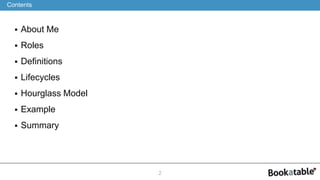
About Me
XP
Enterprise
Agile
Scrum
Kanban
Developers
Scrum
Master
Product
Owner
4
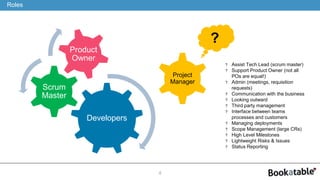
Roles
Project
Manager
?
? Assist Tech Lead (scrum master)
? Support Product Owner (not all
POs are equal!)
? Admin (meetings, requisition
requests)
? Communication with the business
? Looking outward
? Third party management
? Interface between teams
processes and customers
? Managing deployments
? Scope Management (large CRs)
? High Level Milestones
? Lightweight Risks & Issues
? Status Reporting
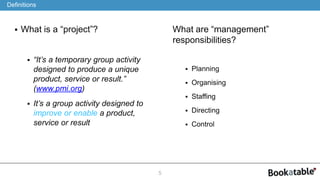
 What is a “project”?
 “It’s a temporary group activity
designed to produce a unique
product, service or result.”
(www.pmi.org)
 It’s a group activity designed to
improve or enable a product,
service or result
What are “management”
responsibilities?
 Planning
 Organising
 Staffing
 Directing
 Control
5
Definitions
6
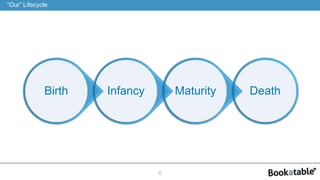
“Our” Lifecycle
DeathMaturityInfancyBirth
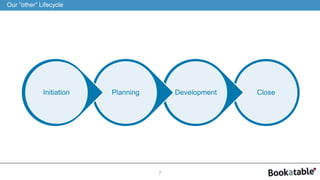
CloseDevelopmentPlanningInitiation
7
Our “other” Lifecycle
Close
Developm
ent
PlanningInitiation
Close
Developm
ent
PlanningInitiation
CloseDevelopmentPlanningInitiation
8
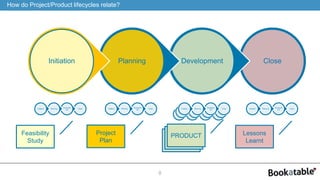
How do Project/Product lifecycles relate?
Close
Developm
ent
PlanningInitiation Close
Developm
ent
PlanningInitiation Close
Developm
ent
PlanningInitiation Close
Developm
ent
PlanningInitiation
Feasibility
Study
Project
Plan
PRODUCT Lessons
Learnt
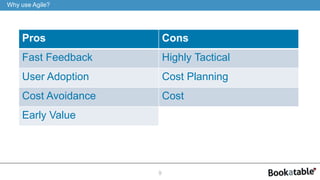
Pros Cons
Fast Feedback Highly Tactical
User Adoption Cost Planning
Cost Avoidance Cost
Early Value
9
Why use Agile?
10
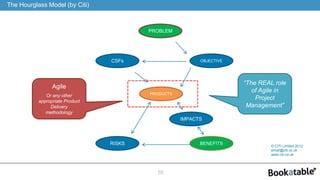
The Hourglass Model (by Citi)
OBJECTIVECSFs
PRODUCTS
RISKS BENEFITS
IMPACTS
PROBLEM
© CITI Limited 2012
email@citi.co.uk
www.citi.co.uk
Agile
Or any other
appropriate Product
Delivery
methodology
“The REAL role
of Agile in
Project
Management”
11
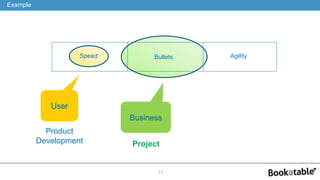
Example
Speed Bullets Agility
Project
Product
Development
User
Business
Looking outward
Communication with the business
High Level Milestones
Lightweight Risks & Issues
 Manage deployments
 Admin (meetings, requisition requests)
 Support Tech Lead (scrum master)
 Support Product Owner (not all POs are equal!)
 Third party management
 Interface between teams processes and customers
 Scope Management (large CRs)
 Status Reporting
12
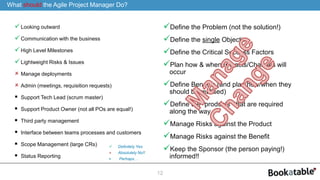
What should the Agile Project Manager Do?
 Definitely Yes
 Absolutely No!!
 Perhaps…
Define the Problem (not the solution!)
Define the single Objective
Define the Critical Success Factors
Plan how & when Impacts/Changes will
occur
Define Benefits (and plan how/when they
should be realised)
Define the “products” that are required
along the way
Manage Risks against the Product
Manage Risks against the Benefit
Keep the Sponsor (the person paying!)
informed!!

The REAL Role of the Project Manager in Agile

  • 1.
    The REAL Roleof the Project Manager in Agile Derek Homer Sept 2014 http://uk.linkedin.com/in/derekhomer/
  • 2.
     About Me Roles  Definitions  Lifecycles  Hourglass Model  Example  Summary 2 Contents
  • 3.
  • 4.
    Developers Scrum Master Product Owner 4 Roles Project Manager ? ? Assist TechLead (scrum master) ? Support Product Owner (not all POs are equal!) ? Admin (meetings, requisition requests) ? Communication with the business ? Looking outward ? Third party management ? Interface between teams processes and customers ? Managing deployments ? Scope Management (large CRs) ? High Level Milestones ? Lightweight Risks & Issues ? Status Reporting
  • 5.
     What isa “project”?  “It’s a temporary group activity designed to produce a unique product, service or result.” (www.pmi.org)  It’s a group activity designed to improve or enable a product, service or result What are “management” responsibilities?  Planning  Organising  Staffing  Directing  Control 5 Definitions
  • 6.
  • 7.
  • 8.
    Close Developm ent PlanningInitiation Close Developm ent PlanningInitiation CloseDevelopmentPlanningInitiation 8 How do Project/Productlifecycles relate? Close Developm ent PlanningInitiation Close Developm ent PlanningInitiation Close Developm ent PlanningInitiation Close Developm ent PlanningInitiation Feasibility Study Project Plan PRODUCT Lessons Learnt
  • 9.
    Pros Cons Fast FeedbackHighly Tactical User Adoption Cost Planning Cost Avoidance Cost Early Value 9 Why use Agile?
  • 10.
    10 The Hourglass Model(by Citi) OBJECTIVECSFs PRODUCTS RISKS BENEFITS IMPACTS PROBLEM © CITI Limited 2012 email@citi.co.uk www.citi.co.uk Agile Or any other appropriate Product Delivery methodology “The REAL role of Agile in Project Management”
  • 11.
  • 12.
    Looking outward Communication withthe business High Level Milestones Lightweight Risks & Issues  Manage deployments  Admin (meetings, requisition requests)  Support Tech Lead (scrum master)  Support Product Owner (not all POs are equal!)  Third party management  Interface between teams processes and customers  Scope Management (large CRs)  Status Reporting 12 What should the Agile Project Manager Do?  Definitely Yes  Absolutely No!!  Perhaps… Define the Problem (not the solution!) Define the single Objective Define the Critical Success Factors Plan how & when Impacts/Changes will occur Define Benefits (and plan how/when they should be realised) Define the “products” that are required along the way Manage Risks against the Product Manage Risks against the Benefit Keep the Sponsor (the person paying!) informed!!

Editor's Notes

  • #4 @ Workshare – Technical Support & bug tracking, XP introduced to the dev team @ Symbian/Nokia – OS Project Manager @ BBC- ScrumMaster in a team responsible for enabler products behind iPlayer
  • #5 The three roles that Scrum describes The Project Manager isn’t mentioned in Scrum – here’s a list of some of the things they might do (based on survey)
  • #6 A reminder of what a “project” is (or might be!) and what “management” means
  • #7 An example lifecycle that we’re all familiar with! It’s useful to determine what phase you’re in so that you can Act appropriately Involve appropriate people Make appropriate decisions The same is true of projects!
  • #8 Another lifecycle we should recognise. Is this a Project lifecycle or Product Development lifecycle? Both! So how do they relate?
  • #9 Every stage of the Porject has deliverables (products) therefore 1 Project lifecycle vs ‘n’ Product Development lifecycles
  • #10 Agile isn’t always the best delivery method! Know why you would want to use it!
  • #11 A Product Manager only worries about the “product” ellipse in the middle (possibly stretching through time) A Project Manager should worry about all ellipses (from the perspective of the change and its objective)
  • #12 The objective = to defend the country Solution = build a fighter jet User requirements focus on the ‘product’ = More Speed (to run away) Business requirements focus on the ‘objective’ = More Bullets (to attack)