EXPLANATION OF ASSISTIVE TECHNOLOGY
• Technology
• Used by individuals with disabilities
• To perform functions that might be difficult to
student
• Mobility devices
• Hardware
• Software
• Section 501 of the Rehabilitation Act –
• prohibits discrimination.
• Section 504 of the Rehabilitation Act –
• prohibits discrimination based on disability in federally
funded and federally conducted programs or activities
in the United States.
• Section 505 of the Rehabilitation Act –
• establishes the enforcement procedures for title V of
the Rehabilitation Act.
• Section 508 of the Rehabilitation Act –
• eliminates barriers in information technology, to make
available new opportunities for people with
disabilities, and to encourage development of
technologies that will help achieve these goals.


Americans with Disabilities Act (ADA) –
 Prohibits discrimination and ensures equal opportunity for
persons with disabilities in employment, state and local
government services, public accommodations, commercial
facilities, and transportation.

 Section 255 of the Telecommunications Act of 1996 –
• requires manufacturers of telecommunications equipment
and providers of telecommunications services to ensure that
such equipment and services are accessible to persons with
disabilities, if readily achievable.
 The Architectural and Transportation Barriers Compliance Board
(Access Board)
 issued final guidelines for accessibility, usability and
compatibility of telecommunications equipment and customer
premises equipment covered by Section 255 of the
Telecommunication Act of 1996.


Assistive Technology Act of 1998 –
• establishes a grant program, administered by the U.S.
Department of Education, to provide Federal funds to support
State programs that address the assistive technology needs of
individuals with disabilities.
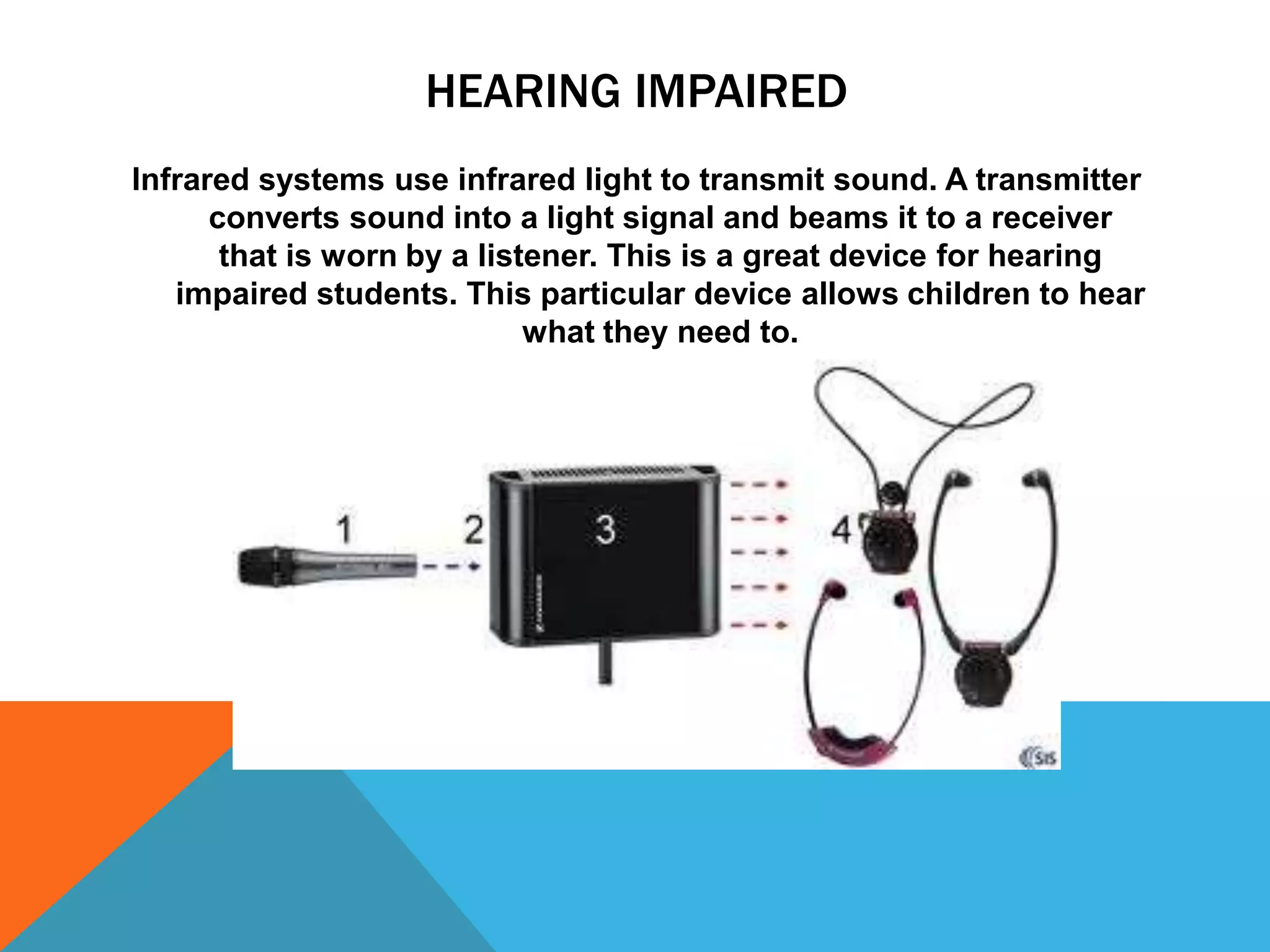
HEARING IMPAIRED
Infrared systems use infrared light to transmit sound. A transmitter
converts sound into a light signal and beams it to a receiver
that is worn by a listener. This is a great device for hearing
impaired students. This particular device allows children to hear
what they need to.
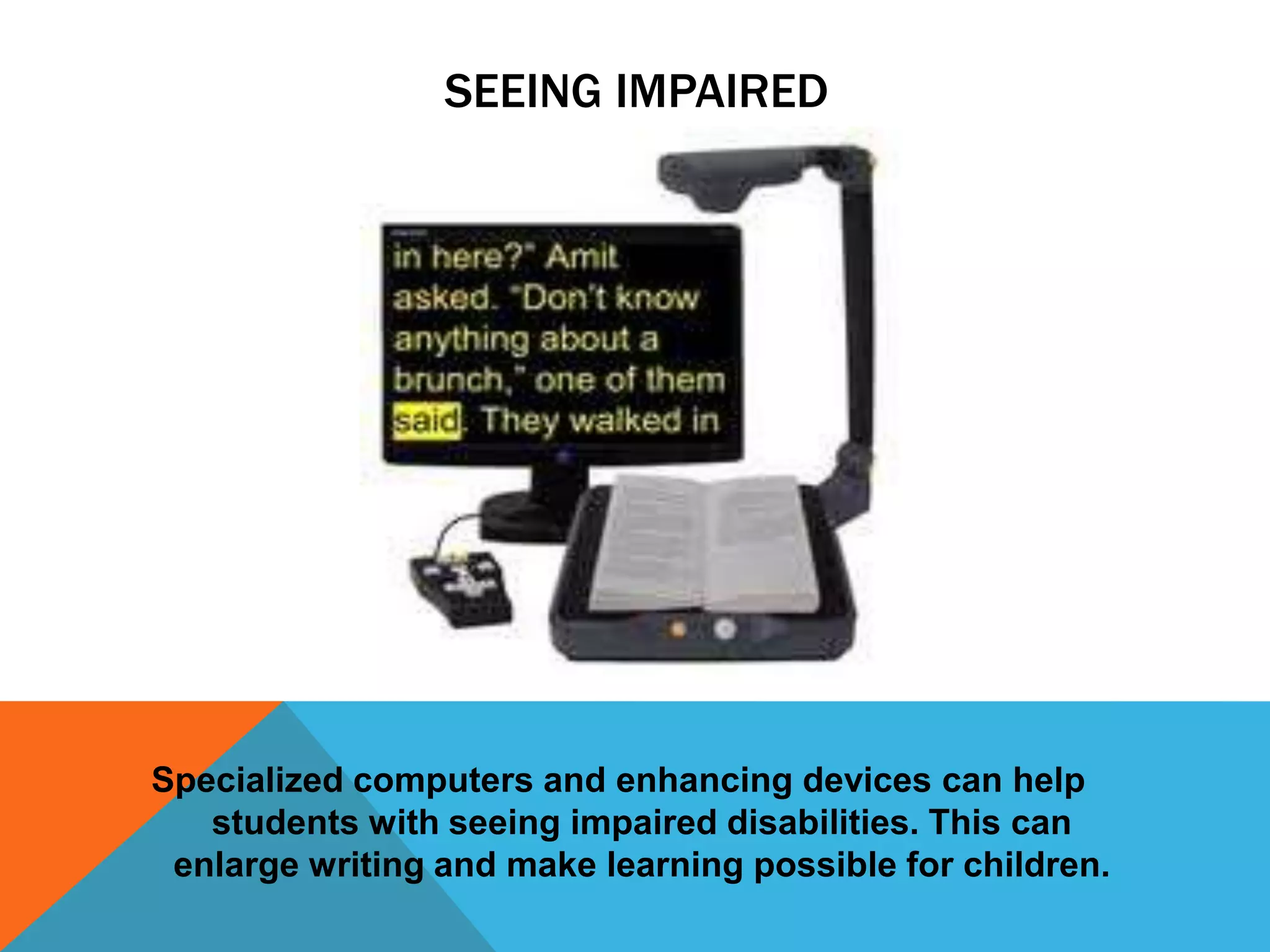
SEEING IMPAIRED

Specialized computers and enhancing devices can help
students with seeing impaired disabilities. This can
enlarge writing and make learning possible for children.
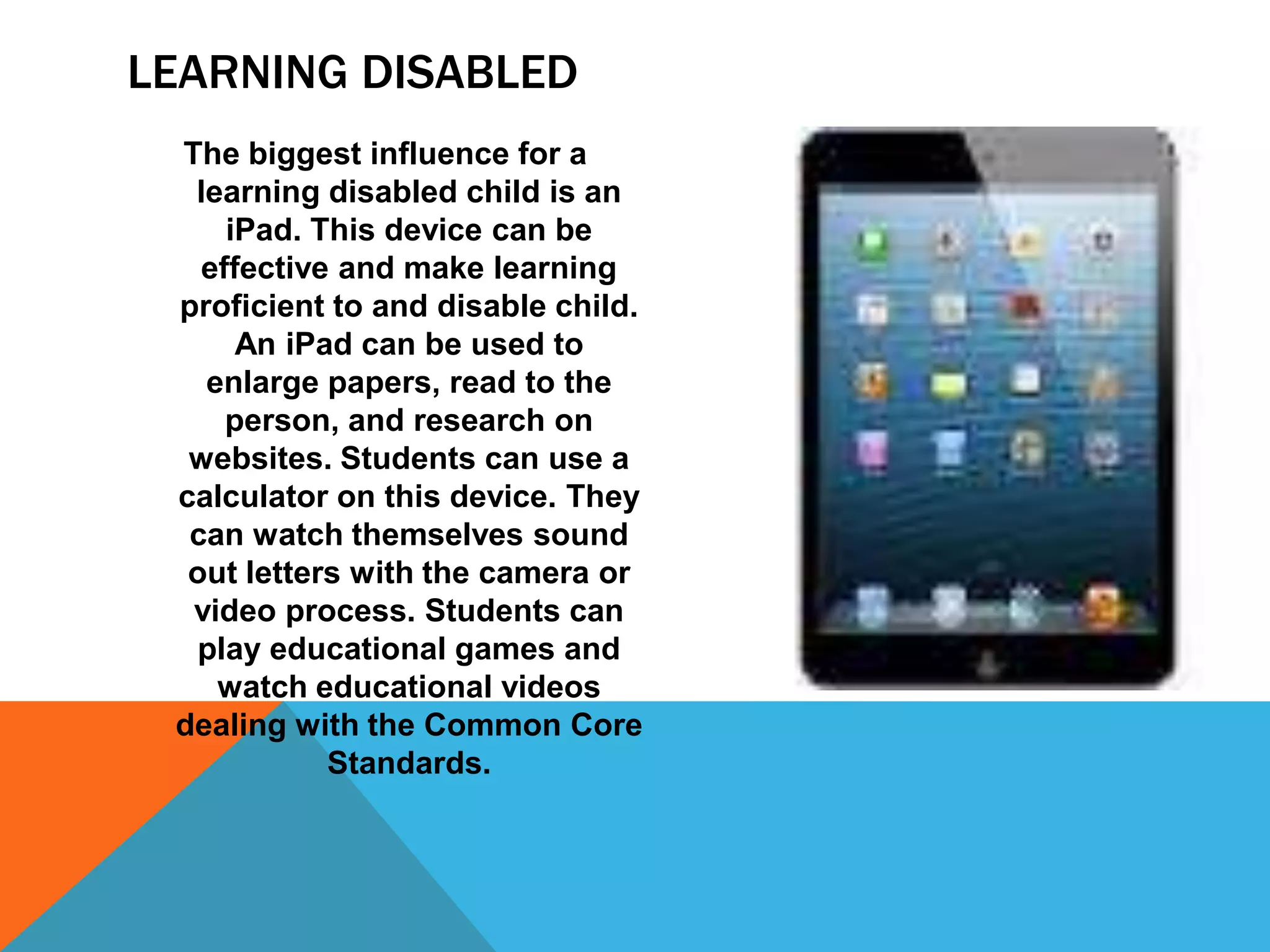
LEARNING DISABLED
The biggest influence for a
learning disabled child is an
iPad. This device can be
effective and make learning
proficient to and disable child.
An iPad can be used to
enlarge papers, read to the
person, and research on
websites. Students can use a
calculator on this device. They
can watch themselves sound
out letters with the camera or
video process. Students can
play educational games and
watch educational videos
dealing with the Common Core
Standards.
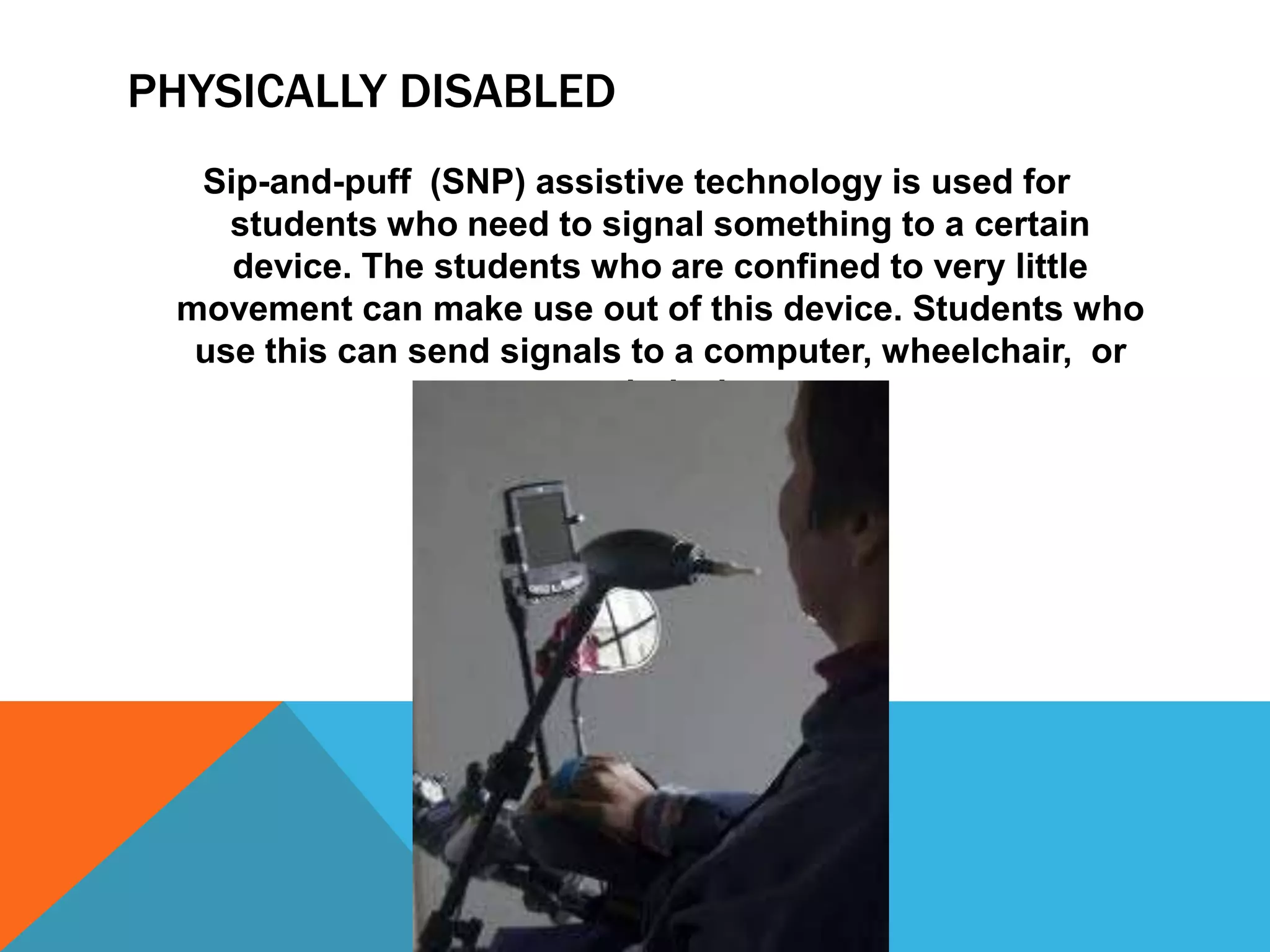
PHYSICALLY DISABLED
Sip-and-puff (SNP) assistive technology is used for
students who need to signal something to a certain
device. The students who are confined to very little
movement can make use out of this device. Students who
use this can send signals to a computer, wheelchair, or
speech devices.
REFERENCES
Assistive Technology. (2010). Retrieved from Adaptive Technology Center:
http://adaptivetech.tcnj.edu/resheet/blind.htm
Assistive Devices. (2012). Retrieved from National Institute for people with
hearing, speech, or language disorders:
http://www.nidcd.nih.gov/health/hearing/pages/assistive-devices.aspx
Assistive Technology Laws and Rights. (2012). Retrieved from National Disability
Rights: http://www.ndrn.org/en/issues/assistive-technology/292-assistivetechnology-federal-law-and-regulations.html
Assistive technology for physically disabled. (2013). Retrieved from Buzzle:
http://www.buzzle.com/articles/assistive-technology-for-physically-disabled.html
Assistive Technology. (n.d.). Retrieved from Wikipedia:
http://en.wikipedia.org/wiki/Assistive_technology
Google. (n.d.). Retrieved from Google Images: Sip-and-puff:
https://www.google.com/search?q=sip+n+puff+assistive+technology&bav=on.2,or.r
_qf.&biw=1524&bih=696&bvm=pv.xjs.s.en_US.OVAlLoE6fvY.O&um=1&ie=UTF8&hl=en&tbm=isch&source=og&sa=N&tab=fi&ei=3vZyUvOdJZOG2wWO8oCYBA
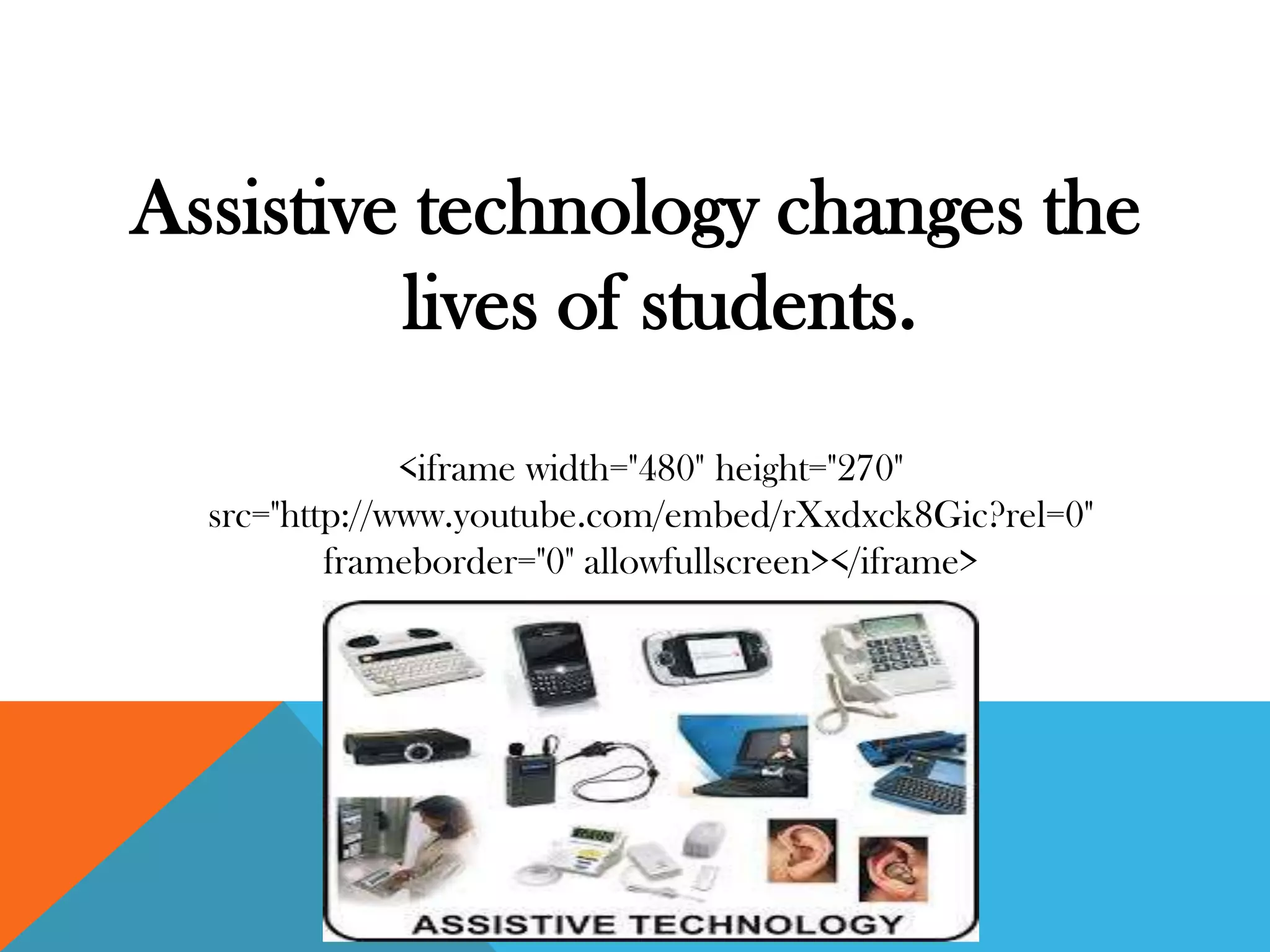
Assistive technology changes the
lives of students.
<iframe width="480" height="270"
src="http://www.youtube.com/embed/rXxdxck8Gic?rel=0"
frameborder="0" allowfullscreen></iframe>

Assistive technology

  • 2.
    EXPLANATION OF ASSISTIVETECHNOLOGY • Technology • Used by individuals with disabilities • To perform functions that might be difficult to student • Mobility devices • Hardware • Software
  • 3.
    • Section 501of the Rehabilitation Act – • prohibits discrimination. • Section 504 of the Rehabilitation Act – • prohibits discrimination based on disability in federally funded and federally conducted programs or activities in the United States. • Section 505 of the Rehabilitation Act – • establishes the enforcement procedures for title V of the Rehabilitation Act. • Section 508 of the Rehabilitation Act – • eliminates barriers in information technology, to make available new opportunities for people with disabilities, and to encourage development of technologies that will help achieve these goals.
  • 4.
     Americans with DisabilitiesAct (ADA) –  Prohibits discrimination and ensures equal opportunity for persons with disabilities in employment, state and local government services, public accommodations, commercial facilities, and transportation.  Section 255 of the Telecommunications Act of 1996 – • requires manufacturers of telecommunications equipment and providers of telecommunications services to ensure that such equipment and services are accessible to persons with disabilities, if readily achievable.  The Architectural and Transportation Barriers Compliance Board (Access Board)  issued final guidelines for accessibility, usability and compatibility of telecommunications equipment and customer premises equipment covered by Section 255 of the Telecommunication Act of 1996.  Assistive Technology Act of 1998 – • establishes a grant program, administered by the U.S. Department of Education, to provide Federal funds to support State programs that address the assistive technology needs of individuals with disabilities.
  • 5.
    HEARING IMPAIRED Infrared systemsuse infrared light to transmit sound. A transmitter converts sound into a light signal and beams it to a receiver that is worn by a listener. This is a great device for hearing impaired students. This particular device allows children to hear what they need to.
  • 6.
    SEEING IMPAIRED Specialized computersand enhancing devices can help students with seeing impaired disabilities. This can enlarge writing and make learning possible for children.
  • 7.
    LEARNING DISABLED The biggestinfluence for a learning disabled child is an iPad. This device can be effective and make learning proficient to and disable child. An iPad can be used to enlarge papers, read to the person, and research on websites. Students can use a calculator on this device. They can watch themselves sound out letters with the camera or video process. Students can play educational games and watch educational videos dealing with the Common Core Standards.
  • 8.
    PHYSICALLY DISABLED Sip-and-puff (SNP)assistive technology is used for students who need to signal something to a certain device. The students who are confined to very little movement can make use out of this device. Students who use this can send signals to a computer, wheelchair, or speech devices.
  • 9.
    REFERENCES Assistive Technology. (2010).Retrieved from Adaptive Technology Center: http://adaptivetech.tcnj.edu/resheet/blind.htm Assistive Devices. (2012). Retrieved from National Institute for people with hearing, speech, or language disorders: http://www.nidcd.nih.gov/health/hearing/pages/assistive-devices.aspx Assistive Technology Laws and Rights. (2012). Retrieved from National Disability Rights: http://www.ndrn.org/en/issues/assistive-technology/292-assistivetechnology-federal-law-and-regulations.html Assistive technology for physically disabled. (2013). Retrieved from Buzzle: http://www.buzzle.com/articles/assistive-technology-for-physically-disabled.html Assistive Technology. (n.d.). Retrieved from Wikipedia: http://en.wikipedia.org/wiki/Assistive_technology Google. (n.d.). Retrieved from Google Images: Sip-and-puff: https://www.google.com/search?q=sip+n+puff+assistive+technology&bav=on.2,or.r _qf.&biw=1524&bih=696&bvm=pv.xjs.s.en_US.OVAlLoE6fvY.O&um=1&ie=UTF8&hl=en&tbm=isch&source=og&sa=N&tab=fi&ei=3vZyUvOdJZOG2wWO8oCYBA
  • 10.
    Assistive technology changesthe lives of students. <iframe width="480" height="270" src="http://www.youtube.com/embed/rXxdxck8Gic?rel=0" frameborder="0" allowfullscreen></iframe>