JIWAJI UNIVERSITY
CENTER FOR GENOMICS
MOLECULAR & HUMAN GENETICS
AKANSHA CHAUHAN
3rd SEMESTER
ASSISTED REPRODUCTIVE
TECHNIQUES
Introduction
History
Factors affecting Conception
Assisted Reproductive Techniques
 In Vitro Fertilization
 Artificial Insemination
 Frozen Embryos
 Gamete Intra Fallopian Transfer
 Zygote Intra Fallopian Transfer
 Assisted Reproductive Technology is the use of technology to assist human
reproduction in the treatment of infertility.
 Infertility is defined as not being able to get pregnant after 1year of properly
timed unprotected intercourse.
 A procedure that involves the removal of eggs from an ovary and fertilization by
sperm in vitro such as in vitro fertilization, intracytoplasmic sperm injection,
cryopreservation of gametes or embryos, or the use of fertility medication.
 Assisted Reproductive Technology has been used in the United States since
1981 to help women become pregnant.
 Between 1845 and 1849, physician J. Marion Sims the most famous American surgeon
of the 19th century and acknowledged as the founder of modern surgical gynecology by
experimenting on enslaved African American women in Montgomery, Alabama.
 Dr. William Pancoast, who in 1884 as a professor at Jefferson Medical College in
Philadelphia consulted with a Quaker couple who were struggling with infertility.
 In 1934 Gregory Pincus, the man who would later gain fame for being the scientist who,
synthesized Enovid, the first oral contraceptive pill on the market. Pincus claimed that
he had achieved in-vitro fertilization of rabbits in his Harvard laboratory.
 Dr. Robert Edwards, a physiologist at Cambridge University.
 Patrick Steptoe a gynecological surgeon in Manchester, England.
• Production of healthy sperm
• Healthy eggs by the woman
• Blocked fallopian tubes
• The ability for the sperm to fertilize the
egg
• The ability for the embryo to implant in
the uterus
• Nutrition- vitamins
• Hormonal Imbalance or Autoimmune
Disorder
• Being Over or Underweight
• Taking Medication or Using Drugs
aurawomen.in
• Failure to ovulate
• Problems in the menstrual cycle
• Structural problems of reproductive system
• Infections
• Failure of an egg to mature properly
• Implantation failure
• Endometriosis
• Polycystic Ovary Syndrome
• Primary Ovary Insufficiency
layyous.com
• Impotence
• Inflammation of blood vessels of the testis
• Discharge incapacity
• Erectile dysfunction
• Sexually Transmitted Diseases
• Physiological causes of infertility in men
• Hormonal misbalance
• Psychological causes of infertility in men
• Genetics causes of infertility in men
doctortipster.com
 Most Common Choices of Treatment :-
In Vitro Fertilization
Artificial Insemination
Frozen Embryos
Gamete Intra Fallopian Transfer
Zygote Intra Fallopian Transfer
 In Vitro Fertilization is the uniting of egg and sperm in vitro.
 The embryos are transferred into the uterus through the cervix and pregnancy
is allowed to begin.
 Infertility issues for which IVF may be necessary include:-
• reduced fertility in women over the age of 40
• blocked or damaged fallopian tubes
• reduced ovarian function
• Endometriosis, uterine fibroids
• male infertility, such as low sperm count or abnormalities in sperm shape
There are five steps involved in IVF:
1.stimulation
2.egg retrieval
3.insemination
4.embryo culture
5.transfer
sbivf.com
 Artificial insemination is a fertility treatment method used to deliver sperm directly to the
cervix or uterus.
 Conceiving requires a man’s sperm to travel up the vagina, through the cervix, into the
uterus, and into a fallopian tube where an egg is fertilized. Sometimes a man’s sperm
isn’t mobile enough to make this trip. Other times, a woman’s cervix may not be
favorable to allow sperm to travel into the uterus. In such situations, artificial
insemination may help a woman conceive.
 Artificial Insemination can be of following types:-
 Intracervical insemination
 Intrauterine insemination
 Intratubular insemination
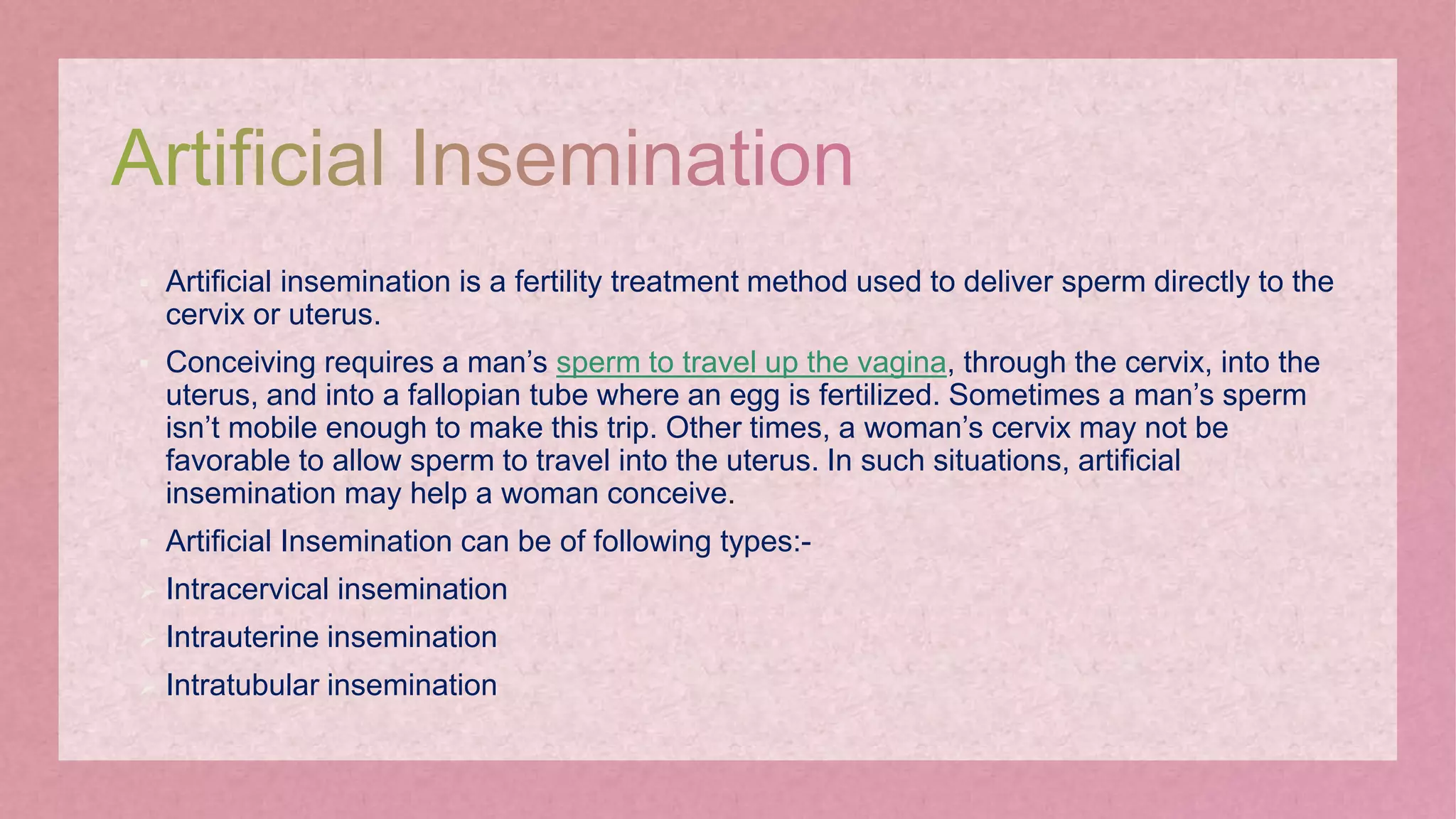
• It is a type of artificial insemination that
involves inserting sperm into the cervix.
This is the passageway just outside the
uterus.
• It involves injection of unwashed or raw
semen into the cervix with the
needleless syringe.
• A vaginal speculum is used to hold open
the vagina so that cervix may be
observed and then syringe is inserted
,the plunger is pushed forward and
semen is emptied deep in the vagina.
• ICI is the easiest and most common
insemination technique.
thebody.com
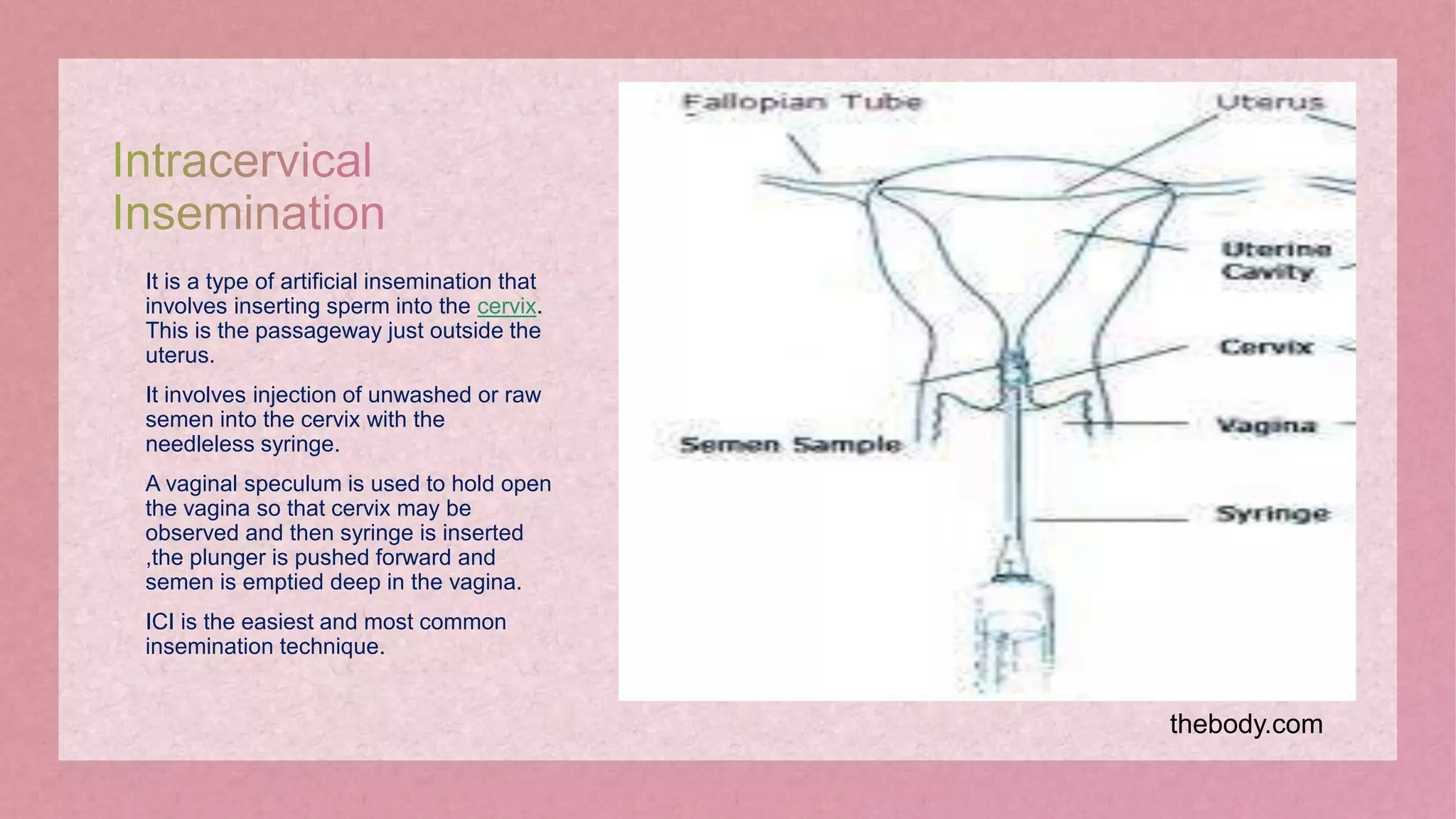
Intrauterine insemination (IUI) is a fertility
treatment where sperm are placed
directly into a woman’s uterus.
During natural conception, sperm have to
travel from the vagina through the cervix,
into the uterus, and up to the fallopian
tubes. With IUI, sperm are “washed” and
concentrated, and also placed directly
into the uterus, which puts them closer to
the egg.
This process can increase the likelihood
of pregnancy in certain couples who have
had difficulty getting pregnant.
thebody.com
• Intratubal insemination involves the
placement of pre-washed sperm
directly into the woman’s fallopian
tube.
• This is also sometimes referred to as
“fallopian tube sperm perfusion.”
• The sperm may be transferred to the
tubes through a special catheter that
goes through the cervix, up through
the uterus, and into the fallopian
tubes.
invitra.com
 Embryo freezing is a procedure that allows people to store embryos for later use. A person can
also freeze eggs, which are not fertilized. An embryo forms after fertilization and after the cells
start to divide.
 The first successful pregnancy resulting from freezing a healthy embryo took place in the 1980s.
 The process is done by using hormones and other medications to stimulate the production of
potentially fertile eggs. A doctor then extracts the eggs from the ovaries, either for fertilizing in a
lab or for freezing.
 Successful fertilization may lead to at least one healthy embryo. A doctor can then transfer the
embryo to the womb, or uterus. If the treatment is successful, the embryo will develop.
 Fertilization often results in more than one embryo, and the doctor can freeze and preserve the
remaining embryos.
Cryopreservation:-It involves replacing the water in
the cell with a substance called a cryoprotectant. The
embryos incubate in increasing levels of cryoprotectant
before freezing them.
After removing most of the water, cool the embryo to its
preservation state. Then use freezing methods:
Slow freezing: This involves placing the embryos in
sealed tubes, then slowly lowering their temperature. It
prevents the embryo’s cells from aging and reduces the
risk of damage. Slow freezing is time-consuming, and it
requires expensive machinery.
Vitrification: In this process, the doctor freezes the
cryoprotected embryos so quickly that the water
molecules do not have time to form ice crystals. This
helps protect the embryos and increases their rate of
survival during thawing.
After the process of freezing is complete, the doctor
stores the embryos in liquid nitrogen.
invitra.com
 Gamete intrafallopian tube transfer is a method of assisting pregnancy, which includes
removing the female egg and sperm and mixing it into the fallopian tube immediately.
 Unlike in vitro fertilization and intra-fallopian tube transplantation, the process of
fertilization in gamete-fallopian tube transplantation is in the fallopian tube rather than in
the petri dish.
 A healthy fallopian tube is very important for gamete transplantation.
 It should only be performed when sperm level is adequate & at least one fallopian tube
is open & functional.
 In GIFT, hospitalization does not require. After completion of the process patient need to
rest for eight hours in a recovery room and then she can go to her home.
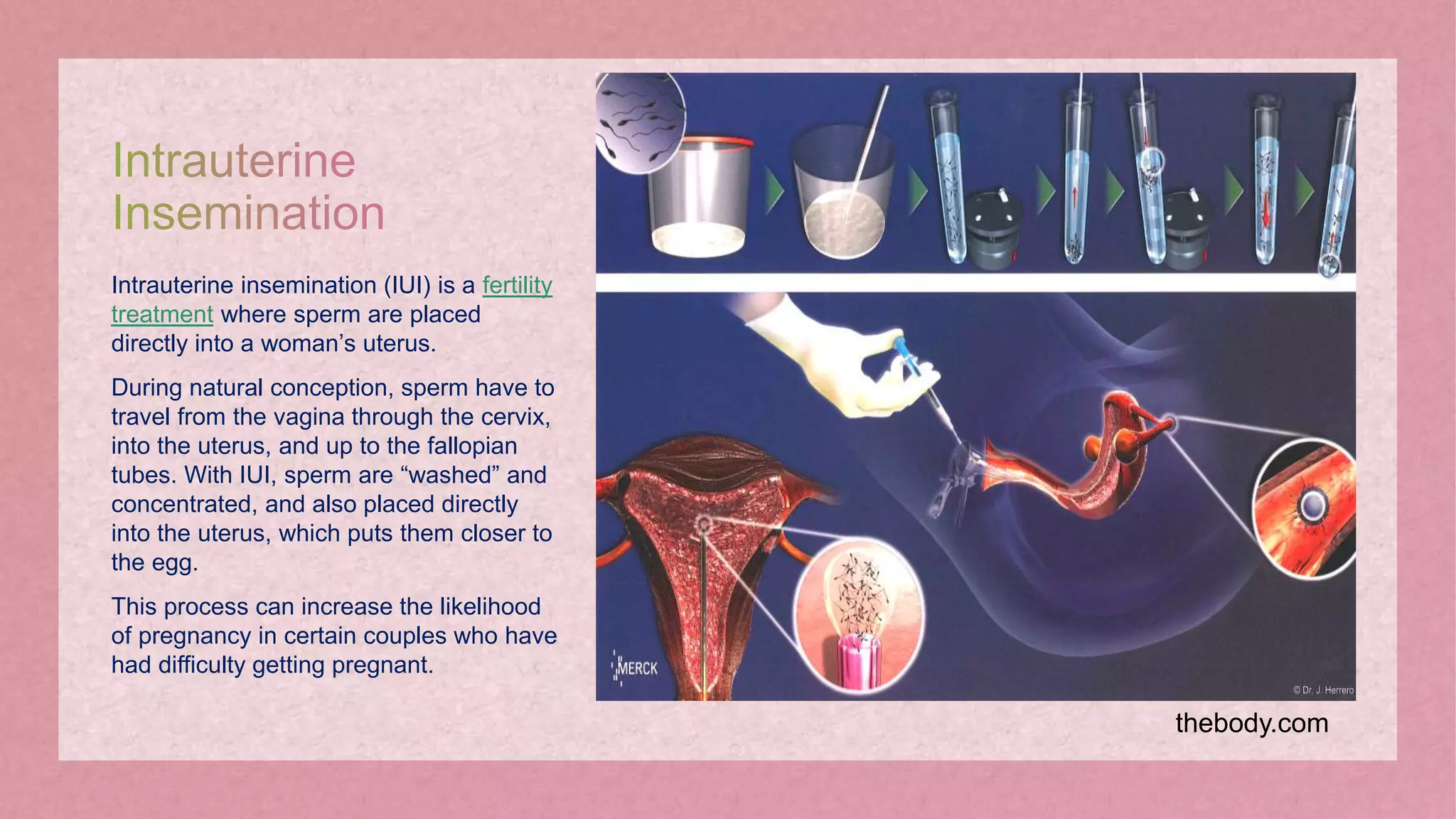
•An X-ray is conducted to the patient for
determining the presence of at least one healthy
fallopian tube. A laparoscopic intervention
suggested ensuring no scar tissue present outside
the fallopian tube.
•After all positive results, the utilization of
laparoscopy for the egg retrieval process from the
ovaries is conducted.
•Subsequently, sperm is also collected on the same
egg retrieval. Freshly collected egg and sperm are
then mixed in a catheter.
•Immediately the mixture of egg and sperm is
inserted into the fallopian tube through the
catheter. Medication is provided to the mother for
the uterine lining build-up, essential for providing
support to the fertilization process.
surrogacycentregeorgia.com
 Zygote intrafallopian transfer is an assisted reproductive technology first used in 1986
in which fertilized embryo is transferred into the fallopian tube instead of the uterus. As
the fertilized egg is transferred directly into the tubes, the procedure is also known as
tubal embryo transfer (TET).
 ZIFT is a hybrid technique derived from a combination of in vitro fertilization and gamete
intrafallopian transfer procedures.
 This procedure can be more successful than GIFT as it has a greater chance, ensuring
that the egg is fertilized. The woman must have healthy tubes for ZIFT.
 The advantage to ZIFT is that it’s clear fertilization has taken place. With GIFT, there’s
no way to know right away if egg and sperm are combining to make a zygote (an early
embryo).
 First the eggs and sperm used to form the zygote
are retrieved from the donor. Then they are
combined to create a zygote. The zygote is then
allowed to mature for a day or two.
 Then physician make a small incision into the
patient’s abdomen and retrieve her fallopian tube
& make a small incision into the fallopian tube to
implant several zygotes.
 After placing zygotes into the fallopian tube, the
body’s natural fertility processes will be engaged
and the zygote will travel down the fallopian tube
and into the uterus.
 In most cases more than one and fewer than four
zygotes are inserted at a time.
www.fertility.com
 As we can see, that ART is a method used to resolve infertility issue among gender of
both sex. These methods are used to bring the males sperm cell and the female egg
cell together to form an embryo which is then returned to the female’s body to form a
baby.
 Upon looking at those ethical issues Assisted reproductive technology shows, the
scientists who engineer these techniques have little respect for the lives of human
beings in their earliest stages, or for the sacredness of the marital act. The miracle of
human procreation has been turned into mere matter for experimentation.
 ART is useful for those who are not able to get pregnant in a natural way. Although, it is
a topic with many annotations from all parties, they agree on the fact that doctors
should only refuse application of ART if the welfare of the child is in question, for
example in cases of psychological or medical problems.
 embyo.asu.edu
 www.huffpost.com
 www.pregnantene.com
 www.just.edu.co
 doctortipster.com
 www.healthline.com
 shecares.com
 americanpregnancy.org
Assisted reproductive techniques

Assisted reproductive techniques

  • 1.
    JIWAJI UNIVERSITY CENTER FORGENOMICS MOLECULAR & HUMAN GENETICS AKANSHA CHAUHAN 3rd SEMESTER
  • 2.
  • 3.
    Introduction History Factors affecting Conception AssistedReproductive Techniques  In Vitro Fertilization  Artificial Insemination  Frozen Embryos  Gamete Intra Fallopian Transfer  Zygote Intra Fallopian Transfer
  • 4.
     Assisted ReproductiveTechnology is the use of technology to assist human reproduction in the treatment of infertility.  Infertility is defined as not being able to get pregnant after 1year of properly timed unprotected intercourse.  A procedure that involves the removal of eggs from an ovary and fertilization by sperm in vitro such as in vitro fertilization, intracytoplasmic sperm injection, cryopreservation of gametes or embryos, or the use of fertility medication.  Assisted Reproductive Technology has been used in the United States since 1981 to help women become pregnant.
  • 5.
     Between 1845and 1849, physician J. Marion Sims the most famous American surgeon of the 19th century and acknowledged as the founder of modern surgical gynecology by experimenting on enslaved African American women in Montgomery, Alabama.  Dr. William Pancoast, who in 1884 as a professor at Jefferson Medical College in Philadelphia consulted with a Quaker couple who were struggling with infertility.  In 1934 Gregory Pincus, the man who would later gain fame for being the scientist who, synthesized Enovid, the first oral contraceptive pill on the market. Pincus claimed that he had achieved in-vitro fertilization of rabbits in his Harvard laboratory.  Dr. Robert Edwards, a physiologist at Cambridge University.  Patrick Steptoe a gynecological surgeon in Manchester, England.
  • 6.
    • Production ofhealthy sperm • Healthy eggs by the woman • Blocked fallopian tubes • The ability for the sperm to fertilize the egg • The ability for the embryo to implant in the uterus • Nutrition- vitamins • Hormonal Imbalance or Autoimmune Disorder • Being Over or Underweight • Taking Medication or Using Drugs aurawomen.in
  • 7.
    • Failure toovulate • Problems in the menstrual cycle • Structural problems of reproductive system • Infections • Failure of an egg to mature properly • Implantation failure • Endometriosis • Polycystic Ovary Syndrome • Primary Ovary Insufficiency layyous.com
  • 8.
    • Impotence • Inflammationof blood vessels of the testis • Discharge incapacity • Erectile dysfunction • Sexually Transmitted Diseases • Physiological causes of infertility in men • Hormonal misbalance • Psychological causes of infertility in men • Genetics causes of infertility in men doctortipster.com
  • 9.
     Most CommonChoices of Treatment :- In Vitro Fertilization Artificial Insemination Frozen Embryos Gamete Intra Fallopian Transfer Zygote Intra Fallopian Transfer
  • 10.
     In VitroFertilization is the uniting of egg and sperm in vitro.  The embryos are transferred into the uterus through the cervix and pregnancy is allowed to begin.  Infertility issues for which IVF may be necessary include:- • reduced fertility in women over the age of 40 • blocked or damaged fallopian tubes • reduced ovarian function • Endometriosis, uterine fibroids • male infertility, such as low sperm count or abnormalities in sperm shape
  • 11.
    There are fivesteps involved in IVF: 1.stimulation 2.egg retrieval 3.insemination 4.embryo culture 5.transfer sbivf.com
  • 12.
     Artificial inseminationis a fertility treatment method used to deliver sperm directly to the cervix or uterus.  Conceiving requires a man’s sperm to travel up the vagina, through the cervix, into the uterus, and into a fallopian tube where an egg is fertilized. Sometimes a man’s sperm isn’t mobile enough to make this trip. Other times, a woman’s cervix may not be favorable to allow sperm to travel into the uterus. In such situations, artificial insemination may help a woman conceive.  Artificial Insemination can be of following types:-  Intracervical insemination  Intrauterine insemination  Intratubular insemination
  • 13.
    • It isa type of artificial insemination that involves inserting sperm into the cervix. This is the passageway just outside the uterus. • It involves injection of unwashed or raw semen into the cervix with the needleless syringe. • A vaginal speculum is used to hold open the vagina so that cervix may be observed and then syringe is inserted ,the plunger is pushed forward and semen is emptied deep in the vagina. • ICI is the easiest and most common insemination technique. thebody.com
  • 14.
    Intrauterine insemination (IUI)is a fertility treatment where sperm are placed directly into a woman’s uterus. During natural conception, sperm have to travel from the vagina through the cervix, into the uterus, and up to the fallopian tubes. With IUI, sperm are “washed” and concentrated, and also placed directly into the uterus, which puts them closer to the egg. This process can increase the likelihood of pregnancy in certain couples who have had difficulty getting pregnant. thebody.com
  • 15.
    • Intratubal inseminationinvolves the placement of pre-washed sperm directly into the woman’s fallopian tube. • This is also sometimes referred to as “fallopian tube sperm perfusion.” • The sperm may be transferred to the tubes through a special catheter that goes through the cervix, up through the uterus, and into the fallopian tubes. invitra.com
  • 16.
     Embryo freezingis a procedure that allows people to store embryos for later use. A person can also freeze eggs, which are not fertilized. An embryo forms after fertilization and after the cells start to divide.  The first successful pregnancy resulting from freezing a healthy embryo took place in the 1980s.  The process is done by using hormones and other medications to stimulate the production of potentially fertile eggs. A doctor then extracts the eggs from the ovaries, either for fertilizing in a lab or for freezing.  Successful fertilization may lead to at least one healthy embryo. A doctor can then transfer the embryo to the womb, or uterus. If the treatment is successful, the embryo will develop.  Fertilization often results in more than one embryo, and the doctor can freeze and preserve the remaining embryos.
  • 17.
    Cryopreservation:-It involves replacingthe water in the cell with a substance called a cryoprotectant. The embryos incubate in increasing levels of cryoprotectant before freezing them. After removing most of the water, cool the embryo to its preservation state. Then use freezing methods: Slow freezing: This involves placing the embryos in sealed tubes, then slowly lowering their temperature. It prevents the embryo’s cells from aging and reduces the risk of damage. Slow freezing is time-consuming, and it requires expensive machinery. Vitrification: In this process, the doctor freezes the cryoprotected embryos so quickly that the water molecules do not have time to form ice crystals. This helps protect the embryos and increases their rate of survival during thawing. After the process of freezing is complete, the doctor stores the embryos in liquid nitrogen. invitra.com
  • 18.
     Gamete intrafallopiantube transfer is a method of assisting pregnancy, which includes removing the female egg and sperm and mixing it into the fallopian tube immediately.  Unlike in vitro fertilization and intra-fallopian tube transplantation, the process of fertilization in gamete-fallopian tube transplantation is in the fallopian tube rather than in the petri dish.  A healthy fallopian tube is very important for gamete transplantation.  It should only be performed when sperm level is adequate & at least one fallopian tube is open & functional.  In GIFT, hospitalization does not require. After completion of the process patient need to rest for eight hours in a recovery room and then she can go to her home.
  • 19.
    •An X-ray isconducted to the patient for determining the presence of at least one healthy fallopian tube. A laparoscopic intervention suggested ensuring no scar tissue present outside the fallopian tube. •After all positive results, the utilization of laparoscopy for the egg retrieval process from the ovaries is conducted. •Subsequently, sperm is also collected on the same egg retrieval. Freshly collected egg and sperm are then mixed in a catheter. •Immediately the mixture of egg and sperm is inserted into the fallopian tube through the catheter. Medication is provided to the mother for the uterine lining build-up, essential for providing support to the fertilization process. surrogacycentregeorgia.com
  • 20.
     Zygote intrafallopiantransfer is an assisted reproductive technology first used in 1986 in which fertilized embryo is transferred into the fallopian tube instead of the uterus. As the fertilized egg is transferred directly into the tubes, the procedure is also known as tubal embryo transfer (TET).  ZIFT is a hybrid technique derived from a combination of in vitro fertilization and gamete intrafallopian transfer procedures.  This procedure can be more successful than GIFT as it has a greater chance, ensuring that the egg is fertilized. The woman must have healthy tubes for ZIFT.  The advantage to ZIFT is that it’s clear fertilization has taken place. With GIFT, there’s no way to know right away if egg and sperm are combining to make a zygote (an early embryo).
  • 21.
     First theeggs and sperm used to form the zygote are retrieved from the donor. Then they are combined to create a zygote. The zygote is then allowed to mature for a day or two.  Then physician make a small incision into the patient’s abdomen and retrieve her fallopian tube & make a small incision into the fallopian tube to implant several zygotes.  After placing zygotes into the fallopian tube, the body’s natural fertility processes will be engaged and the zygote will travel down the fallopian tube and into the uterus.  In most cases more than one and fewer than four zygotes are inserted at a time. www.fertility.com
  • 22.
     As wecan see, that ART is a method used to resolve infertility issue among gender of both sex. These methods are used to bring the males sperm cell and the female egg cell together to form an embryo which is then returned to the female’s body to form a baby.  Upon looking at those ethical issues Assisted reproductive technology shows, the scientists who engineer these techniques have little respect for the lives of human beings in their earliest stages, or for the sacredness of the marital act. The miracle of human procreation has been turned into mere matter for experimentation.  ART is useful for those who are not able to get pregnant in a natural way. Although, it is a topic with many annotations from all parties, they agree on the fact that doctors should only refuse application of ART if the welfare of the child is in question, for example in cases of psychological or medical problems.
  • 23.
     embyo.asu.edu  www.huffpost.com www.pregnantene.com  www.just.edu.co  doctortipster.com  www.healthline.com  shecares.com  americanpregnancy.org