ASSISTED BREECH
DELIVERY
By Assistant Professor Dr. Kavitha M MS OBG
• With a cephalic presentation, once the head is delivered,
the rest of the body typically follows without difficulty.
• With breech, however, successively larger and less
compressible parts are born last.
• Spontaneous complete expulsion of fetus that presents
as breech is seldom accomplished successfully.
MANAGEMENT OF DELIVERY OF BREECH PRESENTATION
• VAGINAL DELIVERY
1. Spontaneous breech delivery : The entire infant is
expelled by natural forces of the mother with no assistance
other than support of the baby as it is born
2. Assisted breech delivery : The fetus is delivered
spontaneously as far as the umbilicus, but the remainder of
the body is delivered with assisted maneuvers, with or
without maternal expulsive efforts.
3. Total breech extraction :the entire body of the infant is
extracted by the obstetrician
• CAESEREAN SECTION
ZATUCHINI-ANDROS PROGNOSTIC
SCORING(1967)
• Most popular scoring system for assessing the
prognosis of successful vaginal delivery.
0 1 2
PARITY primi multigravida
GESTATIONAL
AGE
>39
weeks
38weeks 37 weeks
ESTIMATED
FETAL WEIGHT
>3.5kg 3-3.5kg <3kg
PREVIOUS
BREECH
DELIVERY >2500g
none 1 >2
CERVICAL
DILATATION
<2cm 3cm > 4cm
STATION OF
BREECH
> - 3 -2 < -1
• Score 3 or less : CESAREAN SECTION
• Women with higher scores can be allowed for
VAGINAL DELIVERY.
INDICATIONS FOR VAGINAL DELIVERY
Frank or complete
breech
presentation
Gestational age >36
weeks
Estimated fetal
weight 2.5 to
3.5kg
Fetal head
must be
flexed
Adequate
maternal pelvis.
No other
obstetric
complications
Good ZA score
MANAGEMENT OF FIRST STAGE OF LABOUR
⮚An iv line is started preferably with
ringer lactate.
⮚Vaginal examination is indicated
- at the onset of labour for pelvic assessment
- soon after rupture of membrane to exclude cord
prolapse
⮚Blood is sent for grouping and matching
⮚ Patient with term breech presentation is
advised to stay in bed. (to prevent PROM)
Adequate
analgesia is
given ,
epidural is
preferred.
Fetal heart
rate
monitored
by CTG.
Monitoring
progress of
labour by
PARTOGRA
M
Oxytocin
infusion
may be used
for the
augmentatio
n of labour.
MANAGEMENT OF SECOND STAGE OF
LABOUR
Spontaneous breech delivery
Assisted breech delivery
Total breech extraction
ASSISTED BREECH DELIVERY
• Ideally, the breech is allowed to deliver spontaneously upto the
umbilicus.
• This is the most common mode of vaginal breech delivery.
• This is a “HANDS OFF TECHNIQUE”.
• MASTER INACTIVITY
• WATCHFUL EXPECTENCY
• Certain manoeuvres are initiated by the obstetrician to aid
delivery of the remainder of body , arms and head.
PREREQUISITES
1. The back should always be anterior
2. Fetus should not be pulled from
below.
3. Baby’s body covered by sterile towel
–prevents premature attempt of
inspiration due to external cutaneous
stimuli
4. Fetus head should always be
maintained in flexion.
ASSISTED BREECH DELIVERY STEPS
Wait for the legs to deliver spontaneously. (or hook out
the legs)
With increasing uterine contractions the breech emerges
out of the vulval outlet.
Local infiltration anaesthesia is given and mediolateral
episiotomy is done.
After the decent of the breech into the pelvic floor, once
climbing of perineum takes place
FEMORAL PELVIC GRIP : bony pelvis is
grasped with both hands using a warm
towel.
Fingers on the anterior superior iliac
spine
Thumb on the sacrum.
Maternal expulsion efforts.
Steady, gentle downward traction is
applied until the lower halves of the
scapula are delivered.
Appearance of one axilla indicates the
time for shoulder delivery.
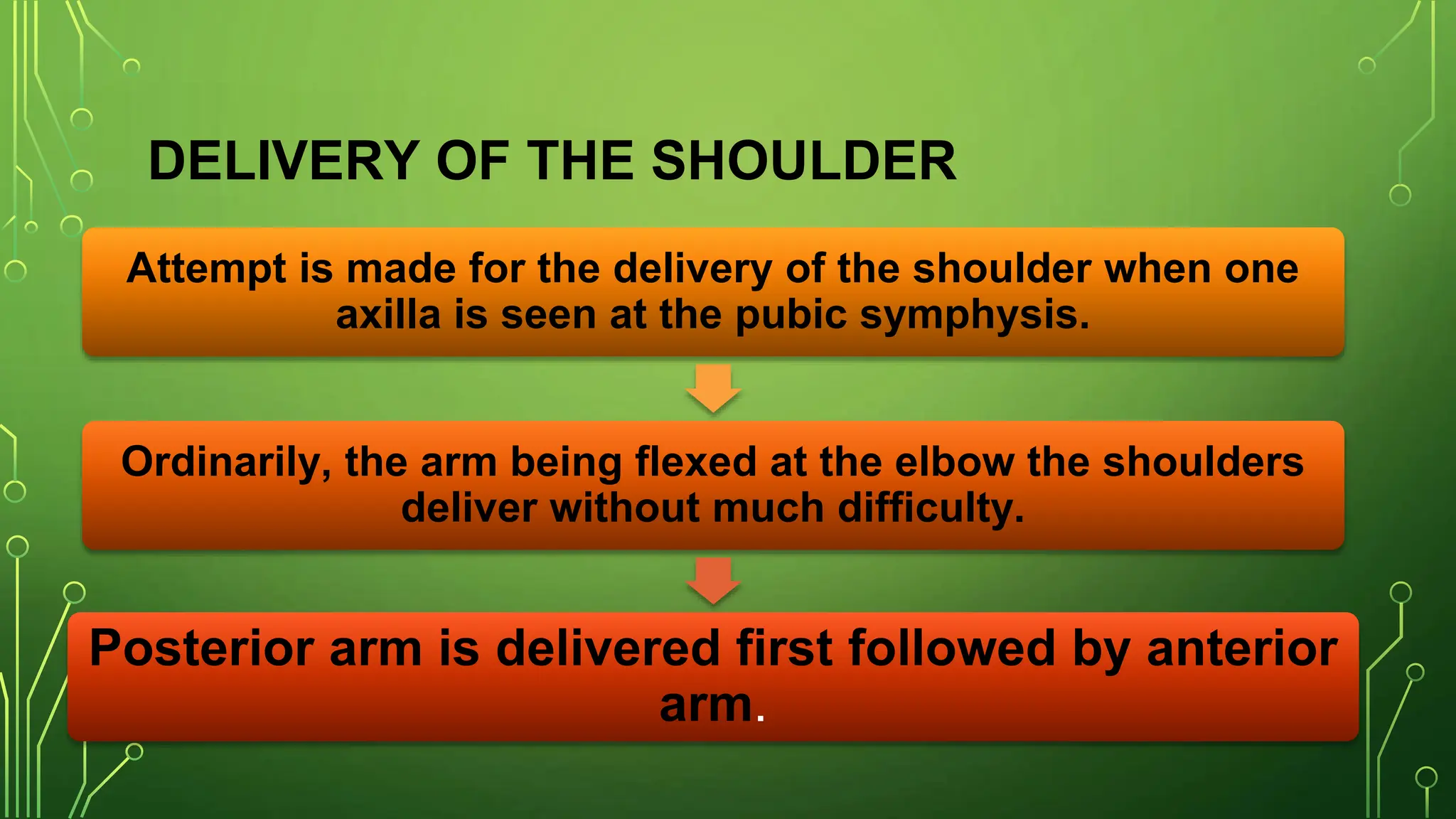
DELIVERY OF THE SHOULDER
Attempt is made for the delivery of the shoulder when one
axilla is seen at the pubic symphysis.
Ordinarily, the arm being flexed at the elbow the shoulders
deliver without much difficulty.
Posterior arm is delivered first followed by anterior
arm.
DELIVERY OF THE HEAD
• After the shoulders are delivered.
• The back of the fetus is in the direction of
the symphysis which is followed by the
assisted delivery of the head.
• Hairline is seen under the symphysis.
• MARSHALL BURNS TECHNIQUE
• MODIFIED MAURICEAU SMELLIE VEIT
PROCEDURE
• FORCEP’S DELIVERY
MARSHALL BURNS TECHNIQUE
The baby is allowed to
hang by its own
weight.
Suprapubic pressure is given
in the downward and
backward direction.
KRISTELLAR MANUEVRE
When nape of the neck
is visible under the
pubic arch, the baby is
grasped by the ankle
with a finger between
the two.
Maintaining traction
the trunk is swung in
upward and forward
direction.
The other hand to
guard the
perineum.
MODIFIED MAURICEAU SMELLIE VEIT
PROCEDURE
Suprapubic pressure is applied
simultaneously which also helps keep the
head flexed.
Two fingers of the other hand then are
hooked over the fetal neck , and grasping
the shoulder downward traction is applied
concurrently until the subocciput region
appears under symphysis.
The index and middle finger of one hand is
applied over the maxilla to flex the head
while the fetal body rests on the hand and
forearm.
Delivery of the head via flexion
MAURICEAU
SMELLIE VEIT
MANEUVER
suprapubic pressure by
one obstetrician on the
mother’s uterus
while another obstetrician
inserts left hand in vagina,
placing 2 fingers on the
malar prominences and
another finger in the fetus
mouth
This maneuver is named after FRANCOIS
MAURICEAU, WILLIAM SMELLIE,GUSTAV
VEIT.
The left hand's palm
should rest against the
fetus' chest,
the right hand can grab
either shoulder of the fetus
and pull in the direction of
the fetus' pelvis.
FORCEPS DELIVERY
PIPER’S FORCEPS
Fetal body is elevated using a warm
towel .
Left blade of the forceps is applied to
the aftercoming head.
Right blade is applied with the body
still elevated.
Locking the blades. Application of
traction with the obstetrician is
kneeling down position.
The fetus head is delivered by pulling
gently outwards and raising the
handles simultaneously.
MANAGEMENT OF COMPLICATED BREECH
DELIVERY
• FRANK BREECH
• EXTENDED ARMS
• NUCHAL ARMS
• OCCIPITOPOSTERIOR POSITION OF HEAD
FRANK
BREECH
PINARD’S MANUEVER
One hand is introduced
into the vagina, fingers
are guided along the
posterior aspect of the
knee.
Gentle pressure is
exerted in the
popliteal space.
This causes the
leg to flex at the
knee.
The foot is
grasped and
brought down to
the vulva
EXTENDED
ARMS
LOVSETT
MANEUVER
LOVSET
MANEUVER
I. The trunk is rotated so that
the anterior shoulder and
arm appear at the vulva
and a finger is passed
along the arm down to the
elbow which is flexed and
the hands drop down.
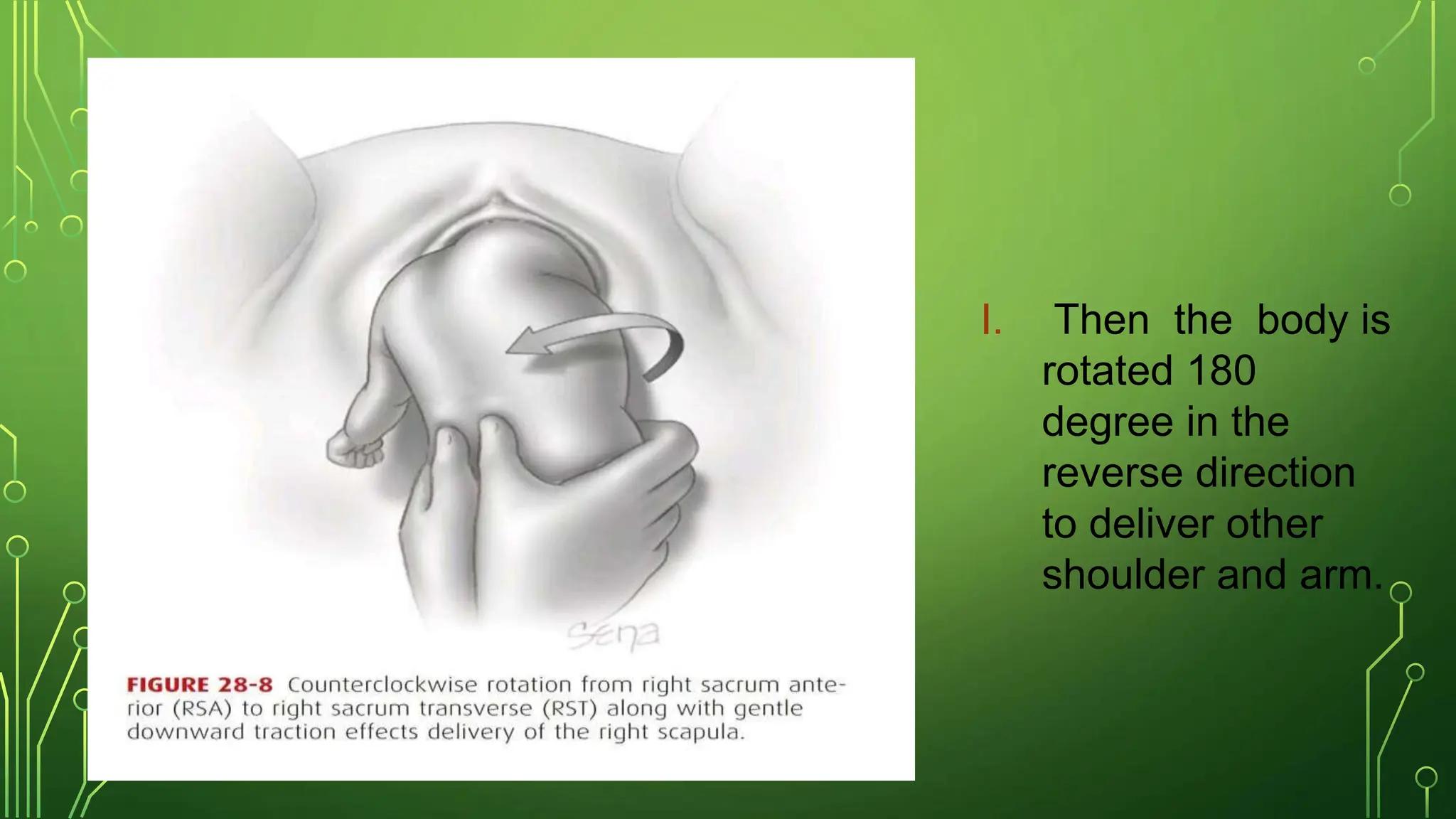
I. Then the body is
rotated 180
degree in the
reverse direction
to deliver other
shoulder and arm.
NUCHAL ARMS
Nuchal arms denotes that the hand is
behind the occiput. One or both hands
may be in this position. (flexed at the
elbow and extended at the head)
Incidence : 0-5% of vaginal breech
deliveries
The diagnosis is made when the
obstetrician notices that the medial
border of the scapula is not parallel to
After grasping the baby at pelvic girdle with
thumbs on sacrum
Rotated 180 degree towards the fingertips of
trapped arm
Lovset maneuver
OCCIPITOPOSTERIOR POSITION OF HEAD
MODIFIED PRAQUE MANEUVER
In rare cases the fetus fails to rotate
anterior, in such cases the fetus maybe
delivered by this method.
Two fingers of one hand grasping the
shoulders back down fetus from
below.
Other hand draws the feet up and over
the maternal abdomen.
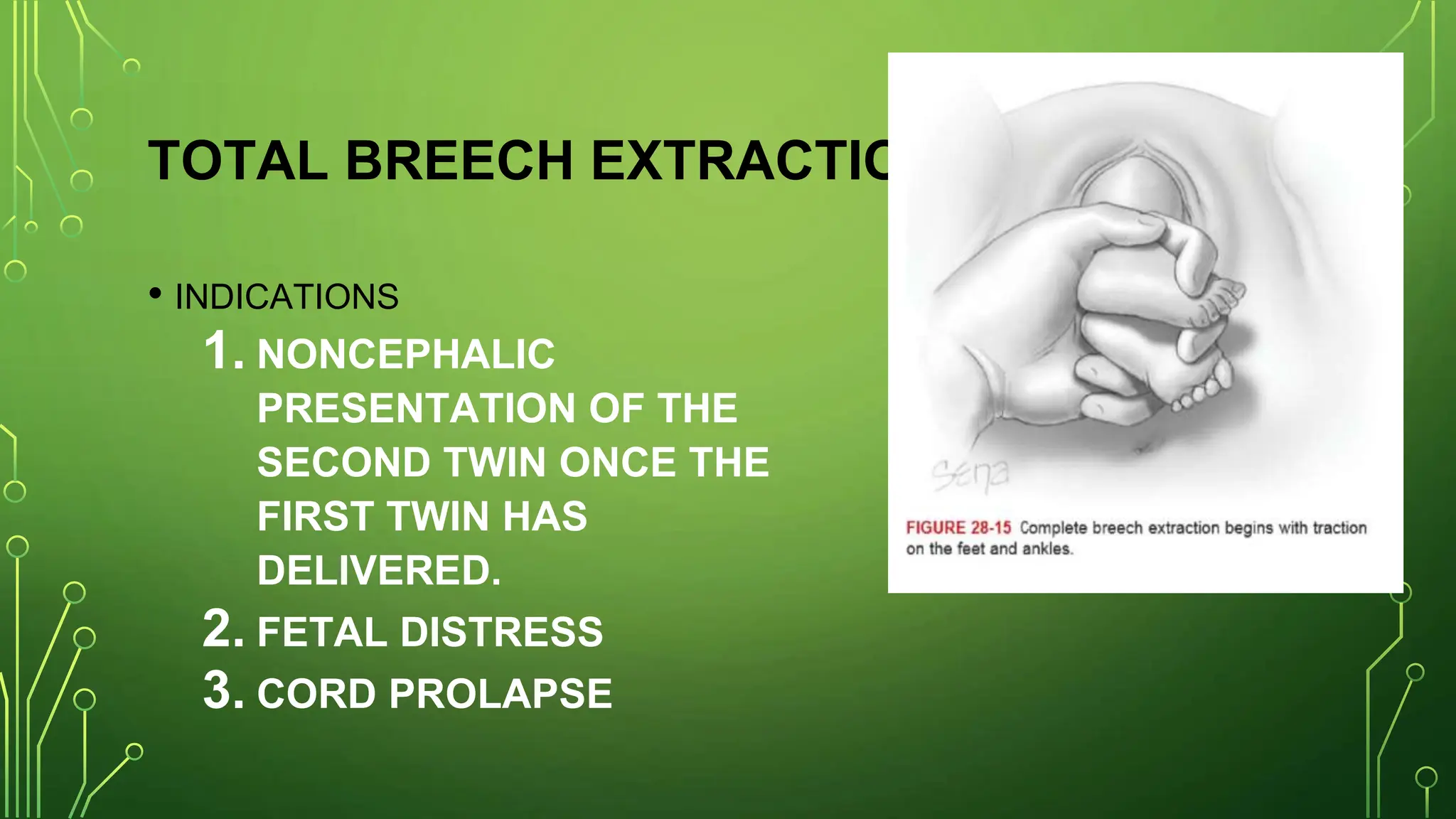
TOTAL BREECH EXTRACTION
• INDICATIONS
1. NONCEPHALIC
PRESENTATION OF THE
SECOND TWIN ONCE THE
FIRST TWIN HAS
DELIVERED.
2. FETAL DISTRESS
3. CORD PROLAPSE
THANK YOU

ASSISTED BREECH DELIVERY Dr. Kavitha.pptx

  • 1.
    ASSISTED BREECH DELIVERY By AssistantProfessor Dr. Kavitha M MS OBG
  • 2.
    • With acephalic presentation, once the head is delivered, the rest of the body typically follows without difficulty. • With breech, however, successively larger and less compressible parts are born last. • Spontaneous complete expulsion of fetus that presents as breech is seldom accomplished successfully.
  • 3.
    MANAGEMENT OF DELIVERYOF BREECH PRESENTATION
  • 4.
    • VAGINAL DELIVERY 1.Spontaneous breech delivery : The entire infant is expelled by natural forces of the mother with no assistance other than support of the baby as it is born 2. Assisted breech delivery : The fetus is delivered spontaneously as far as the umbilicus, but the remainder of the body is delivered with assisted maneuvers, with or without maternal expulsive efforts. 3. Total breech extraction :the entire body of the infant is extracted by the obstetrician • CAESEREAN SECTION
  • 5.
    ZATUCHINI-ANDROS PROGNOSTIC SCORING(1967) • Mostpopular scoring system for assessing the prognosis of successful vaginal delivery.
  • 6.
    0 1 2 PARITYprimi multigravida GESTATIONAL AGE >39 weeks 38weeks 37 weeks ESTIMATED FETAL WEIGHT >3.5kg 3-3.5kg <3kg PREVIOUS BREECH DELIVERY >2500g none 1 >2 CERVICAL DILATATION <2cm 3cm > 4cm STATION OF BREECH > - 3 -2 < -1
  • 7.
    • Score 3or less : CESAREAN SECTION • Women with higher scores can be allowed for VAGINAL DELIVERY.
  • 8.
    INDICATIONS FOR VAGINALDELIVERY Frank or complete breech presentation Gestational age >36 weeks Estimated fetal weight 2.5 to 3.5kg Fetal head must be flexed Adequate maternal pelvis. No other obstetric complications Good ZA score
  • 9.
    MANAGEMENT OF FIRSTSTAGE OF LABOUR
  • 10.
    ⮚An iv lineis started preferably with ringer lactate. ⮚Vaginal examination is indicated - at the onset of labour for pelvic assessment - soon after rupture of membrane to exclude cord prolapse ⮚Blood is sent for grouping and matching ⮚ Patient with term breech presentation is advised to stay in bed. (to prevent PROM)
  • 11.
    Adequate analgesia is given , epiduralis preferred. Fetal heart rate monitored by CTG. Monitoring progress of labour by PARTOGRA M Oxytocin infusion may be used for the augmentatio n of labour.
  • 12.
    MANAGEMENT OF SECONDSTAGE OF LABOUR
  • 13.
    Spontaneous breech delivery Assistedbreech delivery Total breech extraction
  • 14.
    ASSISTED BREECH DELIVERY •Ideally, the breech is allowed to deliver spontaneously upto the umbilicus. • This is the most common mode of vaginal breech delivery. • This is a “HANDS OFF TECHNIQUE”. • MASTER INACTIVITY • WATCHFUL EXPECTENCY • Certain manoeuvres are initiated by the obstetrician to aid delivery of the remainder of body , arms and head.
  • 15.
    PREREQUISITES 1. The backshould always be anterior 2. Fetus should not be pulled from below. 3. Baby’s body covered by sterile towel –prevents premature attempt of inspiration due to external cutaneous stimuli 4. Fetus head should always be maintained in flexion.
  • 16.
    ASSISTED BREECH DELIVERYSTEPS Wait for the legs to deliver spontaneously. (or hook out the legs) With increasing uterine contractions the breech emerges out of the vulval outlet. Local infiltration anaesthesia is given and mediolateral episiotomy is done. After the decent of the breech into the pelvic floor, once climbing of perineum takes place
  • 17.
    FEMORAL PELVIC GRIP: bony pelvis is grasped with both hands using a warm towel. Fingers on the anterior superior iliac spine Thumb on the sacrum. Maternal expulsion efforts. Steady, gentle downward traction is applied until the lower halves of the scapula are delivered. Appearance of one axilla indicates the time for shoulder delivery.
  • 18.
    DELIVERY OF THESHOULDER Attempt is made for the delivery of the shoulder when one axilla is seen at the pubic symphysis. Ordinarily, the arm being flexed at the elbow the shoulders deliver without much difficulty. Posterior arm is delivered first followed by anterior arm.
  • 19.
    DELIVERY OF THEHEAD • After the shoulders are delivered. • The back of the fetus is in the direction of the symphysis which is followed by the assisted delivery of the head. • Hairline is seen under the symphysis.
  • 20.
    • MARSHALL BURNSTECHNIQUE • MODIFIED MAURICEAU SMELLIE VEIT PROCEDURE • FORCEP’S DELIVERY
  • 21.
    MARSHALL BURNS TECHNIQUE Thebaby is allowed to hang by its own weight. Suprapubic pressure is given in the downward and backward direction. KRISTELLAR MANUEVRE
  • 22.
    When nape ofthe neck is visible under the pubic arch, the baby is grasped by the ankle with a finger between the two. Maintaining traction the trunk is swung in upward and forward direction. The other hand to guard the perineum.
  • 23.
  • 24.
    Suprapubic pressure isapplied simultaneously which also helps keep the head flexed. Two fingers of the other hand then are hooked over the fetal neck , and grasping the shoulder downward traction is applied concurrently until the subocciput region appears under symphysis. The index and middle finger of one hand is applied over the maxilla to flex the head while the fetal body rests on the hand and forearm. Delivery of the head via flexion
  • 25.
    MAURICEAU SMELLIE VEIT MANEUVER suprapubic pressureby one obstetrician on the mother’s uterus while another obstetrician inserts left hand in vagina, placing 2 fingers on the malar prominences and another finger in the fetus mouth This maneuver is named after FRANCOIS MAURICEAU, WILLIAM SMELLIE,GUSTAV VEIT.
  • 26.
    The left hand'spalm should rest against the fetus' chest, the right hand can grab either shoulder of the fetus and pull in the direction of the fetus' pelvis.
  • 27.
  • 28.
    Fetal body iselevated using a warm towel . Left blade of the forceps is applied to the aftercoming head. Right blade is applied with the body still elevated. Locking the blades. Application of traction with the obstetrician is kneeling down position. The fetus head is delivered by pulling gently outwards and raising the handles simultaneously.
  • 30.
  • 31.
    • FRANK BREECH •EXTENDED ARMS • NUCHAL ARMS • OCCIPITOPOSTERIOR POSITION OF HEAD
  • 32.
  • 33.
    PINARD’S MANUEVER One handis introduced into the vagina, fingers are guided along the posterior aspect of the knee.
  • 34.
    Gentle pressure is exertedin the popliteal space. This causes the leg to flex at the knee. The foot is grasped and brought down to the vulva
  • 35.
  • 36.
    LOVSET MANEUVER I. The trunkis rotated so that the anterior shoulder and arm appear at the vulva and a finger is passed along the arm down to the elbow which is flexed and the hands drop down.
  • 37.
    I. Then thebody is rotated 180 degree in the reverse direction to deliver other shoulder and arm.
  • 38.
    NUCHAL ARMS Nuchal armsdenotes that the hand is behind the occiput. One or both hands may be in this position. (flexed at the elbow and extended at the head) Incidence : 0-5% of vaginal breech deliveries The diagnosis is made when the obstetrician notices that the medial border of the scapula is not parallel to
  • 39.
    After grasping thebaby at pelvic girdle with thumbs on sacrum Rotated 180 degree towards the fingertips of trapped arm Lovset maneuver
  • 40.
  • 41.
    MODIFIED PRAQUE MANEUVER Inrare cases the fetus fails to rotate anterior, in such cases the fetus maybe delivered by this method. Two fingers of one hand grasping the shoulders back down fetus from below. Other hand draws the feet up and over the maternal abdomen.
  • 42.
    TOTAL BREECH EXTRACTION •INDICATIONS 1. NONCEPHALIC PRESENTATION OF THE SECOND TWIN ONCE THE FIRST TWIN HAS DELIVERED. 2. FETAL DISTRESS 3. CORD PROLAPSE
  • 43.