PAPER NAME :POINTERS IN C
STAFF :SARITHA
CLASS :I
SEMESTER :I
UNIT :I
TOPIC : PROGRAMMING IN C
POINTERS
Whatispointer?
Apointerisaderiveddatatypein C.Pointerscontainsmemoryaddressesastheir
values.Pointerscanbeusedtoaccessandmanipulatedatastoredinthe
memory.Pointersaddedpowerandflexibilitytothelanguage.
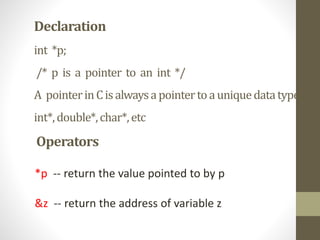
Declaration
int *p;
/* p is a pointer to an int */
A pointerinCisalwaysapointertoauniquedatatype:
int*,double*,char*,etc
Operators
*p -- return the value pointed to by p
&z -- return the address of variable z
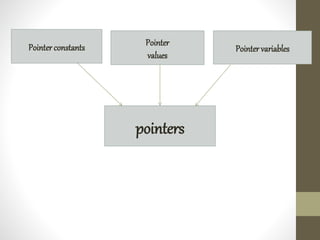
CONCEPTSOF
POINTERS
Pointer constants Pointer
values
Pointer variables
pointers
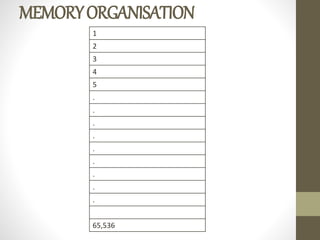
MEMORYORGANISATION
1
2
3
4
5
.
.
.
.
.
.
.
.
.
65,536
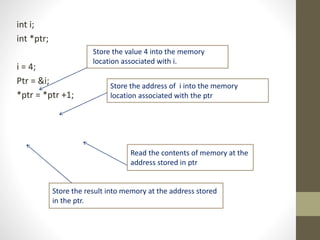
EXAMPLEOFPointer
int i;
int *ptr;
i = 4;
Ptr = &i;
*ptr = *ptr +1;
Store the value 4 into the memory
location associated with i.
Store the address of i into the memory
location associated with the ptr
Read the contents of memory at the
address stored in ptr
Store the result into memory at the address stored
in the ptr.
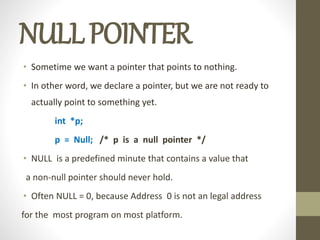
NULLPOINTER
• Sometime we want a pointer that points to nothing.
• In other word, we declare a pointer, but we are not ready to
actually point to something yet.
int *p;
p = Null; /* p is a null pointer */
• NULL is a predefined minute that contains a value that
a non-null pointer should never hold.
• Often NULL = 0, because Address 0 is not an legal address
for the most program on most platform.
POINTERARTHIMETIC
Address calculations depend on size of elements
 In our LC-3 code, we have been assuming one word per
element.
e.g., to find fourth element, we add fourth to base address.
 It's ok, because we have only shown code for integer and
character.
both of which take up one word
• If double, we had have to add 8 to find address of 4th
element.
• C does the size calculations under the covers,
depending on size of item being pointed to:
double x[10];
double *y = x;
*(y + 3) = 13; same as x[3] -- base address plus 6
allocates 20 words (2 per element)
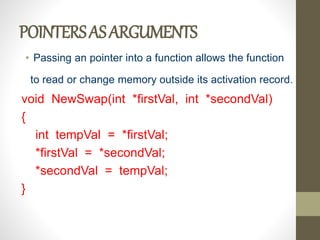
POINTERSASARGUMENTS
• Passing an pointer into a function allows the function
to read or change memory outside its activation record.
void NewSwap(int *firstVal, int *secondVal)
{
int tempVal = *firstVal;
*firstVal = *secondVal;
*secondVal = tempVal;
}
CODEUSINGPOINTERS
• Inside the NewSwap routine.
; int tempVal = *firstVal;
LDR R0, R5, #4 ; R0=xEFFA
LDR R1, R0, #0 ; R1=M[xEFFA]=3
STR R1, R5, #4 ; tempVal=3
; *firstVal = *secondVal;
LDR R1, R5, #5 ; R1=xEFF9
LDR R2, R1, #0 ; R1=M[xEFF9]=4
STR R2, R0, #0 ; M[xEFFA]=4
; *secondVal = tempVal;
LDR R2, R5, #0 ; R2=3
STR R2, R1, #0 ; M[xEFF9]=3
firstVal
secondVal
valueB
valueA
xEFFA
xEFF9
3
4
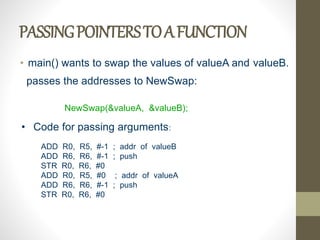
PASSINGPOINTERSTOAFUNCTION
• main() wants to swap the values of valueA and valueB.
passes the addresses to NewSwap:
NewSwap(&valueA, &valueB);
• Code for passing arguments:
ADD R0, R5, #-1 ; addr of valueB
ADD R6, R6, #-1 ; push
STR R0, R6, #0
ADD R0, R5, #0 ; addr of valueA
ADD R6, R6, #-1 ; push
STR R0, R6, #0

Pointers

  • 1.
    PAPER NAME :POINTERSIN C STAFF :SARITHA CLASS :I SEMESTER :I UNIT :I TOPIC : PROGRAMMING IN C
  • 2.
  • 3.
  • 4.
    Declaration int *p; /* pis a pointer to an int */ A pointerinCisalwaysapointertoauniquedatatype: int*,double*,char*,etc Operators *p -- return the value pointed to by p &z -- return the address of variable z
  • 5.
  • 6.
  • 7.
  • 8.
  • 9.
    int i; int *ptr; i= 4; Ptr = &i; *ptr = *ptr +1; Store the value 4 into the memory location associated with i. Store the address of i into the memory location associated with the ptr Read the contents of memory at the address stored in ptr Store the result into memory at the address stored in the ptr.
  • 10.
    NULLPOINTER • Sometime wewant a pointer that points to nothing. • In other word, we declare a pointer, but we are not ready to actually point to something yet. int *p; p = Null; /* p is a null pointer */ • NULL is a predefined minute that contains a value that a non-null pointer should never hold. • Often NULL = 0, because Address 0 is not an legal address for the most program on most platform.
  • 11.
    POINTERARTHIMETIC Address calculations dependon size of elements  In our LC-3 code, we have been assuming one word per element. e.g., to find fourth element, we add fourth to base address.  It's ok, because we have only shown code for integer and character. both of which take up one word • If double, we had have to add 8 to find address of 4th element. • C does the size calculations under the covers, depending on size of item being pointed to: double x[10]; double *y = x; *(y + 3) = 13; same as x[3] -- base address plus 6 allocates 20 words (2 per element)
  • 12.
    POINTERSASARGUMENTS • Passing anpointer into a function allows the function to read or change memory outside its activation record. void NewSwap(int *firstVal, int *secondVal) { int tempVal = *firstVal; *firstVal = *secondVal; *secondVal = tempVal; }
  • 13.
    CODEUSINGPOINTERS • Inside theNewSwap routine. ; int tempVal = *firstVal; LDR R0, R5, #4 ; R0=xEFFA LDR R1, R0, #0 ; R1=M[xEFFA]=3 STR R1, R5, #4 ; tempVal=3 ; *firstVal = *secondVal; LDR R1, R5, #5 ; R1=xEFF9 LDR R2, R1, #0 ; R1=M[xEFF9]=4 STR R2, R0, #0 ; M[xEFFA]=4 ; *secondVal = tempVal; LDR R2, R5, #0 ; R2=3 STR R2, R1, #0 ; M[xEFF9]=3 firstVal secondVal valueB valueA xEFFA xEFF9 3 4
  • 14.
    PASSINGPOINTERSTOAFUNCTION • main() wantsto swap the values of valueA and valueB. passes the addresses to NewSwap: NewSwap(&valueA, &valueB); • Code for passing arguments: ADD R0, R5, #-1 ; addr of valueB ADD R6, R6, #-1 ; push STR R0, R6, #0 ADD R0, R5, #0 ; addr of valueA ADD R6, R6, #-1 ; push STR R0, R6, #0