DMS Sunita M Dol
Walchand Institute of Technology, Solapur Page 1
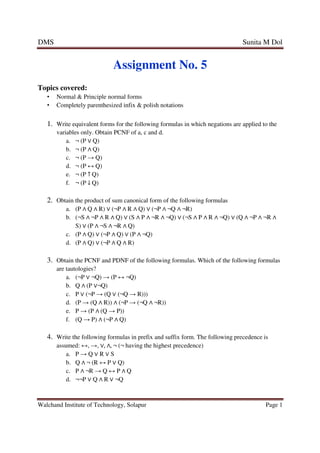
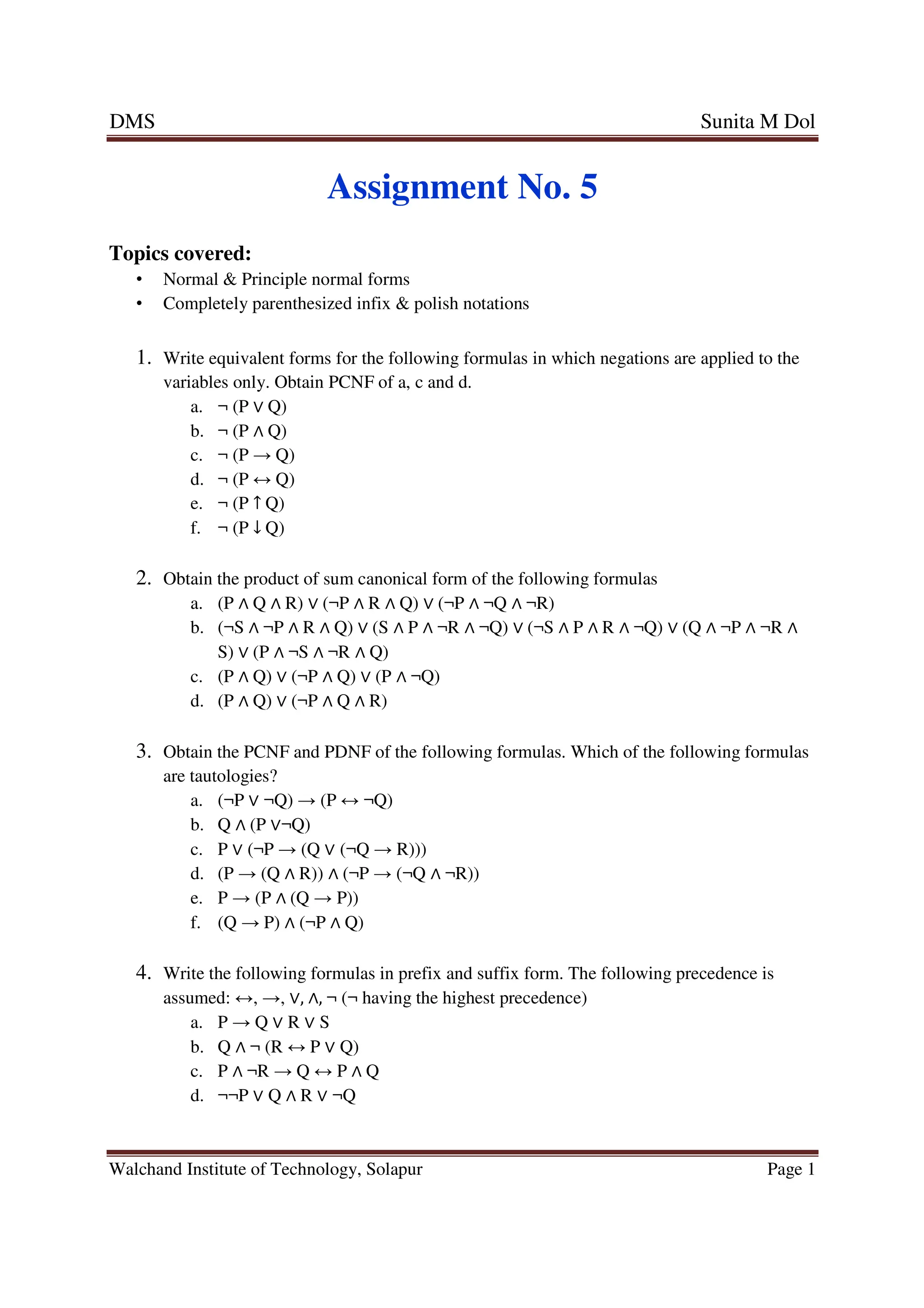
Assignment No. 5
Topics covered:
• Normal & Principle normal forms
• Completely parenthesized infix & polish notations
1. Write equivalent forms for the following formulas in which negations are applied to the
variables only. Obtain PCNF of a, c and d.
a. ¬ (P ∨ Q)
b. ¬ (P ∧ Q)
c. ¬ (P → Q)
d. ¬ (P ↔ Q)
e. ¬ (P ↑ Q)
f. ¬ (P ↓ Q)
2. Obtain the product of sum canonical form of the following formulas
a. (P ∧ Q ∧ R) ∨ (¬P ∧ R ∧ Q) ∨ (¬P ∧ ¬Q ∧ ¬R)
b. (¬S ∧ ¬P ∧ R ∧ Q) ∨ (S ∧ P ∧ ¬R ∧ ¬Q) ∨ (¬S ∧ P ∧ R ∧ ¬Q) ∨ (Q ∧ ¬P ∧ ¬R ∧
S) ∨ (P ∧ ¬S ∧ ¬R ∧ Q)
c. (P ∧ Q) ∨ (¬P ∧ Q) ∨ (P ∧ ¬Q)
d. (P ∧ Q) ∨ (¬P ∧ Q ∧ R)
3. Obtain the PCNF and PDNF of the following formulas. Which of the following formulas
are tautologies?
a. (¬P ∨ ¬Q) → (P ↔ ¬Q)
b. Q ∧ (P ∨¬Q)
c. P ∨ (¬P → (Q ∨ (¬Q → R)))
d. (P → (Q ∧ R)) ∧ (¬P → (¬Q ∧ ¬R))
e. P → (P ∧ (Q → P))
f. (Q → P) ∧ (¬P ∧ Q)
4. Write the following formulas in prefix and suffix form. The following precedence is
assumed: ↔, →, ∨, ∧, ¬ (¬ having the highest precedence)
a. P → Q ∨ R ∨ S
b. Q ∧ ¬ (R ↔ P ∨ Q)
c. P ∧ ¬R → Q ↔ P ∧ Q
d. ¬¬P ∨ Q ∧ R ∨ ¬Q
DMS Sunita M Dol
Walchand Institute of Technology, Solapur Page 2
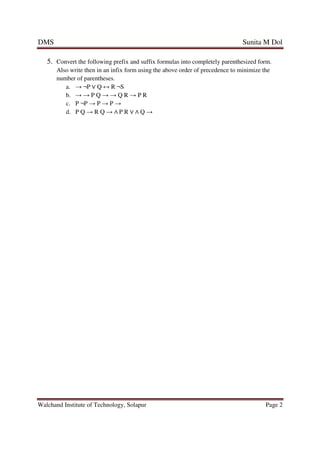
5. Convert the following prefix and suffix formulas into completely parenthesized form.
Also write then in an infix form using the above order of precedence to minimize the
number of parentheses.
a. → ¬P ∨ Q ↔ R ¬S
b. → → P Q → → Q R → P R
c. P ¬P → P → P →
d. P Q → R Q → ∧ P R ∨ ∧ Q →

Assignment No. 5 on Unit-III Representation of Expression

  • 1.
    DMS Sunita MDol Walchand Institute of Technology, Solapur Page 1 Assignment No. 5 Topics covered: • Normal & Principle normal forms • Completely parenthesized infix & polish notations 1. Write equivalent forms for the following formulas in which negations are applied to the variables only. Obtain PCNF of a, c and d. a. ¬ (P ∨ Q) b. ¬ (P ∧ Q) c. ¬ (P → Q) d. ¬ (P ↔ Q) e. ¬ (P ↑ Q) f. ¬ (P ↓ Q) 2. Obtain the product of sum canonical form of the following formulas a. (P ∧ Q ∧ R) ∨ (¬P ∧ R ∧ Q) ∨ (¬P ∧ ¬Q ∧ ¬R) b. (¬S ∧ ¬P ∧ R ∧ Q) ∨ (S ∧ P ∧ ¬R ∧ ¬Q) ∨ (¬S ∧ P ∧ R ∧ ¬Q) ∨ (Q ∧ ¬P ∧ ¬R ∧ S) ∨ (P ∧ ¬S ∧ ¬R ∧ Q) c. (P ∧ Q) ∨ (¬P ∧ Q) ∨ (P ∧ ¬Q) d. (P ∧ Q) ∨ (¬P ∧ Q ∧ R) 3. Obtain the PCNF and PDNF of the following formulas. Which of the following formulas are tautologies? a. (¬P ∨ ¬Q) → (P ↔ ¬Q) b. Q ∧ (P ∨¬Q) c. P ∨ (¬P → (Q ∨ (¬Q → R))) d. (P → (Q ∧ R)) ∧ (¬P → (¬Q ∧ ¬R)) e. P → (P ∧ (Q → P)) f. (Q → P) ∧ (¬P ∧ Q) 4. Write the following formulas in prefix and suffix form. The following precedence is assumed: ↔, →, ∨, ∧, ¬ (¬ having the highest precedence) a. P → Q ∨ R ∨ S b. Q ∧ ¬ (R ↔ P ∨ Q) c. P ∧ ¬R → Q ↔ P ∧ Q d. ¬¬P ∨ Q ∧ R ∨ ¬Q
  • 2.
    DMS Sunita MDol Walchand Institute of Technology, Solapur Page 2 5. Convert the following prefix and suffix formulas into completely parenthesized form. Also write then in an infix form using the above order of precedence to minimize the number of parentheses. a. → ¬P ∨ Q ↔ R ¬S b. → → P Q → → Q R → P R c. P ¬P → P → P → d. P Q → R Q → ∧ P R ∨ ∧ Q →