DMS Sunita M Dol
Walchand Institute of Technology, Solapur Page 1
Assignment No. 6
Topic covered:
• Theory of inference for statement calculus.
1. Show that the conclusion C follows from the premises H1, H2, … in the following cases
a. H1 : P → Q C : P → (P ∧ Q)
b. H1 : ¬P ∨ Q H2 : ¬(Q ∧ ¬P) H3: ¬R C : Q
c. H1 : ¬P H2 : P ∨ Q C : Q
d. H1 : ¬Q H2 : P → Q C : ¬P
e. H1 : P → Q H2 : Q → R C : P → R
f. H1 : R H2 : P ∨ ¬P C : R
2. Determine whether the conclusion C is valid in the following when H1, H2,... are
premises
a. H1 : P → Q H2: ¬Q C : P
b. H1 : P ∨ Q H2 : P → R H3: Q → R C : R
c. H1 : P → (Q → R) H2 : P ∧ Q C : R
d. H1 : P → (Q → R) H2 : R C : P
e. H1 : ¬P H2 : P ∨ Q C : P ∧ Q
3. Show the validity of the following arguments for which the premises are given on the left
and conclusion on right.
a. ¬ (P ∧ ¬Q), ¬Q ∨ R, ¬R ¬P
b. (A → B) ∧ (A → C), (B ∧ C), D ∨ A D
c. ¬J → (M ∨ N), (H ∨ G) → ¬J, H ∨ G M ∨ N
d. P → Q, (¬Q ∨ R) ∧ ¬R, ¬ (¬P ∧ S) ¬S
e. (P ∧ Q) → R, ¬R ∨ S, ¬S ¬P ∨ ¬Q
f. P → Q, Q → ¬R, R, P ∨ (J ∧ S) J S
g. B ∧ C, (B ↔ C) → (H ∨ G) G ∨ H
h. (P → Q) → R, P ∧ S, Q ∧ T R
4. Derive the following using CP rule
a. ¬P ∨ Q, ¬Q ∨ R, R → S ⇒P → S
b. P, P → (Q → (R ∧ S)) ⇒Q → S
c. P → Q ⇒P → (P ∧ Q)
d. (P ∨ Q) → R ⇒(P ∧ Q) → R
e. P → (Q → R), Q → (R → S) ⇒P → (Q → S)
DMS Sunita M Dol
Walchand Institute of Technology, Solapur Page 2
5. Show that following premises are inconsistent
a. P → Q, P → R, Q → ¬R, P
b. A → (B → C), D → (B ∧ ¬C), A ∧ D
6. Show the following (Use indirect method if needed)
a. (R → ¬Q), R ∨ S, S → ¬Q, P → Q ⇒¬P
b. S → ¬Q, S ∨ R, ¬R, ¬R ↔ Q ⇒¬P
c. ¬ (P → Q) → ¬ (R ∨ S), ((Q → P) ∨ ¬R), R ⇒P ↔ Q

Assignment No. 6 on Representation of Expression

  • 1.
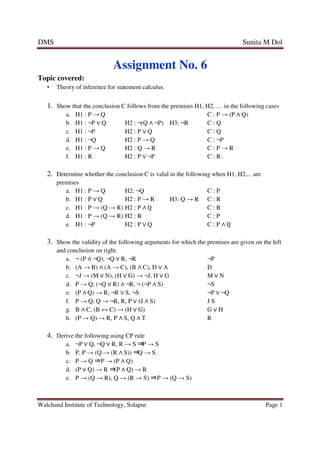
    DMS Sunita MDol Walchand Institute of Technology, Solapur Page 1 Assignment No. 6 Topic covered: • Theory of inference for statement calculus. 1. Show that the conclusion C follows from the premises H1, H2, … in the following cases a. H1 : P → Q C : P → (P ∧ Q) b. H1 : ¬P ∨ Q H2 : ¬(Q ∧ ¬P) H3: ¬R C : Q c. H1 : ¬P H2 : P ∨ Q C : Q d. H1 : ¬Q H2 : P → Q C : ¬P e. H1 : P → Q H2 : Q → R C : P → R f. H1 : R H2 : P ∨ ¬P C : R 2. Determine whether the conclusion C is valid in the following when H1, H2,... are premises a. H1 : P → Q H2: ¬Q C : P b. H1 : P ∨ Q H2 : P → R H3: Q → R C : R c. H1 : P → (Q → R) H2 : P ∧ Q C : R d. H1 : P → (Q → R) H2 : R C : P e. H1 : ¬P H2 : P ∨ Q C : P ∧ Q 3. Show the validity of the following arguments for which the premises are given on the left and conclusion on right. a. ¬ (P ∧ ¬Q), ¬Q ∨ R, ¬R ¬P b. (A → B) ∧ (A → C), (B ∧ C), D ∨ A D c. ¬J → (M ∨ N), (H ∨ G) → ¬J, H ∨ G M ∨ N d. P → Q, (¬Q ∨ R) ∧ ¬R, ¬ (¬P ∧ S) ¬S e. (P ∧ Q) → R, ¬R ∨ S, ¬S ¬P ∨ ¬Q f. P → Q, Q → ¬R, R, P ∨ (J ∧ S) J S g. B ∧ C, (B ↔ C) → (H ∨ G) G ∨ H h. (P → Q) → R, P ∧ S, Q ∧ T R 4. Derive the following using CP rule a. ¬P ∨ Q, ¬Q ∨ R, R → S ⇒P → S b. P, P → (Q → (R ∧ S)) ⇒Q → S c. P → Q ⇒P → (P ∧ Q) d. (P ∨ Q) → R ⇒(P ∧ Q) → R e. P → (Q → R), Q → (R → S) ⇒P → (Q → S)
  • 2.
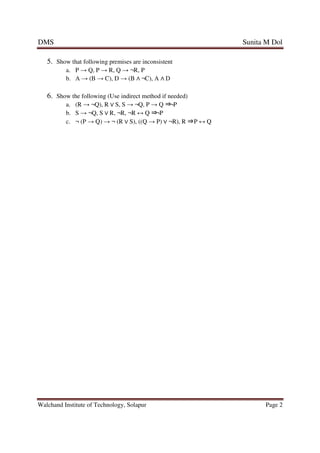
    DMS Sunita MDol Walchand Institute of Technology, Solapur Page 2 5. Show that following premises are inconsistent a. P → Q, P → R, Q → ¬R, P b. A → (B → C), D → (B ∧ ¬C), A ∧ D 6. Show the following (Use indirect method if needed) a. (R → ¬Q), R ∨ S, S → ¬Q, P → Q ⇒¬P b. S → ¬Q, S ∨ R, ¬R, ¬R ↔ Q ⇒¬P c. ¬ (P → Q) → ¬ (R ∨ S), ((Q → P) ∨ ¬R), R ⇒P ↔ Q