Sultanate of Oman
        Sultan Qaboos university
Learning &teaching technology department
                Tech4101
N
w
al
sa
id
al
 g
hf
ri
U
 0
                 82932


         Videoconferencing
This new world of geographical togetherness has been brought about, to a great
extent, by man's scientific and technological genius. Man has been able to dwarf
distance, place time in chains and carve highways through the stratosphere.
“…Through our scientific genius, we have made the world a neighborhood

Video conferencing became one of the most popular technologies used in distance
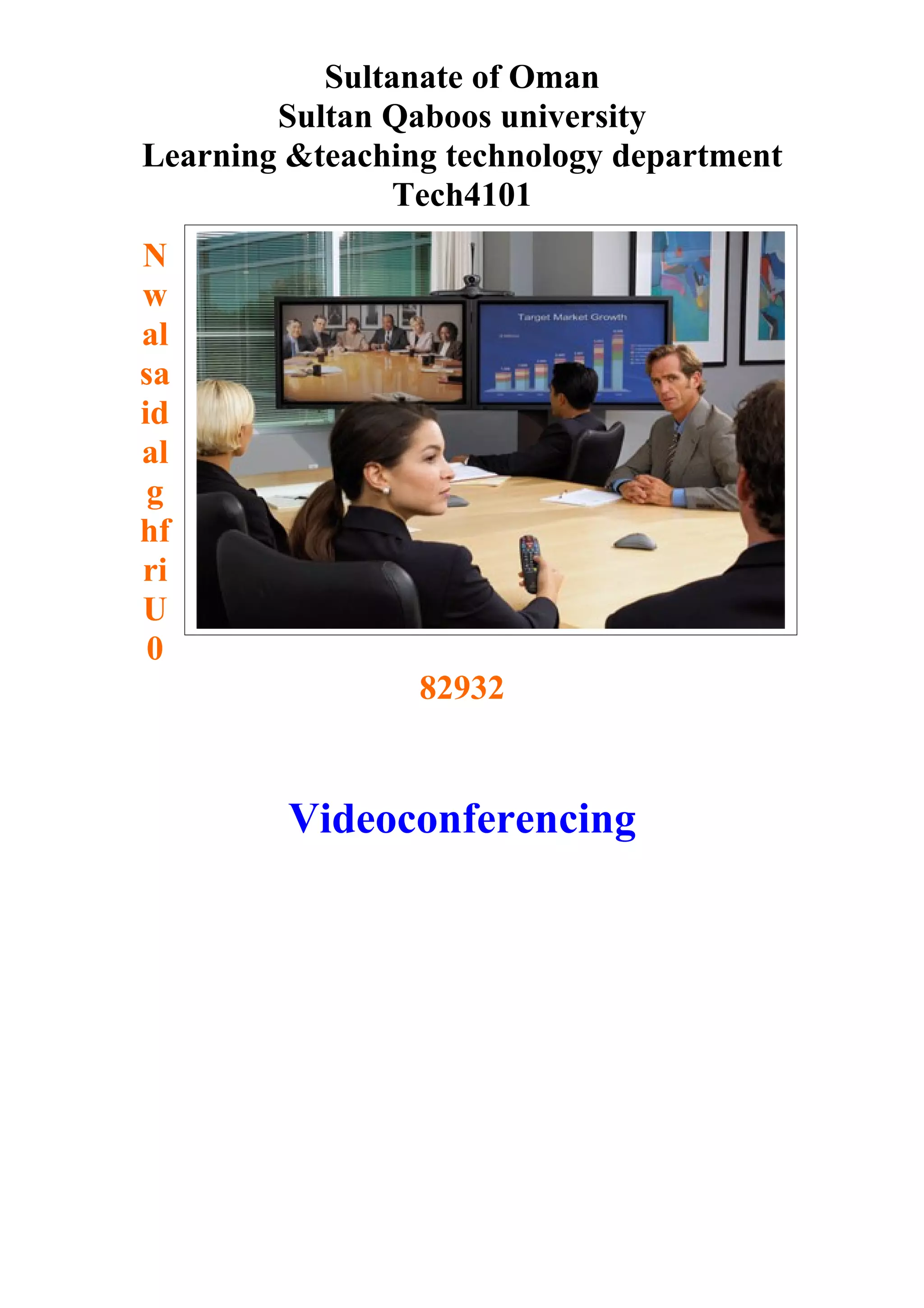
learning , videoconferencing is Video conferencing in its most basic form is the
transmission of image (video) and speech (audio) back and forth between two or
.more physically separate locations

   Videoconferencing is a complex process which includes many
   components such as: Cameras (to capture and send video from your
   local endpoint), Video displays (to display video received from remote
   endpoints), Microphones (to capture and send audio from your local
   endpoint), Speakers (to play audio received from remote endpoints),
   Codec - "compressor/de-compressor“ - makes the audio/video data
   "small enough" to be practical for sending over expensive network
   connections. A codec takes analog signals, compresses and digitizes
   them, and transmits the signals over digital phone lines and finally
   .The Supporting System and the Network Connection

Videoconferencing is not only a video it could be a computer presentation,
other media
(CDs, DVDs, Or ELMO visual presenter (hardcopies, photos

Videoconferencing can be used in different fields and situation for example
we can use it in Presentations, Virtual meetings, Videoconference-based
learning, JIT (just in time) events, Recruitment/search committees
And General meetings, also we can use it in Project coordination, Informal
.work sessions, Alumni relations and Question and answer sessions

Traditional videoconferencing was about audio-video communications to
facilitate meetings without the burden of travel, but Visual collaboration is
much more; it is the combination of audio and video and data in both real-
time and store-and-forward applications, It’s not just about meetings
.anymore


Videoconferencing Can improve work quality of learning, Increase
productivity, Reduce costs, Improves communication, Groups can meet more
frequently, Critical meetings can be convened in less time, More faculty and
staff can be involved, Closely resembles traditional classroom-based
education; permits learners to be active participants in the process, Faculty
and staff needs can be met more quickly through just-in-time training, More
faculty and staff can be trained faster without increasing training resources,
Guest lecturers can be easily integrated into the course , Enables any site to
be the provider of the learning activities, Videoconferencing is cost-effective,
when you consider the traveling costs for traditional training, also
Videoconference-based learning exploits the already acquired
.videoconferencing technologies and network infrastructure
Videoconferencing is anew technology which has too many features helps
learners & teachers to have a better learning environment , even though we
:should aware of the limitation of this technology which includes
       • The initial cost of the equipment and leasing the lines to transmit
          conferences may be prohibitive

       •   Unless a strong effort is made by the instructor, students not located
           with the instructor may remain uninvolved in the course.


       •   If visuals, like handwritten or copied materials, are not properly
           prepared, students may have a difficult time reading them.

       •   If the “pipe” that carries the transmission among sites is not large
           enough, the students may observe “ghost images” when rapid
           movement occurs in “real time”


       •   If the system is not properly configured, class members may observe
           an audio “echo” effect. The result is audio interference that detracts
           from the learning environment.

       •   The absence of QOS (Quality of Service) provides virtually no
           guarantee of a satisfying and successful experience.


       •   Though the technology is improving, a successful videoconference is
           dependent upon the connections and technologies at all of the
           participating sites, AND the network infrastructure

       •   Security issues


     A videoconferencing-based learning strategy aims to:
    Establish Class Expectations
        • It ain’t MTV
        • At the begging of the session, prepare the preparing learners for
            an active experience
       Reduce Distractions

    Engage Students with Variety and Interaction

    Encourage Dialogue


   Using videoconferencing in Open University in UK is something becomes
   important as instructional tool.
   In Open University there courses are uploaded within the website using
   several types of delivery system including videoconferencing , they use this
   technology within there website for many reasons but over all they try to
   deliver there learning materials to learners as easy as possible and enhancing
   communication and interaction among participants.
article

article

  • 1.
    Sultanate of Oman Sultan Qaboos university Learning &teaching technology department Tech4101 N w al sa id al g hf ri U 0 82932 Videoconferencing
  • 2.
    This new worldof geographical togetherness has been brought about, to a great extent, by man's scientific and technological genius. Man has been able to dwarf distance, place time in chains and carve highways through the stratosphere. “…Through our scientific genius, we have made the world a neighborhood Video conferencing became one of the most popular technologies used in distance learning , videoconferencing is Video conferencing in its most basic form is the transmission of image (video) and speech (audio) back and forth between two or .more physically separate locations Videoconferencing is a complex process which includes many components such as: Cameras (to capture and send video from your local endpoint), Video displays (to display video received from remote endpoints), Microphones (to capture and send audio from your local endpoint), Speakers (to play audio received from remote endpoints), Codec - "compressor/de-compressor“ - makes the audio/video data "small enough" to be practical for sending over expensive network connections. A codec takes analog signals, compresses and digitizes them, and transmits the signals over digital phone lines and finally .The Supporting System and the Network Connection Videoconferencing is not only a video it could be a computer presentation, other media (CDs, DVDs, Or ELMO visual presenter (hardcopies, photos Videoconferencing can be used in different fields and situation for example we can use it in Presentations, Virtual meetings, Videoconference-based learning, JIT (just in time) events, Recruitment/search committees And General meetings, also we can use it in Project coordination, Informal .work sessions, Alumni relations and Question and answer sessions Traditional videoconferencing was about audio-video communications to facilitate meetings without the burden of travel, but Visual collaboration is much more; it is the combination of audio and video and data in both real- time and store-and-forward applications, It’s not just about meetings .anymore Videoconferencing Can improve work quality of learning, Increase productivity, Reduce costs, Improves communication, Groups can meet more frequently, Critical meetings can be convened in less time, More faculty and staff can be involved, Closely resembles traditional classroom-based education; permits learners to be active participants in the process, Faculty and staff needs can be met more quickly through just-in-time training, More faculty and staff can be trained faster without increasing training resources, Guest lecturers can be easily integrated into the course , Enables any site to be the provider of the learning activities, Videoconferencing is cost-effective, when you consider the traveling costs for traditional training, also Videoconference-based learning exploits the already acquired .videoconferencing technologies and network infrastructure
  • 3.
    Videoconferencing is anewtechnology which has too many features helps learners & teachers to have a better learning environment , even though we :should aware of the limitation of this technology which includes • The initial cost of the equipment and leasing the lines to transmit conferences may be prohibitive • Unless a strong effort is made by the instructor, students not located with the instructor may remain uninvolved in the course. • If visuals, like handwritten or copied materials, are not properly prepared, students may have a difficult time reading them. • If the “pipe” that carries the transmission among sites is not large enough, the students may observe “ghost images” when rapid movement occurs in “real time” • If the system is not properly configured, class members may observe an audio “echo” effect. The result is audio interference that detracts from the learning environment. • The absence of QOS (Quality of Service) provides virtually no guarantee of a satisfying and successful experience. • Though the technology is improving, a successful videoconference is dependent upon the connections and technologies at all of the participating sites, AND the network infrastructure • Security issues A videoconferencing-based learning strategy aims to:  Establish Class Expectations • It ain’t MTV • At the begging of the session, prepare the preparing learners for an active experience  Reduce Distractions  Engage Students with Variety and Interaction  Encourage Dialogue Using videoconferencing in Open University in UK is something becomes important as instructional tool. In Open University there courses are uploaded within the website using several types of delivery system including videoconferencing , they use this technology within there website for many reasons but over all they try to deliver there learning materials to learners as easy as possible and enhancing communication and interaction among participants.