Ryan D. Giviens
Effective   language      learning    requires     real-time
interpersonal interactions.

  Jim, a boy at almost the age of four, has trouble
  developing his language skills. His parents are both
  deaf but his hearing ability is fully functional. He has no
  verbal communication at home in English or ASL; this
  hinders his language skills.
Media may compliment, but not take the place of
interpersonal language learning.

  Holly employs the use of multiple children’s language
  development DVDs to help her son, Nick, learn from the
  age of three months. From her observations, the media
  does not teach her child much. Rather, it encourages
  her to utilize similar methods in person to teach Nick.
Language Learning:
Do the rules apply across
differing classes?
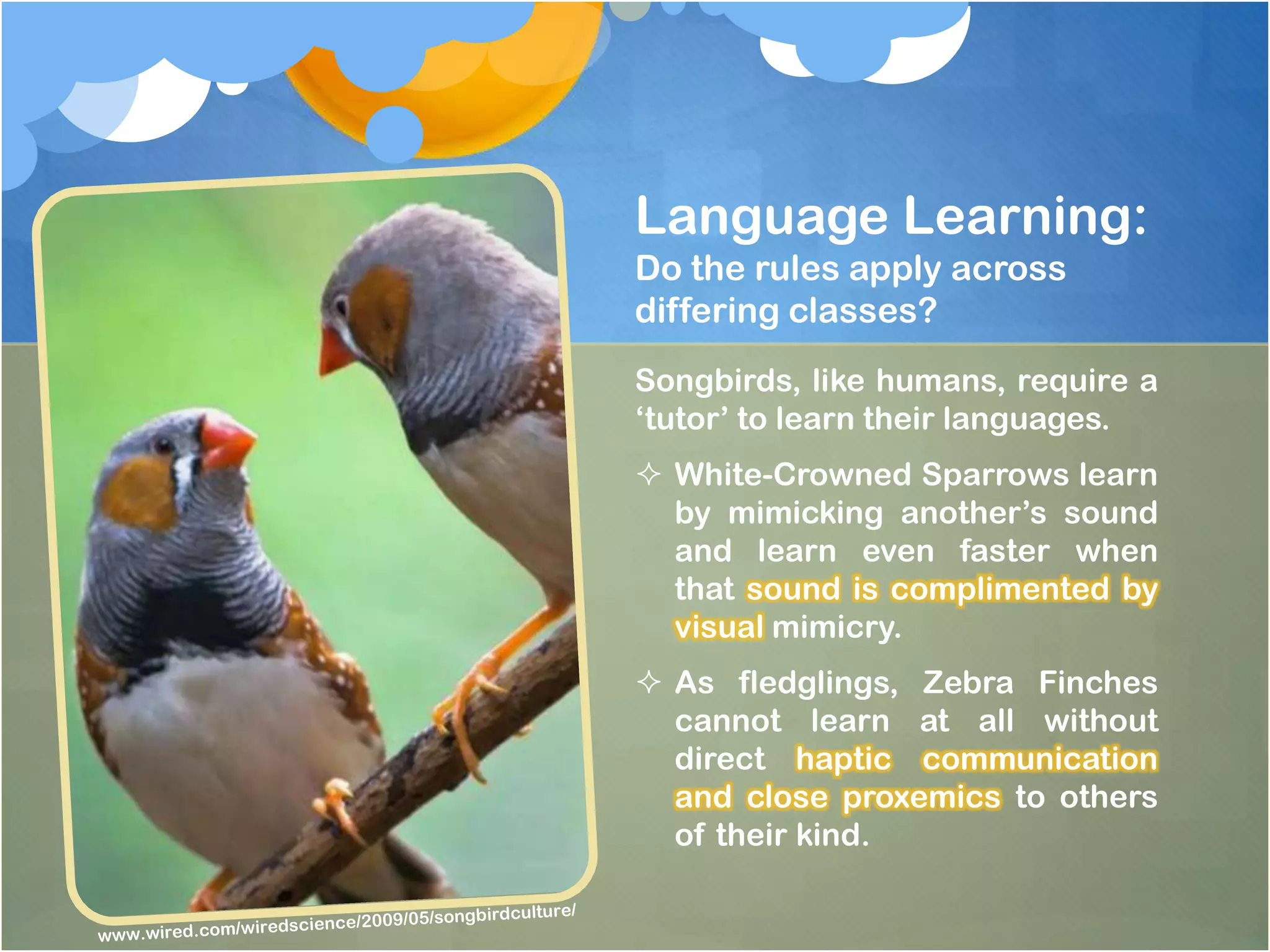
Songbirds, like humans, require a
‘tutor’ to learn their languages.
 White-Crowned Sparrows learn
  by mimicking another’s sound
  and learn even faster when
  that sound is complimented by
  visual mimicry.
 As fledglings, Zebra Finches
  cannot learn at all without
  direct haptic communication
  and close proxemics to others
  of their kind.
Babies possess the ability to distinguish a
variety of phonemes, which adults cannot. This
enables them to more easily learn languages.

Language DVDs sometimes lack in perfected
education methods.
 Audio and video components may not match up
 Speakers may not sound native to the language
 Words may be presented without gender articles


Guernsey, L. (2012). Screen Time. New York:
Basic Books.
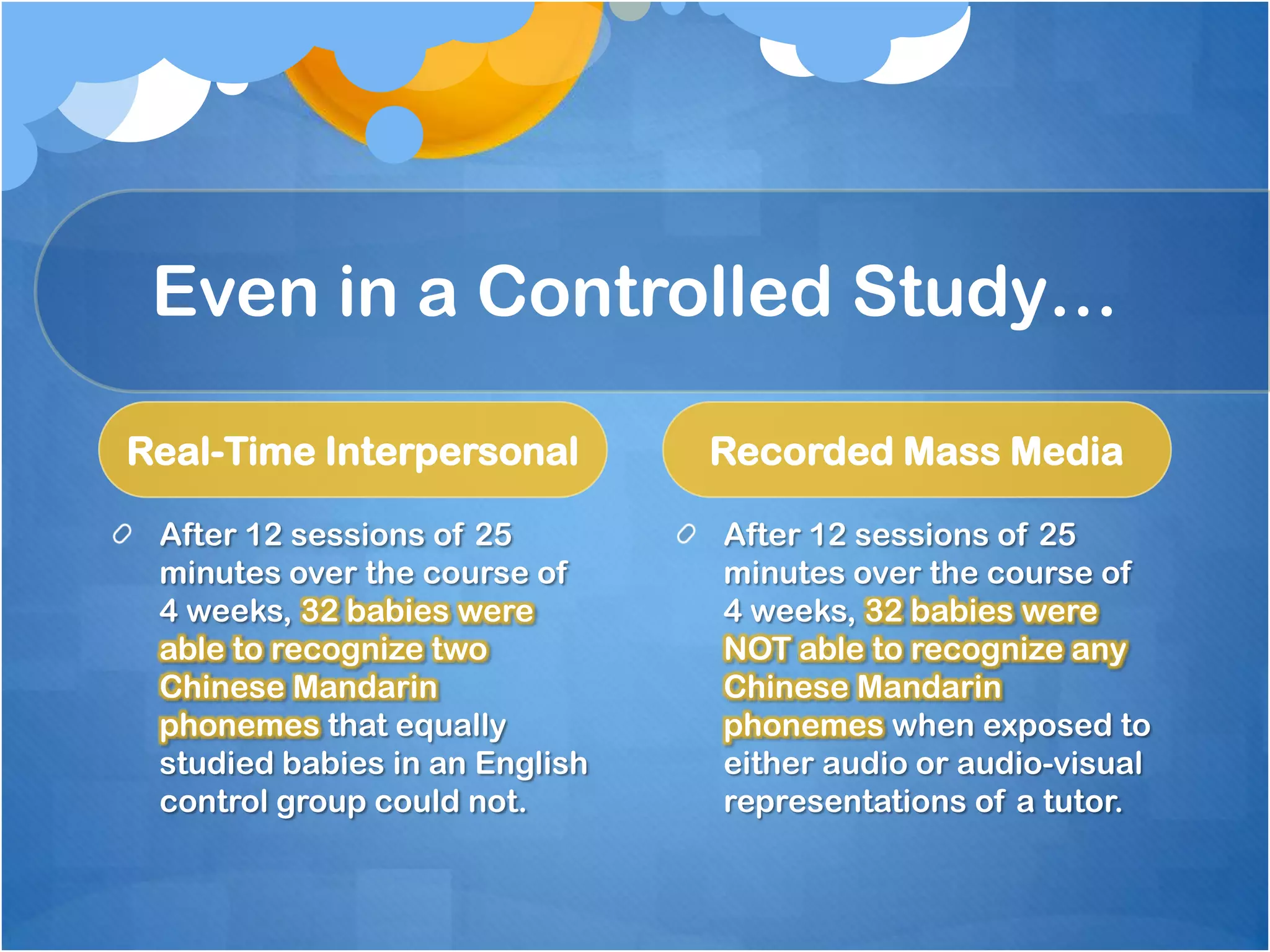
Even in a Controlled Study…

Real-Time Interpersonal         Recorded Mass Media

 After 12 sessions of 25        After 12 sessions of 25
 minutes over the course of     minutes over the course of
 4 weeks, 32 babies were        4 weeks, 32 babies were
 able to recognize two          NOT able to recognize any
 Chinese Mandarin               Chinese Mandarin
 phonemes that equally          phonemes when exposed to
 studied babies in an English   either audio or audio-visual
 control group could not.       representations of a tutor.
Questions for Critical Analysis

Guernsey uses evidence to stress the necessity of interpersonal interaction
with any individual, particularly when it comes to language learning. However,
her book does not provide an equal amount of research to prove certain forms
of media cannot provide the same education. Use your own experiences with
digital language media as well as observations you have made of children and
their use of similar tools to provide evidence that both supports and refutes
Guernsey’s claim.

Consider your experience in the field of Communication and/or Media Studies
both in the classroom and in your personal life. What forms of communication
and its tools [i.e. haptics, complementing, supplementing, proxemics] do you
find most effective in interpersonal communication? What about in the media?
Certain methods work better in different areas of communication and for
different types of messages.

What can you infer about the differences between using media language tools
as an adolescent and using them at a much older age?

Guernsey Chapter 7

  • 1.
  • 2.
    Effective language learning requires real-time interpersonal interactions. Jim, a boy at almost the age of four, has trouble developing his language skills. His parents are both deaf but his hearing ability is fully functional. He has no verbal communication at home in English or ASL; this hinders his language skills. Media may compliment, but not take the place of interpersonal language learning. Holly employs the use of multiple children’s language development DVDs to help her son, Nick, learn from the age of three months. From her observations, the media does not teach her child much. Rather, it encourages her to utilize similar methods in person to teach Nick.
  • 3.
    Language Learning: Do therules apply across differing classes? Songbirds, like humans, require a ‘tutor’ to learn their languages.  White-Crowned Sparrows learn by mimicking another’s sound and learn even faster when that sound is complimented by visual mimicry.  As fledglings, Zebra Finches cannot learn at all without direct haptic communication and close proxemics to others of their kind.
  • 4.
    Babies possess theability to distinguish a variety of phonemes, which adults cannot. This enables them to more easily learn languages. Language DVDs sometimes lack in perfected education methods. Audio and video components may not match up Speakers may not sound native to the language Words may be presented without gender articles Guernsey, L. (2012). Screen Time. New York: Basic Books.
  • 5.
    Even in aControlled Study… Real-Time Interpersonal Recorded Mass Media After 12 sessions of 25 After 12 sessions of 25 minutes over the course of minutes over the course of 4 weeks, 32 babies were 4 weeks, 32 babies were able to recognize two NOT able to recognize any Chinese Mandarin Chinese Mandarin phonemes that equally phonemes when exposed to studied babies in an English either audio or audio-visual control group could not. representations of a tutor.
  • 6.
    Questions for CriticalAnalysis Guernsey uses evidence to stress the necessity of interpersonal interaction with any individual, particularly when it comes to language learning. However, her book does not provide an equal amount of research to prove certain forms of media cannot provide the same education. Use your own experiences with digital language media as well as observations you have made of children and their use of similar tools to provide evidence that both supports and refutes Guernsey’s claim. Consider your experience in the field of Communication and/or Media Studies both in the classroom and in your personal life. What forms of communication and its tools [i.e. haptics, complementing, supplementing, proxemics] do you find most effective in interpersonal communication? What about in the media? Certain methods work better in different areas of communication and for different types of messages. What can you infer about the differences between using media language tools as an adolescent and using them at a much older age?