Course: 
Foundations 
of 
Virtual 
Instruction 
by 
Cindy 
Carbajal 
Virtual 
Lesson 
Plan 
Assignment 
Alma 
Guerrero 
October 
20th, 
2013. 
The 
following 
Virtual 
Lesson 
Plan 
is 
designed 
to 
reinforce 
the 
face 
to 
face 
learning 
process 
in 
students 
of 
first 
semester 
(grade 
10th 
in 
USA), 
who 
are 
about 
15 
years 
old 
and 
currently 
studying 
at 
Colegio 
de 
Bachilleres, 
Plantel 
5, 
located 
in 
Cardenas, 
Tabasco. 
Mexico. 
I. LESSON TITLE, SUBJECT AND GRADE LEVEL. 
LESSON: MODULE 2.- “What do I do? and How do I live? 
SUBJECT: Lengua Adicional al Español 1 (English 1) 
GRADE LEVEL: 1st. Semester 
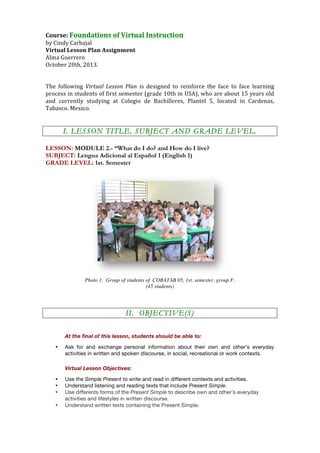
Photo 1. Group of students of COBATAB 05, 1st. semester, group F. 
(45 students) 
II. OBJECTIVE(S) 
At the final of this lesson, students should be able to: 
• Ask for and exchange personal information about their own and other’s everyday 
activities in written and spoken discourse, in social, recreational or work contexts. 
Virtual Lesson Objectives: 
• Use the Simple Present to write and read in different contexts and activities. 
• Understand listening and reading texts that include Present Simple. 
• Use differents forms of the Present Simple to describe own and other’s everyday 
activities and lifestyles in written discourse. 
• Understand written texts containing the Present Simple.
Learning Objecs: 
• Simple present 
• Physical features 
• Ethnic and cultural features 
• Family members 
• Geographical features 
• Numbers 
• Verb to be 
• Personal pronouns 
• Impersonal pronouns 
• Possessive adjectives 
• Definite articles 
• Indefinite articles 
III. OVERVIEW 
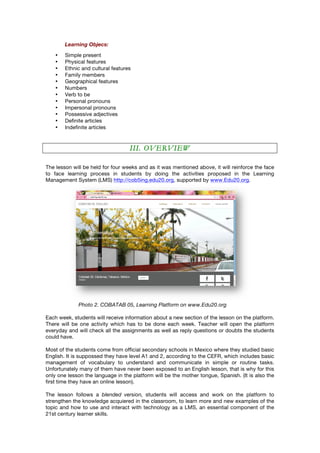
The lesson will be held for four weeks and as it was mentioned above, it will reinforce the face 
to face learning process in students by doing the activities proposed in the Learning 
Management System (LMS) http://cob5ing.edu20.org, supported by www.Edu20.org. 
Photo 2. COBATAB 05, Learning Platform on www.Edu20.org 
Each week, students will receive information about a new section of the lesson on the platform. 
There will be one activity which has to be done each week. Teacher will open the platform 
everyday and will check all the assignments as well as reply questions or doubts the students 
could have. 
Most of the students come from official secondary schools in Mexico where they studied basic 
English. It is suppossed they have level A1 and 2, according to the CEFR, which includes basic 
management of vocabulary to understand and communicate in simple or routine tasks. 
Unfortunately many of them have never been exposed to an English lesson, that is why for this 
only one lesson the language in the platform will be the mother tongue, Spanish. (It is also the 
first time they have an online lesson). 
The lesson follows a blended version, students will access and work on the platform to 
strengthen the knowledge acquiered in the classroom, to learn more and new examples of the 
topic and how to use and interact with technology as a LMS, an essential component of the 
21st century learner skills.
IV. VIRTUAL COMPONENTS AND LESSON ACTIVITIES 
The main activities will be held by students on an asynchronous way as they intend to reinforce 
the lessons in the classroom, by giving them the opportunity to work on their own pace, place 
and time. 
There is one synchronous activity included and it is the chat tool which is used by students 
and the tutor in the platform when they are online to ask and answer questions about the topic. 
The lesson (Module 2) is divided into 5 learning sections (the first one with the content 
information), two exercises and one simple test, as it is shown in the photo 3. 
Photo 3. Lesson Structure 
1.- Section 1, has the basic information about the lesson such as name, objective and 
competencies that students will be able to develop. 
2.- Next section contains a text about Daily Routines (photo 4). Students will read and select all 
the actions (verbs) they can identify, noticing the tense used in this situation. (Present Simple).
3.-­‐ 
Section 3, presents important grammar notes about the Present Simple. Something that is 
usually boring to learn in the classroom and sometimes time is not enough, so I consider that 
by using the platform is a good way learners interact with this information in an attractive 
format. 
4.- Sections 4 and 5 (photos 5 and 6), include tables with information, links to access to them 
and some interactives activities where learners can learn and practice. 
Photo 5. 
Photo 6. A link inserted as a resource in Section 4.
V. Method of evaluation 
One of the benefits of using an LMS is the opportunity to save a lot of time when the activities 
need to be graded (so helpful when a teacher has 10 classes with 45 students in each one, like 
me). In the lesson described in this paper, there are two exercises wich are rated by the 
program according to the parameters the designer decides. Next pictures show the results 
students get after the assigned attempts and before the deadline also assigned by the 
instructor. 
Photo 7. Assignment Grading of Exercise 1. 
Even the program automatically sends the results, it is very important to write a brief comment 
and send it to the learner, so they feel not alone and can notice their tutor is monitoring 
constantly the platform. 
Photo 8. Result obtained by a student in exercise 2.
Photo 9. An example of an item in exercise 2. 
It is also very important to write the specific instruction for each activity, the more careful you 
design the assignment, the less conflict learners have when do their activities. 
On the other hand, the parameters of evaluation depend on the kind of activity, for example in 
a test; the attempts can not be more than one and the time for answer is limited. 
Photo 10. Parameters designed for Test 1.
Finally, as the tutors of a virtual course, the LMS gives the tools to know how many times the 
learner has accessed to it, as well as the time he has spent in it. This gives us an idea about 
the responsability in each learner and take the necessary steps to adjust any irregularities. 
Photo 11. A learner results. 
Photo 12. Activity of a student. 
Thanks for reading, this is my first try in the virtual teaching world. I would 
appreciate any comment. 
Alma Leticia. 
Cardenas, Tabasco. Mex.

Assignment 1

  • 1.
    Course: Foundations of Virtual Instruction by Cindy Carbajal Virtual Lesson Plan Assignment Alma Guerrero October 20th, 2013. The following Virtual Lesson Plan is designed to reinforce the face to face learning process in students of first semester (grade 10th in USA), who are about 15 years old and currently studying at Colegio de Bachilleres, Plantel 5, located in Cardenas, Tabasco. Mexico. I. LESSON TITLE, SUBJECT AND GRADE LEVEL. LESSON: MODULE 2.- “What do I do? and How do I live? SUBJECT: Lengua Adicional al Español 1 (English 1) GRADE LEVEL: 1st. Semester Photo 1. Group of students of COBATAB 05, 1st. semester, group F. (45 students) II. OBJECTIVE(S) At the final of this lesson, students should be able to: • Ask for and exchange personal information about their own and other’s everyday activities in written and spoken discourse, in social, recreational or work contexts. Virtual Lesson Objectives: • Use the Simple Present to write and read in different contexts and activities. • Understand listening and reading texts that include Present Simple. • Use differents forms of the Present Simple to describe own and other’s everyday activities and lifestyles in written discourse. • Understand written texts containing the Present Simple.
  • 2.
    Learning Objecs: •Simple present • Physical features • Ethnic and cultural features • Family members • Geographical features • Numbers • Verb to be • Personal pronouns • Impersonal pronouns • Possessive adjectives • Definite articles • Indefinite articles III. OVERVIEW The lesson will be held for four weeks and as it was mentioned above, it will reinforce the face to face learning process in students by doing the activities proposed in the Learning Management System (LMS) http://cob5ing.edu20.org, supported by www.Edu20.org. Photo 2. COBATAB 05, Learning Platform on www.Edu20.org Each week, students will receive information about a new section of the lesson on the platform. There will be one activity which has to be done each week. Teacher will open the platform everyday and will check all the assignments as well as reply questions or doubts the students could have. Most of the students come from official secondary schools in Mexico where they studied basic English. It is suppossed they have level A1 and 2, according to the CEFR, which includes basic management of vocabulary to understand and communicate in simple or routine tasks. Unfortunately many of them have never been exposed to an English lesson, that is why for this only one lesson the language in the platform will be the mother tongue, Spanish. (It is also the first time they have an online lesson). The lesson follows a blended version, students will access and work on the platform to strengthen the knowledge acquiered in the classroom, to learn more and new examples of the topic and how to use and interact with technology as a LMS, an essential component of the 21st century learner skills.
  • 3.
    IV. VIRTUAL COMPONENTSAND LESSON ACTIVITIES The main activities will be held by students on an asynchronous way as they intend to reinforce the lessons in the classroom, by giving them the opportunity to work on their own pace, place and time. There is one synchronous activity included and it is the chat tool which is used by students and the tutor in the platform when they are online to ask and answer questions about the topic. The lesson (Module 2) is divided into 5 learning sections (the first one with the content information), two exercises and one simple test, as it is shown in the photo 3. Photo 3. Lesson Structure 1.- Section 1, has the basic information about the lesson such as name, objective and competencies that students will be able to develop. 2.- Next section contains a text about Daily Routines (photo 4). Students will read and select all the actions (verbs) they can identify, noticing the tense used in this situation. (Present Simple).
  • 4.
    3.-­‐ Section 3,presents important grammar notes about the Present Simple. Something that is usually boring to learn in the classroom and sometimes time is not enough, so I consider that by using the platform is a good way learners interact with this information in an attractive format. 4.- Sections 4 and 5 (photos 5 and 6), include tables with information, links to access to them and some interactives activities where learners can learn and practice. Photo 5. Photo 6. A link inserted as a resource in Section 4.
  • 5.
    V. Method ofevaluation One of the benefits of using an LMS is the opportunity to save a lot of time when the activities need to be graded (so helpful when a teacher has 10 classes with 45 students in each one, like me). In the lesson described in this paper, there are two exercises wich are rated by the program according to the parameters the designer decides. Next pictures show the results students get after the assigned attempts and before the deadline also assigned by the instructor. Photo 7. Assignment Grading of Exercise 1. Even the program automatically sends the results, it is very important to write a brief comment and send it to the learner, so they feel not alone and can notice their tutor is monitoring constantly the platform. Photo 8. Result obtained by a student in exercise 2.
  • 6.
    Photo 9. Anexample of an item in exercise 2. It is also very important to write the specific instruction for each activity, the more careful you design the assignment, the less conflict learners have when do their activities. On the other hand, the parameters of evaluation depend on the kind of activity, for example in a test; the attempts can not be more than one and the time for answer is limited. Photo 10. Parameters designed for Test 1.
  • 7.
    Finally, as thetutors of a virtual course, the LMS gives the tools to know how many times the learner has accessed to it, as well as the time he has spent in it. This gives us an idea about the responsability in each learner and take the necessary steps to adjust any irregularities. Photo 11. A learner results. Photo 12. Activity of a student. Thanks for reading, this is my first try in the virtual teaching world. I would appreciate any comment. Alma Leticia. Cardenas, Tabasco. Mex.