MODULE 2:
MOST ESSENTIAL LEARNING
COMPETENCIES
(MELCs)
MODULE 2: MOST ESSENTIAL LEARNING COMPETENCIES
(MELCs)
After having been introduced to the course in Module 1,
you will now begin this course by gaining an understanding
of the Most Essential Learning Competencies (MELCs). We
hope that you will be able to strengthen your understanding
through this Module.
In this Module, the development of the MELCs will be
discussed, and how these can be unpacked and combined in
planning and designing your lessons.
MODULE OBJECTIVES:
By the end of this Module, you will be able to:
1. explain the background and development of the
MELCs
2. unpack the MELCs
3. combine related competencies into learning
objectives
MODULE CONTENT:
Lesson 1. Background, Rationale, and Development of
MELCs
Lesson 2. Unpacking and Combining MELCs into
Learning Objectives LAC Session 2
LESSON 1: BACKGROUND, RATIONALE, AND
DEVELOPMENT OF MELCS
By the end of this lesson, you should be able to familiarize
yourself with the background, rationale, and development
of MELCs. In this session, you will be able to:
1. identify the background and basic process of the
identification and development of the MELCs
2. make sense of the function of MELCs as an educational
response to a global health crisis
3. appreciate the MELCs as support for teachers during
this time
Key Topics/Concepts
curriculum standards; essential learning compet
encies; desirable learning
competencies; enduring knowledge
Resources Required
✓ Development and Design of MELCs
✓ Your learning area’s original K-12 Curriculum
Guide and corresponding list of MELCs
✓ Study Notebook
Activity 1:
Answer the following reflective questions in your Study
Notebook:
1. The closure of schools around the world due to the global
pandemic posed serious challenges on the delivery of
quality basic education. As a teacher, what do you think are
the fundamental concerns in terms of curriculum standards
that need to be addressed in order to ensure learning
continuity? Cite a specific example. Do you think these
concerns could be solved by teachers alone? Why or why not?
Activity 1:
Answer the following reflective questions in your Study
Notebook:
2. Even prior to the spread of COVID-19 that eventually led
to the closure of schools nationwide, the congested
curriculum has been a perennial problem of teachers
(Andaya, 2018). This is perceived to be one of the hindering
factors on the poor performance of Filipino learners. Do you
agree with this observation? Why or why not?
Activity 2:
Familiarize yourself with the course reading on the
Development and Design of the MELCs. After going through
the document, provide a brief and concise response to the
following guide questions. Write your answers in your Study
Notebook.
1. What are the general and specific purposes of the
development of MELCs?
2. How does curriculum review aid in the identification of
essential learning competencies?
3. What is the difference between essential learning
competencies and desirable learning competencies?
Activity 2:
Familiarize yourself with the course reading on the
Development and Design of the MELCs. After going through
the document, provide a brief and concise response to the
following guide questions. Write your answers in your Study
Notebook.
4. How were the most essential learning competencies
identified? What were the decisions made in order to trim dow
n the number of the essential learning competencies further?
5. What is the importance of the MELCs in ensuring the
delivery of quality instruction?
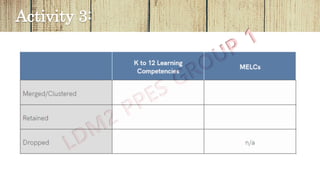
Activity 3:
Prepare a copy of your learning area’s original K-12
Curriculum Guide and corresponding list of MELCs.
Go to the sections of the curriculum guide and MELCs that
are relevant to your instructional needs. Copy and
accomplish the following table in your Study Notebook and
compare the two documents to determine which learning
competencies were retained, dropped, or merged.
Activity 4:
In your LAC Session, discuss and
share your answers to Activities 1-3
in this lesson. Discuss any questions
about the MELCs that need
clarification as well. Share your
thoughts and let your co-teachers a
rticulate their insights regarding
your questions. Jot down all the
insights shared in the discussion,
including your own, in your Study
Notebook.
Activity 3:
Good job! You are now done with Lesson 1.
Proceed to Lesson 2 to learn how to
unpack and combine the
MELCs into Learning Objectives.
LESSON 2: UNPACKING AND COMBINING MELCS
INTO LEARNING OBJECTIVES
In this session, you will familiarize yourself with unpacking
and combining MELCs into Learning Objectives. By the end
of this lesson, you will be able to:
1. understand the vital considerations in unpacking and com
bining MELCs
2. unpack and combine sample MELCs
3. affirm that unpacking and combining MELCs provide
curricular flexibilities to field implementers
Key Topics/Concepts
unpack; curriculum standards;
essential learning competencies;
content standards;
performance standards
Resources Required
✓ Unpacking and Combining the MELCs
✓ Your learning area’s original K-12 Curriculum
Guide and corresponding list of MELCs
✓ Study Notebook
Activity 1:
Familiarize yourself with the course reading on Unpacking
and Combining the MELCs. After reading the document,
provide a brief and concise response to the following guide
questions in your Study Notebook:
1. What is the importance of unpacking and combining the
MELCs?
2. What considerations must be taken in unpacking and
combining the MELCs? Explain each.
3. Do all the MELCs need to be unpacked or combined?
Why or why not?
Activity 2:
1. Form a group of four members within your LAC,
preferably with fellow teachers in your respective learning
area.
2. Using the curriculum guide and a list of the MELCs,
choose MELCs in the first quarter and unpack these into
learning objectives.
3. Each team will present their unpacked learning objectives.
Discussion and processing will follow each presentation.
Suggestions and insights from each group will be considered
in enhancing the learning objectives.
Activity 2:
Repeat the above process but instead of unpacking, each
team will now combine at least two MELCs of their choice.
Group deliberation will be observed in order to arrive at a
consensus.
Discuss and jot down the synthesis of the presentations in
your Study Notebook.
Activity 3:
Submit your Activity 2 Outputs to your LAC Leader.
Make sure to keep a copy of your outputs.
Congratulations!
You have completed Module 2.
You may now proceed to
Module 3A
Lesson Design and Assessment
in the Modalities.

Learning Delivery Modalities Course 2:

  • 1.
    MODULE 2: MOST ESSENTIALLEARNING COMPETENCIES (MELCs)
  • 2.
    MODULE 2: MOSTESSENTIAL LEARNING COMPETENCIES (MELCs) After having been introduced to the course in Module 1, you will now begin this course by gaining an understanding of the Most Essential Learning Competencies (MELCs). We hope that you will be able to strengthen your understanding through this Module. In this Module, the development of the MELCs will be discussed, and how these can be unpacked and combined in planning and designing your lessons.
  • 3.
    MODULE OBJECTIVES: By theend of this Module, you will be able to: 1. explain the background and development of the MELCs 2. unpack the MELCs 3. combine related competencies into learning objectives MODULE CONTENT: Lesson 1. Background, Rationale, and Development of MELCs Lesson 2. Unpacking and Combining MELCs into Learning Objectives LAC Session 2
  • 4.
    LESSON 1: BACKGROUND,RATIONALE, AND DEVELOPMENT OF MELCS By the end of this lesson, you should be able to familiarize yourself with the background, rationale, and development of MELCs. In this session, you will be able to: 1. identify the background and basic process of the identification and development of the MELCs 2. make sense of the function of MELCs as an educational response to a global health crisis 3. appreciate the MELCs as support for teachers during this time
  • 5.
    Key Topics/Concepts curriculum standards;essential learning compet encies; desirable learning competencies; enduring knowledge Resources Required ✓ Development and Design of MELCs ✓ Your learning area’s original K-12 Curriculum Guide and corresponding list of MELCs ✓ Study Notebook
  • 6.
    Activity 1: Answer thefollowing reflective questions in your Study Notebook: 1. The closure of schools around the world due to the global pandemic posed serious challenges on the delivery of quality basic education. As a teacher, what do you think are the fundamental concerns in terms of curriculum standards that need to be addressed in order to ensure learning continuity? Cite a specific example. Do you think these concerns could be solved by teachers alone? Why or why not?
  • 7.
    Activity 1: Answer thefollowing reflective questions in your Study Notebook: 2. Even prior to the spread of COVID-19 that eventually led to the closure of schools nationwide, the congested curriculum has been a perennial problem of teachers (Andaya, 2018). This is perceived to be one of the hindering factors on the poor performance of Filipino learners. Do you agree with this observation? Why or why not?
  • 8.
    Activity 2: Familiarize yourselfwith the course reading on the Development and Design of the MELCs. After going through the document, provide a brief and concise response to the following guide questions. Write your answers in your Study Notebook. 1. What are the general and specific purposes of the development of MELCs? 2. How does curriculum review aid in the identification of essential learning competencies? 3. What is the difference between essential learning competencies and desirable learning competencies?
  • 9.
    Activity 2: Familiarize yourselfwith the course reading on the Development and Design of the MELCs. After going through the document, provide a brief and concise response to the following guide questions. Write your answers in your Study Notebook. 4. How were the most essential learning competencies identified? What were the decisions made in order to trim dow n the number of the essential learning competencies further? 5. What is the importance of the MELCs in ensuring the delivery of quality instruction?
  • 10.
    Activity 3: Prepare acopy of your learning area’s original K-12 Curriculum Guide and corresponding list of MELCs. Go to the sections of the curriculum guide and MELCs that are relevant to your instructional needs. Copy and accomplish the following table in your Study Notebook and compare the two documents to determine which learning competencies were retained, dropped, or merged.
  • 11.
    Activity 4: In yourLAC Session, discuss and share your answers to Activities 1-3 in this lesson. Discuss any questions about the MELCs that need clarification as well. Share your thoughts and let your co-teachers a rticulate their insights regarding your questions. Jot down all the insights shared in the discussion, including your own, in your Study Notebook.
  • 12.
  • 13.
    Good job! Youare now done with Lesson 1. Proceed to Lesson 2 to learn how to unpack and combine the MELCs into Learning Objectives.
  • 14.
    LESSON 2: UNPACKINGAND COMBINING MELCS INTO LEARNING OBJECTIVES In this session, you will familiarize yourself with unpacking and combining MELCs into Learning Objectives. By the end of this lesson, you will be able to: 1. understand the vital considerations in unpacking and com bining MELCs 2. unpack and combine sample MELCs 3. affirm that unpacking and combining MELCs provide curricular flexibilities to field implementers
  • 15.
    Key Topics/Concepts unpack; curriculumstandards; essential learning competencies; content standards; performance standards Resources Required ✓ Unpacking and Combining the MELCs ✓ Your learning area’s original K-12 Curriculum Guide and corresponding list of MELCs ✓ Study Notebook
  • 16.
    Activity 1: Familiarize yourselfwith the course reading on Unpacking and Combining the MELCs. After reading the document, provide a brief and concise response to the following guide questions in your Study Notebook: 1. What is the importance of unpacking and combining the MELCs? 2. What considerations must be taken in unpacking and combining the MELCs? Explain each. 3. Do all the MELCs need to be unpacked or combined? Why or why not?
  • 17.
    Activity 2: 1. Forma group of four members within your LAC, preferably with fellow teachers in your respective learning area. 2. Using the curriculum guide and a list of the MELCs, choose MELCs in the first quarter and unpack these into learning objectives. 3. Each team will present their unpacked learning objectives. Discussion and processing will follow each presentation. Suggestions and insights from each group will be considered in enhancing the learning objectives.
  • 18.
    Activity 2: Repeat theabove process but instead of unpacking, each team will now combine at least two MELCs of their choice. Group deliberation will be observed in order to arrive at a consensus. Discuss and jot down the synthesis of the presentations in your Study Notebook.
  • 19.
    Activity 3: Submit yourActivity 2 Outputs to your LAC Leader. Make sure to keep a copy of your outputs.
  • 20.
    Congratulations! You have completedModule 2. You may now proceed to Module 3A Lesson Design and Assessment in the Modalities.