FACULTAD DE CIENCIAS HUMANAS Y DE LA EDUCACION
                  CARRERA DE IDIOMAS

              STUDENT PORTFOLIO

“INTERNET AND MULTIMEDIA RESOURCES”
            Quinto Semestre

       Rina Marianela Arroba Poveda

             AMBATO - ECUADOR
              Marzo-Agosto 2012
Element 1: Describe evaluation criteria used to
   critically analize the content of Webpages.
Element 2: Identify and bookmark free online
   journals and Websites about Language skills.
Element 3: Develop technology enhanced lesson
   plans using Internet resources.
Element 4: Experiment the use of different Web 2.0
   tools to teach and assess the English
   communicative competence.
Element 5: Create effective teaching and assessment
   materials as well as online environments for EFL
   classrooms.
QUESTIONS TO ANSWER
1.    Is it somebody’s web page?
2.    What type of domain does it come from?
3.    Is it published by an entity that makes sense?
4.    Who wrote this page?
5.    Is the page dated? Is it current enough?
6.    What are the author’s credentials on this subject?
7.    Are sources document with footnotes or links?
8.    If reproduced information (from another source), is it complete, not altered not
      fake or forged?
9.    Are these links to other resources on the topic?
10.   Who links to the page?
11.   Is the page listed in one or more reportable directories or page?
12.   What do other say about the author or responsible authoring body?
13.   Why was the page put on the web?
14.   Might it be ironic? Satire or parody?
15.   Is this as credible and useful as the resources (book, journal articles, etc.)
      available in print or online through the library?
   http://www.reggie.net/teaching/       VS
    http://learnenglishkids.britishcouncil.org/en/

    CONCLUSION: Which web site is better.
    The best one is http://learnenglishkids.britishcouncil.org/en/
    Because this webpage provides reliable information and
    children can get fun with English. Also there are good teaching
    tips in order to develop teacher s role in the classroom.
    Furthermore it is a useful page to find teachers resources,
    training and articles related to education. For example, English
    teachers can use vocabulary games, phonics songs, phonics
    stories to teach children in the classroom. In conclusion, this
    website has an educational purpose and it comes form British
    Council, The United Kingdom's international organization.
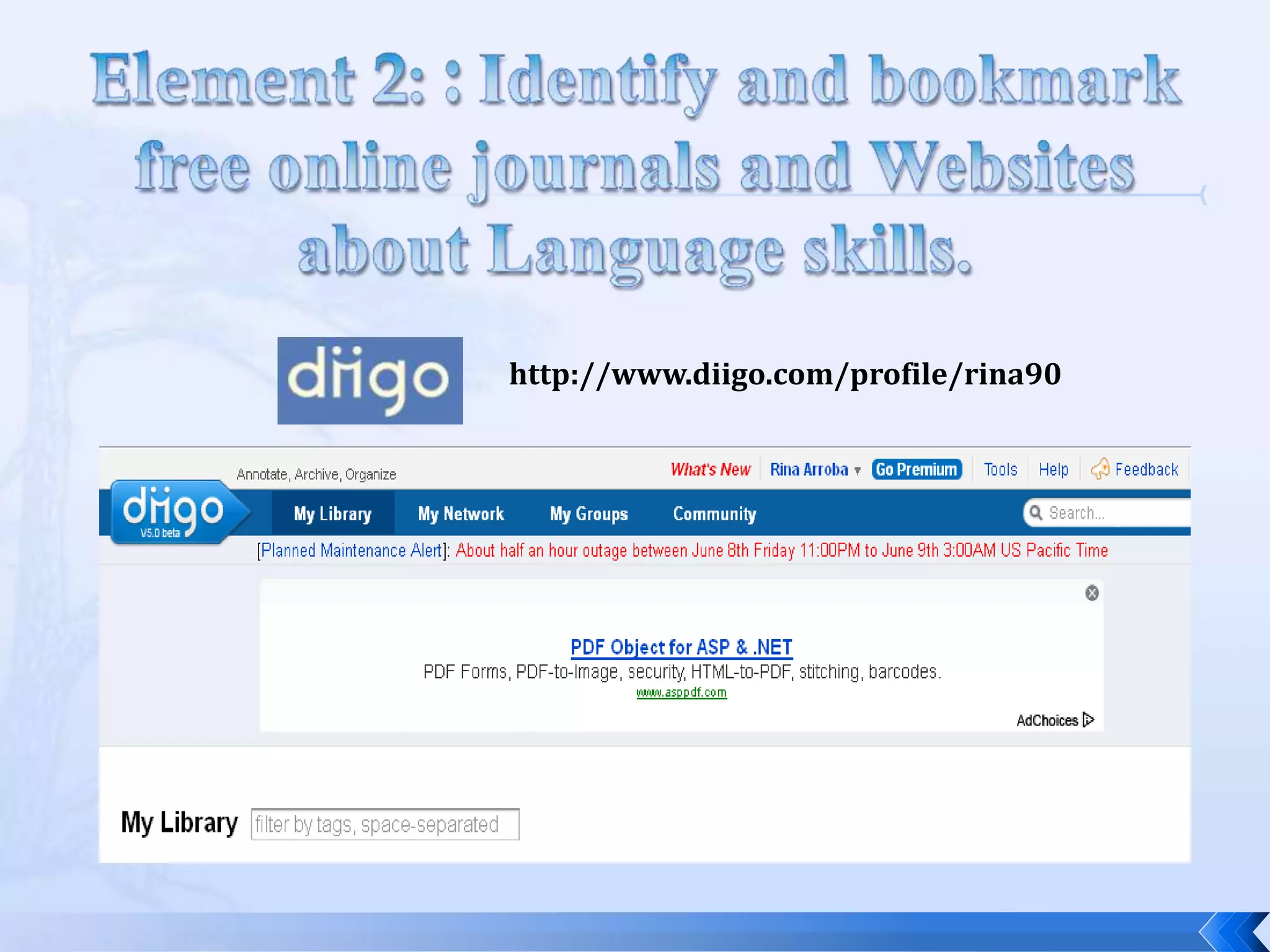
http://www.diigo.com/profile/rina90
I think Diigo is a useful Web 2.0 tool that allows us to
bookmark and tag web pages. Also it allows us to
highlight any part of the webpage and attach sticky
note to specific parts of the website. This assignment
was pretty nice for me, because I learned how to use
it for educational purposes. I think Technology
makes life easier and open a new world for us. So,
Diigo is very useful for me and for everybody who
wants to keep everything organized on the web. For
example, we can give tags to the pages, descriptions
of them, add a title and save the URL in order to
know better about what the website is for.
QUESTIONS LESSON PLANNING
1.    Who are the learners?
2.    What is their English level?
3.    How long is the lesson going to last?
4.    What is the topic of the lesson?
5.    What are they going to learn in this lesson?
6.    What materials and technology resources are they going to use?
7.    Are the activities in this lesson plan logically organized?
8.    Will the activities employed by the teacher help students to achieve the
      lesson objectives?
9.    Do you think the students will have enough practice?
10.    Is the assessment according to the lesson objectives?
11.   Is the homework assignment aimed to help students to have extra
      practice in the topic studies in class?
12.   If you had to teach this lesson tomorrow, would this lesson plan help you?
Blogs in Education
   Question 1: How would you define the term
    "blog"?
   Blog is an online journal which can be used as a
    diary. It means, you can share your thoughts,
    opinions, experiences, reflections or whatever that
    you want on your blog. Also, it allows you to
    update information and to keep a regular record of
    all information that you uploaded. In short, blog is
    a useful Web 2.0 tool that works as your personal
    online journal
   Question 2: What types of blogs have you heard about?
    Well, there are three types of blogs for use in ESL classroom. The
    first one is called the Tutor blog and it serves to give extra
    information or as resources of links for self-study to students. This
    blog is run by the teacher in order to help students in their learning
    process. The second one is called the Learner blog and it is run by
    individual students or small groups of learners. It can serve for
    reading and writing classes in order to develop these language
    skills. For example, students can use blogs as journals for writing
    practice or just to express themselves. The third one is called The
    Class blog and it is run by the entire class. It could be useful for
    collaborative work activities, projects, homework, etc.

WEB 2.0
1.    Twitter
2.    Google Maps           It is a set of web applications
3.    Podcasts                that allow online users to
4.    authorSTREAM                upload information,
5.    Wikispaces                 participate actively on
6.    Mappyfriends           websites, share information
7.    Flickr                with others and interact with
8.    K12 Lesson Plans         the web pages more they
9.    PodOmatic             would with an application on
10.    WebQuests                      their desktop.
11.    Dokeos
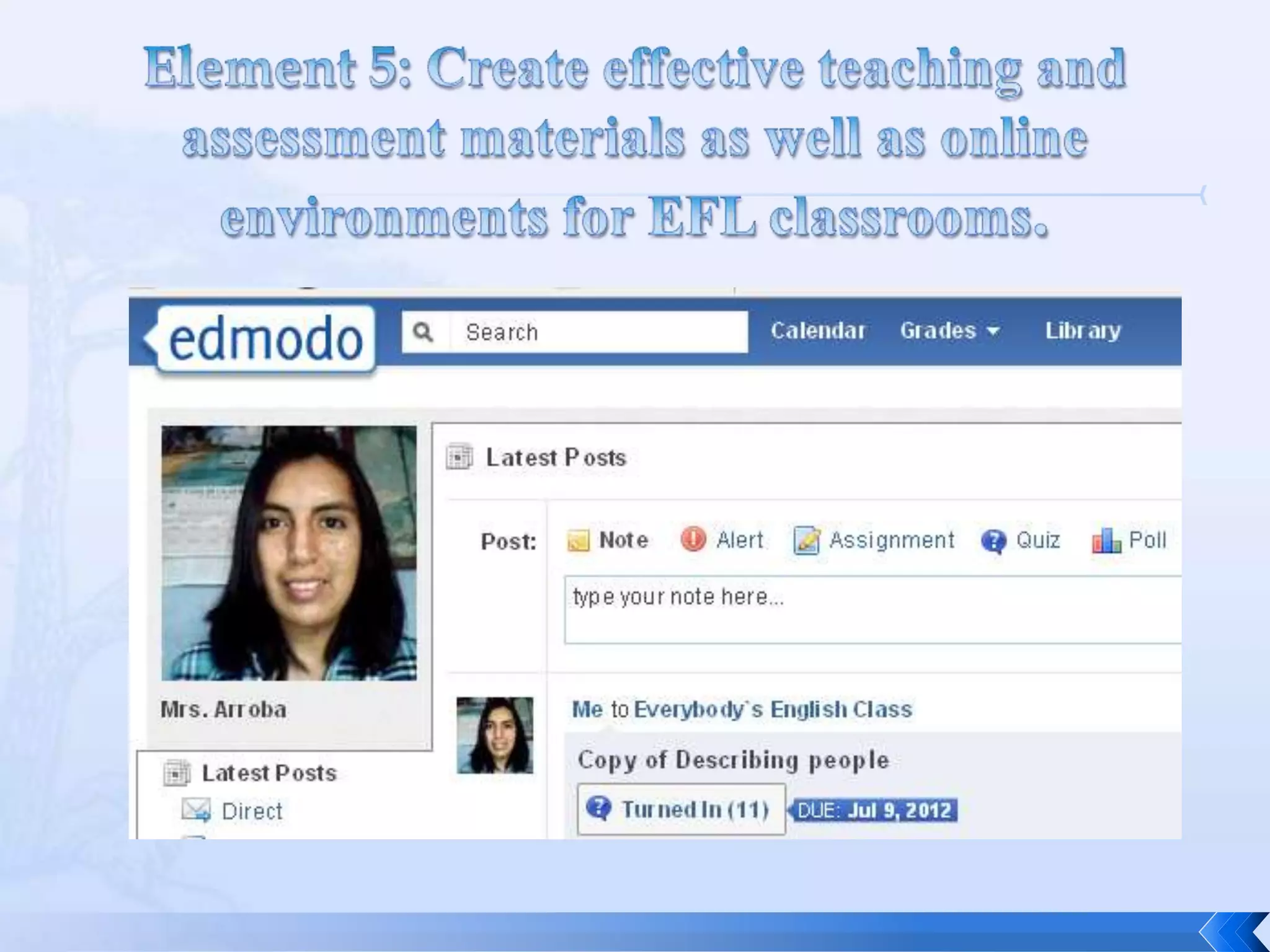
   The main objective of my VLE is to develop lexis in
    students related to physical description , in order to
    make them able to describe their family members. It
    is for students of seventh grade of “Ovidio Decroly”
    Elementary school. They are beginners English
    learners from 11 to 12 years old. They have an
    elementary English level. I have included many
    videos, PPTs and useful webpages resources that are
    related to this topic. In the evaluation section,
    students will demonstrate what they have learned
    by taking a quiz. The code for EDMODO is qbqz71

Internet and Multimedia-Student Portfolio

  • 1.
    FACULTAD DE CIENCIASHUMANAS Y DE LA EDUCACION CARRERA DE IDIOMAS STUDENT PORTFOLIO “INTERNET AND MULTIMEDIA RESOURCES” Quinto Semestre Rina Marianela Arroba Poveda AMBATO - ECUADOR Marzo-Agosto 2012
  • 2.
    Element 1: Describeevaluation criteria used to critically analize the content of Webpages. Element 2: Identify and bookmark free online journals and Websites about Language skills. Element 3: Develop technology enhanced lesson plans using Internet resources. Element 4: Experiment the use of different Web 2.0 tools to teach and assess the English communicative competence. Element 5: Create effective teaching and assessment materials as well as online environments for EFL classrooms.
  • 3.
    QUESTIONS TO ANSWER 1. Is it somebody’s web page? 2. What type of domain does it come from? 3. Is it published by an entity that makes sense? 4. Who wrote this page? 5. Is the page dated? Is it current enough? 6. What are the author’s credentials on this subject? 7. Are sources document with footnotes or links? 8. If reproduced information (from another source), is it complete, not altered not fake or forged? 9. Are these links to other resources on the topic? 10. Who links to the page? 11. Is the page listed in one or more reportable directories or page? 12. What do other say about the author or responsible authoring body? 13. Why was the page put on the web? 14. Might it be ironic? Satire or parody? 15. Is this as credible and useful as the resources (book, journal articles, etc.) available in print or online through the library?
  • 4.
    http://www.reggie.net/teaching/ VS http://learnenglishkids.britishcouncil.org/en/ CONCLUSION: Which web site is better. The best one is http://learnenglishkids.britishcouncil.org/en/ Because this webpage provides reliable information and children can get fun with English. Also there are good teaching tips in order to develop teacher s role in the classroom. Furthermore it is a useful page to find teachers resources, training and articles related to education. For example, English teachers can use vocabulary games, phonics songs, phonics stories to teach children in the classroom. In conclusion, this website has an educational purpose and it comes form British Council, The United Kingdom's international organization.
  • 5.
  • 6.
    I think Diigois a useful Web 2.0 tool that allows us to bookmark and tag web pages. Also it allows us to highlight any part of the webpage and attach sticky note to specific parts of the website. This assignment was pretty nice for me, because I learned how to use it for educational purposes. I think Technology makes life easier and open a new world for us. So, Diigo is very useful for me and for everybody who wants to keep everything organized on the web. For example, we can give tags to the pages, descriptions of them, add a title and save the URL in order to know better about what the website is for.
  • 7.
    QUESTIONS LESSON PLANNING 1. Who are the learners? 2. What is their English level? 3. How long is the lesson going to last? 4. What is the topic of the lesson? 5. What are they going to learn in this lesson? 6. What materials and technology resources are they going to use? 7. Are the activities in this lesson plan logically organized? 8. Will the activities employed by the teacher help students to achieve the lesson objectives? 9. Do you think the students will have enough practice? 10. Is the assessment according to the lesson objectives? 11. Is the homework assignment aimed to help students to have extra practice in the topic studies in class? 12. If you had to teach this lesson tomorrow, would this lesson plan help you?
  • 8.
    Blogs in Education  Question 1: How would you define the term "blog"?  Blog is an online journal which can be used as a diary. It means, you can share your thoughts, opinions, experiences, reflections or whatever that you want on your blog. Also, it allows you to update information and to keep a regular record of all information that you uploaded. In short, blog is a useful Web 2.0 tool that works as your personal online journal
  • 9.
    Question 2: What types of blogs have you heard about? Well, there are three types of blogs for use in ESL classroom. The first one is called the Tutor blog and it serves to give extra information or as resources of links for self-study to students. This blog is run by the teacher in order to help students in their learning process. The second one is called the Learner blog and it is run by individual students or small groups of learners. It can serve for reading and writing classes in order to develop these language skills. For example, students can use blogs as journals for writing practice or just to express themselves. The third one is called The Class blog and it is run by the entire class. It could be useful for collaborative work activities, projects, homework, etc. 
  • 10.
    WEB 2.0 1. Twitter 2. Google Maps It is a set of web applications 3. Podcasts that allow online users to 4. authorSTREAM upload information, 5. Wikispaces participate actively on 6. Mappyfriends websites, share information 7. Flickr with others and interact with 8. K12 Lesson Plans the web pages more they 9. PodOmatic would with an application on 10. WebQuests their desktop. 11. Dokeos
  • 12.
    The main objective of my VLE is to develop lexis in students related to physical description , in order to make them able to describe their family members. It is for students of seventh grade of “Ovidio Decroly” Elementary school. They are beginners English learners from 11 to 12 years old. They have an elementary English level. I have included many videos, PPTs and useful webpages resources that are related to this topic. In the evaluation section, students will demonstrate what they have learned by taking a quiz. The code for EDMODO is qbqz71