on target by hans_s on flickr CC-BY-ND
Assessment that supports learning1
What do you notice?
What do you wonder?
Peter Newbury, Ph.D.
Center forTeaching Development,
University of California, San Diego
pnewbury@ucsd.edu
@polarisdotca #ctducsd ctd.ucsd.edu
CTD Weekly Workshops:
Assessment that Supports Learning
Unless otherwise noted, content is licensed under a Creative CommonsAttribution-Non Commercial 3.0 License.
resources: ctd.ucsd.edu/programs/weekly-workshops-spring-2015/
please
sign in
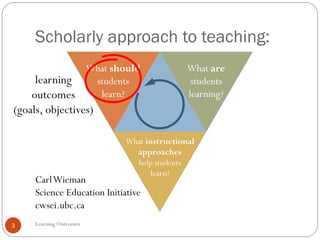
Scholarly approach to teaching:
Learning Outcomes3
CarlWieman
Science Education Initiative
cwsei.ubc.ca
What should
students
learn?
learning
outcomes
(goals, objectives)
What should
students
learn?
What are
students
learning?
What instructional
approaches
help students
learn?
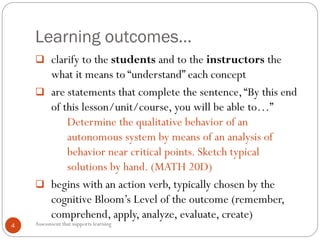
Learning outcomes…
Assessment that supports learning4
 clarify to the students and to the instructors the
what it means to “understand” each concept
 are statements that complete the sentence,“By this end
of this lesson/unit/course, you will be able to…”
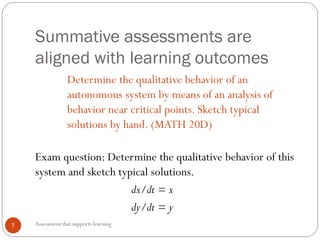
Determine the qualitative behavior of an
autonomous system by means of an analysis of
behavior near critical points. Sketch typical
solutions by hand. (MATH 20D)
 begins with an action verb, typically chosen by the
cognitive Bloom’s Level of the outcome (remember,
comprehend, apply, analyze, evaluate, create)
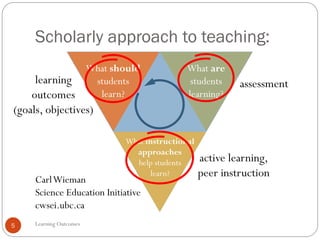
Scholarly approach to teaching:
Learning Outcomes5
CarlWieman
Science Education Initiative
cwsei.ubc.ca
What should
students
learn?
learning
outcomes
(goals, objectives)
assessment
active learning,
peer instruction
What should
students
learn?
What are
students
learning?
What instructional
approaches
help students
learn?
Vocabulary check: assessment
summative assessment formative assessment
Assessment that supports learning6
is that which gives a final
judgment of evaluation of
proficiency,such as grades or scores.
(How LearningWorks, p. 139)
explicitly communicates to students
about some specific aspects of their
performance relative to specific
target criteria, and … provides
information that helps students
progress toward meeting those
criteria…[It] informs students’
subsequent learning.
(How LearningWorks, p. 139)
Summative assessments are
aligned with learning outcomes
Assessment that supports learning7
Determine the qualitative behavior of an
autonomous system by means of an analysis of
behavior near critical points. Sketch typical
solutions by hand. (MATH 20D)
Exam question: Determine the qualitative behavior of this
system and sketch typical solutions.
dx/dt = x
dy/dt = y
Vocabulary check: assessment
summative assessment formative assessment
Assessment that supports learning8
is that which gives a final
judgment of evaluation of
proficiency,such as grades or scores.
(How LearningWorks, p. 139)
explicitly communicates to students
about some specific aspects of their
performance relative to specific
target criteria, and … provides
information that helps students
progress toward meeting those
criteria…[It] informs students’
subsequent learning.
(How LearningWorks, p. 139)
Feedback and Practice that Enhance
Learning (How Learning Works)
9
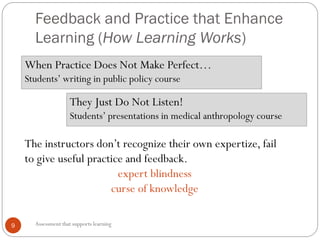
When Practice Does Not Make Perfect…
Students’ writing in public policy course
Assessment that supports learning
The instructors don’t recognize their own expertize, fail
to give useful practice and feedback.
expert blindness
curse of knowledge
They Just Do Not Listen!
Students’ presentations in medical anthropology course
Feedback and Practice that Enhance
Learning (How Learning Works)
10
Goal-directed practice coupled with targeted feedback are
critical to learning. [3]
Assessment that supports learning
Music by Piulet on flickr CCExcellent Shot byVarsity Life on flickr CC
Feedback and Practice that Enhance
Learning (How Learning Works)
11
Goal-directed practice coupled with targeted feedback are
critical to learning. [3]
Goals can direct the nature of focused practice,provide the basis
for evaluating observed performance, and shape the targeted
feedback that guides students’future efforts.
[p. 127]
Targeted feedback gives students prioritized information about
how their performance does or does not meet the criteria so they
can understand how to improve their future performance.
[p. 141]
Assessment that supports learning
Feedback and Practice that Enhance
Learning (How Learning Works)
12
Goal-directed practice coupled with targeted feedback are
critical to learning. [3]
 practice is goal-directed
 productive practice
 timely feedback
 feedback at appropriate level
Assessment that supports learning
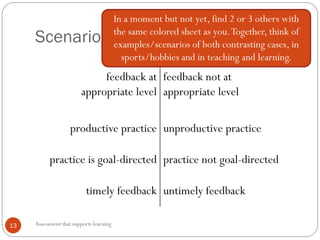
Scenarios
Assessment that supports learning13
feedback at
appropriate level
feedback not at
appropriate level
productive practice unproductive practice
practice is goal-directed practice not goal-directed
timely feedback untimely feedback
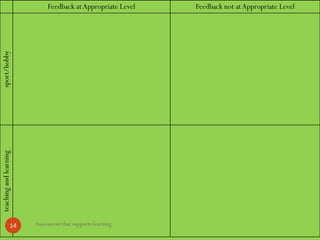
In a moment but not yet, find 2 or 3 others with
the same colored sheet as you.Together, think of
examples/scenarios of both contrasting cases, in
sports/hobbies and in teaching and learning.
Feedback atAppropriate Level Feedback not atAppropriate Levelsport/hobbyteachingandlearning
Assessment that supports learning14
Productive Practice Unproductive Practicesport/hobbyteachingandlearning
Assessment that supports learning15
Practice Goal-directed Practice not Goal-directedsport/hobbyteachingandlearning
Assessment that supports learning16
Timely Feedback Untimely Feedbacksport/hobbyteachingandlearning
Assessment that supports learning17
Assessment that supports learning18
What kind of assessment gives
timely feedback at an
appropriate level to support
goal-directed and
productive practice?
Assessment that supports learning19
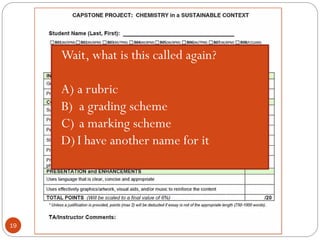
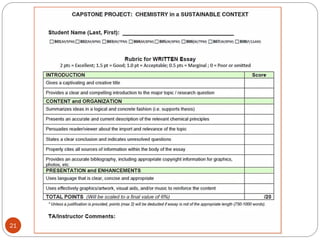
Wait, what is this called again?
A) a rubric
B) a grading scheme
C) a marking scheme
D) I have another name for it
20
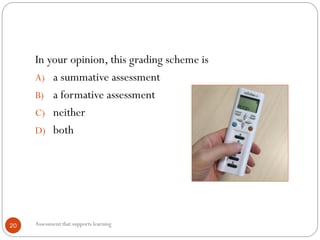
In your opinion, this grading scheme is
A) a summative assessment
B) a formative assessment
C) neither
D) both
Assessment that supports learning
Assessment that supports learning21
Assessment that supports learning
RobertTalbert
tinyurl.com/RobertTalbertRubric22
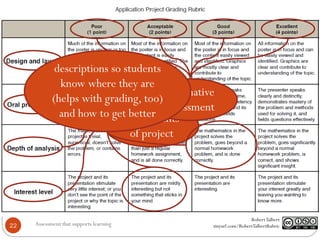
components
of project
summative
assessment
descriptions so students
know where they are
(helps with grading, too)
and how to get better
Rubric = path to improvement
23
 goal-directed
Goals can direct the nature of focused practice, provide the basis for
evaluating observed performance, and shape the targeted feedback
that guides students’future efforts.
 targeted feedback
Targeted feedback gives students prioritized information about how
their performance does or does not meet the criteria so they can
understand how to improve their future performance.
 Students need to be aware of the rubric (and using it)
throughout the assignment/project (that is, not just a grading
scheme at the end.)
Assessment that supports learning
Recall “How People Learn”
Assessment that supports learning24
Key Finding A“metacognitive”approach to instruction can help
students learn to take control of their own learning by defining
learning goals and monitoring their progress in achieving them.
Implications for teaching The teaching of metacognitive
skills should be integrated into the curriculum in a variety of
subject areas.
Classroom Environments Formative assessments —
ongoing assessments designed to make students’thinking visible to
both teachers and students — are essential.
Big picture for course design
Assessment that supports learning25
CarlWieman
Science Education Initiative
cwsei.ubc.ca
What should
students
learn?
What should
students
learn?
What are
students
learning?
What instructional
approaches
help students
learn?
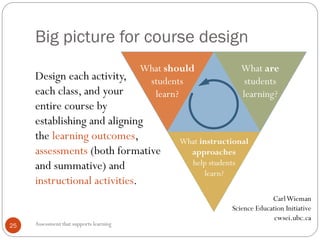
Design each activity,
each class, and your
entire course by
establishing and aligning
the learning outcomes,
assessments (both formative
and summative) and
instructional activities.
References
Assessment26
1. National Research Council (2000). How People Learn:Brain,Mind,
Experience,and School:Expanded Edition. J.D. Bransford,A.L
Brown & R.R. Cocking (Eds.),Washington, DC:The National
Academies Press.
2. Ambrose, S.A., Bridges, M.W., DiPietro, M., Lovett, M.C., &
Norman, M.K. (2010).How LearningWorks. San Fransisco: Jossey-
Bass.

CTD Spring 2015 Weekly Workshop: Assessment that supports learning

  • 1.
    on target byhans_s on flickr CC-BY-ND Assessment that supports learning1 What do you notice? What do you wonder?
  • 2.
    Peter Newbury, Ph.D. CenterforTeaching Development, University of California, San Diego pnewbury@ucsd.edu @polarisdotca #ctducsd ctd.ucsd.edu CTD Weekly Workshops: Assessment that Supports Learning Unless otherwise noted, content is licensed under a Creative CommonsAttribution-Non Commercial 3.0 License. resources: ctd.ucsd.edu/programs/weekly-workshops-spring-2015/ please sign in
  • 3.
    Scholarly approach toteaching: Learning Outcomes3 CarlWieman Science Education Initiative cwsei.ubc.ca What should students learn? learning outcomes (goals, objectives) What should students learn? What are students learning? What instructional approaches help students learn?
  • 4.
    Learning outcomes… Assessment thatsupports learning4  clarify to the students and to the instructors the what it means to “understand” each concept  are statements that complete the sentence,“By this end of this lesson/unit/course, you will be able to…” Determine the qualitative behavior of an autonomous system by means of an analysis of behavior near critical points. Sketch typical solutions by hand. (MATH 20D)  begins with an action verb, typically chosen by the cognitive Bloom’s Level of the outcome (remember, comprehend, apply, analyze, evaluate, create)
  • 5.
    Scholarly approach toteaching: Learning Outcomes5 CarlWieman Science Education Initiative cwsei.ubc.ca What should students learn? learning outcomes (goals, objectives) assessment active learning, peer instruction What should students learn? What are students learning? What instructional approaches help students learn?
  • 6.
    Vocabulary check: assessment summativeassessment formative assessment Assessment that supports learning6 is that which gives a final judgment of evaluation of proficiency,such as grades or scores. (How LearningWorks, p. 139) explicitly communicates to students about some specific aspects of their performance relative to specific target criteria, and … provides information that helps students progress toward meeting those criteria…[It] informs students’ subsequent learning. (How LearningWorks, p. 139)
  • 7.
    Summative assessments are alignedwith learning outcomes Assessment that supports learning7 Determine the qualitative behavior of an autonomous system by means of an analysis of behavior near critical points. Sketch typical solutions by hand. (MATH 20D) Exam question: Determine the qualitative behavior of this system and sketch typical solutions. dx/dt = x dy/dt = y
  • 8.
    Vocabulary check: assessment summativeassessment formative assessment Assessment that supports learning8 is that which gives a final judgment of evaluation of proficiency,such as grades or scores. (How LearningWorks, p. 139) explicitly communicates to students about some specific aspects of their performance relative to specific target criteria, and … provides information that helps students progress toward meeting those criteria…[It] informs students’ subsequent learning. (How LearningWorks, p. 139)
  • 9.
    Feedback and Practicethat Enhance Learning (How Learning Works) 9 When Practice Does Not Make Perfect… Students’ writing in public policy course Assessment that supports learning The instructors don’t recognize their own expertize, fail to give useful practice and feedback. expert blindness curse of knowledge They Just Do Not Listen! Students’ presentations in medical anthropology course
  • 10.
    Feedback and Practicethat Enhance Learning (How Learning Works) 10 Goal-directed practice coupled with targeted feedback are critical to learning. [3] Assessment that supports learning Music by Piulet on flickr CCExcellent Shot byVarsity Life on flickr CC
  • 11.
    Feedback and Practicethat Enhance Learning (How Learning Works) 11 Goal-directed practice coupled with targeted feedback are critical to learning. [3] Goals can direct the nature of focused practice,provide the basis for evaluating observed performance, and shape the targeted feedback that guides students’future efforts. [p. 127] Targeted feedback gives students prioritized information about how their performance does or does not meet the criteria so they can understand how to improve their future performance. [p. 141] Assessment that supports learning
  • 12.
    Feedback and Practicethat Enhance Learning (How Learning Works) 12 Goal-directed practice coupled with targeted feedback are critical to learning. [3]  practice is goal-directed  productive practice  timely feedback  feedback at appropriate level Assessment that supports learning
  • 13.
    Scenarios Assessment that supportslearning13 feedback at appropriate level feedback not at appropriate level productive practice unproductive practice practice is goal-directed practice not goal-directed timely feedback untimely feedback In a moment but not yet, find 2 or 3 others with the same colored sheet as you.Together, think of examples/scenarios of both contrasting cases, in sports/hobbies and in teaching and learning.
  • 14.
    Feedback atAppropriate LevelFeedback not atAppropriate Levelsport/hobbyteachingandlearning Assessment that supports learning14
  • 15.
    Productive Practice UnproductivePracticesport/hobbyteachingandlearning Assessment that supports learning15
  • 16.
    Practice Goal-directed Practicenot Goal-directedsport/hobbyteachingandlearning Assessment that supports learning16
  • 17.
    Timely Feedback UntimelyFeedbacksport/hobbyteachingandlearning Assessment that supports learning17
  • 18.
    Assessment that supportslearning18 What kind of assessment gives timely feedback at an appropriate level to support goal-directed and productive practice?
  • 19.
    Assessment that supportslearning19 Wait, what is this called again? A) a rubric B) a grading scheme C) a marking scheme D) I have another name for it
  • 20.
    20 In your opinion,this grading scheme is A) a summative assessment B) a formative assessment C) neither D) both Assessment that supports learning
  • 21.
  • 22.
    Assessment that supportslearning RobertTalbert tinyurl.com/RobertTalbertRubric22 components of project summative assessment descriptions so students know where they are (helps with grading, too) and how to get better
  • 23.
    Rubric = pathto improvement 23  goal-directed Goals can direct the nature of focused practice, provide the basis for evaluating observed performance, and shape the targeted feedback that guides students’future efforts.  targeted feedback Targeted feedback gives students prioritized information about how their performance does or does not meet the criteria so they can understand how to improve their future performance.  Students need to be aware of the rubric (and using it) throughout the assignment/project (that is, not just a grading scheme at the end.) Assessment that supports learning
  • 24.
    Recall “How PeopleLearn” Assessment that supports learning24 Key Finding A“metacognitive”approach to instruction can help students learn to take control of their own learning by defining learning goals and monitoring their progress in achieving them. Implications for teaching The teaching of metacognitive skills should be integrated into the curriculum in a variety of subject areas. Classroom Environments Formative assessments — ongoing assessments designed to make students’thinking visible to both teachers and students — are essential.
  • 25.
    Big picture forcourse design Assessment that supports learning25 CarlWieman Science Education Initiative cwsei.ubc.ca What should students learn? What should students learn? What are students learning? What instructional approaches help students learn? Design each activity, each class, and your entire course by establishing and aligning the learning outcomes, assessments (both formative and summative) and instructional activities.
  • 26.
    References Assessment26 1. National ResearchCouncil (2000). How People Learn:Brain,Mind, Experience,and School:Expanded Edition. J.D. Bransford,A.L Brown & R.R. Cocking (Eds.),Washington, DC:The National Academies Press. 2. Ambrose, S.A., Bridges, M.W., DiPietro, M., Lovett, M.C., & Norman, M.K. (2010).How LearningWorks. San Fransisco: Jossey- Bass.