CTD WEEKLY WORKSHOPS:
ASSESSMENT
Peter Newbury
Center for Teaching Development,
University of California, San Diego
pnewbury@ucsd.edu @polarisdotca
ctd.ucsd.edu #ctducsd
resources: http://tinyurl.com/AssessmentSp2013
May 14, 2013 11:00 – 11:50 am
Center Hall, Room 316
We know How People Learn
Assessment2
…and what that means for teaching [1]:
1. Teachers must draw out and work with the pre-
existing understanding that their students bring with
them. Classrooms must be learner centered.
2. Teachers must teach some subject matter in depth,
providing many examples in which the same concept
is at work and providing a firm foundation of
factual knowledge.
3. The teaching of metacognitive (“thinking about
thinking”) skills should be integrated into the
curriculum in a variety of subject areas.
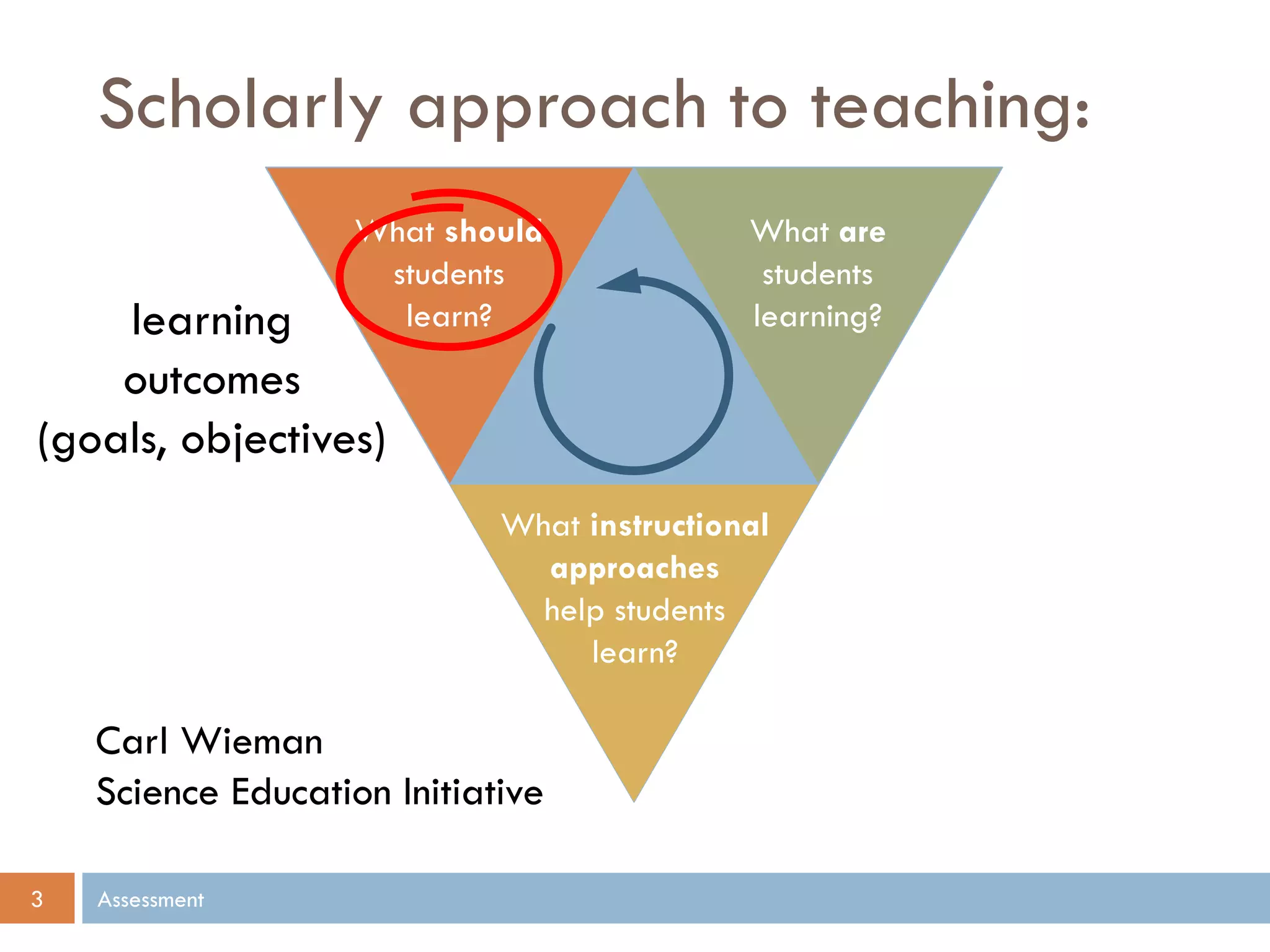
Scholarly approach to teaching:
Assessment3
Carl Wieman
Science Education Initiative
What should
students
learn?
What are
students
learning?
What instructional
approaches
help students
learn?
learning
outcomes
(goals, objectives)
Learning outcomes, recall,…
Assessment4
 are statements that complete the sentence, “By this
end of this lesson/unit/course, you will be able to…”
 begins with an action verb, typically chosen by the
cognitive Bloom’s Level of the outcome (remember,
comprehend, apply, analyze, evaluate, create)
 clarify to the students and to the instructors the
what it means to “understand” the concept
[Intro Astronomy] deduce from patterns in the properties of
the planets, moons, asteroids and other bodies that the Solar
System had single formation event.
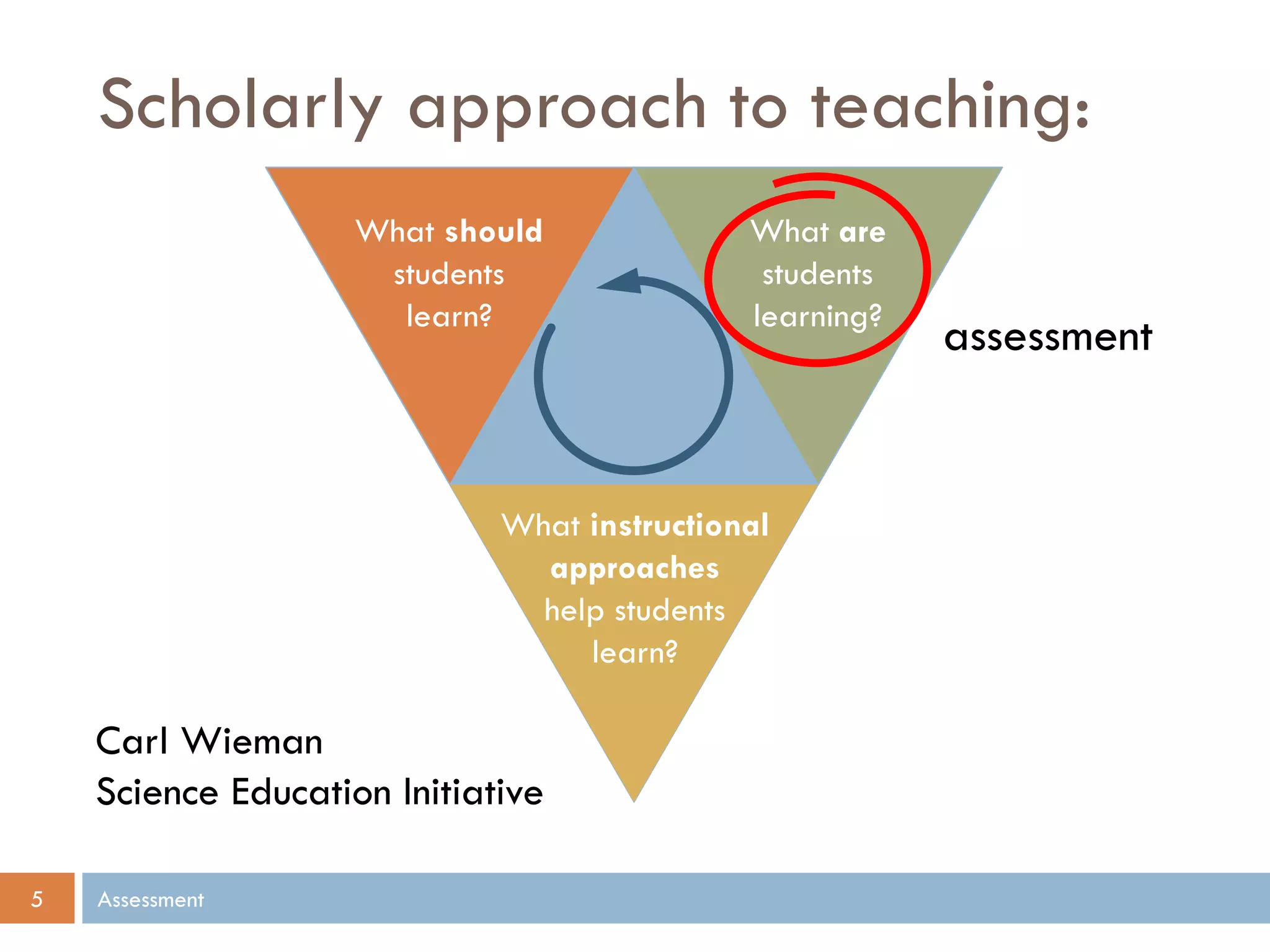
Scholarly approach to teaching:
Assessment5
Carl Wieman
Science Education Initiative
What should
students
learn?
What are
students
learning?
What instructional
approaches
help students
learn?
assessment
Vocabulary check: assessment
Assessment6
is that which gives a final
judgment of evaluation of
proficiency, such as grades or
scores.
(How Learning Works, p. 139)
explicitly communicates to
students about some specific
aspects of their performance
relative to specific target
criteria, and … provides
information that helps students
progress toward meeting those
criteria…[It] informs students’
subsequent learning.
(How Learning Works, p. 139)
formative assessmentsummative assessment
Feedback and Practice that
Enhance Learning [2]
Assessment7
Solution: Goal-directed practice coupled with targeted
feedback are critical to learning.
Music by Piulet on flickr CCExcellent Shot by Varsity Life on flickr CC
Feedback and Practice that
Enhance Learning [2]
Assessment8
Solution: Goal-directed practice coupled with targeted
feedback are critical to learning.
[G]oals can direct the nature of focused practice, provide
the basis for evaluating observed performance, and shape
the targeted feedback that guides students’ future efforts.
[p. 127]
[T]argeted feedback gives students prioritized information
about how their performance does or does not meet the
criteria so they can understand how to improve their future
performance.
[p. 141]
Feedback and Practice that
Enhance Learning [2]
Assessment9
Solution: Goal-directed practice coupled with targeted
feedback are critical to learning.
 practice is goal-directed
 productive practice
 timely feedback
 feedback at appropriate level
Aside: exploring these characteristics
Assessment10
 analogy
Students come to the classroom with preconceptions
about how the world works…Teachers must draw out
and work with the preexisting understandings that their
students bring with them. (How People Learn [1])
 contrasting cases
Teachers must teach some subject matter in depth,
providing many examples in which the same concept is
at work and providing a firm foundation of factual
knowledge
(How People Learn [1])
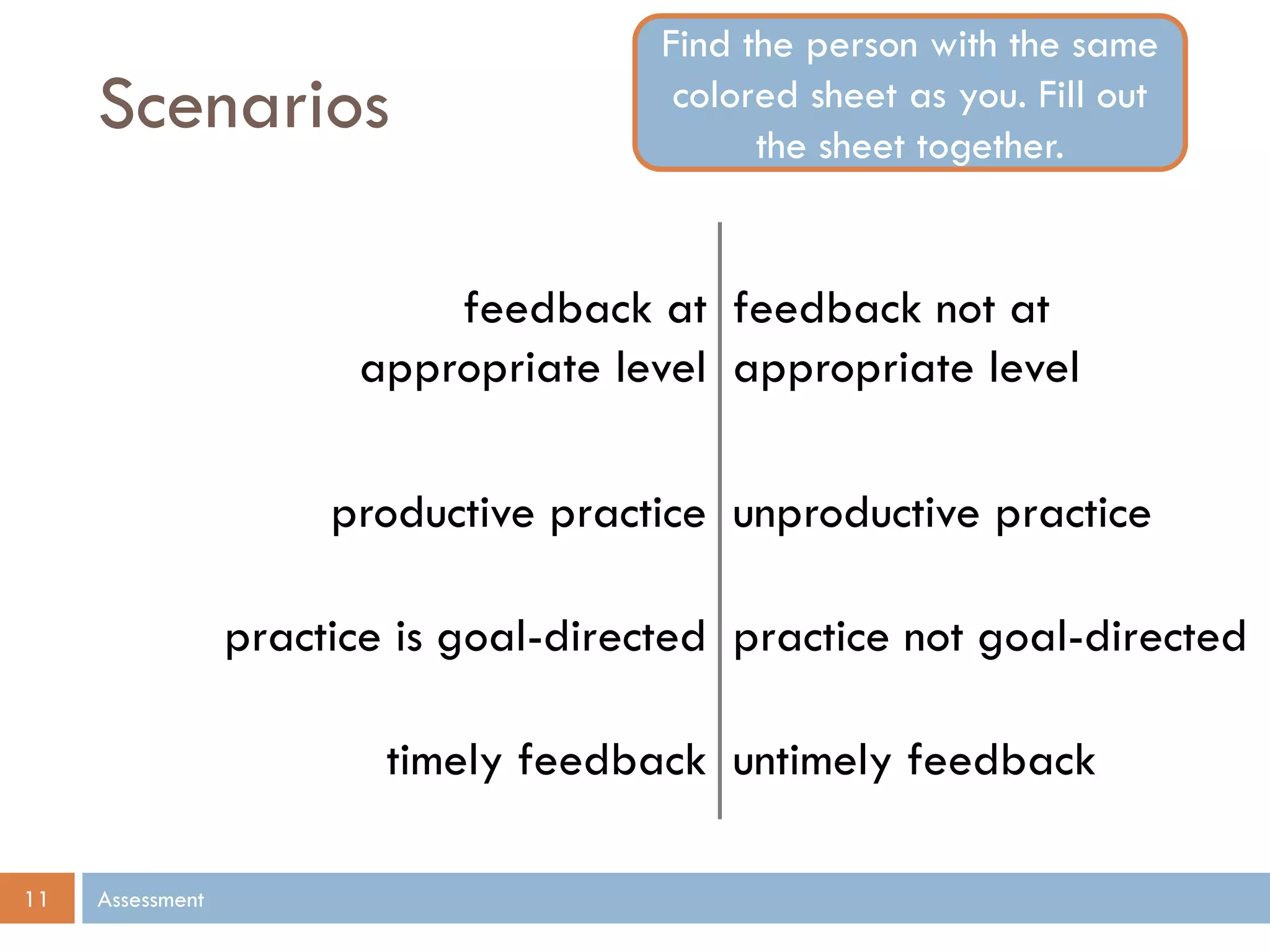
Scenarios
Assessment11
feedback at
appropriate level
feedback not at
appropriate level
productive practice unproductive practice
practice is goal-directed practice not goal-directed
timely feedback untimely feedback
Find the person with the same
colored sheet as you. Fill out
the sheet together.
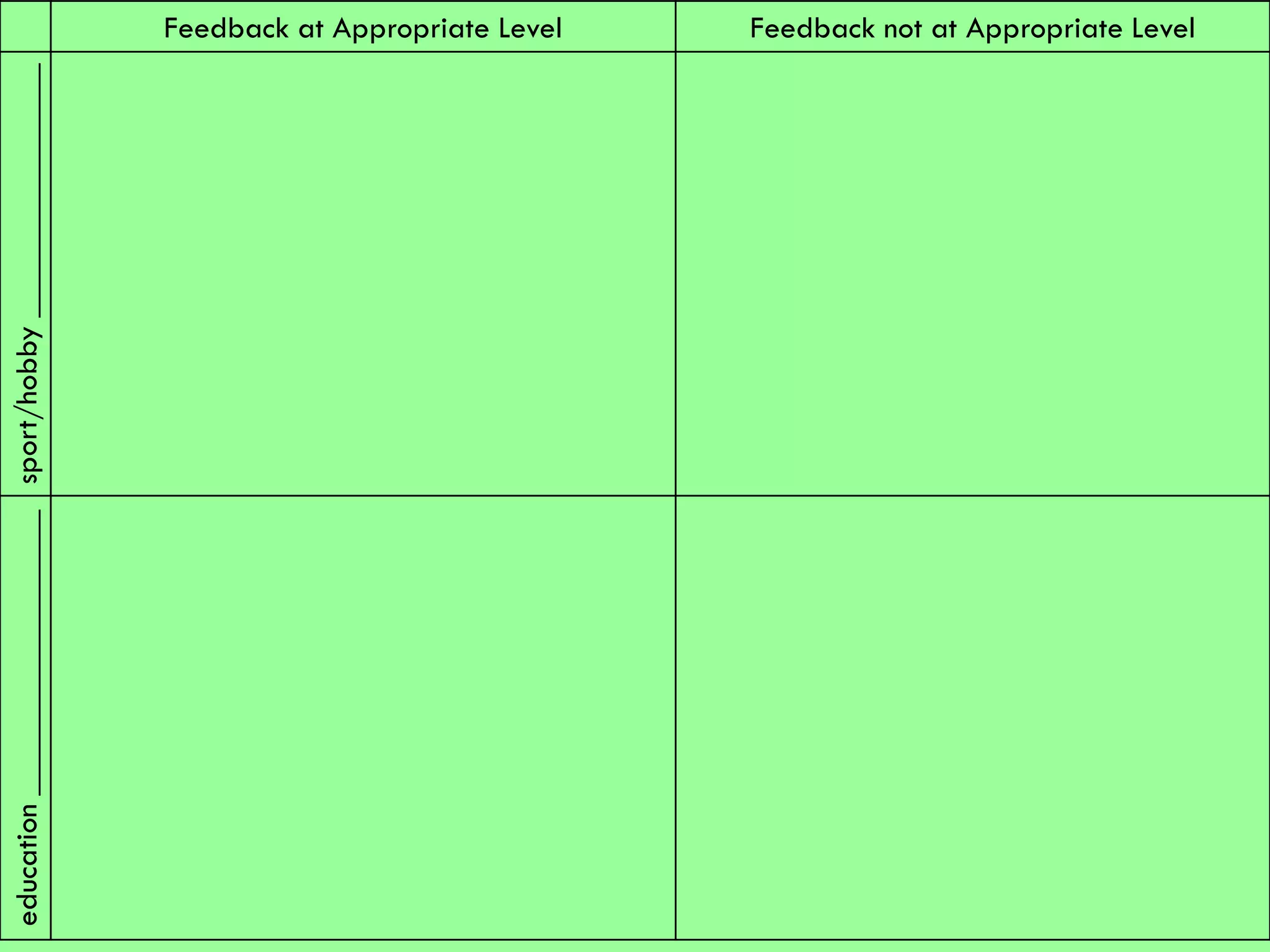
Feedback at Appropriate Level Feedback not at Appropriate Levelsport/hobby________________education__________________
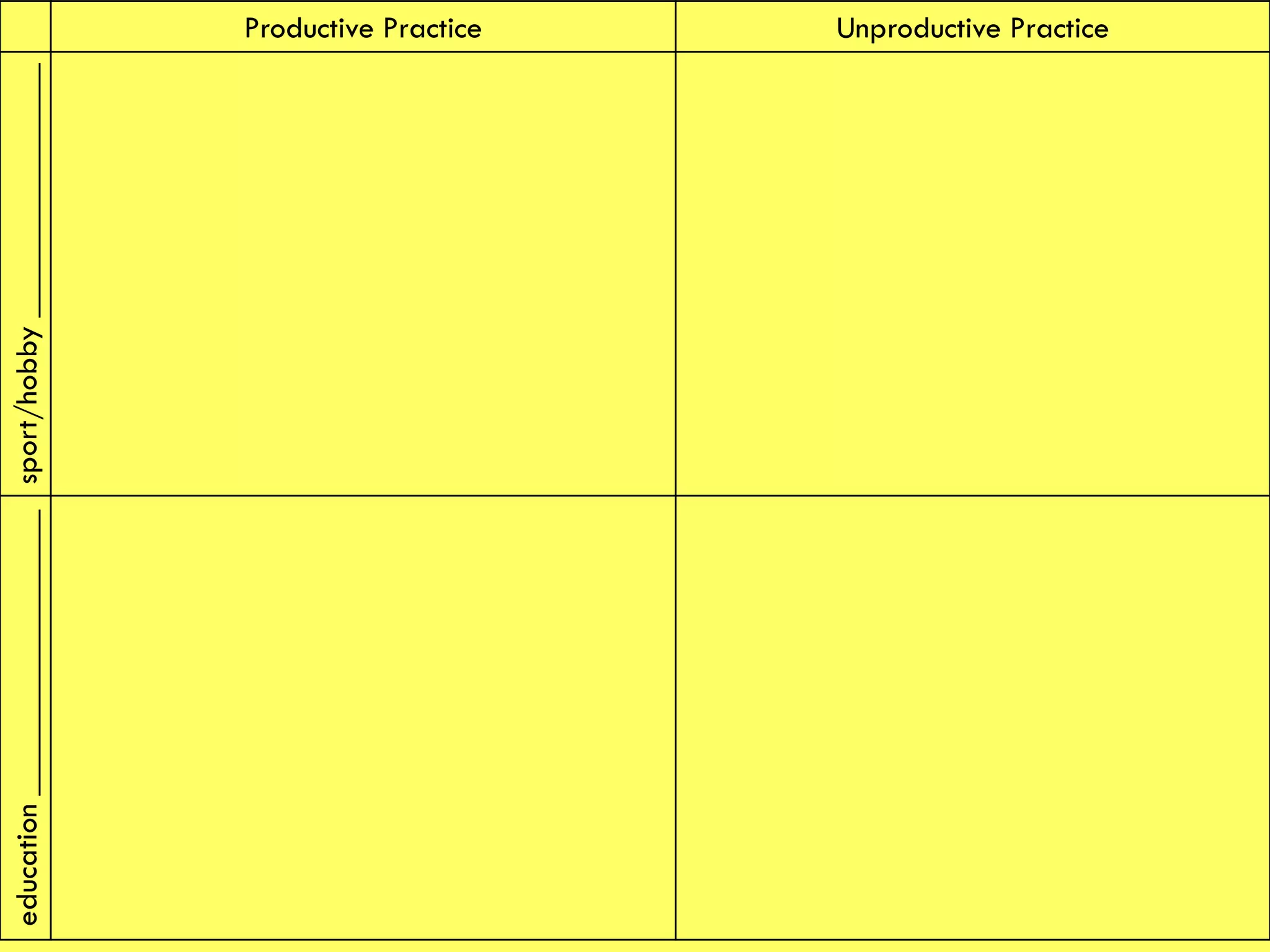
Productive Practice Unproductive Practicesport/hobby________________education__________________
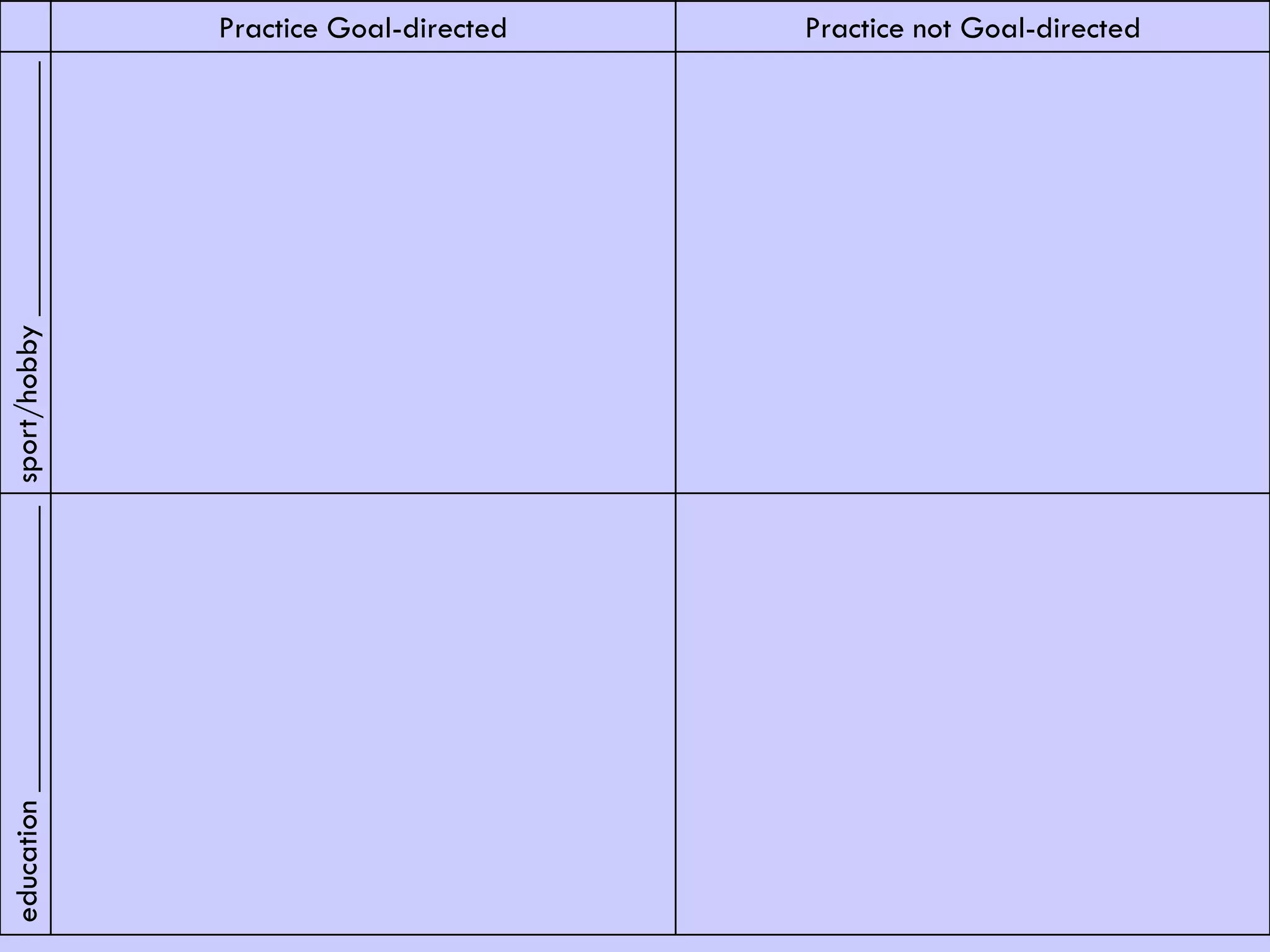
Practice Goal-directed Practice not Goal-directedsport/hobby________________education__________________
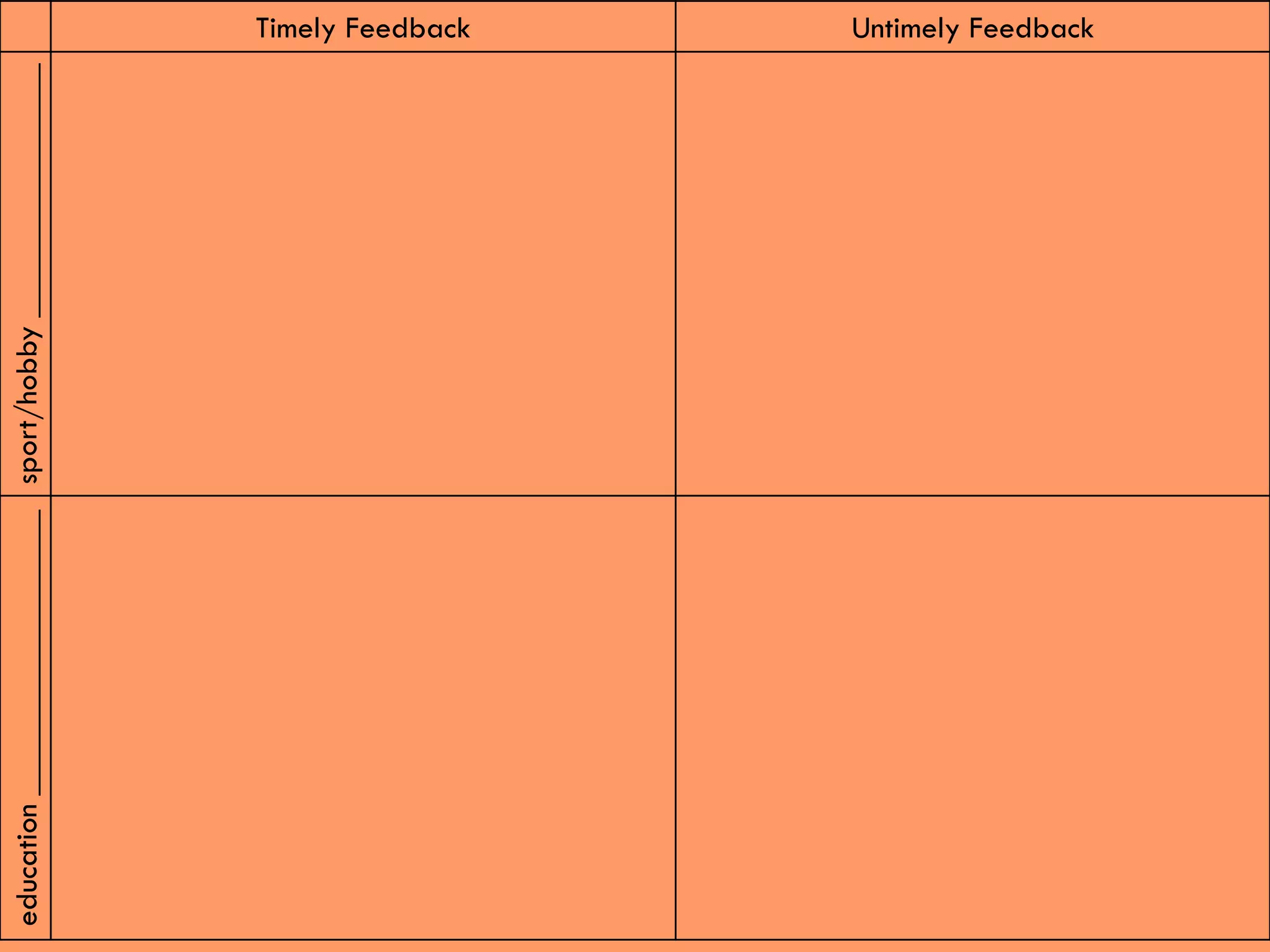
Timely Feedback Untimely Feedbacksport/hobby________________education__________________
Assessment
16
What kind of assessment introduces and supports
goal-directed, productive practice while giving
timely feedback at an appropriate level?
Assessment17
CTD Weekly Workshops: Assessment
tinyurl.com/AssessmentSp2013
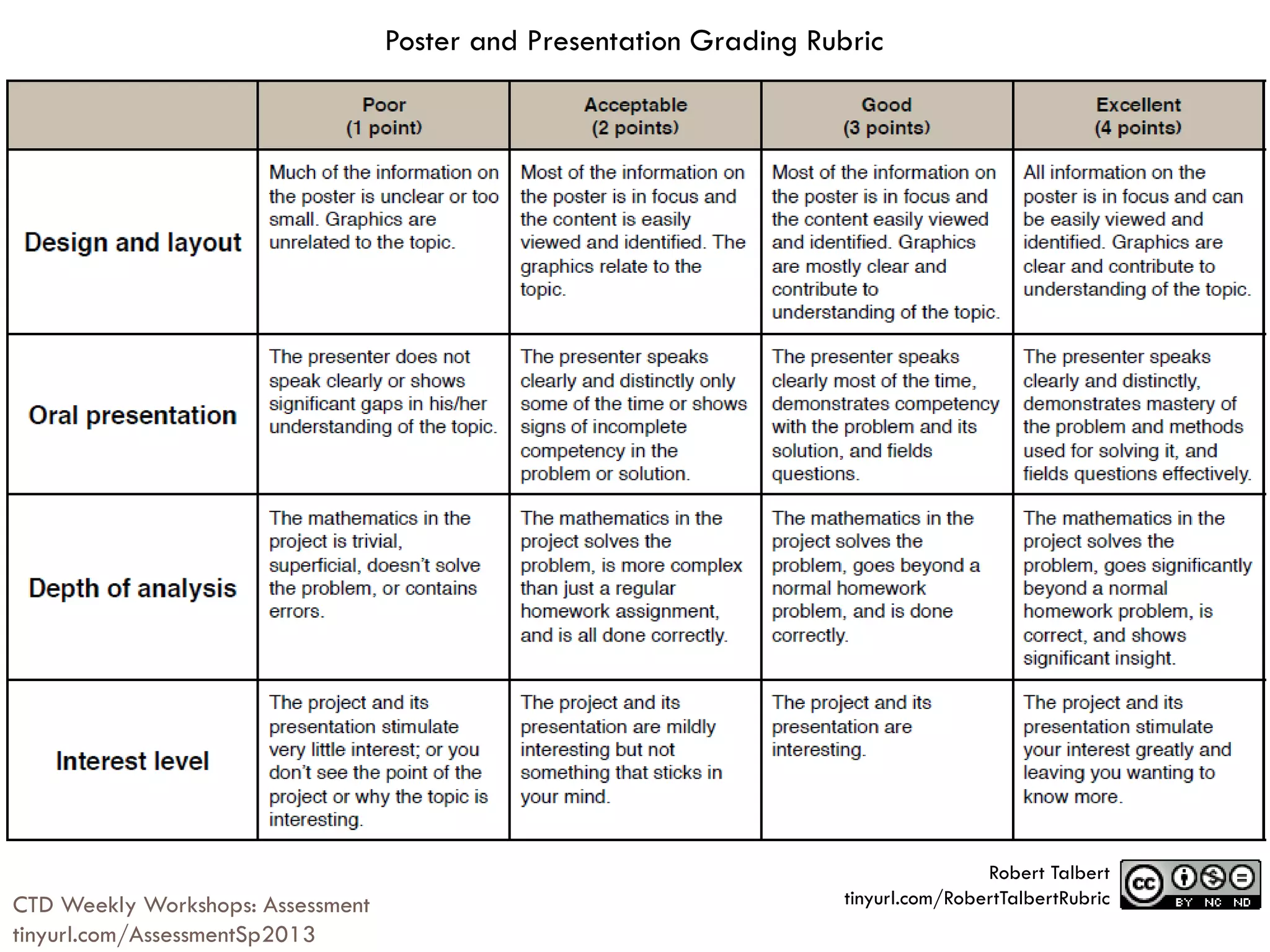
Robert Talbert
tinyurl.com/RobertTalbertRubric
Poster and Presentation Grading Rubric
Rubrics…
Assessment19
 goal-directed
[G]oals can direct the nature of focused practice,
provide the basis for evaluating observed
performance, and shape the targeted feedback that
guides students’ future efforts.
 targeted feedback
[T]argeted feedback gives students prioritized
information about how their performance does or
does not meet the criteria so they can understand
how to improve their future performance.
Rubrics…
Assessment20
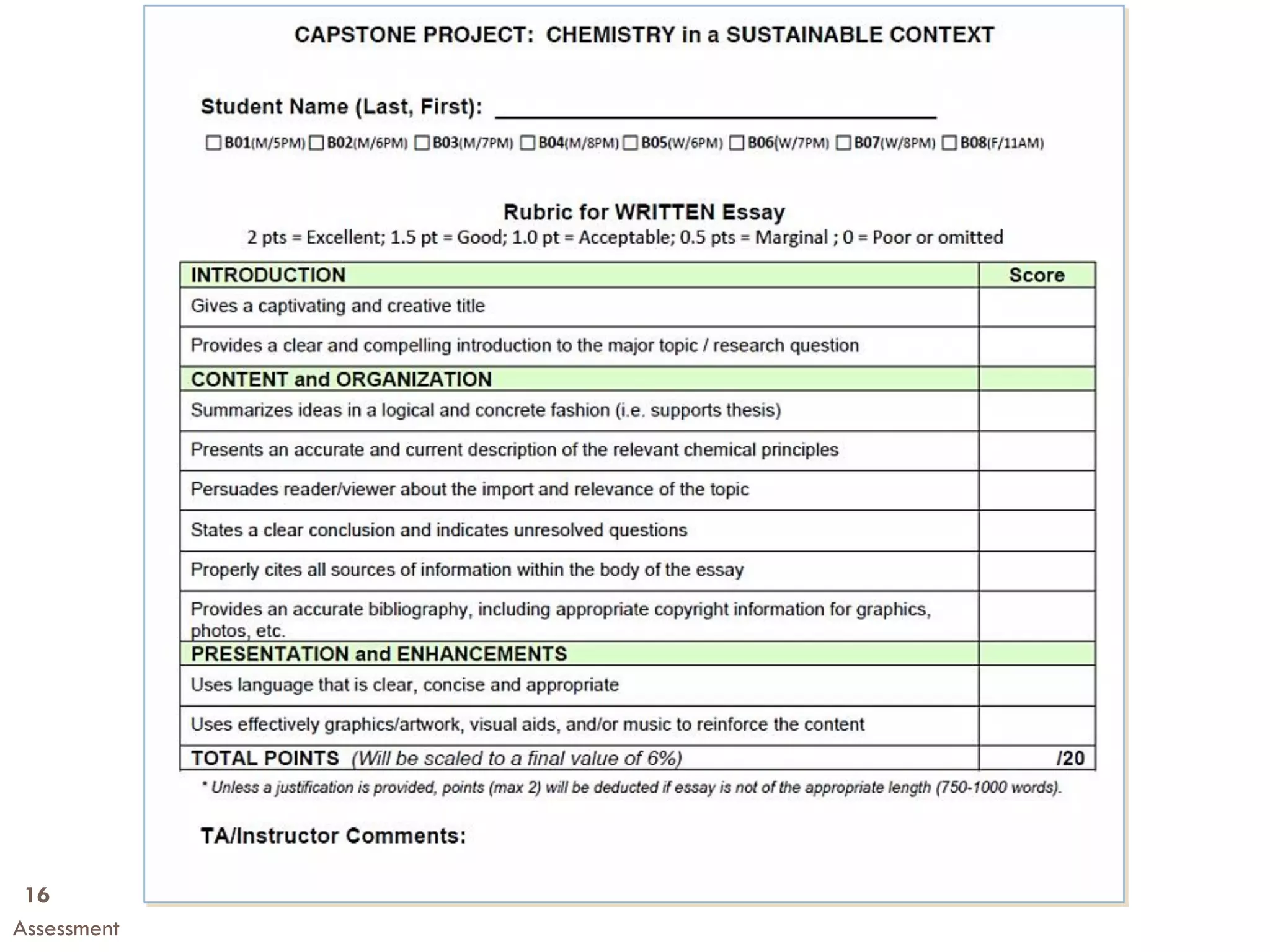
 need to be given BEFORE and BUILT INTO assignment
 outline what it takes to improve: path to improvement
 offer an appropriate level of challenge (defined by
the learning outcomes)
 support growth mindsets (see Dweck [3])
 give students opportunities to practice being
metacognitive
Take Away:
Assessment21
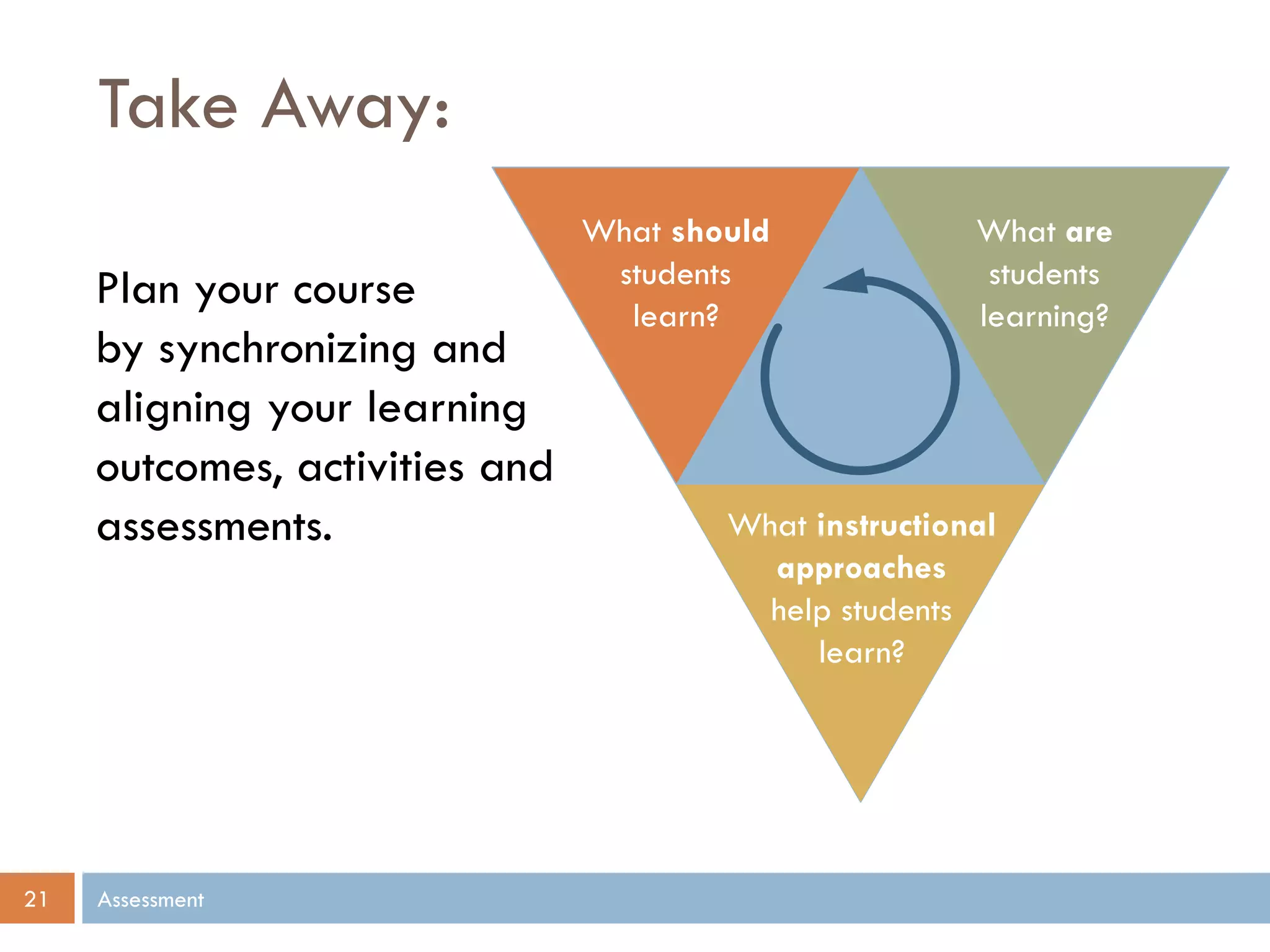
Plan your course
by synchronizing and
aligning your learning
outcomes, activities and
assessments.
What should
students
learn?
What are
students
learning?
What instructional
approaches
help students
learn?
References
Assessment22
1. National Research Council (2000). How People Learn: Brain, Mind,
Experience, and School: Expanded Edition. J.D. Bransford, A.L Brown & R.R.
Cocking (Eds.),Washington, DC: The National Academies Press.
2. Ambrose, S.A., Bridges, M.W., DiPietro, M., Lovett, M.C., & Norman, M.K.
(2010). How Learning Works. San Fransisco: Jossey-Bass.
3. Dweck, C.S. (2007). The Secret to Raising Smart Kids. Scientific American,
18, 6, 36-43.

Weekly Workshop: Assessment

  • 1.
    CTD WEEKLY WORKSHOPS: ASSESSMENT PeterNewbury Center for Teaching Development, University of California, San Diego pnewbury@ucsd.edu @polarisdotca ctd.ucsd.edu #ctducsd resources: http://tinyurl.com/AssessmentSp2013 May 14, 2013 11:00 – 11:50 am Center Hall, Room 316
  • 2.
    We know HowPeople Learn Assessment2 …and what that means for teaching [1]: 1. Teachers must draw out and work with the pre- existing understanding that their students bring with them. Classrooms must be learner centered. 2. Teachers must teach some subject matter in depth, providing many examples in which the same concept is at work and providing a firm foundation of factual knowledge. 3. The teaching of metacognitive (“thinking about thinking”) skills should be integrated into the curriculum in a variety of subject areas.
  • 3.
    Scholarly approach toteaching: Assessment3 Carl Wieman Science Education Initiative What should students learn? What are students learning? What instructional approaches help students learn? learning outcomes (goals, objectives)
  • 4.
    Learning outcomes, recall,… Assessment4 are statements that complete the sentence, “By this end of this lesson/unit/course, you will be able to…”  begins with an action verb, typically chosen by the cognitive Bloom’s Level of the outcome (remember, comprehend, apply, analyze, evaluate, create)  clarify to the students and to the instructors the what it means to “understand” the concept [Intro Astronomy] deduce from patterns in the properties of the planets, moons, asteroids and other bodies that the Solar System had single formation event.
  • 5.
    Scholarly approach toteaching: Assessment5 Carl Wieman Science Education Initiative What should students learn? What are students learning? What instructional approaches help students learn? assessment
  • 6.
    Vocabulary check: assessment Assessment6 isthat which gives a final judgment of evaluation of proficiency, such as grades or scores. (How Learning Works, p. 139) explicitly communicates to students about some specific aspects of their performance relative to specific target criteria, and … provides information that helps students progress toward meeting those criteria…[It] informs students’ subsequent learning. (How Learning Works, p. 139) formative assessmentsummative assessment
  • 7.
    Feedback and Practicethat Enhance Learning [2] Assessment7 Solution: Goal-directed practice coupled with targeted feedback are critical to learning. Music by Piulet on flickr CCExcellent Shot by Varsity Life on flickr CC
  • 8.
    Feedback and Practicethat Enhance Learning [2] Assessment8 Solution: Goal-directed practice coupled with targeted feedback are critical to learning. [G]oals can direct the nature of focused practice, provide the basis for evaluating observed performance, and shape the targeted feedback that guides students’ future efforts. [p. 127] [T]argeted feedback gives students prioritized information about how their performance does or does not meet the criteria so they can understand how to improve their future performance. [p. 141]
  • 9.
    Feedback and Practicethat Enhance Learning [2] Assessment9 Solution: Goal-directed practice coupled with targeted feedback are critical to learning.  practice is goal-directed  productive practice  timely feedback  feedback at appropriate level
  • 10.
    Aside: exploring thesecharacteristics Assessment10  analogy Students come to the classroom with preconceptions about how the world works…Teachers must draw out and work with the preexisting understandings that their students bring with them. (How People Learn [1])  contrasting cases Teachers must teach some subject matter in depth, providing many examples in which the same concept is at work and providing a firm foundation of factual knowledge (How People Learn [1])
  • 11.
    Scenarios Assessment11 feedback at appropriate level feedbacknot at appropriate level productive practice unproductive practice practice is goal-directed practice not goal-directed timely feedback untimely feedback Find the person with the same colored sheet as you. Fill out the sheet together.
  • 12.
    Feedback at AppropriateLevel Feedback not at Appropriate Levelsport/hobby________________education__________________
  • 13.
    Productive Practice UnproductivePracticesport/hobby________________education__________________
  • 14.
    Practice Goal-directed Practicenot Goal-directedsport/hobby________________education__________________
  • 15.
    Timely Feedback UntimelyFeedbacksport/hobby________________education__________________
  • 16.
  • 17.
    What kind ofassessment introduces and supports goal-directed, productive practice while giving timely feedback at an appropriate level? Assessment17
  • 18.
    CTD Weekly Workshops:Assessment tinyurl.com/AssessmentSp2013 Robert Talbert tinyurl.com/RobertTalbertRubric Poster and Presentation Grading Rubric
  • 19.
    Rubrics… Assessment19  goal-directed [G]oals candirect the nature of focused practice, provide the basis for evaluating observed performance, and shape the targeted feedback that guides students’ future efforts.  targeted feedback [T]argeted feedback gives students prioritized information about how their performance does or does not meet the criteria so they can understand how to improve their future performance.
  • 20.
    Rubrics… Assessment20  need tobe given BEFORE and BUILT INTO assignment  outline what it takes to improve: path to improvement  offer an appropriate level of challenge (defined by the learning outcomes)  support growth mindsets (see Dweck [3])  give students opportunities to practice being metacognitive
  • 21.
    Take Away: Assessment21 Plan yourcourse by synchronizing and aligning your learning outcomes, activities and assessments. What should students learn? What are students learning? What instructional approaches help students learn?
  • 22.
    References Assessment22 1. National ResearchCouncil (2000). How People Learn: Brain, Mind, Experience, and School: Expanded Edition. J.D. Bransford, A.L Brown & R.R. Cocking (Eds.),Washington, DC: The National Academies Press. 2. Ambrose, S.A., Bridges, M.W., DiPietro, M., Lovett, M.C., & Norman, M.K. (2010). How Learning Works. San Fransisco: Jossey-Bass. 3. Dweck, C.S. (2007). The Secret to Raising Smart Kids. Scientific American, 18, 6, 36-43.