Faculty Development
Creative Teaching and Learning Strategies

Lisa M. Sullivan
Associate Dean for Education
Professor and Chair, Department of Biostatistics
Boston University School of Public Health

Boston University School of Public Health
Learning Objectives
Boston University Slideshow Title Goes Here

 Promote active learning
 Match student and faculty expectations
 Stimulate learning in trainees

Boston University School of Public Health
Outline
Boston University Slideshow Title Goes Here

 Course content - what needs to be covered
(why? how?)
 Changing landscape
 Competencies (Outcomes)
 Making the connection (mapping)
 Some suggestions

Boston University School of Public Health
Course Content
Boston University Slideshow Title Goes Here

 Link to desired outcomes
 Relate to mission, vision for School, Program,
Course
 Ideally - defined by the needs of the workforce

Boston University School of Public Health
Changing Landscape - Students
Boston University Slideshow Title Goes Here
 Age of incoming students decreasing (slowly)
 Faculty aging
 Economic and other pressures
 Value of education
 Encourage changes in careers later in life
Varied classrooms

Boston University School of Public Health
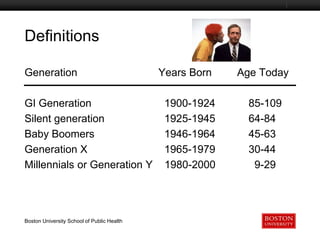
Definitions
Boston University Slideshow Title Goes Here

Generation
GI Generation
Silent generation
Baby Boomers
Generation X
Millennials or Generation Y

Boston University School of Public Health

Years Born
1900-1924
1925-1945
1946-1964
1965-1979
1980-2000

Age Today
85-109
64-84
45-63
30-44
9-29
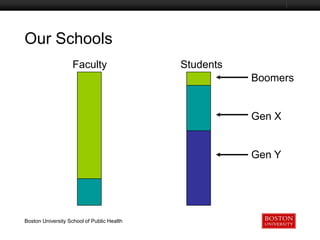
Our Schools
Boston University Slideshow Title Goes Here

Faculty

Students

Boomers

Gen X

Gen Y

Boston University School of Public Health
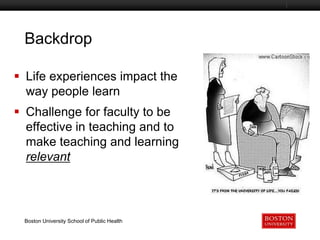
Backdrop
Boston University Slideshow Title Goes Here

 Life experiences impact the
way people learn
 Challenge for faculty to be
effective in teaching and to
make teaching and learning
relevant

Boston University School of Public Health
Generation X
Boston University Slideshow Title Goes Here

 “Latchkey” kids – both parents working
 Many from single parent homes
 Technologically savvy

 Grew up with corporate downsizing and
layoffs, fewer career opportunities

Boston University School of Public Health
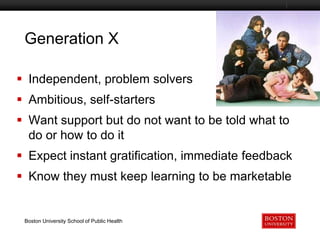
Generation X
Boston University Slideshow Title Goes Here

 Independent, problem solvers
 Ambitious, self-starters
 Want support but do not want to be told what to
do or how to do it
 Expect instant gratification, immediate feedback
 Know they must keep learning to be marketable

Boston University School of Public Health
Generation Y
Boston University Slideshow Title Goes Here

 Largest generation since baby boomers

 Many from divorced, single parent homes but
parents are extremely hands-on (“decade of the
child”)
 Overindulged, overprotected, self-absorbed
 Technologically savvy

Boston University School of Public Health
Generation Y
Boston University Slideshow Title Goes Here









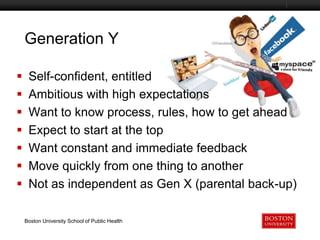
Self-confident, entitled
Ambitious with high expectations
Want to know process, rules, how to get ahead
Expect to start at the top
Want constant and immediate feedback
Move quickly from one thing to another
Not as independent as Gen X (parental back-up)
Boston University School of Public Health
Mixed Classrooms
Boston University Slideshow Title Goes Here

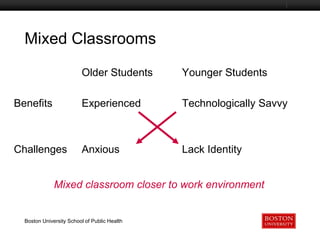
Older Students

Younger Students

Benefits

Experienced

Technologically Savvy

Challenges

Anxious

Lack Identity

Mixed classroom closer to work environment

Boston University School of Public Health
Our Students
Boston University Slideshow Title Goes Here








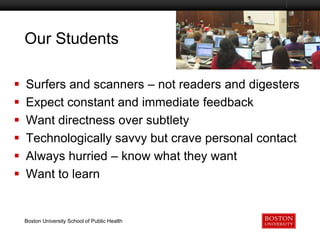
Surfers and scanners – not readers and digesters
Expect constant and immediate feedback
Want directness over subtlety
Technologically savvy but crave personal contact
Always hurried – know what they want
Want to learn

Boston University School of Public Health
Our Faculty
Boston University Slideshow Title Goes Here

 Healthiest and wealthiest of generations to
date
 Redefine traditional values
 Hard-working
 Passionate (can change the world)
 Believe in hierarchy – may find it difficult to
adapt to more flexible arrangements
Boston University School of Public Health
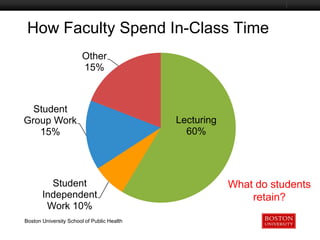
How Faculty Spend In-Class Time
Other
15%

Boston University Slideshow Title Goes Here

Student
Group Work
15%

Student
Independent
Work 10%
Boston University School of Public Health

Lecturing
60%

What do students
retain?
Lecturing
Boston University Slideshow Title Goes Here

 Research has shown that it is impossible for
students to absorb all of the information in a
lecture (limited short term memory)
 We need every student to learn – not just a
few
 More effective approach – get students
actively thinking and learning

Boston University School of Public Health
Student’s Expectations
Boston University Slideshow Title Goes Here

 Want solid knowledge base and real-world
applications
 Want clear and organized presentation of material
 Want to be stimulated, active and participatory
 Want to know why (how does this activity, reading
connect to my future career?)
 Want faculty to be enthusiastic, helpful and engaged
 Expect “customer service”
 Want face-to-face contact but accept boundaries

Boston University School of Public Health
Faculty’s Challenges
Boston University Slideshow Title Goes Here

 Time
 Keeping up with their field
 Dealing with students with varied
backgrounds and skill levels

Boston University School of Public Health
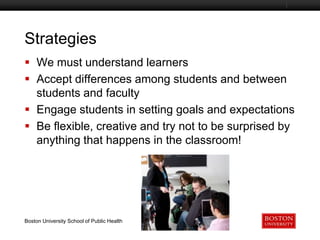
Strategies
 We must understand learners
 Accept differences among students and between
students and faculty
 Engage students in setting goals and expectations
 Be flexible, creative and try not to be surprised by
anything that happens in the classroom!
Boston University Slideshow Title Goes Here

Boston University School of Public Health
Strategies
Boston University Slideshow Title Goes Here

 Problem-based learning
 Student-centered instruction
(Adult learning/Adult education)

 Competency-based (outcomes-based)
instruction

Boston University School of Public Health
Student-Centered Learning
Boston University Slideshow Title Goes Here

 Substitute active learning projects and
experiences for lectures
 Hold students responsible for material not yet
covered
 Assign open-ended questions and problems
 Use simulations, role-playing
 Use self-paced or cooperative (team) learning

Boston University School of Public Health
Student Challenges
 Students feel that teachers have changed the
rules
 Teachers not teaching
 Paying tuition for what?
 Team based learning - some do not want to
work in groups
 Do all members contribute equally?
 Too difficult to schedule, coordinate
 Some dominate, others hide
Boston University Slideshow Title Goes Here

Boston University School of Public Health
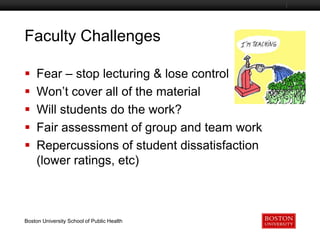
Faculty Challenges
Boston University Slideshow Title Goes Here







Fear – stop lecturing & lose control
Won’t cover all of the material
Will students do the work?
Fair assessment of group and team work
Repercussions of student dissatisfaction
(lower ratings, etc)

Boston University School of Public Health
Competencies
Boston University Slideshow Title Goes Here

 Defined by the needs of the workforce and are
the essential knowledge, skills and attitudes
(KSA’s) required to achieve an acceptable
level of performance
 Achieved through formal training in the
classroom and through hands-on field work
(e.g., capstone experience, practicum)

Boston University School of Public Health
Competencies
Boston University Slideshow Title Goes Here

 Each competency is supported by multiple
learning objectives.
 Learning objectives for the core competencies
generally fall in lower-middle cognitive domains
of Bloom’s Taxonomy (knowledge,
comprehension, application, analysis)
 Concentration-specific and cross-cutting (or
interdisciplinary) objectives are more complex
and include synthesis and evaluation
Boston University School of Public Health
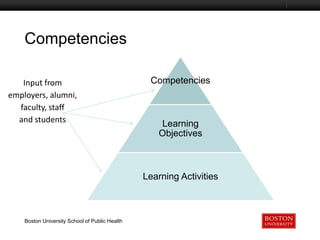
Competencies
Boston University Slideshow Title Goes Here

Input from
employers, alumni,
faculty, staff
and students

Competencies

Learning
Objectives

Learning Activities

Boston University School of Public Health
Getting from Here to There….
Boston University Slideshow Title Goes Here

Students
Learn best when outcomes are clear and integrated
into relevant context
Need practical - not hypothetical - experiences
Competencies
Increase relevance and accountability in curricula
Challenges
Too many competencies
Levels vary
Assessment
Boston University School of Public Health
Course Design
Boston University Slideshow Title Goes Here

 Define competencies
 Map the learning objectives that support each
competency
 Determine activities and assessments that
promote student learning that are authentic
(i.e., scenarios reflecting what students would
actually do in practice) and that are feasible to
administer
Boston University School of Public Health
Teaching Strategies
Boston University Slideshow Title Goes Here






Set context
Tie topics together continually
Pre-assignments
In class lectures and activities
 Opportunity to practice – with feedback
 Audience response system “clickers”
 Short but realistic examples
 Assessments
Boston University School of Public Health
Be Flexible
Boston University Slideshow Title Goes Here

 Check-in
 Are students learning?
 How do you know?
 What could be improved?

Boston University School of Public Health
Summary
Can’t satisfy everyone so mix it up!
Teach to the top
Use student-centered approaches
Use effective technology (audience response,
real examples)
 Consider team work, peer-to-peer exchange
 Stay connected





Boston University Slideshow Title Goes Here

Boston University School of Public Health
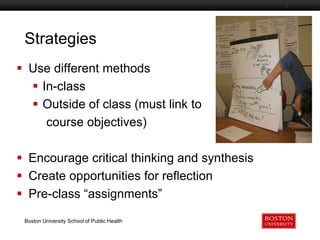
Strategies
Boston University Slideshow Title Goes Here

 Use different methods
 In-class
 Outside of class (must link to
course objectives)
 Encourage critical thinking and synthesis
 Create opportunities for reflection
 Pre-class “assignments”
Boston University School of Public Health
Set The Tone






Boston University Slideshow Title Goes Here

Create an environment that supports learning
Encourage different points of view
Recognize (discuss) your own biases
Maintain rigor
Excite students about content

Boston University School of Public Health
Boston University Slideshow Title Goes Here

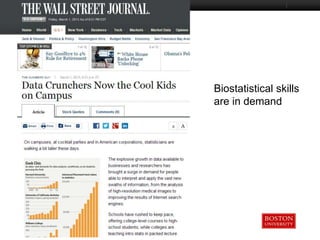
Biostatistical skills
are in demand

Boston University School of Public Health
Important Questions
Make Connections
Boston University Slideshow Title Goes Here

 What are the causes, prevention
and treatment of autism, childhood obesity,
asthma, cancer, diabetes, cardiovascular
disease?
 Is disease preventable with behavior change
and modification of risk factors?
 Are new drugs safe and effective?
 How do genes affect health and longevity?
Boston University School of Public Health
Discussion Points
Boston University Slideshow Title Goes Here

 What are your biggest challenges in teaching?
 Do you have a teaching mentor?
 Is teaching valued by your chair, in A&P
decisions?

Boston University School of Public Health

Creative teaching-and-learning-strategies

  • 1.
    Faculty Development Creative Teachingand Learning Strategies Lisa M. Sullivan Associate Dean for Education Professor and Chair, Department of Biostatistics Boston University School of Public Health Boston University School of Public Health
  • 2.
    Learning Objectives Boston UniversitySlideshow Title Goes Here  Promote active learning  Match student and faculty expectations  Stimulate learning in trainees Boston University School of Public Health
  • 3.
    Outline Boston University SlideshowTitle Goes Here  Course content - what needs to be covered (why? how?)  Changing landscape  Competencies (Outcomes)  Making the connection (mapping)  Some suggestions Boston University School of Public Health
  • 4.
    Course Content Boston UniversitySlideshow Title Goes Here  Link to desired outcomes  Relate to mission, vision for School, Program, Course  Ideally - defined by the needs of the workforce Boston University School of Public Health
  • 5.
    Changing Landscape -Students Boston University Slideshow Title Goes Here  Age of incoming students decreasing (slowly)  Faculty aging  Economic and other pressures  Value of education  Encourage changes in careers later in life Varied classrooms Boston University School of Public Health
  • 6.
    Definitions Boston University SlideshowTitle Goes Here Generation GI Generation Silent generation Baby Boomers Generation X Millennials or Generation Y Boston University School of Public Health Years Born 1900-1924 1925-1945 1946-1964 1965-1979 1980-2000 Age Today 85-109 64-84 45-63 30-44 9-29
  • 7.
    Our Schools Boston UniversitySlideshow Title Goes Here Faculty Students Boomers Gen X Gen Y Boston University School of Public Health
  • 8.
    Backdrop Boston University SlideshowTitle Goes Here  Life experiences impact the way people learn  Challenge for faculty to be effective in teaching and to make teaching and learning relevant Boston University School of Public Health
  • 9.
    Generation X Boston UniversitySlideshow Title Goes Here  “Latchkey” kids – both parents working  Many from single parent homes  Technologically savvy  Grew up with corporate downsizing and layoffs, fewer career opportunities Boston University School of Public Health
  • 10.
    Generation X Boston UniversitySlideshow Title Goes Here  Independent, problem solvers  Ambitious, self-starters  Want support but do not want to be told what to do or how to do it  Expect instant gratification, immediate feedback  Know they must keep learning to be marketable Boston University School of Public Health
  • 11.
    Generation Y Boston UniversitySlideshow Title Goes Here  Largest generation since baby boomers  Many from divorced, single parent homes but parents are extremely hands-on (“decade of the child”)  Overindulged, overprotected, self-absorbed  Technologically savvy Boston University School of Public Health
  • 12.
    Generation Y Boston UniversitySlideshow Title Goes Here        Self-confident, entitled Ambitious with high expectations Want to know process, rules, how to get ahead Expect to start at the top Want constant and immediate feedback Move quickly from one thing to another Not as independent as Gen X (parental back-up) Boston University School of Public Health
  • 13.
    Mixed Classrooms Boston UniversitySlideshow Title Goes Here Older Students Younger Students Benefits Experienced Technologically Savvy Challenges Anxious Lack Identity Mixed classroom closer to work environment Boston University School of Public Health
  • 14.
    Our Students Boston UniversitySlideshow Title Goes Here       Surfers and scanners – not readers and digesters Expect constant and immediate feedback Want directness over subtlety Technologically savvy but crave personal contact Always hurried – know what they want Want to learn Boston University School of Public Health
  • 15.
    Our Faculty Boston UniversitySlideshow Title Goes Here  Healthiest and wealthiest of generations to date  Redefine traditional values  Hard-working  Passionate (can change the world)  Believe in hierarchy – may find it difficult to adapt to more flexible arrangements Boston University School of Public Health
  • 16.
    How Faculty SpendIn-Class Time Other 15% Boston University Slideshow Title Goes Here Student Group Work 15% Student Independent Work 10% Boston University School of Public Health Lecturing 60% What do students retain?
  • 17.
    Lecturing Boston University SlideshowTitle Goes Here  Research has shown that it is impossible for students to absorb all of the information in a lecture (limited short term memory)  We need every student to learn – not just a few  More effective approach – get students actively thinking and learning Boston University School of Public Health
  • 18.
    Student’s Expectations Boston UniversitySlideshow Title Goes Here  Want solid knowledge base and real-world applications  Want clear and organized presentation of material  Want to be stimulated, active and participatory  Want to know why (how does this activity, reading connect to my future career?)  Want faculty to be enthusiastic, helpful and engaged  Expect “customer service”  Want face-to-face contact but accept boundaries Boston University School of Public Health
  • 19.
    Faculty’s Challenges Boston UniversitySlideshow Title Goes Here  Time  Keeping up with their field  Dealing with students with varied backgrounds and skill levels Boston University School of Public Health
  • 20.
    Strategies  We mustunderstand learners  Accept differences among students and between students and faculty  Engage students in setting goals and expectations  Be flexible, creative and try not to be surprised by anything that happens in the classroom! Boston University Slideshow Title Goes Here Boston University School of Public Health
  • 21.
    Strategies Boston University SlideshowTitle Goes Here  Problem-based learning  Student-centered instruction (Adult learning/Adult education)  Competency-based (outcomes-based) instruction Boston University School of Public Health
  • 22.
    Student-Centered Learning Boston UniversitySlideshow Title Goes Here  Substitute active learning projects and experiences for lectures  Hold students responsible for material not yet covered  Assign open-ended questions and problems  Use simulations, role-playing  Use self-paced or cooperative (team) learning Boston University School of Public Health
  • 23.
    Student Challenges  Studentsfeel that teachers have changed the rules  Teachers not teaching  Paying tuition for what?  Team based learning - some do not want to work in groups  Do all members contribute equally?  Too difficult to schedule, coordinate  Some dominate, others hide Boston University Slideshow Title Goes Here Boston University School of Public Health
  • 24.
    Faculty Challenges Boston UniversitySlideshow Title Goes Here      Fear – stop lecturing & lose control Won’t cover all of the material Will students do the work? Fair assessment of group and team work Repercussions of student dissatisfaction (lower ratings, etc) Boston University School of Public Health
  • 25.
    Competencies Boston University SlideshowTitle Goes Here  Defined by the needs of the workforce and are the essential knowledge, skills and attitudes (KSA’s) required to achieve an acceptable level of performance  Achieved through formal training in the classroom and through hands-on field work (e.g., capstone experience, practicum) Boston University School of Public Health
  • 26.
    Competencies Boston University SlideshowTitle Goes Here  Each competency is supported by multiple learning objectives.  Learning objectives for the core competencies generally fall in lower-middle cognitive domains of Bloom’s Taxonomy (knowledge, comprehension, application, analysis)  Concentration-specific and cross-cutting (or interdisciplinary) objectives are more complex and include synthesis and evaluation Boston University School of Public Health
  • 27.
    Competencies Boston University SlideshowTitle Goes Here Input from employers, alumni, faculty, staff and students Competencies Learning Objectives Learning Activities Boston University School of Public Health
  • 28.
    Getting from Hereto There…. Boston University Slideshow Title Goes Here Students Learn best when outcomes are clear and integrated into relevant context Need practical - not hypothetical - experiences Competencies Increase relevance and accountability in curricula Challenges Too many competencies Levels vary Assessment Boston University School of Public Health
  • 29.
    Course Design Boston UniversitySlideshow Title Goes Here  Define competencies  Map the learning objectives that support each competency  Determine activities and assessments that promote student learning that are authentic (i.e., scenarios reflecting what students would actually do in practice) and that are feasible to administer Boston University School of Public Health
  • 30.
    Teaching Strategies Boston UniversitySlideshow Title Goes Here     Set context Tie topics together continually Pre-assignments In class lectures and activities  Opportunity to practice – with feedback  Audience response system “clickers”  Short but realistic examples  Assessments Boston University School of Public Health
  • 31.
    Be Flexible Boston UniversitySlideshow Title Goes Here  Check-in  Are students learning?  How do you know?  What could be improved? Boston University School of Public Health
  • 32.
    Summary Can’t satisfy everyoneso mix it up! Teach to the top Use student-centered approaches Use effective technology (audience response, real examples)  Consider team work, peer-to-peer exchange  Stay connected     Boston University Slideshow Title Goes Here Boston University School of Public Health
  • 33.
    Strategies Boston University SlideshowTitle Goes Here  Use different methods  In-class  Outside of class (must link to course objectives)  Encourage critical thinking and synthesis  Create opportunities for reflection  Pre-class “assignments” Boston University School of Public Health
  • 34.
    Set The Tone      BostonUniversity Slideshow Title Goes Here Create an environment that supports learning Encourage different points of view Recognize (discuss) your own biases Maintain rigor Excite students about content Boston University School of Public Health
  • 35.
    Boston University SlideshowTitle Goes Here Biostatistical skills are in demand Boston University School of Public Health
  • 36.
    Important Questions Make Connections BostonUniversity Slideshow Title Goes Here  What are the causes, prevention and treatment of autism, childhood obesity, asthma, cancer, diabetes, cardiovascular disease?  Is disease preventable with behavior change and modification of risk factors?  Are new drugs safe and effective?  How do genes affect health and longevity? Boston University School of Public Health
  • 37.
    Discussion Points Boston UniversitySlideshow Title Goes Here  What are your biggest challenges in teaching?  Do you have a teaching mentor?  Is teaching valued by your chair, in A&P decisions? Boston University School of Public Health