Teaching with Technology -
Assessment for Learning
Institute of Technology Carlow, TEL week 2016
#irishdigitalchampions
Sharon Flynn
Assistant Director, Centre for Excellence in Learning and Teaching
National University of Ireland, Galway
Email: sharon.flynn@nuigalway.ie
Twitter: @sharonlflynn
learntechgalway.blogspot.com
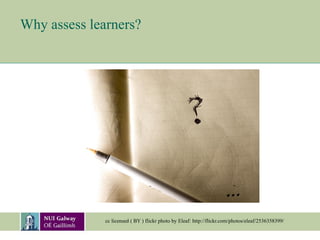
Why assess learners?
cc licensed ( BY ) flickr photo by Eleaf: http://flickr.com/photos/eleaf/2536358399/
Assessment for learning
Assessment for learning is formative and diagnostic. It provides
information about student achievement which allows teaching
and learning activities to be changed in response to the needs
of the learner and recognises the huge benefit that feedback
can have on learning.
Assessment as learning sees student involvement in assessment,
using feedback, participating in peer assessment, and self-
monitoring of progress as moments of learning in themselves.
(Bloxham & Boyd, 2012)
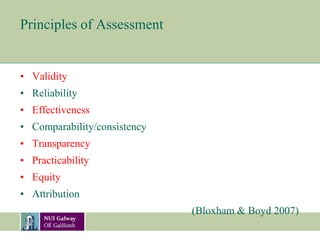
Principles of Assessment
• Validity
• Reliability
• Effectiveness
• Comparability/consistency
• Transparency
• Practicability
• Equity
• Attribution
(Bloxham & Boyd 2007)
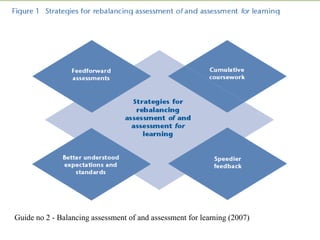
Guide no 2 - Balancing assessment of and assessment for learning (2007)
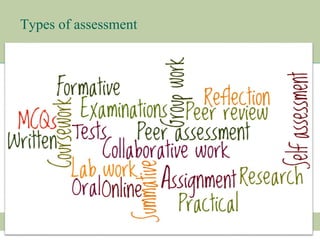
Types of assessment
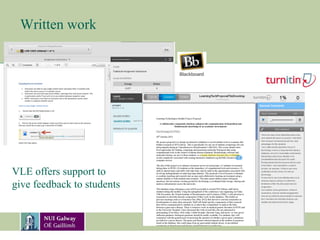
Written work
VLE offers support to
give feedback to students
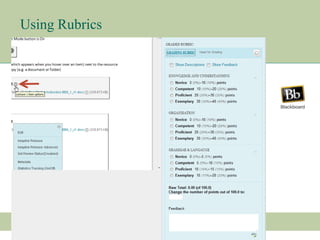
Using Rubrics
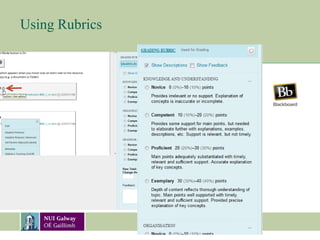
Using Rubrics
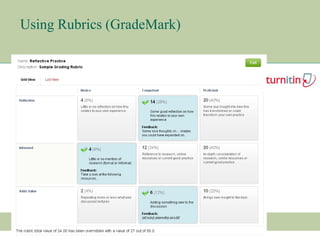
Using Rubrics (GradeMark)
#irishdigitalchampions
Andrew Flaus - Biochemistry
Opportunities for
• feedback
• transparency
• consistency
Phase 1: Using tagged comments to give feedback
Phase 2: Using rubrics for final grading
#irishdigitalchampions
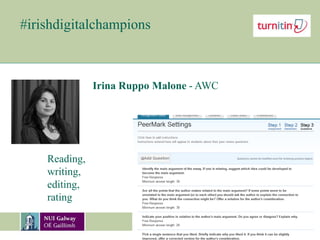
Irina Ruppo Malone - AWC
Reading,
writing,
editing,
rating
#irishdigitalchampions
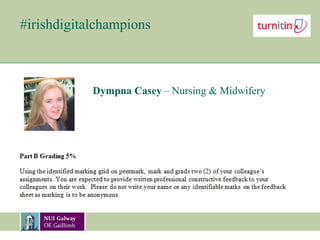
Dympna Casey – Nursing & Midwifery
Benefits of peer assessment (Sue Bloxham)
Evidence shows students find their peers a useful and more
approachable source of help with assignments but we need to stress
the main value in peer assessment is standing in the shoes of the
assessor – not being assessed – because:
 learning about standards – absolutely crucial to making
progress and understanding feedback
 Seeing other ways of going about the task – develops strategies
for taking action
 Key employability skill – being able to judge own performance
and assessing and giving feedback to others
 More opportunity for dialogue
 Chance for more, rich, formative feedback
#irishdigitalchampions
John Morrissey – Geography
“One of the great practical roles podcasting can play is in efficiently
providing effective ‘student feedback’, particularly covering
generic assignment shortcomings of content, style and presentation”
Teacher friendly formative feedback on written
work (Sue Bloxham)
• Teacher posts good examples of completed tasks on VLE
• Students peer assess tasks using assessment criteria
• Teachers give feedback on work in class
• Teachers put main effort into marking drafts (agreed with
examiner), just checking for change and putting mark on final
piece
• Tasks are done on-line (MCQs), auto marked giving
immediate feedback
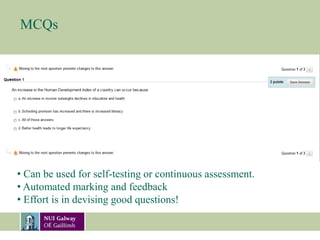
MCQs
• Can be used for self-testing or continuous assessment.
• Automated marking and feedback
• Effort is in devising good questions!
#irishdigitalchampions
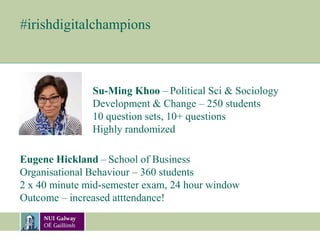
Su-Ming Khoo – Political Sci & Sociology
Development & Change – 250 students
10 question sets, 10+ questions
Highly randomized
Eugene Hickland – School of Business
Organisational Behaviour – 360 students
2 x 40 minute mid-semester exam, 24 hour window
Outcome – increased atttendance!
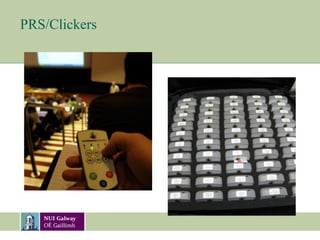
PRS/Clickers
#irishdigitalchampions
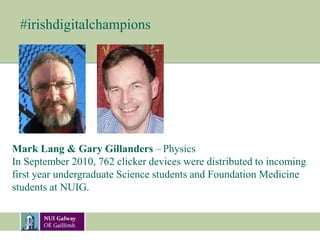
Mark Lang & Gary Gillanders – Physics
In September 2010, 762 clicker devices were distributed to incoming
first year undergraduate Science students and Foundation Medicine
students at NUIG.
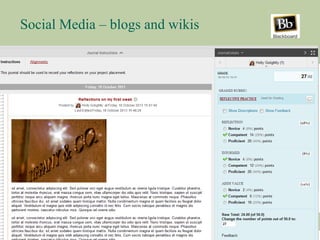
Social Media – blogs and wikis
#irishdigitalchampions
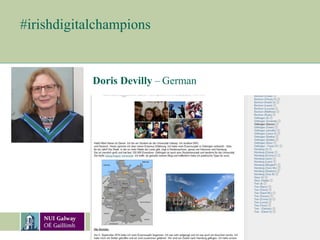
Doris Devilly – German
#irishdigitalchampions
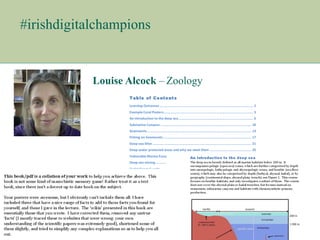
Louise Alcock – Zoology
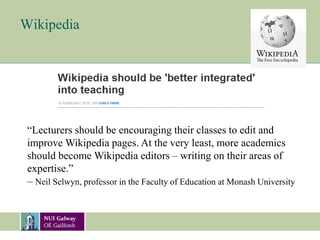
Wikipedia
“Lecturers should be encouraging their classes to edit and
improve Wikipedia pages. At the very least, more academics
should become Wikipedia editors – writing on their areas of
expertise.”
– Neil Selwyn, professor in the Faculty of Education at Monash University
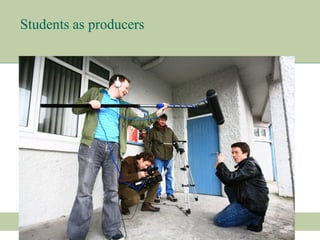
Students as producers
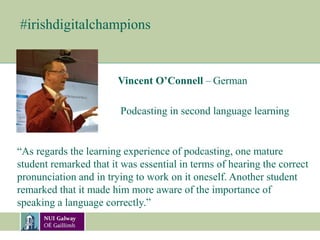
#irishdigitalchampions
Vincent O’Connell – German
“As regards the learning experience of podcasting, one mature
student remarked that it was essential in terms of hearing the correct
pronunciation and in trying to work on it oneself. Another student
remarked that it made him more aware of the importance of
speaking a language correctly.”
Podcasting in second language learning
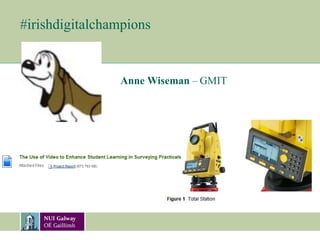
#irishdigitalchampions
Anne Wiseman – GMIT
#irishdigitalchampions
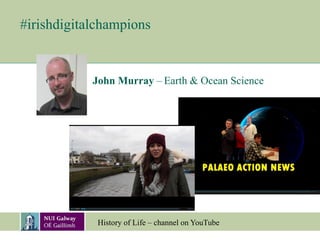
John Murray – Earth & Ocean Science
History of Life – channel on YouTube
Conclusions
• Focus on the pedagogy, let the technology support
• We need to celebrate our digital champions
• We need to document, share and learn from their experiences
Thank you for listening. Questions?
References
Bloxham, S & Boyd, P (2007) Developing assessment in Higher Education: a practical guide,
Maidenhead, Open University Press
Hounsell, D., Xu, R., & Tai, C. (2007) Guide no 2 - Balancing assessment of and assessment for
learning, Integrative Assessment Enhancement Theme,
http://www.enhancementthemes.ac.uk/pages/docdetail/docs/publications/guide-no-2---balancing-
assessment-of-and-assessment-for-learning
Morrissey, J. (2012) Podcast Steering of Independent Learning in Higher Education. AISHE-J, 4
(1):1-12.
The Quality Assurance Agency for Higher Education (2012)Understanding assessment: its role
in safeguarding academic standards and quality in higher education
http://www.qaa.ac.uk/en/Publications/Documents/understanding-assessment.pdf
Thomas, L. (2012) What Works? Building student engagement and belonging in higher
education at a time of change. https://www.heacademy.ac.uk/resource/building-student-
engagement-and-belonging-higher-education-time-change-summary-findings-and
On learntechgalway.blogspot.com
The clicker experience at NUIG: student feedback
http://learntechgalway.blogspot.ie/2012/02/clicker-experience-at-nuig-student.html
The clicker experience at NUIG: Issues and concerns for staff
http://learntechgalway.blogspot.ie/2012/02/clicker-experience-at-nuig-issues-and.html
Flipping great! (On flipped classroom)
http://learntechgalway.blogspot.ie/2015/12/flipping-great.html
A lecturer perspective on peer assessment
http://learntechgalway.blogspot.ie/2015/11/a-lecturer-perspective-on-peer.html
Academic writing and wikipedia
http://learntechgalway.blogspot.ie/2015/02/academic-writing-and-wikipedia.html

Dr Sharon Flynn: Teaching with technology - assessment for learning

  • 1.
    Teaching with Technology- Assessment for Learning Institute of Technology Carlow, TEL week 2016 #irishdigitalchampions Sharon Flynn Assistant Director, Centre for Excellence in Learning and Teaching National University of Ireland, Galway Email: sharon.flynn@nuigalway.ie Twitter: @sharonlflynn learntechgalway.blogspot.com
  • 2.
    Why assess learners? cclicensed ( BY ) flickr photo by Eleaf: http://flickr.com/photos/eleaf/2536358399/
  • 3.
    Assessment for learning Assessmentfor learning is formative and diagnostic. It provides information about student achievement which allows teaching and learning activities to be changed in response to the needs of the learner and recognises the huge benefit that feedback can have on learning. Assessment as learning sees student involvement in assessment, using feedback, participating in peer assessment, and self- monitoring of progress as moments of learning in themselves. (Bloxham & Boyd, 2012)
  • 4.
    Principles of Assessment •Validity • Reliability • Effectiveness • Comparability/consistency • Transparency • Practicability • Equity • Attribution (Bloxham & Boyd 2007)
  • 5.
    Guide no 2- Balancing assessment of and assessment for learning (2007)
  • 6.
  • 7.
    Written work VLE offerssupport to give feedback to students
  • 8.
  • 9.
  • 10.
  • 11.
    #irishdigitalchampions Andrew Flaus -Biochemistry Opportunities for • feedback • transparency • consistency Phase 1: Using tagged comments to give feedback Phase 2: Using rubrics for final grading
  • 12.
    #irishdigitalchampions Irina Ruppo Malone- AWC Reading, writing, editing, rating
  • 13.
  • 14.
    Benefits of peerassessment (Sue Bloxham) Evidence shows students find their peers a useful and more approachable source of help with assignments but we need to stress the main value in peer assessment is standing in the shoes of the assessor – not being assessed – because:  learning about standards – absolutely crucial to making progress and understanding feedback  Seeing other ways of going about the task – develops strategies for taking action  Key employability skill – being able to judge own performance and assessing and giving feedback to others  More opportunity for dialogue  Chance for more, rich, formative feedback
  • 15.
    #irishdigitalchampions John Morrissey –Geography “One of the great practical roles podcasting can play is in efficiently providing effective ‘student feedback’, particularly covering generic assignment shortcomings of content, style and presentation”
  • 16.
    Teacher friendly formativefeedback on written work (Sue Bloxham) • Teacher posts good examples of completed tasks on VLE • Students peer assess tasks using assessment criteria • Teachers give feedback on work in class • Teachers put main effort into marking drafts (agreed with examiner), just checking for change and putting mark on final piece • Tasks are done on-line (MCQs), auto marked giving immediate feedback
  • 17.
    MCQs • Can beused for self-testing or continuous assessment. • Automated marking and feedback • Effort is in devising good questions!
  • 18.
    #irishdigitalchampions Su-Ming Khoo –Political Sci & Sociology Development & Change – 250 students 10 question sets, 10+ questions Highly randomized Eugene Hickland – School of Business Organisational Behaviour – 360 students 2 x 40 minute mid-semester exam, 24 hour window Outcome – increased atttendance!
  • 19.
  • 20.
    #irishdigitalchampions Mark Lang &Gary Gillanders – Physics In September 2010, 762 clicker devices were distributed to incoming first year undergraduate Science students and Foundation Medicine students at NUIG.
  • 21.
    Social Media –blogs and wikis
  • 22.
  • 23.
  • 24.
    Wikipedia “Lecturers should beencouraging their classes to edit and improve Wikipedia pages. At the very least, more academics should become Wikipedia editors – writing on their areas of expertise.” – Neil Selwyn, professor in the Faculty of Education at Monash University
  • 25.
  • 26.
    #irishdigitalchampions Vincent O’Connell –German “As regards the learning experience of podcasting, one mature student remarked that it was essential in terms of hearing the correct pronunciation and in trying to work on it oneself. Another student remarked that it made him more aware of the importance of speaking a language correctly.” Podcasting in second language learning
  • 27.
  • 28.
    #irishdigitalchampions John Murray –Earth & Ocean Science History of Life – channel on YouTube
  • 29.
    Conclusions • Focus onthe pedagogy, let the technology support • We need to celebrate our digital champions • We need to document, share and learn from their experiences Thank you for listening. Questions?
  • 30.
    References Bloxham, S &Boyd, P (2007) Developing assessment in Higher Education: a practical guide, Maidenhead, Open University Press Hounsell, D., Xu, R., & Tai, C. (2007) Guide no 2 - Balancing assessment of and assessment for learning, Integrative Assessment Enhancement Theme, http://www.enhancementthemes.ac.uk/pages/docdetail/docs/publications/guide-no-2---balancing- assessment-of-and-assessment-for-learning Morrissey, J. (2012) Podcast Steering of Independent Learning in Higher Education. AISHE-J, 4 (1):1-12. The Quality Assurance Agency for Higher Education (2012)Understanding assessment: its role in safeguarding academic standards and quality in higher education http://www.qaa.ac.uk/en/Publications/Documents/understanding-assessment.pdf Thomas, L. (2012) What Works? Building student engagement and belonging in higher education at a time of change. https://www.heacademy.ac.uk/resource/building-student- engagement-and-belonging-higher-education-time-change-summary-findings-and
  • 31.
    On learntechgalway.blogspot.com The clickerexperience at NUIG: student feedback http://learntechgalway.blogspot.ie/2012/02/clicker-experience-at-nuig-student.html The clicker experience at NUIG: Issues and concerns for staff http://learntechgalway.blogspot.ie/2012/02/clicker-experience-at-nuig-issues-and.html Flipping great! (On flipped classroom) http://learntechgalway.blogspot.ie/2015/12/flipping-great.html A lecturer perspective on peer assessment http://learntechgalway.blogspot.ie/2015/11/a-lecturer-perspective-on-peer.html Academic writing and wikipedia http://learntechgalway.blogspot.ie/2015/02/academic-writing-and-wikipedia.html