ASSESSING LEARNING
OUTCOMES IN NURSING
PROGRAMS
NORTHERN ESSEX COMMUNITY COLLEGE
Presenters:
Patricia Demers – Assistant Dean, Division of Health Professions
Francine Pappalardo – Nursing Curriculum Coordinator
Ellen Wentland - Assistant Dean, Assessment and Educational
Effectiveness
Facilitator:
Suzanne VanWert – Assessment Fellow; Professor of English
AMCOA STATEWIDE CONFERENCE ON ASSESSING
LEARNING OUTCOMES
Greenfield Community College – November 17, 2011
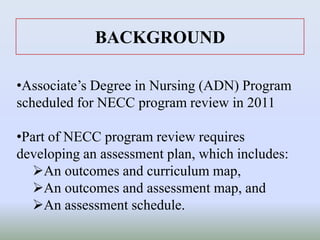
BACKGROUND
•Associate’s Degree in Nursing (ADN) Program
scheduled for NECC program review in 2011
•Part of NECC program review requires
developing an assessment plan, which includes:
An outcomes and curriculum map,
An outcomes and assessment map, and
An assessment schedule.
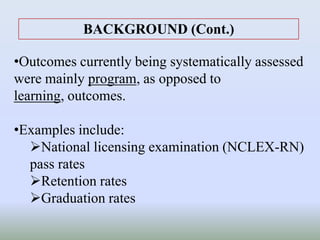
•Outcomes currently being systematically assessed
were mainly program, as opposed to
learning, outcomes.
•Examples include:
National licensing examination (NCLEX-RN)
pass rates
Retention rates
Graduation rates
BACKGROUND (Cont.)
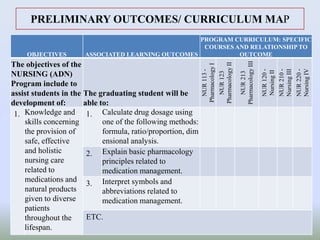
PRELIMINARY OUTCOMES/ CURRICULUM MAP
OBJECTIVES ASSOCIATED LEARNING OUTCOMES
PROGRAM CURRICULUM: SPECIFIC
COURSES AND RELATIONSHIP TO
OUTCOME
The objectives of the
NURSING (ADN)
Program include to
assist students in the
development of:
The graduating student will be
able to:
NUR113-
PharmacologyI
NUR123
PharmacologyII
NUR213
PharmacologyIII
NUR120-
NursingII
NUR210-
NursingIII
NUR220-
NursingIV
1. Knowledge and
skills concerning
the provision of
safe, effective
and holistic
nursing care
related to
medications and
natural products
given to diverse
patients
throughout the
lifespan.
1. Calculate drug dosage using
one of the following methods:
formula, ratio/proportion, dim
ensional analysis.
2. Explain basic pharmacology
principles related to
medication management.
3. Interpret symbols and
abbreviations related to
medication management.
ETC.
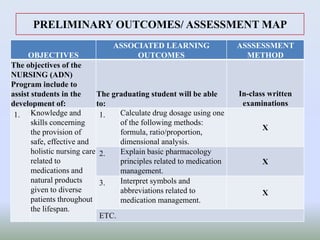
PRELIMINARY OUTCOMES/ ASSESSMENT MAP
OBJECTIVES
ASSOCIATED LEARNING
OUTCOMES
ASSSESSMENT
METHOD
The objectives of the
NURSING (ADN)
Program include to
assist students in the
development of:
The graduating student will be able
to:
In-class written
examinations
1. Knowledge and
skills concerning
the provision of
safe, effective and
holistic nursing care
related to
medications and
natural products
given to diverse
patients throughout
the lifespan.
1. Calculate drug dosage using one
of the following methods:
formula, ratio/proportion,
dimensional analysis.
X
2. Explain basic pharmacology
principles related to medication
management.
X
3. Interpret symbols and
abbreviations related to
medication management.
X
ETC.
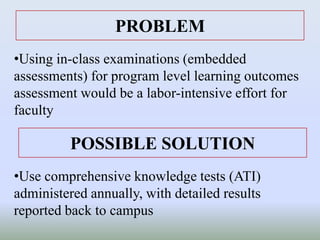
PROBLEM
•Using in-class examinations (embedded
assessments) for program level learning outcomes
assessment would be a labor-intensive effort for
faculty
•Use comprehensive knowledge tests (ATI)
administered annually, with detailed results
reported back to campus
POSSIBLE SOLUTION
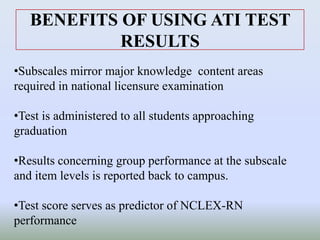
BENEFITS OF USING ATI TEST
RESULTS
•Subscales mirror major knowledge content areas
required in national licensure examination
•Test is administered to all students approaching
graduation
•Results concerning group performance at the subscale
and item levels is reported back to campus.
•Test score serves as predictor of NCLEX-RN
performance
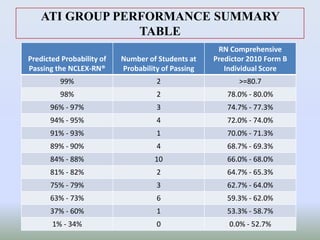
ATI GROUP PERFORMANCE SUMMARY
TABLE
Predicted Probability of
Passing the NCLEX-RN®
Number of Students at
Probability of Passing
RN Comprehensive
Predictor 2010 Form B
Individual Score
99% 2 >=80.7
98% 2 78.0% - 80.0%
96% - 97% 3 74.7% - 77.3%
94% - 95% 4 72.0% - 74.0%
91% - 93% 1 70.0% - 71.3%
89% - 90% 4 68.7% - 69.3%
84% - 88% 10 66.0% - 68.0%
81% - 82% 2 64.7% - 65.3%
75% - 79% 3 62.7% - 64.0%
63% - 73% 6 59.3% - 62.0%
37% - 60% 1 53.3% - 58.7%
1% - 34% 0 0.0% - 52.7%
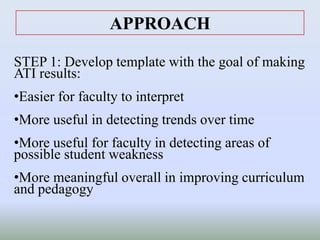
APPROACH
STEP 1: Develop template with the goal of making
ATI results:
•Easier for faculty to interpret
•More useful in detecting trends over time
•More useful for faculty in detecting areas of
possible student weakness
•More meaningful overall in improving curriculum
and pedagogy
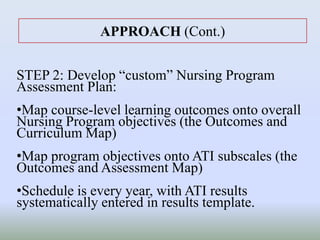
APPROACH (Cont.)
STEP 2: Develop “custom” Nursing Program
Assessment Plan:
•Map course-level learning outcomes onto overall
Nursing Program objectives (the Outcomes and
Curriculum Map)
•Map program objectives onto ATI subscales (the
Outcomes and Assessment Map)
•Schedule is every year, with ATI results
systematically entered in results template.
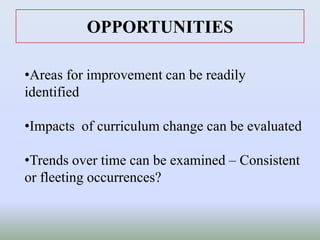
OPPORTUNITIES
•Areas for improvement can be readily
identified
•Impacts of curriculum change can be evaluated
•Trends over time can be examined – Consistent
or fleeting occurrences?

Assessing+learning+outcomes+in+nursing+programs+c427 a

  • 1.
    ASSESSING LEARNING OUTCOMES INNURSING PROGRAMS NORTHERN ESSEX COMMUNITY COLLEGE Presenters: Patricia Demers – Assistant Dean, Division of Health Professions Francine Pappalardo – Nursing Curriculum Coordinator Ellen Wentland - Assistant Dean, Assessment and Educational Effectiveness Facilitator: Suzanne VanWert – Assessment Fellow; Professor of English AMCOA STATEWIDE CONFERENCE ON ASSESSING LEARNING OUTCOMES Greenfield Community College – November 17, 2011
  • 2.
    BACKGROUND •Associate’s Degree inNursing (ADN) Program scheduled for NECC program review in 2011 •Part of NECC program review requires developing an assessment plan, which includes: An outcomes and curriculum map, An outcomes and assessment map, and An assessment schedule.
  • 3.
    •Outcomes currently beingsystematically assessed were mainly program, as opposed to learning, outcomes. •Examples include: National licensing examination (NCLEX-RN) pass rates Retention rates Graduation rates BACKGROUND (Cont.)
  • 4.
    PRELIMINARY OUTCOMES/ CURRICULUMMAP OBJECTIVES ASSOCIATED LEARNING OUTCOMES PROGRAM CURRICULUM: SPECIFIC COURSES AND RELATIONSHIP TO OUTCOME The objectives of the NURSING (ADN) Program include to assist students in the development of: The graduating student will be able to: NUR113- PharmacologyI NUR123 PharmacologyII NUR213 PharmacologyIII NUR120- NursingII NUR210- NursingIII NUR220- NursingIV 1. Knowledge and skills concerning the provision of safe, effective and holistic nursing care related to medications and natural products given to diverse patients throughout the lifespan. 1. Calculate drug dosage using one of the following methods: formula, ratio/proportion, dim ensional analysis. 2. Explain basic pharmacology principles related to medication management. 3. Interpret symbols and abbreviations related to medication management. ETC.
  • 5.
    PRELIMINARY OUTCOMES/ ASSESSMENTMAP OBJECTIVES ASSOCIATED LEARNING OUTCOMES ASSSESSMENT METHOD The objectives of the NURSING (ADN) Program include to assist students in the development of: The graduating student will be able to: In-class written examinations 1. Knowledge and skills concerning the provision of safe, effective and holistic nursing care related to medications and natural products given to diverse patients throughout the lifespan. 1. Calculate drug dosage using one of the following methods: formula, ratio/proportion, dimensional analysis. X 2. Explain basic pharmacology principles related to medication management. X 3. Interpret symbols and abbreviations related to medication management. X ETC.
  • 6.
    PROBLEM •Using in-class examinations(embedded assessments) for program level learning outcomes assessment would be a labor-intensive effort for faculty •Use comprehensive knowledge tests (ATI) administered annually, with detailed results reported back to campus POSSIBLE SOLUTION
  • 7.
    BENEFITS OF USINGATI TEST RESULTS •Subscales mirror major knowledge content areas required in national licensure examination •Test is administered to all students approaching graduation •Results concerning group performance at the subscale and item levels is reported back to campus. •Test score serves as predictor of NCLEX-RN performance
  • 8.
    ATI GROUP PERFORMANCESUMMARY TABLE Predicted Probability of Passing the NCLEX-RN® Number of Students at Probability of Passing RN Comprehensive Predictor 2010 Form B Individual Score 99% 2 >=80.7 98% 2 78.0% - 80.0% 96% - 97% 3 74.7% - 77.3% 94% - 95% 4 72.0% - 74.0% 91% - 93% 1 70.0% - 71.3% 89% - 90% 4 68.7% - 69.3% 84% - 88% 10 66.0% - 68.0% 81% - 82% 2 64.7% - 65.3% 75% - 79% 3 62.7% - 64.0% 63% - 73% 6 59.3% - 62.0% 37% - 60% 1 53.3% - 58.7% 1% - 34% 0 0.0% - 52.7%
  • 9.
    APPROACH STEP 1: Developtemplate with the goal of making ATI results: •Easier for faculty to interpret •More useful in detecting trends over time •More useful for faculty in detecting areas of possible student weakness •More meaningful overall in improving curriculum and pedagogy
  • 10.
    APPROACH (Cont.) STEP 2:Develop “custom” Nursing Program Assessment Plan: •Map course-level learning outcomes onto overall Nursing Program objectives (the Outcomes and Curriculum Map) •Map program objectives onto ATI subscales (the Outcomes and Assessment Map) •Schedule is every year, with ATI results systematically entered in results template.
  • 11.
    OPPORTUNITIES •Areas for improvementcan be readily identified •Impacts of curriculum change can be evaluated •Trends over time can be examined – Consistent or fleeting occurrences?