Source: von Frank, V. (2013, Winter). Evaluations serve as pathways for professional
growth: Teacher-led teams help build evaluation system that promotes learning. The
Learning System 8(2), pp.1, 4-5.
Title
Body
Evaluations serve
as pathways for
professional growth
Source: von Frank, V. (2013, Winter). Evaluations serve as pathways for professional
growth: Teacher-led teams help build evaluation system that promotes learning. The
Learning System 8(2), pp.1, 4-5.
This presentation is a supplement
to the full article. Download more
information, resources, and tools to
help you implement these ideas in
The Learning System (Winter, 2013).
Available at www.learningforward.
org/publications/learning-system.
Download the article and
accompanying tools
F
or teachers in at least six New York districts,
evaluations mean a lot more now than a piece of
paper filed away in a manila folder in the main
office. These educators are using evaluations to
mark the path of professional growth in a new
system created by teachers for teachers.
The New York State United Teachers association
began work that would lead to the Teacher Evaluation and
Development system, known as TED, even before the 2009
Race to the Top and the federal School Improvement Grant
programs spurred district and state initiatives across the
nation to overhaul how teachers are evaluated. Teams of
teachers and district administrators from six districts — Al-
bany, Hempstead, Marlboro, North Syracuse, Plattsburgh,
and Poughkeepsie — came together over several years to
research and design a new strategy, supported by grants
from the American Federation of Teachers and the U.S.
Department of Education.
The intent, according to Carolyn Williams, educational
services and project coordinator for New York State United
Teachers, was to involve teachers in creating evaluations
that would develop into meaningful dialogues and plans for
continued professional learning. Past evaluations, she said,
had not provided constructive feedback that teachers could
use to take action.
“There was clear agreement that the old teacher evalu-
ation system had no impact in terms of helping teachers in
their practice,” Williams said. “Most teachers received no
support to develop their own effectiveness and capacity. ”
The teams set out to transform the old system of evalu-
ation that involved sole administrator observations, what
some termed “subjective drive-by evaluations,” to more
comprehensive, meaningful reviews that involve multiple
measures of teacher performance and are designed to pro-
mote teacher learning and growth.
“TED’s strength is that it brings practitioners in to
analyze their own practice, which is the critical component
to making instructional shifts,” Maria Neira, the union’s
vice president, said in a statement.
Develop an approach that Drives
improvement
Williams said the first need before developing a differ-
THE LEARNING
system
inside
• Implementation: The second dimension of professional learning, p. 2
• Addressing diversity requires transparency, fidelity, and modeling, p. 3
• Tool: Personal learning plan, p. 6
• Tool: Teacher evaluation and development process, p. 7
Winter 2013
Vol. 8, No. 2
Continued on p. 4
By valerie von Frank
EvERy EducAToR ENGAGEs IN effecTIVe ProfessIoNAl leArNINg eVery dAy so eVery sTudeNT AchIeVes
Your membership in learning Forward gives you access to a wide range
of publications, tools, and opportunities to advance professional learning for
student success. Visit www.learningforward.org to explore more of your
membership benefits.
Evaluations serve
as pathways for
professional growth
Teacher-led teams help build evaluation
system that promotes learning
Source: von Frank, V. (2013, Winter). Evaluations serve as pathways for professional
growth: Teacher-led teams help build evaluation system that promotes learning. The
Learning System 8(2), pp.1, 4-5.
How the New York State United Teachers
association led teams of teachers and district
administrators in researching and designing a
new teacher evaluation system that includes
meaningful dialogues and plans for continued
professional learning.
Source: von Frank, V. (2013, Winter). Evaluations serve as pathways for professional
growth: Teacher-led teams help build evaluation system that promotes learning. The
Learning System 8(2), pp.1, 4-5.
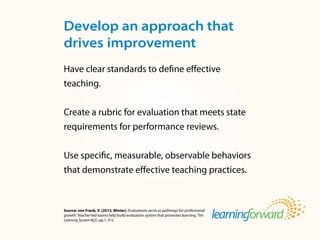
Have clear standards to define effective
teaching.
Create a rubric for evaluation that meets state
requirements for performance reviews.
Use specific, measurable, observable behaviors
that demonstrate effective teaching practices.
Develop an approach that
drives 	improvement
Source: von Frank, V. (2013, Winter). Evaluations serve as pathways for professional
growth: Teacher-led teams help build evaluation system that promotes learning. The
Learning System 8(2), pp.1, 4-5.
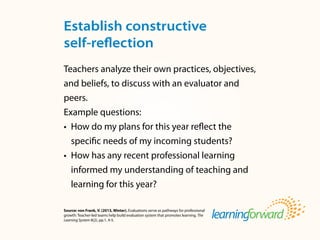
Teachers analyze their own practices, objectives,
and beliefs, to discuss with an evaluator and
peers.
Example questions:
•	 How do my plans for this year reflect the
specific needs of my incoming students?
•	 How has any recent professional learning
informed my understanding of teaching and
learning for this year?
Establish constructive
self-reflection
Source: von Frank, V. (2013, Winter). Evaluations serve as pathways for professional
growth: Teacher-led teams help build evaluation system that promotes learning. The
Learning System 8(2), pp.1, 4-5.
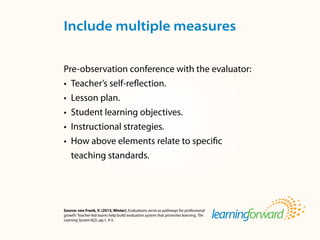
Pre-observation conference with the evaluator:
•	 Teacher’s self-reflection.
•	 Lesson plan.
•	 Student learning objectives.
•	 Instructional strategies.
•	 How above elements relate to specific
teaching standards.
Include multiple measures
Source: von Frank, V. (2013, Winter). Evaluations serve as pathways for professional
growth: Teacher-led teams help build evaluation system that promotes learning. The
Learning System 8(2), pp.1, 4-5.
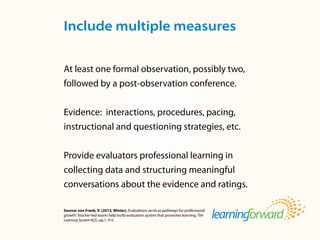
At least one formal observation, possibly two,
followed by a post-observation conference.
Evidence: interactions, procedures, pacing,
instructional and questioning strategies, etc.
Provide evaluators professional learning in
collecting data and structuring meaningful
conversations about the evidence and ratings.
Include multiple measures
Source: von Frank, V. (2013, Winter). Evaluations serve as pathways for professional
growth: Teacher-led teams help build evaluation system that promotes learning. The
Learning System 8(2), pp.1, 4-5.
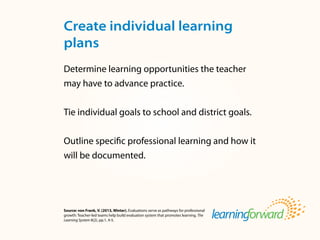
Determine learning opportunities the teacher
may have to advance practice.
Tie individual goals to school and district goals.
Outline specific professional learning and how it
will be documented.
Create individual learning
plans
Source: von Frank, V. (2013, Winter). Evaluations serve as pathways for professional
growth: Teacher-led teams help build evaluation system that promotes learning. The
Learning System 8(2), pp.1, 4-5.
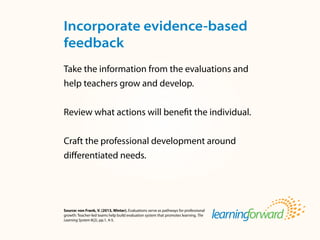
Take the information from the evaluations and
help teachers grow and develop.
Review what actions will benefit the individual.
Craft the professional development around
differentiated needs.
Incorporate evidence-based
feedback
Source: von Frank, V. (2013, Winter). Evaluations serve as pathways for professional
growth: Teacher-led teams help build evaluation system that promotes learning. The
Learning System 8(2), pp.1, 4-5.
Remember that evaluations are not a“gotcha
system”to remove the ineffective educator.
Build on trust
Learn more with
Learn more about professional learning at all
levels of education with Learning Forward, an
international nonprofit association of learning
educators:
www.learningforward.org
Membership in Learning Forward gives you
access to a wide range of publications, tools,
and opportunities to advance professional
learning for student success.

Teacher evaluations as pathways for professional growth

  • 1.
    Source: von Frank,V. (2013, Winter). Evaluations serve as pathways for professional growth: Teacher-led teams help build evaluation system that promotes learning. The Learning System 8(2), pp.1, 4-5. Title Body Evaluations serve as pathways for professional growth
  • 2.
    Source: von Frank,V. (2013, Winter). Evaluations serve as pathways for professional growth: Teacher-led teams help build evaluation system that promotes learning. The Learning System 8(2), pp.1, 4-5. This presentation is a supplement to the full article. Download more information, resources, and tools to help you implement these ideas in The Learning System (Winter, 2013). Available at www.learningforward. org/publications/learning-system. Download the article and accompanying tools F or teachers in at least six New York districts, evaluations mean a lot more now than a piece of paper filed away in a manila folder in the main office. These educators are using evaluations to mark the path of professional growth in a new system created by teachers for teachers. The New York State United Teachers association began work that would lead to the Teacher Evaluation and Development system, known as TED, even before the 2009 Race to the Top and the federal School Improvement Grant programs spurred district and state initiatives across the nation to overhaul how teachers are evaluated. Teams of teachers and district administrators from six districts — Al- bany, Hempstead, Marlboro, North Syracuse, Plattsburgh, and Poughkeepsie — came together over several years to research and design a new strategy, supported by grants from the American Federation of Teachers and the U.S. Department of Education. The intent, according to Carolyn Williams, educational services and project coordinator for New York State United Teachers, was to involve teachers in creating evaluations that would develop into meaningful dialogues and plans for continued professional learning. Past evaluations, she said, had not provided constructive feedback that teachers could use to take action. “There was clear agreement that the old teacher evalu- ation system had no impact in terms of helping teachers in their practice,” Williams said. “Most teachers received no support to develop their own effectiveness and capacity. ” The teams set out to transform the old system of evalu- ation that involved sole administrator observations, what some termed “subjective drive-by evaluations,” to more comprehensive, meaningful reviews that involve multiple measures of teacher performance and are designed to pro- mote teacher learning and growth. “TED’s strength is that it brings practitioners in to analyze their own practice, which is the critical component to making instructional shifts,” Maria Neira, the union’s vice president, said in a statement. Develop an approach that Drives improvement Williams said the first need before developing a differ- THE LEARNING system inside • Implementation: The second dimension of professional learning, p. 2 • Addressing diversity requires transparency, fidelity, and modeling, p. 3 • Tool: Personal learning plan, p. 6 • Tool: Teacher evaluation and development process, p. 7 Winter 2013 Vol. 8, No. 2 Continued on p. 4 By valerie von Frank EvERy EducAToR ENGAGEs IN effecTIVe ProfessIoNAl leArNINg eVery dAy so eVery sTudeNT AchIeVes Your membership in learning Forward gives you access to a wide range of publications, tools, and opportunities to advance professional learning for student success. Visit www.learningforward.org to explore more of your membership benefits. Evaluations serve as pathways for professional growth Teacher-led teams help build evaluation system that promotes learning
  • 3.
    Source: von Frank,V. (2013, Winter). Evaluations serve as pathways for professional growth: Teacher-led teams help build evaluation system that promotes learning. The Learning System 8(2), pp.1, 4-5. How the New York State United Teachers association led teams of teachers and district administrators in researching and designing a new teacher evaluation system that includes meaningful dialogues and plans for continued professional learning.
  • 4.
    Source: von Frank,V. (2013, Winter). Evaluations serve as pathways for professional growth: Teacher-led teams help build evaluation system that promotes learning. The Learning System 8(2), pp.1, 4-5. Have clear standards to define effective teaching. Create a rubric for evaluation that meets state requirements for performance reviews. Use specific, measurable, observable behaviors that demonstrate effective teaching practices. Develop an approach that drives improvement
  • 5.
    Source: von Frank,V. (2013, Winter). Evaluations serve as pathways for professional growth: Teacher-led teams help build evaluation system that promotes learning. The Learning System 8(2), pp.1, 4-5. Teachers analyze their own practices, objectives, and beliefs, to discuss with an evaluator and peers. Example questions: • How do my plans for this year reflect the specific needs of my incoming students? • How has any recent professional learning informed my understanding of teaching and learning for this year? Establish constructive self-reflection
  • 6.
    Source: von Frank,V. (2013, Winter). Evaluations serve as pathways for professional growth: Teacher-led teams help build evaluation system that promotes learning. The Learning System 8(2), pp.1, 4-5. Pre-observation conference with the evaluator: • Teacher’s self-reflection. • Lesson plan. • Student learning objectives. • Instructional strategies. • How above elements relate to specific teaching standards. Include multiple measures
  • 7.
    Source: von Frank,V. (2013, Winter). Evaluations serve as pathways for professional growth: Teacher-led teams help build evaluation system that promotes learning. The Learning System 8(2), pp.1, 4-5. At least one formal observation, possibly two, followed by a post-observation conference. Evidence: interactions, procedures, pacing, instructional and questioning strategies, etc. Provide evaluators professional learning in collecting data and structuring meaningful conversations about the evidence and ratings. Include multiple measures
  • 8.
    Source: von Frank,V. (2013, Winter). Evaluations serve as pathways for professional growth: Teacher-led teams help build evaluation system that promotes learning. The Learning System 8(2), pp.1, 4-5. Determine learning opportunities the teacher may have to advance practice. Tie individual goals to school and district goals. Outline specific professional learning and how it will be documented. Create individual learning plans
  • 9.
    Source: von Frank,V. (2013, Winter). Evaluations serve as pathways for professional growth: Teacher-led teams help build evaluation system that promotes learning. The Learning System 8(2), pp.1, 4-5. Take the information from the evaluations and help teachers grow and develop. Review what actions will benefit the individual. Craft the professional development around differentiated needs. Incorporate evidence-based feedback
  • 10.
    Source: von Frank,V. (2013, Winter). Evaluations serve as pathways for professional growth: Teacher-led teams help build evaluation system that promotes learning. The Learning System 8(2), pp.1, 4-5. Remember that evaluations are not a“gotcha system”to remove the ineffective educator. Build on trust
  • 11.
    Learn more with Learnmore about professional learning at all levels of education with Learning Forward, an international nonprofit association of learning educators: www.learningforward.org Membership in Learning Forward gives you access to a wide range of publications, tools, and opportunities to advance professional learning for student success.