GETTING READY FOR THE ORAL EXAM
How to make the most of it
October 20th, 2018
WHAT ARE THE MAIN ISSUES WE FACE?
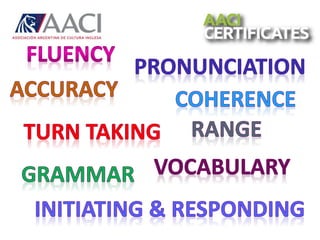
WHAT ASPECTS OF STUDENT
PERFORMANCE SHOULD I FOCUS ON?
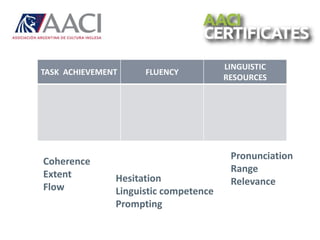
TASK ACHIEVEMENT FLUENCY
LINGUISTIC
RESOURCES
Coherence
Extent
Flow
Hesitation
Linguistic competence
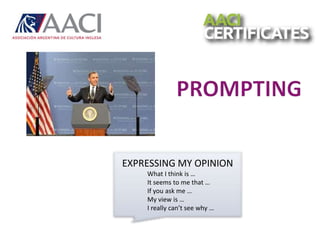
Prompting
Pronunciation
Range
Relevance
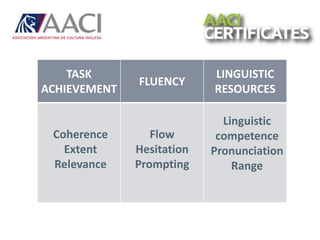
TASK
ACHIEVEMENT
FLUENCY
LINGUISTIC
RESOURCES
Coherence
Extent
Relevance
Flow
Hesitation
Prompting
Linguistic
competence
Pronunciation
Range
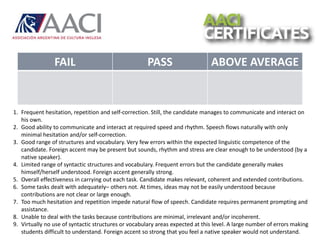
FAIL PASS ABOVE AVERAGE
1. Frequent hesitation, repetition and self‐correction. Still, the candidate manages to communicate and interact on
his own.
2. Good ability to communicate and interact at required speed and rhythm. Speech flows naturally with only
minimal hesitation and/or self‐correction.
3. Good range of structures and vocabulary. Very few errors within the expected linguistic competence of the
candidate. Foreign accent may be present but sounds, rhythm and stress are clear enough to be understood (by a
native speaker).
4. Limited range of syntactic structures and vocabulary. Frequent errors but the candidate generally makes
himself/herself understood. Foreign accent generally strong.
5. Overall effectiveness in carrying out each task. Candidate makes relevant, coherent and extended contributions.
6. Some tasks dealt with adequately– others not. At times, ideas may not be easily understood because
contributions are not clear or large enough.
7. Too much hesitation and repetition impede natural flow of speech. Candidate requires permanent prompting and
assistance.
8. Unable to deal with the tasks because contributions are minimal, irrelevant and/or incoherent.
9. Virtually no use of syntactic structures or vocabulary areas expected at this level. A large number of errors making
students difficult to understand. Foreign accent so strong that you feel a native speaker would not understand.
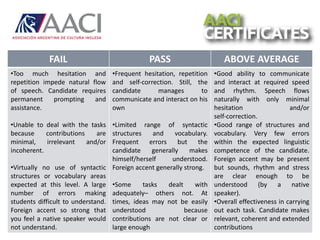
FAIL PASS ABOVE AVERAGE
•Too much hesitation and
repetition impede natural flow
of speech. Candidate requires
permanent prompting and
assistance.
•Unable to deal with the tasks
because contributions are
minimal, irrelevant and/or
incoherent.
•Virtually no use of syntactic
structures or vocabulary areas
expected at this level. A large
number of errors making
students difficult to understand.
Foreign accent so strong that
you feel a native speaker would
not understand.
•Frequent hesitation, repetition
and self‐correction. Still, the
candidate manages to
communicate and interact on his
own
•Limited range of syntactic
structures and vocabulary.
Frequent errors but the
candidate generally makes
himself/herself understood.
Foreign accent generally strong.
•Some tasks dealt with
adequately– others not. At
times, ideas may not be easily
understood because
contributions are not clear or
large enough
•Good ability to communicate
and interact at required speed
and rhythm. Speech flows
naturally with only minimal
hesitation and/or
self‐correction.
•Good range of structures and
vocabulary. Very few errors
within the expected linguistic
competence of the candidate.
Foreign accent may be present
but sounds, rhythm and stress
are clear enough to be
understood (by a native
speaker).
•Overall effectiveness in carrying
out each task. Candidate makes
relevant, coherent and extended
contributions
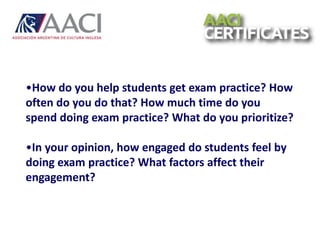
•How do you help students get exam practice? How
often do you do that? How much time do you
spend doing exam practice? What do you prioritize?
•In your opinion, how engaged do students feel by
doing exam practice? What factors affect their
engagement?
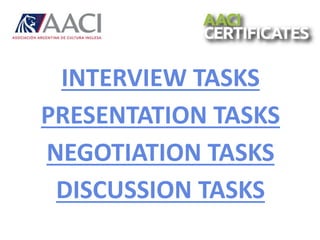
CAN YOU IDENTIFY THE TASK TYPES?
INTERVIEW TASKS
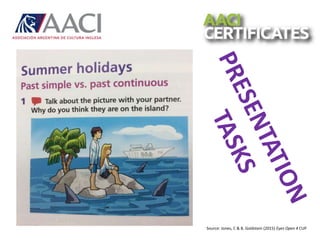
PRESENTATION TASKS
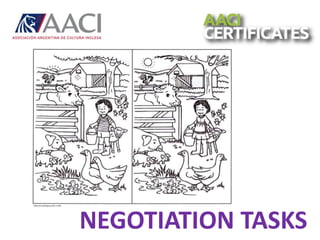
NEGOTIATION TASKS
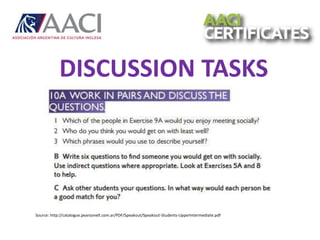
DISCUSSION TASKS
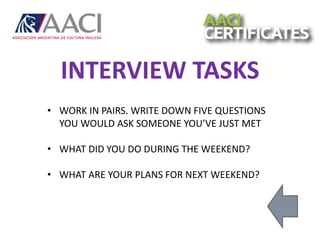
• WORK IN PAIRS. WRITE DOWN FIVE QUESTIONS
YOU WOULD ASK SOMEONE YOU’VE JUST MET
• WHAT DID YOU DO DURING THE WEEKEND?
• WHAT ARE YOUR PLANS FOR NEXT WEEKEND?
INTERVIEW TASKS
Source: Jones, C & B. Goldstein (2015) Eyes Open 4 CUP
NEGOTIATION TASKS
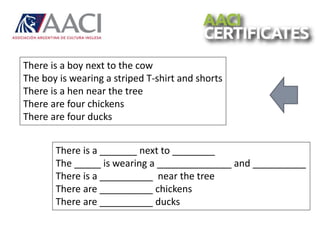
There is a boy next to the cow
The boy is wearing a striped T-shirt and shorts
There is a hen near the tree
There are four chickens
There are four ducks
There is a _______ next to ________
The _____ is wearing a ______________ and __________
There is a __________ near the tree
There are __________ chickens
There are __________ ducks
Source: http://catalogue.pearsonelt.com.ar/PDF/Speakout/Speakout-Students-UpperIntermediate.pdf
DISCUSSION TASKS
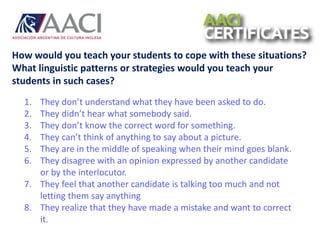
How would you teach your students to cope with these situations?
What linguistic patterns or strategies would you teach your
students in such cases?
1. They don’t understand what they have been asked to do.
2. They didn’t hear what somebody said.
3. They don’t know the correct word for something.
4. They can’t think of anything to say about a picture.
5. They are in the middle of speaking when their mind goes blank.
6. They disagree with an opinion expressed by another candidate
or by the interlocutor.
7. They feel that another candidate is talking too much and not
letting them say anything
8. They realize that they have made a mistake and want to correct
it.
EXPRESSING MY OPINION
What I think is …
It seems to me that …
If you ask me …
My view is …
I really can’t see why …
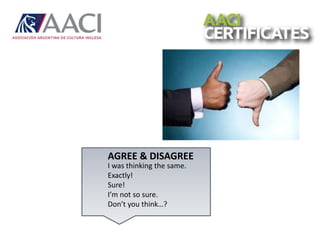
AGREE & DISAGREE
I was thinking the same.
Exactly!
Sure!
I’m not so sure.
Don’t you think…?
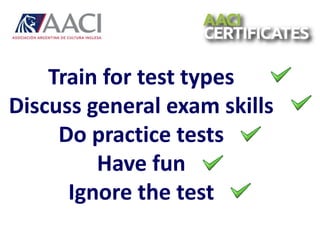
Train for test types
Discuss general exam skills
Do practice tests
Have fun
Ignore the test
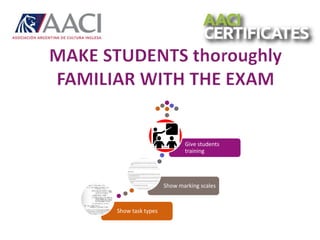
Show task types
Show marking scales
Give students
training
• Adding an element of competition
• How long can you talk about a picture?
• How many possible questions can you ask?
• How many words can you associate with a topic?
• Students create their own exercises
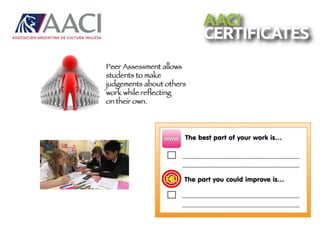
• Students as examiners / assessors
• Etc
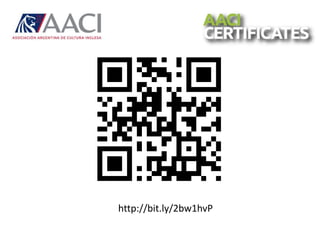
http://bit.ly/2bw1hvP

Assessing speaking

  • 1.
    GETTING READY FORTHE ORAL EXAM How to make the most of it October 20th, 2018
  • 3.
    WHAT ARE THEMAIN ISSUES WE FACE?
  • 5.
    WHAT ASPECTS OFSTUDENT PERFORMANCE SHOULD I FOCUS ON?
  • 7.
  • 8.
  • 9.
    FAIL PASS ABOVEAVERAGE 1. Frequent hesitation, repetition and self‐correction. Still, the candidate manages to communicate and interact on his own. 2. Good ability to communicate and interact at required speed and rhythm. Speech flows naturally with only minimal hesitation and/or self‐correction. 3. Good range of structures and vocabulary. Very few errors within the expected linguistic competence of the candidate. Foreign accent may be present but sounds, rhythm and stress are clear enough to be understood (by a native speaker). 4. Limited range of syntactic structures and vocabulary. Frequent errors but the candidate generally makes himself/herself understood. Foreign accent generally strong. 5. Overall effectiveness in carrying out each task. Candidate makes relevant, coherent and extended contributions. 6. Some tasks dealt with adequately– others not. At times, ideas may not be easily understood because contributions are not clear or large enough. 7. Too much hesitation and repetition impede natural flow of speech. Candidate requires permanent prompting and assistance. 8. Unable to deal with the tasks because contributions are minimal, irrelevant and/or incoherent. 9. Virtually no use of syntactic structures or vocabulary areas expected at this level. A large number of errors making students difficult to understand. Foreign accent so strong that you feel a native speaker would not understand.
  • 10.
    FAIL PASS ABOVEAVERAGE •Too much hesitation and repetition impede natural flow of speech. Candidate requires permanent prompting and assistance. •Unable to deal with the tasks because contributions are minimal, irrelevant and/or incoherent. •Virtually no use of syntactic structures or vocabulary areas expected at this level. A large number of errors making students difficult to understand. Foreign accent so strong that you feel a native speaker would not understand. •Frequent hesitation, repetition and self‐correction. Still, the candidate manages to communicate and interact on his own •Limited range of syntactic structures and vocabulary. Frequent errors but the candidate generally makes himself/herself understood. Foreign accent generally strong. •Some tasks dealt with adequately– others not. At times, ideas may not be easily understood because contributions are not clear or large enough •Good ability to communicate and interact at required speed and rhythm. Speech flows naturally with only minimal hesitation and/or self‐correction. •Good range of structures and vocabulary. Very few errors within the expected linguistic competence of the candidate. Foreign accent may be present but sounds, rhythm and stress are clear enough to be understood (by a native speaker). •Overall effectiveness in carrying out each task. Candidate makes relevant, coherent and extended contributions
  • 13.
    •How do youhelp students get exam practice? How often do you do that? How much time do you spend doing exam practice? What do you prioritize? •In your opinion, how engaged do students feel by doing exam practice? What factors affect their engagement?
  • 15.
    CAN YOU IDENTIFYTHE TASK TYPES?
  • 16.
  • 17.
    • WORK INPAIRS. WRITE DOWN FIVE QUESTIONS YOU WOULD ASK SOMEONE YOU’VE JUST MET • WHAT DID YOU DO DURING THE WEEKEND? • WHAT ARE YOUR PLANS FOR NEXT WEEKEND? INTERVIEW TASKS
  • 18.
    Source: Jones, C& B. Goldstein (2015) Eyes Open 4 CUP
  • 19.
  • 20.
    There is aboy next to the cow The boy is wearing a striped T-shirt and shorts There is a hen near the tree There are four chickens There are four ducks There is a _______ next to ________ The _____ is wearing a ______________ and __________ There is a __________ near the tree There are __________ chickens There are __________ ducks
  • 21.
  • 24.
    How would youteach your students to cope with these situations? What linguistic patterns or strategies would you teach your students in such cases? 1. They don’t understand what they have been asked to do. 2. They didn’t hear what somebody said. 3. They don’t know the correct word for something. 4. They can’t think of anything to say about a picture. 5. They are in the middle of speaking when their mind goes blank. 6. They disagree with an opinion expressed by another candidate or by the interlocutor. 7. They feel that another candidate is talking too much and not letting them say anything 8. They realize that they have made a mistake and want to correct it.
  • 25.
    EXPRESSING MY OPINION WhatI think is … It seems to me that … If you ask me … My view is … I really can’t see why …
  • 26.
    AGREE & DISAGREE Iwas thinking the same. Exactly! Sure! I’m not so sure. Don’t you think…?
  • 30.
    Train for testtypes Discuss general exam skills Do practice tests Have fun Ignore the test
  • 31.
    Show task types Showmarking scales Give students training
  • 33.
    • Adding anelement of competition • How long can you talk about a picture? • How many possible questions can you ask? • How many words can you associate with a topic? • Students create their own exercises • Students as examiners / assessors • Etc
  • 36.