ORAL EXAMS

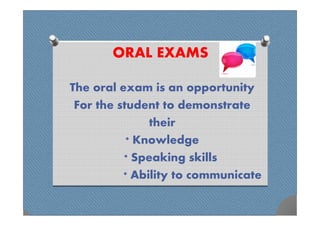
The oral exam is an opportunity
 For the student to demonstrate
               their
           * Knowledge
          * Speaking skills
          * Ability to communicate
FEATURES OF GOOD ORAL
      INTERVIEWS
O A safe and relaxed
 environment

O A focus on communication


O Scaffolded questions
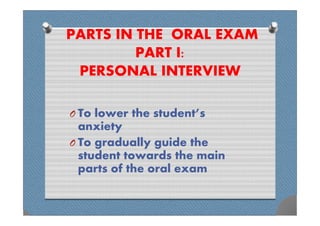
PARTS IN THE ORAL EXAM
         PART I:
 PERSONAL INTERVIEW

O To lower the student’s
  anxiety
O To gradually guide the
  student towards the main
  parts of the oral exam
PART II : USING A TEXT

OLevels of questions:*Summary/Definition
                   * Analysis questions
                   * Hypothesis questions
                   * Evaluation questions
OSituations
OTalk about …
OProblem solving
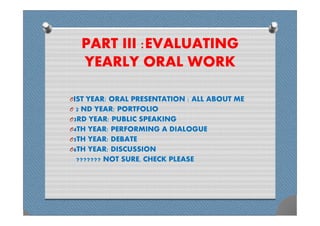
PART III :EVALUATING
  YEARLY ORAL WORK

OIST YEAR: ORAL PRESENTATION : ALL ABOUT ME
O 2 ND YEAR: PORTFOLIO
O3RD YEAR: PUBLIC SPEAKING
O4TH YEAR: PERFORMING A DIALOGUE
O5TH YEAR: DEBATE
O6TH YEAR: DISCUSSION
 ??????? NOT SURE, CHECK PLEASE
IT IS IMPORTANT:

O The student must be given the opportunity to
  communicate as naturally as possible

O Ask some personal questions at the beginning of the
  interview

O Provide students ample wait time after asking a
  question

O Make sure your students understand what you
  mean
O Give students some choices when they
 have problems to answer a question

O Do not over-emphasize grammar
 during an exam

O Give students opportunities to show
 what they know
THINGS TO AVOID

O Do not insist students to respond with
 grammatically perfect answers like «Yes, I
 do». Any logical response such as «Yes»
 or «Of course» should be accepted

O There is no need to insist on complete
 sentences. The conversation should be
 natural

O Be sure you are asking what is logical
TIPS
O Plan your questions in advance

O When asking about a course you
 haven´t taught, try to read the
 texts beforehand

O Trust your colleagues and share
 your ideas, experiences and
 opinions

O Be fair !
REMEMBER THAT…
O The oral exam rubric focuses
 on COMPREHENSION
    FLUIDITY
    VOCABULARY
    PRODUCTION
    GRAMMAR
Inferior (1-4)              Básico (5-7)                Superior (8-12)


Comprensión        No comprende consignas      Comprende en términos       Comprende el idioma sin
                   básicas ni logra mantener   generales pero persisten    dificultades
                   una conversación            dificultades
                   elemental


Fluidez            No logra conformar          Articula ideas en forma     Articula ideas en forma
                   oraciones completas ni      coherente                   clara y las expresa sin
                   expresar ideas                                          titubeos


Elementos          Pobre, sin demostrar        Demuestra conocimiento      Utiliza rico vocabulario y
léxicos            conocimiento de lo          del vocabulario del curso   en situaciones correctas
                   trabajado en el curso


Expresión          No logra comunicarse, no    Se comunica pero con        Se comunica en forma
                   produce                     dificultad                  adecuada al nivel que
                                                                           cursa


Uso del lenguaje   Errores graves que          Comete errores pero se      Logra comunicación con
                   impiden la comunicación     comunica                    un mínimo de errores
« What a teacher writes on the

blackboard of life, can never be erased»

Oral exams

  • 1.
    ORAL EXAMS The oralexam is an opportunity For the student to demonstrate their * Knowledge * Speaking skills * Ability to communicate
  • 2.
    FEATURES OF GOODORAL INTERVIEWS O A safe and relaxed environment O A focus on communication O Scaffolded questions
  • 3.
    PARTS IN THEORAL EXAM PART I: PERSONAL INTERVIEW O To lower the student’s anxiety O To gradually guide the student towards the main parts of the oral exam
  • 4.
    PART II :USING A TEXT OLevels of questions:*Summary/Definition * Analysis questions * Hypothesis questions * Evaluation questions OSituations OTalk about … OProblem solving
  • 5.
    PART III :EVALUATING YEARLY ORAL WORK OIST YEAR: ORAL PRESENTATION : ALL ABOUT ME O 2 ND YEAR: PORTFOLIO O3RD YEAR: PUBLIC SPEAKING O4TH YEAR: PERFORMING A DIALOGUE O5TH YEAR: DEBATE O6TH YEAR: DISCUSSION ??????? NOT SURE, CHECK PLEASE
  • 6.
    IT IS IMPORTANT: OThe student must be given the opportunity to communicate as naturally as possible O Ask some personal questions at the beginning of the interview O Provide students ample wait time after asking a question O Make sure your students understand what you mean
  • 7.
    O Give studentssome choices when they have problems to answer a question O Do not over-emphasize grammar during an exam O Give students opportunities to show what they know
  • 8.
    THINGS TO AVOID ODo not insist students to respond with grammatically perfect answers like «Yes, I do». Any logical response such as «Yes» or «Of course» should be accepted O There is no need to insist on complete sentences. The conversation should be natural O Be sure you are asking what is logical
  • 9.
    TIPS O Plan yourquestions in advance O When asking about a course you haven´t taught, try to read the texts beforehand O Trust your colleagues and share your ideas, experiences and opinions O Be fair !
  • 10.
    REMEMBER THAT… O Theoral exam rubric focuses on COMPREHENSION FLUIDITY VOCABULARY PRODUCTION GRAMMAR
  • 11.
    Inferior (1-4) Básico (5-7) Superior (8-12) Comprensión No comprende consignas Comprende en términos Comprende el idioma sin básicas ni logra mantener generales pero persisten dificultades una conversación dificultades elemental Fluidez No logra conformar Articula ideas en forma Articula ideas en forma oraciones completas ni coherente clara y las expresa sin expresar ideas titubeos Elementos Pobre, sin demostrar Demuestra conocimiento Utiliza rico vocabulario y léxicos conocimiento de lo del vocabulario del curso en situaciones correctas trabajado en el curso Expresión No logra comunicarse, no Se comunica pero con Se comunica en forma produce dificultad adecuada al nivel que cursa Uso del lenguaje Errores graves que Comete errores pero se Logra comunicación con impiden la comunicación comunica un mínimo de errores
  • 12.
    « What ateacher writes on the blackboard of life, can never be erased»