Download to read offline
![http://www.tutorialspoint.com/assembly_prog ramming /assembly_arrays.htm Copyright © tutorialspoint.com
ASSEMBLY - ARRAYS
We have already discussed that the data definitiondirectives to the assembler are used for allocating storage for
variables. The variable could also be initialized withsome specific value. The initialized value could be specified in
hexadecimal, decimalor binary form.
For example, we candefine a word variable months ineither of the following way:
MONTHS DW 12
MONTHS DW 0CH
MONTHS DW 0110B
The data definitiondirectives canalso be used for defining a one-dimensionalarray. Let us define a one-
dimensionalarray of numbers.
NUMBERS DW 34, 45, 56, 67, 75, 89
The above definitiondeclares anarray of six words eachinitialized withthe numbers 34, 45, 56, 67, 75, 89. This
allocates 2x6 = 12 bytes of consecutive memory space. The symbolic address of the first number willbe
NUMBERS and that of the second number willbe NUMBERS + 2 and so on.
Let us take up another example. Youcandefine anarray named inventory of size 8, and initialize allthe values
withzero, as:
INVENTORY DW 0
DW 0
DW 0
DW 0
DW 0
DW 0
DW 0
DW 0
Whichcanbe abbreviated as:
INVENTORY DW 0, 0 , 0 , 0 , 0 , 0 , 0 , 0
The TIMES directive canalso be used for multiple initializations to the same value. Using TIMES, the
INVENTORY array canbe defined as
INVENTORY TIMES 8 DW 0
Example:
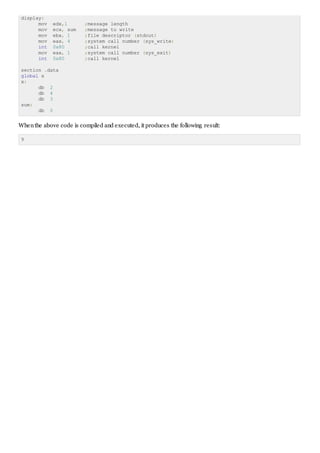
The following example demonstrates the above concepts by defining a 3-element array x, whichstores three
values: 2, 3 and 4. It adds the values inthe array and displays the sum9:
section .text
global _start ;must be declared for linker (ld)
_start:
mov eax,3 ;number bytes to be summed
mov ebx,0 ;EBX will store the sum
mov ecx, x ;ECX will point to the current element to be summed
top: add ebx, [ecx]
add ecx,1 ;move pointer to next element
dec eax ;decrement counter
jnz top ;if counter not 0, then loop again
done:
add ebx, '0'
mov [sum], ebx ;done, store result in "sum"](https://image.slidesharecdn.com/ksjuopjvsrauuarv4pxh-signature-f0bcef7f9817b10cd8e4303a3bd252588637176c0b8a4a51961fd9a43b349005-poli-140718025717-phpapp01/85/N_Asm-Assembly-arrays-sol-1-320.jpg)

The document discusses arrays in assembly language. It explains that data definition directives can be used to allocate storage for variables and initialize them with values. Arrays can be defined as one-dimensional using these directives by declaring multiple values separated by commas. For example, an array named NUMBERS is defined with six words initialized to the values 34, 45, 56, 67, 75, 89. The document also provides examples of initializing all values in an array to zero using repetition directives like TIMES and DW.


![Chap03[1]](https://cdn.slidesharecdn.com/ss_thumbnails/chap031-140914002717-phpapp01-thumbnail.jpg?width=640&height=640&fit=bounds)


