http://www.tutorialspoint.com/assembly_prog ramming /assembly_variables.htm Copyright © tutorialspoint.com
ASSEMBLY - VARIABLE DECLARATIONS
NASM provides various define directives for reserving storage space for variables. The define assembler
directive is used for allocationof storage space. It canbe used to reserve as wellas initialize one or more bytes.
Allocating Storage Space for Initialized Data
The syntax for storage allocationstatement for initialized data is:
[variable-name] define-directive initial-value [,initial-value]...
Where, variable-name is the identifier for eachstorage space. The assembler associates anoffset value for
eachvariable name defined inthe data segment.
There are five basic forms of the define directive:
Directive Purpose Storage Space
DB Define Byte allocates 1 byte
DW Define Word allocates 2 bytes
DD Define Doubleword allocates 4 bytes
DQ Define Quadword allocates 8 bytes
DT Define TenBytes allocates 10 bytes
Following are some examples of using define directives:
choice DB 'y'
number DW 12345
neg_number DW -12345
big_number DQ 123456789
real_number1 DD 1.234
real_number2 DQ 123.456
Please note that:
Eachbyte of character is stored as its ASCII value inhexadecimal
Eachdecimalvalue is automatically converted to its 16-bit binary equivalent and stored as a hexadecimal
number
Processor uses the little-endianbyte ordering
Negative numbers are converted to its 2's complement representation
Short and long floating-point numbers are represented using 32 or 64 bits, respectively
The following programshows use of the define directive:
section .text
global _start ;must be declared for linker (gcc)
_start: ;tell linker entry point
mov edx,1 ;message length
mov ecx,choice ;message to write
mov ebx,1 ;file descriptor (stdout)
mov eax,4 ;system call number (sys_write)
int 0x80 ;call kernel
mov eax,1 ;system call number (sys_exit)
int 0x80 ;call kernel
section .data
choice DB 'y'
Whenthe above code is compiled and executed, it produces the following result:
y
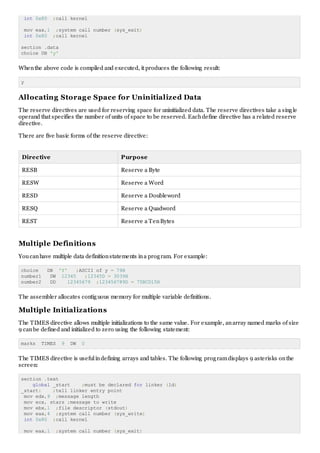
Allocating Storage Space for Uninitialized Data
The reserve directives are used for reserving space for uninitialized data. The reserve directives take a single
operand that specifies the number of units of space to be reserved. Eachdefine directive has a related reserve
directive.
There are five basic forms of the reserve directive:
Directive Purpose
RESB Reserve a Byte
RESW Reserve a Word
RESD Reserve a Doubleword
RESQ Reserve a Quadword
REST Reserve a TenBytes
Multiple Definitions
Youcanhave multiple data definitionstatements ina program. For example:
choice DB 'Y' ;ASCII of y = 79H
number1 DW 12345 ;12345D = 3039H
number2 DD 12345679 ;123456789D = 75BCD15H
The assembler allocates contiguous memory for multiple variable definitions.
Multiple Initializations
The TIMES directive allows multiple initializations to the same value. For example, anarray named marks of size
9 canbe defined and initialized to zero using the following statement:
marks TIMES 9 DW 0
The TIMES directive is usefulindefining arrays and tables. The following programdisplays 9 asterisks onthe
screen:
section .text
global _start ;must be declared for linker (ld)
_start: ;tell linker entry point
mov edx,9 ;message length
mov ecx, stars ;message to write
mov ebx,1 ;file descriptor (stdout)
mov eax,4 ;system call number (sys_write)
int 0x80 ;call kernel
mov eax,1 ;system call number (sys_exit)
int 0x80 ;call kernel
section .data
stars times 9 db '*'
Whenthe above code is compiled and executed, it produces the following result:
*********

N_Asm Assembly variables (sol)

  • 1.
    http://www.tutorialspoint.com/assembly_prog ramming /assembly_variables.htmCopyright © tutorialspoint.com ASSEMBLY - VARIABLE DECLARATIONS NASM provides various define directives for reserving storage space for variables. The define assembler directive is used for allocationof storage space. It canbe used to reserve as wellas initialize one or more bytes. Allocating Storage Space for Initialized Data The syntax for storage allocationstatement for initialized data is: [variable-name] define-directive initial-value [,initial-value]... Where, variable-name is the identifier for eachstorage space. The assembler associates anoffset value for eachvariable name defined inthe data segment. There are five basic forms of the define directive: Directive Purpose Storage Space DB Define Byte allocates 1 byte DW Define Word allocates 2 bytes DD Define Doubleword allocates 4 bytes DQ Define Quadword allocates 8 bytes DT Define TenBytes allocates 10 bytes Following are some examples of using define directives: choice DB 'y' number DW 12345 neg_number DW -12345 big_number DQ 123456789 real_number1 DD 1.234 real_number2 DQ 123.456 Please note that: Eachbyte of character is stored as its ASCII value inhexadecimal Eachdecimalvalue is automatically converted to its 16-bit binary equivalent and stored as a hexadecimal number Processor uses the little-endianbyte ordering Negative numbers are converted to its 2's complement representation Short and long floating-point numbers are represented using 32 or 64 bits, respectively The following programshows use of the define directive: section .text global _start ;must be declared for linker (gcc) _start: ;tell linker entry point mov edx,1 ;message length mov ecx,choice ;message to write mov ebx,1 ;file descriptor (stdout) mov eax,4 ;system call number (sys_write)
  • 2.
    int 0x80 ;callkernel mov eax,1 ;system call number (sys_exit) int 0x80 ;call kernel section .data choice DB 'y' Whenthe above code is compiled and executed, it produces the following result: y Allocating Storage Space for Uninitialized Data The reserve directives are used for reserving space for uninitialized data. The reserve directives take a single operand that specifies the number of units of space to be reserved. Eachdefine directive has a related reserve directive. There are five basic forms of the reserve directive: Directive Purpose RESB Reserve a Byte RESW Reserve a Word RESD Reserve a Doubleword RESQ Reserve a Quadword REST Reserve a TenBytes Multiple Definitions Youcanhave multiple data definitionstatements ina program. For example: choice DB 'Y' ;ASCII of y = 79H number1 DW 12345 ;12345D = 3039H number2 DD 12345679 ;123456789D = 75BCD15H The assembler allocates contiguous memory for multiple variable definitions. Multiple Initializations The TIMES directive allows multiple initializations to the same value. For example, anarray named marks of size 9 canbe defined and initialized to zero using the following statement: marks TIMES 9 DW 0 The TIMES directive is usefulindefining arrays and tables. The following programdisplays 9 asterisks onthe screen: section .text global _start ;must be declared for linker (ld) _start: ;tell linker entry point mov edx,9 ;message length mov ecx, stars ;message to write mov ebx,1 ;file descriptor (stdout) mov eax,4 ;system call number (sys_write) int 0x80 ;call kernel mov eax,1 ;system call number (sys_exit)
  • 3.
    int 0x80 ;callkernel section .data stars times 9 db '*' Whenthe above code is compiled and executed, it produces the following result: *********